Midwest
New look at 'Mad Butcher’s' murder victims could uncover more about mysterious serial killer

Authorities in Cleveland are pairing with a nonprofit to identify body parts left behind by one of America’s oldest known serial killers using genetic genealogy almost a century after they were found.
The “Torso Killer,” also known as the “Mad Butcher of Kingsbury Run,” murdered at least 12 people between 1935 and 1938, according to the Cleveland Police Museum website. But recent research has suggested there could have been 20 or more total victims, Cleveland.com reported.
Just two of the killer’s victims were identified. The bodies were rarely found whole, often missing heads that were never recovered.
Those who did have heads, which were located a distance from the rest of their bodies, according to the Cleveland Police Museum, are believed to have been drifters who weren’t recognized in disseminated sketches.
MOM OF NEW YORK GIRL WHO WAS KIDNAPPED RESCUED OVER 47 HOURS REFLECTS ON YEAR SINCE TERRIFYING EXPERIENCE
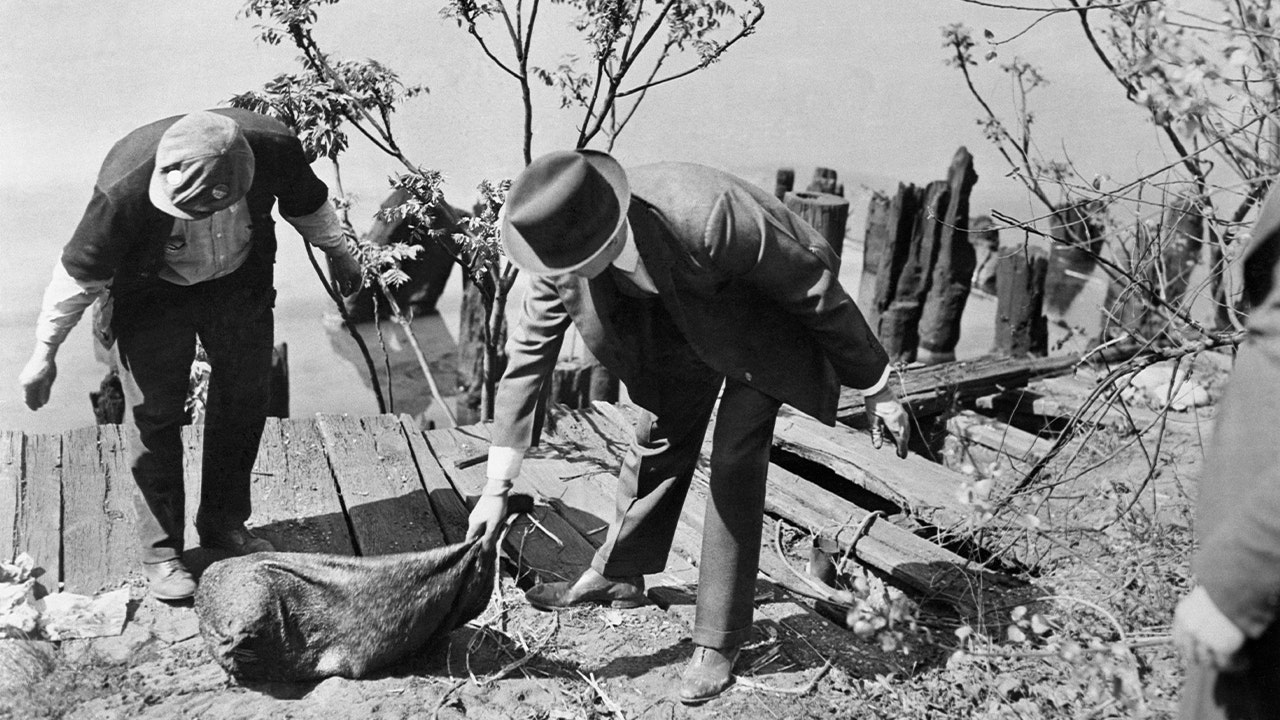
Cleveland Police, puzzled since 1934 about the identity of Cleveland’s “Mad Torso Murderer,” had a new problem to solve when bridge tenders on the murky Cuyahoga River dragged from the water five portions of a woman’s body. (Bettmann/Getty Images)
Two victims tied to the unknown killer were positively identified, according to the museum, as Edward Andrassy and Florence Polillo.
Andrassy, a 28-year-old white man, was found decapitated, emasculated, wearing only socks and drained of blood in July 1939. His fingertips identified him, the museum said.
HOUSES OF HORROR: MURDERS LEAVE HAUNTS PASTS IN THESE HOMES
Police searching the crime scene found the corpse of a woman, likely in her 40s, who was never identified. Parts of Polillo, a waitress and barmaid, were found wrapped carefully in newspaper in January 1936. The rest of her body, with the exception of her head, was recovered in another location 10 days later. She was also identified by her fingerprints.
Dental records allowed for the “unofficial” identification of a third victim, Rose Wallace. But, according to the museum, police were unable to make a definitive determination.
Although an arrest was never made, police believe a surgeon named Francis E. Sweeney, who would have had the expertise and equipment to dismember bodies, was responsible for the killings. He was questioned by police for a week but never confessed, according to the Cleveland Police Museum. However, after he committed himself to an institution, the murders came to a halt.
The DNA Doe Project, a nonprofit organization that carries out and helps fund genetic genealogy testing in cold cases, has paired with the Cuyahoga County Medical Examiner’s Office in an attempt to put names to some of the 10 unidentified victims.
CRIME SCENE CLUE COULD HELP SOLVE YOUNG DAD’S CAMPING TRIP MURDER AS KILLER REMAINS ON THE LOOSE
Detectives and a coroner examine bones of two murder victims found at the East 9th Street Lakeshore Dump Aug. 16, 1938, in Cleveland. (Bettmann/Getty Images)
Genetic genealogist CeCe Moore told Fox News Digital there is a “very high likelihood that the DNA Doe project will be successful in identifying these individuals.”
SIGN UP TO GET TRUE CRIME NEWSLETTER
“In 1938, there was no such thing as DNA testing. It was not even something they probably could have imagined. And, so, the advancements that we’ve seen over the almost 100 years are just unfathomable to the people who originally worked on this case, undoubtedly,” she said.
“You know, in the ‘80s is when DNA started being looked at for criminal applications. In the ’90s is when it really started coming into use in the United States. But it really took quite a while before it was accepted. I mean, we can look just back at the O.J. Simpson case, for instance, you know, where the jury didn’t understand DNA well enough to really weigh it as heavily as we would today. So, it has really come leaps and bounds. And then, in the last six years, we’ve had another leap forward with investigative genetic genealogy.
“Direct to consumer DNA testing was introduced in the year 2000 by a company called Family Tree DNA. It was the first time that we could test our own DNA to learn more about our family tree and our genetic heritage,” Moore explained. “That became what is now called genetic genealogy. That is the marriage of using DNA testing and genealogical records.
“So people have been genealogists for decades, for hundreds of years, really using records to build family trees. And we’re really fortunate today that we have billions of records online that are digitized so most of us can build our family trees way back in time from the comfort of our own home.”
GET REAL-TIME UPDATES DIRECTLY ON THE TRUE CRIME HUB
Thus far, two of the bodies have been exhumed. One, which WOIO-TV characterized as the killer’s “most famous” victim, is known as the “Tattooed Man.”
Left near railroad tracks in the summer of 1936, the unknown man’s head was found about 1,500 feet away from his body. Even after police fingerprinted him and widely disseminated pictures of his six tattoos, including the names “Helen” and “Paul,” according to the Cleveland Police Museum, he was never identified.
At the Great Lakes Exposition of 1936, more than 100,000 people saw a display featuring a plaster cast of the man’s head and images of his tattoos, but no one reported recognizing him.
The second body that will be tested was found on Cleveland’s lakefront in the summer of 1938 and is believed to be the killer’s sixth victim.
Kingsbury Run is indicated on this map by dots locating 10 of the 11 torso murders, which occurred there in the 1930s. (Bettmann/Getty Images)
A single anonymous donor is funding the lab costs, DNA Doe told CBS News. Although the remains may be contaminated or degraded because of their age, Jennifer Randolph, the nonprofit’s executive director of case management, said that DNA Doe has identified older remains before.
“We’ll figure out who the DNA relative matches are. We’ll build their trees, find those common ancestors and, then, you know, build forward or maybe look a little bit back, to see who the unidentified individual is,” Randolph told WOIO-TV.
“So, there could still be living people who know, you know, that these are individuals who were missing from their family and nobody knew whatever happened to them,” Randolph said. “And regardless of that piece, especially given how, you know, they died, they deserve the dignity and justice of being memorialized with their names.”
Moore told Fox News Digital scientists will face a host of challenges working with such old remains.
“We are dealing with degradation, potential contamination from bacteria. It’s very difficult to work on what we would call ‘ancient remains,’” Moore explained. “When you work with very old cases, you are almost certainly dealing with degradation where you can’t analyze all the DNA.
“Some of that DNA is going to be missing. And then, with contamination, we see bacteria actually inserts its own genome into the human genome. And, so, you have to have skilled scientists who are able to remove that bacterial genome, separate it from the human genome before we can perform our investigative genetic genealogy.”
FOLLOW THE FOX TRUE CRIME TEAM ON X
But even older remains have been identified using the practice, Moore said, citing at least one victim of the 1921 Tulsa Race Massacre whose family was finally notified in July of this year.
According to Fox 59, World War I veteran C.L. Daniel was identified as one of the victims of the 1921 tragedy, and his family was notified 103 years later.
“I have some inside information on that, and it’s been really, really difficult to get the DNA that is needed to perform investigative genetic genealogy from those very old remains,” Moore said. “But there has been some success, and it’s taken sometimes multiple rounds at the lab before they finally were able to get that DNA that was viable for our work. That’s pretty comparable, and it’s been very difficult.”
Read the full article from Here


Milwaukee, WI
After Another Unsuccessful Opportunity, Craig Yoho’s Time In Milwaukee Could Be Nearing Its End

After he dominated the minor leagues and reached the majors in his second full professional season last year, Craig Yoho’s career has not followed the path he or the Brewers hoped for. In 13 career appearances, most of them low-leverage outings, the 26-year-old has pitched to a 6.75 ERA and 5.22 SIERA.
It was not long ago that Pat Murphy spoke highly of Yoho after a dominant spring training showing in 2025. Within a few months, he became an afterthought on the 40-man roster. After a few rough outings last year, it became clear that the Brewers struggled to trust Yoho in pivotal situations. This season, they’ve rarely trusted him enough to roster him at all.
Control issues have been the primary culprit, in part because Yoho’s stuff moves so much. In Triple-A this year, his signature screwball-like changeup has averaged 2.2 inches of induced vertical drop and 17.8 inches of arm-side run. Even his fastball has averaged 16.6 inches of horizontal movement. In his big-league career, he’s walked 17.9% of batters faced.
Back in the big leagues by necessity for most of June, Yoho showed signs of progress this month amid his longest stint to date. In his first four outings, he was throwing enough strikes and missing barrels, posting a 1.73 xERA and 2.54 SIERA. According to Statcast, he induced whiffs on 36.6% of swings, and his average exit velocity allowed on balls in play was 83.5 mph. His walk rate was still 10%, but that will always be part of the picture for a reliever with so much movement. In each of his last two outings, Yoho threw more than half of his pitches in the strike zone.
On Monday in Cincinnati, Murphy said that performance played a role in the decision to option left-handed reliever Drew Rom, not Yoho, to make room for Brandon Woodruff’s return. Given that solid work and the recent unsteadiness throughout Milwaukee’s ‘B’ bullpen, one could argue Yoho had earned another shot at higher-leverage work.
He got that opportunity on Wednesday night, as Trevor Megill, Aaron Ashby, and a suspended Abner Uribe were unavailable. Yoho inherited a bases-loaded jam from Grant Anderson in the seventh inning, with JJ Bleday representing the tying run in a 6-2 game. With one pitch, a changeup in the zone, he induced an early swing from Bleday for a soft inning-ending groundout to first base. Yoho had answered the call in a big spot.
Things went haywire when he returned for the eighth. Edwin Arroyo waited back on an elevated changeup, dunking it to right field for a leadoff single. Elly De La Cruz worked him for a nine-pitch walk. Yoho nearly escaped with just one run allowed after coaxing routine groundouts from Dane Myers and Sal Stewart, but Spencer Steer blasted an 0-1 fastball over the heart of the plate for a three-run home run. With the score now 6-5, Yoho’s night – and his latest big-league stint – was over. The Brewers optioned him to Triple-A the following day.
As Yoho was being informed in the Cincinnati clubhouse that his next travel would be to Nashville instead of Milwaukee, Murphy gave a blunt postgame assessment of his outing, reiterating the shortcomings that have kept the Brewers from trusting him as an MLB-caliber reliever.
“They don’t know him yet, they haven’t faced him yet,” Murphy said of Yoho’s first inning. “Now he goes out the second inning, they’re expecting it. It’s a two-pitch guy, really, and he doesn’t throw strikes. You can’t do that … You can see he wasn’t comfortable in that situation.”
There were signs on Wednesday that some hitters could easily formulate a productive approach against Yoho. Arroyo waited back on his changeup. De La Cruz appeared intent on waiting him out and forcing him back into the strike zone; he watched five of those nine pitches, including two just outside the strike zone and a 3-1 changeup down the middle.
“They know the deal,” Murphy said. “I mean, the report’s out there. Fastball command, question mark. Changeup, very slow, sit on it, not a swing-and-miss [pitch]. So he’s got to make some adjustments with it, and I think he will. He’s a great kid.”
Most of the Brewers’ concerns are valid. Yoho’s movement is not only difficult to control, but it also makes pitch sequencing more challenging. His changeup is more than 15 mph slower than his fastball, and its extreme depth means he can’t tunnel any pitches within – or even near – the strike zone.
Assume that to get a chase on a changeup just below the zone, Yoho must make it look like his fastball out of the hand. The visual below from FanGraphs shows that, based on how his pitches move, he would have to throw that fastball well above the zone for the two pitches to start at the same sight line. In other words, his stuff moves so much that he can’t use an in-zone pitch to set up a chase on an out-of-zone pitch, or vice-versa.

Murphy made a questionable assertion that Yoho is purely a two-pitch pitcher, as he also features a curveball and cutter. However, the curveball is a more extreme inverse of his changeup in all the wrong ways: averaging 75.9 mph with 10 inches of induced vertical drop and 20 inches of glove-side break in Triple-A, it’s challenging for Yoho to land in the zone and is effectively impossible to tunnel. To even get that breaking ball to fit on a similar tunneling graphic from last year, you’d have to position his fastball at a right-handed batter’s helmet.
A pitcher with Yoho’s stuff will never defeat hitters with pitch tunneling and deception, though. Instead, it will work because the extreme movement will miss barrels, even if it’s not particularly deceptive. That’s where the Brewers may be selling him short.
So far, Yoho’s changeup has excelled at avoiding loud contact, even though hitters have likely known it’s coming and it has not always been located competitively. In his limited big-league work across two seasons, opponents have managed just a .247 xwOBA, 17.6% hard-hit rate, and 5.9% barrel rate against it with a 33.8% whiff rate. On Wednesday night, it induced two chases and two soft ground balls. The Reds did not whiff on it, but Murphy’s claim that it isn’t a swing-and-miss pitch is, frankly, incorrect.
Such a pitch does not need to be disguised as a fastball to be effective. Yoho just needs to throw it in and around the zone below the belt. When hitters start timing it up, a timely in-zone fastball can produce a take or a late swing. So far, he has done neither consistently. Yoho is partially responsible for his current situation because he sprayed the ball too much in his early chances last summer.
At the same time, it’s becoming clear that a poor fit between player and team is also part of the issue. Whenever Chris Hook talks about a particular pitch, he instinctively states whether it “tracks” in the strike zone like it’s a checklist item. To the Brewers, many big shapes pose tunneling problems and do not maximize in-zone swings, so they often find throwing more fastball variants and shorter sliders to be more useful than better “stuff” pitches. There are some exceptions, like Grant Anderson’s sweeper, but Yoho’s stuff is well beyond the mold.
Perhaps the Brewers are right about him, or perhaps it’s simply a poor fit. At this point, a change of scenery looks like the best way to find out. The club has a history of trading former prospects who have been leapfrogged on the 40-man roster for moderate upgrades at the trade deadline. In 2018, they flipped Brett Phillips in a two-player package for Mike Moustakas. In 2019, it was Mauricio Dubon for Drew Pomeranz. More recently, they traded Joey Wiemer for Frankie Montas in 2024.
With the deadline five weeks away, Yoho could be next. A fresh start – and, just as importantly, a setting where he’ll get a longer leash to become as competitive as possible with his arsenal – may be exactly what he needs. The Brewers, meanwhile, could fill his roster spot with a more consistent contributor.

A shooting in north Minneapolis injured a man near Penn Avenue.
According to the Minneapolis Police Department, officers responded to a shooting near the 700th block of Penn Avenue North, where they found a man with a gunshot wound.
Authorities said preliminary information shows that the man was outside when the shooting happened, possibly coming from a vehicle. A nearby hospital treated the man for non-life-threatening injuries.
Police are still investigating, with a forensic team collecting evidence from the scene. Officers said no arrests have been made.
This is a developing story; check back for updates.
-

 Movie Reviews2 minutes ago
A New Dawn Anime Film Review
-

 Lifestyle52 minutes ago
Sunday Puzzle: That’s HOT!
-

 Technology1 hour ago
The Cube is Jim Henson’s little-known proto-Black Mirror masterpiece
-

 World1 hour ago
33 rescued from Venezuelan rubble: Survival window desperately fading with nearly 50,000 missing
-

 Politics1 hour ago
WATCH: Biden appears confused about where to exit stage after Democratic gala remarks
-

 Health1 hour ago
Could ‘humanmaxxing’ actually help you live longer? Here’s what experts say
-

 Sports1 hour ago
WWE NXT The Great American Bash 2026 preview, predictions and more
-

 Technology1 hour ago
FBI warns Microsoft users about passwordless scam

