


Washington had the open shooter it wanted, and much like those fourth-quarter attempts, it was just a tad off line. Incredible game by the Huskies, pushing the No. 3 seed TCU to the very edge. Easily one of the best games of the tournament so far.
Minnesota
Peatlands are protecting Minnesota’s ecosystem. Scientists are working to restore them


Here in Minnesota, scientists say we are sitting on a climate change superhero.
Peatlands, a type of wetland, cover more than 10% of the state — that’s the most of any in the lower 48. But over time, peatlands have been misunderstood and mistreated. Now some are trying to change that.
“You might feel like we’ve jumped into a Dr. Suess novel,” said Mark Felice, a peatland scientist with The Nature Conservancy.
At the Cedar Creek Ecosystem Science Reserve in East Bethel, truffle top black spruces, cotton grass puffs, colorful mosses and carnivorous plants fill in where glacial lakes retreated.
“It’s just like a whole little world,” said Eric Seabloom, interim director of Cedar Creek Ecosystem Science Reserve.
Except in this world each step squishes shaking the ground around it.
“It feels like walking on a water bed,” said Felice.
Scientists say the moss-carpeted wetland is pure magic.
“Peatlands are basically areas where as plants die they fall on the ground and then slowly decompose like your compost pile,” said Seabloom.
When that happens, it pulls carbon dioxide out of the atmosphere and stores it in the soil.
“So slowly little by little, layer by layer, we’ve built up the soil we’re standing on,” said Felice.
And while peatlands occupy just 3% of Earth’s land surface, scientists say they store about 30% of the planet’s land-based carbon. That’s more than double held by the world’s forests, according to the Nature Conservancy.
To capture their power, Felice brings along his portable greenhouse gas analyzer, which he says reminds him of R2D2 from “Star Wars.” He also carries with him laser sensors that detect methane and carbon dioxide emissions.
“Peat soil can hold about 20 times its weight in water,” said Felice
It acts like a sponge for both carbon and water, and can provide flood protection and water filtration.
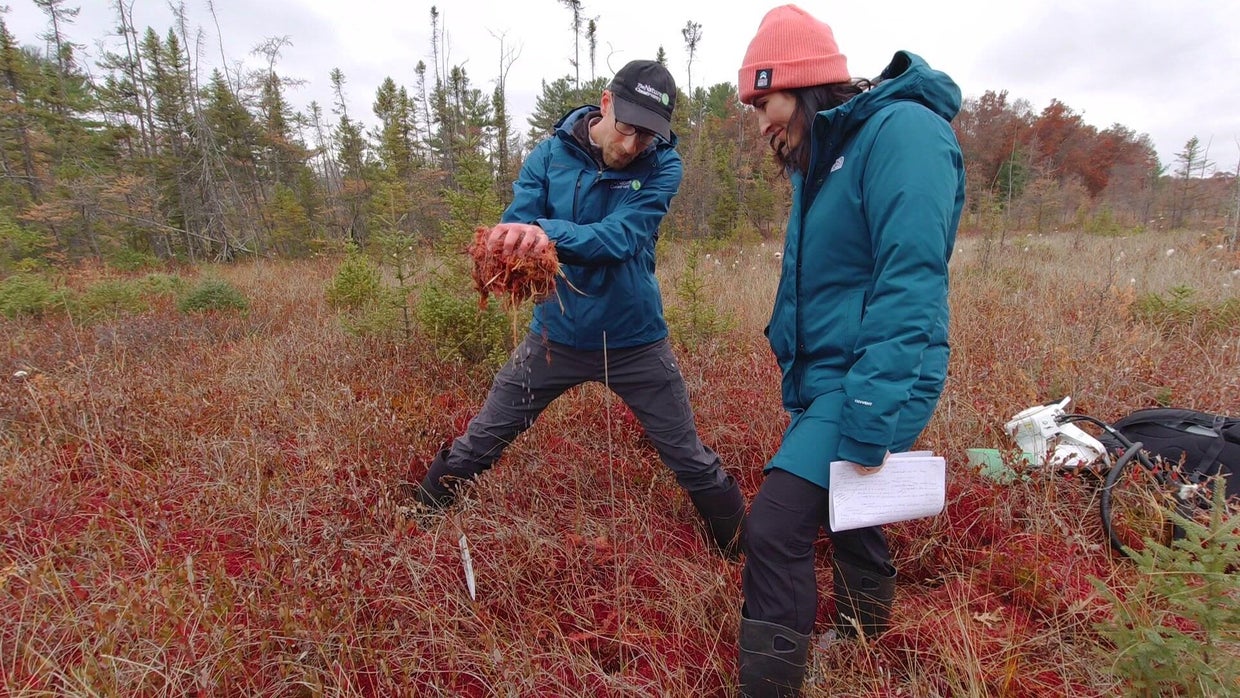
“They’re sort of a hidden treasure that we don’t really think about,” said Seabloom. “Now we can understand better how these are really important, huge stores of carbon. We definitely need them.”
But over time scientists say peatlands have been misunderstood, drained for development or agriculture and scientists are now learning why that was a mistake and how we can fix it.
“People always thought of peatlands or wetlands as sort of a menace to society or something in the way to be drained away,” said Chris Lenhart, a restorationist at The Nature Conservancy. “We’re right along Cedar Creek here. This is the part that’s been straightened about 100 to 120 years ago.”
The Nature Conservancy says up to one sixth of Minnesota’s peatlands were drained in the early 20th century.
The soil of a drained peatland looks a lot like dirt.
“It’s breaking down the organic matter and releasing the carbon dioxide as opposed to holding it in place,” said Lenhart.
To fix it, restoration teams will take a straightened section of the stream and rewiggle it to it’s original form.

Restoring the stream to its original form slows the water, raises the levels, and rewets the peat soils on the shores, emitting less carbon dioxide and accumulating valuable peat once again.
The Nature Conservancy says restoring and rewetting farmed and partially-drained peatlands in Minnesota could cut roughly 6.36 million metric tons of carbon dioxide equivalents, which is like getting rid of nearly 1.5 million gas powered cars for a year.
“We can have a lot of impact by managing and taking care of a pretty small blueprint,” said Felice.
“Even around the world people know about Minnesota I’d say for peatland and wetland science and protection,” said Lenhart.
Cedar Creek Ecosystem Science Reserve is owned by the University of Minnesota. It’s an area with many active research studies and restoration projects. It’s also known nationally for its research.


DFL and Latine community leaders are pushing for the repeal of César Chávez Day in Minnesota after sexual abuse allegations against the late civil rights icon have surfaced.
The New York Times published a report on March 18 detailing several allegations of sexual abuse by Chávez, a farm labor activist, including the sexual abuse of two minor girls and the assault and rape of Dolores Huerta, who led the farmworkers’ movement of the 1960s and ’70s alongside Chávez.
“The farmworker movement has always been bigger and far more important than any one individual,” Huerta, now 95, said in a statement. “Cesar’s actions do not diminish the permanent improvements achieved for farmworkers with the help of thousands of people. We must continue to engage and support our community, which needs advocacy and activism now more than ever.”
State and local leaders have quickly responded, and an effort is underway at the state Capitol to repeal the quickly approaching March 31 “César Chávez Day.”
The House passed a repeal late Monday afternoon. The Senate still have to consider it. It’s not clear whether the state would eventually designate the day with another person’s name or another farmer union-related title.
Rep. María Isa Pérez-Vega, DFL-St. Paul, how authored repeal legislation, said “it was gutting” to read the sexual abuse allegations.
“This legislation to repeal César Chávez Day out of the Minnesota Constitution marks one crucial step in a multi-faceted process. We acknowledge that this is merely the beginning. Constantly, we must advocate for numerous causes, recognizing that a movement transcends individual figures,” she said.
‘Drawing a clear line’
Emilia Gonzalez, executive director of Unidos Minnesota, said the repeal is about “drawing a clear line.”
“Repealing César Chávez Day is about drawing a clear line that no legacy, no matter how powerful, no matter how important, stands above the safety and dignity of our children and our community. We can honor farm workers, we can honor the movement, La Causa. We can honor the struggle of labor rights, but we don’t have to enshrine a single figure in a way that leaves no room for truth, complexity or accountability,” she said.
Rep. Liish Kozlowski, DFL-Duluth, said accountability starts with the repeal of César Chávez Day.
“Our community is showing the nation how to respond to sexual violence and violence in all of its forms,” they said. “We are showing what it means to listen and believe survivors when they break their silence. We believe them, we stand with them, and we hold individuals and institutions accountable.”
A street in St. Paul
Minnesota also has a street named after Chávez in St. Paul, as well as a charter school, Academia César Chávez.
St. Paul Mayor Kaohly Her, who was at the Capitol on Monday, didn’t provide a timeline for when the street name could be changed, but said she’s getting a group of stakeholders and residents together to discuss the issue.
Ramona Arreguín de Rosales, an activist who personally met Chávez and the co-founder of Academia César Chávez, said she has recommended that the Board of Academia César Chávez change the school’s name, but said she does not want to “diminish the good work that the movement has accomplished.”
Minnesota
NCAA women’s tournament takeaways, Day 3: Minnesota drains buzzer-beater as LSU, Texas dominate again

The Sweet 16 field is halfway filled as the first weekend of the NCAA tournament starts to wrap up. There weren’t a ton of surprises on Sunday for the start of the second round, but we did get our first buzzer-beater.
Minnesota reaches Sweet 16 on buzzer-beater
After a buzzer-beater was called off on Saturday, we finally got one.
Advertisement
Amaya Battle got her game-winner to fall on Sunday afternoon, which lifted Minnesota to what is its first Sweet 16 appearance since 2005. Battle, with less than a second left on the clock, drilled a contested jumper from the short corner to push the Gophers past Ole Miss 65-63. Naturally, that sparked a massive celebration on their home court.
Minnesota had trailed entering the fourth quarter but tied it back up with just 1:17 left to set up the eventual game-winner.
The shot came after what was almost an incredible buzzer-beater to lift Clemson past USC on Saturday. That shot, however, was called off just barely in brutal fashion. The Trojans eventually pushed past the Tigers in overtime.
Advertisement
Draft your Yahoo Fantasy Baseball team for the 2026 MLB Season
The Gophers will now advance to take on either No. 1 UCLA or No. 8 Oklahoma State in the Sweet 16 in Sacramento next weekend. If it’s UCLA, it’ll be a rematch between the Bruins and Gophers in Big Ten play, but the Bruins cruised to a dominant 76-58 win in Minneapolis. That was part of a 25-game win streak that gave UCLA both the regular season and conference tournament titles.
While that’s undoubtedly going to be a tough task, Battle has lifted the Gophers to a place they haven’t been in decades.
LSU keeps dominating
Flau’jae Johnson and the Tigers have had absolutely no issues so far this March. Sunday’s win over Texas Tech set a new NCAA record, too.
Advertisement
The Tigers cruised to a blowout 101-47 win over the Red Raiders at the Pete Maravich Assembly Center. Johnson and Mikaylah Williams each dropped 24 points in the win, and the Tigers shot 56% from the field.
The win was LSU’s 16th game with at least 100 points this season. That set a new NCAA Division I record, snapping the mark that Long Beach State had during the 1986-87 campaign. LSU beat Jacksonville 116-58 in the opening round of the tournament, and entered the event averaging a nation-best 95.1 points per game.
LSU will now take on No. 3 Duke in the Sweet 16, which marks the program’s fifth straight trip to the second weekend of the tournament. The Blue Devils beat No. 6 Baylor 69-46 on Sunday to secure their spot in the Sacramento region.
While the Blue Devils are undoubtedly a very talented group — they ran the table and won both ACC titles, after all — stopping the Tigers has proven to be a nearly impossible task so far this season. It’s going to take a tremendous defensive effort, and likely then some, to pull off that upset win.
Madison Booker dropped a career-high 40 points on Sunday night. (AP/Eric Gay)
(ASSOCIATED PRESS)
Madison Booker drops 40
Texas was never in any trouble on Sunday, thanks largely to a massive effort from Madison Booker.
Advertisement
Booker dropped a career-high 40 points to lead the Longhorns to a 100-58 blowout win over No. 8 Oregon. She shot 14-of-21 from the field and had eight rebounds and five assists to go with her 40-piece. It marked the highest-scoring game from anyone in the NCAA tournament so far, men’s or women’s.
The Longhorns are now coming off of back-to-back blowout wins at home to reach what is now their third straight Sweet 16. They beat Missouri State by 42 points on Friday in their first-round matchup, too.
Texas was again the only No. 1 seed in action on Sunday. The other three schools will square off against their respective opponents on Monday to wrap up the first round.
The Longhorns will now await the winner of the matchup between Kentucky and West Virginia in the Sweet 16, which they’ll get to play in Fort Worth. That’s a little less than 200 miles from Austin, which should be a big advantage for them.
Advertisement
TCU survives in OT
Perhaps the best game of the day came at the very end.
No. 6 Washington took TCU to the very end on Sunday night, and nearly knocked Olivia Miles and the Horned Frogs out of the tournament early. The Huskies forced overtime after Miles missed a potential game-winner, and then they rallied back within a single point after the Horned Frogs opened the extra period on a 7-0 burst.
But in the end, TCU held on and forced a late stop to secure the 62-59 win. That kept the Horned Frogs’ 44-game home win streak alive and sent them into a second straight Sweet 16. Miles had 18 points and 10 rebounds, and was just two assists shy from another triple-double. They’ll now get to take on either Iowa or Virginia in the Sweet 16 in Sacramento.
Advertisement
Follow along with Yahoo Sports for the latest news, highlights and upsets from the women’s NCAA tournament:
-

Cassandra Negley
-
Phew, that one was close. Sayvia Sellers missed the 3-pointer with seconds to go, and the Horned Frogs hold on to extend their home win streak to 44 and go to their second straight Sweet 16.
-
Cassandra Negley
Donovyn Hunter was largely a non-factor for TCU until that layup. Put the Horned Frogs up three. Taylor Bigby made a fastbreak layup on the Miles rebound that pushed it to 62-57.
-
TCU is up five points, but the pace has been so quick in this overtime period, anything can happen here.
-
Cassandra Negley
Thought Olivia Miles should have gotten to the rim on the final possession, instead of taking that deep of a 3 that early. She’s better when she draws attention and can use her shiftiness to cut through the lanes.
Seems like she knew it at the time, and is making up for it here with an assist and a tough bucket. TCU is in control on a 7-0 OT run.
-
Olivia Miles’ passing has been incredible in the back half of this game. She’s got seven assists, and just threw up a layup to put TCU up by seven with 3:21 to play.
-
Cassandra Negley
WE’RE IN TRUE PAC-12* AFTER DARK TERRITORY
*RIP
-
Olivia Miles missed a step-back 3 as time ticked off the clock, and we’re headed to overtime in Fort Worth. Who will punch their ticket to the Sweet 16?
-
Cassandra Negley
These Washington shots rimming in and out are heartbreaking. They’ve missed 7 of their last 8 in a one-possession game.
-
Cassandra Negley
That is NASTY work by Olivia Miles. With two defenders on her, she hits the baseline flip-back pass to a wide-open Marta Suarez to tie the game. They last led in the first quarter. It’s the only tie of the game.
-
OK, now Olivia Miles is doing Olivia Miles things. She’s got 16 points, 9 rebounds and 5 assists.
-
-
Cassandra Negley
Sayvia Sellers, my word! Back-to-back 3-pointers from the top keeps the cushion for Washington. Shoutout to Alaskan hoopers.
-
They’re up seven with six minutes to go, and just keep hitting huge shots.
-
Cassandra Negley
TCU is on pace for a season-low 48 points.
The Horned Frogs scored fewer than 60 only three times. All were against West Virginia: a 51-50 win in January, 62-53 loss in the Big 12 champ game; and a 59-50 win in February.
-
This one’s getting chippy as TCU comes clawing back. Can the Horned Frogs keep up their streak of 43 straight wins at home?
-
Cassandra Negley
There is a lot of emotion, a lot on the line and a lot falling on officials here. Everyone on both TCU and Washington needs to be careful given the close nature of this game they’re not drawing a technical in these final 10ish minutes.
-
Here comes Olivia Miles. TCU pulls within four as Miles scored her 10th point. But Marta Suarez just picked up her fourth foul, which is bad news for the Horned Frogs.
-
Halfway through the third period, Washington still leads, by eight points. Olivia Miles hasn’t been a huge factor yet, with just eight points on 4-of-14 shooting.
-
It’s been a low-scoring affair in the first half of this one, and the Huskies are looking for the upset. But TCU seemed to find some momentum toward the end of the first half; can they carry it forward?

Seattle’s Andrew Thomas finished with two saves and Drake Callender did likewise as the Sounders and Minnesota United played to a scoreless draw on Sunday.
It was the third straight and fourth shutout in five starts this season for Thomas. The 27-year-old took the starting reins from mainstay Stefan Frei — now in a backup role. He hasn’t allowed a goal since a 2-1 loss to Real Salt Lake in Seattle’s road opener. He also blanked the Colorado Rapids 2-0 in the season opener at home. Thomas had the lone save of the first half.
Callender notched his second clean sheet in his first season with Minnesota United. Callender and Inter Miami goalkeeper Dayne St. Claire switched teams in the offseason. Callender made 92 starts for Miami beginning in 2022, but only five last season.
Jordan Morris saw his first action for the Sounders (3-1-1) since he was injured in the season opener. Morris entered in the 65th minute along with Jesús Ferreira and 18-year old midfielder Snyder Brunell.
Seattle was coming off back-to-back 1-0 road victories over St. Louis City and the San Jose Earthquakes.
Minnesota United (1-2-2) came in after being outscored 9-1 in two straight road losses to Nashville SC and the Vancouver Whitecaps.
Minnesota swept Seattle during the regular season last year and then eliminated the Sounders in the best-of-three first round of the playoffs, winning twice at home on penalty kicks after 0-0 and 3-3 draws in regulation. Seattle posted a 4-2 victory at home in the middle match.
Up next
Seattle: Visits the Houston Dynamo on April 4.
Minnesota: Visits the Los Angeles Galaxy on April 4.

Indiana5 minutes ago
Does this diner serve the biggest pork tenderloin sandwich in Indiana?

Iowa11 minutes ago
Iowa lawmakers at a standstill over pipeline fight that could shape landowners’ rights

Kentucky23 minutes ago
Kentucky vs. West Virginia – Second round NCAA tournament extended highlights
Louisiana29 minutes ago
Louisiana’s health secretary wants AI on the phones and the website

Maine35 minutes ago
Meet the 2025-26 Varsity Maine All-State girls wrestling team

Florida1 year ago
Florida High School Football Rankings: Top 25 teams – Oct. 21

Oregon2 years ago
How old is Bo Nix? What to know about Oregon quarterback ahead of 2024 NFL Draft

Connecticut2 years ago
Cleary's 21 help Le Moyne down Central Connecticut State 69-64 in OT

Virginia2 years ago
99th annual Pony Swim held in Virginia

Indiana2 years ago
Indiana Members Credit Union announced as new anchor tenant at Bottleworks District

News4 hours ago
See TSA Wait Times at Major U.S. Airports

Politics5 hours ago
Senate hopeful with deep Dem ties slapped with scathing complaint targeting alleged family payout ‘scheme’

World7 hours ago
How the Iran war is about to hit your wallet

News7 hours ago
Suspect in slaying of Loyola University student was in the country illegally, officials say

News16 hours ago
Video: Plane Collides With Vehicle at LaGuardia Airport
-

 Detroit, MI5 days ago
Drummer Brian Pastoria, longtime Detroit music advocate, dies at 68
-

 Oklahoma1 week ago
Family rallies around Oklahoma father after head-on crash
-

 Georgia1 week ago
How ICE plans for a detention warehouse pushed a Georgia town to fight back | CNN Politics
-
 Science1 week ago
Federal EPA moves to roll back recent limits on ethylene oxide, a carcinogen
-

 Alaska1 week ago
Police looking for man considered ‘armed and dangerous’
-

 Movie Reviews5 days ago
‘Youth’ Twitter review: Ken Karunaas impresses audiences; Suraj Venjaramoodu adds charm; music wins praise | – The Times of India
-
 Science1 week ago
Long COVID leaves thousands of L.A. county residents sick, broke and ignored
-

 Education1 week ago
Video: Turning Point USA Clubs Expand to High Schools Across America