Milwaukee, WI
Was It Wrong For The Milwaukee Brewers To Trade Freddy Peralta?


The question everyone asks when a trade like this happens is pretty simple: Was this the right move for the team?
Some deals cut a little deeper, and this one definitely feels like one of those.
But this is how the Milwaukee Brewers operate, regardless of whether you agree with the strategy. On Wednesday, the Crew traded ace right-hander Freddy Peralta. They sent him and an expendable piece, right-hander Tobias Myers, to the New York Mets for two of their top-five prospects: infielder-outfielder Jett Williams and right-handed starter Brandon Sproat.
One of the first negative reactions I saw on social media was something from a national baseball writer to the effect of “The Brewers, not the Dodgers, are ruining baseball because they can’t afford $8 million.”
That is certainly a take. Very wrong, but certainly a take.
The Brewers were more than willing to pay Peralta $8 million for 2026. The reason behind the trade is what comes after 2026. No, I’m not talking about whatever happens related to a lockout or strike or anything related to the collective bargaining agreement.
Instead, it has to do with Peralta’s future. He will be a free agent following the 2026 World Series. Peralta enters his age-30 season in a prime position to cash in. After a team-friendly five-year, $15.5 million contract extension that then became a seven-year, $31.6 million deal with two club options that bought out two free-agent years, Peralta is due a payday. He has earned it. Remember that Peralta came to the Brewers as one of three wild cards as they dealt first baseman Adam Lind to the Seattle Mariners following the 2015 season. Peralta hadn’t played any higher than the complex league in Arizona at that point and was 19 years old when he joined the Crew.
In the 10 years since, Peralta has been a self-made pitcher. Sure, the Brewers gave him all the tools they could, but it was Peralta who put in the work and rose from obscurity to MLB All-Star and Cy Young Award contender. And the Brewers reaped the benefits of that and took advantage of the salary-suppression system MLB employs to get more value out of their investment in Peralta. No longer is he Fastball Freddy, the youngster who could only throw a variety of fastballs. Now he features three offspeed pitches in a changeup, slider, and curveball to go along with a four-seam fastball.
Since his stunning 13-strikeout MLB debut on that Mother’s Day in Colorado in 2018, Peralta has been an integral part of the Brewers’ success. Since joining the rotation full-time at the beginning of the 2021 season, Peralta has been a rock in the rotation, even if he wasn’t spectacular for most of that. He started 139 of 141 games with a FIP of 3.65, an ERA of 3.30, and an ERA+ of 126. That ERA+ means Peralta was 26% above the average MLB pitcher. That number was certainly boosted by his 2025 performance, where he posted a 154 ERA+ and finished fifth in NL Cy Young Award voting.
The Brewers’ philosophy of baseball business is not to overpay. They don’t want to hand out exorbitant salaries that could weigh down their roster at the back end. The Brewers are approaching that situation with Christian Yelich, who has three more years at about $24 million each before a mutual option at $20 million for 2029 (those are usually declined). Peralta will certainly clear what Yelich, technically the Crew’s highest-paid player*, is making, perhaps even approach $30 million a year. It is his market value at this moment. The Brewers would have given Peralta a qualifying offer (probably around $23 million for 2027), which he would have declined and netted the Brewers one single draft pick.
That was the situation Brandon Woodruff was in this offseason. Woodruff accepted the qualifying offer and returned on a $22.025 million contract for 2026. That is on top of the $10 million mutual option buyout the Crew paid Woodruff instead of a $20 million contract. So Woodruff is really making $32.025 million this season* (thus the mythical highest-paid Brewers player).
Could the Brewers afford Peralta’s $8 million for 2026? Of course. That was never in question. But the Brewers, like they did with closer Josh Hader, starter Corbin Burnes, and closer Devin Williams, sold high on the player in question. Burnes netted shortstop Joey Ortiz, left-hander DL Hall, and a draft pick that resulted in first baseman Blake Burke from the Baltimore Orioles. Williams brought back third baseman Caleb Durbin and left-handed starter Nestor Cortes.
Hall hasn’t panned out yet, and Cortes flamed out due to injury. Ortiz and Durbin are the starting left side of the infield. Time will tell on Jett Williams and Sproat, but their pedigree is higher than that of the others acquired in those other two deals. This is how the Brewers churn their talent. This is part of the secret sauce they have used to win three straight NL Central titles.
I am on record as saying Peralta was the perfect player for the Brewers to invest in. He epitomizes what they do, taking a ball of clay and molding it into something useful.
But I also understand the Brewers’ philosophy and agree with it to a certain extent. Players should get paid what they are worth, and teams also have the right not to make a bad investment. Hader cashed in. Devin Williams got his payday. So did Burnes, who then got hurt. Peralta, barring the unforeseen, will get his next offseason.
Just not from the Brewers, who sold Peralta at his peak and now instead have two good prospects, bolstering an already-burgeoning farm system.
Was this the right move for the team?
Yes, it was.



MILWAUKEE – A person of interest remains in custody following a fatal shooting on Water Street that left one person dead and two others injured early Sunday.
The Milwaukee Police Department says 22-year-old Dylan Jackson was killed. An 18-year-old and a 19-year-old were also injured.
Local perspective:
Before the shooting, a bar manager says the area was already chaotic.

Tim Sluga, general manager of Duke’s on Water, said problems were brewing outside the bars before shots were fired. He said he was working Saturday night into Sunday morning and feared violence would occur.
FREE DOWNLOAD: Get breaking news alerts in the FOX LOCAL Mobile app for iOS or Android
“Chaos. It was just chaos outside,” said Sluga. “The pistol whippings, the shootings, everything else. The street was already chaos when that happened.”
Sluga said he was working Saturday night into Sunday morning and feared violence would occur.
“My reaction in general that night was, ‘here we go again,’” said Sluga. “It’s sadly not surprising.”
Sluga said the violence over the weekend reflects a recurring problem in the entertainment district.
Dig deeper:
Last July, city leaders held an emergency meeting after increased violence in the area. Police later announced plans to increase their presence and curb loitering.
Sluga said he expected more enforcement.
“We were told by MPD there was going to be a curfew enforced this year, we didn’t see that this weekend,” said Sluga.
Some patrons say they are also frustrated.
SIGN UP TODAY: Get daily headlines, breaking news emails from FOX6 News
“It’s like the younger crowd pushing out the older crowd now. If you ain’t 21, there’s no reason for you to be down here,” said Dequan Cave of Milwaukee.
Sluga said bars themselves are generally safe, but problems occur outside.
“It’s a great place and there’s a lot of really good people,” said Sluga. “These are just issues that are out of our control.”
What’s next:
MPD said a Code Red deployment focused on safety in the entertainment district was in place over the weekend. Police also say plans may be modified to improve downtown safety.
The Source: The information in this post was collected and produced by FOX6 News.

Brewers new foods and drinks at American Family Field for 2026 season
From fried kringle, cream puffs, funnel cake fries, brisket loaded waffles, s’mores cheesecake and more, here are the new food items at Brewers games for the 2026 season.
Spring training in Phoenix has wrapped up and the Milwaukee Brewers are set to begin the 2026 regular season at 1:10 p.m. Thursday, March 26 at American Family Field against the Chicago White Sox.
The Brewers exceeded expectations in 2025, recording a franchise-record 97 wins and the best record in baseball (97-65) and advancing to the National League Championship Series. Can they match that in 2026? Here are Journal Sentinel staff predictions for the season.
HOW I SEE IT: I understand what I’m doing with this prediction, ultimately putting so much of the Brewers’ 2026 outlook on a group of largely unproven, young starters. But I think the Brewers do, too. I’d be lying to you if I said I felt good about the plan to throw Brandon Woodruff and a cavalcade of guys with minimal big-league experience, but I also have to acknowledge the potential upside here. It’s been a few years since the Brewers’ rotation was this talented, and we know what the Brewers can do with those kinds of arms. On offense, I’d also be lying if I said I wasn’t somewhat concerned about their chances of repeating last year’s scoring output without adding any external thump to the lineup. My brain says it’s going to be a step back this year – although not a big one, maybe just to a wild-card spot – but my eyes have seen this film before. And it usually ends with the Brewers fielding a roster much better than the public is giving them credit for.
2026 PREDICTION: 89-73, NL Central champions, lose in NL Wild Card round.
HOW I SEE IT: Count me among the group of non-believers a year ago at this time. Heck, as late as the start of that series against the Pittsburgh Pirates at PNC Park in late May I penned a story guessing all the players the Brewers would be trading away in the near future because they were going nowhere. How wrong I was. And I’ve learned my lesson – don’t bet against these guys. Especially with the bulk of the team that ended up winning a franchise-record 97 games and advanced to the National League Championship Series for the first time since 2018 returning. No doubt, Freddy Peralta would look really good anchoring the staff. So would Caleb Durbin at third base. All five of the players Milwaukee received in return are going to factor in, however, with right-hander Brandon Sproat, left-hander Kyle Harrison and infielder David Hamilton in particular expected to fill large roles. There are major questions – most notably whether veteran Brandon Woodruff can remain healthy and how the young starting pitching will fare. No question, the Chicago Cubs, Cincinnati Reds and Pirates are all improved. But the road to the Central Division title has run through Milwaukee the past three years, and this group expects to win.
2026 PREDICTION: 90-72, NL Wild Card spot, advance to NL Division Series.
HOW I SEE IT: I should finally just trust that this franchise can identify the correct unproven arms in the rotation and players who weren’t seen as building blocks in other organizations, transforming that brew into a runaway Central Division title. They did it last year. And 2024. And 2023. Why do I still have this nagging feeling that 2027 will be the year the Brewers really swing for the fences, and 2026 is about seeing what they’ll still need? Remember how weird it was that the Brewers thrived at scoring runs last year because other teams kept committing errors? They were one of the best run-scoring offenses in baseball, and yet it still feels like they got a lot of breaks offensively. Then, they didn’t get perceptively better in the offseason, while the chief rival Cubs and other NL Central brethren did. You know what? Maybe the Brewers just need the semi-professional prognosticators like me to keep hating. And maybe it’s just impossible for me to accept this team has solved the riddle of how to win consistently without overtly addressing their perceived weaknesses. One of these years, though, they really won’t get away with it.
2026 PREDICTION: 86-76, miss playoffs (barely)

Milwaukee police chief negotiated big salary bump. Is fire chief next?
How an overlooked footnote impacts pay negotiations for Milwaukee’s fire chief.
A 25-year-old Milwaukee man has been identified as the fatal victim following a shooting that injured five people on the city’s north side.
Simeon I. Calvert was shot on March 21 a little after 11 a.m. at the intersection of North Darien and North 37th streets, according to the Milwaukee County Medical Examiner’s Office.
Calvert was transported to a hospital where he died in the operating room, the medical examiner said.
Four other people were injured in the shooting, ranging in age from 20 to 29 years old.
Police said March 23 that they have “persons of interest” in custody but continue to seek additional information.
The investigation is ongoing, police added, but it is believed that the incident was the result of an argument.
Anyone with any information about the incident is being asked to contact the Milwaukee Police Department at 414-935-7360. To remain anonymous while providing information, contact Crime Stoppers at 414-224-TIPS.
This story was updated to add new information.

Kansas firefighters rescue chubby cat trapped in massive recliner while trying to hide from the vet

Will Louisiana’s U.S. Senate candidates debate? Bill Cassidy says no to Moon Griffon.

Maine Senate advances ‘right to repair’ electronics bill

‘Mattresses all over the place’: Maryland begins yearly operation to clean state highways – WTOP News

Showers, thunderstorms expected to hit SE Michigan Thursday — What to know

Florida High School Football Rankings: Top 25 teams – Oct. 21

How old is Bo Nix? What to know about Oregon quarterback ahead of 2024 NFL Draft

Cleary's 21 help Le Moyne down Central Connecticut State 69-64 in OT

99th annual Pony Swim held in Virginia

Indiana Members Credit Union announced as new anchor tenant at Bottleworks District

LaGuardia Crash Timeline: Moments Before Air Canada Plane Collided With Fire Truck

Chicago alderwoman apologizes for ‘wrong place at the wrong time’ comment on slain student

Fake Euronews website targets Hungary election with false claims
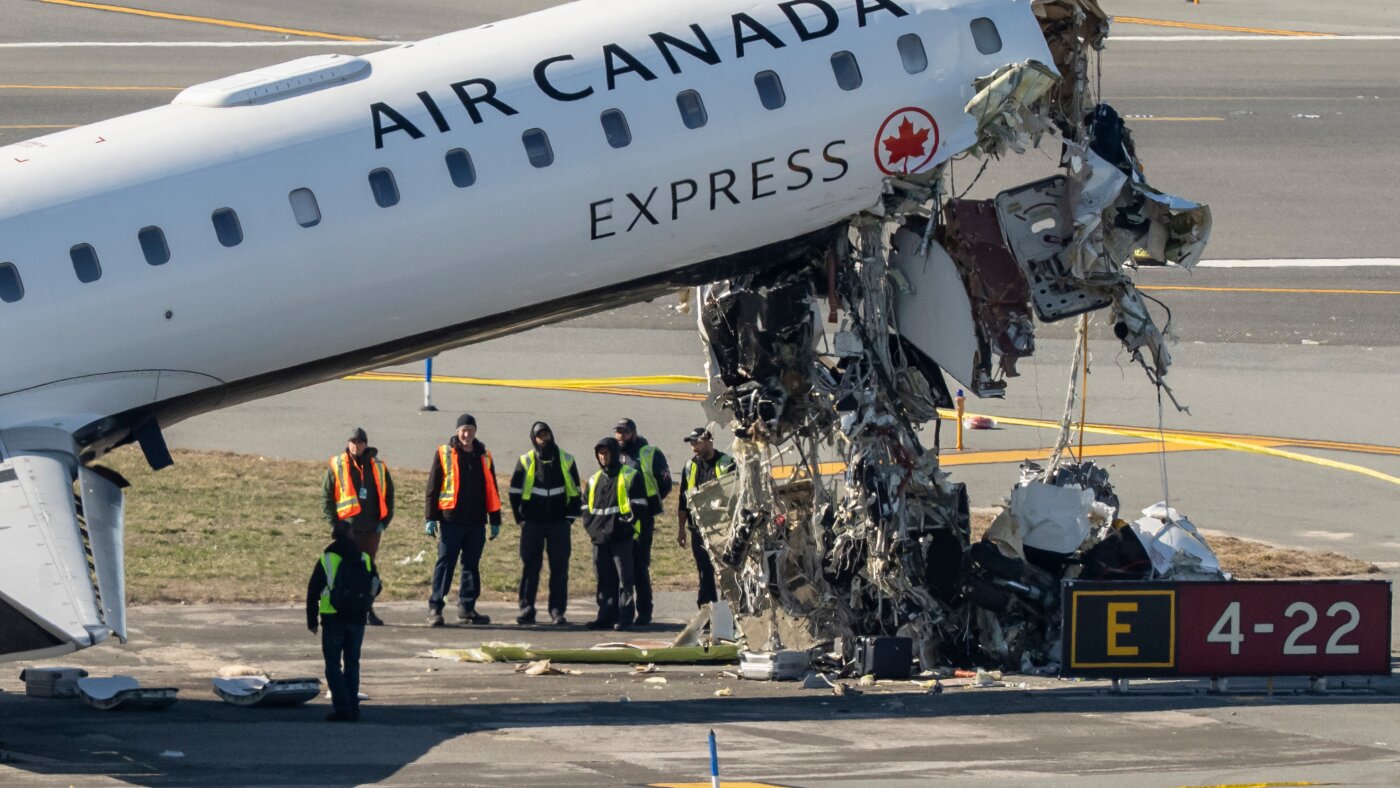
An air traffic controller was juggling extra roles during the LaGuardia plane crash

Iran War: Pentagon set to send thousands of elite 82nd Airborne troops to region | BBC News
-

 Detroit, MI6 days ago
Drummer Brian Pastoria, longtime Detroit music advocate, dies at 68
-

 Georgia1 week ago
How ICE plans for a detention warehouse pushed a Georgia town to fight back | CNN Politics
-

 Movie Reviews6 days ago
‘Youth’ Twitter review: Ken Karunaas impresses audiences; Suraj Venjaramoodu adds charm; music wins praise | – The Times of India
-

 Education1 week ago
Video: Turning Point USA Clubs Expand to High Schools Across America
-

 Sports4 days ago
IOC addresses execution of 19-year-old Iranian wrestler Saleh Mohammadi
-
 Science1 week ago
Industrial chemicals have reached the middle of the oceans, new study shows
-

 Science1 week ago
How a Melting Glacier in Antarctica Could Affect Tens of Millions Around the Globe
-

 Culture1 week ago
Test Your Memory of Great Lines From Classic Irish Poems