Milwaukee, WI
Amid the Milwaukee lead crisis, a laid-off CDC scientist volunteered his expertise. It wasn’t so simple


In mid-April, an unusual offer arrived in the Milwaukee health commissioner’s inbox. “I’m writing as a concerned private citizen to offer my support in Milwaukee’s ongoing response to the lead contamination in your schools,” it said. “While I regret that I’m no longer able to assist in my former government role, my commitment to this public health crisis remains steadfast.”
The commissioner, Michael Totoraitis, could have used some help. His department’s regular work hadn’t stopped. In a few days, there were two restaurants to close temporarily, one for rodent reasons, another for cleanliness violations, a tuberculosis case whose contacts needed tracing, and the countless other largely invisible tasks involved in forestalling public health messes before they occurred. But mostly there was the gargantuan job of figuring out which of the district’s 68,000 public school students were likeliest to have been exposed to lead dust and most urgently needed testing and follow-up.
That was what the U.S. Centers for Disease Control and Prevention’s lead poisoning experts had been helping with when their office was slashed in the Trump administration’s mass federal layoffs in early April.
Now, here was one of those scientists, coming forward as a volunteer. “It is just an American thing to do,” he said, speaking on condition of anonymity because of his family’s fear of retaliation. “As far as I know, it’s still a free country, and if you want to volunteer your time to help people in need, I don’t think that’s proscribed.”
Yet it wasn’t so simple. The same risks that made this expert’s family afraid for him to speak openly about his offer also made Totoraitis unsure if he could accept it. He hadn’t ruled it out, but there were complexities. He was scrounging for funds that would allow him to hire such laid-off federal specialists once they were officially let go from their government jobs in June. For now, though, they were in limbo, not allowed to work in those roles while on paid administrative leave. “We don’t want to jeopardize their current situation,” Totoraitis said.
Some CDC lead poisoning prevention employees share that concern. Some have kids at home and are too busy looking for paid work to join their colleague in offering to volunteer. Some are too worried that the federal government might be looking for reasons to strip them of their pay or severance, and offering to help Milwaukee might provide just such an excuse or might keep them from being rehired by the agency at a later date.
In certain cases, they’re torn. “There’s this sense like, we can’t keep doing the work that is being cut, because then there’s no sign that the work has been cut,” another laid off employee said, also speaking on condition of anonymity. “But then all of us are public health servants, and we want to continue regardless.”
From the volunteer’s perspective, though, offering aid was worthwhile, and he’d done his due diligence, checking in with the leaders in his division, who’d also been laid off, and making clear to the city of Milwaukee that he represented only himself.
The Department of Health and Human Services, the CDC’s parent agency, has been squishy about what’s allowed. Initially, when STAT asked the press office, an official wrote that “employees would not be barred” from volunteering under administrative leave regulations. But in response to follow-up queries about whether there was an issue with federal scientists proffering the expertise they would’ve normally provided in their government jobs had those roles not been cut, the official said they needed prior approval from an ethics office, and that “these situations are reviewed on a case by case basis.”
HHS has been similarly hard to pin down about the fate of the lead poisoning prevention team. After it was gutted in the layoffs, health secretary Robert F. Kennedy Jr. said he believed that that program had been cut by mistake and would be reinstated — only for the agency to walk back its leader’s claim. HHS told ABC News that the team as it previously existed would not be brought back and that such “duplicate programs” were being consolidated, and told STAT that the branch’s “important work” would continue under the Administration for a Healthy America. Officials did not respond to questions about who would be doing that work and when it would be up and running.
Laid-off federal workers were skeptical. “There is no other unit like ours,” said Erik Svendsen, who directed the CDC’s Division of Environmental Health and Science Practice, which included the lead poisoning prevention team, until he was laid off on April 1. “If someone’s saying that it was duplicative, that was based on misinformation, or a misunderstanding of what we do, and I’m hoping that that mistake is fixed so that we can continue to protect public health.”
Meanwhile, Milwaukee has been left in the middle of a crisis with no backup. It began when a student showed a concerning lead level on a blood test late in 2024, and the source turned out to be the child’s school. The subsequent investigation has proved at once vast and full of fiddly details. The city has lead experts, Totoraitis explained, but the cases they usually investigate involve toddlers and generally occur in the home. Now they’re dealing with exposures in older kids, in the city’s 106 public schools that were built before 1978, when lead paint was banned.
“If we’re investigating lead hazards in a residential duplex or something like that, it might take two of our staff a couple hours to do the assessment,” Totoraitis said. “A school, on the other hand, takes about six to eight staff around six hours. So the scale of what we’re talking about is enormous.”
Before the CDC lead experts got laid off, his team would often turn to the feds for both strategic planning and step-by-step guidance. If they found a surface, say, that had much higher lead levels than was acceptable, what then? “We were asking questions like, ‘Should we move people out right away? Should we close the school down? What if we’re not finding lead-poisoned kids?’” Totoraitis said. “They really helped us to triage which rooms should be closed, which schools should be closed, and validate a faster process for us to do a site investigation.”
All of this also had to happen as soon as possible. When a kid is exposed to lead — breathing in the dust that contains flakes of leaded paint, say, or getting it on their hands and swallowing it along with lunch — its molecular structure looks similar to the calcium and iron that the body’s cells need for their daily work. It latches onto the receptors that should be binding those other minerals and gums up the biochemistry. All sorts of issues can result: cognitive impairment, hearing loss, organ damage.
“The number one ‘treatment’ — and I say that in air quotes, because it’s not really a treatment — is finding the source and removing it from the child,” said Jennifer Sample, a pediatric toxicologist in Platte City, Mo., who wrote the pediatric lead poisoning guidance for UpToDate, software that many doctors use as a clinical reference.
The CDC team wasn’t only helping with that, but also with the task of finding which children might’ve been exposed. “If we identify those kids, there are things that can be done to reduce the harm,” said the laid-off scientist who offered his expertise to Milwaukee. That could mean ensuring the child’s diet contains the calcium and iron that lead might’ve displaced in their cells, or it could mean helping a child whose hearing has been damaged access devices or other services that might improve their educational outcomes.
Before the layoffs, he and his colleagues were also helping Totoraitis’ department to prevent any more exposures. “They found a lot of evidence of lead contamination in custodial closets,” he said. “One of the questions that came up is, ‘all right, so what are the occupational health and safety arrangements that would help to prevent the workers from getting exposed in the first place, but also prevent them from taking home that lead and then exposing members of their families?’”
That federal help is gone now, at least for the moment. While some of those who would normally be providing it have considered volunteering — or taking paid work from the city of Milwaukee once their leave ends and they’re no longer officially government workers — that couldn’t actually fill the gap left by the slashing of this office, they say. Take the national surveillance of blood lead levels, which can help identify where lead exposures are arising and why.
“You need a place to receive the data, edit it, process it, store it, and then make it available for researchers. That relies on standardized variable names and technical assistance, when states have questions, like ‘Does this count? What do I do about this?’” said another laid-off lead expert who spoke on condition of anonymity. “There’s no way one person could just run that from their home desk, their personal computer.”



While the Milwaukee Brewers continue their battle for NL Central supremacy, 2025 first-round selection Andrew Fischer is working his way up the minor leagues. Now the No. 6 ranked prospect in the team’s farm system, the third baseman posted a .311/.402/.446 slash line in 19 games with the High-A Wisconsin Timber Rattlers.
Fischer’s recent performance warranted a promotion to the Double-A, where he is now competing as part of the Biloxi Shuckers. The 22-year-old is turning heads around the league, leading him to join Foul Territory TV for a recent interview about his experience in the Brewers’ farm system so far:
“The talent in here is unreal. I think that’s why the Brewers do such a good job of developing their guys, is they put you in environments where you’re literally competing every day with the best of the best,” Fischer explained. “For me, it’s going to make my batting practice sharper. It’s going to make my in-game reps sharper. It’s going to make our communication on the field sharper. It’s honestly really special what they have over here.”
Before diving into the specifics of what he discussed — this was a great first impression as someone who had never seen Fischer in an interview before! He’s well-spoken, he seems passionate, and he has a good sense of the value of the opportunities around him. As the Brewers search for answers at third base, he’ll certainly be in the back of GM Matt Arnold’s mind. If he can keep producing the way he has thus far, it won’t be a hard decision down the line.
But more importantly in the short-term, Fischer pinpointed the exact winning recipe that has been driving sustainable long-term success for the Brewers all decade.
Andrew Fischer just summed up one of the hardest lessons the Brewers organization has ever learned.
When you’re considered a small market in a league like the MLB where spending can equate to success, the only way to compete is to double down on what you’re good at. For the Milwaukee Brewers, that’s become scouting and development.
From rookies to reclamation projects, the Brewers help players find the best in themselves by simplifying the game, building good habits, and having players lead by example. As Fischer discussed, surrounding talented players with other like-minded individuals is a recipe for building sustainable growth. Those incremental steps toward success stack up until eventually, you’ve got a winning ballclub on your hands.
It starts with the front office, where GM Matt Arnold and the Brewers’ elite scouting team identify players with the traits that fit on and off the field. That trickles down to the managers and coaches, who see the potential in these players and use their expertise to draw it out of them. That, along with the camaraderie these players build along the way, is the recipe for a culture that could bring success to Milwaukee for many years to come.
Follow

Every morning throughout Summerfest 2026, we’ll deliver a guide that covers the day’s entertainment and how you can get in the gate free of charge. This is where you’ll find info about the AmFam Amp headliners, eclectic picks from our knowledgeable staff and the music lineup for the day (see the full 2026 Summerfest lineup here).
Today at the AmFam Amp + Radio Milwaukee staff pick #1
Carín León, 7 p.m.
For the first time in the festival’s 58-year history, a Spanish-language artist is headlining the main amphitheater. As a Mexican, it’s super exciting to see rising stars bring our music and vibrant dancing to an entirely new crowd. Hearing live banda is a whole new world and something everyone needs to experience at least once in their life. Think of it as a taste of what Mexican Fiesta brings to the lakefront every August (coming very soon, too!). Grab a beer your boots and your tickets to witness a very special moment.
— Leslie Garcia Ramirez
Radio Milwaukee staff pick #2
The Academy Is… @ Miller Oasis, 10:30 p.m.
In the midst of the emo and screamo wave of the early to mid 2000s, this Midwest band made a name for themselves. Still, you may have missed The Academy Is… like I did.
Fortunately, I got some help after becoming a diehard fan boy of the Milwaukee indie-rock outfit Whips (RIP! 😢) and discovered that band wasn’t Milwaukee-based drummer Andy Mrotek’s first rodeo. Mrotek was with The Academy Is… almost from day one, did his own thing when the group broke up and returned when they got back together a few years back.
Since reconnecting, the band have been touring and recording, and this past March they released their most recent album — their first in nearly 20 years. Whether you’re a fan of The Academy Is… or just loved the genre, reunite with your mid-2000s self and check them out at the Miller Oasis (and come early to check out fellow emo greats Braid, which you may hear about momentarily).
— Jay Burseth
Radio Milwaukee staff pick #3
Braid @ Miller Oasis, 8:30 p.m.
Hailing from the Midwest Emo Holy Land of Champaign, Ill., Braid is the sonic personification of everything it means to grow up in the chilling plains of Middle America. The stinging lyrics and pouting guitars amalgamate to anthems that have had angsty teens in a chokehold since well before their landmark 1998 album, Frame and Canvas.
This posse of sad dads is set to take on the Miller Oasis, making their return to the Summerfest grounds for the first time since 2015, when they closed the set with their love note for our great city, “Milwaukee Sky Rocket.” Braid’s irrefutable impact on our city’s emo scene will be sure to draw in kickers and screamers from all over, and you won’t want to miss it.
— Matthew Poulton
Radio Milwaukee staff pick #4
Trapper Schoepp @ Uline Warehouse, 5:30 p.m.
It’s always a special treat to see Milwaukee bands playing Summerfest. I get excited to think about all the new fans our local artists reach when they hit the stage — something singer-songwriter Trapper Schoepp has experienced a time or two over his wonderful career.
One of Milwaukee’s true artists, Schoepp’s career in music literally started as an accident. While recuperating from a BMX-related back injury, he heard Bob Dylan’s “Hurricane” and was inspired to pick up a guitar as a “safer” hobby. He put out his first record at the age of 17 with his brother Tanner; he’s collaborated with Bob Dylan, Nicole Atkins and Wilco; and — almost two decades later — he’s still one of those musicians who seems to thrive onstage.
Schoepp’s songs are a slice of Americana with a bit of a punk-rock edge. He sings about the nostalgia of his youth on Bay Beach Amusement Park, and his journey through addiction and recovery on new album Osborne. Will he come out into the crowd and play guitar while standing on the benches with you? Check out the show this today and find out for yourself.
How to get in free today
Briggs & Stratton United Way Diaper & Wipe Drive
Help United Way of Greater Milwaukee & Waukesha County provide essential diapers and wipes to families across the community. Between noon and 3 p.m., the first 1,500 patrons who donate new unopened wipes or diapers with a total minimum value of $10 per person will receive one free admission ticket, valid for the day and time of the promotion only. All donations benefit United Way of Greater Milwaukee & Waukesha County’s Diaper Bank network.
Summerfest schedule for Saturday, June 20
American Family Insurance Amphitheater
American Family Insurance House
- 4 p.m. — Weston Estate
- 2 p.m. — Flipturn
BMO Pavilion
- 9 p.m. — David Lee Roth
- 7:15 p.m. — Kirstie Kraus
- 5:30 p.m. — Substitute: Tales From The Who
Miller Lite Oasis
- 10:30 p.m. — The Academy Is…
- 8:30 p.m. — Braid
- 6:30 p.m. — The Juliana Theory
- 4:30 p.m. — Colin Bracewell
- 2:45 p.m. — American Progress
- 1:15 p.m. — IDKCONUNDRUM
T-Mobile Stage
- 10:15 p.m. — Nate Smith
- 8:15 p.m. — McCoy Moore
- 6:15 p.m. — Scott Wolverton
- 4:15 p.m. — Rhys Rutherford
- 2:30 p.m. — Will Terry
- 12:45 p.m. — Lauren Gottshall
Generac Power Stage
- 9:30 p.m. — Flipturn
- 7:30 p.m. — Penelope Road
- 5:30 p.m. — Winyah
- 3:30 p.m. — Old Mervs
- 2 p.m. — Tobacco Road
- 12:30 p.m. — The Band Solstice
Uline Warehouse
- 9:30 p.m. — Christopher Cross
- 7:30 p.m. — Don Felder
- 5:30 p.m. — Trapper Schoepp
- 3:30 p.m. — A.J. Croce
- 2 p.m. — Kenneth Brian Band
- 12:30 p.m. — Milly & The Mayhem
Briggs & Stratton Big Backyard
- 10 p.m. — Connor Price
- 8 p.m. — Weston Estate
- 6 p.m. — Graham
- 4 p.m. — SM6
- 2:30 p.m. — Noah Richardson
- 1 p.m. — Sarah Krohn
Aurora Pavilion
- 9 p.m. — Aspen
- 7 p.m. — Dexter & The Moonrocks
- 5:45 p.m. — Red Leather
- 4:30 p.m. — Altered By Mom
- 3:15 p.m. — Cigarettes @ Sunset
- 2:15 p.m. — Candy Cigarette
- 1:45 p.m. — Woraz
- 1:15 p.m. — Take Back the Sun
- 12:45 p.m. — White Paper Walls
- 12:15 p.m. — Mala Mala

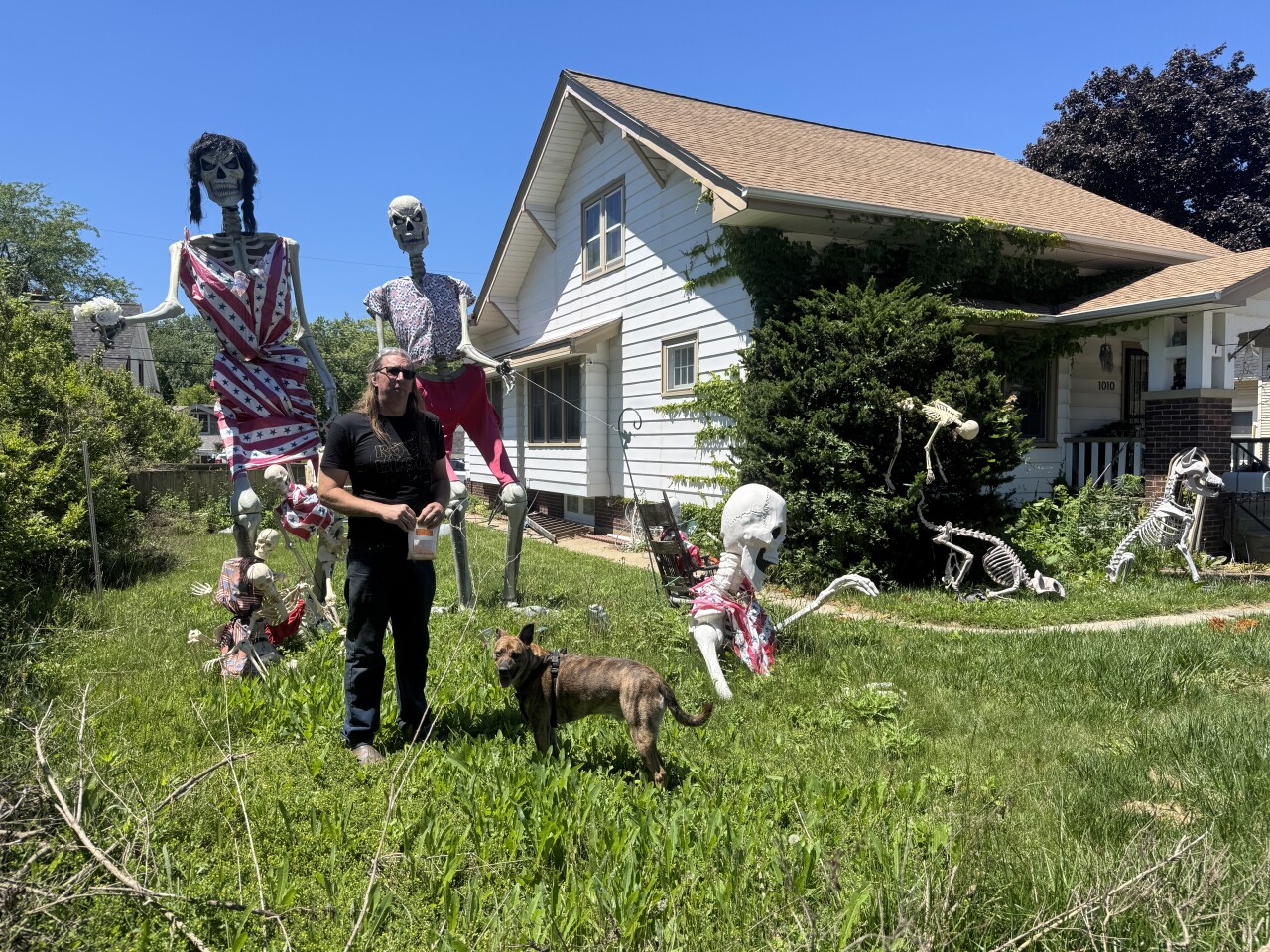
SOUTH MILWAUKEE, Wis. — A South Milwaukee homeowner is pushing back after the city ordered him to take down his year-round skeleton display, calling it a violation of property maintenance codes.
Sean Oster and his wife have maintained the display — featuring skeletons named Hector and Henrietta along with other decorations— for nearly two years, dressing them up for holidays, sports events, and other occasions.
Mike Beiermeister
The display has drawn attention from neighbors and passersby, with some saying it has become part of the neighborhood’s character.
Watch: South Milwaukee homeowner fights city order to remove year-round skeleton display
South Milwaukee homeowner fights city order to remove year-round skeleton display
“It’s like an expression of the owner’s passion… and I think it’s cool they can use their lawn that way,” neighbor Jeremy Payment said.

Mike Beiermeister
Last month, Oster received a letter from the city of South Milwaukee describing the skeletons as Halloween decorations being displayed outside the appropriate time of year and ordering him to remove them by July 7.
Under the city’s property maintenance code, yards must be kept free of anything considered an “unreasonable blighting influence,” which the city says can include displays left up out of season. The notice also flagged an inoperable vehicle on the property. Each violation could result in fines of up to $500 per day if not corrected by the deadline.
Oster says he understands part of the city’s concern.
“They have a few points… I’ve got a couple collector cars… I understand those shouldn’t be out,” Oster said.
Mike Beiermeister
He plans to move the cars into the garage and clean up the yard, but says the skeletons are staying.
“I don’t think it’s hurting anybody. It’s literally a victimless crime,” Oster said.
Oster also had a message for whoever filed the complaint.
“Live with it… more people like it than hate it. And if we’re enforcing this, then we should go around and take down Christmas lights that are up year-round,” Oster said.
The city administrator did not respond to a request for comment.
This story was reported on-air by a journalist and has been converted to this platform with the assistance of AI. Our editorial team verifies all reporting on all platforms for fairness and accuracy.
Let’s talk:
Hey there! At TMJ4 News, we’re all about listening to our audience and tackling the stuff that really matters to you. Got a story idea, tip, or just want to chat about this piece? Hit us up using the form below. For more ways to get in touch, head over to tmj4.com/tips.
It’s about time to watch on your time. Stream local news and weather 24/7 by searching for “TMJ4” on your device.
Available for download on Roku, Apple TV, Amazon Fire TV, and more.
Report a typo or error // Submit a news tip
-

 World11 minutes ago
Trump vows Iran will not charge Strait of Hormuz tolls, but says US might
-
 News34 minutes ago
DOJ memo stokes fear among disability advocates of a return to institutionalization
-

 Los Angeles, Ca2 hours ago
Armed home invasion in L.A.’s Fairfax District leaves resident assaulted
-

 Detroit, MI2 hours ago
Tigers top Chicago White Sox 4-1; Detroit pitcher Troy Melton allows 1 hit in 6 innings
-

 San Francisco, CA2 hours ago
MLB Rumors: Latest Intel on Potential Matt Chapman Trade for San Francisco Giants
-

 Dallas, TX2 hours ago
Dallas’ Fair Park to Get $2.5M Boost From McKesson – Dallas Weekly
-

 Miami, FL3 hours ago
Air quality alert in effect in Miami-Dade and Broward counties: National Weather Service
-

 Boston, MA3 hours ago
Boston Signs Big Blueliner Rylind MacKinnon To One-Year Extension

