


The remainder of the bracket is going to be tough for the Michigan Wolverines, including Sunday’s tilt against the Tennessee Volunteers, but of the two options for the Elite Eight, this was the preferrable opponent. Analytics believe this squad is underseeded (No. 11 overall per Kenpom), but compared to the swarming defense of Iowa State, the Wolverines have to feel great about their chances of advancing to the Final Four.
Michigan
Socialist Equality Party candidates submit 20,000 signatures to appear on Michigan presidential ballot


The Socialist Equality Party (SEP) candidates in the 2024 US presidential elections, Joseph Kishore and Jerry White, announced Thursday that their campaign had submitted “far in excess” of the required signatures to appear on the ballot in Michigan.
The ballot access laws for third-party candidates are different in every state, compounding the difficulty of running a nationwide campaign. For Michigan, the socialist campaign was required to gather at least 100 signatures from a majority of the state’s 13 congressional districts and at least 12,000 total. A campaign manager for Kishore/White told this reporter that the campaign exceeded that total in at least 11 congressional districts, and as a whole the campaign submitted 20,000 signatures.
Presidential candidate Kishore stated in a video accompanying a press release that the gathering of the signatures was a “tremendous achievement” that “would not have been possible without the self-sacrifice and dedication of SEP supporters from throughout the state and indeed across the country.”
Loading Tweet …
Vice presidential candidate Jerry White said, “In the course of this campaign, we spoke with hundreds of thousands of people. There is enormous opposition to the genocide in Gaza, the escalating global war, extreme levels of social inequality and the turn of the ruling class toward dictatorship and fascism…
“As we turned these petitions in, the Republican National Convention was being held, a festival of fascistic reaction. In the aftermath of the attempted assassination of Trump, the line from the Democrats and Biden, dripping in blood from the genocide in Gaza, is “unity”—which means the unity of the ruling class in war abroad and war on the working class at home.”
Explaining the purpose of the SEP campaign, Kishore stated that it “gives expression to the interests of the working class, in the US and throughout the world.
“We are developing within the working class an understanding that our interests cannot be realized except through the fight against capitalism–that is, the taking of power by the working class, the expropriation of the rich, and the creation of a society free of war and exploitation, a society based on equality.”
Michigan is considered a “must win” state by both the Republican and Democratic campaigns. It is the third most populous state in the Midwest, with over 10 million people and 15 Electoral College votes. President Joe Biden won the state in 2020 by roughly 155,000 votes, while Donald Trump was able to best Hillary Clinton in the state in 2016 by some 11,000 votes.
In addition to the automotive industry, which still employs over 1.1 million workers in Michigan, tens of thousands of workers in the state labor at technology companies, such as Google, and in the healthcare industry, including at major facilities at the University of Michigan in Ann Arbor, the Detroit Medical Center and Henry Ford Health System in Detroit, and Corewell Health, a recently merged system that covers the entire state.
As of this writing, Kishore and White of the SEP would join Jill Stein of the Green Party and right-wing anti-vaccine zealot Robert F. Kennedy Jr. on the ballot in Michigan. The campaign for Dr. Cornel West is still awaiting certification by the state, according to their campaign website.
In a bid to block the emergence of an independent, left-wing movement in the working class to the capitalist two-party system, both the Democrats and Republicans have used the courts, legislature and election boards to deny ballot access. Just this week, Democrats on the North Carolina State Election Board voted to block West from appearing on the ballot despite the fact that his campaign submitted over 3,200 verified signatures above the minimum limit.
According to the SEP campaign manager, a majority of the signatures were collected in populous Wayne County, home to Detroit, with over 1.7 million residents. The Kishore/White campaign was warmly received throughout the county, including in Dearborn, which is home to the largest Muslim population in the US per capita.
In Dearborn and throughout the state, there is mass outrage over the Democratic Party’s and Biden’s unwavering support for the genocide in Gaza, which a recent Lancet study estimated has claimed the lives of over 186,000 people. Petitioners for Kishore/White regularly campaigned outside halal grocery stores, mosques and community events, where they explained that the fight against Zionism requires a break from both the Democratic and Republican parties and a fight against the capitalist system which they all defend.
While over 11,000 signatures were gathered in Wayne County alone, the campaign also garnered over 6,000 signatures total in the other three counties of the greater Detroit-Ann Arbor metropolitan area, Oakland, Macomb and Washtenaw. Over 650 people signed the petition each in Genesee County, home to Flint, and Kent County, where Grand Rapids is located. Triple-digit signature totals were also gathered in Ottawa, Kalamazoo, Ingham and St. Clair counties. In total, the campaign gathered signatures in 74 of Michigan’s 83 counties.
The widespread and broad support for the socialist campaign in Michigan refutes notions advanced by demoralized middle-class elements that workers and students in the United States are hopelessly backward and incapable of entertaining the possibility of a socialist perspective.
Less than two years ago, some 5,000 autoworkers voted for socialist Will Lehman for president of the UAW, including many in Michigan. This was an expression of growing opposition in the working class to the UAW apparatus and support for an internationalist and socialist perspective.
The SEP is continuing to gather signatures in other states where it is fighting to get on the ballot.


By

Paula Wethington is a digital producer at CBS Detroit. She previously held digital content roles at NEWSnet, Gannett/USA Today network and The Monroe News in Michigan. She is a graduate of the University of South Carolina.
Read Full Bio
Southeast Michigan will see an increasingly severe weather threat from Monday night into Tuesday, starting with warming temperatures in the 60s and 70s across the area.
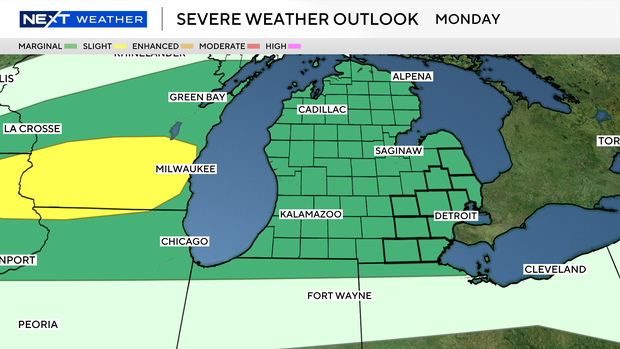
Monday’s weather
A marginal risk (level 1/5) is in place for Monday night, meaning only isolated severe storms are expected, mainly after 7 p.m. through midnight. The primary threats will be hail around 1 inch and a few localized damaging wind gusts, with storms moving quickly west to east, with storm coverage remaining limited.
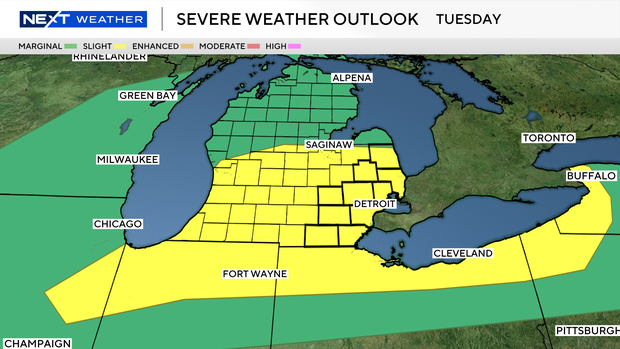
Tuesday’s weather
By contrast, Tuesday brings a Weather Alert Day with a slight risk (level 2/5), indicating a higher chance of more organized and scattered severe storms through the day as a cold front moves through.
On Tuesday, all severe weather hazards are possible, including damaging winds (potentially 60+ mph), large hail, heavy rainfall, and even a low risk of tornadoes, with damaging winds expected to be the main concern.
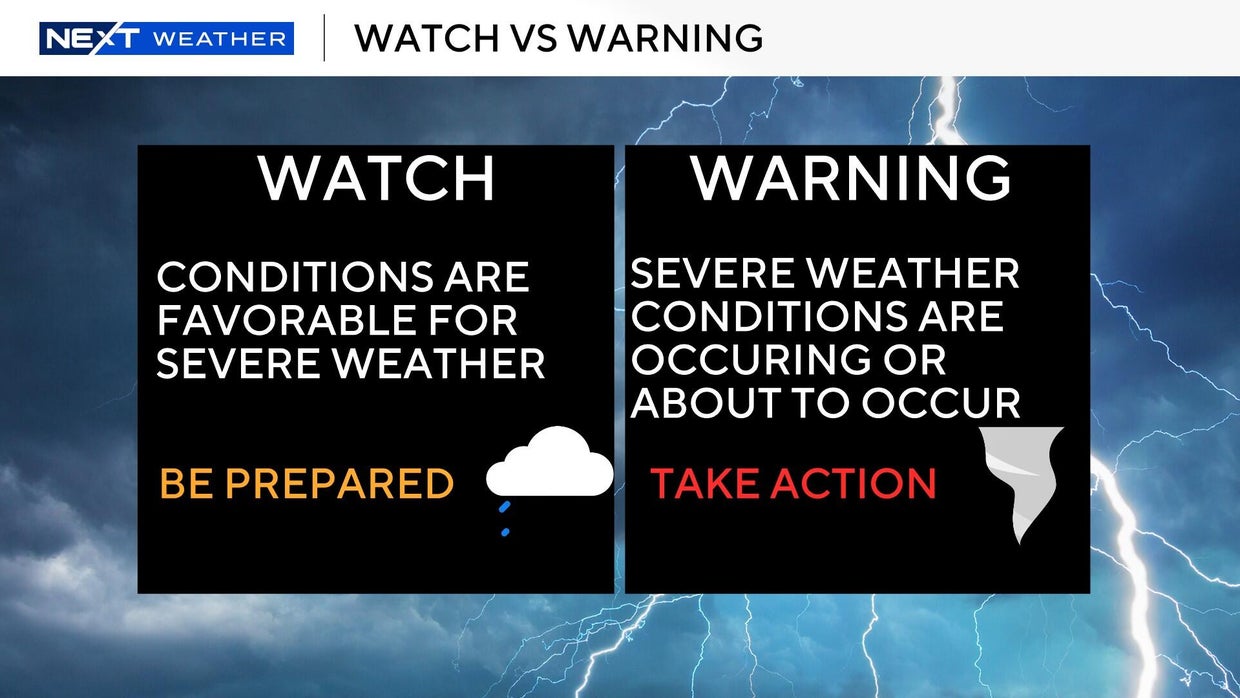
Watch vs. warning
The National Weather Service says a severe weather watch means “be prepared.” It is possible that the weather will reach severe levels during the time frame specified.
A severe weather warning means “take action,” that severe weather conditions have been reported by spotters or can be detected on radar. People are asked to take shelter indoors, away from windows.
It is possible for a tornado warning to be issued without a tornado watch already in effect. This is the scenario that happened in Southwest Michigan on March 6, 2026.

Jim Harding has landed his first commitment on the recruiting trail as offensive line coach in Ann Arbor, as 2027 four-star Sidney Rouleau announced on Sunday night that he will be playing college football for at Michigan.
Rouleau — a native of Canada but now playing high school football at The Brook Hill School in Bullard, Texas — is coming off an unofficial visit to Michigan this weekend. That was his third time in Ann Arbor, as he also visited for the Purdue game last fall and another time a couple summers ago.
Understandably so, Rouleau had great things to say after his most recent trip.
“My visit to Michigan was awesome,” Rouleau told Rivals’ Steve Wiltfong ($). “The energy around the program is contagious, and I really connected with the coaches and players. What excites me most about playing for coach (Kyle) Whittingham and the Wolverines is the chance to be part of building something special. Their vision for the future, combined with the tradition and passion of the fanbase, makes it an opportunity I couldn’t pass up. I’m excited to contribute to their success and also being able to play for coach Harding!”
Rouleau is listed at 6-foot-5 and 240 pounds, per Rivals, but 247Sports has him listed at 6-foot-7 and 269 pounds, so he may be a bit bigger than Rivals’ last update on him. Regardless, the expectation is that he will eventually play one of the tackle positions at Michigan.
Other than the Wolverines, Rouleau also earned offers from Ohio State, Clemson, Penn State, Oregon, Georgia, USC, Wisconsin, Texas, Alabama, Oklahoma Miami, Washington, Florida, Florida State and many others.
Michigan is now up to six total commitments in the 2027 recruiting class, and three of them are offensive linemen — Rouleau, and three-stars Louis Esposito and Tristan Dare. Rouleau also joins four-star edge rusher Recarder Kitchen, four-star safety Darrell Mattison and three-star safety Maxwell Miles in the class.
Rouleau is ranked No. 300 overall on the Rivals Industry Ranking. Check out some of his junior year highlights down below.

The Vols lost four of their last six games heading into the NCAA Tournament, though were impressive against Miami (OH), Virginia, and Iowa State. Their defense is solid (11th) while the offense is productive (31st), perhaps making their No. 6 seed a little misleading. Still, Michigan is the better overall team here, and unfortunately the odds of a third straight year of losing to a No. 1 seed in the Elite Eight are quite high for Rick Barnes and company.
Elite Eight: No. 1 Michigan (34-3) vs. No. 6 Tennessee (25-11)
Date & Time: Sunday, March 29, 2:15 p.m. ET
Location: United Center, Chicago, IL
TV/Streaming: CBS
Oddly, this is the fourth Tournament meeting between these schools since 2010-11, with the prior three favoring the maize and blue. That first contest was a 30-point First Round blowout, followed by a narrow Michigan win in the 2013-14 Sweet Sixteen. The most recent edition was also a close one, with Hunter Dickinson and Eli Brooks each topping 20 points as the No. 11 Wolverines upset No. 3 Tennessee in the Second Round in 2021-22.
Tennessee 2PT Defense: 49.0% (63rd)
The most obvious path to victory for Michigan over Alabama was using its huge size advantage in the paint, yet both Aday Mara and Morez Johnson had games to forget. The bigs will get their chance for redemption on Sunday against a Tennessee defense that is much better than its SEC rival’s, yet is beatable down low. Weak hands and poor finishing will not work against this frontcourt, but the Wolverines have proven they can win physical battles all year.
As fun as March Roddy (Gayle) is, or the rapid emergence of Trey McKenney, Michigan will not win a national championship if it does not get substantial production from the Mara-Johnson duo. Enough others contributed against the Tide to still claim the win, and perhaps that could be possible again in the Elite Eight, but it would give a lot more confidence heading into the final weekend if these two could bounce back in a big way. The Vols have had issues fouling too, so being aggressive at the rim is a must.
Tennessee Offensive Rebounding: 45.1% (1st)
Yes, that is correct — Tennessee grabs nearly half of its own misses. With an effective field goal rate around 140th, this is less extreme than the Texas A&M gameplan last year, but surely no one will be caught sleeping after witnessing the Vols collect 53.3% (!!) of their opportunities against the Cyclones on Friday. Without basically any outside shooting, second-chance points are the only way this offense scores enough to keep it close.
However, since the Duke and Illinois games, the Wolverines have been pretty solid on the defensive glass and should feel capable of at least reducing the impact of Tennessee’s rebounding. The Michigan frontcourt can match up body-to-body, and this is another way Mara and Johnson can make huge contributions. Like Saint Louis and Alabama hitting threes, there will be frustrating stretches of elongated possessions, but the key is just getting enough rebounds to stop any torrent.
Tennessee Defensive 3PT Rate: 44.7% (33oth)
Few teams see more opposing three-point attempts than the Vols do, yet this rarely seems to burn them, as opponents connect on just 30.3% of their shots, which is 11th-best nationally. This resilience is going to be really tested by a Michigan offense that is making 47.3% of its threes in the Tournament thus far after a cold Big Ten Tournament. The touch could certainly cool off on Sunday, but is that a bet Tennessee really wants to take?
If the Wolverines can stay disciplined and keep taking the high-percentage looks, this should be a huge factor on Sunday. While I still would like to see the offense attack the paint, there are too many good shooters on the roster to not take advantage when the defense is passive. Should Barnes choose to start closing out on shooters, there will be paths open to the hoop. Though the metrics consider this a strong defense, it feels like there is an easy way Michigan blows this game open.
Tennessee Adj. Offense: 31st
As a whole, the Tennessee offense appears fine, but the analytics are actually kind of sour on most of the parts. Bad free throw shooting (286th) on modest attempts (103rd), too many turnovers (233rd), limited three-point attempts (329th), and a slow tempo (290th) make me wonder how anything actually happens aside from getting good second-chance looks on offensive rebounds.
Clearly that strategy has worked this year — and over the past two weekends — but the 24-point loss to Florida (with a 17.1% OReb rate) might tell the story of what happens against defenses with size. The best actual shooter is Ja’Kobi Gillespie, who has improved since his combined 6-for-22 effort in two games against Michigan last season, but aside from him and Nate Ament, there is little outside threat.
I do think there will be enough offensive rebounds and tough makes to avoid an instant blowout (though not off the table for the final score), and maybe the Vols’ three-point defense is real, but the ways Michigan can win are so much more numerous than the ways it can lose. Trust the better team to take care of business and move on to Indianapolis next weekend.

San Francisco, CA11 minutes ago
This Week: Bike Ambassador, Lake Merritt Loop, Cayuga Street – Streetsblog San Francisco

Dallas, TX17 minutes ago
How FC Dallas Can Unlock Santiago Moreno Alongside Musa, Valiente, and Farrington

Miami, FL23 minutes ago
Could Miami Dolphins trade up in first round of 2026 NFL Draft?

Boston, MA29 minutes ago
Tech entrepreneur Paul English gives $1m to kick-start AI program in Boston Public Schools – The Boston Globe

Denver, CO35 minutes ago
Three former Denver mayors urge a “yes” vote on license plate cameras (Opinion)

Florida1 year ago
Florida High School Football Rankings: Top 25 teams – Oct. 21

Oregon2 years ago
How old is Bo Nix? What to know about Oregon quarterback ahead of 2024 NFL Draft

Connecticut2 years ago
Cleary's 21 help Le Moyne down Central Connecticut State 69-64 in OT

Virginia2 years ago
99th annual Pony Swim held in Virginia

Indiana2 years ago
Indiana Members Credit Union announced as new anchor tenant at Bottleworks District

News7 hours ago
Video: Iran to Allow More Oil Ships Through Strait of Hormuz, Trump Says

Politics8 hours ago
Dem senator warns deportation could let Virginia woman’s illegal immigrant killer ‘escape accountability’

World10 hours ago
Newsletter: G7 ministers to hold talks on war’s economic fallout
News10 hours ago
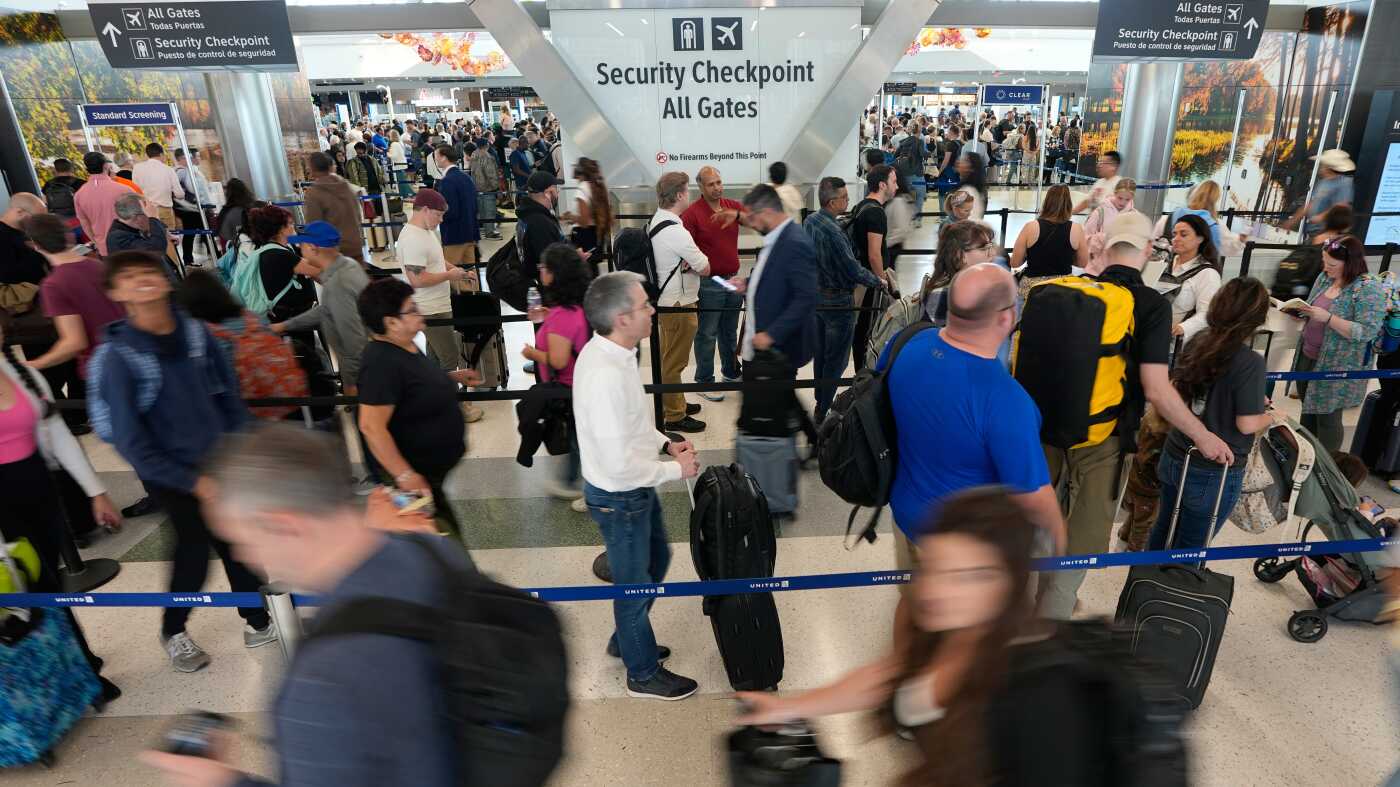
ICE officers could remain at airports after TSA workers are paid

Politics21 hours ago
Scathing report claims nation’s oldest labor union ‘betrayed’ MAGA members through ‘shocking’ spending
-

 Sports1 week ago
IOC addresses execution of 19-year-old Iranian wrestler Saleh Mohammadi
-

 Miami, FL4 days ago
Jannik Sinner’s Girlfriend Laila Hasanovic Stuns in Ab-Revealing Post Amid Miami Open
-

 New Mexico1 week ago
Clovis shooting leaves one dead, four injured
-

 Politics1 week ago
Schumer gambit fails as DHS shutdown hits 36 days and airport lines grow
-

 Tennessee7 days ago
Tennessee Police Investigating Alleged Assault Involving ‘Reacher’ Star Alan Ritchson
-

 Minneapolis, MN4 days ago
Boy who shielded classmate during school shooting receives Medal of Honor
-

 Science1 week ago
Record Heat Meets a Major Snow Drought Across the West
-

 Politics1 week ago
Trump gives Iran 48-hour ultimatum to reopen Strait of Hormuz or face strikes on power plants