Michigan
MSU’s Khris Bogle Talks Playing Rush End, Coach Chad Wilt


Michigan State’s defense is going to look different than in years past, but nonetheless, the standard will still be the same.
For one, under new defensive coordinator Joe Rossi, the system will include a rush end position.
As a reminder, as Michigan State rush ends coach Chad Wilt had said back in the spring, “This rush end position … it’s it’s a hybrid outside backer/D-end thing. So sometimes, he’s going to have D-end jobs — play over tight end, right? Play in the C-gap, be strong and sturdy and sometimes it might be ‘Hey, you’re gonna be over this tight end man-to-man.”
One of Wilt’s rush ends is veteran defensive lineman Khris Bogle.
“Still, [like] back in the spring, just learning the new technique,” Bogle told reporters on Thursday. “We got Coach Wilt, that’s my coach. Just learning the new technique with him and just keep stacking days.”
Wilt was added to Coach Jonathan Smith’s staff this offseason after spending the past two seasons on Indiana’s coaching staff.
“Coach Wilt, he brings energy every day,” Bogle said. “And he elevates the room to just keep going, keep going, keep going. Make camp be as hard as it can so when the season comes around, we’re ready to go.”
Wilt had also detailed the benefits of the rush end position in the spring.
“It goes back to … the jobs that they’re going to be asked are very different,” he said. “And some of those jobs you can’t do from a three-point stance — or, I shouldn’t say can’t — extremely difficult to do from a three-point stance. So, now we can do that from a two-point, and you don’t know offensively that, ‘Okay, hey, we’re gonna be in our pressure package or we’re gonna be in our base package here — base calls.’ So I think just allow those guys the freedom and flexibility, but then it also gives us, I think, another set of eyes that can see, right? Instead of having four guys down — and those guys, once they put their hand in the stance, you can see a whole lot.”
Don’t forget to follow the official Spartan Nation Page on Facebook Spartan Nation WHEN YOU CLICK RIGHT HERE, and be a part of our vibrant community group Go Green Go White as well WHEN YOU CLICK RIGHT HERE.



Michigan must shut down Pohlkamp’s offensive blue line presence, Lorenz’s momentum-building play, and Hicks’ rookie goaltending to advance.
Video Transcript
Give me, yeah, give me like 30 seconds to a minute.
Give me, yeah, give me like 30 seconds to a minute.
obviously their overall record, Michigan, let’s see here.
obviously their overall record, Michigan, let’s see here.
They’re running right now at 22 and 4, I think.
They’re running right now at 22 and 4, I think.
They’re 10 and 2 at home.
They’re 10 and 2 at home.
They’re on a six-game win streak.
They’re on a six-game win streak.
and in conference right now they’re 13 and 3.
and in conference right now they’re 13 and 3.
So they did play Michigan State twice already.
So they did play Michigan State twice already.
they split the series.
they split the series.
I think, the first game it was in Ann Arbor or whatever.
I think, the first game it was in Ann Arbor or whatever.
They won the, against, in the opposite place, right?
They won the, against, in the opposite place, right?
Yeah, yeah, yeah.
Yeah, yeah, yeah.
And they split the series, so- Each home, each home team won a game, right?
And they split the series, so- Each home, each home team won a game, right?
That’s it, right.
That’s it, right.
Yeah, exactly.
Yeah, exactly.
and so I was looking this up earlier ’cause I was looking up probably the most interesting stat ear- when I first, you know, the season started, Michigan was oh, way in ahead with the most goals overall for Division I hockey.
and so I was looking this up earlier ’cause I was looking up probably the most interesting stat ear- when I first, you know, the season started, Michigan was oh, way in ahead with the most goals overall for Division I hockey.
and I looked up again and I refreshed that and they’re still 26 games played, 125 goals scored, 56 goals scored against them.
and I looked up again and I refreshed that and they’re still 26 games played, 125 goals scored, 56 goals scored against them.
That’s- I mean, that’s- Whoa.
That’s- I mean, that’s- Whoa.
That’s, that’s amazing.
That’s, that’s amazing.
That’s Yeah.
That’s Yeah.
The next, the next best team is Quinnipiac, and they’ve played two more games and they have 115 goals and 62 goals scored against them.
The next, the next best team is Quinnipiac, and they’ve played two more games and they have 115 goals and 62 goals scored against them.
So- Wow I think, I think you got the top five teams are all in the Big 10 right now.
So- Wow I think, I think you got the top five teams are all in the Big 10 right now.
You got Michigan, Michigan State, Western Wisconsin, and I think Penn State was up there, but I know they just lost two games to Michigan State, and then Gavin McKenna might be going to prison, so.
You got Michigan, Michigan State, Western Wisconsin, and I think Penn State was up there, but I know they just lost two games to Michigan State, and then Gavin McKenna might be going to prison, so.
Yeah, I saw that.
Yeah, I saw that.
That’s kinda crazy.
That’s kinda crazy.
Yeah.
Yeah.
Anyways, but the thing about it is some of the players like Michigan has right now, Will Horkoff, he has Let’s see.
Anyways, but the thing about it is some of the players like Michigan has right now, Will Horkoff, he has Let’s see.
He has the most goals.
He has the most goals.
He has 20 goals right now.
He has 20 goals right now.
TJ Hughes, he’s right behind him with 13.
TJ Hughes, he’s right behind him with 13.
Michael Hage, another great player.
Michael Hage, another great player.
You’re gonna, guys You guys are obviously are, is familiar, so those are probably three of the names you’re gonna hear.
You’re gonna, guys You guys are obviously are, is familiar, so those are probably three of the names you’re gonna hear.
Jayden Perron, one of the best defensemen.
Jayden Perron, one of the best defensemen.
His name’s Dakota, so you’ll probably hear him too.
His name’s Dakota, so you’ll probably hear him too.
but the way they play- Gotta sneak that in, huh?
but the way they play- Gotta sneak that in, huh?
Yeah.
Yeah.
The, the way they play, their coach, Brandon Yarioto, he’s, he’s, he played at Michigan.
The, the way they play, their coach, Brandon Yarioto, he’s, he’s, he played at Michigan.
He’s a great coach.
He’s a great coach.
They extended his contract.
They extended his contract.
Yeah.
Yeah.
So you just kinda see the success just getting more and more.
So you just kinda see the success just getting more and more.
Their, their goaltender went down a few games ago, and he was phenomenal.
Their, their goaltender went down a few games ago, and he was phenomenal.

LANSING, Mich. — Convenience stores, smoke shops and even drug stores across Michigan often offer a wall of tobacco products behind the counter. Michigan is one of only eight states where retailers aren’t required to obtain a license to sell the items, and now lawmakers want to change that.
A package of House bills making its way through committee would strengthen regulations, seeking to protect minors.
“We know how potentially dangerous tobacco usage is, and that we need to prevent teens from starting in the first place, helping them to avoid a lifelong health challenges that are caused by smoking and vaping,” Rep. Bradley Slagh (R-Zeeland) said.
The package, a version of which already passed the state Senate, would require retailers to obtain a license to sell tobacco or nicotine products.
It would also penalize those who sell to minors, from the cashier to the store’s owner.
“We license people that might give me a bad haircut, but we’re not going to license people selling tobacco, and increasingly more to our youth,” Jeff Griffith, of The Youth Connection, said.
The bills would further remove penalties for minors that obtain or attempt to buy tobacco products.
“There is no evidence demonstrating that these laws are effective in reducing youth initiation, use of or addiction to tobacco products,” Rep. Helena Scott (D-Detroit) said. “Research shows that African American and Hispanic youth were more likely to receive these citations. We do not want to increase interactions between young people of color and law enforcement.”
The 2023 Michigan Youth Tobacco survey found 29% of minors got their products through retailers.
Only 9% of respondents reported that retailers refused to sell cigarettes to them because of age, and only 5% said the same for vapes.
According to Food and Drug Administration (FDA) data, within just the past five years, more than 3,100 enforcement actions have been taken against retailers for selling to minors.
Among them, five violations since 2022 at just one store, Deering’s Market in Traverse City. Last year, the FDA even sought a 30-day ban on tobacco sales at the store.
Under the bills, Deering’s would have been fined $10,000 and their license would have been revoked.
Two other stores, one in Ann Arbor and the other in Detroit, also received those orders.
“They continue to operate and profit in the State of Michigan, while, as it was pointed out, the kids pay the price for the laws that criminalize them,” Jodi Radke, regional director for Campaign for Tobacco-Free Kids, said. “Today, Michigan kids are counting on you to place accountability where it belongs.”
Critics note mistakes are made and welcome regulation, but call the effort as a cash grab, with its $500 license fee.
They also point out the bills fail to address the 64% of minors who got their tobacco elsewhere, citing the 2023 survey.
“Quite frankly, we have little faith that based on our past experience with regulation enforcement and all these investigations we’ve seen that this is going to solve the problem of mom and dad and aunt and uncle giving smokes to kids,” Mark Griffin, president of the Michigan Association of Convenience Stores, said.
Supporters acknowledge the bills won’t completely solve the issue, but believe it shows Michigan is serious on the matter.


Paula Wethington is a digital producer at CBS Detroit. She previously held digital content roles at NEWSnet, Gannett/USA Today network and The Monroe News in Michigan. She is a graduate of the University of South Carolina.
Read Full Bio
Southeast Michigan will see an increasingly severe weather threat from Monday night into Tuesday, starting with warming temperatures in the 60s and 70s across the area.
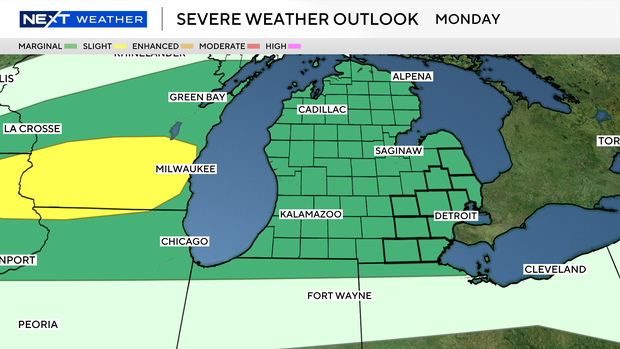
Monday’s weather
A marginal risk (level 1/5) is in place for Monday night, meaning only isolated severe storms are expected, mainly after 7 p.m. through midnight. The primary threats will be hail around 1 inch and a few localized damaging wind gusts, with storms moving quickly west to east, with storm coverage remaining limited.
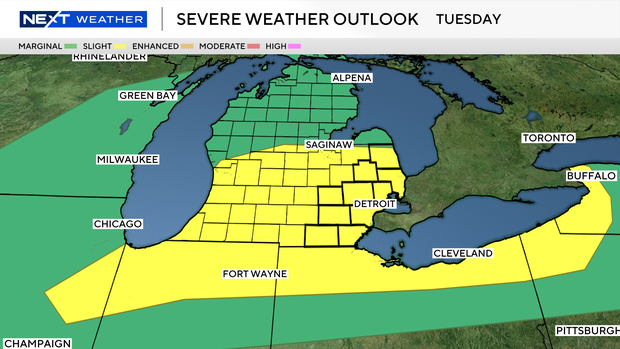
Tuesday’s weather
By contrast, Tuesday brings a Weather Alert Day with a slight risk (level 2/5), indicating a higher chance of more organized and scattered severe storms through the day as a cold front moves through.
On Tuesday, all severe weather hazards are possible, including damaging winds (potentially 60+ mph), large hail, heavy rainfall, and even a low risk of tornadoes, with damaging winds expected to be the main concern.
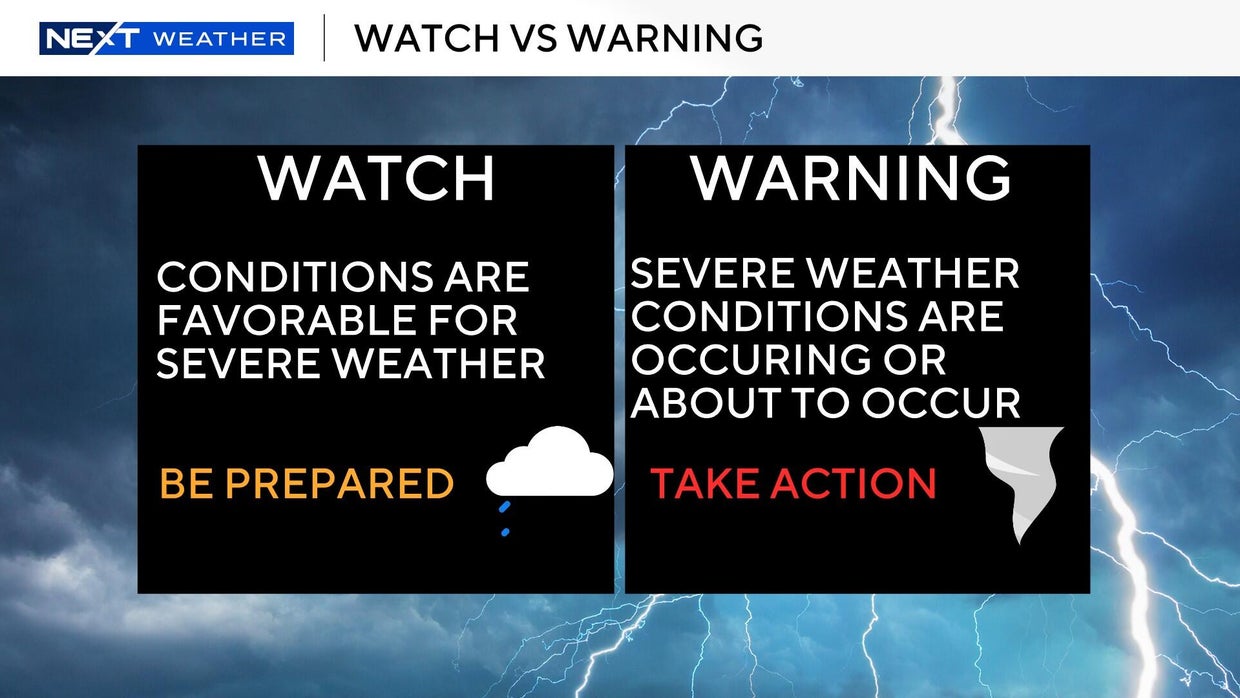
Watch vs. warning
The National Weather Service says a severe weather watch means “be prepared.” It is possible that the weather will reach severe levels during the time frame specified.
A severe weather warning means “take action,” that severe weather conditions have been reported by spotters or can be detected on radar. People are asked to take shelter indoors, away from windows.
It is possible for a tornado warning to be issued without a tornado watch already in effect. This is the scenario that happened in Southwest Michigan on March 6, 2026.

Sheffield sets focus on key issues in first State of City speech. How to watch

Our Trip to San Francisco | Cup of Jo

Mark Cuban has one major regret after selling Dallas Mavericks

Need to Know: Bruins vs. Stars | Boston Bruins

Denver weather: Seasonal with spotty showers

Florida High School Football Rankings: Top 25 teams – Oct. 21

How old is Bo Nix? What to know about Oregon quarterback ahead of 2024 NFL Draft

Cleary's 21 help Le Moyne down Central Connecticut State 69-64 in OT

99th annual Pony Swim held in Virginia

Indiana Members Credit Union announced as new anchor tenant at Bottleworks District
Latino Republicans in South Texas Turn on Trump Over Birthright Citizenship

Fugitive illegal alien convict on the run after attempting to strike ICE officer with vehicle: DHS

EU to urge Israel to scrap death penalty bill as ‘grave regression’

Army reviewing after helicopters hovered alongside Kid Rock’s swimming pool as he saluted

Emanuel pushes back on ‘straight White man’ question, says ideas matter most in 2028
-

 Sports1 week ago
IOC addresses execution of 19-year-old Iranian wrestler Saleh Mohammadi
-

 Miami, FL5 days ago
Jannik Sinner’s Girlfriend Laila Hasanovic Stuns in Ab-Revealing Post Amid Miami Open
-

 South-Carolina2 days ago
South Carolina vs TCU predictions for Elite Eight game in March Madness
-

 New Mexico1 week ago
Clovis shooting leaves one dead, four injured
-

 Science1 week ago
Record Heat Meets a Major Snow Drought Across the West
-

 Politics1 week ago
Schumer gambit fails as DHS shutdown hits 36 days and airport lines grow
-

 Minneapolis, MN5 days ago
Boy who shielded classmate during school shooting receives Medal of Honor
-

 Tennessee1 week ago
Tennessee Police Investigating Alleged Assault Involving ‘Reacher’ Star Alan Ritchson