Midwest
Knife-wielding man in St. Louis airport shot and killed by police

NEWYou can now listen to Fox News articles!
A knife-wielding suspect was shot and killed Friday morning at St. Louis Lambert International Airport after refusing orders to drop his weapon, police said.
The officer-involved shooting happened around 1:05 a.m. local time as “STL Airport Police officers were conducting routine security checks in Terminal 1” and “encountered an adult male with a knife,” according to St. Louis County Police.
“The suspect refused to drop the weapon and was tased by one police officer. The suspect continued to advance towards officers, and a second police officer fired his service weapon, striking the male suspect,” police added. “He was pronounced deceased on scene.”
Investigators said both officers involved in the incident have been with STL Airport Police for six months and one year, respectively, and each have prior law enforcement experience.
PASSENGER FINDS LOADED MAGAZINE WITH MYSTERIOUS INSCRIPTION ON ATLANTA PLANE, FBI NOTIFIED
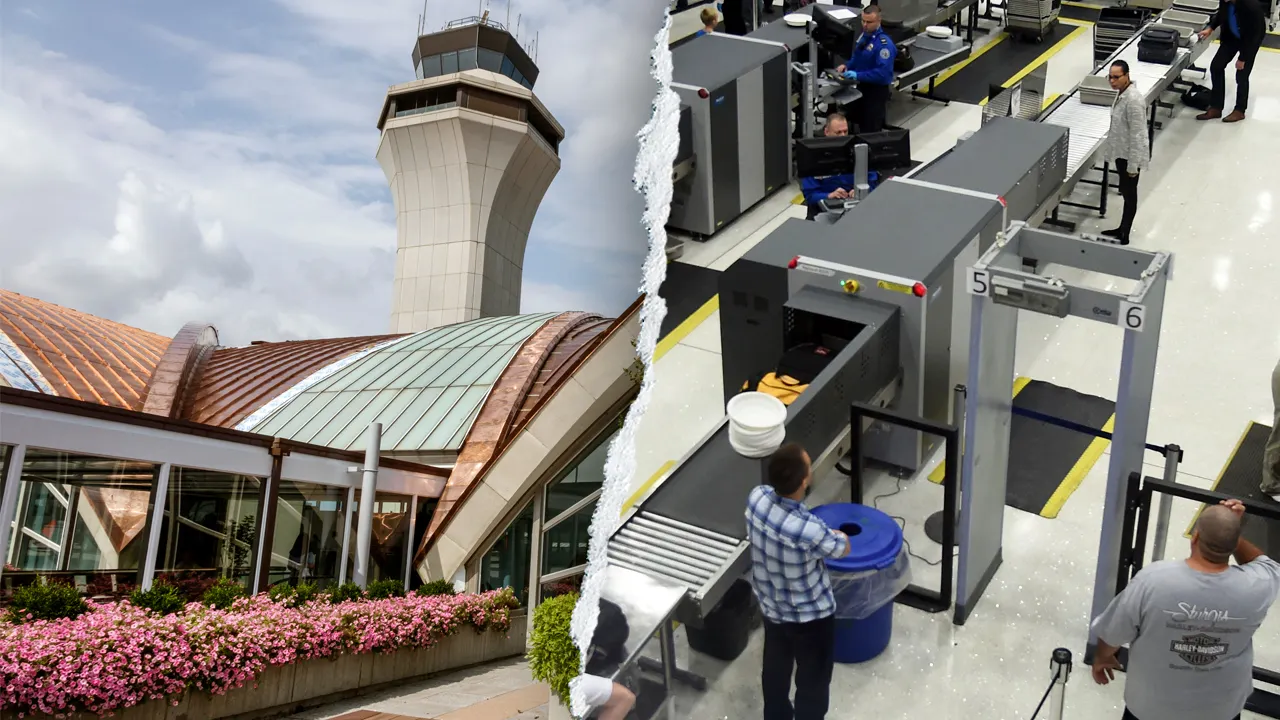
A terminal at St. Louis Lambert International Airport, left. On the right, Transportation Security Administration (TSA) officers inspect airline passengers before they board their flights at the airport in October 2016. (Jeffrey Greenberg/Universal Images Group via Getty Images; Robyn Beck/AFP via Getty Images)
St. Louis County Police Bureau of Crimes Against Persons detectives are now reviewing the incident.
Fox News Digital reached out to St. Louis Lambert International Airport for comment.
NEW TSA POLICY MAY CHARGE PASSENGERS WHO DO NOT HAVE ACCEPTABLE IDS AT CHECKPOINTS
A man walking with his carry-on luggage at St. Louis Lambert International Airport. (Jeffrey Greenberg/Universal Images Group via Getty Images)
The suspect has not been publicly identified.
“Today’s incident in Terminal One was a tragic event for our Airport Community. However, I take great pride in our response. As police responded and county authorities conducted their investigation, we were able to continue normal operations at STL,” St. Louis Lambert International Airport CEO and Airport Director Rhonda Hamm-Niebruegge told KSDK.
An American Eagle plane is seen on the tarmac at St Louis Lambert International Airport in St Louis, Missouri, on Oct. 23, 2019. (Daniel Slim/AFP via Getty Images)
CLICK HERE TO DOWNLOAD THE FOX NEWS APP
“The Terminal One MetroLink station was closed for approximately three hours. During that time, shuttle buses were used to transport riders from Terminal One to the Terminal Two MetroLink station,” she added. “The airport is cooperating with the St. Louis County Police Department as they continue their investigation.”
Read the full article from Here



While almost all sports betting is now legal and easy in Illinois, wagering on home-state Illini basketball to win the NCAA Final Four is illegal. And that is no doubt surprising and frustrating a lot of Illinois basketball fans as they go to their favorite online betting site, only to find that they can’t bet on their own team here.
U of I may be a winner on the court this season, but they are losing on the wagering front in Illinois.
On the popular gambling site Draft Kings, there is a harsh reality for Illini fans: the school doesn’t exist as a betting option in the Final Four. U of I’s Saturday game against Connecticut is missing and off limits under an Illinois law that prohibits gambling on all in-state NCAA universities.
Right now, there are only three choices to bet on for the National Championship, and Illinois is M-I-A.
When sports betting was made legal in 2020, the Illinois General Assembly in Springfield passed a specific cut-out for in-state teams: all NCAA schools – any game, championship or not – is banned for you to bet on. And in the last six years, sports betting here has generated more than $59 million, and is increasing each year.
“We have definitely seen an increase in people coming in to treatment,” said Anita Pindiur, executive director of the Illinois Council on Problem Gambling. “We have seen about a 30 to 35% increase in young adult males, 18 to 35,” Pindiur said.
For U of I this is a total ban that even includes the trendy “prop” bets, where you concoct your own proposition wager on anything. For instance, betting that the long-banned Chief Illiniwek will make a return at the Final Four. Prop bets involving anything Illini are no-go.
But apparently, those customary friendly bets between state governors are exempt from the Illinois ban. Gov. JB Pritzker – who said he was recently lucky to win 1.4 million dollars in a Vegas blackjack game – on Monday said he has some kind of interstate sports bet brewing with Connecticut’s Democratic Gov. Ned LaMont.
“I already got a call from the governor of Connecticut, because we’re playing against the University of Connecticut on Saturday. And he wants to make a bet…a public…so you’ll be hearing about that,” Gov. Pritzker said.
Gov. Lamont’s spokesman told NBC Chicago the wager details are now being finalized, and Pritzker’s office told us there would be an announcement with details on Tuesday.
Illinois is now the nation’s second-biggest legal sports betting market and is not alone with this regulation. Several other states have similar local school laws.
We asked U of I officials about the ban on local college bets here. A university spokesperson told us: they aren’t involved in any efforts to change the law or those restrictions. There is one legal workaround: drive to Indiana, Iowa, Wisconsin or Michigan and go to a casino sportsbook there to place a bet on the Illini.
For anyone who needs help due to gambling abuse, the Illinois Council on Problem Gambling hotline is 1-800-GAMBLER and it is staffed 24/7 with experts who speak numerous languages. There are also problem gambling resources available at the Illinois helpline: Areyoureallywinning.com

Indiana Governor Mike Braun will join locked-out union members at the BP Whiting refinery on Tuesday morning.
Union leaders said that Braun will meet with workers picketing outside the company’s main offices in the 2800 block of Indianapolis Boulevard.
This comes after hundreds of workers were locked out of the BP refinery on March 19 after contract negotiations failed to produce a deal ahead of a midnight deadline. Since then, workers have been walking the picket lines.
Union leaders said negotiations have stalled for months, and are accusing BP of rejecting their proposals on jobs, pay, and safety. Union members said they are prepared to stay out on the picket lines 24/7 until there is movement at the bargaining table.
BP said it has made a comprehensive offer, and plans to continue operating the refinery with trained staff, adding that it does not expect disruptions to production.
The Whiting refinery is BP’s largest refinery in the world, producing 440,000 barrels a day. It is located less than 20 miles from downtown Chicago.
Braun is expected to join the union members around 9:15 p.m.
The video above is from a previous report.

The Iowa Boys Tennis Coaches have released team rankings for the start of the 2026 season in Iowa boys high school tennis.
Starting off the year in the No. 1 spots will be Waukee Northwest in Class 2A and Cedar Rapids Xavier in Class 1A.
Iowa City West, Johnston, Pleasant Valley and Linn-Mar round out the Top 5 in 2A while Dubuque Wahlert Catholic, Sergeant Bluff-Luton, Decorah and Waverly-Shell Rock complete the 1A Top 5 behind Cedar Rapids Xavier.
Both Waukee Northwest and Cedar Rapids Xavier claimed the team state titles a year ago. The Wolves earned 5-0 wins over both Dowling Catholic and Iowa City West before besting Cedar Rapids Prairie in the finals, 5-1.
Cedar Rapids Xavier silenced Boone and Decorah, earning a 5-3 victory over Dubuque Wahlert Catholic in the championship match.
State Team Tennis Makes Change For 2026
New for 2026 Iowa boys tennis season will be substate team tennis, as the Top 32 teams from each classification advance to participate. Previously, all teams started play in team state just like individual state qualifiers.
Eight substates with up to four teams each will compete. There will be one host site for each substate for the semifinal round and the substate final.
Here are the Iowa boys high school tennis team rankings from the Iowa Boys Tennis Coaches.
Iowa Boys High School Tennis Team Rankings
Class 2A
- Waukee Northwest
- Iowa City West
- Johnston
- Pleasant Valley
- Linn-Mar
- Ames
- Dowling Catholic
- Cedar Rapids Prairie
- Cedar Rapids Washington
- West Des Moines Valley
Class 1A
- Cedar Rapids Xavier
- Dubuque Wahlert Catholic
- Sergeant Bluff-Luton
- Decorah
- Waverly-Shell Rock
- Pella
- Central DeWitt
- Boone
- Ballard
- Shenandoah

Randolph County museum to host Arkansas Heritage director

New CA mandate requires Corn tortillas to contain Folic Acid, more states considering same rule

Colorado bill would bar debt collectors from seizing wages, homes over medical debt

Why school districts in Connecticut have been combining, or closing, schools

Chester Water Authority lifts boil water advisory in Upper Chichester area

Florida High School Football Rankings: Top 25 teams – Oct. 21

How old is Bo Nix? What to know about Oregon quarterback ahead of 2024 NFL Draft

Cleary's 21 help Le Moyne down Central Connecticut State 69-64 in OT

99th annual Pony Swim held in Virginia

Indiana Members Credit Union announced as new anchor tenant at Bottleworks District

Emanuel pushes back on ‘straight White man’ question, says ideas matter most in 2028

French police make two more arrests over foiled attack on Bank of America

‘What’s going on?’: US judge calls aspects of new Pentagon press policy ‘weird’

Video: Iran to Allow More Oil Ships Through Strait of Hormuz, Trump Says

Dem senator warns deportation could let Virginia woman’s illegal immigrant killer ‘escape accountability’
-

 Sports1 week ago
IOC addresses execution of 19-year-old Iranian wrestler Saleh Mohammadi
-

 Miami, FL4 days ago
Jannik Sinner’s Girlfriend Laila Hasanovic Stuns in Ab-Revealing Post Amid Miami Open
-

 South-Carolina2 days ago
South Carolina vs TCU predictions for Elite Eight game in March Madness
-

 New Mexico1 week ago
Clovis shooting leaves one dead, four injured
-

 Politics1 week ago
Schumer gambit fails as DHS shutdown hits 36 days and airport lines grow
-

 Minneapolis, MN4 days ago
Boy who shielded classmate during school shooting receives Medal of Honor
-

 Tennessee1 week ago
Tennessee Police Investigating Alleged Assault Involving ‘Reacher’ Star Alan Ritchson
-

 Science1 week ago
Record Heat Meets a Major Snow Drought Across the West