Midwest
Iowa high school principal, hailed as hero for protecting students during school shooting, dies of injuries

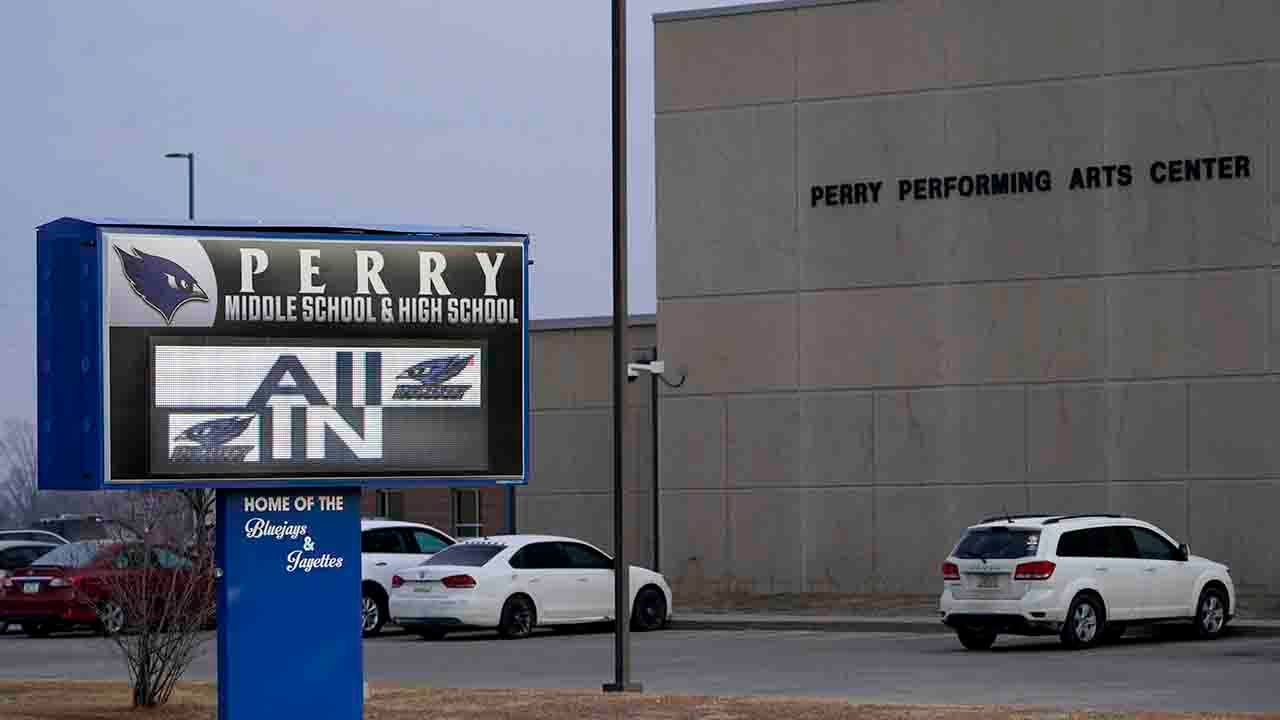
Shooting at Perry High School
There is a police presence at Perry High School in response to reports of a shooting in Perry, Iowa. (Credit: ThePerryNews.com / LOCAL NEWS X /TMX)
A high school principal in Iowa who was critically wounded in a school shooting while protecting students earlier this month has died, according to his family.
Perry High School Principal Dan Marburger died Sunday, his family announced on a GoFundMe page. Caldwell Parrish Funeral Home & Crematory confirmed the death to The Associated Press.
“Although the news has not fully set in yet, Dan Marburger gave the ultimate sacrifice,” the GoFundMe page said. “After 10 days, he lost his battle and this tragedy took his life.”
The shooting unfolded in the cafeteria at Perry High School just after 7:30 a.m. on Jan. 4, the first day students returned from winter break.
WEST VIRGINIA SENATE PASSES BILL TO ALLOW ARMED SECURITY PERSONNEL IN SCHOOLS
Perry High School Principal Dan Marburger died Sunday from critical injuries he sustained while protecting students during a shooting at the school on Jan. 4, his family said. (AP Photo/Charlie Neibergall, file)
An 11-year-old middle school student was killed in the shooting, and six other people were injured. The shooter, identified as a 17-year-old student at the school, died of an apparent self-inflicted gunshot.
Local residents pray during a candlelight vigil following a shooting at Perry High School on Thursday Jan. 4 in Perry, Iowa. (AP Photo/Charlie Neibergall)
The day after the shooting, the state Department of Public Safety said Marburger “acted selflessly and placed himself in harm’s way in an apparent effort to protect his students.”
‘SIMPLY DEVASTATED’: PARENTS OF IOWA TEEN WHO KILLED 1 AND WOUNDED 7 IN SHOOTING RELEASE STATEMENT
Marburger’s wife Elizabeth posted to the family’s GoFundMe that her husband died around 8 a.m. Sunday.
A 17-year-old student at the school was identified as the shooter. He was found dead with an apparent self-inflicted gunshot wound. (AP Photo/Bryon Houlgrave)
“He fought hard and gave us 10 days that we will treasure forever,” she wrote.
CLICK TO GET THE FOX NEWS APP
Perry is a town of about 8,000 residents. The high school is part of the 1,785-student Perry Community School District.
The Associated Press contributed to this report.
Read the full article from Here


MADISON – Well, this was different.
“And better,” said Alexander Pendleton of Shorewood, Wis.
We stood May 17 on Bascom Hill on the University of Wisconsin-Madison campus and took in the sight.
The grassy space is famous for hosting gatherings, sometimes even pranks by students. One of the most well-known was the Sept. 4, 1979 placement of about 1,000 plastic pink flamingos on the sloping terrain.
But this day Bascom was graced by something more natural.
The hill was peppered with dozens of wild turkey decoys. Hens. Toms. Preeners. Strutters. Feeders.
A crowd of people, volunteers, biologists, conservation organization staff and curious onlookers, reveled in the scene.
I think I even saw a satisfied smile crease the face of Pres. Abraham Lincoln, the statue that overlooks the hill.
Everybody knew this was no joke. This was a gathering with meaning.
“The most successful wildlife reintroduction in state history,” said Pendleton, accompanied by his wife Terese. “What an achievement.”
The May 17 event on Bascom, and a subsequent luncheon and program in UW Memorial Union, was a celebration of the 50th anniversary of the reintroduction of wild turkeys to Wisconsin.
The National Wild Turkey Federation was the primary sponsor of the events. Department of Natural Resources staff, both current and retired, also took part.
Significantly, former DNR employees Ron Nicklaus and Jon Nelson were on hand. Nicklaus was the leader of field operations of the 1976 turkey reintroduction and helped release the first 29 birds near Romance in Vernon County. Nelson was hired as a field technician about three months after the first birds arrived and worked on the turkey project for 10 years.
“Nobody really knew how it would go,” Nicklaus said. “And if anyone tries to tell you they knew it would be so successful and over so much of the state, they are lying. It’s been incredible.”
Wild turkeys were native to Wisconsin but the species was depleted through the 1800s by removal of vast areas of timber and high, unregulated turkey harvests by market and subsistence hunters.
By 1860 the birds were rare, and in 1881 the last wild turkey in the state’s original flock was killed near Darlington, according to the Department of Natural Resources’ document “Ecology of Wild Turkeys in Wisconsin.”
Efforts through the early to mid-1900s to bring the species back, mostly through stocking game farm birds, largely failed.
But by the 1970s the DNR had seen what worked in other states and put a plan together for Wisconsin.It was based on transferring wild turkeys obtained in the Ozark Mountains of Missouri into suitable habitat. In Wisconsin, the best wild turkey habitat was in the Driftless Area of southwestern Wisconsin.
The plan also relied on an agreement between state agencies. The Wisconsin DNR would exchange three ruffed grouse for each wild turkey provided by the Missouri Department of Conservation.
That proved trickier than it may seem. Nicklaus, who was tasked with capturing the grouse, had to bend and even break some rules to get it done.
“The grouse were tough to trap, and then of course you had to check the traps at least once a day, even on weekends and holidays,” Nicklaus said. “So we worked every day to get it done.”
Eventually enough grouse had been captured to convince the Missouri biologists to collect some wild turkeys for the trade.
On Jan. 21, 1976 the first flight of 29 Missouri wild turkeys landed at the La Crosse airport. It was met by about a dozen people, including Nicklaus and wildlife biologist Carl Batha, local rod-and-gun club members and UW-Madison professor Tom Yuill, an expert in wildlife diseases.
Yuill took a blood sample from and inspected each turkey. After the birds were pronounced healthy, Nicklaus, Batha and a crew of other DNR staff and volunteers drove the birds to Vernon County and released them on the farm of Butch and Iva Lee Baumgartner near Romance.
More turkey transfers followed. The success is now seen in all 72 Wisconsin counties.
Wisconsin started a spring turkey hunting season in 1983 and a fall season in 1989. By 2000, the DNR had earned a reputation for one of the leading turkey management programs in the nation. Wisconsin regulations spread hunting pressure over time and space and have helped reduce hunter conflicts, improve hunting quality and protect the turkey population, all while providing ample hunting opportunity.
It’s become common for the Wisconsin spring turkey harvest to be in the top three in the nation.
Pendleton, who was a UW freshman in 1979 when the flamingos were planted, hatched the idea for a wild turkey flock on the hill.
“I’ve always thought that in celebration of one of the anniversaries of the 1976 successful reintroduction of wild turkeys to Wisconsin a group should get together and cover Bascom Hill with gobbler and hen turkey decoys,” Pendleton wrote to me in October 2017. “Would be even better [and more germane to Wisconsin] than the 1979 covering of Bascom Hill with the pink flamingos.”
He and I corresponded about it over the years and it came together for the 50th due to the NWTF’s expert and enthusiastic staff and volunteers.
When I suggested it to Al May, state chapter chairman, his immediate response was: “Let’s do something!”
Scott Chandler, NWTF regional director, and Brian Dalsing, Wisconsin NWTF board member, took on lead roles in the planning and execution. More than a dozen other NWTF staff and volunteers pitched in.
Decoy manufacturer Avian X donated 50 dekes for the event, most of which were raffled off at NWTF banquets to help sponsor the 50th celebration and will be used in future years at Wisconsin learn to hunt turkey events.
The donated decoys arrived in an NWTF trailer wrapped with turkey images and information on the organization’s “Roots to Roost” program, a Midwestern initiative to provide landowners and others with training, tools and resources for forest management, prescribed fire and conservation best practices.
Those donated decoys were joined by dozens of others brought by attendees to help adorn Bascom Hill.
After group photos, the celebration headed indoors to UW Memorial Union for lunch, speeches and raffles.
Award winning turkey call makers Heather van Doorn of Glen Flora and Dave Constantine of Durand donated hand-carved and painted turkey calls.
Van Doorn’s wild turkey hen was made of basswood and nested on a northern Wisconsin red oak burl and a maple base, accompanied by a hand-turned red oak pot call including pyrography art and a bit of color depicting an alert hen with a spring trillium flower.
Inspiration for the call was “based on my appreciation for the wild turkey hen and her dedication which is unwavering for ensuring the continued existence and survival of the wild turkey population,” van Doorn said.
Pendleton, who earned a history degree from UW and a law degree from the University of Minnesota, said the turkey reintroduction is “a great example of the Wisconsin way.”
“We’ve got the university, a private conservation organization and the DNR, which I’ve always thought is the governmental agency that’s closest to the people, in this tremendous success story,” Pendleton said. “Everybody should know about it and take inspiration from it.”
Nicklaus and Nelson, the retired DNR biologists who were blazing the reintroduction trail in 1976, were humbled by the attention.
Fifty years have passed and the signs of their success are visible daily around the state.
“Working on the turkey reintroduction was one of the greatest privileges of my life,” Nicklaus said. “I hope it helps people realize what good can happen and also to make sure these birds, and other native species, will never get wiped out again.”

Angelette Green has sold newspapers in Detroit for many years. But lately the news she has shared has focused on one person, the late David Woods, who sold papers for Woods at an iconic location.

The story of the late David Woods lives on through Angelette Green
Angelette Green says the late David Woods was a dependable hawker of the Sunday Detroit Free Press and a dear friend who always delivered.
In today’s world, where most Americans and people around the globe get their news from digital devices, Detroiter Angelette Green represents something much different.
And in the process, she’s providing living proof that old school printed newspapers still have a dedicated audience.
On most weekdays, often during odd hours, while working for an independent contractor, Green plays an important role in making printed newspapers — including the Detroit Free Press — available in the Detroit market by delivering papers to area gas stations and other businesses that sell the papers.
Then on Sundays, Green can be found outdoors across the Detroit area, at newsstands that primarily sell the Sunday Free Press, which each have “hawkers” (salespeople) that work for Green, who drives her team members to their locations in a van.
Green provides chairs for her hawkers at each newsstand, but says sitting is not exactly a recipe for success when it comes to selling Sunday newspapers.
“If I come by and see one of my people just sitting, I’ll say: ‘If I was a lion, huntin’, I wouldn’t miss my meal, because you’re not moving,” stated Green, a 1974 Mackenzie High School graduate who worked in the electronics department for Texas Instruments in two Texas towns for 19 years before returning to Detroit in 2002, which set the stage for her newspaper journey.
Green continued: “Mostly, people work for the tips. I pay them, but they make more money with the tips, especially if you’ve been at a spot for a long time. That’s why you need to move around so the people can see you.”
But it’s what (or rather, who) folks didn’t see Sunday, May 24, on the corner of Seven Mile Road and Livernois, in the heart of the Avenue of Fashion, that had folks talking.
David Woods, the gentle giant hawker who worked for Green, stood watch over the newsstand on that corner for years. He died May 13 at the age of 37.
“Dave was a giving person and a quality human being,” Green said fondly of her friend, who became a part of her Sunday newspaper hawking team around 2009 and later became a familiar face and presence for drivers, bikers and pedestrians alike. “Dave didn’t wave the papers around, but he built up a clientele here on this corner because customers always knew that he would be here — through rain, sleet, snow and any other kind of weather.
“We could always count on Dave every Sunday. And he was the same way when it came to his family and friends. Dave’s mother passed when he was 14 and he was kind of incorporated into another family. Dave became like a father figure to the younger children, and when that mother passed, Dave stepped all the way up for the younger kids. He was just an awesome man and I’m going to miss the heck out of him — Dave, Dave, Dave.”
Green’s respect for Woods drove her to take on yet another responsibility on May 24 as she stood in for Woods at the newsstand, informing everyone she knew with a connection to Woods about his funeral service, which was scheduled to take place on May 27 at the Hutchinson Funeral Home in Detroit.
In one instance, the person Green informed was as close to Woods as she was.
“Big Dave was like family and we were cool from Day 1,” Green’s brother, Orlando, recalled about the impression Woods made on him, his sister and their late father David Green, when Woods joined the Green’s family newspaper business.
“Big Dave was just a loyal, cool, giving, gentle giant. The people loved Big Dave. And once he settled in at Seven Mile and Livernois, nothing bad ever happened at that corner.”
It was at that corner, which decades ago was the home to two former anchor businesses on the Avenue of Fashion — Revco drugstore and B. Siegel Department Store — where a Detroiter, who wished to be known only as Dexter F., learned from Angelette Green that Woods had died.
“I met Dave about seven or eight years ago, right at this corner, as he was giving out papers and he received me,” said Dexter F., whose Detroit Tigers cap featured a miniature Dexter Avenue street sign attached to it. “Dave was a giver, a good spirit and a love spirit. And I’m going to miss him.”
As Dexter F. spoke during the morning of May 24, the voice of Misty Taylor could be heard in the background when drivers made quick stops at the corner to purchase newspapers.
Taylor said she was more than happy to give her cousin, Angelette Green, a hand with selling papers. And when the traffic near the corner became less busy, Taylor also was happy to share her thoughts about Woods.
“I’ve been around David several times through the years dealing with these papers and he was a wonderful, spiritual young man,” the 64-year-old Taylor recalled. “He was warm at heart with an intelligent mind. David was just an outward good person.
“I’m happy to come back and fill in, but he will be missed.”
Later in the morning, Taylor was in need of a restroom break, so she borrowed some of the goodwill that Woods had established somewhat recently with Lily’s & Elise Tea House, at 19037 Livernois, where retired Detroit fireman and Vietnam Navy veteran John Miller would bring water out to Woods on Sundays when Miller was helping out at his granddaughter’s business.
Those who knew Woods well say it was only fitting that Miller helped to take care of Woods’ hydration needs on Sundays because giving was something that Woods specialized in — particularly away from his appointed newsstand.
“When it came to taking care of people with food, Dave always came through,” said Ron Goss, who sells Sunday newspapers at the corner of Curtis and Myers in northwest Detroit and also is Woods’ cousin. “Even if there wasn’t enough food to make an extra plate for someone, he would find enough.”
Like Goss, Detroiter Tiara Boyette had a longtime relationship with Woods that spanned more than 20 years. During that time, Woods no doubt shared his food with Boyette on many occasions. But on Memorial Day evening, Boyette wanted to talk about another form of nourishment that Woods, a proud father of two, provided.
“Though we did not share blood, we shared a bond built on love, loyalty, and years of memories that I will cherish forever,” Boyette said. “David was someone who protected the people he loved, showed up when it mattered, and made those around him feel cared for.
“Losing him has been heartbreaking, especially knowing there were still so many plans, conversations, and moments ahead of us that will never come. I will always be grateful for the time we shared and for the love he gave so freely. David will forever hold a special place in my heart and will never be forgotten.”
Scott Talley is a native Detroiter, a proud product of Detroit Public Schools and a lifelong lover of Detroit culture in its diverse forms. In his second tour with the Free Press, which he grew up reading as a child, he is excited and humbled to cover the city’s neighborhoods and the many interesting people who define its various communities. Contact him at stalley@freepress.com or follow him on Twitter @STalleyfreep. Read more of Scott’s stories at www.freep.com/mosaic/detroit-is/. Please help us grow great community-focused journalism by becoming a subscriber.

How will Auburn baseball approach pitching for rest of NCAA regional?
What’s Auburn baseball’s strategy on the mound after its upset loss to 4-seed Milwaukee? Here’s what Butch Thompson said.
Milwaukee proved its offensive outburst in the Auburn Regional opener was no fluke, though UCF’s pitchers certainly aided the Panthers’ efforts on May 30.
The Horizon League champs tagged the Knights for five extra-base hits and capitalized on five walks in the first three innings to cruise for a 13-6 victory at Plainsman Park. Milwaukee (27-31) sits in the driver’s seat to become just the 10th regional No. 4 seed to advance to supers in NCAA baseball tournament history.
UCF (32-22) will meet Auburn (39-20) at 3 p.m. Sunday in an elimination game. The winner will turn around and face Milwaukee at 8, needing to upend the Panthers twice.
Milwaukee scored the game’s first nine runs to win for the 22nd time in their last 30 games. They jumped out to a 10-0 lead the day before to stun Auburn.
Andrew Williamson demolished his fourth home run of the regional to lead off the sixth inning, a 443-foot blast with an exit velocity of 110 mph off the bat. Evan Jones gave the Knights a chance at an improbable comeback with a career-high 4⅓ innings of two-run relief.
Here are three takeaways from an untimely upset that puts the Knights on the brink of elimination.
UCF had no answers for the top of Milwaukee’s order
Milwaukee’s big bats at the top of the lineup set the tone and proved to be near-impossible outs for UCF’s pitchers.
Panthers leadoff hitter Grant Ross reached base in each of his five plate appearances, including an unorthodox solo home run deflected off the head of UCF center fielder De’Amez Ross — reminiscent of an infamous 1993 José Canseco blooper in Cleveland.
“We’re just gritty, man. We’re grinding it out,” Grant Ross told the ESPN+ broadcast crew after the game. “We knew we had the talent all along. It’s just clicking.”
Charlie Marion singled twice, walked twice, was hit by a pitch and scored twice. Dylan O’Connell smacked doubles in his first two at-bats and drove in four runs.
The Panthers chased Mateo Gray after 1⅓ innings. He found the strike zone on just 13 of his 27 pitches, allowing three hits and three earned runs. UCF burned through five of its bullpen arms, a potentially problematic situation for the rest of the weekend.
Home plate umpire exits after taking foul tip off mask
Play was halted for 20 minutes in the second inning when home plate umpire Blake Felix absorbed a foul ball off the face mask — a fastball thrown by Milwaukee starter Aric Ehmke that UCF catcher Zak Skinner tipped.
Felix was visibly shaken up, and he met with the on-site athletic training staff before heading into the dugout. He underwent testing for a concussion and did not return, replaced behind the plate by second base umpire Travis Carlson.
Alan Gorewitz filled the void at second base for the remainder of the evening.
UCF faces elimination against No. 4 national seed Auburn
The Knights will need to knock out the fourth-ranked team in the country to keep hope of a first trip to supers alive.
Auburn rebounded to eliminate NC State in a 17-13 slugfest in earlier action Saturday. Five Tigers had multi-hit games; Ethin Bingaman and Cade Belyeu each homered twice, and Chase Fralick drove in six RBIs.
UCF has a 5-6 all-time record against the Tigers, though it swept a three-game series at Plainsman Park during the abbreviated 2020 season.
Auburn’s pitching staff has allowed 26 runs through two regional games. During the regular season, the Tigers ranked fourth in Division I with a 3.45 ERA.
-
 Tennessee57 seconds ago
Nashville’s Eastpoint Neighborhood groundbreaking marks largest affordable housing project in Tennessee
-

 Texas8 minutes ago
Andy Beshear says ‘Texas is in play’ for Democrats after Ken Paxton’s Senate GOP primary win
-

 Utah11 minutes ago
A Utah Utes coach was ‘too negative’ with his players. Here’s how he’s changing his approach now.
-

 Vermont16 minutes ago
Check out the 2026 Vermont Principal’s Association softball playoff pairings for the Franklin County!
-

 Virginia23 minutes ago
Mass. family, Worcester woman identified as victims in deadly Virginia bus crash
-

 Washington26 minutes ago
Workers killed in chemical vat implosion at Washington paper mill identified; 11 dead
-

 Wisconsin31 minutes ago
Smith: A celebration of wild turkeys and the people who brought them back
-

 West Virginia38 minutes ago
Starting Lineups + Live Score Updates for West Virginia vs. Wake Forest

