Lifestyle
Word of the Week: Coachella began as a typo. Here's what happened next


The Coachella Valley Music and Arts Festival has been a tradition since 1999. But it’s not actually held in the city of Coachella.
Frazer Harrison/Getty Images
hide caption
toggle caption
Frazer Harrison/Getty Images
Each April, tens of thousands of people flock to the heart of the Coachella Valley to camp, dance and let loose at the music festival by that same name.
The Coachella Valley Music and Arts Festival features hundreds of performers on some half a dozen stages, spread out across two consecutive three-day weekends. This year, performances by the likes of Lady Gaga, Charli XCX, Post Malone, Benson Boone and even an appearance by Sen. Bernie Sanders, I-Vt., instantly went viral.
Coachella’s diverse lineup, celebrity-studded audience, and ample commercial opportunities for brands and social media influencers make it one of the most popular and profitable music festivals in the world. The event — combined with the country music festival Stagecoach, which is always the following weekend — sold about 250,000 tickets in 2024.

The catch?
Coachella the festival does not actually take place in Coachella the city. Since its founding in 1999, it’s been held in nearby Indio. Both are part of the Coachella Valley, which is located in Southern California’s Colorado Desert and is also home to cities like Palm Springs and Indian Wells.
“I think a lot of people who come to this area from other places aren’t really sure what’s what, and I don’t think they really care,” says Jeff Crider, a freelance writer and historian who has written a book about the Coachella Valley. “I think they just come and want to have a good time.”
But it’s worth learning about Coachella, both the place and the festival. The Coachella Valley’s two primary industries, agriculture and entertainment, have rich histories that intertwine in fascinating ways.
The Coachella Valley is synonymous with wealth and celebrity, given its long list of famous visitors and winter residents, including many former U.S. presidents and Hollywood stars. But the region — which is also known for its agricultural production, particularly dates — is also home to a large population of farmworkers, many of whom are immigrants
“Yes, the rich and famous have winter homes here. Yes, we have some of the most famous entertainment events in the world taking place here,” Crider says. “But the majority of the people who live and work out here year round are not rich and famous. Many, many, many of them are struggling to make it.”
Where did the word come from?

Celebrities including Zeppo and Harpo Marx play backgammon in Palm Springs, California, in this undated photo.
Bettmann Archive/
hide caption
toggle caption
Bettmann Archive/
Coachella itself was a product of the country’s railroad system — and a typo.
As the City of Coachella’s website explains, the Southern Pacific Railroad laid the first tracks throughout the valley in 1876, linking it to a growing network of railways across California. A secondary track, called a side spur, was built in present-day Coachella.
“It was literally just like an offramp from the railroad,” Crider explains.
A railroad employee named Jason Rector was tasked with clearing the trees in that area, which became known as Woodspur. Rector is credited with becoming the town’s first permanent resident and “unofficial mayor” for the rest of his life. He also helped name it.
According to the city’s website, during the process of laying out the townsite in 1901, Rector proposed “Conchilla,” which means “little shell” in Spanish and references the fossils that were found in the area.
The developers, in agreement, designed a prospectus that would announce the opening of the new town. But the product they got back from the printer misspelled “Conchilla” as “Coachella.” Rather than delay the announcement, the founders decided to roll with the name — which the valley itself went on to adopt. The town, however, didn’t become a city until 1946.
“‘Coachella’ was a mistake,” Crider says. “They decided just to keep the name, even though ‘Coachella’ itself does not mean anything. It doesn’t mean anything in Spanish, it doesn’t mean anything in English, other than the place that we know as Coachella.”
In the decades that followed, the region’s dry, sunny climate and fertile soil began to attract both farmers and celebrities.
Early growers realized their crops could be ready to harvest long before other regions, and started planting dates and other types of produce to sell without competition. It has an important place in the labor movement too: The first significant farm labor strike — against table grape growers — took place in the Coachella Valley in 1965, led in part by Cesar Chavez.
At the same time, grand hotels like Palm Springs’ El Mirador began drawing high-profile visitors from Los Angeles, about 100 miles away. The 1960’s further boosted tourism, Crider says, thanks to the interstate and air conditioning.
In other words, Coachella Valley was a prominent venue for golf, tennis and other forms of entertainment long before the music festival came on the scene. Crider says it’s been “an escape for the elite literally for a century” — and the Coachella festival has only made the area more famous since then.
“Because just like in the 1920’s and ’30s, when you had the photos of the Hollywood stars lounging by the swimming pool that made this place famous 100 years ago, today what makes this place famous is having pictures of the latest celebrities, Lady Gaga, for example, and others who are at Coachella right now,” Crider adds. “They’re making this place famous, but they’re making the whole valley famous.”
How has the word been used over time?

It took a few years for the Coachella festival — pictured in April 2001 — to grow into the phenomenon it is today.
Tim Mosenfelder/Getty Images
hide caption
toggle caption
Tim Mosenfelder/Getty Images
The Coachella Valley Music and Arts Festival made its debut in early October 1999, with headliners including Beck and Rage Against the Machine and tickets costing $50 per day.
It was the brainchild of concert promoters Rick Van Santen and Paul Tollett, organized by Tollett’s company Goldenvoice — which made its name in the 1980s booking punk rock acts that other promoters wouldn’t.
Tollett also helped the band Pearl Jam book alternate venues during its boycott of Ticketmaster after a dispute in the early 1990s. One of their gigs ended up at the Empire Polo Club — and showed Tollett how prime the venue could be for the large-scale festival of his dreams.
Coachella’s organizers hoped to emulate the multi-act, days-long music festivals that were so popular overseas, such as those in Reading and Glastonbury in the United Kingdom.
“For Southern California, this could be the start of something really special,” Tollett told the Los Angeles Times in 1999.
But that first year wasn’t a huge success, in part because of the intentional lack of corporate sponsors, blazing triple-digit temperatures and a drop in advance ticket sales after Woodstock ’99 descended into violence. Tollett revealed much later that the festival’s first year cost the company $750,000.

Coachella took a break in 2000 and returned in 2001, this time scaled back to a single day and scheduled for the milder weather of April. Its lineups, ticket prices and crowd sizes kept growing.
“The desert town of Indio has become the unlikely location of one of the hottest music festivals in the country,” NPR’s Stacey Bond reported in 2004.
That was the year tickets sold out for the first time, drawing a crowd of 120,000 to see acts including Radiohead and The Cure, as well the reunited Pixies (the first of many reunions on the Coachella stage).
Coachella has expanded and evolved over the years: It eliminated single-day tickets in favor of three-day passes in 2010, added a second weekend starting in 2012 and increasingly broke attendance records until the city increased its cap to 125,000 in 2017.
These days, general admission passes start around $600, not including extra fees for camping and parking. The festival that originally resisted sponsorship deals now boasts dozens of corporate partners, including food, beverage and cosmetic companies.
And while it still showcases dozens of the moment’s biggest artists (144 acts this year), it’s about much more than just music, especially in the era of social media and influencers.
“The word ‘Coachella’ itself has become shorthand for a tastemaker event,” the Los Angeles Times declared in 2019, the festival’s 20th anniversary.
Why does the word matter today?

Festivalgoers enjoy the first weekend of the 2025 Coachella Valley Music and Arts Festival at the Empire Polo Club on Sunday.
Amy Harris/Invision/AP
hide caption
toggle caption
Amy Harris/Invision/AP
Crider says the local economy is dependent on events like Coachella to draw people in, calling the influx of festival goers “a huge shot in the arm for our economy.”
“As someone who has lived in this valley for half of my lifetime, I love seeing the kids come in, come into our stores, buying alcohol, sunscreen, whatever else they need, souvenirs,” Crider says. “And then they line up at grocery stores and they go on buses that take them down to … the polo grounds, where they’re going to see all the music performed. And it’s just a great time.”
That said, the reality of life in the region — and the huge discrepancies in wealth — are not necessarily apparent to people who associate Coachella simply with the festival that bears its name.
He says festival goers who complain about the Coachella heat likely don’t realize that there are farmworkers harvesting produce in that same sun just miles away, or that many of the people putting the food on their restaurant tables rely on food banks themselves.
“That is something that people might not realize when they’re out here spending a gazillion dollars to attend a music festival and being overcharged for drinks and whatnot, as we know that happens,” Crider says. “You wouldn’t think that there would be so much poverty out here at the same time.”
Crider says a lot of young people leave the area for college and don’t return because of a lack of jobs, which is something business interests in the valley are trying to change.
“There have been efforts to try to diversify the economy … so that we don’t remain forever dependent on just agriculture or tourism,” he adds. “But that’s how this area was really created — and it works.”




On-air challenge
Every answer today is a familiar two-word phrase or name in which the first word starts BE- and the second word start D- (as in “bed”). (Ex. Sauce often served with tortilla chips –> BEAN DIP)
1. Sinuous Mideast entertainer who may have a navel decoration
2. Oscar category won multiple times by Frank Capra and Steven Spielberg
3. While it’s still light at the end of the day
4. Obstruction in a stream made by animals that gnaw
5. Actress who starred in “Now, Voyager” and “Whatever Happened to Baby Jane?”
6. Two-time Conservative prime minister of Great Britain in the 19th century
7. Italian for “beautiful woman”
8. Patron at an Oktoberfest, e.g.
9. Dim sum dish made with ground meat and fillings wrapped in a wonton and steamed
10. [Fill in the blank:] Something that is past its prime has seen ___
11. Like the engine room and sleeping quarters on a ship
Last week’s challenge
Last week’s challenge came from Robert Flood, of Allen, Texas. Name a famous female singer of the past (five letters in the first name, seven letters in the last name). Remove the last letter of her first name and you can rearrange all the remaining letters to name the capital of a country (six letters) and a food product that its nation is famous for (five letters).
Challenge answer
Sarah Vaughan, Havana, Sugar.
Winner
Josh McIntyre of Raleigh, N.C.
This week’s challenge (something different)
I was at a library. On the shelf was a volume whose spine said “OUT TO SEA.” When I opened the volume, I found the contents has nothing to do with sailing or the sea in any sense. It wasn’t a book of fiction either. What was in the volume?
If you know the answer to the challenge, submit it below by Wednesday, December 24 at 3 p.m. ET. Listeners whose answers are selected win a chance to play the on-air puzzle.

JoJo Siwa
Boyfriend Chris Hughes Reveals Engagement Plans …
Gotta Take Her By Surprise!!!
Published
JoJo Siwa and her man Chris Hughes have clearly discussed engagement details … because Hughes dished on a few specifics about a potential proposal.
The singer and beau gave The Sun an update on their relationship Sunday … and, the conversation turned to all things engagement — including the right and wrong time to pop the question.
Waiting for your permission to load the Instagram Media.
In the clip, Hughes says he’s against getting engaged on an obvious milestone day like Christmas for example … claiming it takes away the surprise from the proposal.
JS seemed into the idea … joking that Chris is trying to keep her guessing — though she did give it some thought before stamping the idea with a seal of approval.
However, one nontraditional engagement practice the two won’t participate in is Siwa popping the question to Hughes … because he says he wants to buy the ring and ask her to marry him.
JoJo won’t wait forever though … telling Hughes he’s got seven years to ask her — or she’ll ask him. Clock’s ticking down to 2032!
Anyhoo … keep your head on a swivel, JoJo — because a surprise engagement could be right around the corner!

Rafael López / Roaring Brook Press
A couple of years ago, after his mom died, Fry Bread author Kevin Maillard found himself wondering, “but where did she go?”
“I was really thinking about this a lot when I was cleaning her house out,” Maillard remembers. “She has all of her objects there and there’s like hair that’s still in the brush or there is an impression of her lipstick on a glass.” It was almost like she was there and gone at the same time.
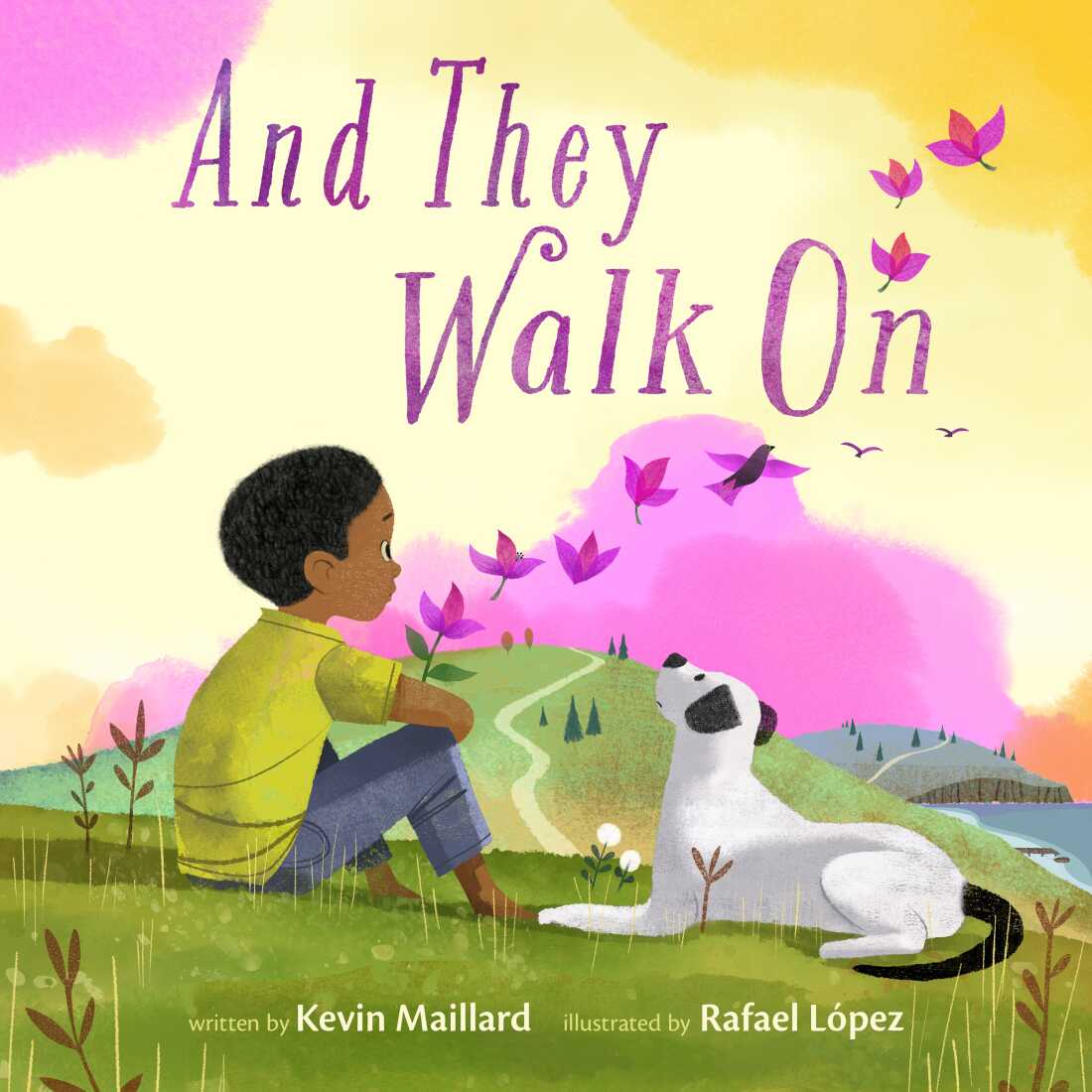
Maillard found it confusing, so he decided to write about it. His new children’s book is And They Walk On, about a little boy whose grandma has died. “When someone walks on, where do they go?” The little boy wonders. “Did they go to the market to thump green melons and sail shopping carts in the sea of aisles? Perhaps they’re in the garden watering a jungle of herbs or turning saplings into great sequoias.”

Rafael López / Roaring Brook Press
Maillard grew up in Oklahoma. His mother was an enrolled member of the Seminole Nation. He says many people in native communities use the phrase “walked on” when someone dies. It’s a different way of thinking about death. “It’s still sad,” Maillard says, “but then you can also see their continuing influence on everything you do, even when they’re not around.”
Rafael López / Roaring Brook Press
And They Walk On was illustrated by Mexican artist Rafael López, who connected to the story on a cultural and personal level. “‘Walking on’ reminds me so much of the Day of the Dead,” says López, who lost his dad 35 years ago. “My mom continues to celebrate my dad. We talk about something funny that he said. We play his favorite music. So he walks with us every day, wherever we go.”
It was López who decided that the story would be about a little boy: a young Kevin Maillard. “I thought, we need to have Kevin because, you know, he’s pretty darn cute,” he explains. López began the illustrations with pencil sketches and worked digitally, but he created all of the textures by hand. “I use acrylics and I use watercolors and I use ink. And then I distressed the textures with rags and rollers and, you know, dried out brushes,” he says. “I look for the harshest brush that I neglected to clean, and I decide this is going to be the perfect tool to create this rock.”
The illustrations at the beginning of the story are very muted, with neutral colors. Then, as the little boy starts to remember his grandmother, the colors become brighter and more vivid, with lots of purples and lavender. “In Mexico we celebrate things very much with color,” López explains, “whether you’re eating very colorful food or you’re buying a very colorful dress or you go to the market, the color explodes in your face. So I think we use color a lot to express our emotions.”

Rafael López / Roaring Brook Press
On one page, the little boy and his parents are packing up the grandmother’s house. The scene is very earthy and green-toned except for grandma’s brightly-colored apron, hanging on a hook in the kitchen. “I want people to start noticing those things,” says López, “to really think about what color means and where he is finding this connection with grandma.”
Kevin Maillard says when he first got the book in the mail, he couldn’t open it for two months. “I couldn’t look at it,” he says, voice breaking. What surprised him, he said, was how much warmth Raphael López’s illustrations brought to the subject of death. “He’s very magical realist in his illustrations,” explains Maillard. And the illustrations, if not exactly joyful, are fanciful and almost playful. And they offer hope. “There’s this promise that these people, they don’t go away,” says Maillard. “They’re still with us… and we can see that their lives had meaning because they touched another person.”

Rafael López / Roaring Brook Press

Fortune Tech: The sheer scale | Fortune

Dallas’ 12 most popular food and restaurant stories in 2025

6 Boston writers share their go-to bars, cafes and restaurants

Win over Broncos should allow Jaguars to think about ‘super’ heights

Rick Steves steps in to save Seattle-area hygiene center serving homeless residents

Florida High School Football Rankings: Top 25 teams – Oct. 21

Cleary's 21 help Le Moyne down Central Connecticut State 69-64 in OT

How old is Bo Nix? What to know about Oregon quarterback ahead of 2024 NFL Draft

99th annual Pony Swim held in Virginia

Video: ‘It Didn’t Have to Happen This Way:’ U.Va. Faculty Call for Review of Police Response to Protests

DHS responds after reports CISA chief allegedly failed polygraph for classified intel access

EU plans to raise €90 billion in joint debt for Ukraine — here’s how

Lawmakers threaten Attorney General Bondi with contempt over incomplete Epstein files

DNI Gabbard warns ‘Islamist ideology’ threatens Western freedom at AmFest

Algeria bill seeks to criminalise French colonial rule: What to know
-

 Iowa1 week ago
Addy Brown motivated to step up in Audi Crooks’ absence vs. UNI
-

 Iowa1 week ago
How much snow did Iowa get? See Iowa’s latest snowfall totals
-

 Maine6 days ago
Elementary-aged student killed in school bus crash in southern Maine
-

 Maryland1 week ago
Frigid temperatures to start the week in Maryland
-

 South Dakota1 week ago
Nature: Snow in South Dakota
-

 New Mexico5 days ago
Family clarifies why they believe missing New Mexico man is dead
-

 Detroit, MI7 days ago
‘Love being a pedo’: Metro Detroit doctor, attorney, therapist accused in web of child porn chats
-

 Education1 week ago
Opinion | America’s Military Needs a Culture Shift