Lifestyle
What is a 'flexologist' — and do you need to see one?

The signs seemed to be proliferating around Los Angeles — along Sunset Boulevard in Echo Park, in mini-malls on Pacific Coast Highway, on side streets in Glendale and Venice: StretchLab, Stretch Zone, StretchSPOT, StretchMed.
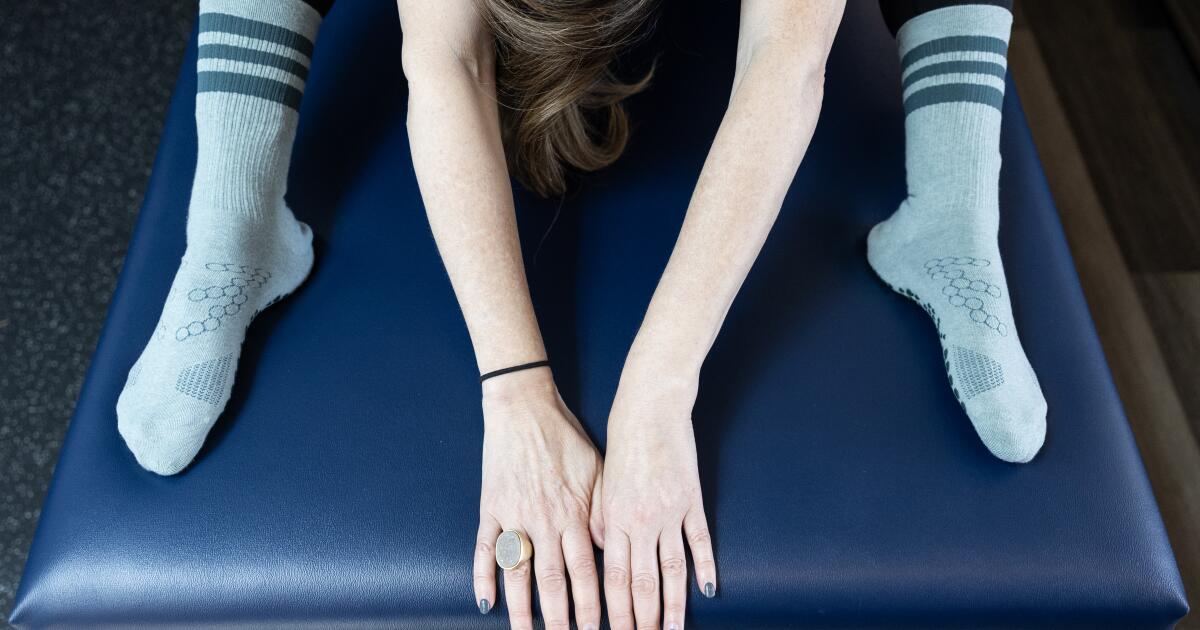
Deborah Vankin’s 50-minute stretch session included 13 stretches on either side of her body.
(Luke Johnson / Los Angeles Times)
I’d been curious about assisted stretching for a while. But I never thought to visit a studio. Sure, “recovery” is a growing trend in fitness — meaning rejuvenating muscles, tendons and the central nervous system between exercise sessions by focusing on hydration, proper nutrition, sleep and, yes, active stretching so as to maximize athletic performance. But I own three foam rollers — one smooth, one spiky, one padded — and even use them at home. I’m also far from an extreme athlete, preferring instead brisk hikes for cardio and basic strength training.
Why would I drive to a mini-mall and pay someone to stretch me? What would that even look like — and was it worth it?
The questions rumbled in my head as I drove past yet another StretchLab recently — this one on Beverly Boulevard near Hollywood. So I called them up.
StretchLab has 15 locations in the L.A. area, including in Echo Park.
(Luke Johnson / Los Angeles Times)
Turns out StretchLab, which opened its first studio in Venice in 2015, now has more than 500 studios nationwide, 15 of them in the L.A. area. Its clientele are generally either serious athletes, older adults and desk workers who struggle with stiffness and want to work on their mobility, or those healing injuries and other conditions. They come to be stretched out more deeply, in positions they couldn’t possibly get into, physically, on their own. Many of them appreciate the intimacy and accountability of working with a practitioner, one-on-one. And it can be helpful to have a professional, with a trained eye, isolate asymmetries in their bodies and guide their stretching, especially for those who suffer from chronic pain or are healing an injury, says StretchLab‘s director of marketing, Gabi Khowploum.
“We see a lot of people who say, ‘Hey, I’m having back pain,’” Khowploum says. “And they come to stretch it, but it might be they’re having issues with hip mobility — they just don’t realize it.”
Stretch therapists — or “flexologists,” as they’re sometimes called — are not doctors. Chiropractors, physical therapists and some massage therapists are trained in assisted stretching — but stretch therapists can’t do what they do. Stretch therapists don’t diagnose and treat injuries; they don’t provide spinal or joint manipulation, imaging such as X-rays or CT scans or massage. They focus, instead, on stretching muscles and fascia to increase flexibility and mobility. There also isn’t a national certification for stretch therapists, as there is for physical therapists and chiropractors, though most stretch therapists are certified in-house by their respective employers.
Dr. Jeremy Swisher, a sports medicine physician at UCLA Health, says assisted stretching can help increase range of motion and flexibility, stimulate blood flow, which aids healing, and help with posture, particularly for sedentary populations, as well as alleviate stress. Done consistently, long term, it can help with pain relief and stiffness and — possibly — prevent injuries. But it’s “not a cure-all,” he warns.
“It’s just a piece of the puzzle,” he says. “Strength training and other forms of exercise are equally as important, long term.” Swisher also warns that assisted stretching could exacerbate existing injuries “like an acute sprain or tear without being cleared by a doctor first.” And for those with hypermobility syndromes, meaning overly flexible joints, “it’s important to be mindful that increased stretching could lead to dislocations of the joints.”
On a recent Friday afternoon, StretchLab in Echo Park was busier than I would have expected. Several clients laid on their backs on what looked like massage tables as their flexologists rolled or twisted or pressed on their body parts — a limb over the shoulder here, a spinal twist there.
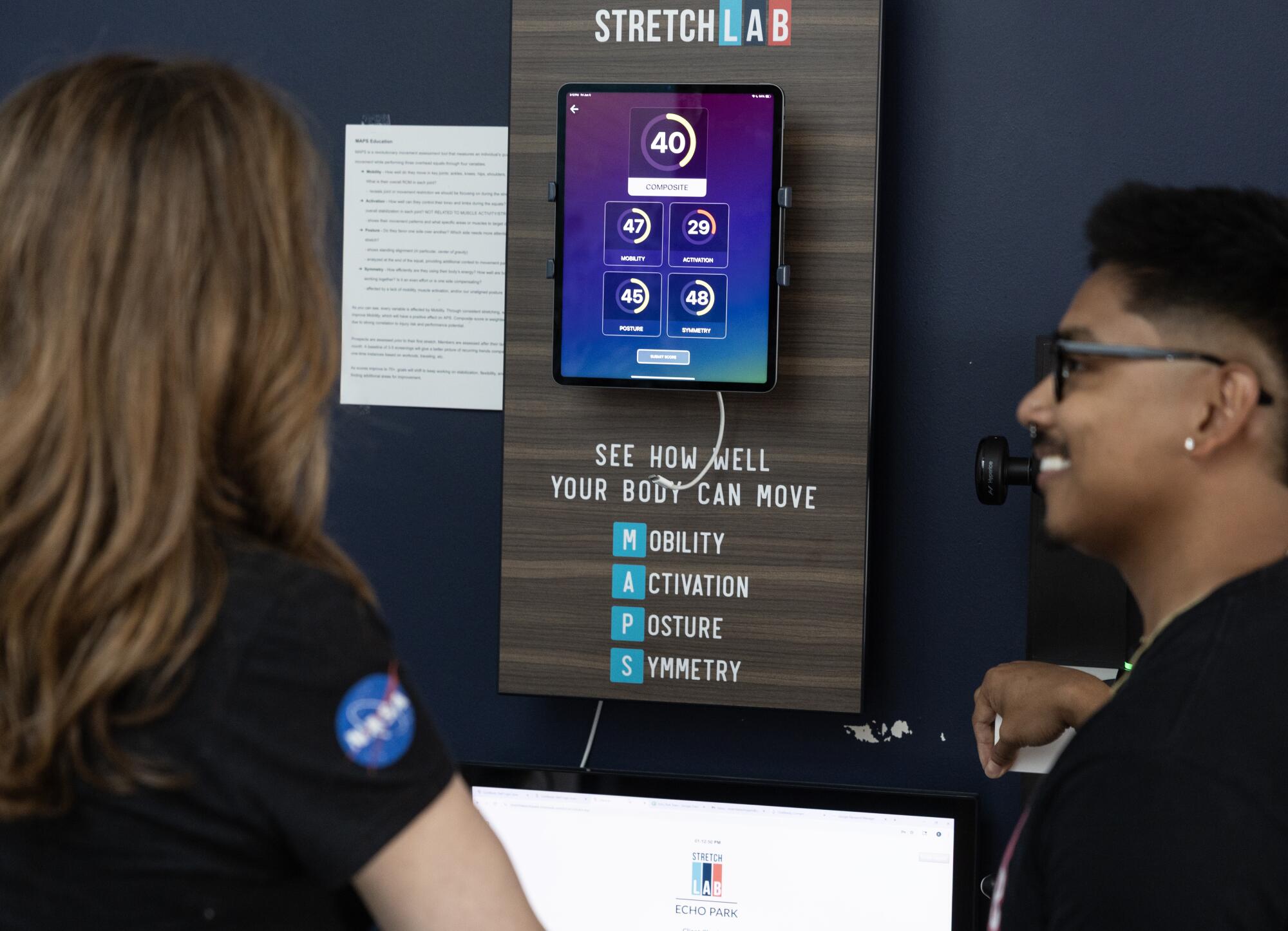
Flexologist Joel Badilla walks Deborah Vankin through the MAPS assessment process.
(Luke Johnson / Los Angeles Times)
My practitioner, Joel Badilla, walked me through the assessment before my 50-minute session (as a “drop in,” it cost me $125, but prices differ depending on the package and location). StretchLab uses a 3-D body scanning tool called MAPS, which TRX Training developed for them. It assesses mobility (range of motion), activation (quality of movement), posture and symmetry so as to isolate areas that are tight or imbalanced and customize a stretch program for the client. I did three overhead squats in front of an iPad before MAPS gave me a score in each area. (Scores far lower than I would have liked, the culprits being tight hips and “tech neck,” but such is the case with desk workers, I was told.)
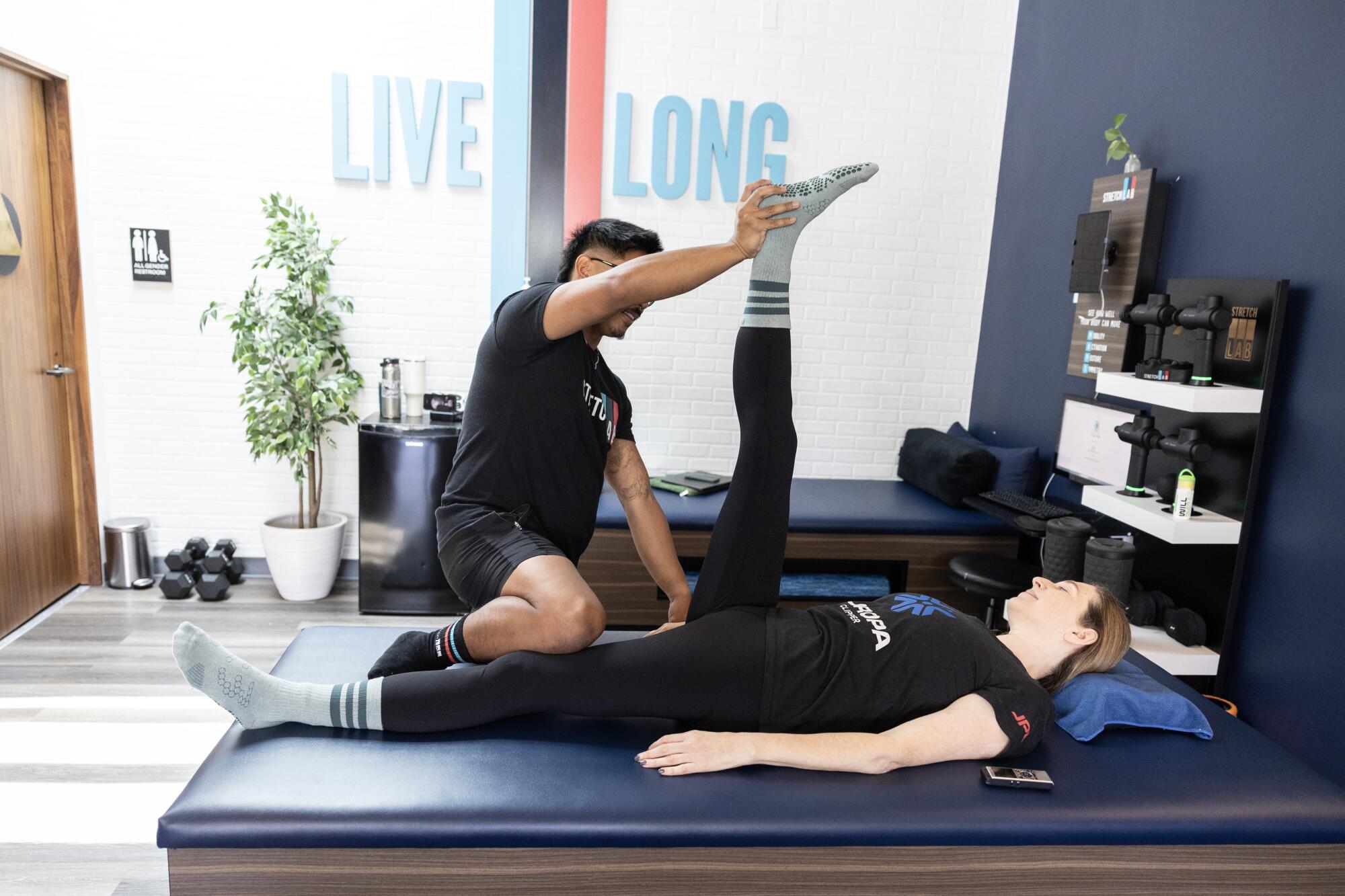
Then I laid down on the table and Badilla lifted my legs and gently pulled them forward, toward him. It felt wonderful, as if my spine were elongating, all the stress draining from my back. He then put me through 26 stretches, 13 on each side of my body.

Joel Badilla tugs gently on Deborah Vankin’s legs at the start of her stretch session.
(Luke Johnson / Los Angeles Times)
StretchLab uses PNF stretching (proprioceptive neuromuscular facilitation), Badilla explained, which is a “push and release” technique. The recipient holds the stretch for a set period of time, then pushes into resistance provided by the practitioner for a shorter period of time, then goes back into a deeper version of the stretch. We did this repeatedly for different body parts.
Afterward, I felt loose and limber heading back to my car — though the sensation didn’t last for very long after my car ride home. That’s because the benefits of stretching come from consistency, says Amber Donaldson, vice president of Sports Medicine Clinics for the United States Olympic & Paralympic Committee.
“Just stretching once isn’t beneficial,” she says. “You need two weeks, minimum, of consistency to see a benefit. These [assisted stretching] places — paying for a series of treatments may keep you consistent with going.”
That said, there are questions around the benefits of stretching, overall, in the sports medicine community, Donaldson adds. “It’s controversial. When should you do it — before or after a workout — and to what extent is it beneficial at all? The jury is still out.”
Assisted stretching, if done consistently over many weeks, may help with stiffness, pain relief and even injury prevention.
(Luke Johnson / Los Angeles Times)
StretchLab is far from an anomaly in L.A. There are more than half a dozen dedicated assisted stretching businesses in the area — and the trend, which began to swell nationwide in 2017-18, only seems to be growing. In addition to franchises like StretchLab and Stretch Zone, many personal trainers offer assisted stretching, as do most physical therapists. Gyms such as Life Time in Orange County and the Los Angeles Athletic Club offer one-on-one assisted stretching now. Even certain massage outlets, such as Massage Envy, offer 30 and 60-minute assisted stretching sessions.
The basic concept of assisted stretching is the same, no matter where you go, but different studios take slightly different approaches.
Stretch Zone in Redondo Beach and Rancho Palos Verdes doesn’t use the PNF technique. Instead, the studio (which has almost 400 outlets nationwide) uses a graduated stretch modality that moves the client along an intensity scale of one-10. It starts at a three “right when you first start to feel the stretch,” owner Deborah Ashley says, “and seven is where you want us to stop.” They also use a patented system of belts and straps on a stretch table “to secure and mobilize one side of your body while we stretch the other,” Ashley says. “It acts like a second set of hands for our practitioners.”
StretchMed in Glendale has only one location in the L.A. area (there are about 30 in the U.S.). It prides itself on not being part of an especially big franchise, says owner Carlos Rivera, adding that the studio takes a personal and data-driven approach to stretch therapy. It does use the PNF stretching technique but puts a good deal of emphasis on warming up before one-on-one stretch sessions. Toward that end, clients do 15-minute warm-up routines on so-called “stretch trainers,” which have tilted seats, leg pads and safety straps for stability. A video walks them through the routine, which includes gentle movement and is meant to stimulate circulation. “You want to warm up before you stretch,” Rivera says, “to get a much better benefit.”
Would I do assisted stretching again?
Absolutely — it was gentler than I imagined and I felt immediate relief afterward, particularly in my lower back.
Would I do it regularly?
Not for StretchLab’s membership rate of $320 a month, their cheapest monthly package of four 50-minute sessions (prices vary slightly by location). At Stretch Zone, the roughly comparable package of four 60-minute sessions is $400. At StretchMed, four 55-minute sessions is $216.
But on this particular Friday, at least, I headed into the weekend feeling looser and, if nothing else, an inch or so taller. I’ll take it.


Lifestyle
L.A. Affairs: It’s hot when a man drives to me. But would this new guy make the trek from the Valley?

I met Dan on Hinge.
He lives in Woodland Hills, and I live in Venice. In Los Angeles, this is considered a long-distance relationship. In another city it might be nothing. Here, it’s a factor.
But I believe that with the right person, you can make anything work, so I stay open. I’m a native New Yorker, and if I were living in Brooklyn and a guy lived on the Upper West Side, that would be a 45-minute subway ride, which is truly nothing in New York. So with that same logic, I try to have flexibility with men in L.A.
When we started planning our first date, Dan suggested three options: a hike on mushrooms, a wine tasting or a walk on the beach.
A hike on mushrooms is something I’d only do with someone I already trust, not someone I just met online. I don’t do first-date hikes because I don’t like feeling trapped if the guy’s a dud. So I chose the wine tasting.
Then I learned the wine tasting was in West Hills.
On a Friday night, driving there from Venice would be insane. So I said I didn’t want to meet there because of the traffic. He suggested Malibu. That was also not ideal on a Friday.
I was getting annoyed — this was a pink flag because in my dating world, the guy is supposed to come to the woman’s neighborhood in the early days. I’ve gone out with plenty of men from the Valley who effortlessly suggested they come to me. It’s not rare or impossible.
I suggested he come to the Westside. I didn’t specifically say Venice, and in hindsight, I probably should have. He landed on Brentwood, which was manageable for both of us. On our first date, we met at an Irish pub on Wilshire Boulevard. He was cuter and more interesting than I had expected, and with the Guinness flowing, we had fun.
When I got home, he texted me: “Well, I like you 🙂 Less the tik tok and the lack of rock music in your life, but it’s not a deal breaker — there are other qualities 🙂 What are your thoughts?”
I noticed the slight negativity but was mostly dazzled that a man texted immediately after the date to say he liked me. In the modern dating economy, this felt rare.
The next day, both of our evening plans fell through, so we made a last-minute date. The wine tasting he originally suggested still sounded like fun, and although it meant me driving to the Valley, I was up for it now that we’d met.
We sipped flights at Malibu Wines & Beer Garden in its airy, romantic courtyard and played a flirty version of Truth or Dare. Halfway through, he dared me to kiss him.
We ended with sushi on Ventura Boulevard and a short make-out session in his car. He invited me to Thanksgiving at his uncle’s, which felt too soon, but also sweet.
After the second date, he texted and said he had his kids that week and was also hosting an event on Thursday, so his only day to meet was Wednesday. I said great.
On Tuesday night, he checked if we were still on, and I said yes.
Then he texted: “I’m flexible on time but not on location. I have a big event on Thursday, hopefully you can come to me again.”
My stomach tightened. This again?
So I texted back: “I drove to you last time, which was a bit of an exception for me especially in the early days, but the wine tasting location sounded special. Usually guys come to my area. How about we switch it up this time?”
He replied: “I appreciate the effort! Because of my event, I’d rather be close to a computer just if needed … Here is what i offer:
— I’ll come to your area anytime next week/end
— Lunch/dinner on me
I want to continue where we stopped last time 😉 No pressure of course, but let’s snuggle”
I responded: “Ok let’s meet next week. Snuggles sound nice … let’s see what happens …”
Then he wrote: “So I won’t see you tomorrow?”
I replied: “Unless you wanna come to me and bring your laptop along, let’s rain check until you have more flexibility.”
He said: “Dang, you are hard. I’ll let you know tomorrow around midday if it’s ok.”
And then — surprise — he decided to come.
He drove to Venice for a 5 p.m. date. He said his ETA was 5 p.m., and it ended up being 5:25 p.m., typical 405 Freeway.
When he showed up, he was in a cranky mood. On our way to KazuNori in Marina del Rey, I thanked him for picking me up and told him I think it’s hot when the guy comes to the girl.
“You’re just saying that because you want me to come to you more,” he said, not playfully, but aggressively.
That was basically the end for me. But there I was, in his car, heading to dinner. So I stayed pleasant and tried to make the best of it.
I shared that in the early stages of dating, I find it’s good etiquette for the guy to come to the woman’s neighborhood. He immediately disagreed and started ranting about how dating rules are ridiculous and how they swing in women’s favor. He resented paying for dates and declared he wasn’t looking to “sponsor a woman’s life.”
“If women want equality and equal rights,” he said, “then it should apply all across the board, including dating, and the man shouldn’t have to pay.”
I said women don’t actually have equal rights because we get paid less than men and often receive lower salaries than men in the same position.
I tried to change the subject and reset the mood, but he insisted we keep hashing it out.
I tried to explain masculine/feminine dynamics: providing and protecting, giving and receiving.
“What does the man get out of this arrangement?” he asked.
It was like watching someone’s personality warp into Mr. Hyde. Then he brought up another point: He’s a single dad of two kids, so he gets tired; and because I don’t have kids, that should factor into who drives where.
At this point, I was barely engaging and focused on eating my hand rolls, and I couldn’t wait to get home.
The check came, and I happily split it, wanting nothing further from him.
In the car back to my place, he remarked: “It’s obvious we’re never gonna see each other again.”
Obvious, but did it need to be stated?
Then he showed me a Spotify playlist he’d made for me of his favorite electronic music, because he knows I like EDM.
“Oh, that’s sweet,” I said.
“Yeah, that’s how I show interest. Through things like this, not who drives to who,” he replied.
When I got out of the car, we wished each other luck, and I headed inside and shut the door.
Two hours later, he sent me the playlist. I’ve yet to listen to it.
It wasn’t the distance that ruined it. It was the resentment. I’m not looking for a man who feels burdened by the effort. I’m looking for a man who sees the value of courting a woman in the first place.
The author is a writer, comedian and former psychologist who lives in Venice. She is the creator of the new vertical series “Manfari.” She’s on Instagram: @solange_neue and @manfari.show.
L.A. Affairs chronicles the search for romantic love in all its glorious expressions in the L.A. area, and we want to hear your true story. We pay $400 for a published essay. Email LAAffairs@latimes.com. You can find submission guidelines here. You can find past columns here.

Lonnie Bunch III is the 14th Secretary of the Smithsonian. He’s pictured above in September 2017.
J. Scott Applewhite/AP
hide caption
toggle caption
J. Scott Applewhite/AP
In a memo addressed to staffers sent Tuesday, the secretary of the Smithsonian, Lonnie G. Bunch III, defended the institution after the White House issued a 162-page report that characterizes the National Museum of American History as a place which has become “subject to institutional capture by a radical, activist ideology that is fundamentally opposed to telling the noble, honest story of the great country we know and love.”
In his email, which NPR has obtained, Bunch wrote in part: “While there will always be room for improvement, this report is not a fair characterization of the work and totality of the National Museum of American History. At the Smithsonian, our work is driven by scholarship, accuracy and an uncompromising commitment to tell the fullness of America’s story. As public servants and the keepers of this institution, we are charged with helping a nation find understanding, hope and clarity and as part of that duty, we are dedicated to excellence, reflection and growth.”

He continued: “We remain focused on what grounds us: a steadfast commitment to scholarship, nonpartisanship, independence, accuracy and integrity. For nearly 180 years, the Smithsonian has worked alongside partners across government — from the White House to Congress to our governing Board of Regents — guided by our enduring mission to increase and diffuse knowledge. That purpose remains: to pursue knowledge with rigor and to serve the American public with clarity and care.”
The White House report was issued on July 4 by the Domestic Policy Council under the title “Saving America’s Story: How Ideological Capture at the Smithsonian Institution’s National Museum of American History Erases Our Heritage.”

The council faults the National Museum of American History on a multitude of fronts, saying it underemphasized the Founding Fathers and early colonial and Revolutionary history; was not sufficiently celebratory of the country’s 250th anniversary; and that it engaged in “anti-white,” “illegal alien” and transgender activism.
It also accuses the museum of trying to “indoctrinate” teachers and students through its exhibitions, programming and teaching resources.
In the report, the council also specifically criticizes museum director Anthea Hartig, who has led the National Museum of American History since 2019 and is concurrently the president of the Organization of American Historians, calling her “an activist advancing an ideological agenda contradictory to the museum’s founding purpose of fostering patriotism.”

The Trump administration has made the Smithsonian museums one of its primary targets in its efforts to reshape cultural narratives to align with its viewpoints. In August 2025, the White House requested a “comprehensive internal review” of eight Smithsonian museums, including the National Museum of American History, following an executive order issued by President Trump in March 2025 in which he called for the removal of “improper ideology” from the Smithsonian’s offerings.
According to the Smithsonian’s charter, all of its 21 museums, 14 education and research centers, and the National Zoo are meant to be run independently of the federal government. The Smithsonian is overseen by Bunch and a board of regents, which includes Vice President Vance, Supreme Court Chief Justice John Roberts and other members appointed by Congress.
In an interview with NBC’s Meet the Press on Sunday, Bunch spoke about the Smithsonian’s 250th anniversary special exhibition at the Smithsonian Castle, which is called “American Aspirations.”
He told NBC: “It’s really important for people to understand that America is much an ideal as it is a place, that it’s a series of aspirations that have really shaped who this country is. And so for me, what is so powerful is to say, ‘Let us honor the words of Thomas Jefferson and the founders, but let us use those to challenge us to be better.’”
Jennifer Vanasco edited this story.

-
Lifestyle4 minutes ago
‘The Invite’ is a marriage comedy with sex and heart
-

 Technology16 minutes ago
I spent a week using the Trump phone — it sucks
-

 World19 minutes ago
With US unleashing attacks, Iranian official threatens that the Islamic Republic will deliver a ‘hard slap’
-

 Politics24 minutes ago
WATCH: Trump’s Energy chief reveals what escalating Iran tensions could mean for gas prices
-

 Health31 minutes ago
Coffee may have powerful effect on liver health, major study suggests
-

 Sports34 minutes ago
Oba Femi vs Brock Lesnar at SummerSlam is a ‘generational matchup,’ WWE legend JBL says
-
 Business46 minutes ago
Billionaire exodus? California drew 10 times more venture capital than any other state this year
-
 Entertainment49 minutes ago
Disney Channel maximalism to pop-star glam: What fans wore to Hilary Duff’s L.A. show

