Lifestyle
Weed changed this California town. Now artsy residents are all in on psychedelics

On a brisk mid-March night in the small Northern California town of Grass Valley, more than 100 people crowded around a Grateful Dead cover band in a drafty warehouse. They were an eccentric mix: aging hippies, hypebeast college kids and burners bundled in faux fur rainbow coats, swaying to guitar riffs. In the parking lot, people exchanged cigarettes, joints, pills and powders.
Scenes from a night at the Chambers Project, an art gallery curated by Brian Chambers in Grass Valley, California.
(Colin M. Day)
This is a typical night at the warehouse — home to an art gallery called the Chambers Project and a new nonprofit, Psychedelic Arts and Culture Trust (PACT). It sits just off State Route 49 and shares its parking lot with a natural foods store. From the road, it can be identified only from its logo: an illuminati eye nestled into a pyramid, which sheds a tear into a river that vanishes into the horizon. The image was drawn by one of the most famous psychedelic artists, Rick Griffin, who created seven album covers for the Grateful Dead.
The logo was a taste of what awaited inside. Almost every corner of the warehouse was covered in trippy art. From the ceiling hung a twisted glass chandelier by Eric Dunn, its spiked lampshades mimicking the tendrils of a brain’s dendrites. On the walls were dozens of otherworldly paintings by Mario Martinez (a.k.a. MARS-1), who renders amorphous architecture straight out of science fiction. Behind the musicians, sculptures of bright pink disembodied legs and a matching pink unicorn in medieval armor add trippy ambience. Outside, projected onto the facade, was a kaleidoscopic video that overlaid cartoonish eyes, lightning bolts and sacred geometry.
Brian Chambers, founder and curator of the gallery, is the face of this event. The concert was part of the opening reception for his gallery’s new exhibition, “The Godfathers” — which showcases four artists who defined the art movement — and also the launch party for PACT, which he hopes will be a a community hub for the psychedelic-curious, whether that pertains to art, experimenting with substances, or educational programming about the two.
A recent PACT event included a benefit concert to raise money for a local marijuana farmer known as Uncle Jay, who’s battling cancer. This month, an exhibition of peyote paintings will donate proceeds to the Wixárika tribe of northwestern Mexico, California, Arizona and Texas — Indigenous people whose shamans famously guide people through spiritual peyote ceremonies.
They are also planning talks about major moments within psychedelic art history, a deep dive of blotter art, and a panel on magic mushrooms and their scientific properties.
“We have a community of care,” said Marci Hovanski, 48, who works at the natural foods store next door. “Brian’s bringing something so special, and it really just raises the whole frequency of the neighborhood.”
Mary Barry, 74, and her husband Jesus Ceballos, 72, have been attending Chambers’ art openings for years. Like many residents in Nevada County, where the biggest cash crop is marijuana, they moved to the quiet town 51 years ago to work on a friend’s weed farm and never left.
Ceballos wears a tangle of walrus beads over his tie-dye Grateful Dead T-shirt. He and Barry came tonight because they wanted to see the artwork and hear the Grateful Dead cover band. They’ve seen the original group play at least 50 shows, often timing the moment they dropped acid so they peaked at the song “Greensleeves.”
“If you’ve ever done psychedelics you feel comfortable in this environment. People recognize each other and they feel safe.”
— Marci Hovanski, Chambers Project patron
Grateful Dead shows were places for them to experiment with drugs, and Ceballos compares the Chambers Project to that environment. “The vibe here is very, very good,” he said.
In this way, Chambers’ nonprofit functions as a third space for the local community, especially those who dabble in psychedelics — substances like psilocybin (magic mushrooms), peyote, ayahuasca, DMT, LSD, ketamine and MDMA — that affect the mind and often cause hallucinations. Whether someone’s smoking weed to make art-viewing more pleasurable, dropping acid to enhance a concert experience, or dosing magic mushrooms to go on a path of self-discovery, Hovanski said the Chambers Project provides a nonjudgmental setting to do that.
“If you’ve ever done psychedelics, you feel comfortable in this environment,” Hovanski said. “People recognize each other and they feel safe.”
Even so, she said visiting the gallery is thrilling while sober too. “People can just go there and be themselves. It’s kind of magic. … It’s opened up a space that holds the rainbow. It’s like the end of the rainbow.”
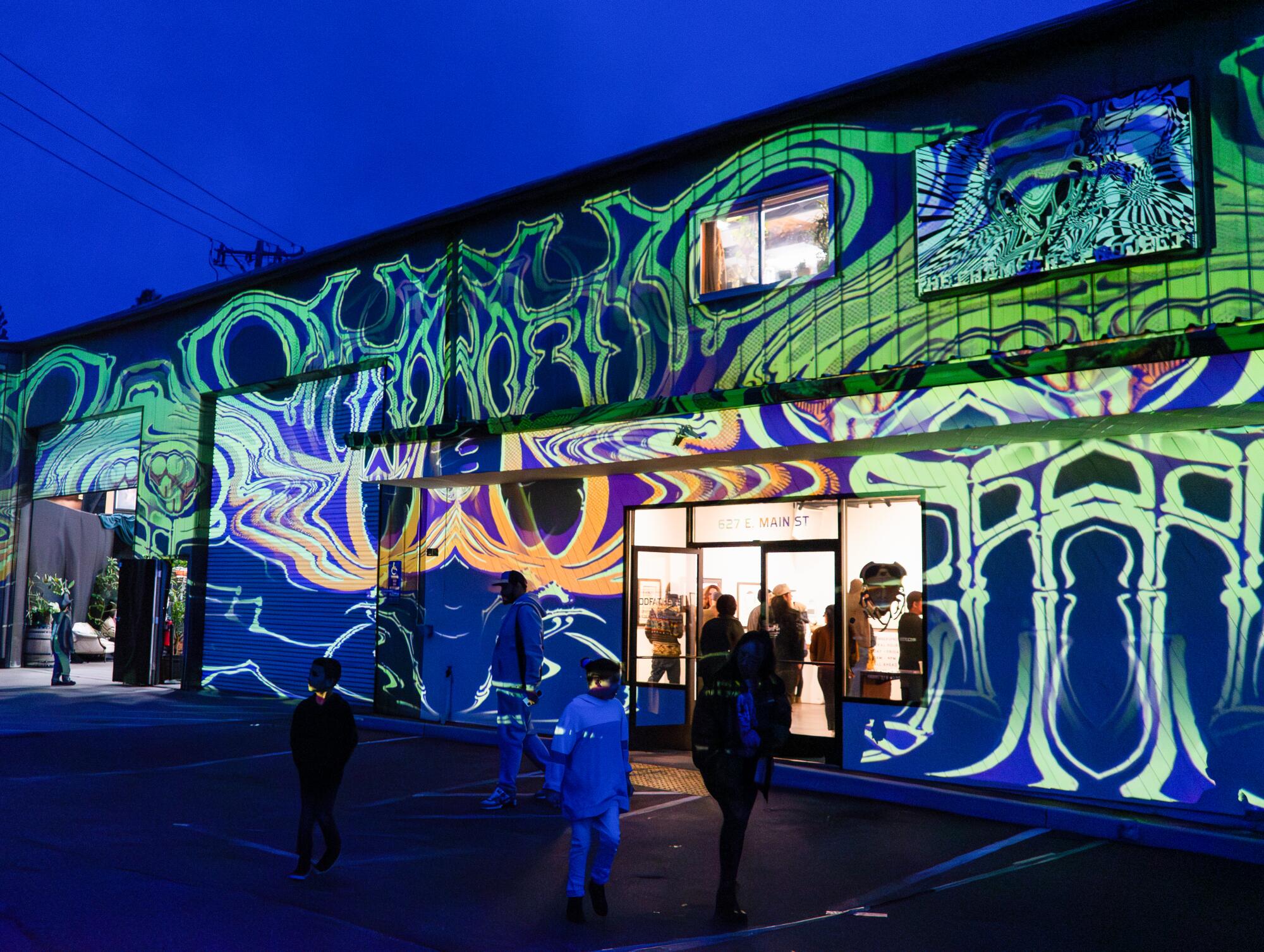
The Chambers Project warehouse sits just off State Route 49 and is home to an art gallery and a new nonprofit, Psychedelic Arts and Culture Trust (PACT).
(Colin M. Day)
Life after weed farms
After California legalized recreational marijuana in 2016, Grass Valley’s economy entered a recession. Many independent farmers couldn’t meet the regulation requirements for legal operation and shut down. Psychedelic culture, however, might be the ticket to Grass Valley’s recovery; through Chambers’ magnetism, more artists have been taking trips to this rural town on the Yuba River.
“Tourism is like the only thing we’ve got going,” Hovanski said. “Brian opened a light, a place for people to see love or care. That just opens the space for more creativity, more greatness.”
Before trekking to Grass Valley, I first met Chambers over Zoom in February. The 44-year-old gallerist has a long, gray beard. The day we spoke he wore a baseball cap embroidered with the illuminati eye from the Chambers Project logo. In the background was a large, red swirling canvas by MARS-1, a young artist whom Chambers has mentored. Positioned behind Chambers, it made him glow like a martian.
“This is a moment that I’ve been anticipating and waiting for,” he said.
He was referring to a cultural shift surrounding psychedelics. Many cities across the nation have decriminalized possession and in Oregon and Colorado, voters passed ballots that allowed for state-regulated psilocybin medical centers. Oregon opened its first psilocybin clinic in 2023, and so-called healing centers are slated to arrive in Colorado in 2025.
“This is a moment that I’ve been anticipating and waiting for.”
— Brian Chambers, founder of the Chambers Project and the nonprofit Psychedelic Arts and Culture Trust (PACT)
In the meantime, cities are advocating for psychedelics use on the local level. In the last five years, possession of magic mushrooms has been decriminalized to varying degrees in cities across California, including Oakland, Santa Cruz, Arcata, San Francisco, Berkeley and Eureka.
Last October, Gov. Gavin Newsom vetoed a state-wide bill that would have decriminalized various psychedelics. Legislators, in step with public opinion, have nevertheless continued their push to grant wider access to the substances. State Sen. Scott Wiener (D-San Francisco) introduced a plan in February that would legalize psychedelic-assisted psychotherapy.
Beyond the medical industry, psychedelic aesthetics are jumping from counterculture into the mainstream: There are now black light-lit bars that specialize in kava, a root plant that can produce low-level psychoactive effects; immersive art chains like Meow Wolf, which sells chromadepth glasses that mimic a trip by producing prismatic halos around lights; and even a brand new shroom festival in Denver, which will have mushroom grow kits for sale.
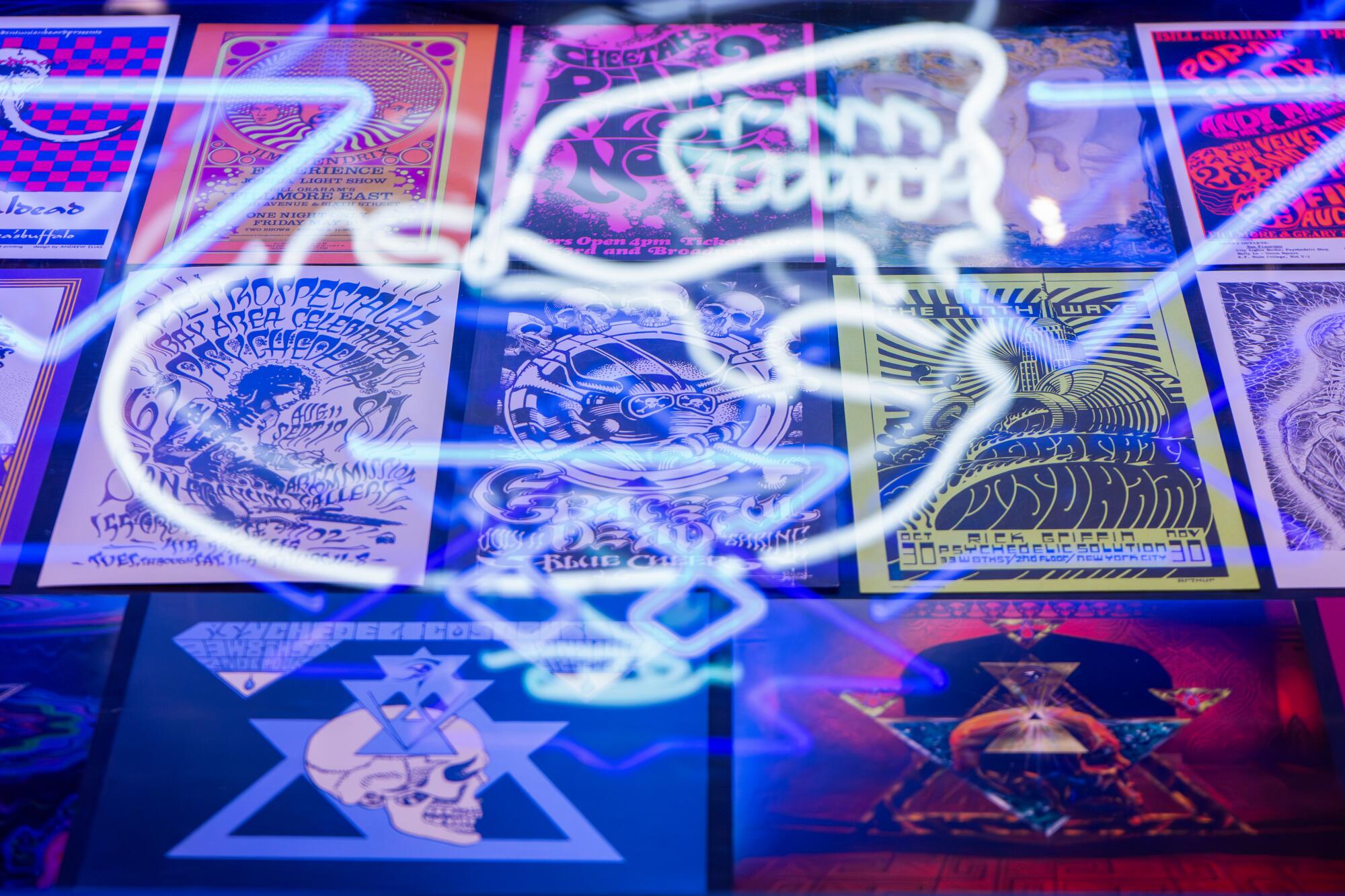
Artwork featured at the Chambers Project’s “Godfathers” exhibition.
(Colin M. Day)
A looming shift
Due to recent studies, including an FDA-backed statement that “psychedelic drugs show initial promise as potential treatments for mood, anxiety and substance use disorders,” the substances may be on the precipice of legalization in California and across the United States.
“Psychedelics are remarkable for their potential to elicit non-ordinary states of consciousness and ability to facilitate healing through experiences of profound transpersonal and mystical states,” said Barbara Chandler, a therapist and ketamine-assisted psychotherapist based in Truckee.
“These experiences can expand one’s sense of self and deepen one’s understanding of existence and connectedness,” she said.
Chambers sees the timing of PACT’s launch as a chance to take advantage of this shift. He wants the organization to be a resource for the new generation of people discovering these substances.
“People that are exploring it and getting into that side of life are doing it with an intention,” Chambers said. “They’re trying to use them as tools to get through it. I see enormous value in that, and I think it’s a beautiful thing.”
Chambers is alluding to the fact that recent research has shown that psychedelic-assisted therapy — when drugs are combined with psychotherapy or talk-therapy — can treat PTSD, depression and chronic pain. It’s possible this has helped destigmatize the drugs. A recent poll out of UC Berkeley shows that 61% of registered voters across America support regulated use of psychedelic-assisted psychotherapy.
Currently the federal government classifies all psychedelics as Schedule I controlled substances, meaning they have “no currently accepted medical use and a high potential for abuse.” But there are signs the FDA is getting closer to downgrading that status for psilocybin, LSD and MDMA. Compass Pathways and the Multidisciplinary Assn. for Psychedelic Studies (MAPS) are among organizations that have entered phase III clinical trials with psilocybin and MDMA therapies. Experts say that’s the final hoop to clear before federal agencies acknowledge a drug’s medical potential and clear it for FDA-approved programs.
In June 2023, the FDA issued its first draft guidance for conducting psychedelic research. That will help scientists design studies that can lead to the drugs being approved for the market.
“The move by the FDA has researchers, advocates for veterans and others hopeful for the development of better medication for frequently diagnosed disorders,” Eric Licas reported for The Times in 2023.
Medical providers have already used legal loopholes to get certain illegal substances to patients. Ketamine, for example, is FDA-approved for anesthetic use, which allows clinics to obtain it. They can then turn around and administer it off-label, meaning they can use it for an unapproved treatment, which is legal so long as “it is based in sound medical evidence.” This workaround has helped roughly 500 to 750 ketamine clinics pop up around the country since 2020.
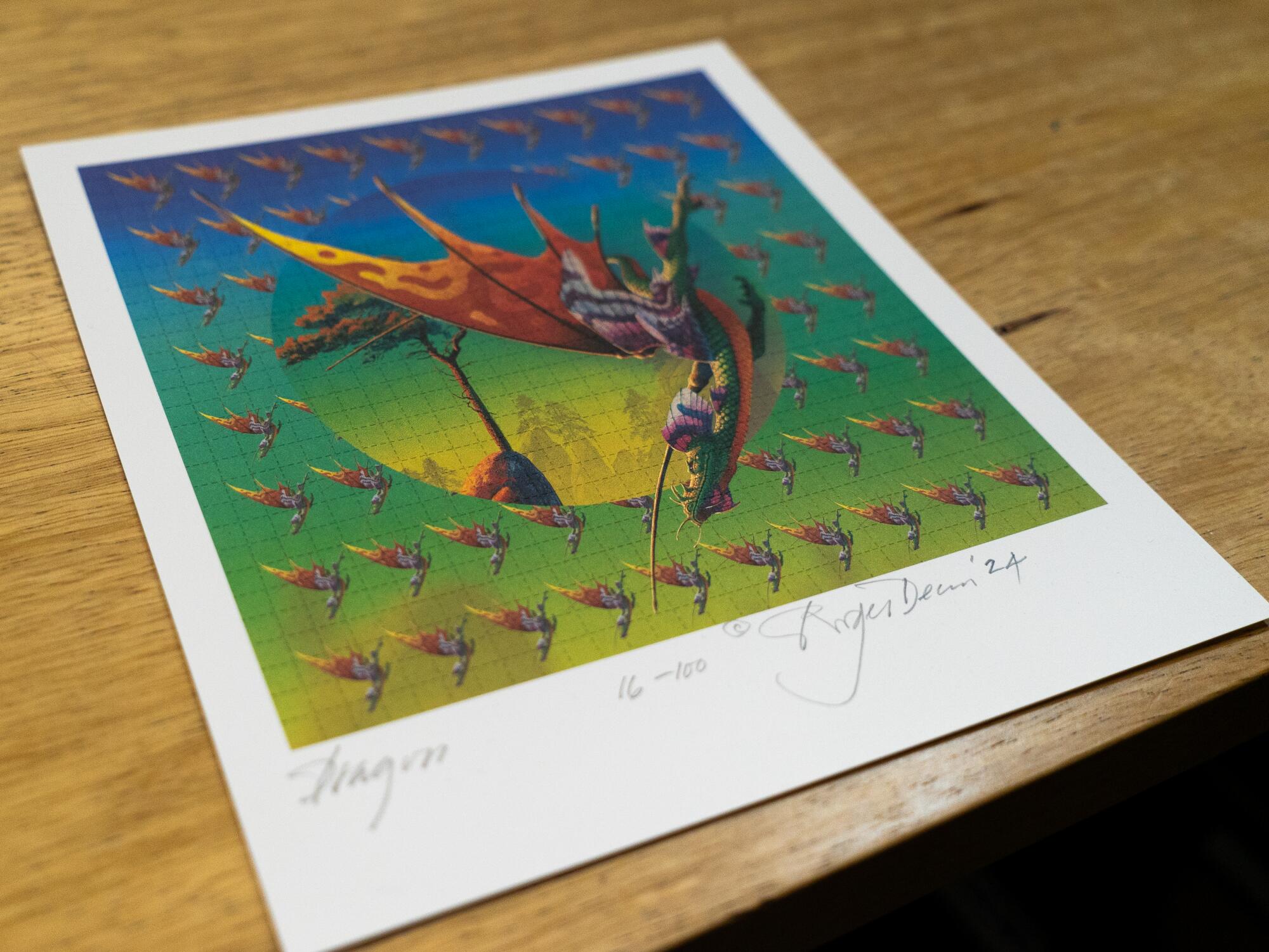
Artwork featured at the Chambers Project’s “Godfathers” exhibition.
(Colin M. Day)
Reaching a new generation
As a longtime user of psychedelic substances, Chambers sees legalization as the new gateway into his culture. He discovered psychedelic drugs in 1995 during his sophomore year of high school, when he said he showed up to his science class on LSD and became enthralled with an Alex Grey poster that hung in the classroom.
Beyond its mental effects, he was immediately drawn to the aesthetics — swirling colors, optical illusions and surreal depictions of cognition — associated with it. At age 15, he purchased his first piece of art, a “Bicycle Day” poster celebrating the discovery of LSD signed by the chemist who made it. Chambers, who said he earned a comfortable living in the marijuana industry, owns roughly 400 works of psychedelic art.
That candy-colored trove now rotates through the Chambers Project. The current “Godfathers” show (running until May 25) includes original pen-and-ink drawings that Ralph Steadman drew for Hunter S. Thompson’s seminal work of gonzo journalism, “Fear and Loathing in Las Vegas”; Rick Griffin’s “flying eyeball,” which cemented itself into history when it appeared on a Jimi Hendrix Experience concert poster in 1968; the pop surrealist Roger Dean’s “Relayer,” a serpentine painting that became an album cover for the prog-rock band Yes; and ephemera from a gritty Manhattan venue called Psychic Solutions Gallery, founded by Jacaeber Kastor, that treated blotter papers as high art.
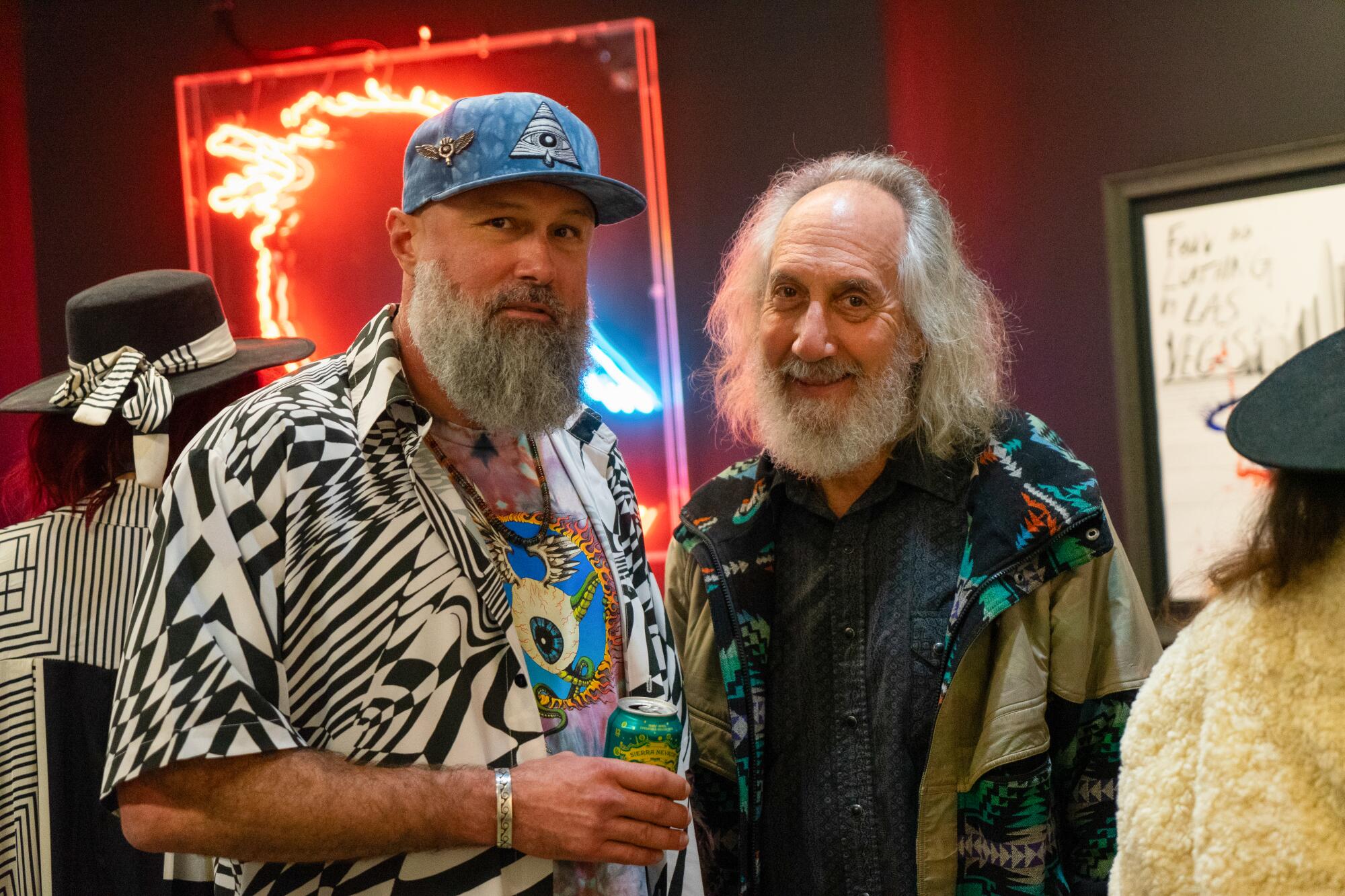
Brian Chambers, left; Jacaeber Kastor, right. Kastor is one of the artists in the exhibition and founded Psychedelic Solution Gallery, a gritty Manhattan venue that treated blotter papers as high art.
(Colin M. Day)
Since psychedelics have become less taboo, the interest in Chambers’ art collection has grown. He said he has sold work to the Pritzker family, which has placed a number of his pieces at its Grand Hyatt Hotel in San Francisco. Often deemed lowbrow, unserious and too commercial, a wider acceptance of magic mushrooms and ketamine among some pockets of the country also means that the art is no longer reserved for outcasts and hippies.
“We’re trying to make these world-class, globally known artists accessible to the common folk that don’t come from money or a serious art background,” Chambers said.
He supports artists like MARS-1, Damon Soule and Justin Lovato by providing them studio space, showing their work and selling it to his network of collectors. Chambers has also encouraged many of these artists to relocate to Grass Valley to be closer to the community he’s building.
Chambers met Soule, a 49-year-old artist known for drawing flowing grids as optical illusions, in 2009 in San Francisco. Five years later he made the move to the woods. Soule chatted with me over Zoom from his homemade art studio in April, where he relied on one bar of spotty cell service. Pixelated, he sat in front of plywood walls covered with black-and-white painting studies, an artsy recluse in his off-grid sanctuary.
“Artists tend to be individualistic and focused on their own little world,” he said. “Brian is a connection-maker. It’s good to be near someone who helps you meet other artists, other musicians, people who have parties and collaborative events.”
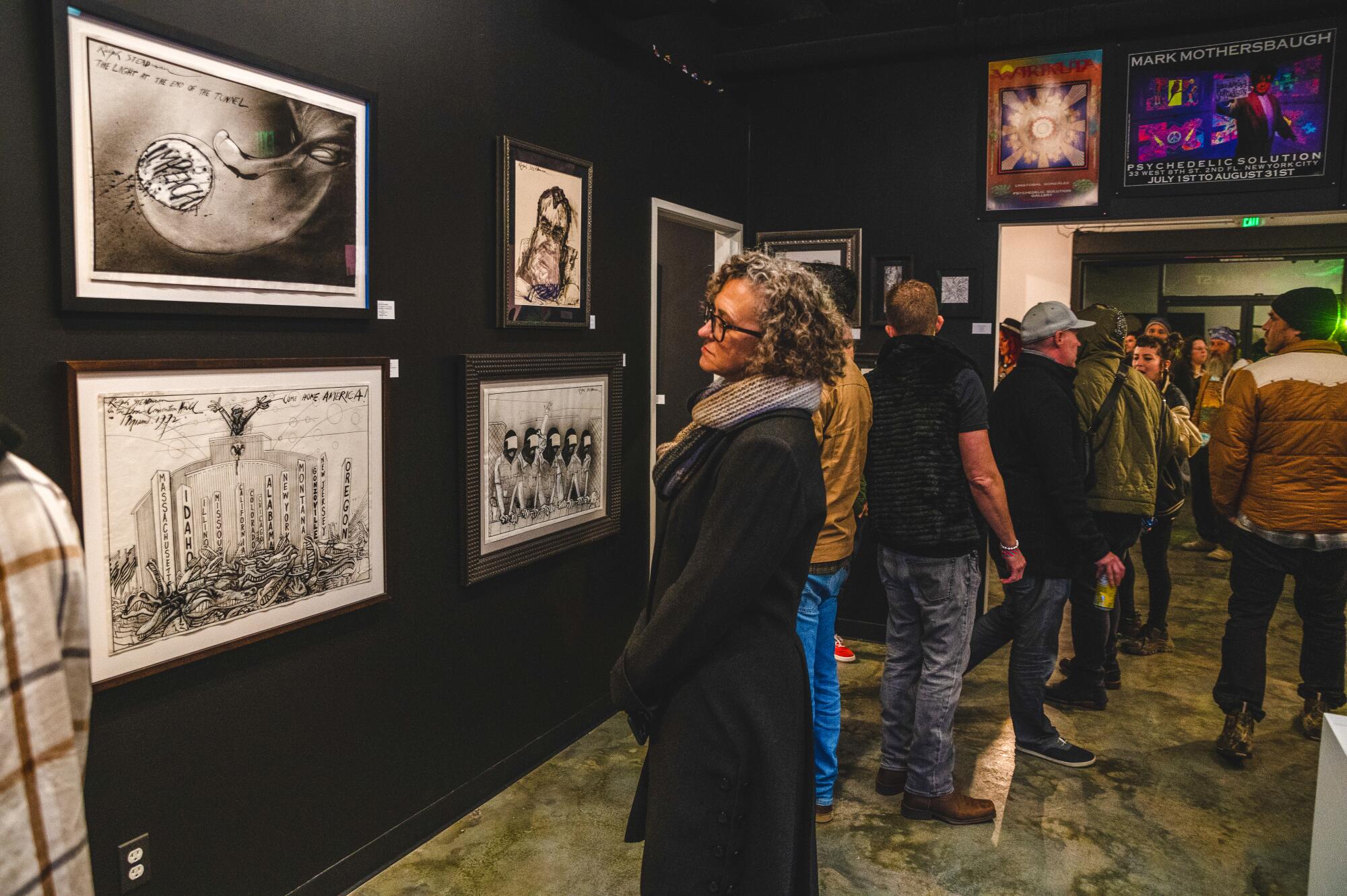
Scenes from a night at the Chambers Project, an art gallery curated by Brian Chambers.
(Bailey Whitehill)
Soule calls PACT “the clubhouse” because it’s always filled with a diverse set of creative people united by the profound experiences they had taking psychedelics.
When I spoke to Chambers, he was careful to clarify that, though he is a passionate advocate of psychedelics, PACT is not a medical organization, nor does it distribute substances. Instead, they focus on education by holding discussions with experts, historians and artists who help people understand how to safely consume drugs if they so desire.
Gagan Levy, a PACT board member and founder of We Are Guru, a creative agency that plays a large role in pushing for the legalization of psilocybin, believes PACT’s discussions are crucial for building a positive relationship with the drugs. He emphasizes the importance of “set and setting.” The phrase was coined by his mentor Ram Dass, the famed Harvard scientist and spiritual icon who conducted groundbreaking studies on psychedelics in the 1960s and wrote “Be Here Now.”
“We don’t have a Hunter S. Thompson, or ‘Fear and Loathing’ like that. We’re trying to recapture that, but in a totally new and weird way.”
— Woody Tuttle, Chambers Project patron
“What’s your mindset and the setting going into a psychedelic experience?” he asked. “Then, how do you have a mind-expanding experience, but, most importantly, how do you then integrate that into your life to be more fulfilled?”
Woody Tuttle, 21, traveled from Chico to attend the “Godfathers” opening. He said that because his generation lacks a true counterculture movement, his cohort sees psychedelics as more spiritual gateways to connecting with art, nature and other people. He said many of his peers are pairing their experiences with chants, intention-setting, spells and manifestation.
“We don’t have a Hunter S. Thompson, or ‘Fear and Loathing’ like that,” Tuttle said. “We’re trying to recapture that, but in a totally new and weird way.”
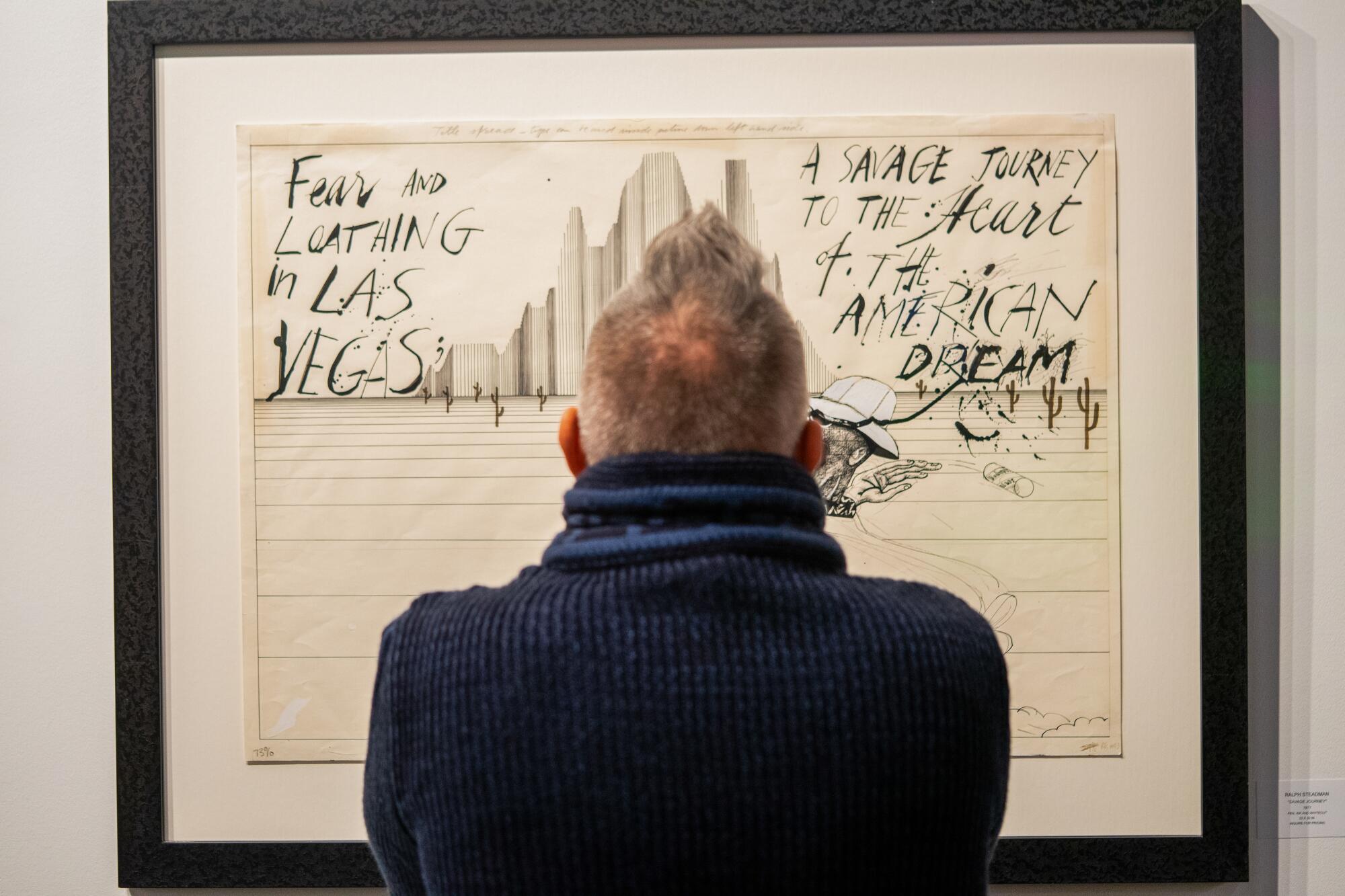
A Chambers Project visitor views artwork by “Fear & Loathing in Las Vegas” artist Ralph Steadman.
(Colin M. Day)
PACT cultivates an environment where people can discuss how psychedelics have provided them breakthroughs, healing and answers to personal questions.
“Integrating the psychedelic experience is as important as the experience itself,” the artist Soule said. “For me, art is the most direct way of transmuting all types of metaphysical spaces into the default world. It resonates with people by giving them a reflection of those shared places, states, mysteries.”
In Grass Valley, the community has embraced PACT and the Chambers Project. Their parties regularly sell out, the gallery has made the front page of the local newspaper more than once, and the Nevada County Arts Council has arranged private gallery tours for visitors.
By fostering a community around art, music and education, PACT hopes to transform this small, rural town into a preeminent hub for psychedelic culture.
“The art speaks for itself and it has really inspired a movement,” Chambers said.
Renée Reizman is an interdisciplinary writer, artist and educator based in Los Angeles. She researches the ways infrastructure impacts culture, community and environment. Find her work at @reneereizman.


The Kennedy Center, the facade of which remains covered with a tarp, is seen in Washington, DC, on June 28, 2026. A US federal judge asked on June 24 for an explanation for why a tarpaulin continues to cover the facade of the Kennedy Center where President Donald Trump’s name was recently removed. District Judge Christopher Cooper gave the board of trustees of the performing arts venue until the end of July to explain “the purpose for and status of the tarp and scaffolding that Defendants have erected on the front portico of the Center.”
ALEX WROBLEWSKI/AFP via Getty Images
hide caption
toggle caption
ALEX WROBLEWSKI/AFP via Getty Images
More than two weeks ago, President Trump’s name was removed from the Kennedy Center facade though it is still covered by a tarp and the legal battle continues.
On Monday, a U.S. Department of Justice filing on behalf of the Kennedy Center included some surprises. The document was submitted in response to issues raised by lawyers for ex-officio board member Rep. Joyce Beatty of Ohio who is suing to remove President Trump’s name from the center and stop its closure for renovations.
Among the revelations, the Kennedy Center admitted that, during a board meeting on December 18, 2025, Beatty had been “muted and prevented from speaking.” It was at that meeting that the board voted to add President Trump’s name to the center. The filing later acknowledges the congresswoman was “prevented from voicing her opposition.”
The John F. Kennedy Center for the Performing Arts is a living memorial to its namesake. The guidelines for how the theatre complex spends federal dollars are very specific. Among other rules, it states that “no additional memorials or plaques shall be designated or installed.” Beatty argues adding Trump’s name runs afoul of those rules and that any change requires approval from Congress.
According to one of Beatty’s filings, “There was no advance notice in the agenda that the Board would be considering a name change,” a statement the Kennedy Center now does not deny. The center admits that, prior to voting, there was “no discussion about potential risks or downsides of the vote to adopt a secondary name for the Center.” Nor was there a board discussion “about any potential conflict of interest that might result from the vote.”
The center’s lawyers previously contended that if Trump’s name were to be removed, it would “lose money from donors who support” him and “impede the Center’s fundraising efforts.”
Closing for renovations
Earlier this year, Trump announced on social media that the Kennedy Center would close for two years for renovations. He wrote that he made the decision after “a one year review” with “Contractors, Musical Experts, Art Institutions, and other Advisors and Consultants.”
But, according to the center’s lawyers, Trump’s announcement “was made without presenting any plans, analyses, timelines, or funding information to his cotrustees and without any Board vote.”
The Kennedy Center has long denied reporting by The Washington Post that ticket sales plummeted after President Trump became the Center’s board chair. In Monday’s legal filing, the Center admits that, by October 2025, “nearly half of the Center’s tickets were going unsold.”


Paul Tremblay has made a career of pushing the horror genre – and the novel format – in strange and exciting new directions.
In his latest, Dead but Dreaming of Electric Sheep, the author offers an amalgamation of genre elements that can be best described as psychological-dystopian-science-fiction horror. It’s a mouthful, but the narrative does all of that and more in a way that defies categorization.
Julia Flang is a former semiprofessional gamer working two mediocre jobs she dislikes and living in a modest ranch house in a San Fernando Valley suburb with her retired uncle, whom she calls Uncle Fun. Julia likes movies and gaming but there’s little else going on in her life, so when her estranged mother, the CFO of a large tech company, contacts her with a possible job offer – a “once-in-a-lifetime thing” that pays handsomely just for doing the interview – she hesitantly agrees.

The job is relatively simple and perfect for someone with gaming skills: using a controller built into a phone to get a man, who is stuck in a vegetative state, from California to the East Coast. It will require her to learn how to control his body – walking, moving, sitting, standing, using his arms – so she can maneuver him out of the facility where he is located and into cars and planes and through crowded airports. A fan of movies, Julia decides to call the man Bernie – after the movie Weekend at Bernie’s. When the ethics of the job start to bother her, Julia realizes it’s too late and she must go through with it. However, she’s soon contacted by people interested in sabotaging the whole thing, people who, like her, don’t align with the shady interests of conglomerates and those set to make “gobs of money” from this new, somewhat inhuman technology.

As with every Tremblay novel, any synopsis barely scratches the surface. The novel’s chapters alternate between Julia and you (yes, you). Julia’s chapters are “normal” in the sense that they obey a chronological order and have action, basic descriptions of movement and places, and dialogue. The chapters in second person are like fever dreams from a shadow world; the desperate experiences of a man trapped inside his own body with no control of it, no clue what’s happening to him, and only a few fragmented memories of his life. Also, Tremblay uses a similarly fragmented style of storytelling (including words and sentences trapped in boxes and/or “moving” on the page) to keep things interesting but also confusing and creepy.
This novel operates on several different levels and – planes of existence? Bernie has a head full of AI that controls his body, but his consciousness is still there and struggling to regain control, struggling to remember things. There are monsters, leeches, mysterious rabbits, and eerie shadows in his world, but the true horror comes from the lack of control, from being moved around against his will and having no clue what comes next. Bernie is the embodiment of losing control to AI, and when taken together with the commentary of creativity and AI and the meta interludes in which the author takes a wrecking ball to the fourth wall and addresses readers, this is the best anti-Generative AI story horror has produced so far.
Despite the horror of it, this is a very funny novel. Julia is sarcastic and struggles to keep her comebacks in line, but the conversations she has and messages she writes are always entertaining. However, the humor is far from the crown jewel here. That title belongs to a plethora of big ideas Tremblay juggles. The nature of life, death, and consciousness, the evils of conglomerates, inhuman practices in the name of capitalism, and AI, and even what it means to be human are all explored here: “Is Bernie alive? Is he feeling pain? Is he experiencing everything as a prisoner looking through the bars of his body? Has his consciousness been winnowed to a metaphysical keyhole? Where does consciousness begin or end?” There are no definite answers here, but the way Tremblay infuses humanity, love, the importance of relationships, and humor throughout the narrative provides the kind of answers that can’t and don’t need to be spelled out.
A genre-bender full of big ideas that constantly switches between a world full of real or uncomfortably plausible nightmares and a bizarre hellscape in which loss of self, memory, and autonomy are only the tip of the proverbial iceberg, Dead but Dreaming of Electric Sheep is a horrific and terrifyingly disorienting novel that invites readers to consider a future that already started. Tremblay has always been an innovator, but this beautifully written collection of real and imagined grotesqueries cements him not only as one of the most original and exciting voices in horror but also as one of the smartest, most engaging authors in contemporary fiction.
Gabino Iglesias is an author, book reviewer and professor living in Austin, Texas. Find him on X, formerly Twitter, at @Gabino_Iglesias.

-

 Movie Reviews4 minutes ago
‘Supergirl’ Movie Review
-

 World12 minutes ago
Map: 6.0-Magnitude Earthquake Shakes Off Mexico’s Coast
-

 News19 minutes ago
In the United States, Every World Cup Team Is a Home Team
-
Lifestyle57 minutes ago
How does the Kennedy Center board make decisions? This legal filing sheds some light
-

 Technology1 hour ago
Meta is adding ridiculous ‘rate limits’ and a soft paywall to its smart glasses
-

 World1 hour ago
Boy, 2, pulled alive from rubble six days after Venezuela’s devastating twin earthquakes
-

 Politics1 hour ago
Socialism goes west as DSA-backed challenger ousts longtime Democrat
-

 Health1 hour ago
Americans are giving up multivitamins for a different daily health habit, study finds

