Lifestyle
The Second City, named for its Chicago location, opens an outpost in New York


An outpost of The Second City has opened in Brooklyn. Above, the Brooklyn Bridge and lower Manhattan skyline are pictured at sunset.
Charly Triballeau/AFP via Getty Images
hide caption
toggle caption
Charly Triballeau/AFP via Getty Images

An outpost of The Second City has opened in Brooklyn. Above, the Brooklyn Bridge and lower Manhattan skyline are pictured at sunset.
Charly Triballeau/AFP via Getty Images
The sketch comedy and improv group, The Second City, is famously named for its location: Chicago. And while some of its illustrious graduates, like Stephen Colbert and Tina Fey, have become famous New Yorkers, there’s never been an outpost in the First City, until now.
A new facility has been built in the Second Borough – Brooklyn. The trendy neighborhood of Williamsburg to be exact. On the site of an old record shop and club, the company has built a 200-seat mainstage, a 60-seat second stage, several classrooms, where improv and comedy writing are taught, and a restaurant.
It’s not The Second City’s first foray outside Chicago: There’s been an outpost in Toronto since 1973, which spawned the successful television series SCTV, and other companies have been in Hollywood and Detroit. In addition, there’s a touring company that crisscrosses the United States.
The Second City New York in Brooklyn.
Jeff Lunden/NPR
hide caption
toggle caption
Jeff Lunden/NPR
The Second City New York in Brooklyn.
Jeff Lunden/NPR
“We know that there is a really great comedy scene in New York,” said The Second City’s CEO, Ed Wells, “and a demand for comedy-based entertainment, but there is no one doing what we do.”
With the closing of several clubs in New York during the pandemic, he felt there was an opportunity. “I mean, New York is the home of Saturday Night Live, right?,” Wells explained. “Saturday Night Live and The Second City have had a relationship since Saturday Night Live started. … Its very first cast was filled with Second City alumni from, you know, John Belushi to Dan Aykroyd to Gilda Radner.”
Other grads include Nia Vardalos, the writer and director of My Big Fat Greek Wedding, who spent four and a half years with the company in Toronto and Chicago. “It absolutely formed who I am,” she said. “You enter an institution that is formidable, and yet filled with irreverence; where you will be rewarded for being a person who doesn’t follow the rules. And yet you’re getting a paycheck, and you are part of a union.”
It’s such a good gig, that when Second City opened up the call for auditions in New York, within three days, 1,000 people responded, and they had to cut it off. The New York revue is a mix of improv, new material and some classic sketches from Chicago.
Drew Riley, a graduate of The Second City Conservatory in Chicago is one of the six people who are opening the new mainstage. And the first number – which the company developed over half a year, features something every New York has an opinion about: the subway. “We would ask, you know, ‘what’s something about New York that you love? What’s something about New York that you hate?,’” he recalled, laughing. “And the answer to both those questions with us was the same. And it was the train … we wanted to honor that.”
Jacklyn Uweh, who trained with The Second City in Hollywood, and is part of the first ensemble in New York, said that one of her favorite sketches is a classic free association piece for two actors playing spies that was created by Second City alum Stephen Colbert. The first part of the sketch is written but at a certain point it becomes improv, with input from the audience. “It is the hardest sketch I’ve ever rehearsed!” Uweh says. (The night I attended, the improv part went on for two and a half minutes, to peals of laughter from the audience.)
One of the most important partners in the show is not onstage. It’s Kayla Freeman, the stage manager, who sits on a perch above the stage. With a background in comedy and improv, as well as technical theater, she looks and listens intently while the actors make up their material on the spot, to determine when to call a blackout to end the sketch. “A lot of the time, what I’m looking out for is a big audience laugh or watching the internal games that they’re playing and figuring out when that game has resolved itself,” Freeman explained. Basically, she said she and the actors “ride the waves together.”
Cast member Drew Riley said part of the exhilaration of doing improv is the possibility of falling flat on your face. “It’s the reason you go to the circus to watch the acrobats. Right? Because you think maybe they might fall,” he said laughing. “But you’re thrilled when they don’t. You’re thrilled when they land the triple somersault. It is a theatrical experience unlike anything else.”
The doors of The Second City New York have only just opened but the company hopes they stick the landing for years to come.

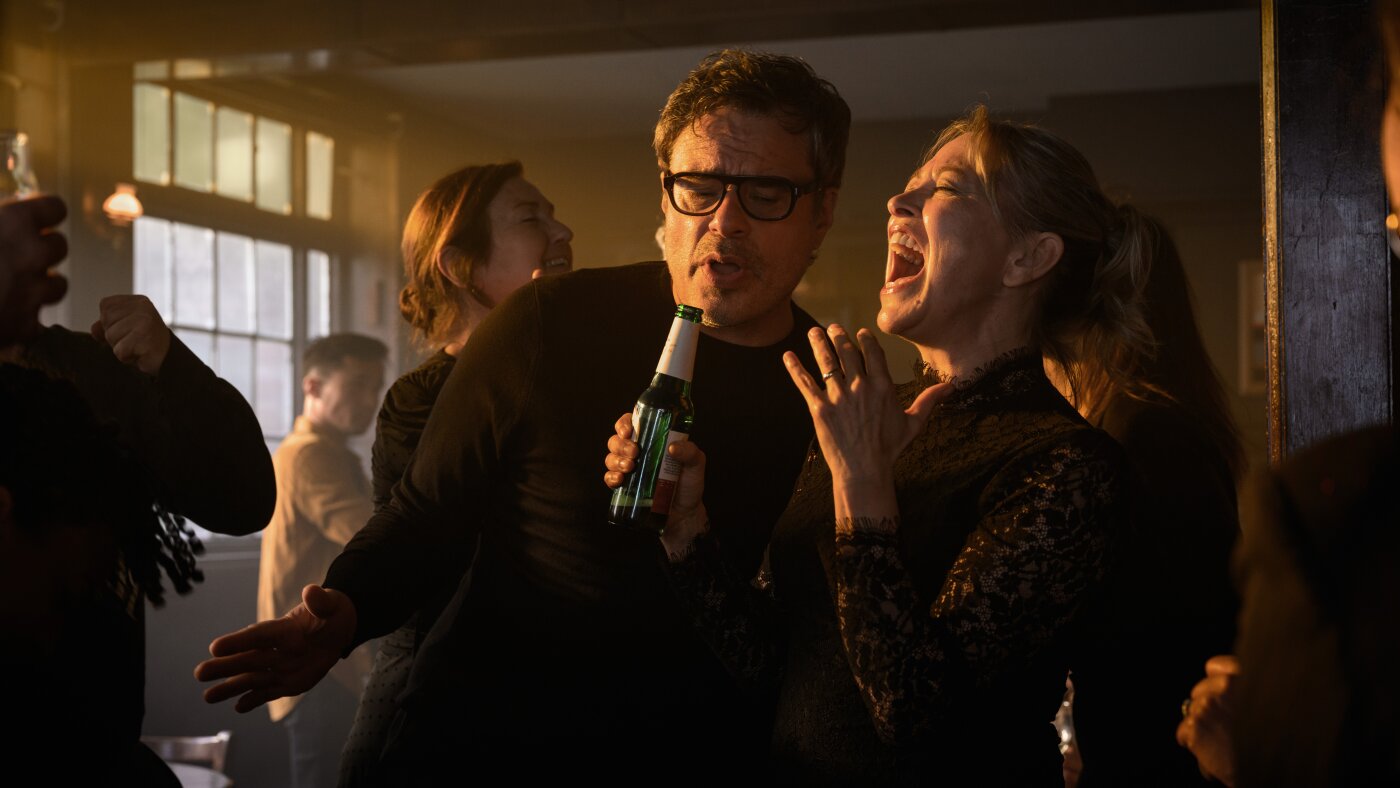
In Alice and Steve, Jemaine Clement and Nicola Walker play long-time friends who turn on each other after he gets involved with her 26-year-old daughter.
Lara Cornell/Disney+
hide caption
toggle caption
Lara Cornell/Disney+
I grew up watching episodic shows on network TV, nearly all of them formulaic but some indelibly great. Then, like everyone else, I moved into the days of what my colleague David Bianculli dubbed Platinum TV, where series like The Sopranos and The Wire and Fleabag aspired to something higher. What both these eras had in common was that their shows were carefully crafted — they had an internal logic, and a tone, that held them together.
In recent years, though, there’s been a proliferation of shows that, possibly obeying some algorithm, care less for coherence than sensation. They lurch among tones, from cuteness to sentimentality to meanness, stirring in random plot twists along the way. Bouncing all over the emotional map, these shows depend on compelling actors and a few memorable scenes to make us overlook their loose construction.
A great example is Alice and Steve, an entertaining but sometimes exasperating six-part British comedy on Hulu about two 50-something best friends who turn on each other after he gets involved with her 26-year-old daughter.


While the premise is juicy, it’s also a tad yucky, and I mainly tuned in because its title characters are played by performers Jemaine Clement from Flight of the Conchords and Nicola Walker, whom I’ve raved up on this show more than once.
The series starts poorly with Steve and Alice going on a cutesy bender after a friend’s funeral. Now, I always hate drunk scenes, which are an invitation to overact. As Clement and Walker bray their lines, we learn that Steve’s a divorced celebrity hair stylist who can’t find a girlfriend while Alice is a clothes designer with a doting younger husband, nicely played by Joel Fry, a sweetie-pie of a teenage son — that’s Tyrese Eaton-Dyce — and, of course, that 26-year-old daughter, Izzy, who has inherited her mother’s willfulness. Played by Yali Topol Margalith, Izzy kickstarts the plot by flirting with Steve. Predictably, he succumbs.

Almost immediately, they think they’re in love. While the weak-willed Steve wants to hide their romance — he knows it’s inappropriate — Izzy just blurts out the facts to her mom. Alice flips. And from hereon out in this series where the women are as alpha as the men are hangdog, Alice drives the action. Betrayed and violently angry, she’ll do whatever it takes to break them up — no matter who gets hurt. Her antics unleash Steve’s own malice. We’re in Beef territory.
At its core, Alice and Steve hinges on the way that platonic friendships are often richer and more powerful than romantic ones. It’s a fascinating subject, which may be why I found the script by Sophie Goodhart so frustrating. I wanted her to dig deeper. While the show’s got some very funny bits — Alice’s sharp-tongued mother is a blast — it’s often annoyingly lax.

If Steve really does the hair of Charli XCX, how come he’s a clueless older guy whose pop culture references are Willie Nelson and Woody Allen? If Izzy truly adores her mother as she claims, why does she keep rubbing her relationship with Steve in her mom’s face? Halfway through, one character nukes the other’s career, but this life-shattering event has no real weight: It’s barely even mentioned for the rest of the series.
That said, Alice and Steve is worth seeing for scenes like the one in which Steve spinelessly sells Izzy out or the lacerating discussion between Alice and her husband when he fully grasps that he adores a woman who views him as a reliable but dull concierge, not a man she likes hanging with. Most touching of all may be the lovely sequence when Alice, wise for once, smooths a romantic crisis between her son and his would-be girlfriend, a pair who are the show’s emblem of hope. For once, we understand why people love her.

While most viewers will find Steve more likable than Alice — the show takes pains not to make him appear predatory or creepy — the role doesn’t give Clement a whole lot to do except play variations on shambolic dread and discomfort. The show gets its galvanizing zing from Walker, a beloved star in England with amazing, luminous eyes. Her Alice is the kind of complicated, volcanic heroine that you don’t see in movies and rarely see on TV, one who shows her apocalyptic rage freely and in many different forms.
At least once in every episode, something would lead me to say, “Man, is this show a mess.” But that wasn’t a deal breaker. I kept watching. After all, life is messy, too.


How to enter your Sporty Spice era.
Getty Images/quantic69/Olga Kurbatova/Anastasiia Zvonary/Photo Illustration by NPR
hide caption
toggle caption
Getty Images/quantic69/Olga Kurbatova/Anastasiia Zvonary/Photo Illustration by NPR
Reality dating and professional sports are not as different as you’d think.
Brittany is in her Sporty Spice era – she watched the NBA playoffs, she’s following World Cup games, and she’s watching the New York Liberty play their WNBA season. These games are daily – and so is the reality dating show Love Island. And she noticed that the two formats are not very different at all. Defector.com staff writer and co-owner Kelsey McKinney came to the same conclusion – so the two of them discuss why these games of athleticism and love can bring us together… and why they get valued differently in our culture.
For more episodes on sports and reality TV, check out:
Get rich or die trying: how sports betting is changing our love of the game
Is this the end of reality TV?
The ugly truth of America’s expensive homes
Support Public Media. Join NPR Plus.
Follow Brittany on Instagram: @bmluse
This episode was produced by Liam McBain. It was edited by Neena Pathak. Our Supervising Producer is Cher Vincent. Our Executive Producer is Barton Girdwood. Our VP of Programming is Yolanda Sangweni.

-
Lifestyle5 minutes ago
‘Alice and Steve’ might be a mess — but it’s also too fun to stop watching
-

 Technology12 minutes ago
America’s greatest idea is still under threat
-

 World20 minutes ago
Zelenskyy pressures US and Europe for more ‘air defense’ assistance amid ongoing war with Russia
-

 Politics23 minutes ago
ICE renews hunt for El Chapo’s last two fugitive sons with massive reward
-

 Health35 minutes ago
Biohacker hoping to live to 160 reveals alarming diagnosis: ‘My stomach is eating itself’
-

 Sports37 minutes ago
FIFA president addresses Trump call amid scrutiny over decision on USA World Cup star
-

 Technology43 minutes ago
Fake Booking.com travel credit scam targets travelers
-
 Business50 minutes ago
Many indie festival films struggle to get distribution. Alamo Drafthouse is trying to change that

