Lifestyle
The benefits of dressing up to stay in — and why they outweigh dressing up to go out


I only sleep in silk. It’s a bit of a dirty secret.
This isn’t the type of thing you want to admit to a friend, much less a stranger. It’s undemocratic. Polyester isn’t good enough for you? Rayon, viscose, all the leaps and bounds made in synthetics — don’t you believe in science?
Fine silk runs through the fingers like soft water. It drapes without hiding your lines or curves — but can, if woven with enough heft, still deliver on structure. In the right color, it is impervious to sweat. With a little Woolite — and the stomach to ignore the tsk-tsk of “dry clean only” — it’ll survive a hundred washings. Silk comforts and cocoons, so light it practically hovers. I sleep in silk. I cook in silk. I clean in silk. I live in silk — it’s all I wear when I’m at home. (And, often, an apron.) Why dress up to go out when you can dress to stay in?
Pamela wears Versace briefs and robe , Justine Clenquet earrings and necklace.
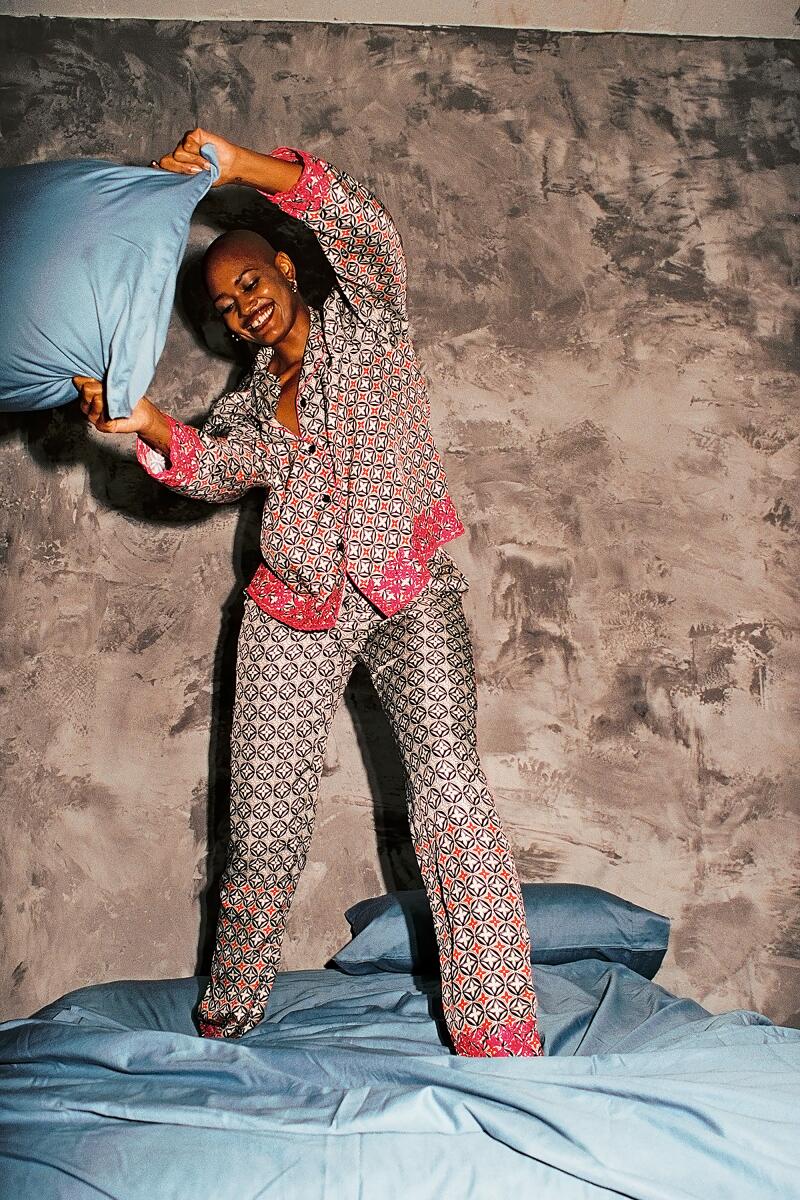
Louis Vuitton pajamas, Justine Clenquet earrings.
Like many immigrant families, the one I grew up in drew a hard line between inside clothes and outside clothes. (Or maybe it’s not about hyphens but just having some manners; as Phoebe Robinson says, “Please Don’t Sit on My Bed in Your Outside Clothes.”) Outside, the world is covered in dog s—. Plus a good deal of pollen that will have me up all night hacking. Inside, my bare feet walk on the qilim my mother “lent” me 15 years ago, and the air’s laced with cardamom from my decaf-black virgin nightcap. Inside, there’s a candle burning and a ban on overhead lighting. Inside, one rule reigns: respect the sanctity of Inside.
Pajamas, you see, aren’t just for sleeping. They’re inside clothes. This is a lesson the pandemic brought home to everyone, but for some of us it’s always been so.
The word “pajama” stems from Persian/Farsi, as I learned in my medieval Persian seminar in college after a life of speaking Farsi at home but somehow never registering the echo of this particular cognate. A compound of “pay,” or leg, and “jāma,” cloth (as in, clothes), the term first traveled to India via the Mughals, who spoke Persian at court. We’re talking the 1500s. A few centuries later — as a Dolce & Gabbana blog post on “the pyjama” also so kindly explains — the word, and corresponding style of loose pants coupled with a matching top, then went West via the Raj: colonial Brits stole the breezy unisex look from their subjects. In short, as an Iranian, I come from a long uninterrupted line of pajamas. Though probably in cotton.
When I was a kid, I also had a few nightgowns. My favorite my mother had sewn for me. Puff sleeves, peach and brown stripes. Memorialized, these days, in a snapshot of me and my childhood best friend on her family’s pullout couch, Nick at Nite on the TV.
Historically, nightgowns, opposite from pajamas, traveled from West to East. And they didn’t start out femme — in medieval Europe, men and women alike retired for the night in long, loose shirts. Today nightgowns are pretty much dead. But there was a time when Dior could dress you so good in lace and pastels it’d make you want to wear makeup to bed. Now few luxury brands bother, including Dior. (Albeit the occasional exception, like this truly wild floor-length, rhinestone-encrusted sheer getup by Dolce & Gabbana.) Probably for the same reason, I no longer have any nightgowns. First Wave feminism-slash-medieval Muslim culture has finally crashed on the shores of fashion, and women wear pants. Dresses can be restrictive. I like to lounge with one leg up.
Since those childhood days of puffs sleeves past, I’ve accrued a small collection of adult pajama sets. Window-shopping for my next set, I come back across the garment’s colonial lineage. A matching set by Dior — clearly I’m dreaming — features a generic jungle scene as the house’s take on Toile de Jouy (i.e., fussy French pastoral). Prints of “exotic” flora and fauna have become such a mainstay of luxury pajamas (see: Olivia von Halle) that we don’t even notice the history behind them. I’m not calling for a boycott, but every now and then, I like to see how the sausage gets made.
Inside you are your main audience. The joy lies in the freedom. Be extra. Go bold.
Me, I like it simple. But always in silk.
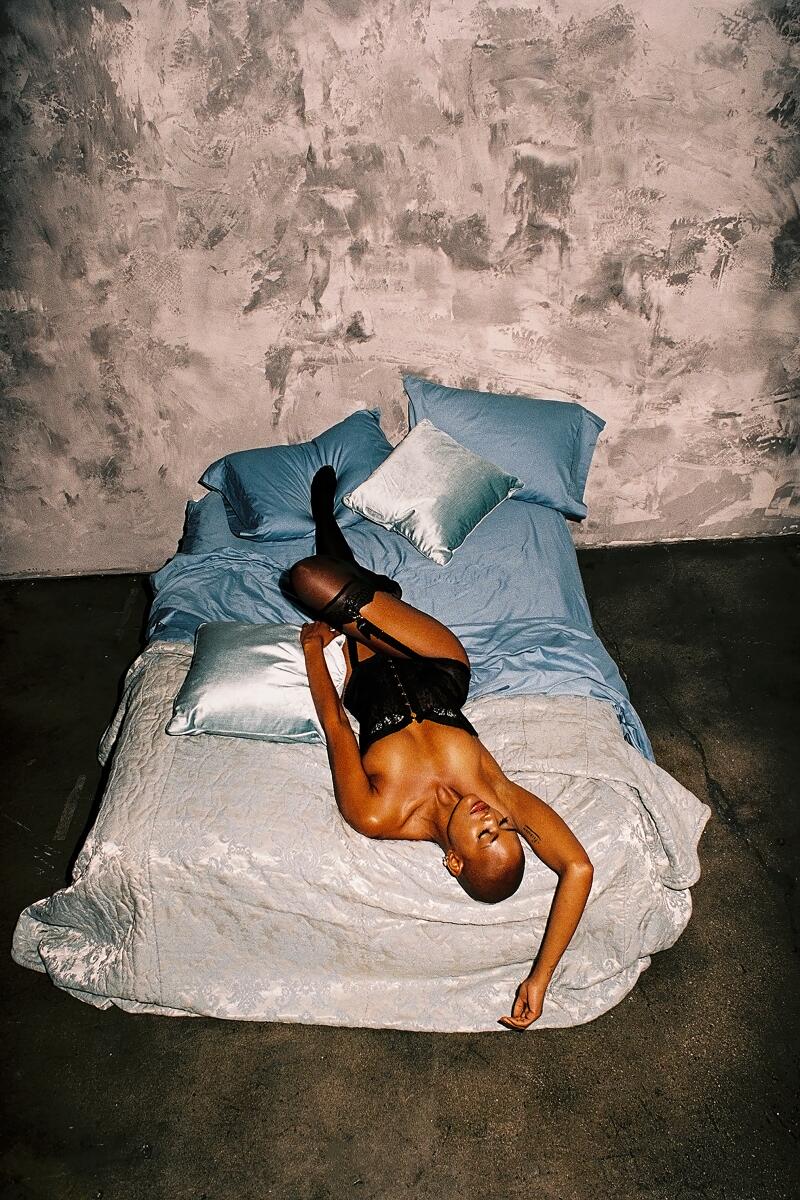
Pamela wears Agent Provocateur lingerie, Wolford stockings.
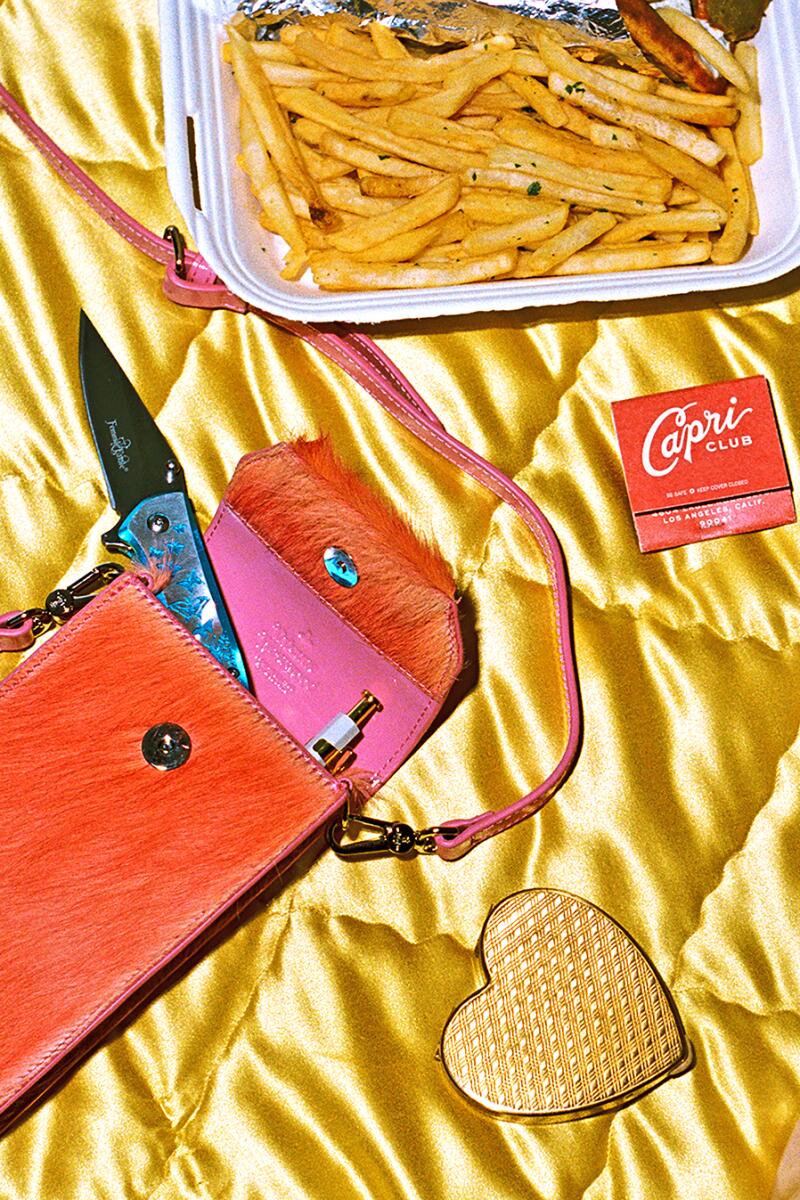
Vivienne Westwood phone purse.
My first set of silk pajamas came relatively late in life. Christmas in Fort Greene, my mid-20s. It was snowing. The kind of snow that feels like the first snow even when it isn’t, those light bright flakes that hang in the air so mournfully and beautifully you’d think you were on set for the holiday special except you can feel them melting on your chapped lips. There were so many firsts that year. My first apartment shared by an “us” that wasn’t simply financial, wasn’t me and a roommate. My first — in the form of our first — Christmas tree. (I didn’t grow up celebrating.) And, surely just as momentous, my first foray into pure silk.
Black silk with black piping. Fat black buttons, curved lapels. Long sleeves, long pants. Men’s. We’d gone Christmas shopping in the snow at the Brooklyn flea. When the scrawny guy draped over a folding chair across the stall saw me thumbing the package, he assured me that all his “girlfriends” wore them in an S, as if I needed an excuse to shop menswear and women only came in one size. He quoted 50 dollars for the set, a price that seemed at once fair and substantial. Back in the apartment that night, too lazy to iron out folds creased by time, I let more time and the wet heat of my body shake out the fabric.
Going silk is like what I imagine it felt like to step into the ’70s and burn (i.e., toss) your bras — there’s no way back. Now I have silk for every season — just a piece or two. Princesse tam tam cami and shorts in cherry red — not the skin but the flesh, which is redder. Another Princesse tam tam cami (black, bustle button detail) whose matching bottom I spent hours searching for in vain (such are sales). Thrifted and gifted to my beau before I took it back, a silk men’s tee by Cos big enough to serve as a micro-dress. Actually gifted to myself for a pandemic birthday, a classic Sleeper set in high-shine satin, the color an indulgence in itself: cream, as in farm-fresh and organic. And, I must say, way too high-maintenance. Like after I’ve done my own mani — for hours, I can hardly lift a finger without fear of effing something up.
True luxury lies in ease. As in donning that old black pajama set, day after gray rainy day, this past L.A. winter. Silk lasts. After over a decade of sitting cross-legged on the sofa in these silk pajama pants, reading or watching something; after over a decade of tossing and turning in them as I made and remade myself in cities and careers that were miles and miles apart; after over a decade of washing them, not by hand like my other silks, but by throwing them in the monstrous machine at the laundromat with regular detergent, and yes, sometimes, even machine-drying them (come out soft as a caterpillar) — after over a decade of use and abuse, I only just recently had to have a couple seams resewn. This stuff is ox-strong. Twelve years of sweat and soap, and now when the fabric ripples, black fades to gray, thick with light. You can’t buy patina like this.
Clothes are our closest homes, our first layers of shelter. I guess most folks think they’re only worth investing in when there are strangers to impress. But I want to say that being inside, being alone, is important. Maybe you’re no raja or rani, but your skin might like the touch of silk.

Pamela wears Vivienne Westwood corset, vintage purple briefs, Justine Clenquet choker.
Production: Mere Studios
Model: Pamela Holmes
Prop stylist: Gina Caravan
Makeup: Carla Perez
Photo assistant: Nicholas Mora
Prop assistant: Jessica Ayala
Mariam Rahmani is a writer and translator. Her first novel, “Liquid, A Love Story,” comes out in March from Algonquin. It takes place between L.A. and Tehran.


Dara and her song “Bangaranga” skyrocketed Bulgaria to first place at the 70th Eurovision Song Contest
Helmut Fohringer/APA/AFP via Getty Images
hide caption
toggle caption
Helmut Fohringer/APA/AFP via Getty Images
Bulgaria has won the 70th Eurovision Song Contest — the country’s first-ever win.
The achievement surprised many because Bulgaria wasn’t among the favorites to win in 2026. But with its catchy “Welcome to the riot!” refrain and bouncy vibe, performer Dara’s banging anthem “Bangaranga” bested 24 other nations for the glittery global musical crown at the finals on Saturday in Vienna, Austria.
Israel came in second, as it did last year. Ten competitors were eliminated from the original group of 35 in the semi-finals earlier this week.
In his appraisal of his 10 favorite Eurovision 2026 songs, NPR critic Glen Weldon called “Bangaranga” an “insanely catchy bop” and praised its “deep, profound, abiding grooviness.”
“Oh my god!” Dara yelled, as she accepted the Crystal Microphone, the event’s glass trophy, from last year’s winner, JJ of Austria.
As with other global cultural events, such as the Venice Biennale currently underway in Italy, the glittery annual songfest is intended as a display of goodwill and togetherness between nations. “In a world often divided, we stand united by music,” said host Michael Ostrowski at the conclusion of this year’s event.
Last year’s contest, held in Basel, Switzerland, saw record viewership, reaching 166 million viewers across 37 markets.
Israel prepared for ‘boos’
Eurovision has long strived to prioritize artistry over political antagonism. However, as with the Biennale, Eurovision 2026 found itself at the center of protests related to the war in Gaza.
Five countries — Iceland, Ireland, the Netherlands, Slovenia and Spain — pulled out between September and December 2025 in protest over event organizer European Broadcasting Union’s decision to allow Israel to participate amid the ongoing war in Gaza.
In this year’s finals, Israeli singer Noam Bettan performed the romantic breakup song “Michelle” in French, Hebrew and English. Unlike in the semifinal, when the artist sang over chants of “stop the genocide,” Bettan was not booed — at least audibly. The artist told The Times of Israel last month he had been practicing performing in front of hecklers.
There were both anti- and pro-Israel demonstrations in Vienna this week.
Pro-Palestinian protests at the last two contests called for Israel to be disbarred from Eurovision over its role in the conflict, as well as allegations it attempted to manipulate voting to favor its entries. The European Broadcasting Union changed its voting rules in response. Among other requirements, contestants and broadcasters are prohibited from taking part in promotional campaigns by third parties including governments. Countries outside of Europe, such as Israel, participate in Eurovision because eligibility is based on European Broadcasting Union membership, not necessarily geographics.
A double standard?
Although Israel’s participation is the biggest cause of dissent in 2026, the country avoided being banned from the event.
That was not the case with Russia, which was disbarred indefinitely from participating in the contest soon after launching its full-scale invasion of Ukraine in 2022.
European Broadcasting Union deputy director general Jean Philip De Tender defended his organization’s decision to allow Israel to perform, the European edition of Politico reported ahead of the contest’s final, because Israel’s public broadcaster KAN, the body behind its entry, is independent, whereas Russia’s state broadcaster, VGTRK, is run by the Russian government.
In a social media post on Friday, Spanish Prime Minister Pedro Sánchez decried the European Broadcasting Union for its “double standard.”

This story is part of Image’s May Momentum issue, which looks at art as a sport and sport as an art.

I love reading about artists’ processes and routines. Toni Morrison wrote before dawn, before her children awoke and she had to go to her publishing job. In the evenings, Maya Angelou cleaned and put away all her dishes before she sat with what she had written that morning. Louise Bourgeois only worked in complete silence. These rules and routines are reminders that art takes work — and immense amounts of energy.
I grew up with parents who are also artists and had to find time for their projects between life and daily obligations. My father wrote in the early mornings; my mother painted in the hours after lunch and before we were done with school. It normalized for me the intentional carving out of time needed for writing, reading and creating. This has meant that I’m almost always busy doing something, and sometimes tired, but when I don’t carve that time, I’m guaranteed to be in a bad mood, like the hanger that comes from skipping a meal.
In Viv Chen’s interview with Tory Burch, the designer compares her workdays to being “like an athlete where it’s about discipline and grit and endurance.” It’s a sentiment that sums up much of the spirit of this issue, which looks at art as a sport and sport as an art. Whether you’re playing fútbol, sewing clothes or staging a performance, it’s a physical as well as mental game.
Above all, the artist-athletes in these pages show us the rewards of their commitments. We witness this in the sizzling images of Tory Burch shoes pounding the hot Los Angeles pavement and in the sportswear designs that Otis students worked on for months, the results literally glowing and electric. We witness this in the portraits of Betye Saar, regally dressed in a Gucci kaftan for what will likely be the last exhibition she’s involved in during her lifetime. We witness this in the image of our fútbol queen on the cover, strong, reverent and at peace. These stories are all reminders that dedication to one’s craft is not just life-giving, it’s what makes life worth living.


Elisa Wouk Almino Editor in chief
Jess Aquino de Jesus Design Director
Julissa James Staff Writer
Claire Salinda Staff Writer
Keyla Marquez Fashion Director at Large
Elizabeth Burr Art Director
Jamie Sholberg Art Director, Web
Samantha Lee Editorial Intern
Jennelle Fong Contributing Photographer
Tyler Matthew Oyer
Contributing Photographer
Mere Studios Contributing Producer
Cecilia Alvarez Blackwell
Contributing Producer
Dave Schilling Contributing Writer
Harmony Holiday Contributing Writer
Goth Shakira Contributing Writer
Cover
Fashion Direction Keyla Marquez
Creative Direction Keyla Marquez
Photography Guicho Palma
Styling Julianna Aguirre Martinez
Talent Yusra, Natalie Renelle Muñoz,
Dylan D. Lopez
Hair Jeanette Ponce
Makeup Selena Ruiz
Nails Tatiana Calderon
Production Cecilia Alvarez Blackwell
Styling Assistant Matzi
Videographer Abraham Anzurez Galindo
Gaffer James Armas
Photo Assistants Monica Zulema,
Diego Luciano
Image Flag Bas van Brandwijk

Ken Jennings attends Kennections during the 2026 TCM Classic Film Festival on April 30, 2026 in Hollywood, California. (Photo by Araya Doheny/Getty Images for TCM)
Araya Doheny/Getty Images
hide caption
toggle caption
Araya Doheny/Getty Images
This week’s show was recorded in Chicago with host Peter Sagal, judge and scorekeeper Bill Kurtis, Not My Job guest Ken Jennings and panelists Tom Bodett, Joyelle Nicole Johnson, and Faith Salie. Click the audio link above to hear the whole show.
Who’s Bill This Time
ou Cruise, You Lose; Renovations on the Mall; A New Game Show For Word Nerds
Panel Questions
No Justice For Plumbers
Bluff The Listener
Our panelists tell three stories about an unusual situation on the beach, only one of which is true.
Not My Job: Jeopardy‘s Ken Jennings lives down his demons and answers our three questions about H&R Block
Peter talks to Jeopardy legend and host Ken Jennings. Ken plays our game called, “What is H&R Block?” Three questions about H&R Block, the subject of the Jeopardy question Ken got wrong and it ended his 74 game win streak.
Panel Questions
Open Your Heart and Lock Up Your Assets; Restaurants Get Clingy
Limericks
Bill Kurtis reads three news-related limericks: Uranus Overshadowed; Running From Romance; Double Date Danger
Lightning Fill In The Blank
All the news we couldn’t fit anywhere else
Predictions
Our panelists predict, what will be the next show made out something we do to kill time?
-

 Indiana3 minutes ago
Possible recounts of tight state Senate races could extend into July
-

 Iowa9 minutes ago
Iowa’s most popular baby names of 2025 start with O and C
-

 Kansas15 minutes ago
These are the 5 most beautiful Gothic churches in Kansas
-

 Kentucky21 minutes ago
On This Day, May 17: Aristides wins first Kentucky Derby – UPI.com
-

 Louisiana27 minutes ago
Republican Senator Cassidy loses Louisiana primary after opposing Trump
-

 Maine33 minutes ago
Fish passage, flood control and a Maine town united | Nature Connects
-

 Michigan45 minutes ago
GOP governor candidates pledge to overhaul Michigan schools at forum – Bridge Michigan
-

 Massachusetts51 minutes ago
3 ‘secret’ Massachusetts beaches you need to see this summer

