Lifestyle
Plants saved her life. Now she's helping others heal at her L.A. plant shop


On a Sunday afternoon, inside a whimsical Redondo Beach plant shop, eight women and I sat at a workshop table, smiling and laughing as we played with dirt.
With bird chirping sounds and mediation music humming in the background, we closed our eyes and dug our hands into containers filled with soil, noticing the coolness of it and its texture. There were tissue boxes within reach in case we needed to wipe away any tears.
In our Plant PPL series, we interview people of color in the plant world. If you have suggestions for PPL to include, tag us on Instagram @latimesplants.
“Remember when we were little, we weren’t scared of this,” said Barbara Lawson, who was leading the group at Meet Me in the Dirt, which she opened at the South Bay Galleria in 2022. In the 2,400-square foot space, which is brimming with houseplants and self-care products, Lawson holds gatherings such as group journaling events, wellness retreats, grief counseling sessions and today’s workshop, a soil meditation experience.
“The efficacy of gardening and mental health is a real thing,” said Lawson, who is also a certified grief counselor. “Not only did it heal me, [I’ve been] able to use it to help heal other people.”
At the workshop table, Lawson offered us gloves but discouraged us from wearing them, so we could experience the benefits of putting our hands in the soil. Some research suggests that a bacterium found in soil, Mycobacterium vaccae, may help fend off stress.
“My mama used to tell me, ‘A little dirt don’t hurt,’” Lawson, 51, quipped.
“The efficacy of gardening and mental health is a real thing,” said Barbara Lawson, who is also a certified grief counselor.
Workshop participants massage their hands in soil to experience the healing benefits of it.
Lawson knows firsthand the impact that playing in soil and being exposed to greenery can have on one’s wellness. Although she grew up watching her grandmother tend to the fruit trees in her garden when she was a child, Lawson didn’t pick up gardening until she was in her 30s. As a wife and mother of six children — she has a blended family — Lawson used gardening to carve out alone time and express herself creatively. The self-taught painter, who only paints flowers and has a functional art business called Barbara’s Delight, planted trees and colorful flowers in her backyard. The garden was “my escape,” she said.
Then over time, Lawson stopped spending as much time in her garden. And before she knew it, more than a decade had passed since she’d tended to it.
“I’m a very optimistic person — that’s my normal personality — [but] I started noticing a very dull sadness [in myself],” she recalled. “It didn’t come on all of a sudden, it was something that crept in a little bit at a time.”
Lawson realized that she was going through a period of depression because she’d never fully grieved her mother’s death. Her mom died from congestive heart failure when Lawson was 24 years old.
Lawson regularly holds soil meditation experiences at Meet Me in the Dirt.
“If you do not deal with [grief], it can come back to create problems later,” Lawson said. Instead of confronting the pain of her mother’s death, she focused on her career and raising her family, she added.
“Nobody sits around and talks about how to deal with the loss of a person, a relationship or a career,” Lawson said, adding that other cultures such as the Latino community have holidays like Día de los Muertos to grieve their loved ones. But many Black people “are not in contact with whatever our traditional practices were, so beyond the funeral, there is no other support there.”
The thought of her mother “not being here hurt too much, so I pushed the memories away,” said Lawson, “even if I knew instinctively that I wanted to think about her.”
In 2016, Lawson started going to therapy for the first time, and her therapist suggested that she get back into gardening since it used to bring her so much joy. One day after she returned home from therapy, Lawson gutted her garden so she could start anew. At first, she planted vegetables and fruits, including eggplant, corn, watermelon and cucumber, as well as an herb garden.
When she was sad, she wanted to be around greenery “because that meant something was growing,” Lawson said. “Green is serene. It is calming and it just means growth. That’s what I felt like I needed.”
As she started to feel more like herself, she slowly added more color to her garden. She planted an array of flowers including black-eyed Susans (Rudbeckia hirta), daisy-like cosmos, sunflowers and pansies. She also decorated the garden with keepsakes from her life, including some of her mother’s antiques and her husband’s old work boots, which she used to hold plants.
“It was literally saving my life,” Lawson said. “Doing sustainable gardening helped me kind of put myself back together.” She documented her healing journey on Facebook and talked about the correlation that gardening had with her life.
After discovering several caterpillars in her backyard, Lawson decided to raise monarch butterflies in her garden as well. And to her surprise, they transitioned into fully formed butterflies on her mother’s birthday.
“It was like [God] being like, ‘It’s done,’” she said, adding that she felt like she’d gone through a transition just like the butterfly. “For Him to give me [that] gift on her birthday was a miracle.”
After this experience, Lawson started teaching people how to use plants for healing in their own lives via Facebook Live. She also demonstrated how to grow food and start herb gardens. And because her garden was overflowing with plants, she began selling some of them.
Then in early 2020, Lawson was laid off from her corporate job with an anesthesia company. The timing worked out perfectly, though, because she was already planning to leave so she could focus on building Meet Me in the Dirt.
Much like her own garden, Lawson has decorated her store with captivating and bright art pieces and other items.
Lawson designed Meet Me in the Dirt to feel like a healing oasis for patrons.
The plant shop, which is located at the South Bay Galleria, specializes in indoor houseplants.
In April 2021, she converted a small bus that she found on Facebook Marketplace into a mobile plant nursery, which she named “Oasis.” (She refers to Oasis as a woman.) Each weekend, she’d take Oasis to farmers markets and pop-up events around Los Angeles to sell plants and teach people about their healing powers. After several months of doing that, she purchased a space to do this outside of the Del Amo Fashion Center in Torrance.
A few months later, a representative from the South Bay Galleria asked her if she’d be open to having a storefront for Meet Me in the Dirt inside the mall. Lawson wasn’t interested at first because she loved her mobile nursery, but when she saw the space in person, she knew that she had to have it.
The retail space “fit into my God-sized dream,” she said, adding that she wanted to have a place where she could meet with her grief counseling clients, host events regularly and provide an overall wellness retreat experience. She officially opened the plant shop and wellness center in June 2022.
“Doing sustainable gardening helped me kind of put myself back together,” said Lawson.
Meet Me in the Dirt sells an array of houseplants and self-care products such as candles, body oils and bath salts that Lawson makes herself.
Lawson said she wants people to feel like they are transported into a healing oasis each time they enter the store. The space, which looks like an enchanted forest, is filled with easy-care houseplants including monsteras, different types of pothos, Zanzibar Gems (a.k.a. ZZ plants), calatheas and aglaonemas. Sparkling chandeliers hang from the ceiling. Floral sculptures appear throughout the store, including one that is garbed in a silk robe. A projector screen displays a peaceful waterfall and meditation music plays on a loop. There’s also a swing near the front of the shop, and a framed photo of Lawson’s mother sits near the cash register.
Once you walk over a turf-grass-covered bridge toward the back of the shop, there are five “Zen” rooms, which people ages 21 and up can rent for $50 to $100 per hour. (The price varies depending on which amenities you select, such as a meal, an art box, a massage with a professional masseuse, etc.). The rooms represent and are named after what people may need in their life at that time. The names include worthy, valued, cherished (this room has a massage chair inside), loved and chosen.
In addition to soil meditation experiences, Lawson hosts birthday parties, private gardening classes, bridal showers, women empowerment workshops and more at the shop. People can rent the store for private events as well.
Brenda Gallow, right, participates in a soil meditation experience at Meet Me in the Dirt.
Although Brenda Gallow has been to Meet Me in the Dirt several times, she started crying when she walked inside on a recent visit.
“It never fails,” she said. “The aroma. The scent. My soul [feels] like it’s releasing.”
Gallow met Lawson several years ago when she purchased a few Barbara’s Delight products. She also held her 60th birthday party at the Meet Me in the Dirt shop. What keeps her coming back is the feeling she gets when she’s there, Gallow said.
She believes the experience is more than just playing in the dirt. “You literally find yourself,” she said. “You can come and do work here. You can be worked on and blessed all at the same time.”
Gallow added, “This is a safe haven for no matter what you’re going through.”
For Angela Cooper, Lawson’s recent soil meditation event gave her “permission” to relax and prioritize herself.
“She knows I have a lot going on in my life and [that] I don’t get a lot of self-care in, so she wanted me to come and not worry about anything else. Not worry about the kids [or] my family — just worry about me” said Cooper, who has been friends with Lawson since high school. She’s attended several of Lawson’s workshops, but this was her first time doing the soil meditation.
“It was very refreshing and rewarding, especially when our hands were in that dirt,” she said, adding that it felt good to soothe herself with it. “I’m always blessed when I come here.”
Lawson comforts her friend, Tselane Gardner, a longtime mental health professional, at the end of the workshop.
In addition to soil meditation experiences, Meet Me in the Dirt hosts birthday parties, gardening classes and more.
Toward the end of the two-hour workshop, Lawson instructed everyone to pick a plant that we felt most called to. I chose a monstera, with its leaves like Swiss cheese, because of its uniqueness. Then Lawson told us to remove our plants from the flimsy plastic pots they came in, so we could repot and place them into larger pots that were more sturdy. (All of the materials, including the plants and pots, were provided by Lawson as part of the $75 workshop.)
It was easy to pull out my monstera plant from its original pot, but I watched as others struggled to remove theirs because the roots had grown so thick and tight. Some women even had to stand up in order to remove their plants.
“Sometimes you’re going to have to take really drastic moves [and] apply force to remove yourself from a place,” Lawson said in a tender, motherly tone. Like plants, we can get comfortable in a space even though we’ve outgrown it, she said.
That was the moment when Lawson’s message clicked for many of the women, including me, and tears began to fall.
Once we finished repotting our plants, one of Lawson’s assistants passed out plastic monarch butterflies for us to place in our pots. The butterflies were meant to serve as a visual reminder of how far we’d come and what we had to shed along the way in order to enter a new season.
“This is still a caterpillar,” Lawson said as she held up the plastic butterfly. “It’s just a fuller version of itself.”


The real spectrum of housing insecurity
Annika McFarlane/Getty Images/Getty Images
hide caption
toggle caption
Annika McFarlane/Getty Images/Getty Images
Who counts as homeless in America?
If you ask the Department of Housing and Urban Development, around 750,000 people are homeless in America. If you ask the Department of Education, that number shoots up into the millions. What does this discrepancy tell us? And how do our cultural ideas about homelessness shape who we see as homeless, and who gets help? To find out, Brittany talks with Dr. Margot Kushel, Director at the UCSF Benioff Homelessness and Housing Initiative, and Dr. Molly Richard, assistant professor in the Department of Public Health at the University of Rhode Island’s College of Health Sciences.
Want more deep dives on cultural taboos? Check out these episodes:
The truth about men on the ‘down low’
Why can’t we be normal about polyamory?
Support Public Media. Join NPR Plus.
Follow Brittany on Instagram: @bmluse
For handpicked podcast recommendations every week, subscribe to NPR’s Pod Club newsletter at npr.org/podclub.
This episode was produced by Corey Antonio Rose. It was edited by Neena Pathak. We had engineering support from Josephine Nyounai. Our Supervising Producer is Cher Vincent. Our Executive Producer is Barton Girdwood. Our VP of Programming is Yolanda Sangweni.
Lifestyle
They just completed all of L.A. Times’ 101 Best California Experiences — and we’ve got questions!

By December of 2023, Paul Preston realized that his girlfriend Susan Huckle was a big fan of road trips and lists. So for Christmas, he gave her L.A. Times’ ”101 Best California Experiences” zine, a traveler’s bucket list highlighting my top destinations throughout my four decades of traveling the state.
The gift, I’m delighted to hear, was a hit.
Preston and Huckle went through it and checked off locations they’d seen already. Then they hit the road.
And now, after two and a half years of roaming the state between work assignments, they’re back to report that they’ve covered all 101 locations on that list. Though the two have also traveled beyond state lines, the quest to cover California “totally informed our lives for the last two or three years,” said Huckle, who sent me a note of thanks after ticking the last box.
After the note arrived, I was eager to call them and learn more. I caught the couple, of course, in the middle of a day trip.
Susan Huckle and Paul Preston set out to visit every spot on the L.A. Times’ 2023 list of “101 Best California Experiences.” Along the way, they got married in Yosemite Valley.
(Nick Wuthrich)
“We’re out exploring,” Preston said. “So you’re getting what we’re about.”
They’re also now married. That happened last July in Yosemite Valley, which, yes, was on the list.
Huckle, 41, an actress, a host on “L.A. This Week” on Channel 35, a Universal Studios performer and an author, grew up in Santa Maria on California’s Central Coast.
Preston, 56, is also an actor. He leads movie location tours and hosts podcasts, movie trivia nights and special events. He grew up and went to college on the East Coast, so he had fewer California miles under his belt when the couple met in 2020.
Their California 101 travels began in early 2024 with a trip to Paso Robles, where they saw the green slopes along Highway 46, Morro Rock and the elephant seals at Piedras Blancas near Hearst Castle.
“And then,” Preston said, “we just kept going.”
Some of their most satisfying stops, the two agreed, were places they hadn’t heard of, such as Orange Works in the Central Valley town of Strathmore and Angel Island State Park, sometimes known as the Ellis Island of the West. Huckle called Angel Island “a marriage of natural beauty with great, powerful, historic information.”
By early this year, there were only a few destinations left to check.
In April, they did the Indian Canyons and Sunnylands estate near Palm Springs, the Integratron near Joshua Tree and the Cheech Marin Center for Chicano Art & Culture in Riverside. In June, they rafted the South Fork of the American River, along with stops in Old Sacramento and, last of all, Columbia State Historic Park. Then they made their own favorites lists.
Susan Huckle’s top 10:
Yosemite Valley
Badwater Basin
Mammoth Mountain
Angel Island State Park
Cheech Marin Center
Joshua Tree National Park
American River South Fork
The Marshall Store on Tomales Bay
Santa Cruz Island
Sunnylands
Paul Preston’s top 10:
Yosemite Valley
Hollywood Bowl
Griffith Observatory
Catalina
Mammoth Mountain
American River South Fork
Erick Schats’ Bakery in Bishop
Huntington Library and Gardens
Palm Springs Aerial Tramway
Balboa Park, San Diego
Now that they’ve seen so much of the state, I had questions. For one, which spots not on the list would they have included?
Alcatraz, they agreed. Also, as an admirer of redwoods, Preston liked Calaveras Big Trees State Park. As an avid cyclist, Huckle liked the 22-mile Marvin Braude Bike Trail from Torrance to Pacific Palisades.
And was anything on the list a disappointment?
“The Carmel Mission,” Huckle said quickly. “It’s beautiful and the missions are an important part of California history.” But she said the mission’s account of its own history seemed “whitewashed,” saying little about the Native loss and trauma that historians are increasingly recognizing in accounts of the missions.
Said Huckle: “I was like, ‘C’mon guys, nobody really thinks this any more, right?’”
Now that they’re done with the Times’ “101 Best California Experiences,” what what will shape their next trips?
They have a list for that. Huckle picked up an L.A. guide, Danny Jensen’s “Secret Los Angeles,” and the couple plans to start where the book does, with the Triforium, a many-colored sculpture that went up outside City Hall in 1975 (and once featured music).
After that? Maybe the Faces of Elysian Valley, a traffic circle sculpture that Huckle said “looks like Easter Island in the middle of Cypress Park.”
That will leave only about 138 more destinations in the book to cover.
If anybody can do it, it’s these two.
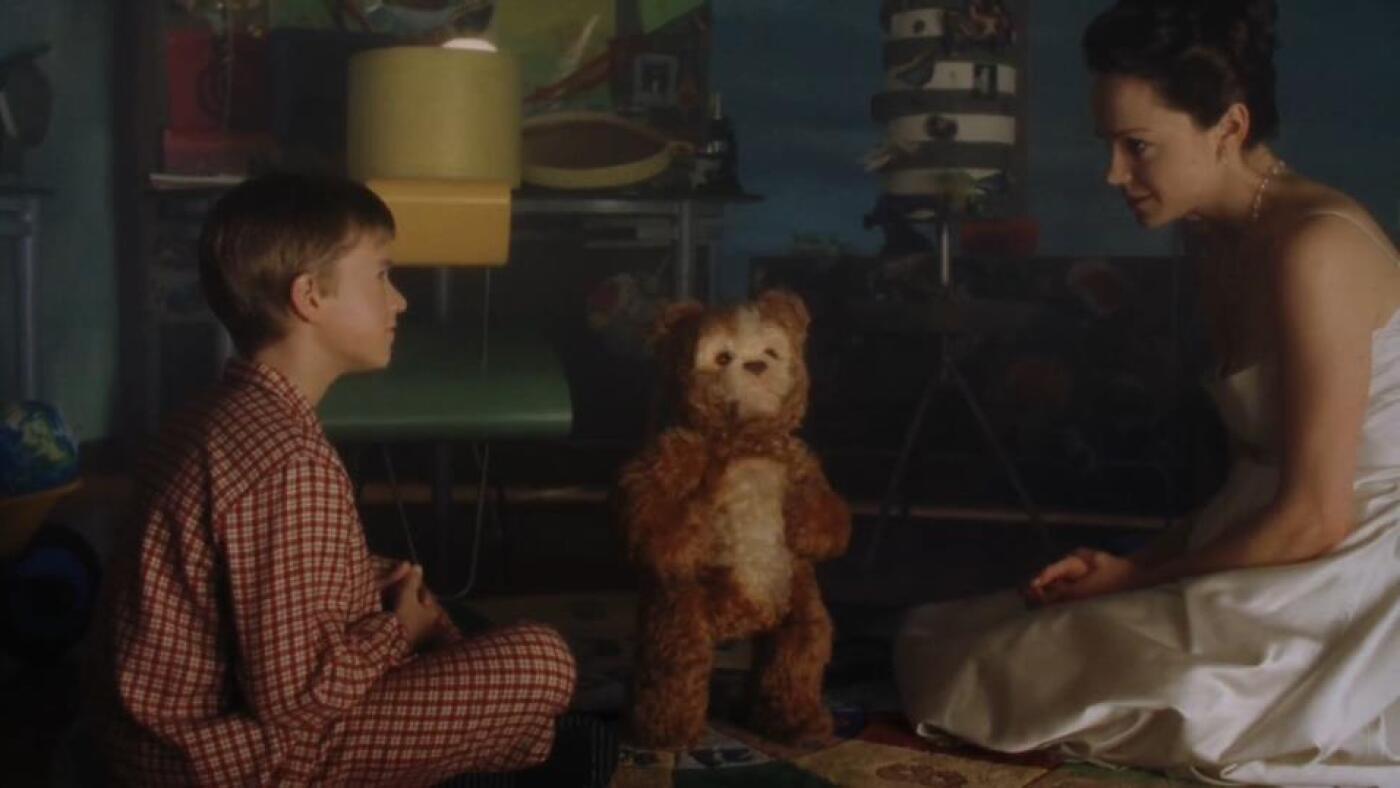
In A.I. Artificial Intelligence, Monica introduces Teddy to David. The seemingly ordinary teddy bear quickly reveals himself to be an intelligent companion capable of conversation and emotional support.
Warner Bros. Pictures
hide caption
toggle caption
Warner Bros. Pictures
Back in 2001, Steven Spielberg released an underrated scifi movie named A.I. Artificial Intelligence (yes, the title is a bit redundant). The movie, which loosely borrows from Pinocchio, tells the story of a family who adopts a robotic boy programmed for love, and that robot’s heartbreaking quest to become a real boy.
Much of the technology in A.I. remains elusive. We’re probably not anywhere close to building androids that can convincingly pass as Haley Joel Osment — or Jude Law, for that matter. But some of the AI products imagined in the movie are starting to look surprisingly plausible. Take Teddy, an animatronic teddy bear. Teddy can walk, talk, make decisions, and respond to the needs and emotions of people around him. He’s more than just a toy. He’s an intelligent companion and protector for children.
Today, a slew of technology companies are developing AI companions that sort of resemble Teddy. The most intelligent AI chatbots still live on digital screens, but a wave of startups is giving them bodies — creating dolls, action figures, and robots that can serve as companions for kids.
What happens when kids grow up with AI?
AI is already a part of childhood. Recommendation algorithms curate what many kids watch and listen to. Chatbots stand ready to answer questions like, “Are monsters real?” or “Why is the sky blue?” They can help with homework, tell bedtime stories, or even feel like a friend. And companies are racing to embed AI into toys, nurseries, classrooms, and eventually robots that live alongside families.
In a new book, Human Raised: Nurturing Connection, Curiosity & Lifelong Learning in the Age of AI, author Dana Suskind grapples with what the rising tide of artificial intelligence means for raising kids. On the one hand, she acknowledges that the technology offers promise as, for example, a productivity enhancer and time saver for parents, a monitoring and research tool that can give parents and scientists valuable data on child development, and an interactive tutor that might help some kids learn.
But Suskind worries about what happens if AI begins replacing the kinds of human interactions that young brains evolved to learn from.
In fact, Suskind says, her original, working title for the book was, “The Trojan Teddy Bear,” a warning that AI companions may seem cute and cuddly — but they carry hidden risks for child development. She ultimately went with Human Raised because she wanted to emphasize the positive — and irreplaceable — role that parents, teachers, and caregivers play in molding young ones.
“If we want children to be able to continue to connect with each other and with other human beings, to be able to think critically, to be able to navigate the human world, we’re gonna need to make sure that kids have a distinctly human-raised early childhood,” Suskind says.
Suskind is a professor of surgery and pediatrics at the University of Chicago Medical Center, where she directs a program aimed at giving kids hearing with cochlear implants. After she began doing this incredible work — literally helping children hear — she noticed that some kids who had the procedure went on to understand spoken language and talk with relative ease, while others had a much harder time. Hearing alone wasn’t enough. And that led her to dive into neuroscience and social science to understand why.
The brain development of young kids, Suskind learned, is heavily influenced by the back-and-forth interactions they have with their parents and caregivers during the first several years of their life. And she grew concerned that there is a big population of kids who aren’t getting the enriching communication their brains need. And so she founded the TMW Initiative, a research center that helps parents create the kinds of brain-enriching environments that children need to reach their full potential. (You can read more about Suskind’s biography and previous work in a Planet Money newsletter from 2022).
Why Dana Suskind is sounding the alarm
With the explosion of AI, Suskind has grown alarmed by a rush to introduce an unprecedented technology into kids’ lives without careful reflection and rigorous scientific study about its effects on young minds. She is especially concerned about AI companions and other systems that interact socially with children, which she fears many people will use to substitute for the human interactions that children need most.
Since the dawn of civilization, humans have used technology to make raising children a little easier. In Human Raised, Suskind traces that history back to prehistoric times, when mothers used woven slings to carry infants while they worked. Over the centuries, new technologies — like television and tablets — have eased the burdens of caregiving or helped keep children occupied. Many of these technologies have also been greeted with fears that they would rot kids’ brains.
But Suskind argues AI may mark a fundamental shift. Interacting with a chatbot or intelligent teddy bear is more than just a kid glued to a television or an iPad watching Sesame Street or Paw Patrol. AI systems carry on conversations that can feel strikingly human. They respond to kids’ questions, emotions, and fears. They create a kind of synthetic social relationship — one that, Suskind argues, may shape developing minds in ways that, until recently, only humans could.
Suskind cites the research of renowned University of Washington developmental psychologist Patricia K. Kuhl. Kuhl proposed what’s known as the “social gate” hypothesis — the idea that children’s brains are biologically primed to learn through social interaction. Studies have shown, for example, that babies learn language much better from a live person than from a screen. Neuroscientists and psychologists suggest that’s because social interactions engage the brain in ways passive media does not. The sing-song way adults naturally speak to babies, smiles and other facial expressions, gentle touch, eye contact, and back-and-forth exchanges all appear to help open that social gate and facilitate learning and healthy brain development.
While artificial intelligence is no match for human educators and caregivers, Suskind argues, it is capable of opening the social gate in young children in ways that previous technologies could not. That makes AI a potentially extraordinary educational tool — but also a potentially dangerous one.

Companies design AI systems with their own goals, which could include maximizing your kids’ engagement, keeping their attention, collecting data, and making money. They don’t have the same priorities as parents. And while those systems may imitate human interaction, Suskind argues they cannot recreate everything that makes human relationships developmentally valuable.
“Eye contact, shared laughter, patient answers to ‘why’ questions activate ancient neural circuits designed for connection,” Suskind writes. “These exchanges provide a form of nourishment no algorithm, however sophisticated, can match.”
Human relationships are also messy and filled with emotions. Parents misunderstand their children. Kids get frustrated. Families argue, reconnect, and then smooth things over. Suskind argues that those imperfect interactions — and “the productive struggle” they create — are how children learn resilience, emotional regulation, flexibility, and how to navigate real relationships.
Unlike most humans, AI systems can be endlessly engaging, infinitely patient, and relentlessly affirming. Interactions with them often feel frictionless. Suskind worries giving young kids considerable exposure to them may make them less prepared for the messy, unpredictable nature of real human relationships.
AI as junk food for the young mind
Suskind compares AI relationships to ultra-processed food. “ If all you eat is fruit snacks, which is a synthetic version of fruit, when you actually eat the real fruit, you’re gonna be like, “Hmm, it’s not quite as sweet,” she says.
AI could eventually be programmed to try and mimic real parents and caregivers even more closely. But Suskind argues that the problem isn’t simply that today’s AI falls short of human relationships. It’s that AI represents a fundamentally new kind of social experience for children — one that already raises concerns based on what we know about child development and whose long-term effects remain deeply uncertain.
Suskind uses an analogy from the 19th century, when a German chemist named Justus von Liebig created one of the first infant formulas, hoping to replicate the nourishment of human milk. But when a French physician tested the formula on four newborns, all of them died within days, and the episode sparked a fierce controversy.
The lesson, Suskind suggests, is that we should be cautious about engineering substitutes for something as biologically, emotionally, and socially complex as human caregiving before we understand how those substitutes shape children’s development.
Given so much uncertainty about this rapidly evolving technology and its potential effects on kids, Suskind spends a lot of the book offering parents a practical guide for safely navigating child-rearing in the age of AI. She emphasizes that it’s especially important to shield kids from AI during their first years of life.
“Older children and adults encounter AI with already-built neural scaffolding, but young children are still wiring the very circuits that shape future learning and relationships,” she writes. “Introducing AI during this sensitive period presents a fundamentally different challenge with greater potential for harm.”
Suskind is open to the idea of using AI to enhance education for some kids — but only as a tool that enhances, rather than replaces, humans. She argues that human caregivers are the best way to cultivate what she calls “the Human Edge,” a set of social, emotional, and cognitive skills like “critical thinking, interpersonal connection, genuine creativity, empathy, and resilience.”
But, like time-crunched parents who rely on screens to buy themselves some time today, there may be growing temptations to outsource parts of child-rearing to AI, especially considering the fact that childcare is incredibly expensive. Suskind worries that, over time, a fully human-raised childhood could become a kind of luxury good — much the way fresh, healthy food often is today. Families with the time and resources would provide rich human interaction to their kids. Everyone else might increasingly rely on cheaper, more convenient AI substitutes.
And children raised largely by AI might not only lag socially, emotionally, and cognitively, but, ironically, they could also be less prepared for an AI-driven economy.
Suskind points to a recent essay by the University of Chicago economist Alex Imas. Imas argues that as AI automates more cognitive work, human jobs may be increasingly concentrated in what he calls “the relational sector” — occupations where humans are valued for qualities that make them distinctly human, from education to health care to hospitality, the arts, and therapy.
If that’s true, then the traits children develop through a human-raised childhood won’t just matter for their social lives. They may also become an economic advantage. In a world increasingly shaped by artificial intelligence, the most valuable skills may be the ones that are the most deeply human.
-

 World5 minutes ago
WATCH: Russian soldier thrown through air as Soviet-era helicopter gun spins out of control
-

 Politics11 minutes ago
Lindsey Graham’s final act reverberates in Senate as sister is urged to “keep pedaling”
-

 Health17 minutes ago
Is lettuce still safe to eat amid Taco Bell illness probe? Doctors answer
-

 Sports23 minutes ago
Marcello Hernández roasts Jake Paul, Tiger Woods and Bill Belichick in ESPYS monologue
-

 Technology29 minutes ago
You paid for it. So why is your device showing ads?
-
 Business35 minutes ago
Paramount shareholder lawsuit accuses Ellisons of corruption
-
 Entertainment41 minutes ago
‘You’re scaring my people.’ Shia LaBeouf’s alleged stalker arrested after posting viral video
-
 Politics53 minutes ago
Californians back Becerra and reject AI data centers by big margins, poll finds

