Connect with us

Lifestyle

L.A. Affairs: I'm a divorced woman. Was I ready to be naked with a new guy?

Published

on

L.A. Affairs: I'm a divorced woman. Was I ready to be naked with a new guy?
As a newly single woman in my 50s in Los Angeles, I was terrified. I’d been married so long that the last time I’d heard the words “sexy” and “hot” was when I’d ordered sea bass in a spicy shiitake broth. I hadn’t been nipped, tucked, suctioned, filled or augmented. I figured I stood a better chance of being hit by lightning than hit on by a good-looking guy.

Understandably my girlfriends were getting weary of my “I’m going to die alone” attitude so they dragged me out to have some fun, which I assumed meant a glass of wine and a nice cheese plate, not shots of tequila in a trendy nightclub in Westlake. The last time I was in a club I was doing the Hammer Dance in parachute pants! I was in over my head. What if no one checked me out or asked me to dance. My self-esteem was already so low that I considered spending the rest of the year in bed. Maybe I just needed 11 months to reevaluate my Sleep Number and catch up on “The Bachelor.”

As it turned out, guys don’t ask you to dance anymore. They just move in on you. One guy moved in so close, it was less about dancing and more about grinding. I joked that in some countries, we were now officially married.

He didn’t get the joke, and I was not about to stay with a man with no sense of humor. I was starting to enjoy myself when fate reminded me that I was newly separated and supposed to be miserable and made me trip on an unseen step. I fell. Hard. On a concrete floor.

Advertisement

I was mortified. I was sure people were laughing at me, but instead, they just stepped over me on the way to the bar. Alcohol trumps everything. I got up, dusted off my pride and went back on the dance floor. I was in the middle of “raising the roof” when a pocket-sized man approached me and asked if I liked his friend. At first, I thought he was referring to his penis in the most unimaginative way, but then he gestured behind me to his actual friend — a thirtysomething tall, dark and gorgeous man. And me definitely likey!

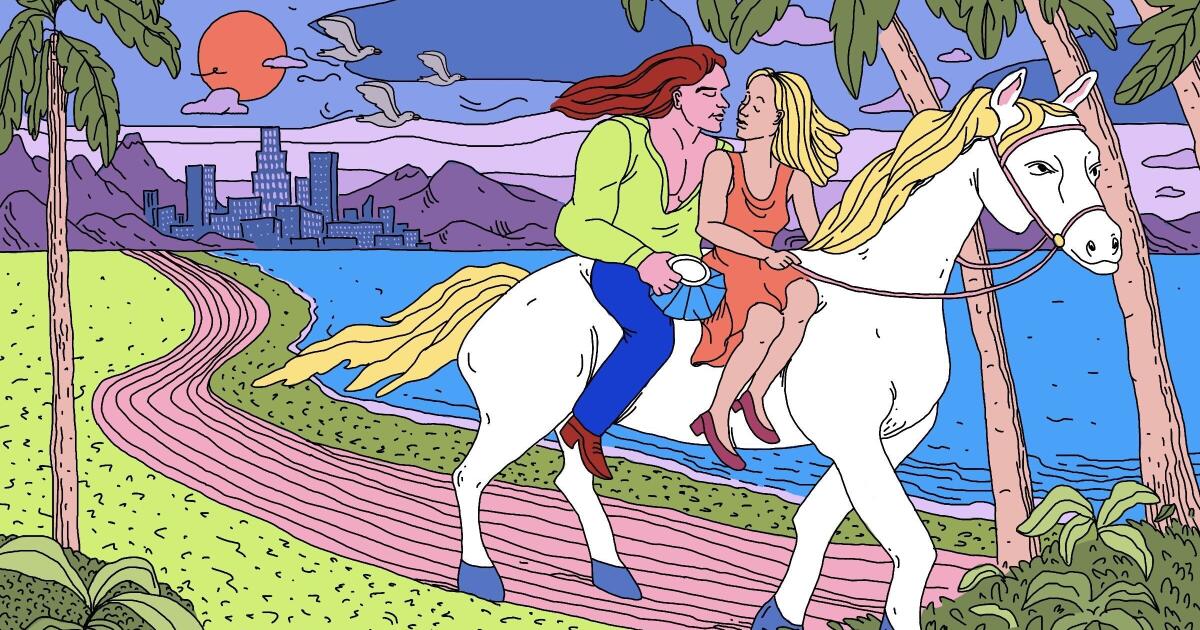
He introduced himself in broken English as Daniel. He had just moved to Southern California from Italy to be a chef at a local hot spot. I felt like I was stepping into the pages of a Harlequin romance. Pretty soon he’d be shirtless on a horse, and I’d be behind him, holding his abs so I didn’t fall. Like I really needed a reason.

He suggested we go back to his apartment for Prosecco and more dancing, and I did what any mid-50s woman would in my situation: I threw all reason, good sense and safety concerns to the wind and blurted “Yes, God, yes!”

Daniel asked if I had a friend who could join us because the pocket-sized man had ironically big pockets and would pick up our tab and drive us in his fancy SUV. I knew convincing a girlfriend wouldn’t be easy, so I went for the jugular. I used guilt. I’d been miserable for months going on years. Did my friends really want to deny me one night of a superficial, meaningless lust connection?

After a speedy ride where I sat on my one good butt cheek, the four of us arrived at Daniel’s apartment in Agoura Hills. He popped open some bubbly and made a toast that was seductive and unintelligible, but I was suddenly in my head.

Advertisement

What was I doing? I wasn’t ready for sex. I wouldn’t even get naked in front of a mirror! And what about the bump on my butt from the fall that was swelling by the minute? Would it be too conspicuous if I sat on a bag of ice or frozen peas? Before I could get to the freezer, Daniel pulled me and my spiraling in for a slow dance and he started singing to me in Italian. It was corny, off-key and incredibly romantic. My girlfriend, Shauna, seeing where this might go, asked Daniel’s friend to drive her home. (That is a comedy of errors for a whole other essay.)

I didn’t say goodbye. I was too focused on Daniel’s roaming hands that were headed south for warmer regions. I yelped as he touched the bruised cheek then quickly recovered with a flirty laugh. Encouraged by my fake flirty laugh, he started undoing the buttons on my jeans. I stopped him and moved his hands up. He moved them down. I moved them up. I wondered if you could have sex with your clothes on. It had been a minute since I’d had sex with someone new. Maybe things had changed.

He took my hand and led me to the bedroom. I looked at the bed and briefly wondered if the sheets were clean. As a mom, I could get stains out of anything. My domestic reverie was cut short as he took off his shirt. I looked at his ridiculous body and I knew it was my turn. I also knew I wasn’t ready. I got into bed fully clothed, and he crawled in next to me. He pulled me in and kissed me, and I forgot all about the divorce, the heartache and the fear of being alone. I was making out with a hot Italian guy with a hematoma on my butt that was now the size of a ping-pong ball, and it was exactly what I needed. I felt hotter and sexier than any sea bass, but most important, I felt hopeful. Maybe I was going to be OK after all.

The author is a Golden Globe-winning TV comedy writer from England. She lives in Woodland Hills, but her adventures happen everywhere. She’s on Instagram: @mariaannebrown

L.A. Affairs chronicles the search for romantic love in all its glorious expressions in the L.A. area, and we want to hear your true story. We pay $400 for a published essay. Email LAAffairs@latimes.com. You can find submission guidelines here. You can find past columns here.

Advertisement

Lifestyle

If you loved ‘Sinners,’ here’s what to watch next

Published

on

If you loved ‘Sinners,’ here’s what to watch next

Michael B. Jordan plays twin brothers Smoke and Stack in Sinners.

Warner Bros. Pictures


hide caption

toggle caption

Advertisement

Warner Bros. Pictures

What to watch if you loved…

Ryan Coogler’s supernatural horror stars Michael B. Jordan playing twin brothers who open a 1930s juke joint in Mississippi. Opening night does not go as planned when vampires appear outside. “In a straightforward metaphor for all the ways Black culture has been co-opted by whiteness, the raucous pleasures and sonic beauty of the juke joint attract the interest of a trio of demons … they wish to literally leech off of the talents and energy of Black folks,” writes critic Aisha Harris. The film made history with a record 16 Academy Award nominations.

We asked our NPR audience: What movie would you recommend to someone who loved Sinners? Here’s what you told us:

Advertisement

Near Dark (1987)
Directed by Kathryn Bigelow; starring Adrian Pasdar, Jenny Wright, Lance Henriksen
If you want another cool vampire movie with Western kind of vibes, check out Kathryn Bigelow’s Near Dark — super underseen and kind of hard to find, but really gritty and sexy and another very different take on what you might think is a genre that had been wrung dry. – Maggie Grossman, Chicago, Ill.

30 Days of Night (2007)
Directed by David Slade; starring Josh Hartnett, Melissa George, Danny Huston
It follows a group of people in a small Alaskan town as they struggle to survive an invasion of vampires who have taken advantage of the month-long absence of the sun. Both this and Sinners revolve around a vampire takeover and the people’s fight to outlast the “night.” – Nathan Strzelewicz, DeWitt, Mich.

The Wailing (2016)
Directed by Na Hong-jin; starring Kwak Do-won, Hwang Jung-min, Chun Woo-hee, Jun Kunimura
In this South Korean supernatural horror film, a mysterious illness causes people in a quiet rural village to become violent and murderous. A local police officer investigates while trying to save his daughter, who begins showing the same disturbing symptoms. The film blends folk horror, religion, and psychological dread, exploring themes of faith, evil, and moral weakness. Like Sinners, it centers on a supernatural force corrupting a close-knit community, builds slow-burning tension, and examines spiritual conflict and human frailty. – Amy Merke, Bronx, N.Y.

Fréwaka (2024)
Directed by Aislinn Clarke; starring Bríd Ní Neachtain, Clare Monnelly, Aleksandra Bystrzhitskaya
In this Irish folk horror film, a home care worker, Shoo, is assigned to stay with an elderly woman who’s convinced she’s under siege by malevolent fairies. Like Sinners, Fréwaka blends folk traditions and social commentary with horror. The social failures Shoo copes with (untreated mental health issues, religious abuse) are just as frightening as the supernatural forces. – Kerrin Smith, Baltimore, Md.

And a bonus pick from our critic:

Advertisement

Ma Rainey’s Black Bottom (2020)
Directed by George C. Wolfe; starring Viola Davis, Chadwick Boseman, Glynn Turman
This is an adaptation of August Wilson’s play about a legendary blues singer (Viola Davis) muscling through a recording session with white producers who want to control her music. Chadwick Boseman’s blistering in his final role. – Bob Mondello, NPR movie critic

Carly Rubin and Ivy Buck contributed to this project. It was edited by Clare Lombardo.

Continue Reading

Lifestyle

Solar energy for renters has taken off in 10 states. Not in California

Published

on

Solar energy for renters has taken off in 10 states. Not in California

The tiny town of West Goshen, Calif., was exactly the kind of place that community solar was designed for.

Near Visalia, most of its 500 residents live in mobile homes, where companies won’t install rooftop panels without a solid foundation. And until recently, they used propane for heating and cooking, with price fluctuations in the winter posing hardships for low-income families.

Community solar, in which residents get a discount on their bills for subscribing as a group to small solar arrays nearby, was designed to help low-income residents, apartment dwellers, renters and others who can’t put panels on their own roofs.

Over the last 11 years, New York, Maine, Minnesota, Massachusetts and other states have built thriving community solar programs. But California has built, at most, only 34 projects since 2015, and experts say that’s a generous accounting.

“We’ve had community solar for a dozen years, and it simply has not produced anything of scale and anything of note,” said Derek Chernow, director of Californians for Local, Affordable Solar and Storage, a developer trade group that’s pushing to get a more robust program off the ground. “Projects don’t pencil out.”

Advertisement

The West Goshen residents were among the lucky few, becoming part of a community solar project in 2024.

“It has kind of allowed us to kind of breathe a little bit,” said resident and community organizer Melinda Metheney. Her bill has dropped by about $300 in the summer months, thanks to the 20% community solar discount, stacked with other low-income discounts and clean energy incentives, she said.

West Goshen’s panels sit about 10 miles out of town, in a field surrounded by farms. Energy and climate experts agree California must add much more clean energy to its grid, some 6 gigawatts by 2032, the California Public Utilities Commission said in a new plan last week.

Assemblymember Christopher M. Ward (D-San Diego), who in 2022 authored a bill to create a more effective community solar program, said the state needs to double its annual solar installation rate to reach that goal and is not on track to do that using only large utility-scale solar farms and individual rooftop arrays.

“We need mid-scale community solar,” he said.

Advertisement
Aerial view of solar panels installed on top of Extra Space Storage in Pico Rivera

Energy and climate experts agree California must add much more clean energy to its grid, some 6 gigawatts by 2032, the California Public Utilities Commission said in a new plan last week. Above, solar panels at Extra Space Storage in Pico Rivera.

(Kayla Bartkowski / Los Angeles Times)

He and a coalition of environmental groups, solar developers and the Utility Reform Network, a ratepayer advocacy group, worked to put his 2022 law into effect. They coalesced around requiring utilities to pay community solar developers and customers for the electricity they feed to the grid using the same formula they use for people who install rooftop solar.

But in May 2024, the California Public Utilities Commission decided to go with a late-in-the-game proposal backed by the state’s investor-owned utilities to pay community solar at a lower rate.

The agency, along with its public advocate’s office, argued that crediting solar developers at the higher rate would raise bills for customers who don’t have solar, who would still have to shoulder the cost of grid maintenance. It’s similar to the argument they’ve made to cut incentives for rooftop solar.

Advertisement

The new program relied on federal money, including the Biden administration’s Solar for All, to sweeten the deal for developers. But the utilities commission spent very little of the $250 million available under that grant before the Trump administration tried to claw it back last summer, and now it is held up in litigation.

At a legislative oversight hearing last week, Kerry Fleisher, the commission’s director of distributed energy resources, blamed the loss for the new program’s failure to launch.

“There’s been a tremendous amount of uncertainty in terms of the Solar for All funding that was intended to supplement this program,” Fleisher said. “That’s part of the reason why this has taken longer than normal.” She said the commission still plans to release a program in the next several months.

Ward, the San Diego lawmaker who wrote the community solar bill, called the program “fatally flawed” in an interview.

He’s now considering a bill to bring the community solar program more in line with what he initially envisioned — higher incentives, requirements for battery storage, and compliance with state law that mandates new houses be built with solar.

Advertisement

A study last year funded by a solar trade group found that could save California’s electric system $6.5 billion over 20 years. But Ward’s effort to revive his program last year failed to pass the Assembly appropriations committee.

“All the other states in our country that have adopted similar community solar program models, they are working,” said Ward, adding that 22 states have programs comparable to the one solar advocates want in California. “The writing on the wall suggests that, exactly as we feared years ago, this was not the way to go.”

California Public Utilities Commission spokesperson Terrie Prosper called California “a leader in cost-effective, least-cost solar deployment overall compared to any other state,” in an emailed statement.

Under the commission’s definition, the state has brought on 34 projects, representing 235 megawatts of community solar. But studies from groups such as the Institute for Local Self-Reliance and Wood Mackenzie use different definitions for community solar, and they show California far behind at least 10 other states.

Meanwhile, advocates and developers involved in successful community solar projects in California say they were difficult to get off the ground.

Advertisement
A view of homes in the Avocado Heights area of Los Angeles County

Homes in the Avocado Heights area of Los Angeles County are part of a community solar project.

(Kayla Bartkowski / Los Angeles Times)

One that came online in May in the unincorporated communities of Bassett and Avocado Heights in the San Gabriel Valley provides solar electricity to about 400 low-income residents. They get 20% discounts on their electric bills for subscribing to panels installed on two Extra Space Storage building rooftops in Pico Rivera.

Organizers said it took nearly five years to find the right location and comply with utility requirements. They also got a grant in addition to funding provided by the state utilities commission’s solar program.

It “would not have happened if it hadn’t been for the grant,” said Genaro Bugarin, a director at the Energy Coalition nonprofit that proposed and coordinated the project.

Advertisement

Brandon Smithwood, vice president of policy at Dimension Energy, the developer for the project in West Goshen, said he still hopes to see a community solar program in California that compensates projects for the way they help out the grid.

“We’ve seen it can work, and we know what we have won’t work,” Smithwood said at the hearing.

Continue Reading

Lifestyle

Mundane, magic, maybe both — a new book explores ‘The Writer’s Room’

Published

on

Mundane, magic, maybe both — a new book explores ‘The Writer’s Room’

There’s a three-story house in Baltimore that looks a bit imposing. You walk up the stone steps before even getting up to the porch, and then you enter the door and you’re greeted with a glass case of literary awards. It’s The Clifton House, formerly home of Lucille Clifton.

The National Book Award-winning poet lived there with her husband, Fred, starting in 1967 until the bank foreclosed on the house in 1980. Clifton’s daughter, Sidney Clifton, has since revived the house and turned it into a cultural hub, hosting artists, readings, workshops and more. But even during a February visit, in the mid-afternoon with no organized events on, the house feels full.

The corner of Lucille Clifton's bedroom, where she would wake up and write in the mornings

The corner of Lucille Clifton’s bedroom, where she would wake up and write in the mornings

Andrew Limbong/NPR


hide caption

Advertisement

toggle caption

Andrew Limbong/NPR

“There’s a presence here,” Clifton House Executive Director Joël Díaz told me. “There’s a presence here that sits at attention.”

Advertisement

Sometimes, rooms where famous writers worked can be places of ineffable magic. Other times, they can just be rooms.

The Writer’s Room: The Hidden Worlds That Shape the Books We Love

Princeton University Press

Katie da Cunha Lewin is the author of the new book, The Writer’s Room: The Hidden Worlds That Shape the Books We Love, which explores the appeal of these rooms. Lewin is a big Virginia Woolf fan, and the very first place Lewin visited working on the book was Monk’s House — Woolf’s summer home in Sussex, England. On the way there, there were dreams of seeing Woolf’s desk, of retracing Woolf’s steps and imagining what her creative process would feel like. It turned out to be a bit of a disappointment for Lewin — everything interesting was behind glass, she said. Still, in the book Lewin writes about how she took a picture of the room and saved it on her phone, going back to check it and re-check it, “in the hope it would allow me some of its magic.”

Let’s be real, writing is a little boring. Unlike a band on fire in the recording studio, or a painter possessed in their studio, the visual image of a writer sitting at a desk click-clacking away at a keyboard or scribbling on a piece of paper isn’t particularly exciting. And yet, the myth of the writer’s room continues to enrapture us. You can head to Massachusetts to see where Louisa May Alcott wrote Little Women. Or go down to Florida to visit the home of Zora Neale Hurston. Or book a stay at the Scott & Zelda Fitzgerald Museum in Alabama, where the famous couple lived for a time. But what, exactly, is the draw?

Advertisement

Lewin said in an interview that whenever she was at a book event or an author reading, an audience question about the writer’s writing space came up. And yes, some of this is basic fan-driven curiosity. But also “it started to occur to me that it was a central mystery about writing, as if writing is a magic thing that just happens rather than actually labor,” she said.

In a lot of ways, the book is a debunking of the myths we’re presented about writers in their rooms. She writes about the types of writers who couldn’t lock themselves in an office for hours on end, and instead had to find moments in-between to work on their art. She covers the writers who make a big show of their rooms, as a way to seem more writerly. She writes about writers who have had their homes and rooms preserved, versus the ones whose rooms have been lost to time and new real estate developments. The central argument of the book is that there is no magic formula to writing — that there is no daily to-do list to follow, no just-right office chair to buy in order to become a writer. You just have to write.

Continue Reading

Trending
