Lifestyle
In today's global migrant crisis, echoes of Dorothea Lange's American photos


Dorothea Lange, Human Erosion in California (Migrant Mother), March 1936, gelatin silver print
The J. Paul Getty Museum
hide caption
toggle caption
The J. Paul Getty Museum

Dorothea Lange, Human Erosion in California (Migrant Mother), March 1936, gelatin silver print
The J. Paul Getty Museum
Migration is global these days. In this country, it echoes the desolation of the 1930s Depression, and the Dust Bowl, when thousands of Americans left home to look for work somewhere … anywhere.
In Dorothea Lange: Seeing People an exhibition at the National Gallery in Washington, D.C., the photographer shows the desolation of those days. Migrant Mother, her best-known picture, from 1936, is a stark reminder of the times
Curator Philip Brookman sees worry in the migrant mother’s face. Three children, the older ones clinging to her. She’s Florence Owens Thompson. Thirty two years old, beautiful once. Now staring into an uncertain future, wondering about survival.
But Brookman also sees “a tremendous amount of resilience and strength in her face as well.”
It’s an American face, but you could see it today in Yemen, Darfur, Gaza.
Lange was worlds away 16 years earlier in San Francisco. She started out as a portrait photographer. Her studio was “the go-to place for high society” Brookman says.
Dorothea Lange, Untitled (Fleishhacker Portrait), 1920, gelatin silver print
Collection of the Oakland Museum of California
hide caption
toggle caption
Collection of the Oakland Museum of California
For this portrait of Mrs. Gertrude Fleishhacker, Lange used soft focus and gentle lighting. Researcher Elizabeth Fortune notices “she’s wearing a beautiful long strand of pearls.” And sits angled on the side. An unusual pose for 1920. Lange and some of her photographer friends were experimenting with new ways to use their cameras. Less formal poses, eyes away from the lens.
But soon, Lange left her studio and went to the streets. It was the Depression. “She wanted to show in her pictures the kind of despair that was developing on the streets of San Francisco,” Fortune says. White Angel Breadline is “a picture she made after looking outside her studio window.”
Dorothea Lange, White Angel Breadline, San Francisco, California, 1933, gelatin silver print
National Gallery of Art, Washington
hide caption
toggle caption
National Gallery of Art, Washington
Dorothea Lange, White Angel Breadline, San Francisco, California, 1933, gelatin silver print
National Gallery of Art, Washington
Fortune points out Lange’s sensitivity to her subject: “He’s anonymous. She’s not taking anything from him. He’s keeping his dignity, his anonymity. And yet he still speaks to the plight of a nation in crisis.
A strong social conscience keeps Lange on the streets. She becomes a documentary photographer — says it lets her see more.
“It was a way for her to understand the world,” Fortune says.
The cover of the hefty exhibition catalogue shows a tightly cropped 1938 photo of a weathered hand, holding a weathered cowboy hat. “A hat is more than a covering against sun and wind,” Lange once said. “It is a badge of service.”
The photographs of Dorothea Lange serve our understanding of a terrible time in American history. Yet in its humanity, its artistry, it speaks to today.
Dorothea Lange, On the Plains a Hat Is More Than a Covering, 1938, printed c. 1965, gelatin silver print
National Gallery of Art, Washington
hide caption
toggle caption
National Gallery of Art, Washington



Flames from the Palisades Fire reach the grounds of the Getty Villa Museum on the Pacific Coast Highway amid a powerful windstorm on January 8, 2025 in Los Angeles, California. The museum was forced to close for around six months, causing a major drop in annual visitorship numbers for 2025.
Apu Gomes/Getty Images
hide caption
toggle caption
Apu Gomes/Getty Images
U.S. museum attendance was beset by natural disasters and political instability in 2025, according to The Art Newspaper‘s annual survey of “the world’s 100 most visited art museums.”
The January 2025 wildfires in Los Angeles hit the Getty Villa particularly hard. Attendance dropped nearly 60% due to the institution being closed for around half the year in response to damage caused by The Palisades fire. (Reached by email, The Getty noted the low attendance in 2025 was the result of the fire-related closure and not reflective of a drop in overall attendance since the museum reopened last June. Villa attendance numbers remain steady.)


Meanwhile, the federal government shutdown last fall crippled D.C. museums. The National Gallery of Art lost more than a quarter of its audience compared to the previous year. The National Museum of African American History and Culture’s and the National Museum of the American Indian’s numbers both dropped by nearly 15%. The National Portrait Gallery and Smithsonian American Art Museum saw audiences reduced to close to half of their pre-COVID size.
“The two museums had a particularly volatile year—with prolonged political battles with the Trump administration over programming, artists pulling out of exhibitions amid accusations of institutional censorship and high-level resignations,” The Art Newspaper said.
Stability despite volatility
Despite unsteadiness across the museum industry, the country’s most-visited institutions remained relatively stable.
Visitorship at New York’s Metropolitan Museum of Art — the world’s fifth most-visited art museum — was up by nearly 5%. Bolstered by the reopening of the Michael C. Rockefeller Wing, it attracted nearly 6 million visitors in 2025. Despite its shutdown troubles, the National Gallery of Art still ranked second in the U.S. in terms of visitor numbers last year. The Museum of Modern Art in New York saw a modest increase compared to 2024. And the Art Institute of Chicago experienced close to a 15% rise in attendance.
The power of prestige
The report attributes some of these gains to the power of blockbuster shows and big-name artists to draw crowds.
In New York, “Superfine: Tailoring Black Style” at The Met and the Jack Whitten retrospective at the Museum of Modern Art were top draws. “The Power of Names: Van Gogh” and Impressionist shows were major successes in D.C., LA and Boston. At the Museum of Fine Arts, Boston, a single Vincent Van Gogh exhibition accounted for more than a quarter of the museum’s annual attendance, which was up overall by 7% compared with 2024.
Big regional gains
Some regional museums also saw big gains.
The San Diego Museum of Contemporary Art nearly doubled its attendance. The Cleveland Museum of Art and Toledo Museum of Art also experienced significant jumps of more than 20%. Several museums even managed to best their pre-COVID benchmarks from 2019, including the Virginia Museum of Fine Arts and Frederik Meijer Gardens and Sculpture Park in Grand Rapids, Mich.
NPR has reached out to these museums for comment.
“In 2025, the museum welcomed more than 800,000 visitors, which was the highest attendance in the CMA’s nearly 110 year history,” said Todd Mesek, the Cleveland Museum of Art’s chief marketing officer in an email to NPR. “We believe that momentum is the result of sustained investment in exhibitions, public programs, and a commitment to free access, which ensures that our collection remains open and meaningful to all.” Mesek added that the ticketed special exhibition “Takashi Murakami: Stepping on the Tail of a Rainbow” generated the museum’s highest attendance in more than 25 years. The museum does not charge entry — and mostly never has — except for special exhibitions.
Global trends
The U.S. findings appear generally modest compared to other parts of the world covered in The Art Newspaper‘s report.

Notwithstanding a difficult year marked by a high-profile jewelry theft among other crises, the Louvre Museum in Paris — the world’s most-visited museum — still experienced a close to 5% gain in visitorship. It attracted more than 9 million people in 2025. And attendance at museums in East Asia — where, according to the report, “demand seems almost unlimited” — was particularly robust. The world’s third most-visited institution, the National Museum of Korea, Seoul, saw a whopping 72% jump on the previous year — “one of the largest rises in absolute numbers we have ever seen,” the report said.
However, political unrest derailed attendance at some institutions, especially in the Middle East. The Israel Museum lost 40% of its visitors compared with 2024, owing to Israel’s war in Gaza. The Tel Aviv Museum of Art faced cancellations of international exhibitions, and was shut for well over half the year owing to security concerns.
More than 200 million visits were made to the top 100 museums on The Art Newspaper‘s list, the report said. While this figure is still under the 230 million recorded in 2019, it is a vast improvement on the 54 million recorded in 2020.
“Our data for 2025 shows that, on the whole, art museums are as popular as they have ever been, with many of the biggest museums continuing to welcome millions every year,” the report said.
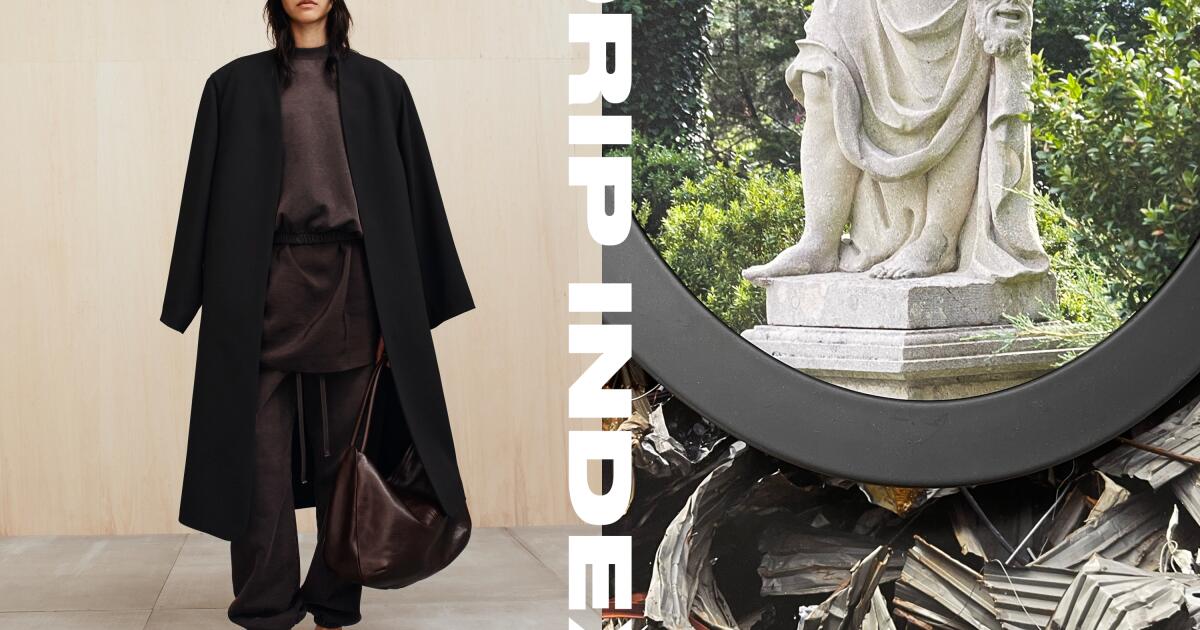
Fear of God women’s collection
The new womenswear collection from Fear of God brings a feminine touch to tailored classics.
(Fear of God)
A longtime staple in men’s luxury streetwear, this month Fear of God debuts its first womenswear line for Collection Nine. The collection brings a feminine touch to tailored classics that the house is known for, with wool cashmere coats and wide-leg slouch pants. Accessories include leather bags inspired by the sport duffel, and minimalist footwear — ranging from flats to slippers to kitten heels — for elegance at every occasion. Shop the collection online at fearofgod.com.
Awe Inspired X Jhené Aiko

The new collection from Awe Inspired X Jhené Aiko is out April 23.
(Awe Inspired)
What is your talisman? Is it a crystal? Is it a lucky coin? Or could it be a gold, labradorite beetle ring from Awe Inspired’s newest jewelry collaboration with Jhené Aiko? The collection taps into the animal spirit, including celestial medallions, saber-teeth, horns, claws and symbolic engravings, in line with Aiko’s forthcoming album, “West$ide Whim$y.” The pieces are like guardian symbols, designed to protect their wearer. They can also be worn as a statement or layered for everyday versatility. aweinspired.com
Madhappy Malibu opening

The new Mahappy Malibu location was designed as both a retail space and a cafe concept.
(Sean Davidson)
Madhappy has always been so L.A. Known for brightly lit, blue-floored stores, the brand opens its fourth permanent flagship in Malibu this month. After having to stall the opening because of last year’s fires, this retail location demonstrates the continued resilience of the L.A. community as they continue to fundraise and support local fire recovery efforts. Designed as both a retail space and a cafe concept, the store will feature collaborations with local favorites like Courage Bagels, Bianca and Beverly Hills Juice. 23465 Civic Center Way, Suite 860, Malibu. madhappy.com
“Portals” by Todd Gray at Perrotin

Todd Gray, “Portals (Antwerp, Paris),” detail, 2026. Three UV pigment prints on Dibond in artist’s frames.
(From the artist and Perrotin)

Artist Todd Gray.
(The Credit Line)
L.A.-based artist Todd Gray makes his debut at the Perrotin gallery with “Portals,” which combines eclectic photo sculptures inspired by the European Renaissance with landscapes from West Africa. The exhibition coincides with the unveiling of Gray’s commission at LACMA. Catch “Portals” through May 30. 5036 W. Pico Blvd., Los Angeles. perrotin.com
Ricari Studios opening

Ricari Studios lands in the Peninsula Beverly Hills.
(Ricari)
A new space for wellness and rejuvenation opens at the Spa in the Peninsula Beverly Hills: Ricari Studios. Known for its tech-forward treatments in blood circulation, tissue health and cellular vitality, the studio offers therapies for toning skin, relieving muscle soreness and lymphatic drainage. Treat yourself this April. 9882 S. Santa Monica Blvd., Beverly Hills. ricaristudios.com
“Curtains” by Jack Pierson at Regen Projects

Installation view of “Curtains” by Jack Pierson at Regen Projects.
(From the artist and Regen Projects)
Jack Pierson returns for his 11th exhibition at Regen Projects with “Curtains,” a collection of work that continues the artist’s exploration of language, using vintage signage and word sculptures coupled with old Hollywood lore like palm trees, clouds and roses. On view through April 18. 6750 Santa Monica Blvd., Los Angeles. regenprojects.com
Mykita’s new collection

It’s only getting hotter and sunnier. Berlin-based eyewear brand Mykita kick-starts a sunglasses spring with new minimalist lens shapes and ultra-slender lightweight frames. Whether rounded for elegance, cat-eye for chicness or with a gradient lens for a dreaminess, sunnies finish a look. Take your pick at mykita.com.
“Duets” by Josef Albers at David Zwirner

Josef Albers, “Study for a Homage to the Square,” c. 1970-1973, and “Study for a Homage to the Square,” c. 1970-1973.
(From the Josef and Anni Albers Foundation and David Zwirner)
Balance is always about mastering duality. “Duets” by Josef Albers is a study on paired compositions that are in dialogue: in form, in color and in texture. Marking the late artist’s first significant L.A. exhibition in decades, Albers’ works will be on display at David Zwirner starting April 9. 606 N. Western Ave., Los Angeles. davidzwirner.com
Damson Madder’s Appreciation Society

Gen Z’s favorite slow fashion brand, Damson Madder, is releasing its summer season “see-now-buy-now collection” that’s part-beach, part-city. Inspired by seaside U.K. town of Brighton, the collection pays homage to photographer Martin Parr’s candid stills of life by the beach. With tunic silhouettes, collars, ruffles, plaid and stripes, the pieces are a new playful summer uniform. damsonmadder.com
“Tatoo” by Ingrid Donat at Carpenters Workshop Gallery

Ingrid Donat, “Banquette aux Caryatides.”
(From the artist and Benjamin Baccarani for Carpenters Workshop Gallery)
Bronze, leather, textile and wood are fused together in furniture-focused sculptures by Ingrid Donat. For her first L.A. exhibition at Carpenters Workshop Gallery, she combines form and function with benches, couches and tables in a style that is simultaneously Art Nouveau, Art Deco and global. On view through May 29. 7070 Santa Monica Blvd., Los Angeles. carpentersworkshopgallery.com
“Free and Queer: Black Californian Roots of Gay Liberation” at CAAM

The Ache Project march, San Francisco, Calif. 1990s. Papers, General Collection, Beinecke Rare Book and Manuscript Library, Yale University.
(Lisbet Tellefsen)
Intersectionality is on display at the California African American Museum with “Free and Queer,” a show that puts Black LGBTQ+ Californians at the center of the civil rights movement. With archival photographs, film and newspapers, it spotlights voices from the movement and unheard historical narratives. On view starting April 7. 600 State Drive, Los Angeles. caamuseum.org

In her long-awaited memoir, Phases, entertainment icon Brandy is opening up about her storied journey from singing in church in rural Mississippi to building a decades-long career in Hollywood as a music artist, songwriter, producer and actress.
Kevin Winter/Getty Images/Kevin Winter/Getty Images
hide caption
toggle caption
Kevin Winter/Getty Images/Kevin Winter/Getty Images
It was in the late summer of 1993 when Brandy first captured viewers nationwide with the premiere season of the sitcom Thea. Playing the vibrant and savvy Danesha Turrell, Brandy stepped into a role that, though short-lived, would become the prelude to her now decades-long entertainment career.
In an interview with Morning Edition ahead of the release of her new memoir, Phases, Brandy recounted that these early achievements affirmed the childhood dreams she held so close growing up in McComb, Mississippi, and Carson, California. While working to reach her visions for herself, Brandy honed her singing and acting skills with the support of her singer and musican father, William “Willie” Norwood Sr., her mother and eventual manager, Sonja Norwood, and her younger brother, Ray J, whose full name is William Norwood Jr.
“All I wanted to do was be a singer, touch people with my voice and meet Whitney Houston. That was my dream. But God had other plans for me. I was able to expand into acting and all sorts of things that I never saw myself doing,” Brandy told NPR’s A Martinez.

Brandy at the ninth annual Soul Train Music Awards in 1995, where she won the award for R&B new artist following the release of her self-titled debut album, which went platinum and featured her chart-topping singles “I Wanna Be Down” and “Baby.”
Jeff Haynes/AFP via Getty/AFP
hide caption
toggle caption
Jeff Haynes/AFP via Getty/AFP
Brandy’s debut acting role came the same year that she secured her first record deal — with her signing to Atlantic Records. Just one year later in 1994, several months after Thea filmed its final episode, Brandy dropped her self-titled debut album. The platinum-selling album stormed the charts, producing two No. 1 singles on the Hot R&B/Hip-Hop Songs chart, three top 10 hits on the Billboard Hot 100 chart and securing Brandy’s title as an artist to watch.
“I just remember being fearless at 14, excited for everything, ready for all of the things that I saw myself doing. I just was so full of spirit,” said Brandy, whose full name is Brandy Norwood, though she’s gone by the mononym Brandy throughout her career.
From a rising star to a pop culture force
Less than a year after releasing her first album, Brandy had already accomplished one of her most coveted goals — meeting her idol Whitney Houston. The pair crossed paths at the Nickelodeon Kids’ Choice Awards in 1995, where Brandy was performing and Houston was hosting the show. Brandy said that encounter was the beginning of a “beautiful friendship” between her and Houston.
YouTube
Brandy and Houston soon worked together again when Houston asked Brandy to be on the soundtrack for Houston’s 1995 film Waiting to Exhale, a music project that Houston curated to feature a roster of all-women music artists and housed Brandy’s No. 1 single “Sittin’ Up in My Room.”
The following year, Brandy took on a new role on the UPN series Moesha, where she starred as the show’s title character, Moesha Mitchell. The show aired for six seasons until its end in 2001, a series run Brandy said she “couldn’t predict” would have lasted so long.

Brandy celebrates the 100th episode of Moesha with her castmates William Allen Young, Yvette Wilson, Shar Jackson, Marcus T. Paulk, Lamont Bentley, Sheryl Lee Ralph and Brandy’s real-life brother, Ray J.
Getty Images/Getty Images/Hulton Archive
hide caption
toggle caption
Getty Images/Getty Images/Hulton Archive
“It was nothing like Moesha on television. It wasn’t a young Black girl with braids on television, just tackling so many topics about life and what teenagers go through. It was different. It was family oriented. It just seemed really grounded,” Brandy said.
“I loved that it was set in Leimert Park. It was just the culture there. It was just so beautiful,” Brandy added, referencing the real-life historic Black neighborhood in Los Angeles where Moesha and her family lived on the show. “I was so happy that we tapped into it. It was such a fun time.”

Brandy and her real-life brother, Ray J, both appeared in the the television series Moesha. Brandy played the series’ title charachter, Moesha Mitchell. While Ray J memorably played several charachters on the show, with his best-known rolebeing Dorian Long.
Getty Images
hide caption
toggle caption
Getty Images
But it was in 1997 that Brandy played one of her most treasured roles — Cinderella in the Disney television film adaption of the musical Rodgers & Hammerstein’s Cinderella. Brandy was cast in the lead role by her own fairy godmother Houston — with Brandy making history as the first Black actress to play a Disney princess on screen.
While working on the film, Brandy says that Whitney centered her with “encouraging energy” and urged Brandy to be herself.
“She just made me feel safe to be myself and I just wanted to impress her,” Brandy said. “Anything I could think of to impress her, I would do it … to make her laugh, to do a run or something to just make her smile. Just because I loved her so much. And I still love her.”

Brandy and Monica arrive at the 41st annual Grammy Awards in February 1999 in Los Angeles, California. That night they won the Grammy Award for best pop duo/group peformance for their chart-topping single “The Boy Is Mine.”
Dan Callister
hide caption
toggle caption
Dan Callister
On the glass heels of the Cinderella film’s international success, Brandy released her 1998 sophomore album Never Say Never. The album included the track “The Boy Is Mine,” her record-breaking duet with her fellow teen sensation Monica. Brandy then closed out the decade with a Grammy win for “The Boy Is Mine,” her becoming the first Black singer to land a CoverGirl contract, Mattel’s release of a Brandy Barbie doll, and her recognition as a beauty and style muse — who’d become known for her trademark braided hairstyles and her fashion on and off the screen.
Balancing the dream
The bustle following Brandy’s debut album in 1994 had surged to a thundering confirmation by the end of the 1990s, with the multiphenate amassing a pop culture significance unrivaled by most of her teen-star contemporaries. But Brandy says navigating her preteen and teenage years as a public figure came with a crushing cost — the mounting expectations of perfection she often felt placed upon her professional and personal life.

Brandy performs during the 50th annual Primetime Emmy Awards on September 13, 1998.
Gerard Burkhart/AFP via Getty Images/AFP
hide caption
toggle caption
Gerard Burkhart/AFP via Getty Images/AFP
“You’re a teenager. That’s when you’re making mistakes, and falling down and trying to get back up — all of these things. And I wasn’t able to do that because I was an example. I was put in a position to be like a role model,” Brandy said.
“The pressures of staying on point and not making mistakes — it was hard to live up to for a long period of time,” Brandy continued. “Because life kicks in. And you do start to learn about yourself. And you do start to make mistakes. And you learn from those mistakes. But when you’re a child star, everything is on blast.”
An expansion of career and honoring of self
Brandy entered the new millennium with artistic fervor, exclaiming her coming of age as a young adult with her 2002 third studio album Full Moon and its acclaimed title track. Her Full Moon era also included the birth of her now 23-year-old daughter Sy’rai Smith, who Brandy says has pulled her own creative inspiration from the beloved project.
“[Sy’rai]’s an artist. She loves music. She can sing her little tail off. So I’m supporting her on her journey, becoming and blossoming into a beautiful artist,” Brandy said, adding that “Full Moon” is Sy’rai’s favorite song out of her mom’s catalog. “Her and her crew, every time that song comes on, they want me to know that they know every lyric. They know every word.”

Brandy visits BET’s 106 & Park and chats with the shows co-host Free in 2002 while promoting her third studio album Full Moon.
Scott Gries/Getty Images/Getty Images North America
hide caption
toggle caption
Scott Gries/Getty Images/Getty Images North America
In the decades following Full Moon, Brandy expanded her career through a melding of film, TV, theater and music projects.
As an actress, she’s taken on feature films like The Perfect Match, her lead role in the sitcom Zoe Ever After, her televsion movie with Sy’rai Christmas Everyday and starring on Broadway as Roxie Hart in the musical Chicago. She’s also continued to foster her musical evolution through studio albums that have found her exploring a range of sonic spaces — including her critically lauded Afrodisiac in 2004, her pop and R&B fusion Human in 2008, Two Eleven in 2012 and her musing experimental album B7 in 2020, which she co-wrote and co-produced.

Brandy’s daughter, Sy’rai Smith, pictured above on the left, is building her own career as a singer and actress. Sy’rai released her debut single “On My Own” in 2023, has been featured on several songs on her mother’s albums and Sy’rai appeared alongside Brandy in the Lifetime holiday movie Christmas Everyday, which premiered in November 2025.
Paras Griffin
hide caption
toggle caption
Paras Griffin
Despite her exhaustive list of creative pursuits, the past three decades have seen Brandy employ moments of dormancy from the spotlight — with her often going inactive on social media and generally retreating from the public eye between projects. It was during one such break that Brandy says she was able to fully address the emotional complexities of her life as a child star.
“Once I was able to step away from the limelight and really work on myself, and work on my self-worth, and heal, I was able to grow and become an amazing person, and mom and a role model for my daughter in the best way possible,” Brandy said. “So I’m grateful for what I’ve been through because I wouldn’t be the person that I am today.”
A timeless icon reinspired
Now putting shape to her fourth decade in the entertainment industry, Brandy says she’s building on the artistic energy she rediscovered during her record-setting joint tour with Monica last fall — which was named after their hit song “The Boy Is Mine.” The 32-date The Boy Is Mine Tour sold out arenas around the nation and dominated social media feeds with performance clips, photos and behind-the-scenes footage.

Brandy attends her Hollywood Walk of Fame induction ceremony on March 30, 2026, in Hollywood, California.
Kevin Winter/Getty Images/Getty Images North America
hide caption
toggle caption
Kevin Winter/Getty Images/Getty Images North America
“When I was creating [The Boy Is Mine] with Rodney Jerkins and LaShawn Daniels, I was watching a lot of [the Jerry Springer Show]. And I saw this [episode] where the show was called pretty much ‘The Boy Is Mine.’ And I was like we should do a song with another artist like Monica,” Brandy said. “I thought my idea for it was amazing. When I heard the song, I just had this idea of our voices going back and forth, and us going back and forth in the song, and producing it like that and. And nobody could see it but me. And I was right.”
“[‘The Boy Is Mine’] is the biggest song of our careers. It won us a Grammy. It put us back on tour 27 years later in 2025 in front of these amazing fans — and reinspired me and reignited me to do more performing and entertainment now. I’m so inspired because of ‘The Boy Is Mine’ and the tour,” Brandy said.

Brandy performs the national anthem ahead of the NFC Championship Game between the Los Angeles Rams and the San Francisco 49ers at SoFi Stadium on January 30, 2022 in Inglewood, California. Brandy’s white tracksuit paid homage to the white windsuit her idol Whitney Houston wore during her iconic performance of the national anthem at the Super Bowl in 1991.
Christian Petersen/Getty Images/Getty Images North America
hide caption
toggle caption
Christian Petersen/Getty Images/Getty Images North America
As Brandy waxes into a new phase of galvanized creativity and self-discovery, she’s reassured that she won’t be overshadowed by weighty expectations and misconceptions. Instead, this era of her life will be fully illuminated by the personal truths she assuredly proclaims in her long-awaited memoir, which she penned in collaboration with journalist Gerrick Kennedy.
“For so long my story was told for me. So given the opportunity to have a chance to speak myself and tell my own story, I just felt like it was divine,” Brandy said. “I wanted to give my younger self a voice and heal my inner child. Some of the things that I went through was super difficult, and I wanted to speak about that and inspire others.”
“[Gerrick Kennedy] helped me to recall some of the things that I didn’t remember and was able to put together a beautiful, compelling story to help other people feel like they can survive whatever they’re going through,” Brandy added.

Jonathan Majors Fell Through a Window on Daily Wire Action Movie Set; Producers Downplay the Accident Amid Crew Strike
Natural disasters and political instability hampered U.S. museum attendance in 2025

A folk musician became a target for AI fakes and a copyright troll

UK prosecutors charge 3, including dual Pakistani citizen, in arson attack on Jewish ambulances in London

FBI’s Patel delivers blunt warning to law enforcement attackers: ‘We’re going to put you down’

Florida High School Football Rankings: Top 25 teams – Oct. 21

How old is Bo Nix? What to know about Oregon quarterback ahead of 2024 NFL Draft

Cleary's 21 help Le Moyne down Central Connecticut State 69-64 in OT

99th annual Pony Swim held in Virginia

Indiana Members Credit Union announced as new anchor tenant at Bottleworks District
FBI’s Patel delivers blunt warning to law enforcement attackers: ‘We’re going to put you down’

Indonesia receives bodies of peacekeepers killed in southern Lebanon

Judge halts Trump effort requiring colleges to show they don’t consider race in admissions

Trump says ‘America needs God’ in Good Friday message touting ‘resurgence of religion’
Fact check: How can a country actually withdraw from NATO?
-

 South-Carolina6 days ago
South Carolina vs TCU predictions for Elite Eight game in March Madness
-

 Miami, FL1 week ago
Jannik Sinner’s Girlfriend Laila Hasanovic Stuns in Ab-Revealing Post Amid Miami Open
-

 Education1 week ago
Video: Transgender Athletes Barred From Women’s Olympic Events
-

 Minneapolis, MN1 week ago
Boy who shielded classmate during school shooting receives Medal of Honor
-

 Vermont7 days ago
Skier dies after fall at Sugarbush Resort
-

 Politics7 days ago
Trump’s Ballroom Design Has Barely Been Scrutinized
-

 Atlanta, GA6 days ago
Fetishist ‘No Kings’ protester in mask drags ‘Trump’ and ‘JD Vance’ behind her wheelchair
-

 Politics1 week ago
WATCH: Senate hearing goes silent after Angel Father confronts top Dem over daughter’s death