Lifestyle
How to have the best Sunday in L.A., according to Kyle Mooney


Now that he has a baby, Kyle Mooney doesn’t leave a certain L.A. radius much if he doesn’t have to. And he’s content with that. The “Saturday Night Live” alum spends most of his time in Pasadena, Glendale, Highland Park and, most of all, Eagle Rock, where he lives with his wife and their infant daughter. “I felt like the ‘artsiness’ of it was something I could relate to,” says Mooney, explaining why he was drawn to the neighborhood. “Highland Park 1734839354 feels a little bit like what Silver Lake did when I was in my 20s, but we were really struck by the neighborhood in Eagle Rock. I think it’s pretty special and quaint in an awesome way.”

In Sunday Funday, L.A. people give us a play-by-play of their ideal Sunday around town. Find ideas and inspiration on where to go, what to eat and how to enjoy life on the weekends.
Mooney has been revisiting the past lately, both on and off the screen. The actor and comedian made his directorial debut with “Y2K,” an early aughts set horror movie that imagines a world where machines actually do rise up against humanity as feared at the turn of the millennium. The film, in theaters now, will arrive available to watch at home on Dec. 24.
Outside of work, Mooney has been revisiting the past lately. He recently reinstated a love for baseball that was born during his childhood days in Little League. “It’s such a nerdy sport but for some reason it does something for me, it’s something that tickles my brain,” he says.
Mooney’s ideal Sunday includes baseball trivia, the hottest of hot sauces and multiple walks around the neighborhood. “Sundays have a very special place in my heart because when I worked on ‘SNL,’ that was my only day off,” he said. “So we would really take advantage of it and try to get as much fun stuff in as possible.”
This interview has been lightly edited and condensed for length and clarity.

8:30 a.m.: “Late” morning wake up
Throughout my 20s, I used to try to sleep in as late as possible so that if I woke up at 4 p.m., I could get away with only having to pay for dinner. And then when I was on “SNL,” the schedule is built for late night so you’re pretty used to sleeping in as late as you can just so you can handle [working] into the early morning.
Our schedule now is pretty much based around the baby. My wife and I switch off every couple days who wakes up with her. She gets up typically around 6-ish, sometimes as early as 5:30 a.m. So if I could sleep in until 9 a.m. or 9:30 a.m., that would be rad.

8:35 a.m.: Baseball trivia games in bed
When I wake up, I always play this [mobile] game called Immaculate Grid that’s a baseball stats game. It’s just recollecting stats that players have had and [recalling] the history of baseball. When baseball season’s going, I have like three other friends [who also play] and we send each other our scores. So I’ll play that and then I’ll hang with the baby.
I loved baseball as a kid. I got really into collecting cards and the history of it. There’s a Ken Burns documentary on baseball and they produced this big old book that my dad would read with me at bedtime when I was in fourth or fifth grade.
I really got back into baseball in the last couple years — I am from San Diego and I’m a Padres fan — and it was a funny feeling as the Dodgers were amid a World Series run to be wearing a San Diego baseball cap. Never before had I felt like a bad guy. This year was the first year where I was like “You know, I’m actually not going to wear my hat [in public].”

10 a.m.: Me-time while baby naps
I try to go to the gym when I can, but if not, I like to jog around the neighborhood. Being able to say that I jogged a mile or a mile and a half feels like a win.
When I’m on my jog, I’ll always listen to music and sometimes try to edit a playlist. That’s something that relaxes me. I turned 40 this past year and my wife and I had a shared birthday party so there was a lot of prep for building the playlist. Around that time, on these jogs I was adding songs to a massive playlist that was like 14 hours long and then making cuts, dwindling it down until it was like six hours of music that we could pass off to the DJ to pull from. The music I love the most for a party environment is ’80s R&B and funk, maybe Italo disco and yacht rock.

11 a.m.: Venture outdoors for brunch and margaritas
One of the places down the street from us is called Relentless, they’re great. They have a great margarita. And we almost every time get the cauliflower wings. They also occasionally have natural wine, which is something that both my wife and I are really into. They’re always good about making a scrambled egg for our baby that sometimes she’ll eat, which is a major win.
We also like to go to the Hermosillo, which is a bar in Highland Park that has great food. I love their cheeseburger, hot dog and fried pickles. They have a great outdoor area where you can hang with kids and there’s a lot of families so you don’t feel like you’re spoiling anyone’s time by having a loud child. We also sometimes go to Mijares in Pasadena for margaritas, chips and salsa and that classic, old-school Mexican cuisine.
11 a.m.: Alternate plan? Have a burning meal
We also go sometimes to the Greyhound, which is a bar and restaurant in Highland Park and Glendale. These days they have a great selection of wings and various sauces. The last time I got the hottest one. I like trying whatever the “fire, extreme danger, high voltage” wing is, especially if I’m at a new place. When we order takeout, if we’re getting Indian food or Thai food, I’ll put in a note like “Please make this as spicy as possible.” One of the spiciest dishes I’ve ever tasted was at Jitlada and they have a competition surrounding it. That was one that I probably had maybe four or five bites and was like “I actually can’t handle it.” I think it’s only happened maybe twice in my life where I’m like, “I can’t go any further.”
I did a Hot Ones Versus recently with Fred Durst, who’s in our movie. He was suffering. They claim we had their spiciest wing. I was grabbing them when I didn’t even have to, just enjoying them. I’m like “it’s not that spicy” but I looked like a clown with a big red ring around my lips.

3 p.m.: Second walk of the day
Both in the morning and [before dinner] in the evening, we’ll work in a walk with the whole family. I put her in the Baby Bjorn and we’ll walk around the neighborhood and look at birds and doggies and squirrels. One of the really awesome parts about Eagle Rock is that it’s full of nice people, so we see a lot of familiar faces and know a lot of the folks that we run into. And my wife and I can catch up on gossip if we want to.
4:30 p.m.: Dinnertime
Going out to eat twice in a day, I don’t know how often we do it. A place we love to go to a lot is Colombo’s down the street from us. It is definitely walkable but we typically drive just because it’s pretty hilly. I love Colombo’s, we’ve just figured out our order: I like the sausage and peppers dish, the steak, the fried mozzarella. My wife tends to do a make-your-own pasta with angel hair, garlic and butter. And then if I can handle it, I’ll get a cocktail martini.

6 p.m.: Gradual wind-down back home
Hopefully baby’s had food at dinner. If not, we’ll make her a little something. Maybe we’ll allow ourselves to watch a little TV, all of us together. Right now she’s really into the “Mickey Mouse Clubhouse,” she will also watch “Ms. Rachel.” And then we’ll get her ready for bed and read some stories and sing some songs. And then depending on our level of exhaustion, sometimes we’ll have friends come over and play Quiplash or something like that.
Usually we will just try to watch a movie on demand or rent one. We’re very bad at finishing them the same night. It almost always takes two days to the point that sometimes we’re paying twice to watch it.
Right now we’re in Christmas zone, so we’ll probably start revisiting the Christmas classics: There’s this animated movie from the ’70s that Rankin/Bass did called “’Twas the Night Before Christmas” that’s about a broken clock, essentially. And I love “A Garfield Christmas.” I’m a “Love, Actually” fan as well. And there’s always a black-and-white Christmas movie that I’ve never seen so sometimes we’ll find something that’s old but new to us.

8 p.m.: YouTube rabbit hole before bed
I like to shower [before bed] and sometimes I’ll go on baseballreference.com and learn about some baseball players. It’s just something to constantly be studying for the competition with my friends.
I truly can entertain myself on the internet for several hours. One recent YouTube search was “’80s Christmas specials.” I’m really obsessed with the idea that there are all these specials that aired on TV that just became lost media, they’re not on DVD or streaming or anything like that. “Flash Beagle” was a Charlie Brown cartoon from the early ’80s that was a spoof of the movie “Flash Dance.” Snoopy’s in a headband dancing and for some reason I’m obsessed.

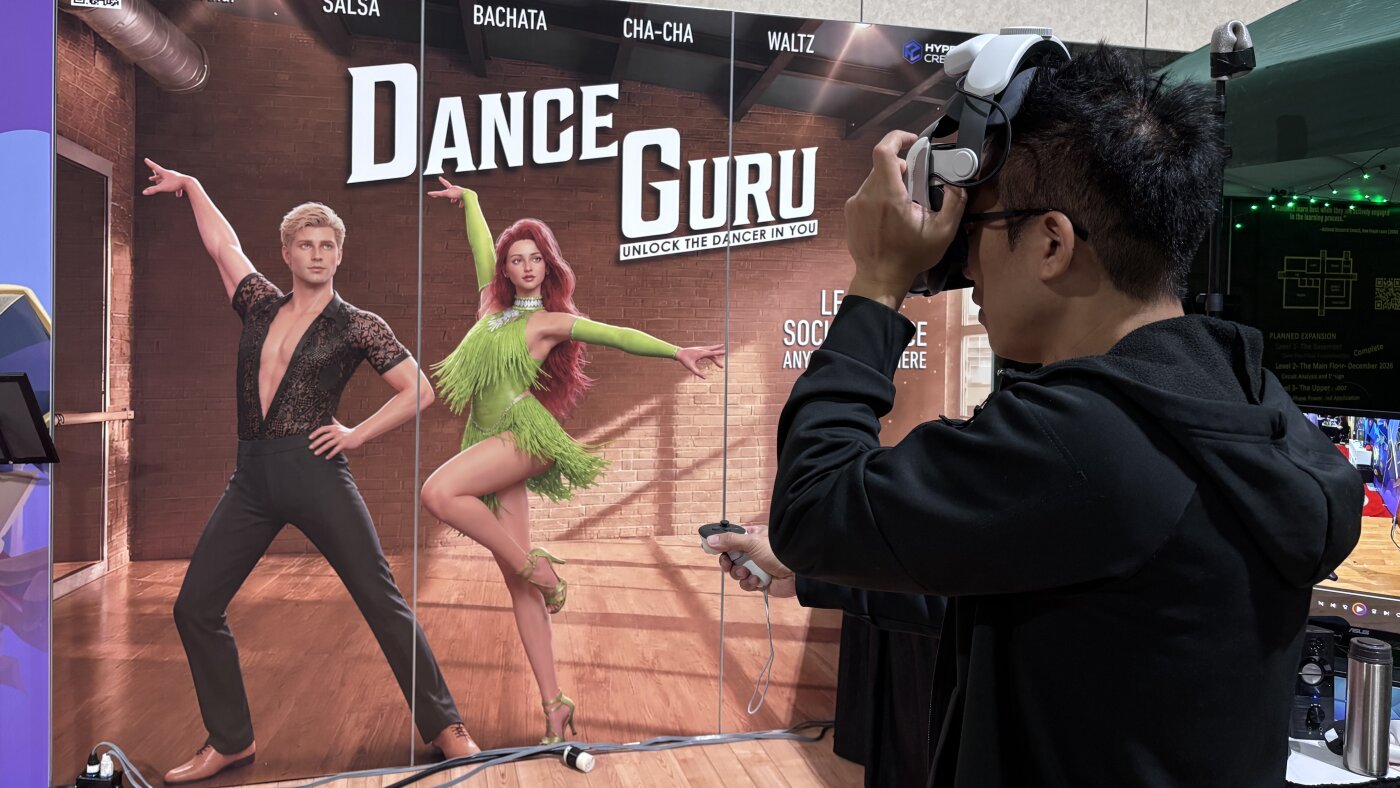
Entrepreneur David Huang tests out a VR headset while conducting demonstrations of the social dance lesson app Dance Guru at the Augmented World Expo in Long Beach, Calif., June 17, 2026.
Chloe Veltman/NPR
hide caption
toggle caption
Chloe Veltman/NPR
Wedding season is in full swing, bringing with it a familiar sense of dread for anyone who fears the dance floor.
But relief may finally be at hand with the help of a new app, Dance Guru, and a virtual reality (VR) headset.
The social dance instruction app transports users to a spacious, digital dance studio. Waiting inside is a computer-generated coach: a handsome, male avatar wearing a shirt open to his navel. He speaks with a slightly gravelly English accent.
“Watch me now,” he instructs at the start of a waltz lesson — which NPR tried out at the Augmented World Expo in Long Beach, Calif., an annual conference showcasing the latest developments in virtual and augmented reality.
The avatar then demonstrates a basic box step.

From there, the lesson becomes interactive. The coach tells the user to hold his hand while an electric pinging sound tracks the student’s foot placement.
“One, two, three, four, five, six,” the virtual teacher counts down.
When the user stumbles, he remains remarkably patient. “Do not worry, foundations take time. Let’s try that again. Work on grounding your steps more intentionally.”
Solving the beginner’s dilemma
Dance Guru creator David Huang said he came up with the idea for the app a couple of years ago out of frustration.
“I always wanted to learn to dance and I was always terrible at it,” Huang said. “And I always ended up stopping midway through the lessons.”
He soon realized that many beginners hit the exact same roadblocks.

“Private lessons are too expensive, and you feel like you’re always forgetting the dance steps,” Huang said. “You cannot find a partner to dance with. So I figured maybe I can create something like this.”
The Dance Guru platform currently offers tutorials in salsa, bachata, waltz, and cha-cha, in both lead and follow modes. To make the digital instruction feel authentic, Huang used motion-capture technology to record the movements of real-life dance teachers — with their permission.
Building on the legacy of online tutorials and video games
Dance Guru belongs to a small but growing wave of apps using VR to demystify social dance. At a nearby booth, conference attendee Victor Chen is testing out a competing app called Trip the Light. It currently offers salsa lessons, as well as freestyle options, where a user can dance with a partner without having to learn specific steps.

Trip the Light’s booth at the Augmented World Expo included posters of the app’s virtual instructors. Real-life performers, who gave Trip the Light permission to motion capture their movements, were used as a basis for these avatars.
Chloe Veltman/NPR
hide caption
toggle caption
Chloe Veltman/NPR
“A lot of times when you’re trying to learn a choreography, it’s watching a YouTube video and you have to pause it, rewind, and play it,” Chen said. “If you were to have a virtual avatar dancing in front of you and correcting for any parts that you missed, it might be a lot easier.”
Interactive video games like Dance Dance Revolution and Just Dance, and YouTube tutorials have been helping people improve their skills in private for years. But those games are mostly aimed at solo players. Unlike the new generation of immersive VR apps, they cannot simulate the mechanics or confidence required for partner dancing on a live dance floor.
The reality check
But this kind of app won’t work for every dancer.
“Everyone learns a little bit differently. And so unless you have a game that has lots of different ways of teaching, you’re going to have things that work for some people and don’t work for others,” said Ariana Katana, a trained contemporary dancer and dance content creator who’s active on YouTube, Twitch and other platforms. “Also, it’s hard to dance with a headset on.”
And then there’s the issue of not being able to physically feel a virtual partner’s hand or shoulder while dancing with them. Patrick Ascolese, the creator of Trip the Light, said the experience could become more tactile in the future. “Haptic suits and wearables will be coming, but I think we’re a little away from that,” he said.
Ascolese said even with their limitations, immersive tools like Trip the Light have immense potential as judgment-free training grounds — giving reluctant dancers the baseline confidence they need to eventually step onto the dance floor with real partners in the real world, including at weddings.
“Just like anything else, practice makes perfect,” said Ascolese. “So the more time you spend in VR with a virtual partner, it works towards helping you get over that social hurdle. We are teaching you the moves that you have to do in order to go out and have fun.”
Jennifer Vanasco edited the broadcast and digital versions of this story. Chloee Weiner mixed the audio.





For half a century, Deidre Hall has taken on every kind of disaster in the drama-packed town of Salem, Ill., as a star of “Days of Our Lives.”
There was the time — actually, it happened twice — when her character, Dr. Marlena Evans, was famously possessed by the devil and even levitated.

In Sunday Funday, L.A. people give us a play-by-play of their ideal Sunday around town. Find ideas and inspiration on where to go, what to eat and how to enjoy life on the weekends.
Or the time a serial killer, who was actually Marlena under hypnosis, seemed to kill several beloved characters. The long-running show’s storylines have become legendary, and in March, while promoting “Hail Mary,” actor Ryan Gosling even gave Hall a shout-out, admitting he was a fan, praising the hard work of soap opera actors and calling her an “OG acting inspiration.”
But Hall’s real life in Santa Monica is much quieter than her character’s, and she likes it that way.
“When I bought my house in Santa Monica, I didn’t realize how great it would be to live near Montana Avenue,” says Hall, 78, about the popular shopping spot. Every day, she walks to the main street with her golden retriever, Riley, and enjoys Pilates, art and good food along the way. “The owners of the Farms Market even keep dog biscuits, so guess where the dog wants to go every time we walk — the Farms, of course,” she says, laughing.
When she isn’t filming the daily soap opera, which airs on Peacock, Hall enjoys raising monarch butterflies, exploring the shops and restaurants on Montana, and hosting movie nights at home with her two sons.
Here’s what a perfect day in L.A. looks like for her.
This interview has been lightly edited and condensed for length and clarity.

7 a.m.: Breakfast and dog walk
I usually kick off my day with a protein shake, feed our golden retriever and take her out for a walk. She’s a phenomenal girl. When we adopted her, her name was Riley, but I did think about naming her after Mrs. Hughes from “Downton Abbey.”

10 a.m.: Church and garden time
After I walk the dog and go to church, I like to spend some time in my yard. I’m not a natural gardener, but I really enjoy it. I started raising monarch butterflies because my identical twin sister, who played my twin on the show, planted a butterfly garden. Monarchs are amazing because they are transitional. Every year, they travel from Mexico to southern New England, but it’s getting harder for them. Their numbers have dropped by about 80%. To help, I plant milkweed, which is what they need to survive. I buy my milkweed from the Staghorn Garden on Wilshire Boulevard in Santa Monica. Julie, who owns the nursery, is delightful and has a wide variety of milkweed. The monarchs always seem to find my garden. Julie was raising some caterpillars too, and she cared a lot about them. We talked about how important it is to help the butterflies. That’s why I do this. Sometimes I get milkweed with eggs already on it, and Julie knows her butterflies are going to a good home.

1 p.m.: Walk to Montana Avenue for some lunch
I live near Montana and love taking long walks, going to Pilates and trying out the great restaurants nearby, like R+D Kitchen and La La Land. I’m a big fan of the waffles at the Courtyard Kitchen. Just a few days ago, I had a chicken salad on raisin bread with an Arnold Palmer, and it was delicious. It is right on Montana and has a nice outdoor seating area. It’s one of my favorite spots. La La Land always has a long line in the morning, which is perfect if you want coffee. They serve coffee, doughnuts, croissants and avocado toast. There’s plenty of outdoor seating, and you can even bring your dog.

2 p.m.: Peek inside a clock shop
There’s a small clock shop on Montana Avenue that’s closed on Sundays, but if you walk by, you’ll see all kinds of clocks — standing, table and wall clocks. The owner is great at fixing them. Once, I bought a wall clock from MacKenzie-Childs, but it didn’t work. And I was really upset because it matched everything else on my countertop. I brought it to the owner and said, “I love this, but I can’t make it work.” He fixed it right away. His name is John, but I call him Geppetto. And we all know why. He really does have a magic touch.

2:30 p.m.: Visit a neighborhood art gallery
Ten Women Gallery is run by 10 artists, all of whom show their work there. I was drawn to some watercolors there, bought a few cards and spoke with one of the artists. She told me, “You seem to love watercolors,” and mentioned that the artist who painted them, Pamela Harnois, lives in Los Angeles and teaches nearby. I got Pamela’s name and found out she taught at the Brentwood Art School. I was so inspired by her gift that I started taking private lessons with her on Saturdays. That gallery is where I discovered my love for watercolor painting.

3 p.m.: Grab some ice cream at Rori’s
The other day, my longtime girlfriend wanted to get ice cream and told me, “We are walking to Rori’s Artisanal Creamery.” It’s a small shop on Montana near Lincoln. They make everything themselves, using local ingredients from grass-fed cows with no added hormones. The place is family-owned and probably has the healthiest ice cream you’ll find. They switch up their flavors often, but my favorite is the salted caramel.

6 p.m.: Family dinner and movie night at home
R+D Kitchen is always packed, so my sons, who are 31 and 33, do the cooking. They come over, and together we make salads and cook dinner. There’s a neighborhood grocery store called the Farms, off Montana, a small family-run place that has everything we need. Everyone knows each other there, and people bring their dogs. We try to have movie night every Sunday. Sometimes the day changes, but we always make sure to have one night a week where we cook a meal and sit down as a family. Keeping that tradition has become really important to us. My sons are great cooks, which is funny because they definitely didn’t get that from me. [Laughs]
9 p.m.: Take Riley for one last walk and visit neighbors
After dinner, I take my dog for a walk. It’s a great way to meet neighbors. We always go around the same block. We’ve met so many people, and since she’s a golden retriever, she loves meeting everyone.

10 p.m.: News, knitting and bedtime
I am a news junkie, so I usually watch whatever is on the news before I go to bed. I have a long-standing passion for knitting. Lately, though, the news would make me drop a stitch.
For Iris van Herpen, couture is a laboratory as much as a runway. Our chief fashion critic, Vanessa Friedman, takes us inside this Dutch designer’s latest Paris show — from sci-fi-inspired gowns to an audacious attempt at a dress made of charged plasma.
-

 North Dakota4 minutes ago
North Dakota State looks awesome on College Football 27
-

 Ohio11 minutes ago
Has there been an explosion of chipmunks this year? Yes. Here’s why
-

 Oklahoma14 minutes ago
How Will Oklahoma Softball Benefit From SEC Revenue Distribution?
-

 Oregon19 minutes ago
Razor clam harvesting set to close soon on north Oregon Coast
-

 Pennsylvania26 minutes ago
Pennsylvania Wins “Best in Show” at The Great American State Fair – Tri-State Alert
-

 Rhode Island29 minutes ago
How Federal Hill became Rhode Island’s iconic Little Italy food hub
-

 South-Carolina34 minutes ago
Editorial: SC Legislature left DUI and THC bills for dead; DUI restrictions can be revived
-

 South Dakota41 minutes ago
South Dakota GFP Commission Holds July Meeting

