Lifestyle
How Karis Dadson’s Icy Stare at Pig Shows Conquered TikTok


As she prepared to enter the pig ring on a recent weekend morning, Karis Dadson shifted her focus toward a judge who stood on a thick mat of sawdust shavings about 30 feet away.
That focus took the form of an icy stare that has captivated the hundreds of thousands of people who follow Karis, 14, and her family on social media. It was the same stare that has been celebrated by her fans — many of them young women — as empowering, “tuff” and the “meanest mug” in the game. The same stare that has been a source of inspiration to those who dream of emulating her while shopping for groceries, walking their dogs or confronting an annoying neighbor.
The same stare that has prompted such questions as: Who ticked her off? Does she feed her victims to the pigs? Can someone explain this to me?
And it was the same stare that was center stage last month at the Western Bonanza Junior Livestock Show, a three-day potpourri of denim, cowboy boots and expertly manicured animals — swine, sheep, goats and cattle — at the Paso Robles Event Center on the central coast of California. “The stare is iconic,” said Madelynn Gardner, 15, who ran up against Karis and her twin brother, Krew, in several contests over the weekend. “It’s a little intimidating.”
And it is purposeful. You just need to know a bit about livestock shows to understand it.
A field of more than 50 boys and girls, along with their pigs, had been cut to 16 for an age-group final in “swine showmanship,” a specialty for Karis. In showmanship, the exhibitors, as the handlers are known, are evaluated at least as stringently as their pigs are. Judges call out instructions and base their decisions on a host of factors, including how effectively the exhibitors present their pigs, the pigs’ responsiveness to their commands and the pace at which the pigs move. (Optimal pace? Between a jaunt and a trot.)
Karis, who stands 5 feet tall, wore a dark top with leopard-print sleeves, bluejeans and a Navajo pearl necklace, with her blonde hair in a bun. She was accompanied by Johnny Ringo, a 9-month-old, 270-pound crossbred barrow pig she had scrubbed to an immaculate shine.
By tapping him with a pair of small, thin whips that bore a resemblance to conducting batons, Karis guided Johnny Ringo through the ring while steering clear of four-legged traffic. As friends and family members watched from metal bleachers, Karis’s mother, Karalyn, crouched outside the ring with her Canon EOS R10.
“I always tell my kids that you have to try the be the least amount of annoying,” Mrs. Dadson said. “If the judges can’t find something annoying, you might stay up there.”
Through social media, the Dadsons, who raise and sell pigs, have brought livestock shows — and, more specifically, the niche world of show pigs — to the masses. A palate cleanser for doomscrollers, the videos, many of which have surpassed 10 million views, are a smorgasbord of farm-themed infotainment: tutorials, explainers, show recaps and, of course, crowd-pleasing stares. Karis, in particular, has emerged as a surprising symbol of female focus and determination — not that she meant for any of that to happen.
More than 100,000 young people participate annually in pig shows across the country, according to Clay Zwilling, the chief executive of the National Swine Registry. But there is only one pair of Dadson twins, who, Mr. Zwilling said, offer a “positive example of the show livestock industry” to many who never would have known it existed.
Karis and Krew have handled newfound celebrity in their own ways. While Krew says he likes the attention, Karis seems bewildered by it all. She sometimes wonders: How did she and her brother wind up on Will Smith’s Instagram feed? Why are so many other kids asking for selfies? Is she really a 21st-century queen and boss who, according to the internet, both serves and slays?
“It’s weird,” she said. “To me, I’m just another person showing a pig.”
Sharing Their Life
One of the semi-apocryphal stories about the Dadson twins is that they were born during a livestock show. The official version is that Mrs. Dadson went into labor while her husband, Kyle, was showing pigs at a nearby county fair. She had nearly told him he should stay home, but there was no chance it would play out that way.
It worked out in the end. After Mrs. Dadson called him, he beat her to the hospital, she said. Karis was born three minutes before Krew and has acted like his older sister ever since.
The Dadsons now live on a quiet street in Paso Robles, where they share their property with 12 show pigs, six sows, six piglets, two show sheep, four dogs, two ducks and four barn cats that work security.
“They’re supposed to eat the mice,” said Mr. Dadson, 46, an agriculture teacher at the nearby Atascadero High School, where Karis and Krew are freshmen.
Dozens of vinyl banners from livestock shows line the interior walls of the barn in their backyard where several of their pigs are housed. The twins have been showing pigs since they were 4. One of their first public appearances was at the California Pork Spectacular.
Mrs. Dadson, 38, had modest goals when she started sharing videos of her children competing. She had always enjoyed watching showmanship content online, she said, and wanted to contribute. She also was proud of her children. Best case scenario? Perhaps the posts would help the family sell some pigs.
So she was floored when her TikTok of Karis (staring, of course) at the 2022 Arizona National Livestock Show eclipsed one million views. Mrs. Dadson thought it would be a one-off. But then it happened again and again and again.
The overwhelming response to the videos was encapsulated in a comment from a TikTok user, which read: “Do I watch livestock shows? No. Did I know who this diva was the second she came on the screen? ABSOLUTELYYYY.” The comment alone received more than 20,000 likes.
The Dadsons have reached their largest audience via TikTok, where they have about 420,000 followers. But given TikTok’s uncertain future, Mrs. Dadson is glad the family has a presence on several other platforms, including Instagram, Facebook and YouTube.
For the record, all that staring is not a gimmick. Austin Thompson, one of the judges at the Western Bonanza, described making eye contact with judges as an “unwritten rule” in showmanship. It is a sign that the exhibitors are paying attention to the judge’s cues. And if it conveys confidence, that helps, too.
“I like the kids who come out of the gate with that kind of intensity,” Mr. Thompson said. “It just shows a little more care: They’re here to win and to do something.”
Karis said she had practiced until staring became second nature.
“I’m not thinking about the way that I look,” she said. “I’m thinking about how I’m moving around the ring.”
“I think it’s a little goofy,” Krew said.
‘We Are Pork Producers’
At the Western Bonanza, Karis was a cyclone of energy, bouncing between barns — she was also showing sheep — even though her path was interrupted every few feet so that she could give someone a hug.
“These are all my best friends,” said Karis, who checked her iPhone. “I’m already at 9,000 steps.”
Here, no one treated her like a social media star. Instead, she was just Karis, a teenager who likes to cook, spend time with her animals and gab on the phone with her friends.
At one point, her mother urged her to grab lunch.
“And not just Starbucks,” Mrs. Dadson said. “You need some protein.”
Karis resurfaced a few minutes later — with an ice cream cone. Her mother groaned.
“The line was too long!” Karis said.
It was also lunchtime for her pigs. James Backman, a show pig breeder from Denair, Calif., who works with several families like the Dadsons, was studying the animals to see how much additional feed each needed to bulk up before the next morning’s contests. The scene was vaguely reminiscent of boxers who cut weight before their bouts, except in reverse.
It served as a reminder that luminaries like Johnny Ringo are livestock, not pets. In the old days, farmers would get together to decide which of their pigs were best for breeding. Now, there are competitions, but the fundamental purpose is much the same. Some show pigs go back to breeders. Others are harvested for meat.
“My dad used to say that you’re producing a product that’s going to land on somebody’s dining room table,” Myrna Wicks, the Dadson twins’ maternal grandmother, said. “And it better be the best product you can put on that table.”
At the Western Bonanza, that message was reinforced when Karis grabbed a pulled pork sandwich from a friend’s nearby spread. Breakfast burritos at a food truck next to the pig barn came with a choice of bacon or chorizo.
Still, emotional attachments form on occasion (think: Wilbur from “Charlotte’s Web”). “There was one pig that Krew was like, ‘Do we have to get rid of him?’” Mrs. Dadson said. “His name was Dwayne.”
Krew gets it, though, and drove the point home when his family appeared on a recent episode of “The Pork Podcast.” The host had asked the Dadsons about their interactions with livestock show neophytes.
“Me, personally, I think the weirdest question I’ve seen on the comments section is, ‘Do you eat pork?’” Krew said. “And to answer that: Yes, we eat pork. We are pork producers, and we eat pork.”
While the Dadsons have earned enough money from social media to “pay for more pigs,” Mrs. Dadson said, the videos do not produce a steady stream of revenue. They enjoy other perks: free swag, for example, from animal feed companies like Hueber and Lindner, and from Andis, which manufactures clippers.
Given their visibility, the Dadsons sometimes feel like piñatas for animal-welfare advocates. Mr. Dadson said he had stopped reading the comments on their social media posts. Mrs. Dadson mines them for material so that she can correct misconceptions.
“It’s constant,” Mrs. Dadson said. “They don’t understand how well we take care of them. We like to think that they got to live out their best lives.”
The Dadsons can often be found wearing baseball caps with branding for All N, a hydration supplement. Their pigs apparently swear by it.
“Makes their skin pop,” Mrs. Dadson said.
‘She Commands Attention’
The pigs were not the only stylish ones in Paso Robles. The girls favored flared, boot-cut jeans by 7 for All Mankind with the No. 7 embroidered on the back pockets. Many of the boys wore jeans, button-down shirts and quarter-zips by Cinch.
“You put all this effort into their outfits,” Mrs. Dadson said, “and then they get ruined so fast. Pig poop all over them. But we try to keep them looking presentable most of the day.”
Despite the scatological obstacles, the fashion world has been calling. Karis recently made her modeling debut, appearing in the first issue of Domina Journal, a biannual art and fashion magazine that describes itself as a “testament to the perseverance of the artistic feminine spirit.”
Last summer, staff members from the magazine spent a few days at the family farm and at the California Mid-State Fair, where Jay Barrett, Domina’s editor in chief and fashion director, said Karis managed to stand out amid “cowboys in 10-gallon hats, rows of livestock and the biggest American flags I’ve ever seen.”
“She commands attention,” Ms. Barrett added in an email. “A look seasoned industry models strive for, at just 14, she’s got it. She’s exactly what we were looking for: defining female power, in an unexpected way.”
Karis said the photo shoot was fun. She also got a kick out of the people who dressed as her for Halloween. (One woman cast her husband in a supporting role as the pig.) But she knew her life had changed last summer when she was recognized at a series of livestock shows in the Midwest.
“It’s just different,” Karis said. “It’s not like I’m mad about it, but it’s new. I’m getting used to it.”
‘All These Kids Are Good’
In many ways, the Dadsons seem like accidental evangelists for the livestock life and the lessons they say it imparts to young people. Karis and Krew care for their pigs before and after school, feeding them, washing them and training them. They typically compete at one show a month.
In the process, Mr. Dadson said, the twins have learned how to create budgets and manage their time. Karis, who wants to work in agriculture when she grows up, said she was proud to be a part of her community.
“You could go up to any group in the pig barn,” she said, “and they would give you a three-course meal.”
Mr. Thompson, the judge at the Western Bonanza, recalled his own childhood raising show pigs. While the chance to compete often felt like a reward, each show produced only a handful of champions.
“It teaches you how to lose more than to win,” Mr. Thompson said. “You can work harder than anybody, and still not win. But you have to work to give yourself a chance.”
Win or lose, exhibitors invariably shake hands with the judge, though their disappointment sometimes manifests itself in the form of slouched shoulders and hangdog expressions.
For the longest time, Mrs. Dadson said, Karis looked up to her friend Maddy Lindley. Karis never thought she would compete at Maddy’s level, and when she did, her confidence soared. But Karis’s unusual level of public exposure has created unrealistic expectations.
“There are people who assume, ‘Oh, Karis should win every time,’” Mrs. Dadson said. “No, all these kids are good. You just don’t see their videos.”
At the Western Bonanza, the Dadsons advanced to the final in four contests. Karis won the showmanship crown in one and finished as the runner-up, or “reserve champion,” in another.
Whenever Karis left the ring and spotted her family, she abandoned the game face that has made her famous and adopted an expression that, as a show pig exhibitor, would most likely get her nowhere on social media: She smiled.



Lifestyle
Terry Tempest Williams on why women with big ideas get labeled ‘crazy’ : Wild Card with Rachel Martin
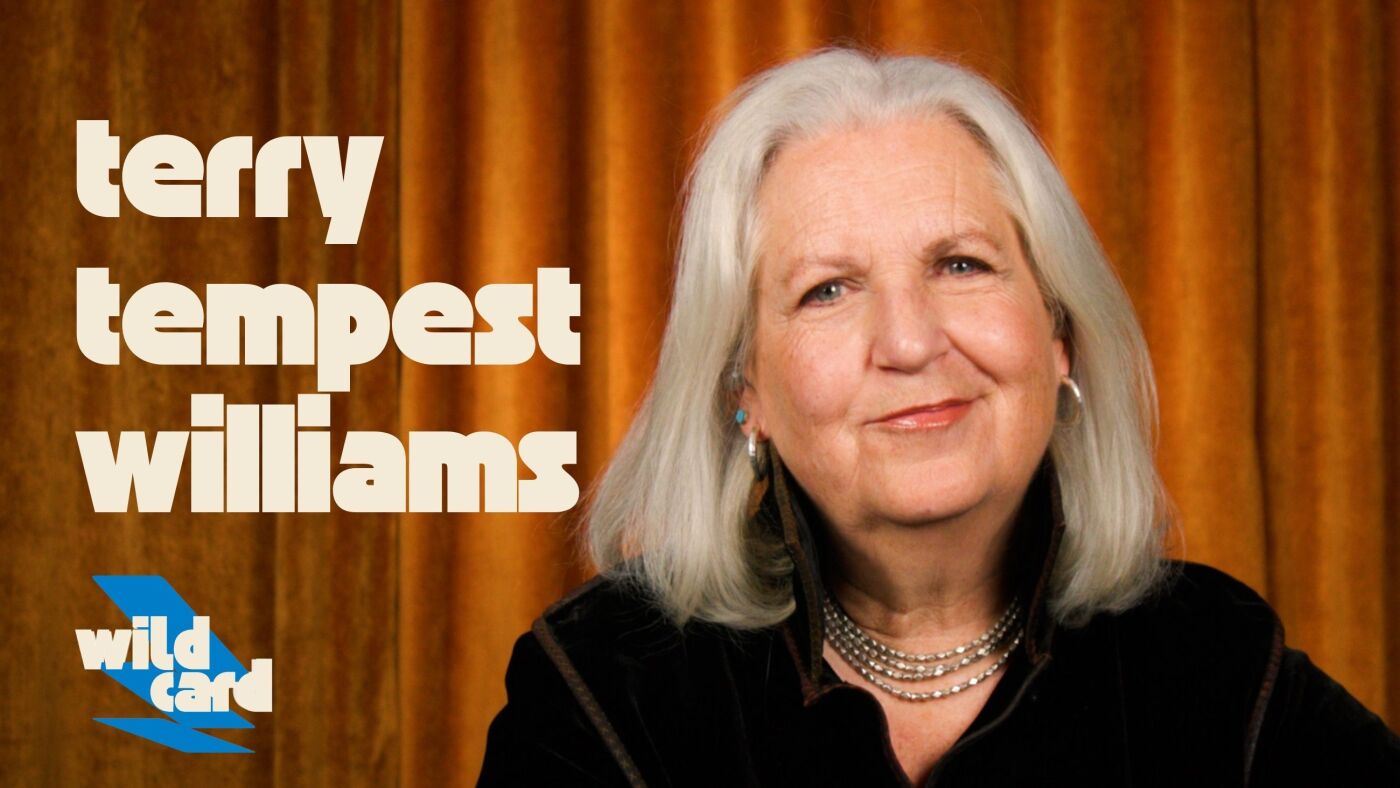
A note from Wild Card host Rachel Martin: I met Terry Tempest Williams about 25 years ago at a writer’s conference in Yosemite Valley. I was a young reporter who was there to do a story about how literature was addressing climate change and she made such a huge impression on me. I had never heard someone talk about the natural world the way Terry did and she had a spiritual depth I hadn’t encountered in my life at that point.
To this day, Terry’s writing always reorients me towards what is good, what is beautiful, and what is true. Her newest book is called “The Glorians.”

For its upcoming Los Angeles venue, experiential art firm Meow Wolf will focus on the art of storytelling, with a specific eye toward skewering our city’s moviemaking magic. To help bring that vision to life, Meow Wolf has entered into a creative partnership with Titmouse, one of L.A.’s most renowned independent animation houses.
The Hollywood-based studio behind popular series such as “Big Mouth” and “Star Trek: Lower Decks” will create animation that will be shown throughout the West L.A. venue, which is on target for a late 2026 opening at the Howard Hughes entertainment complex.
It’s a move that represents a shift for Santa Fe, N.M.-based Meow Wolf. Over the last decade-plus, the art collective has grown beyond its anything-goes, punk-meets-psychedelic roots into an organization with full-scale, maximalist installations in its hometown, Denver, Las Vegas, Houston and the Dallas suburbs. In the past, Meow Wolf kept most of its media in-house.
As part of its larger-than-life participatory art installations, Meow Wolf L.A. will feature a mix of live action and animation, the former filmed by Meow Wolf in its Santa Fe studio. Meow Wolf’s James Stephenson, a senior VP with the company and its creative director of emerging media, said the degree to which the L.A. exhibition will lean into various animation styles necessitated an outside partner. Titmouse’s work, in development by a number of directors with contrasting tones, will be shown on a variety of formats, ranging from cinema screens to full-room projections.
“I really believe in animation as an art form, and I know the Titmouse folks do too,” Stephenson says. “Animation is made by artists. It’s made by artists with their own hands. It’s something that is still very rooted in craft.”
Meow Wolf’s L.A. space is set in a former cinema complex, and will champion its location, taking guests on a journey through a converted movie house and beyond, into a sci-fi-inspired fantasyland with sentient spaceships and a 30-foot-tall mushroom tower. Meow Wolf creatives have spoken of the fantastical movie theater as one that will feature animated, self-aware candy before attendees enter the main exhibition space, making Titmouse’s work some of the first art guests will encounter. Titmouse co-founder Chris Prynoski has said the studio has lined up at least six directors for the exhibit.
An in-progress art installation destined for Meow Wolf L.A. at the art collective’s Santa Fe, N.M., headquarters. The L.A. exhibition will feature animation from Titmouse.
(Gabriela Campos / For The Times)
Titmouse, says Stephenson, is the right partner because “they’re known less for a house style, and more for a house vibe.” Over the years, Titmouse has been behind such diverse shows as “Scavengers Reign,” owning a Jean Giraud influence rooted in French and Spanish surrealism, the lively “Jentry Chau vs. the Underworld,” with an unique color palette that took inspiration from anime and Chinese mythology, the exaggerated comic book feel of Adult Swim’s “Metalocalypse,” and the approachable yet expressive tone of “Star Trek: Lower Decks.”
“Meow Wolf’s vibe is similar to Titmouse’s vibe,” Stephenson says. “It’s artist-first, artist-driven, independent and kinda edgy. They are always trying to find the edge of what’s possible. They try to see how far they can go, and it’s done for fun and in the spirit of taking risks.”
Prynoski says working with Meow Wolf will give Titmouse a sense of artistic freedom it doesn’t always have when delivering content for more traditional Hollywood partners. He says the multi-director approach is a callback to the early days of Warner Bros. Animation, when individual creators put their own stamp on Looney Tunes material.
“I use Bugs Bunny as an example,” Prynoski says. “You’ve got a Friz Freleng Bugs Bunny short. You’ve got a Chuck Jones Bugs Bunny short. You’ve got a Tex Avery Bugs Bunny short. They’re all different versions of Bugs Bunny, and people who are really paying attention can tell which director directed each one. Even though to the layman, these are all Bugs Bunny, but if you lined them up, they are drawing in different styles, sensibilities and techniques.”
Prynoski says that was a centerpiece of his pitch to Meow Wolf, noting that characters will reappear in multiple installations, each handled by a different artist. Meow Wolf L.A., in fact, will be the firm’s most character-driven exhibition, as guests will follow the storylines of three main protagonists throughout the space.
In announcing the partnership, Meow Wolf and Titmouse released an image from an animated work directed by Luca Vitale. It features a key character having a moment with a hummingbird and it’s done in an elegant, slightly anime-influenced style. It’s an image full of movement, reflecting a character in transition with inviting pastels and bold dashes.
“I like that image because I think it captures some of the sense of wonder that we want people to feel,” Stephenson says. “The character is having an encounter with the elusive nature of creativity and reality in a way that makes them have a different perspective of what’s possible.”
Other contributing animation directors to Meow Wolf L.A. include Space Dawg, Felix Colgrave, Alexander Vanderplank and Phimémon Martin, and Jun Ioneda.
Titmouse’s partnership with Meow Wolf will extend beyond the L.A. exhibition. The two will be working on the development of Meow Wolf New York, which is slated to open some time after Los Angeles, and are collaborating on a planned animated series, which Prynoski is spearheading.
Meow Wolf exhibits are the result of sometimes hundreds of disparate artists coming together in a shared space. Distilling that into a signature, singular style for a series could be a challenge. Stephenson pinpoints some guiding principles.
“You really need to feel the hand of the artist,” he says. “You need to feel a DIY aesthetic. You need to feel the materiality. Those are very specific to what we are.”

The Kennedy Center on June 28, with its facade signage still covered by a tarp and scaffolding.
Alex Wroblewski/AFP via Getty Images
hide caption
toggle caption
Alex Wroblewski/AFP via Getty Images
On Wednesday, a federal appeals court denied President Trump’s request to stop the removal of his name from Washington, D.C.’s Kennedy Center. The signage on the building has been covered with tarp and scaffolding since June 13, but in a court filing last month, the center’s current executive director said that Trump’s name has been removed.
In their decision, three judges from the U.S. District Court of Appeals for the District of Columbia Circuit said that the president had failed to prove that the arts center would be “irreparably injured” without Trump’s name attached to it.

NPR requested comment from the Kennedy Center, but did not receive an immediate reply.
This latest round of court decisions is part of the ongoing litigation filed by Rep. Joyce Beatty, D-Ohio, against President Trump and the board of the Kennedy Center. In a statement emailed Wednesday to NPR, Beatty said: “Today’s ruling again affirms that this administration’s efforts to rename the Kennedy Center were unlawful. His name no longer desecrates this sacred memorial, which belongs to the American people. Now it is time for the Trump administration to accept this, comply with the law, and take the tarps down.”
In previous court filings, Trump’s legal team had asserted that removing the president’s name from the arts complex, both on the physical building and in its digital materials, would inflict irreparable harm in both time and money already spent. In the denial, the three judges — Patricia Millett, Robert Wilkins and Gregory Katsas — wrote that since Trump’s name has already been removed, “a stay would not avert those harms.”
Furthermore, Trump had claimed that without his name attached, future fundraising would be threatened “and [will] contribute to the financial decline of the Center.” In response, the appeals judges wrote: “Appellants, however, have failed to support this assertion with any specific facts or evidence. They offer only the conclusory assertions of the Kennedy Center’s Executive Director that were made in a factually unsupported declaration.” The center’s current executive director, Matt Floca, specializes in physical plant management.

The presiding judge in the case, Christopher R. Cooper, has ordered that the center provide him a status report on the center’s operation and programming before the end of this month. As of Wednesday, the center’s calendar lists a small roster of programs, including outdoor free movie screenings, workshops for children, and five free live performances in July on its Millennium Stage. In the past, the Kennedy Center presented over 2,000 arts and education events each year, including free daily Millennium Stage performances.

-

 Ohio4 minutes ago
Feeling itchy? Ohio leads nation with 6 cities on Orkin’s 2026 bed bug list
-

 Oklahoma7 minutes ago
Oklahoma’s Brent Venables named to 2026 Dodd Trophy Preseason watch list
-

 Oregon12 minutes ago
Ryan Reynolds-backed Aviation Gin shutters Oregon distillery
-

 Pennsylvania19 minutes ago
PA state rep. wants to force the York State Fair to change its name
-

 Rhode Island22 minutes ago
R.I. leading multi-state lawsuit against Trump administration housing policy – The Boston Globe
-

 South-Carolina27 minutes ago
SC is at the top for food waste in the nation. How you can make changes
-

 South Dakota34 minutes ago
Petition to clarify South Dakota proof of citizenship law shot down over technicality
-

 Tennessee37 minutes ago
Tennessee State men’s hockey cancels 2026-27 inaugural season for second straight year

