Lifestyle
How does a holiday tradition shine for 104 years? Meet Altadena's village of volunteers


• Christmas Tree Lane in Altadena is a neighborhood holiday lights extravaganza that’s taken place nearly every year since 1920.
• 135 deodar cedars stretching nearly a mile along Santa Rosa Avenue are strung with lights by volunteers each year for the event.
• This year’s lighting ceremony and winter festival takes place from 3 to 9 p.m. — the lights turn on at 6 p.m. — on Dec. 7.
If Santa were skinny and endlessly energetic, he’d be a dead ringer for Scott Wardlaw, president and chief cheerleader of Altadena’s 104-year holiday tradition known as Christmas Tree Lane.
But Wardlaw’s domain is nowhere near the North Pole. Since late September, sometimes in triple-digit heat, he’s been wrangling 20 to 30 volunteers every Saturday and Sunday to get the lane’s 135 massive deodar cedars strung with lights in time for the holidays.
His crew is mostly high school students collecting community service hours along with old hands who have been using wobbly ladders, ropes and pulleys for years to string long strands of lights from the cedars’ graceful branches.
Once the lights are pulled as high as the pulleys will allow, the volunteers whip and flip the strands of lights as best they can from the ground to cover the canopy of bristly branches that stretch nearly a mile along Santa Rosa Avenue (the real name of Christmas Tree Lane) from Woodbury Road to East Mariposa Street.
Wardlaw is 76 and walks with a limp, but on a Saturday in late October, it doesn’t stop him from striding up and down the block repeatedly, answering questions, encouraging newcomers and demonstrating how to muscle a stubborn string of lights up and over an uncooperative branch.
1
2

3

4

1. Scott Wardlaw, 76, president of the Altadena Christmas Tree Lane Assn., pulls on a string of lights while hanging lights on the massive deodar cedars on Santa Rosa Avenue. (Genaro Molina / Los Angeles Times) 2. A volunteer carries a basket of LED light bulbs that will be used on Christmas Tree Lane. 3. Volunteer Clyde Haslett, 13, clutches a handful of lights to replace burned-out bulbs. 4. Volunteer Clyde Haslett tackles the tedious but necessary job of replacing burned-out lights. (Genaro Molina / Los Angeles Times)
It takes nearly 10 weekends to get the lights in place in time for the annual Christmas Tree Lane Lighting Ceremony and Winter Festival, which this year is from 3 to 9 p.m. Saturday and includes vendors and speakers outside the Altadena Public Library. The lights come on at 6 p.m., and visitors will be able to walk the lane until 9 p.m. to admire the display, which is then open to vehicles until the lights go out on Jan. 5.
After all that, the volunteers turn out again for another eight to 10 weekends — depending on the weather — to take the lights back down. It’s not possible to leave the lights up during the year, Wardlaw said. High winds and/or heavy rains can damage the strings, and the trees grow so rapidly that lights quickly become unreachable and can’t be removed for maintenance.
Santa Rosa Avenue has no sidewalks or street lights, so for safety’s sake, once it reopens to traffic, Wardlaw recommends that visitors drive the route. And many thousands do every year, despite the old-school, low-tech display: basically long strands of multicolored lights hoisted a good 30 feet high on the cedars’ stately branches, creating a quiet canopy of sparkly colors for the slow-moving cars lined up underneath.

Temple City High School student Desmond Xie, 14, left, gathers a string of lights to be pulled up into one of the 135 deodar cedar trees that are decorated each year on Altadena’s Christmas Tree Lane.
(Genaro Molina / Los Angeles Times)
“A lot of people are looking for flashy, blinky lights and the sound of music, but that’s not really what we’re about here,” said volunteer foreman Derek Nowak, a 22-year-old urban planning student at Cal Poly Pomona who began helping with the lights when he was 8.
“We’ve had people ask us, ‘Can’t you at least sync it to some music?’ And we have to say, ‘Well, no, unless you want to sit out here every night and flip the switch,” Nowak said, rolling his eyes.
Nowak is a steady, unflappable volunteer who shows up every Saturday and Sunday from 8 a.m. to noon to make sure the work is completed properly. He grew up around the corner from Christmas Tree Lane, and during the holidays, he’s the one who comes out at night, during wind and rainstorms, to fix lights that aren’t working.
He’s been replacing bulbs and rewiring these light strands since he was a teen under the tutelage of his predecessor, longtime volunteer Tony Ward, and he probably knows the ropes almost as well as Wardlaw, who’s been a volunteer since 2008. But he’s taken aback when he’s asked to explain why such an old-fashioned tradition persists.
“What we’re doing is more for the history,” he said finally. “This is something special for the identity of the community. It makes us unique, in a way.”

Volunteers Casty Fortich, from left, and Temple City High School student Patience Cam, 14, pull on a string of light bulbs as Scott Wardlaw and Feli Hernandez, right, look on.
(Genaro Molina / Los Angeles Times)
Sisters Tessa and Hannah Skidmore seem just as flummoxed by the question about why Christmas Tree Lane has been a hit for generations. Tessa, a junior at John Muir High School, followed the lead of Hannah, a senior, who joined the crew as a freshman to collect community service hours. Students need 40 hours of community service to graduate. Hannah, after some prodding from Wardlaw, admits she has 400 community service hours, many from her years of volunteering at Christmas Tree Lane.
But why? Hannah stares at her sister, who laughs and shrugs. “It’s cool to see your work on display when it’s done,” Hannah said finally. “It’s not always fun to be out here, but it’s pretty wonderful to see what the end is. You couldn’t have all this without community service. I guess it’s because it makes things better.”
Her friend Aaydan Aguilar, another John Muir senior, also started his freshman year. At first, he said, it was just for the community service hours. He learned through the school’s Interact Club that the lights he’d loved all his life weren’t put up by the city. “It was this little community organization that needed help,” he said. “And I take care of my own.”
Learning that Christmas Tree Lane is a volunteer operation makes an impression on people, said Ward, 80, who began helping with the lights soon after he and his wife, Maureen, moved to Santa Rosa Avenue in 1971.
They started slow at first, helping to install lights on their block, but eventually their involvement grew. Both served as presidents of the organization, and all five of their children were drafted as volunteers. (“It was an expectation in the Ward household,” Maureen said, laughing.)
1

2

1. Derek Nowak, 22, volunteer foreman of the Christmas Tree Lane installations, prepares to plug a string of lights into an electrical box installed on every deodar cedar on Santa Rose Avenue. Nowak has been helping with the installations since he was 8. 2. Longtime volunteers Tony Ward, 80, and his wife Maureen, 74, have been involved with the Christmas Tree Lane Assn. since they moved to their home on Santa Rosa Avenue in 1971. (Genaro Molina / Los Angeles Times)
But over their decades of service, they never really considered making any changes to the display. “We’ve had feedback,” Tony said, “that people like the small-town atmosphere of Christmas Tree Lane.”
The lane’s history (compiled in a series of short videos by Altadena Libraries, the Altadena Historical Society and Christmas Tree Lane Assn.) dates back to the community’s creation. Back in the 1880s, what is now Santa Rosa Avenue was actually built to be the grand entrance to the home of Altadena’s founder, real estate developer and rancher John Woodbury.
In 1883, Woodbury saw and fell in love with deodar cedars, which are native to the Himalayas in India. The cedars came to Altadena via Italy. After he determined the cedars could thrive in Southern California, Woodbury bought some seeds and had his brother (and partner) Frederick grow them into young trees on their ranch in Altadena. Frederick had already built his house next to the site where John planned to build his.
Two years later, the trees were planted along the long driveway leading to John Woodbury’s future home, under the supervision of ranch foreman Tom Hoag, according to the Christmas Tree Lane Assn.’s official history.

A volunteer from Temple City High School makes sure there are no faulty light bulbs.
(Genaro Molina / Los Angeles Times)
In those days, the long driveway that would become Santa Rosa Avenue was compacted dirt, so lots of effort went into keeping the surface intact during rainstorms, when runoff from the foothills tried to wash it away, Wardlaw said. The solution was mounding the road a bit in the center and building sloping stone-lined ditches on both sides of the avenue to carry the runoff away.
Those slippery ditches still function well today, but they make working against the trees challenging. The adult volunteers have to carefully adjust their ladders to get firm purchase on the stones, so they can climb up to the power boxes installed on the trunk of each tree, a good 15 to 20 feet above the ground. The ladders look a bit precarious, and student volunteers aren’t permitted to use them. But longtime volunteers such as Tony Price and Casty Fortich climb up and down with ease, plugging each string of lights into its power box to make sure they work.
John Woodbury never built his grand house due to the real estate bust of 1887, but the stately avenue became part of his legacy, coming to be known as the Avenue of the Deodars. In 1920, Altadena resident and Pasadena department store owner Frederick C. Nash came up with the idea of stringing lights along the cedars during the holidays.
Nash enlisted help from the city of Pasadena and fellow members of the Pasadena Kiwanis Club to light up a quarter mile of the street.
Within a few years all the deodars were strung with lights, and ever since, people have come by the thousands to admire them. The only years the lights weren’t on was during 1943 and 1944 — not because of World War II, but because the snowpack was very low those years, causing concerns there wouldn’t be enough water to generate hydro electricity, according to the history.
1

2

1. A vintage postcard bearing a 1947 postmark, from the collection of L.A. Times reporter Patt Morrison, tells the story of Altadena’s Christmas Tree Lane, although the dates differ from the Christmas Tree Lane Assn.’s official history that Frederick C. Nash started the lighting in 1920. 2. From Dec. 25, 1948: “BRIGHT HIGHWAY — Lights on Altadena’s Christmas Tree Lane went on last night, and more than 1,000 cars witnessed the annual spectacle of brilliantly lighted 80-foot trees,” according to The Times. (Los Angeles Times)

Motorists cruise Santa Rosa Avenue, better known as Christmas Tree Lane in Altadena, in 2018. The holiday light tradition has continued in pretty much the same way for 100 years.
(Calvin B. Alagot / Los Angeles Times)
In 2020 and 2021, the COVID-19 pandemic canceled the annual Christmas Tree Lane Lighting Festival, but volunteers still got together to hang the lights.
The lighting ceremony and winter festival resumed in 2022, and the display continues pretty much the same as it’s been for the last century. The Christmas Tree Lane Assn. raises money by selling merchandise during the festival and offering $35 memberships to cover power costs, replacement lights and maintenance on the aging cedars.
Many of these trees are more than 140 years old, after all, and the association is always looking ahead, Ward said. In their native Himalayas, deodar cedars reportedly live many centuries, but their lifespans are typically shorter in other parts of the world. Thus, deodar sprouts are carefully collected on the street and tended by a resident on the avenue until they’re big enough to be replanted. Volunteers fill in gaps with saplings sprouted from mature trees growing right there on the avenue.
There has been one significant modernization: The association saved a bundle on its electric bill about five years ago when it switched from incandescent, easy-to-break glass bulbs to plastic LED lights. The lights are faceted, Wardlaw said, so they give off better light and they rarely break. Best of all, the association’s power bill dropped from about $2,500 to under $500.
Nowak, the young foreman of few words, oversees all the wiring. It’s his primary job to ensure the lights go on smoothly during the ceremony on Saturday and stay on throughout the season, and he takes his responsibility seriously. He hopes to find a job in the area after he graduates in June because he likes this community. This is his home. And he expects his work with Christmas Tree Lane to continue for as long as it can.
“I know it won’t last forever,” he said. “Eventually there will be a point where time and availability will be harder and harder, but for the time being, it’s something I will be doing.”
Traditions are important, Nowak said. Christmas Tree Lane helps define his community, and for better or worse, he has a role in keeping that tradition alive. “This started before me,” he said. “I don’t want to be the reason it stopped.”

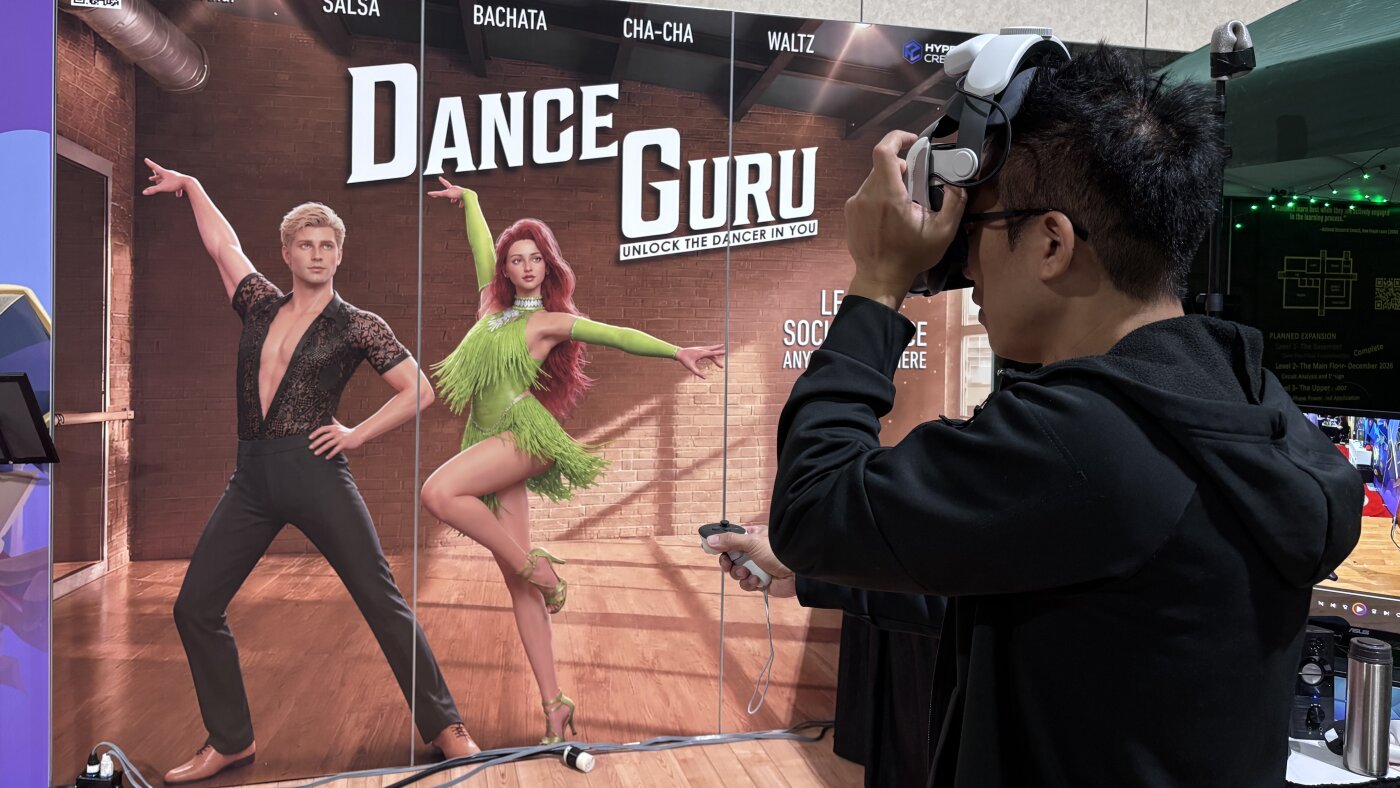
Entrepreneur David Huang tests out a VR headset while conducting demonstrations of the social dance lesson app Dance Guru at the Augmented World Expo in Long Beach, Calif., June 17, 2026.
Chloe Veltman/NPR
hide caption
toggle caption
Chloe Veltman/NPR
Wedding season is in full swing, bringing with it a familiar sense of dread for anyone who fears the dance floor.
But relief may finally be at hand with the help of a new app, Dance Guru, and a virtual reality (VR) headset.
The social dance instruction app transports users to a spacious, digital dance studio. Waiting inside is a computer-generated coach: a handsome, male avatar wearing a shirt open to his navel. He speaks with a slightly gravelly English accent.
“Watch me now,” he instructs at the start of a waltz lesson — which NPR tried out at the Augmented World Expo in Long Beach, Calif., an annual conference showcasing the latest developments in virtual and augmented reality.
The avatar then demonstrates a basic box step.
From there, the lesson becomes interactive. The coach tells the user to hold his hand while an electric pinging sound tracks the student’s foot placement.
“One, two, three, four, five, six,” the virtual teacher counts down.
When the user stumbles, he remains remarkably patient. “Do not worry, foundations take time. Let’s try that again. Work on grounding your steps more intentionally.”
Solving the beginner’s dilemma
Dance Guru creator David Huang said he came up with the idea for the app a couple of years ago out of frustration.
“I always wanted to learn to dance and I was always terrible at it,” Huang said. “And I always ended up stopping midway through the lessons.”
He soon realized that many beginners hit the exact same roadblocks.

“Private lessons are too expensive, and you feel like you’re always forgetting the dance steps,” Huang said. “You cannot find a partner to dance with. So I figured maybe I can create something like this.”
The Dance Guru platform currently offers tutorials in salsa, bachata, waltz, and cha-cha, in both lead and follow modes. To make the digital instruction feel authentic, Huang used motion-capture technology to record the movements of real-life dance teachers — with their permission.
Building on the legacy of online tutorials and video games
Dance Guru belongs to a small but growing wave of apps using VR to demystify social dance. At a nearby booth, conference attendee Victor Chen is testing out a competing app called Trip the Light. It currently offers salsa lessons, as well as freestyle options, where a user can dance with a partner without having to learn specific steps.

Trip the Light’s booth at the Augmented World Expo included posters of the app’s virtual instructors. Real-life performers, who gave Trip the Light permission to motion capture their movements, were used as a basis for these avatars.
Chloe Veltman/NPR
hide caption
toggle caption
Chloe Veltman/NPR
“A lot of times when you’re trying to learn a choreography, it’s watching a YouTube video and you have to pause it, rewind, and play it,” Chen said. “If you were to have a virtual avatar dancing in front of you and correcting for any parts that you missed, it might be a lot easier.”
Interactive video games like Dance Dance Revolution and Just Dance, and YouTube tutorials have been helping people improve their skills in private for years. But those games are mostly aimed at solo players. Unlike the new generation of immersive VR apps, they cannot simulate the mechanics or confidence required for partner dancing on a live dance floor.
The reality check
But this kind of app won’t work for every dancer.
“Everyone learns a little bit differently. And so unless you have a game that has lots of different ways of teaching, you’re going to have things that work for some people and don’t work for others,” said Ariana Katana, a trained contemporary dancer and dance content creator who’s active on YouTube, Twitch and other platforms. “Also, it’s hard to dance with a headset on.”
And then there’s the issue of not being able to physically feel a virtual partner’s hand or shoulder while dancing with them. Patrick Ascolese, the creator of Trip the Light, said the experience could become more tactile in the future. “Haptic suits and wearables will be coming, but I think we’re a little away from that,” he said.
Ascolese said even with their limitations, immersive tools like Trip the Light have immense potential as judgment-free training grounds — giving reluctant dancers the baseline confidence they need to eventually step onto the dance floor with real partners in the real world, including at weddings.
“Just like anything else, practice makes perfect,” said Ascolese. “So the more time you spend in VR with a virtual partner, it works towards helping you get over that social hurdle. We are teaching you the moves that you have to do in order to go out and have fun.”
Jennifer Vanasco edited the broadcast and digital versions of this story. Chloee Weiner mixed the audio.



For half a century, Deidre Hall has taken on every kind of disaster in the drama-packed town of Salem, Ill., as a star of “Days of Our Lives.”
There was the time — actually, it happened twice — when her character, Dr. Marlena Evans, was famously possessed by the devil and even levitated.

In Sunday Funday, L.A. people give us a play-by-play of their ideal Sunday around town. Find ideas and inspiration on where to go, what to eat and how to enjoy life on the weekends.
Or the time a serial killer, who was actually Marlena under hypnosis, seemed to kill several beloved characters. The long-running show’s storylines have become legendary, and in March, while promoting “Hail Mary,” actor Ryan Gosling even gave Hall a shout-out, admitting he was a fan, praising the hard work of soap opera actors and calling her an “OG acting inspiration.”
But Hall’s real life in Santa Monica is much quieter than her character’s, and she likes it that way.
“When I bought my house in Santa Monica, I didn’t realize how great it would be to live near Montana Avenue,” says Hall, 78, about the popular shopping spot. Every day, she walks to the main street with her golden retriever, Riley, and enjoys Pilates, art and good food along the way. “The owners of the Farms Market even keep dog biscuits, so guess where the dog wants to go every time we walk — the Farms, of course,” she says, laughing.
When she isn’t filming the daily soap opera, which airs on Peacock, Hall enjoys raising monarch butterflies, exploring the shops and restaurants on Montana, and hosting movie nights at home with her two sons.
Here’s what a perfect day in L.A. looks like for her.
This interview has been lightly edited and condensed for length and clarity.

7 a.m.: Breakfast and dog walk
I usually kick off my day with a protein shake, feed our golden retriever and take her out for a walk. She’s a phenomenal girl. When we adopted her, her name was Riley, but I did think about naming her after Mrs. Hughes from “Downton Abbey.”

10 a.m.: Church and garden time
After I walk the dog and go to church, I like to spend some time in my yard. I’m not a natural gardener, but I really enjoy it. I started raising monarch butterflies because my identical twin sister, who played my twin on the show, planted a butterfly garden. Monarchs are amazing because they are transitional. Every year, they travel from Mexico to southern New England, but it’s getting harder for them. Their numbers have dropped by about 80%. To help, I plant milkweed, which is what they need to survive. I buy my milkweed from the Staghorn Garden on Wilshire Boulevard in Santa Monica. Julie, who owns the nursery, is delightful and has a wide variety of milkweed. The monarchs always seem to find my garden. Julie was raising some caterpillars too, and she cared a lot about them. We talked about how important it is to help the butterflies. That’s why I do this. Sometimes I get milkweed with eggs already on it, and Julie knows her butterflies are going to a good home.

1 p.m.: Walk to Montana Avenue for some lunch
I live near Montana and love taking long walks, going to Pilates and trying out the great restaurants nearby, like R+D Kitchen and La La Land. I’m a big fan of the waffles at the Courtyard Kitchen. Just a few days ago, I had a chicken salad on raisin bread with an Arnold Palmer, and it was delicious. It is right on Montana and has a nice outdoor seating area. It’s one of my favorite spots. La La Land always has a long line in the morning, which is perfect if you want coffee. They serve coffee, doughnuts, croissants and avocado toast. There’s plenty of outdoor seating, and you can even bring your dog.

2 p.m.: Peek inside a clock shop
There’s a small clock shop on Montana Avenue that’s closed on Sundays, but if you walk by, you’ll see all kinds of clocks — standing, table and wall clocks. The owner is great at fixing them. Once, I bought a wall clock from MacKenzie-Childs, but it didn’t work. And I was really upset because it matched everything else on my countertop. I brought it to the owner and said, “I love this, but I can’t make it work.” He fixed it right away. His name is John, but I call him Geppetto. And we all know why. He really does have a magic touch.

2:30 p.m.: Visit a neighborhood art gallery
Ten Women Gallery is run by 10 artists, all of whom show their work there. I was drawn to some watercolors there, bought a few cards and spoke with one of the artists. She told me, “You seem to love watercolors,” and mentioned that the artist who painted them, Pamela Harnois, lives in Los Angeles and teaches nearby. I got Pamela’s name and found out she taught at the Brentwood Art School. I was so inspired by her gift that I started taking private lessons with her on Saturdays. That gallery is where I discovered my love for watercolor painting.

3 p.m.: Grab some ice cream at Rori’s
The other day, my longtime girlfriend wanted to get ice cream and told me, “We are walking to Rori’s Artisanal Creamery.” It’s a small shop on Montana near Lincoln. They make everything themselves, using local ingredients from grass-fed cows with no added hormones. The place is family-owned and probably has the healthiest ice cream you’ll find. They switch up their flavors often, but my favorite is the salted caramel.

6 p.m.: Family dinner and movie night at home
R+D Kitchen is always packed, so my sons, who are 31 and 33, do the cooking. They come over, and together we make salads and cook dinner. There’s a neighborhood grocery store called the Farms, off Montana, a small family-run place that has everything we need. Everyone knows each other there, and people bring their dogs. We try to have movie night every Sunday. Sometimes the day changes, but we always make sure to have one night a week where we cook a meal and sit down as a family. Keeping that tradition has become really important to us. My sons are great cooks, which is funny because they definitely didn’t get that from me. [Laughs]
9 p.m.: Take Riley for one last walk and visit neighbors
After dinner, I take my dog for a walk. It’s a great way to meet neighbors. We always go around the same block. We’ve met so many people, and since she’s a golden retriever, she loves meeting everyone.

10 p.m.: News, knitting and bedtime
I am a news junkie, so I usually watch whatever is on the news before I go to bed. I have a long-standing passion for knitting. Lately, though, the news would make me drop a stitch.
For Iris van Herpen, couture is a laboratory as much as a runway. Our chief fashion critic, Vanessa Friedman, takes us inside this Dutch designer’s latest Paris show — from sci-fi-inspired gowns to an audacious attempt at a dress made of charged plasma.
-

 Alabama3 seconds ago
Where Alabama’s Justin Lebron landed in final 2026 MLB Draft projections
-

 Alaska3 minutes ago
Delegation Welcomes Corps Permit for King Cove Road
-

 Arizona8 minutes ago
2026 MLB Draft: Arizona likely to be minimally impacted after down season
-

 Arkansas15 minutes ago
ARKANSAS A-Z: Band formed by faculty members of what is now UCA | Arkansas Democrat Gazette
-
 California18 minutes ago
Disneyland turns to cheaper evening passes and the internet speculation explodes
-

 Colorado23 minutes ago
Colorado mountains could see near-record temperatures as heat dome develops over the West
-
Connecticut30 minutes ago
I moved from Connecticut to the South chasing a cheaper, simpler life. It wasn’t at all what I expected, so I moved back.
-

 Delaware31 minutes ago
New information on “sophisticated cybercriminal attack” against Delaware County


