Lifestyle
How do you make a film about Afghan women protesters without being in Afghanistan?

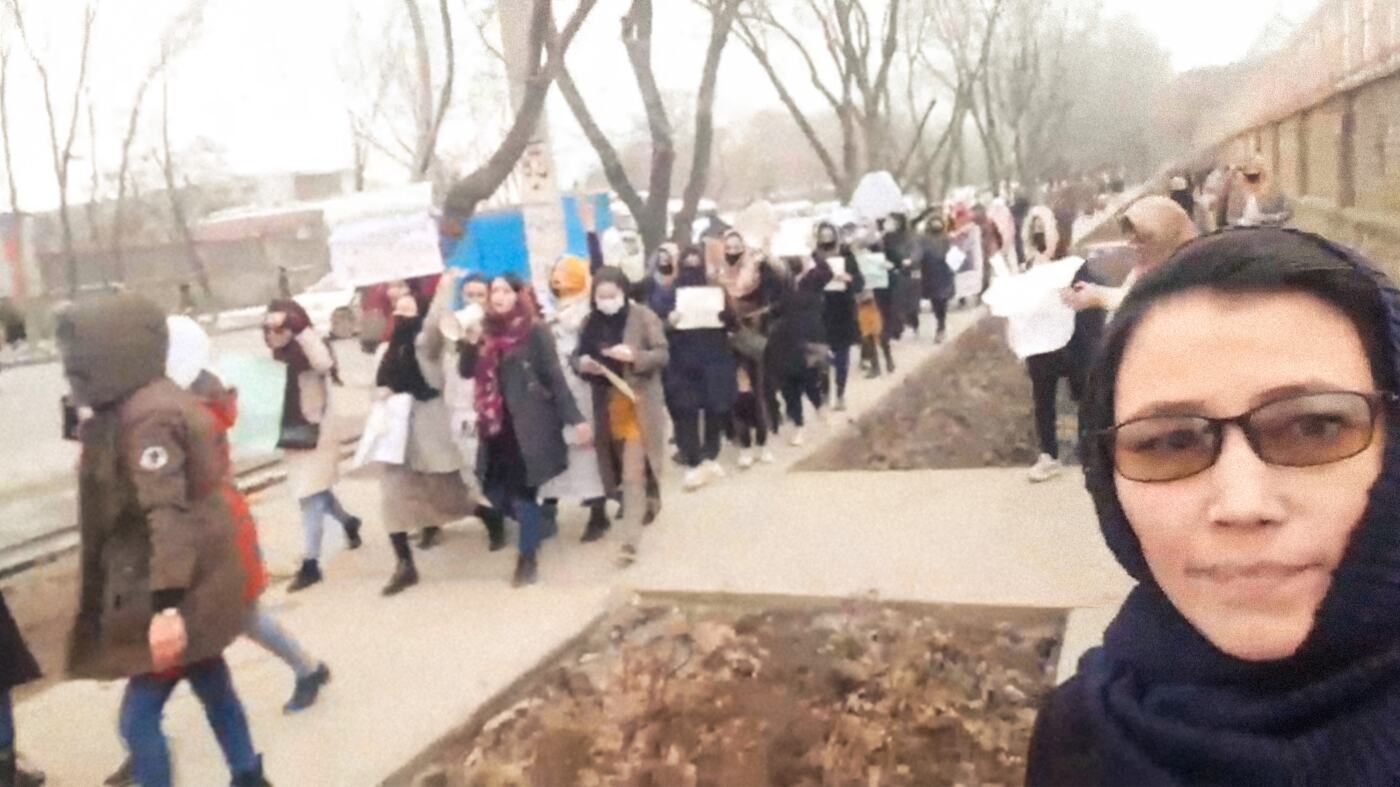
Sharifa Movahidzadeh is one of the three protesters profiled in Bread & Roses, the documentary film about Taliban policies that restrict the rights of women. The film is now streaming on Apple TV+.
Apple TV+/Apple TV
hide caption
toggle caption
Apple TV+/Apple TV
How do you make a documentary when you can’t film in person — and even hiring a cameraperson is risky?
That was the challenge for the award-winning Afghan filmmaker Sahra Mani, who left the country after the Taliban takeover. Her new documentary, Bread & Roses, takes the viewers into the heart of the women’s resistance in Afghanistan.
Using a mosaic of cell phone footage stitched together with video from Mani’s archives, the film tells the story of the women who are protesting the Taliban’s erasure of women from political and public life. It follows the lives of three activists as they navigate a changing country where they are rapidly losing hard-earned rights and freedoms.
With a mosaic of cellphone footage, videos from Mani’s archives and clips from camerapersons hired to follow the protestors, the film tells the story of the women who are protesting the Taliban’s erasure of women from political and public life. It follows the lives of three activists as they navigate a changing country where they are rapidly losing hard-earned rights and freedoms.
The title, Bread & Roses, is inspired by the protestors’ slogan — Naan, Kar, Azaadi (Bread, Work, Freedom) — and also echoes a phrase used by the early women’s suffrage movement in the United States. The film began streaming on Apple TV+ in November.
Since the Taliban came to power in August 2021, they have imposed a series of restrictions on women’s rights and freedoms, including bans on higher education, employment in various sectors and public and political participation. Women are also banned from visiting public baths or parks or traveling long distances without a male guardian.
Despite the restrictions, women in Afghanistan have continued to protest the Taliban and are part of the only civil resistance left in the country. The consequences of such opposition can be dangerous; many women activists have been detained in Taliban prisons where they have reportedly faced torture, abuse and even rape.
Sahra Mani is an Afghan filmmaker best known for her documentary A Thousand Girls Like Me, about women survivors of sexual abuse in Afghanistan, released in 2018 and received the Documentary Studies Filmmaker Award the next year. Mani lived and worked in Kabul prior to the Taliban takeover in 2021 and was a lecturer at Kabul University.

The team behind Bread & Roses: From left, executive producer Malala Yousafzai, producers Jennifer Lawrence and Justine Ciarocchi, and director/producer Sahra Mani at the November premiere of the documentary film about Afghan women.
Chris Pizzello/Invision/AP/Invision
hide caption
toggle caption
Chris Pizzello/Invision/AP/Invision
Three years on, the Taliban’s atrocities against Afghan women seem to have slipped out of international headlines. Mani hopes to highlight these activists and their resistance in her movie, she tells NPR. (The three main subjects have all since left the country.)
“It would be a serious mistake to forget the Afghan women or ignore the Taliban’s atrocities,” she says. “Remember that September 11 attacks were planned in this region, involved this very group. So to join the Afghan women’s resistance is part of everyone’s responsibility for the sake of our collective futures.
Mani spoke to NPR about the film. The interview has been edited for length and clarity.
When was the idea for this movie born?
When I lived in Afghanistan [from birth until the Taliban takeover] , women were visible everywhere — you saw them in the media, on international platforms, in politics, in the parliament representing our people. They worked closely with [the President].
When Kabul fell [to the Taliban in August 2021], I saw women taking charge of the protests, chanting for education, rights to work, resisting the Taliban’s dictatorship. I was very amazed with the bravery of these women. I asked myself where had they been all these years. These were the common women of Afghanistan — young, educated girls and women representing the country. I was so happy to see them and quickly reached out to talk to them.
[During the Taliban takeover] I was working with a charity helping Afghan women at risk. Many of the women were sole breadwinners of their families and had lost their jobs and their rights because of the Taliban. So through the charity, I got to know many women, wonderful brave women, and sometimes they would send me [phone camera] videos of their daily life, their challenges and even their fights with the Taliban.
In one video, a group of women shout their slogan “Bread, work, freedom” as they face off with an armed Taliban fighter as he points his weapon at them. In another video, a group of masked women filmed themselves spraying anti-Taliban graffiti on the streets in Kabul in the middle of the night.
I started archiving these videos. Initially, I wasn’t planning on making a film. The idea was simply to preserve evidence of women’s movement in Afghanistan. But then I was approached by Jennifer Lawrence’s team and we decided that the world needs to see these videos and the strength of the women of Afghanistan.
Was it difficult to get women to participate in the documentary?
On the contrary, they were already filming themselves and had been sharing their experiences with me. They want the world to see what it is like to live under a dictatorship that prevents you from doing basic things, like going to school, working or even taking a taxi.
Later when we started working on the documentary, we found camerapersons inside Kabul and trained them how to safely film [the women protestors].
How did you put the movie together?
Nowadays, documentary filmmaking allows for a lot of opportunities and different ways to tell your story. We used cell phone videos, images with voiceovers as well as materials from my archives from during my time as a filmmaker in Kabul.
The cellphone videos are not always of very good quality, but we found them to be indispensable to the storytelling. [They] provide authenticity. We complemented them with the archival videos.
During the last Taliban rule in the 1990s, every so often a video of the Taliban’s mistreatment of women — including public executions — would get leaked, shocking the world. Now there is a lot more coverage of the situation inside Afghanistan. How does your movie add to our knowledge of the situation.
This movie is documentary evidence of what is happening, the historical changes, inside Afghanistan.
It was only when Jennifer Lawrence and Malala Yousafzai showed willingness to support me as a filmmaker that it made me realize that it could be a more ambitious project. It became more and more urgent to me to help raise voices of the women of Afghanistan, bring them to the larger global platform.
What do you hope will be the impact of this film?
When people watch this film, I want them to be able to feel the experiences of the Afghan women, not only the anger and challenges but also their joys when they help each other or their celebration of the achievement.
As a filmmaker I have tried to use the tool of cinema to bring these stories forward with the hopes that people can connect with the emotions and experiences of these women and express solidarity. I hope the viewer can see and feel the experiences of living under the dictatorship of Taliban, enough for them to want to do something about, take action, reach out to their local governments and pressure them to recognize gender apartheid in Afghanistan.
I want people to join Afghan women in pressuring the United Nations to hold the Taliban accountable for the crime they have done on Afghan women and Afghan people.

Dr. Zahra Mohammadi, a dentist in Afghanistan, is profiled in the new documentary Bread & Roses. She has since left the country.
Apple TV+
hide caption
toggle caption
Apple TV+
What’s the biggest single loss for women?
Afghan women lost so much in the Taliban’s takeover. From the identities they built as professionals, educators, politicians et cetera to their very basic rights as humans, to learn, to sing, to talk to other women, to even exist in many spaces. They are continually losing their rights.
As you probably know there are close to 100 edicts that the Taliban have imposed on just women’s rights. This is not normal. This is terrorism, and it should be accepted by anyone as a normal way of life.
Will the movie be screened, discreetly of course, inside Afghanistan?
There is a possibility. It’s the choice of my distributor, but at the moment Apple TV+ has provided it in 100 countries. So that’s an important step. I also have several [online] workshops and training with Afghan students, Afghan girls and I will talk to them about the film. I would certainly want them to see it, too. Because I don’t look at this only as a movie. To me, this is an extension of the Afghan women’s movement.
Is there one scene that is particularly meaningful to you?
There are so many special and emotional moments, but I remember this one clip when the Taliban used tear gas on the women protestors in the streets. They started shouting and running. The camera follows the women as they try to get away, but [the camera] is upturned [when the camera operator was running] and you see the trees of Kabul. For a moment, all you see are the trees as you hear women shouting and crying.
For me, that represented that even the trees were crying in solidarity with the women. It was very emotional for me personally, as someone from Kabul, that even nature weeps with our women.
Ruchi Kumar is a journalist who reports on conflict, politics, development and culture in India and Afghanistan. She tweets at @RuchiKumarRuchi Kumar is a journalist who reports on conflict, politics, development and culture in India and Afghanistan. She tweets at @RuchiKumar


Azar Nafisi on the set of Eran Riklis’ Reading Lolita in Tehran
Marie Gioanni/Greenwich Entertainment
hide caption
toggle caption
Marie Gioanni/Greenwich Entertainment
A new film version of Azar Nafisi’s critically-praised, worldwide bestselling memoir, Reading Lolita in Tehran, is now in theatres.
The film shows a group of women meeting clandestinely in Nafisi’s home in the mid-1990s, to read forbidden books. They read classics of the West, like Madame Bovary, The Great Gatsby, Pride and Prejudice, and Lolita.
Education had become dangerous and even deadly during the Islamic Revolution, and reading forbidden books was Nafisi’s way to fight back.
The film, directed by Eran Riklis, begins with Nafisi as a university professor and ends with her exiled from her homeland. Nafisi told Scott Simon about the experience of seeing herself and her story depicted on the big screen, “I feel towards it the way I feel towards my children.”
The film is directed by Eran Riklis and won the the Audience Award and a special jury prize at the 2024 Rome Film Festival.
It stars Iranian actors Goldshifteh Farahani, Zar Amir Ebrahimi, and Mina Kavani. Like the author, some of the actors are exiled from Iran.

Actor Golshifteh Farahani stars as Azar Nafisi in Eran Riklis’ Reading Lolita in Tehran.
Greenwich Entertainment
hide caption
toggle caption
Greenwich Entertainment
“These girls were very different, one from the other,” Nafisi said of the students who studied with her in Tehran. Remembering them now, and seeing them depicted on the screen, Nafisi saw anew the power of great literature.
“Outside the classroom, they probably wouldn’t talk to one another. But in that class, they learned to communicate and to connect,” she said.
Through the stories in the books, Nafisi said each woman could find more and become more herself. “It reached a sort of magic,” she said.
The magic was brutally broken by a government that was desperate to quiet the voices of dissenters. Nafisi’s homeland changed quickly into a place she barely recognized
“This wasn’t my land,” she told Simon. “This was a country ruled by a regime that stoned people to death.”
When the religious hardliners in the government banned women from appearing in public without a headscarf, the film shows Nafisi, played by Goldshifteh Farahani, agonizing in front of a mirror with a black headscarf.
“The expression on her face is fear, because by and by, she disappears into this garment,” Nafisi said. For some, the headscarf was a symbol of the place of women in society, but for Nafisi the stakes were even higher.
“This is not a political fight. This is an existential one,” she said. “Our identity as human beings, as women, has been taken away from us.”
When fighting against covering her hair became too dangerous, Nafisi found small ways to rebel. “I never wore my scarf properly. I would always show a few strands out of the scarf to tell them, ‘You don’t own me.’”
Nafisi’s book about fighting the Iranian Revolution through the simple act of reading was an international bestseller, won numerous literary awards, and was named as one of the “100 Best Books of the Decade” by The Times (London).
Nafisi now lives in Washington, D.C., and continues to make a passionate case for the role of artists and writers in society.
She shared with Simon an illustrative story from the beginning of Islamic Revolution. The new leaders tore down the statues of the king and the royal family and changed the names of streets. But when they tried to bring down the statue of Persian poet Abul-Qâsem Ferdowsi, and erase his place of honor within the culture, the people opposed it.
“I thought how fantastic that they can bring down the statue of the Shah, but they can’t touch the poet,” she said.

Get ready to catch a whiff of stink. Not one, but two rare corpse flowers are set to bloom at the Huntington in the coming days, with one of them making its first-ever public bloom.
If both plants unfurl on the same day, it would be just the second time a double bloom has ever occurred at the Huntington.
For those unfamiliar with these funky flora, be warned. Corpse flowers bloom for just 24 to 48 hours, and once opened, they reek of gym socks, rotten eggs and decaying flesh … or, well, a corpse.
Brandon Tam, associate curator of orchids for the Huntington, speaks to reporters in front of two corpse flowers as they prepare to bloom.
(Kayla Bartkowski / Los Angeles Times)
Couple that with their tropical native climate of Sumatra, Indonesia, and you’re in for a sweaty, stinky viewing experience.
The stench is important for pollination, said Brandon Tam, the Huntington’s associate curator of orchids. It attracts carrion beetles and flesh flies, which lay their eggs on rotting animal carcasses.
At the Huntington, pollinators aren’t the only thing it entices. Since the garden exhibited its first corpse flower in 1999, thousands of people flock to its conservatory every summer, just to smell these putrid plants.

-
Share via
It smells like rotting flesh, but thousands of people will be lining up to catch a whiff.
“The kids that first came in 1999 are now bringing their kids — their own kids — to experience this over 20 years later,” Tam said. “It’s amazing, this plant, the impact that it has had over many generations.”
Glendale resident Trinity Shi, 42, witnessed three blooms at the Huntington in 2022 and 2023 and compared the smell to rotten fish: pungent, but not unbearable. She was excited to feature such an unusual specimen on her Instagram plant blog, @cubehousejungle, and hopes to make it to this year’s bloom too.
“It feels really prehistoric to look at this plant, because it is so giant,” Shi said of the corpse flower, which can grow over 12 feet tall. “It’s become kind of like a mascot for the Huntington.”
Thanks to cultivation techniques, the Huntington coaxes the plants to bloom every two to three years, not four to six like they do in their natural habitat, where they’re endangered.
Still, the blooms are notoriously unpredictable, Tam said. He guessed one of the plants will bloom in the coming days.
This upcoming bloom spotlights a plant nicknamed Odora, who last opened in 2024, and Odorysseus, a rookie public bloomer. Visitors offered name suggestions for Odorysseus on the Huntington’s Instagram page, where contenders included Stinkerbell, Gagatha and Count Flatula, among others.
It’s not unusual for the Huntington to have multiple soon-to-be bloomers on display. But only once, in 2018, did two plants actually unfurl on the same day.

A detailed view of a corpse flower as it prepares to bloom.
(Kayla Bartkowski / Los Angeles Times)
For Odora and Odorysseus, siblings from a 2002 pollination, a double bloom is unlikely, Tam said. The plants are inclined to bloom out of sequence, “because they want to pollinate another plant that’s in the vicinity.” That can’t happen if they bloom simultaneously.
Though many refer to these plants as “flowers,” they are actually an “inflorescence,” a flowering structure containing hundreds of smaller blooms inside.
When it’s almost time for the plant to open, the spadix — a conic protrusion from inside the plant — emerges and accelerates in growth, climbing up to six inches per day. After a few days, its growth slows down.
“When it gets to about the one-inch range, we’ll know it’s about to bloom for us fairly soon,” Tam said.
When it does bloom, the spathe — leaflike structures encasing the plant — unfurl around 3 or 4 p.m., reaching maximum size in the early hours of the morning. The odor comes from the spadix, which heats up to about 98 degrees to strengthen the smell.

Brandon Tam, associate curator of orchids at the Huntington, walks past the corpse flowers as they prepare to bloom.
(Kayla Bartkowski / Los Angeles Times)
From there, visitors have until about 3 to 5 p.m. to smell the plant before it closes back up and collapses, losing its odor. Eventually, the plant returns as a leaf or a flower, photosynthesizing energy in preparation for its next bloom.
Today, the Huntington houses 43 corpse flowers, making it one of the largest corpse flower collections in North America. The Huntington cultivates them on-site and has distributed many to botanic gardens and zoos across the country.
“It’s important when it comes to conservation that we make plants accessible,” Tam said. “If we’re able to share these plants with other organizations and other hobbyists, we’re able to decrease the amount of plant theft that occurs in the wild, where a lot of conservation work is much needed.”
Eager sniffers can visit the Huntington from 10 a.m. to 5 p.m. Wednesday to Monday. Be sure to stay hydrated, cool and patient, as it’s humid inside the conservatory and lines can be long. For those who want to track the blooms’ progress from afar, catch the Huntington’s online livestream.
Library, art museum, botanical garden
The Huntington
Address: 1151 Oxford Road, San Marino
Admission: $13-34; children 3 and under, free; “Museums for All” (SNAP EBT) program, $5.
Info: huntington.org
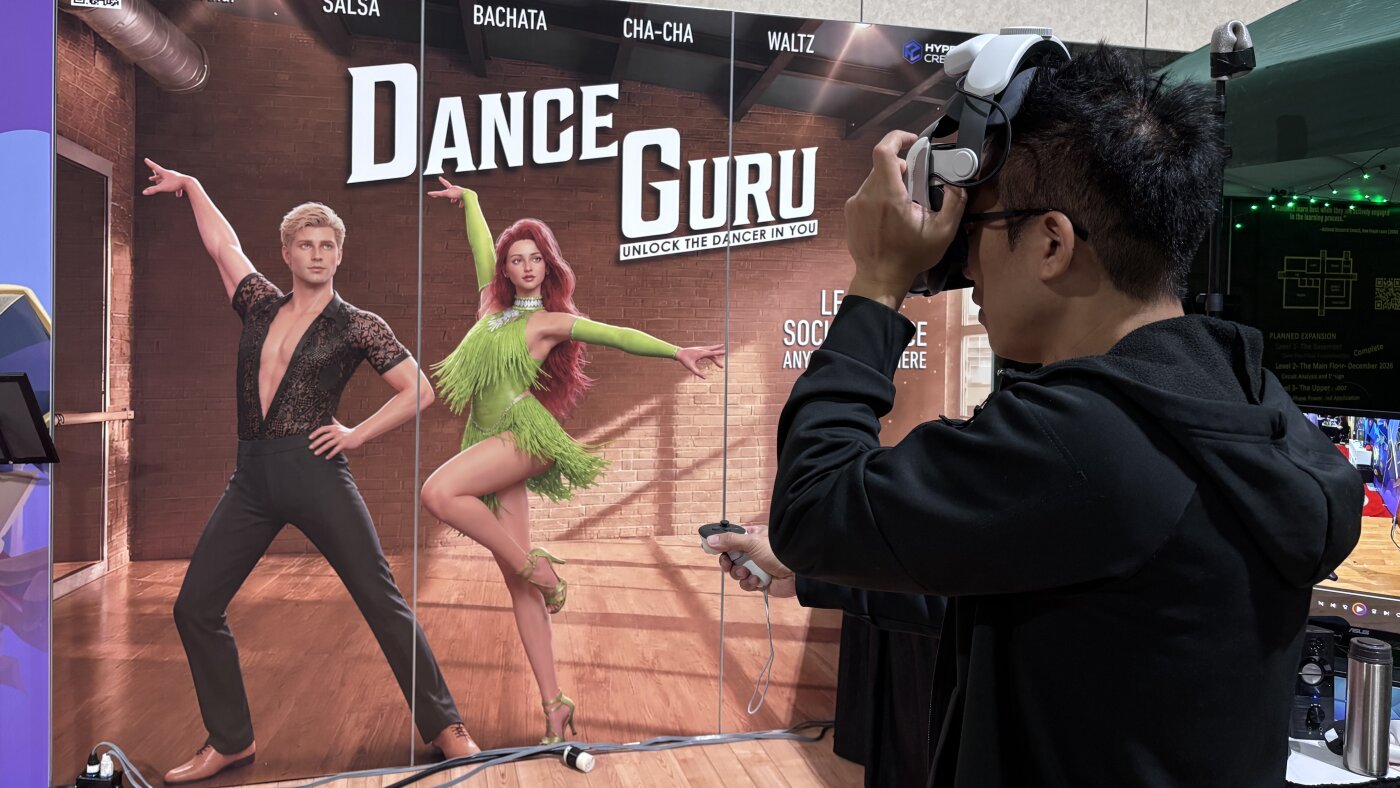
Entrepreneur David Huang tests out a VR headset while conducting demonstrations of the social dance lesson app Dance Guru at the Augmented World Expo in Long Beach, Calif., June 17, 2026.
Chloe Veltman/NPR
hide caption
toggle caption
Chloe Veltman/NPR
Wedding season is in full swing, bringing with it a familiar sense of dread for anyone who fears the dance floor.
But relief may finally be at hand with the help of a new app, Dance Guru, and a virtual reality (VR) headset.
The social dance instruction app transports users to a spacious, digital dance studio. Waiting inside is a computer-generated coach: a handsome, male avatar wearing a shirt open to his navel. He speaks with a slightly gravelly English accent.
“Watch me now,” he instructs at the start of a waltz lesson — which NPR tried out at the Augmented World Expo in Long Beach, Calif., an annual conference showcasing the latest developments in virtual and augmented reality.
The avatar then demonstrates a basic box step.
From there, the lesson becomes interactive. The coach tells the user to hold his hand while an electric pinging sound tracks the student’s foot placement.
“One, two, three, four, five, six,” the virtual teacher counts down.
When the user stumbles, he remains remarkably patient. “Do not worry, foundations take time. Let’s try that again. Work on grounding your steps more intentionally.”
Solving the beginner’s dilemma
Dance Guru creator David Huang said he came up with the idea for the app a couple of years ago out of frustration.
“I always wanted to learn to dance and I was always terrible at it,” Huang said. “And I always ended up stopping midway through the lessons.”
He soon realized that many beginners hit the exact same roadblocks.

“Private lessons are too expensive, and you feel like you’re always forgetting the dance steps,” Huang said. “You cannot find a partner to dance with. So I figured maybe I can create something like this.”
The Dance Guru platform currently offers tutorials in salsa, bachata, waltz, and cha-cha, in both lead and follow modes. To make the digital instruction feel authentic, Huang used motion-capture technology to record the movements of real-life dance teachers — with their permission.
Building on the legacy of online tutorials and video games
Dance Guru belongs to a small but growing wave of apps using VR to demystify social dance. At a nearby booth, conference attendee Victor Chen is testing out a competing app called Trip the Light. It currently offers salsa lessons, as well as freestyle options, where a user can dance with a partner without having to learn specific steps.

Trip the Light’s booth at the Augmented World Expo included posters of the app’s virtual instructors. Real-life performers, who gave Trip the Light permission to motion capture their movements, were used as a basis for these avatars.
Chloe Veltman/NPR
hide caption
toggle caption
Chloe Veltman/NPR
“A lot of times when you’re trying to learn a choreography, it’s watching a YouTube video and you have to pause it, rewind, and play it,” Chen said. “If you were to have a virtual avatar dancing in front of you and correcting for any parts that you missed, it might be a lot easier.”
Interactive video games like Dance Dance Revolution and Just Dance, and YouTube tutorials have been helping people improve their skills in private for years. But those games are mostly aimed at solo players. Unlike the new generation of immersive VR apps, they cannot simulate the mechanics or confidence required for partner dancing on a live dance floor.
The reality check
But this kind of app won’t work for every dancer.
“Everyone learns a little bit differently. And so unless you have a game that has lots of different ways of teaching, you’re going to have things that work for some people and don’t work for others,” said Ariana Katana, a trained contemporary dancer and dance content creator who’s active on YouTube, Twitch and other platforms. “Also, it’s hard to dance with a headset on.”
And then there’s the issue of not being able to physically feel a virtual partner’s hand or shoulder while dancing with them. Patrick Ascolese, the creator of Trip the Light, said the experience could become more tactile in the future. “Haptic suits and wearables will be coming, but I think we’re a little away from that,” he said.
Ascolese said even with their limitations, immersive tools like Trip the Light have immense potential as judgment-free training grounds — giving reluctant dancers the baseline confidence they need to eventually step onto the dance floor with real partners in the real world, including at weddings.
“Just like anything else, practice makes perfect,” said Ascolese. “So the more time you spend in VR with a virtual partner, it works towards helping you get over that social hurdle. We are teaching you the moves that you have to do in order to go out and have fun.”
Jennifer Vanasco edited the broadcast and digital versions of this story. Chloee Weiner mixed the audio.


-
Lifestyle24 minutes ago
Azar Nafisi on the movie adaptation of ‘Reading Lolita in Tehran’
-

 Technology36 minutes ago
After years of teasing, the viral Nopia synth is ‘basically finished’
-

 World39 minutes ago
Beloved musicians among victims in deadly Bahamas plane crash; aviation authority grounds flights
-

 Politics44 minutes ago
Trump-aligned House holdouts accused of holding ‘life-saving’ veterans bill ‘hostage’ over SAVE America Act
-

 Health51 minutes ago
Simple sitting change linked to lower risk of cancer death, study finds
-

 Sports53 minutes ago
Golf star records lowest round in LPGA major history with astounding performance at Evian Championship
-

 Technology59 minutes ago
Meta Verified scam threatens Facebook deletion
-
 Business1 hour ago
Meta discontinues Instagram feature on new AI image generation tool after Hollywood backlash

