Lifestyle
'House of the Dragon' Season 2, episode 3: Make it make sense

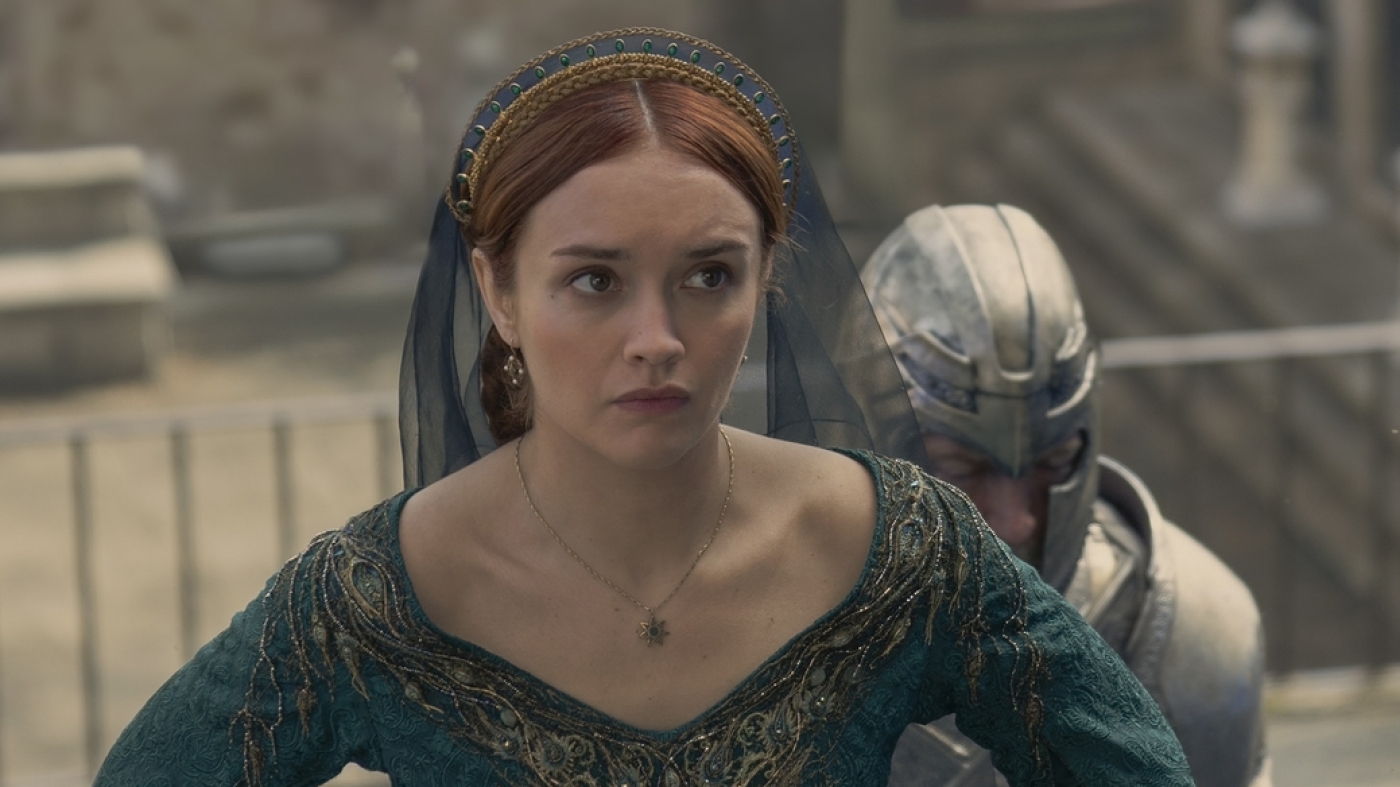
Alicent (Olivia Cooke).
Theo Whitman
hide caption
toggle caption
Theo Whitman
This is a recap of the most recent episode of HBO’s House of the Dragon. It contains spoilers. That’s what a recap is.
Credits! Which bring with them two new additions to the “Die, You!” Tapestry!
1. Li’l Dead Jaehaerys, lying in state. (That embroidery-vine that creeps along and slices him across the neck? A nice touch. A nice, mean touch.) 2. The executed ratcatchers of King’s Landing, hanging from the walls of the city.
I like this! It’s kind of like a “Previously On …,” but in mixed media (colored thread and bloodstains).
Oh and: I just now noticed how accurate the tapestry’s renderings of Aegon II and Rhaenyra are. Aegon’s sporting a haughty smirk, while Rhaenyra just looks P.O.d. Spot on!
We open on a stretch of river (the Red Fork) by an old mill where some cows are grazing on the border between the lands of two Riverlords – House Bracken and House Blackwood. A young knight, Ser Amos Bracken, is confronted by a young knight of House Blackwood. (This may or may not turn out to be Benjicot Blackwood; if so, he’ll be back.) The Brackens have declared for Team Green (Aegon II), while the Blackwoods are, fittingly enough, Team Black (Rhaenyra). They fight, and we smash cut to …
The aftermath of the first armed conflict of the Dance of the Dragons: The Battle of the Burning Mill. Ser Amos is dead, as are many soldiers and at least one cow. RIP, Ser Loin.
On Dragonstone, they bury Arryk and Erryk side by side. Jacaerys seems concerned that Rhaenyra isn’t on a war footing yet. (This will be a theme of the episode – lots of old dudes thinking young Rhaenyra is too soft and unprepared.)

But Rhaenys the Unfailingly Awesome and Inviolately Right knows what’s up, because knowing what’s up is like her entire deal. She approaches Rhaenyra by the gravesite, having correctly sussed out that this incandescently stupid effort on Team Green’s part means that someone sensible like Otto Hightower is no longer advising Aegon. She urges Rhaenyra to reach out to Alicent one last time, to avoid the slaughter that dragon-on-dragon combat will surely bring.
In the Red Keep, Criston Cole seems to have gotten the news that Operation: Twinsies! went pear-shaped. As he walks to the Small Council he, and we, learn that Aegon has dismissed Cole’s fellow members of the Kingsguard and replaced them with the king’s loutish drinking buddies.
We also learn that Cole chooses not to wear the badge of the Hand of the King, instead pinning it to his chair at the Small Council table. I’d like to say this tells us something meaningful about Criston Cole besides “Hates to accessorize,” but I’m not sure it does.

At the Small Council, there is squabbling. There is also Aemond, seated at the Council, which is a new development. He’s fiddling with that coin he found last week. Aegon is also fiddling with something – the Valyrian steel dagger. Yes, that dagger. The one that belonged to Aegon the Conqueror, the one inscribed with the prophecy of the Prince that was Promised, the one that will, in a 150 years or so, be used by the assassin hired by Littlefinger to take out Bran Stark, the one that Arya will then use to kill Littlefinger, and the one that she will use to turn the Night King into so much shaved ice.
Criston resolves to take a small number of soldiers out to seize the small castles near King’s Landing, add their soldiers to his number, and ultimately march on Harrenhal in the Riverlands, which has declared for Rhaenyra. It’s basically the plan he and Aemond came up with in the season premiere, with one revision: Aemond and Vhagar will not provide him air cover – they’ll stay behind to protect the city. Alicent isn’t thrilled with this plan – or with Cole.
On Dragonstone, Rhaenyra thanks Mysaria for warning the guards about the whole Arryk/Erryk michegoss. Mysaria, in return, asks to be a member of Rhaenyra’s court, because Rhaenyra showed her mercy. During this scene, the dragon Seasmoke, once ridden by Rhaenyra’s first husband Laenor, flits about in an agitated manner. If you didn’t put a pin in that plot thread last week, do it now. It’s coming back.
Pencil’s out; we’re gonna be throwing a lot of names at you
Rhaenyra meets with Rhaena. Player Scorecard Time: Rhaena is the younger of the two daughters that Daemon had with his late wife Laena; her older sister is Baela. Baela has a dragon called Moondancer, but Rhaena is dragonless.

Rhaena (Phoebe Campell) and Rhaenyra (Emma D’Arcy).
Theo Whitman/HBO
hide caption
toggle caption
Theo Whitman/HBO
Rhaenyra instructs Rhaena to gather up Joffrey (the youngest son Rhaenyra had with Laenor, but actually Harwin Strong), and the two very young sons that Rhaenyra had with Daemon (who are named Viserys and, resigned sigh, Aegon, whom we refer to as Aegon the Baeby to distinguish him from King Aegon the Aess). Rhaenyra is sending them to stay with her cousin Lady Jeyne Arryn in the Vale for safety, and wants Rhaena to go with them. Rhaena mentions the dragons Tyraxes and Stormcloud. Fill out your dragonspotting cards: Tyraxes is a very young dragon bonded to Joffrey, Stormcloud is another hatchling bonded to Aegon the Baeby.
Rhaenyra mentions that even the Vale isn’t safe, and that Rhaena should eventually take them across the narrow sea to the city of Pentos.
Daemon, astride Caraxes, arrives at the gloomy, cursed, rainy ruin of Harrenhal, in the Riverlands. Harrenhal is the largest castle in Westeros, but these days it’s mostly abandoned and crumbling into the mud.
He’s greeted by Ser Simon Strong and his grandsons, and behaves in his predictable, preening, mistrustful, jerkface manner. A young woman enters and casts an appraising gaze at him. He inquires about Simon’s loyalty to his great-nephew, Lord Larys Strong, who serves King Aegon the Aess. Simon dismisses this and accuses Larys of having his own brother and father killed (he’s right about that; we saw it happen last season); Simon makes it clear he’s bending the knee to Rhaenyra. Daemon clouds the issue by insisting on being referred to as “Your Grace” – which is to say, as the King, and not just the Queen’s consort. No, it’s not subtle, but it is Daemon.
Daemon’s plan is to gather up the armies of the Riverlands and garrison them at Harrenhal. To that end, he demands to speak with Lord Tully, who heads the Great House of the Riverlands.
Stately Gwayne’s manner
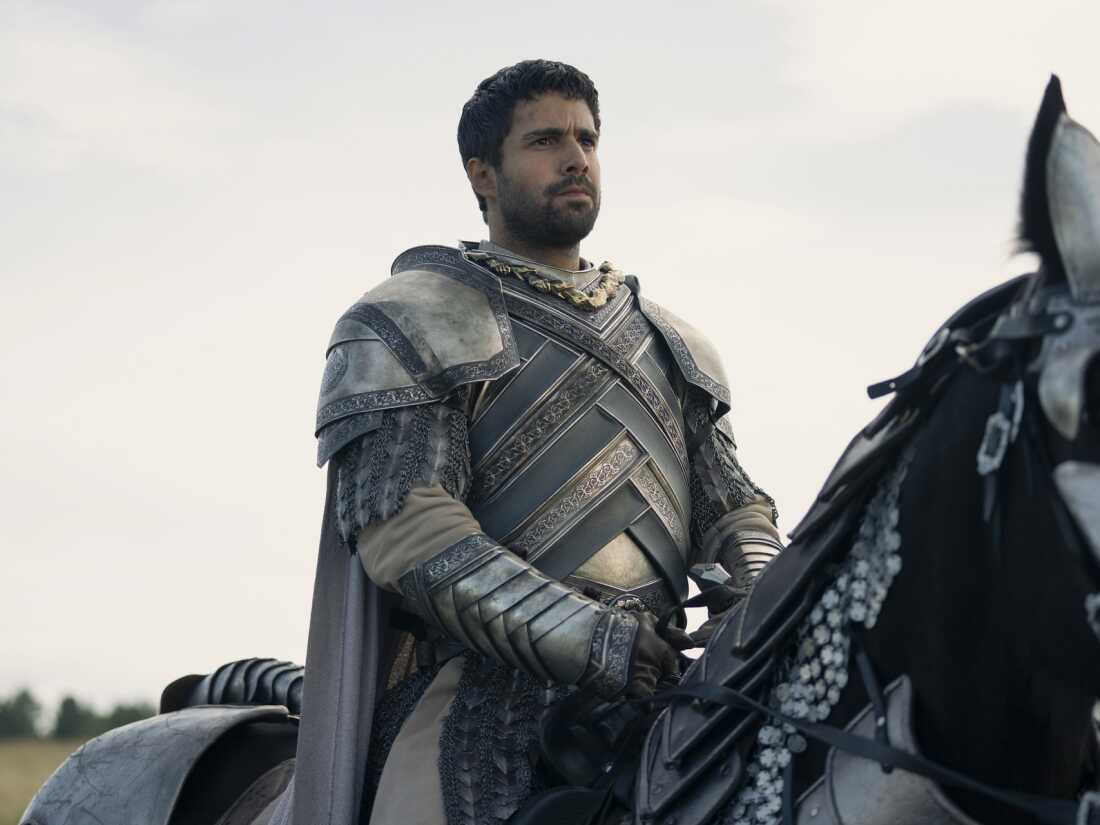
Criston Cole (Fabien Frankel).
Theo Whitman/HBO
hide caption
toggle caption
Theo Whitman/HBO
Back at the Red Keep, Criston Cole is about to depart with five men to seize the nearby castles in King Aegon’s name. Cole’s sporting a new, battle-ready Caesar cut that does not look great on him, I guess so his war-helmet fits better? Alicent insists that her brother, Ser Gwayne Hightower, join the party. Gwayne’s got flowing, lustrous red locks, so there goes my war-helmet theory. He’s a bit of a snot to Criston, but it’s not like Criston doesn’t deserve it. Go nuts, Gwayne. Snot away. Snot like the wind.
On Dragonstone, around the Painted (But Not Actually Painted, Technically Glowing) Table, Rhaenyra’s advisors urge her to seize the moment while she’s waiting for their armies to gather – those from North, and the Vale, and the army Daemon is ostensibly building in the Riverlands – and send the dragons out to burn every Green stronghold to ash.
Rhaenyra slaps them down, knowing that their plan would escalate the war into a dragon-on-dragon conflict that no one would survive (NOTE: But that would be very very cool to look at and make for some pretty awesome television).

Gerardys (Phil Daniels), Ser Alfred Broome (Jamie Kenna), Rhaenyra (Emma D’Arcy), Baela (Bethany Antonia), Lorent Marbrand (Max Wrottesley), and Jacaerys (Harry Collett).
Ollie Upton/HBO
hide caption
toggle caption
Ollie Upton/HBO
On Driftmark, Rhaenys brings her man Corlys a pick-a-nick basket that, she makes clear, she didn’t make herself, because of course she didn’t, she’s Rhaenys. She broaches the possibility of replacing the current heir of Driftmark (young Joffrey, whom they know was fathered by Harwin Strong and not their son Laenor), with Rhaena, their by-blood grand-daughter. Keeping it in the family.
Rhaena leaves for the Vale with the various moppets, the two hatchling dragons and – the show takes time to establish this, so it’ll probably be on the quiz – four dragon eggs.
At the Red Keep, Queen Helaena proves that she may be spacy, but she’s not dumb. The reason she hated having all those commoners stare at her during the funeral procession was not revulsion, but shame – she knows that their kids die in far greater numbers; why should her grief be placed above theirs? Got a good head on her shoulders, does Helaena. Pity it doesn’t run in the family.
King Aegon the Aess is being fitted for armor, as he intends to fly out on Sunfyre to help Criston Cole’s mission. Larys Strong meets with him and deftly scores a neat two-fer. 1. He convinces him that if he does leave King’s Landing, Alicent and Aemond will seize control and 2. He gets Aegon to name him Master of Whisperers.
A ruthless, cunning advisor and a ridiculously pliant king? What could go wrong?

Aegon (Tom Glynn-Carney) and Larys Strong (Matthew Needham).
Ollie Upton/HBO
hide caption
toggle caption
Ollie Upton/HBO
Guy walks into a bar …
Cut to the Street of Silk in King’s Landing, where we catch up with Ulf, the guy we saw stealing an apple and stumbling across the hanged ratcatchers last week. In an impressive tracking shot, we follow him as he enters a boisterous tavern, glad-hands a bunch of folks, sits down at a table and starts spinning a tale about his true parentage. He claims to be half-brother to both the late King Viserys and Prince Daemon and is, like Daemon, uncle to Queen Rhaenyra.
In so doing, he introduces a term we’ll probably be hearing a lot of, in the coming weeks. “Dragonseed,” i.e., an illegitimate child of Valyrian blood (read: House Targaryen and House Velaryon).
Just then Aegon the Aess enters with his repellent homies, dragging with them a squire for whom they will enjoin the services of a sex worker. Ulf’s loyalties to his kin Rheanyra dissolve like beer foam, and he leads a cheer for the king.
Another contract-fulfilling Brothel scene: Aegon stumbles across his brother Aemond with his favorite sex worker, and proceeds to be even more of a jerk to him than his baseline-level jerkiness, which is, let’s recall, a tremendous lot. This scene isn’t doing much work except to remind us that Aemond doesn’t hold his older brother Aegon the Aess in high esteem, a thing we already knew.
On Dragonstone, Rhaenyra mournfully regards some of the toys belonging to li’l Viserys and Aegon the Baeby, which are metal and sharp and pointy, because Westeros ain’t got a Consumer Product Safety Commission. She puts away Tetanus: The Playset and reads a note from Alicent that she’d previously ignored.
On her dragon Moondancer, Baela discovers Criston Cole, Gwayne and the small company of men. (You’ll recall that Baela had been tasked by Rhaenyra to monitor the comings and goings of Team Green around King’s Landing.) She chases them into a forest and loses them.
Back on Dragonstone, the news of Cole’s mission causes Rhaenyra’s council to go back to their sword-rattling, urging her to cry havoc and let slip the dang dragons of war, already.
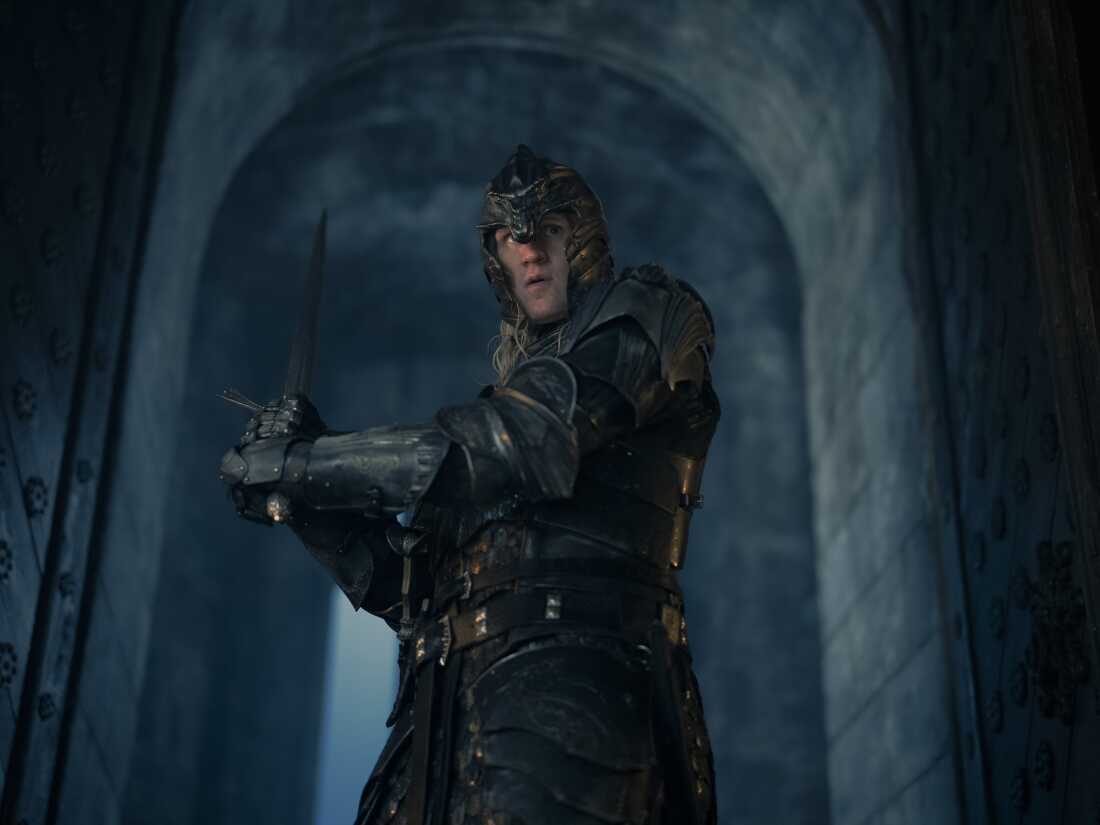
Daemon (Matt Smith) at Harrenhal.
Ollie Upton/HBO
hide caption
toggle caption
Ollie Upton/HBO
At Harrenhal, the cursed castle is giving Daemon creepy, if a bit-on-the nose, dreams. In one, he happens upon his wife-niece Rhaenyra as she was back in the day (welcome back to the stage, Milly Alcock!). She’s stitching li’l Jaehaerys’s head back on his body.
Daemon wakes up (OR DOES HE) (no yeah just kidding, he totally does) and comes across the young woman who earlier in the evening looked him up and down like a side of Valyrian beef. She tells him he will die in this place. This is Alys Rivers. She’s a thing.
In sept, shun
On Dragonstone, Rhaenyra tells Mysaria that she wants to speak directly with Alicent to try to prevent the war. Mysaria says that it will be easy enough to smuggle Rhaenyra into the city (wait, really?) and that Alicent only goes outside the walls of the Red Keep to light candles in the Grand Sept. If Rhaenyra were to go there, she could talk with Alicent in private, queen to dowager queen. (WAIT, REALLY?)
This seems like a dumb plan, but then, dumb plans are fast becoming Standard Operating Procedure on this show: First you had Operation: Blood and Cheese, then Operation: Twinsies! and now Operation: Two Queens Stand Before Me.
Rhaenyra and a bodyguard (Ser Steffon Darklyn, former member of the Kingsguard), dressed as members of Westeros’s holy order, make it to the Grand Sept with an ease that borders on the ludicrous but that is impossible to get truly mad about because why get hung up on realism in a show about dragons? Rhaenyra’s bodyguard waits in the courtyard (why, though?) as Rhaenyra enters the sept.
Alicent arrives with her security detachment, who also wait in the courtyard, because Alicent is not now and has never been in any danger whatsoever so it’s cool don’t think about it STOP THINKING ABOUT IT.

Alicent starts lighting candles, Rhaenyra sidles up to her and threatens her with a dagger. They proceed to have an angry, whispered discussion that nobody around them thinks is at all noteworthy because evidently Alicent has a known habit of bellying up to altars and getting into heated, hissing exchanges with the nuns. Must be Tuesday.
Anyway, never mind, let’s just try to enjoy this moment, because here’s Olivia Cooke and Emma D’Arcy back on our screens, together, and – oh, happy, unlooked-for bonus! – nobody’s mentioned negronis yet.
As for what they are talking about, well. It plays out something like this:
RHAENYRA: Uch, men are the worst, so eager for battle, not like us sensible gals, right, girlfriend?
ALICENT: Surrender!
RHAENYRA: Let’s talk terms.
ALICENT: Terms, shmerms, you totally Pez-dispensered my grandkid.
RHAENYRA: That wasn’t me and anyway your dragon bit into my kid like he was trying to see if he was a jelly or a custard donut. Usurper!
ALICENT: Me? I’m no surper! Viserys changed his mind!
It goes round like this for a while, but then we finally get to the meat of it. Alicent explains that a not-entirely-coherent Viserys, on his deathbed, spoke Aegon’s name, and mentioned the prophecy of The Prince that was Promised.
I like what D’Arcy does with this moment – they let us see the knowledge that Alicent clearly misunderstood Viserys’s final words hitting Rhaenyra like a thunderbolt. We see shock, then realization light up Rhaenyra’s features – and then, finally, frantically, hope. “It was just a story he used to tell … about Aegon the Conqueror,” she says, and becomes insistent: It’s a mistake! It can be corrected, and thousands of lives could be saved! All Alicent has to do is acknowledge it!
Alicent, of course, has meanwhile embarked upon her own emotional journey with an entirely different destination – disbelief, then doubt, then worry (could Rhaenyra be … right?) – but then finally: Resolve. No, there was no mistake, and anyway it’s too late. War is already here.
She gets up to leave, and tells Rhaenyra to hit the bricks. Why she doesn’t immediately have any of the guards standing right outside the sept’s door seize Rhaenyra and chop her into a fine bloody tartare-like mince is anybody’s guess. I guess we’re supposed to see it as her recognition of the friendship they once shared, but boy howdy does it not make sense.
I probably don’t need to tell you that this whole scenario with Alicent and Rhaenyra having a secret, last-ditch meeting is a pure show invention – nothing remotely like it exists in the book. And it’s attempting to do what most show-invention scenes attempt to do, which is to invest the book’s thin and broadly drawn historical figures some measure of the weight and depth they need to emerge as fully dramatized characters.
From where I’m sitting, all it’s done is give Alicent still another chance to implicate herself in the carnage to come, which she promptly seizes. The one thing that was keeping Team Green from coming across like the show’s clear, abject, capital-V Villains was the possibility that Alicent had made an honest mistake at Viserys’ bedside. But this episode establishes that even if she did, and she knows she did, it wouldn’t matter. She’s all in. So, uh: Mwah-hah-hah, I guess?
Parting Thoughts
- We got a Sir playing a Ser this week. The great British actor Sir Simon Russell Beale played Ser Simon Strong, and in just a few lines, he made the character seem … lived-in, enfleshed. He could easily have portrayed him as frightened and obsequious, or indolent and pompous – the script would have supported those readings. But instead he played him as someone who’s simply resigned to his lot in life in a way that seemed kind of charming. Warm, even. And warmth, in the world of Westeros, is notable. And risky.
- Were you okay with the smash-cut to the end of the Battle of the Burning Mill? Shades of the first season of Game of Thrones, when Tyrion got knocked unconscious at the beginning of the Battle on the Green Fork (and saved a big chunk of the production budget in the process). But then, there’s precedent – Bilbo Baggins spent the Battle of the Five Armies in The Hobbit unconscious, too. And by hand-waving away the Battle of the Burning Mill like it did, the show neatly underscores its military insignificance, as it was really just an excuse for two long-feuding Houses to beat the medieval crap out of each other.
- Last season I worried that we’d never get to see D’Arcy and Cooke share the screen again. I figured the plot had moved them both past any chance to exist in the same room believably. Key word there: Believably. So no, I didn’t buy it, and no, I don’t think it added much, but I did like seeing them trading lines again.
- Just a periodic check-in on how we’re doing on pacing. The section of the book Fire & Blood that covers the Dance of the Dragons is roughly 182 pages. With this episode, we’ve only covered about 42 pages of it. That’s a little less than a quarter of the story told so far. It’s not a precise gauge, granted, because so much of what the show’s doing is invented; very little that happened in this episode, for example, happened in the book. But in terms of the simple chronology of events, it’s useful.

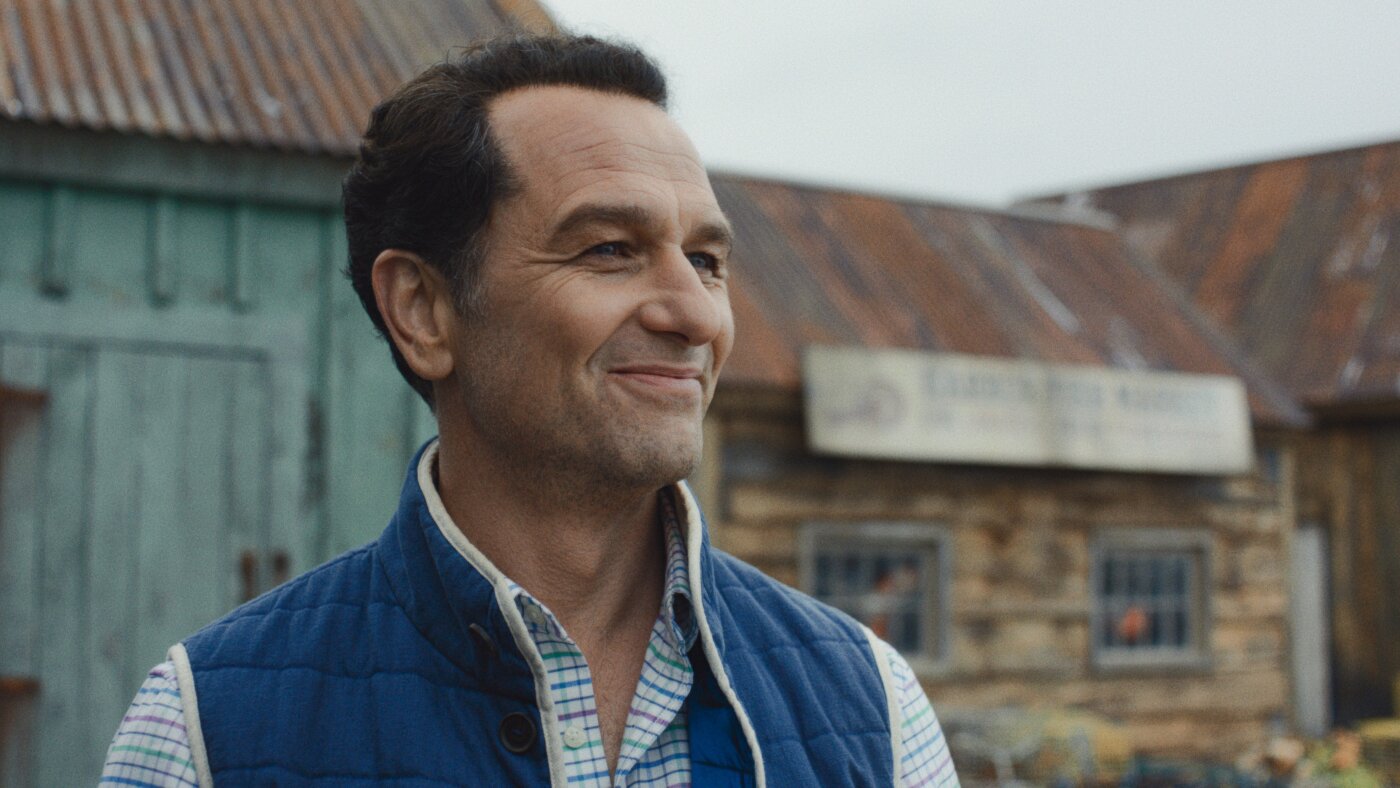
Matthew Rhys was nominated for his role in Widow’s Bay.
Apple TV
hide caption
toggle caption
Apple TV
The 2026 Emmy nominations are here. We’re unpacking the record-breaking nominations for Hacks, plus a big day for Widow’s Bay, The Pitt, and The Bear. We’ll also talk about the snubs and make some early predictions of who will win.
Connect with Pop Culture Happy Hour:
Letterboxd / Facebook
Our weekly newsletter
Support Pop Culture Happy Hour+


Can you say no to a friend’s wedding?
Getty Images/Getty images
hide caption
toggle caption
Getty Images/Getty images
Are we spending too much on other people’s weddings?
Going to a friend’s weddings can be so fun and meaningful… but it can also really hurt your wallet. A survey by LendingTree found that 31% of people who had been to a wedding in the past five years had accrued debt to attend. So what’s driving up the cost of weddings for guests? And what makes it so hard to say no to these expenses?
Brittany breaks it down with Allyson Rees, senior analyst at trend forecasting firm WGSN, and Annie Joy Williams, assistant editor at The Atlantic.
This episode was produced by Liam McBain, with additional support from Corey Antonio Rose. It was edited by Neena Pathak. Our Supervising Producer is Cher Vincent. Our Executive Producer is Barton Girdwood. Our VP of Programming is Yolanda Sangweni.
-

 Denver, CO4 minutes ago
Denver officers cited for separate incidents, 1 fired
-

 Seattle, WA11 minutes ago
Study finds dangerous chemicals in the breast milk of Seattle moms
-

 San Diego, CA14 minutes ago
Tom Krasovic: Justin Verlander’s announcement recalls Padres’ 2004 draft blunder
-
 Milwaukee, WI19 minutes ago
‘Peace on Every Block’ brings Milwaukee community together to fight gun violence
-

 Atlanta, GA26 minutes ago
Atlanta smash-and-grab: Masked men ram U-Haul into clothing store
-

 Minneapolis, MN29 minutes ago
Minneapolis police drone debate sparks privacy concerns
-
Indianapolis, IN34 minutes ago
Adam Vinatieri will celebrate on the field in Indianapolis again as Colts’ Ring of Honor member
-

 Pittsburg, PA41 minutes ago
U.S. launches more strikes against Iran


