Lifestyle
He swapped his lawn for native plants after asking, ‘What was meant to be here?’

Water-hungry lawns are symbols of Los Angeles’ past. In this series, we spotlight yards with alternative, low-water landscaping built for the future.
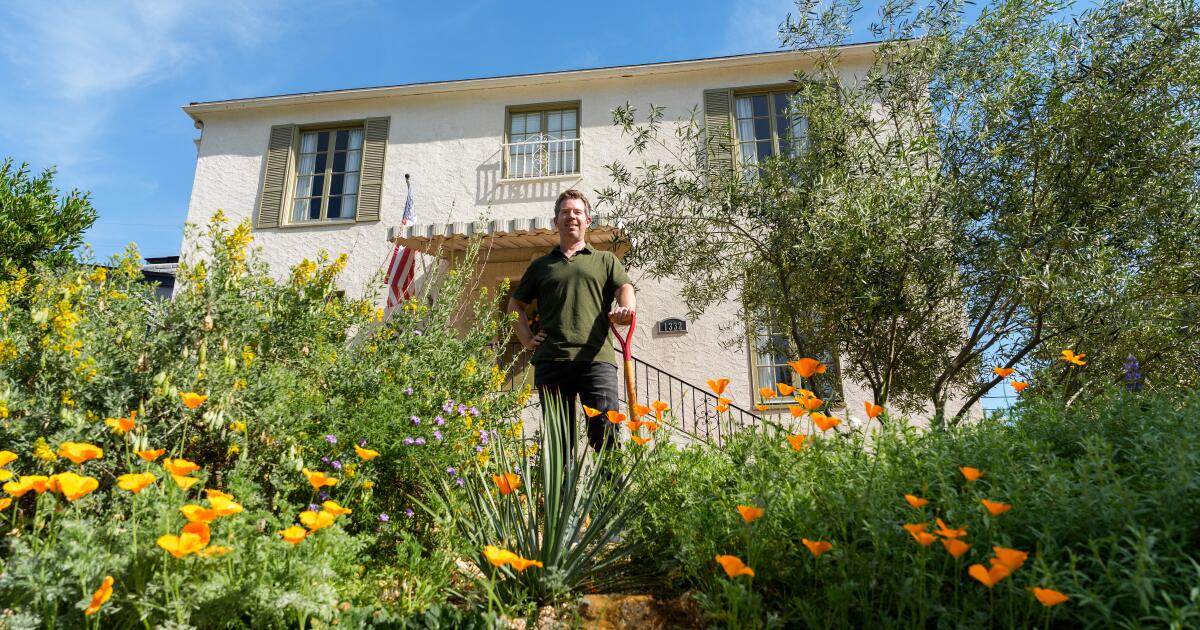
When Christopher Smee welcomes visitors to his Glendale garden, he enjoys giving what his friends jokingly call “the botanical tour.”
“Would you like to walk through the native chaparral?” he asks, pointing out the California native plants in his front yard: a multi-trunk toyon, bright orange California poppies (Eschscholzia californica), lantern-shaped Bladderpod (Cleomella arborea) with yellow flowers that bloom most of the year, purple Arroyo lupines (Lupinus succulentus), fragrant Allen Chickering Sage (Salvia ‘Allen Chickering’), and tall, silvery white sage (Salvia apiana) at the center.
“I love the majesty and structure of the white sage,” he says, pointing out the dried branches he leaves for the birds. “I love the color, and when I learned about its importance to the Indigenous community, I felt it should be at the center of the garden.”
Before: Christopher Smee’s Glendale home when it had Bermuda grass and nonnative plants.
(Christopher Smee)

After: Smee’s garden today.
Like many newcomers to Los Angeles, Smee, a 45-year-old former flight attendant, was fascinated by the city’s landscape and its famous palm trees when he first moved from England.
As he spent more time hiking outdoors in Los Angeles, on the Mount Thom trail in the Verdugo Mountains and the Pacific Crest Trail in the San Bernardino Mountains, Smee started to appreciate the native plants that thrive in Southern California’s dry climate.
So when Smee and his husband, Ryan Tish, bought a 1925 French-style home in the Rossmoyne Historic District, he knew he wanted to redesign the traditional front yard.
“There was a privet hedge, a lonely juniper, a hibiscus, a large bird of paradise and a camellia bush,” he says. “The lawn was mostly dirt. In fact, it had been colored green with CGI in the online real estate listing.”

The new patio, or “wine terrace,” overlooks the garden.
A native of Newcastle Upon Tyne, where English gardens are as beloved as football teams, Smee found the Glendale front yard’s layout off-putting. “You couldn’t get into the garden because the plants were a barrier,” he says. “You had to climb over things to get to the garden. In the U.K., my family had a long front garden that we actually used, so having a front garden and not using it seemed silly to me.”
Even though Smee had never gardened before, he decided to remove the tropical plants and Bermuda grass lawn in 2021 and plant a native garden to honor the California plants that grew there before the homes were built.
“I asked myself the question, ‘What was meant to be here?’ ” he says, standing in his yard as birds, bees and butterflies floated through the landscape. “That was the key question. All these plants I see in gardens — are they original? My husband grew up in L.A., and he couldn’t answer the question himself. I learned that generally they are not. I wanted to make things right, so I went on a journey to find what was here originally.”

The only nonnative in the yard, a multi-trunked olive tree, pays homage to the Glendale neighborhood, which was once an olive grove.
He began by visiting the Theodore Payne Foundation’s demonstration garden in Sun Valley, where people can see native plants growing in their natural habitat. “They sell flash cards that are like the Farrow & Ball paint chips you get for home improvement projects,” he says. He also visited local nurseries such as Plant Material, Artemisisa Nursery and Hahamongna Native Plant Nursery, which offer native species.
Wanting a garden that was easy to use and colorful year-round, Smee contacted landscape designer Guillaume Lemoine of Picture This Land to help design a formal French garden using California native plants.
“I always had a vision of walking down the porch steps, turning straight into the garden, and being able to walk to the wine terrace,” Smee says. “You want to get some usage and joy out of your garden. Not just something to look at when you drive by.”
Like many design projects, the plan changed over time. “The French garden didn’t happen,” Smee says. “But one day I will do it.” Still, the cottage-style garden has a French-inspired look composed of four quadrants with a water fountain in the center.

Smee’s Glendale lawn before it was removed.
(Christopher Smee)

Prolific self-seeding California poppies, lupine and Common Tiny Tips grow in the front yard.
(Kit Karzen / For The Times)
Before planting, Smee and his husband applied for a turf removal rebate from Glendale Water and Power, which gives homeowners $3 per square foot for replacing turf with drought-tolerant and native plants and for installing irrigation and a rainwater capture system. After the work was completed, they received a $1,596 rebate for removing 798 square feet of turf in the 2,000-square-foot yard. Smee estimates they spent about $20,000 in total on design fees, plants, removal and installation before the rebate.
Next, they hired Roger Ridlehoover and Maria Maturano of the Land Design Project to remove the lawn and plant climate-appropriate plants. The team started by cutting the Bermuda grass, turning it over and letting it sit to kill the roots. Then they added cardboard and a thick layer of mulch, using a no-dig gardening method called sheet mulching. “It worked,” Smee says. “We had a few strands of Bermuda grass come back, but that was it.”

Smee is backed by white sage, which he wanted to be the center of the garden. Note: This photo was taken with a 360-degree camera.
After setting up movable micro-emitters for irrigation, they planted native species that fit the site, soil and climate, focusing on their role in supporting a diverse ecosystem.
Because of a delay with their retaining wall, they ended up planting the garden in July 2021, which is usually the hardest time of year to start a new garden.
But the delay proved that you can plant in the summer, Smee says, at least if you use native plants.
“We only lost a few plants,” he says. “Of course, fall is the best time to plant before it gets too hot, but if you are working with a good landscape designer, it is not out of the realm of possibility. “
From the street, you can see the garden’s silver and green leaves shimmering, with bright bursts of California lilac (Ceanothus Yankee Point) spilling over the front wall. Toyon brings red berries in winter and white flowers in spring, while California sagebrush and Cleveland sage fill the air with an intoxicating perfume. There is now a new patio that looks out over the garden, just as Smee wanted. All the plants are native, except for an olive tree he planted to remember the neighborhood’s past when olive groves filled the area before homes were built in the 1920s.

Bladderpod (Cleomella arborea) flowers most of the year.

California poppies bloom in the spring.
“We wanted to honor the history of the area and the theme of the streets,” Smee says about the low-fruit olive tree, which is less messy than other varieties that often leave oily stains on streets and sidewalks. Smee thought about planting an oak tree instead but worried that a large tree might be too heavy for the retaining wall along the sidewalk, so he decided against it. “It’s still a lingering regret,” he says.
“I love seeing the deep, rich green of the toyon next to the pale green of the sage, dudleyas, sagebrush and the olive tree,” Smee says. “I wanted to make sure that even in the hottest part of summer, my garden wouldn’t turn brown.”
After years of working in his garden, the former novice has figured out what grows well in his yard’s different spots. California Wax Myrtle (Morella californica) couldn’t handle the summer heat. Salvia clevelandii ‘Winifred Gilman’ didn’t do as well as the other sages and was too aromatic for his taste. He also tried showy penstemons, but they didn’t like the shade near the house.
“Native plants are often described at nurseries with their sun preferences: ‘full sun’, ‘partial sun’, ‘shade,’ etc.,” he says. “But full sun in Glendale is very different from full sun in coastal Brentwood. Trying out different plants has helped me learn what ‘full sun’ means in my own garden, so now I can choose plants more confidently.”

An overhead view of the garden.
Smee learned a few things about himself along the way too. “I’ve always thought water fountains were a bit twee,” he says with a smile, but now he loves his. He found the clean-lined water fountain at Reseda Discount Pottery & Fountains, which he calls an “Aladdin’s cave” with hundreds of fountains running at once.
“It’s like in ‘Indiana Jones and the Last Crusade’ where he has to choose the goblet,” he says, laughing. The birds and bees love it too, he adds. “The ravens have left Cheez-Its for us.”
Five years later, Smee’s dream is now a reality. He strolls along a stepping-stone path through dry chaparral and coastal sage scrub, with Mexican gold onyx boulders on either side, leading to the patio where he and his husband like to host friends during the summer.

Smee didn’t think he wanted to install a water fountain, but now he’s glad he did because it attracts wildlife.
Last year, he welcomed more than 300 visitors during the Theodore Payne Native Plant Garden Tour and had to set up a one-way path through the garden to help manage the crowd.
For maintenance, Smee says he prunes once each season, four times a year. He doesn’t have a gardener and rarely waters the plants. “There is a lot of ebb and flow in the garden,” he says. “I cut it back a lot every year to make space for wildflowers in the spring. I get sad when the wildflowers die, but then I chop them back and save the seeds, and before I know it, the California Fuchsia (Epilobium canum) blooms, adding red to the garden.”
After the first year, while he was getting the garden established, he saw a big drop in the couple’s water use. “When it gets hot in the summer, I turn on the water once a month,” he says. He tried not watering at all, but when he saw the California fuchsia, also called ‘hummingbird fuchsia’ because the birds love it, struggling, he turned the water back on.
“I’m not in the wild,” he says. “It’s still a garden, and I want to enjoy it.”

“It’s really been a joy to reunite the soil with the plants that belong here,” Smee says of removing his lawn and planting California natives.
Now that he has finished creating a native habitat at home, Smee looks forward to using what he has learned by volunteering at the Sunshine Preserve, a 3½-acre site owned by the nonprofit Arroyos & Foothills Conservancy on the eastern edge of the Verdugo Mountains in Glendale.
Working with other volunteers, Smee has helped remove invasive plants and plant native species, including 30 oak trees that attract local wildlife like the endangered monarch butterfly, mountain lions and bobcats. Smee and his group have planted 40 or 50 white sages to help rebuild the local population.
“At the preserve, I’m learning how things grow in the wild,” he says. “The ground is natural dirt, untouched by gardeners. Woolly bluecurls can be tricky for home gardeners, but at the preserve, it thrives because it’s in the right place. We’ve probably planted hundreds of native plants over the last three years. Come back in 30 years, and you’ll see what we’re working toward.”
Smee admits he knew little about California plants and soil at first, but he says he has since become more connected to the land. In the process, he learned there is real joy in bringing native plants back to the soil where they belong.
“I hope people can see that a California native garden can be joyful, colorful and full of life — that’s it not just about conserving water, but about enriching life through the biodiversity that the native plants attract to the garden,” he says. “Thoughtful plant selection can ensure a native garden has something of interest at all times of the year and doesn’t have to go brown in the summer.”
Many people can make a difference on the planet even with a small garden, says Smee. “Having a native garden brings a unique level of joy because you discover you’re doing something for the native wildlife that no other type of garden can do,” he says. “It’s a really special thing.”

PLANT LIST
Bladderpod, Cleomella arborea
Blue grama grass, Bouteloua gracilis
Blue grama grass ‘Blonde Ambition’, Bouteloua gracilis ‘Blonde Ambition’
Bright green dudleya, Dudleya virens ssp. hassei
Britton’s Dudleya, Dudleya brittonii
California Laurel, Umbellularia californica
California Buckwheat, Eriogonum fasciculatum
California Fuchsia, Epilobium canum
California Goldenrod, Solidago velutina ssp. californica
Canyon Gray Sagebrush, Artemisia californica ‘Canyon Gray’
Canyon Dudleya, Dudleya cymosa
Yankee Point Carmel Ceanothus, Ceanothus thyrsiflorus var. griseus ‘Yankee Point’
Cedros Island liveforever, Dudleya pachyphytum
Chaparral nolina, Nolina cismontana
Chaparral Yucca, Hesperoyucca whipplei
Allen Chickering Sage, Salvia ‘Allen Chickering’
Mound San Bruno California Coffeeberry, Frangula californica ‘Mound San Bruno’
Conejo Buckwheat, Eriogonum crocatum
Desert Agave, Agave deserti
Desert marigold, Baileya multiradiata
Eastwood Manzanita, Arctostaphylos glandulosa ssp. glandulosa
Fingertips, Dudleya edulis
Giant Chain Fern, Woodwardia fimbriata
Lanceleaf Liveforever, Dudleya lanceolata
Lemonade berry, Rhus integrifolia
Emerald Carpet Manzanita, Arctostaphylos ‘Emerald Carpet’
Howard McMinn Manzanita, Arctostaphylos ‘Howard McMinn’
Vibrant Red Monkeyflower, Diplacus ‘Vibrant Red’
Narrow Leaf Milkweed, Asclepias fascicularis
Wilson’s olive, Olea europaea ‘Wilson Fruitless’
Tall Oregon Grape, Berberis aquifolium
Palmer’s Dudleya, Dudleya palmeri
Margarita BOP Penstemon, Penstemon heterophyllus ‘Margarita BOP’
Red-flowered Buckwheat,Eriogonum grande var. rubescens
David’s Choice Sagebrush, Artemisia pycnocephala ‘David’s Choice’
San Quintín liveforever, Dudleya anthonyi
Tecate Cypress, Hesperocyparis forbesii
Toyon, Heteromeles arbutifolia
De La Mina Verbena, Verbena lilacina ‘De La Mina’
White Sage, Salvia apiana
Woolly Bluecurls, Trichostema lanatum
WILDFLOWERS
Blue-eyed Grass, Sisyrinchium bellum
Arroyo lupine, Lupinus succulentus
California Poppy, Eschscholzia californica
Common Tidy Tips, Layia platyglossa
California Goldfields, Lasthenia californica



Ilia Malinin celebrates after winning his third Figure Skating World Championships in Prague on Saturday.
Michal Cizek/AFP via Getty Images
hide caption
toggle caption
Michal Cizek/AFP via Getty Images
American figure skater Ilia Malinin won his third consecutive world title this weekend, just weeks after missing the podium at the Winter Olympics.
The self-proclaimed “Quad God” was a heavy medal favorite going into Milan, but finished in eighth place after an uncharacteristic series of stumbles, which he later blamed on the pressure and expectations.

Six weeks after one of the most shocking twists of the Olympics, Malinin rebounded with a literal roar at the World Championships in Prague. He delivered two clean, quad-heavy programs to win gold by over 20 points, capping off the season on a note as high as his infamous jumps.
“I felt relieved that the season’s finally done after a long up and down for this whole season,” Malinin told U.S. Figure Skating, calling worlds a “change in mindset” from the Olympics. “All I wanted to do was skate for myself, enjoy every moment on the ice and just have fun out there, and that’s exactly what I did.”
Malinin skated the same routines that he brought to Italian ice — in the individual and the team event, in which he helped Team USA win gold — minus the visible nerves and mistakes. He earned a personal best score in his short program on Thursday to enter the second half of the competition in first place.
And he held onto that lead with a dazzling free skate on Saturday, even as he played it safe by his own standards.
Malinin wowed the crowd with his signature backflip and “raspberry twist” sideways spin, and landed five quadruple jumps. It’s an eye-popping number, but not his upper limit: He made history at a competition in December by landing all seven jumps as quads.
He fell short of that all-time high score but still won handily, by 22.73 points, becoming the first U.S. skater to three-peat at worlds since Nathan Chen.
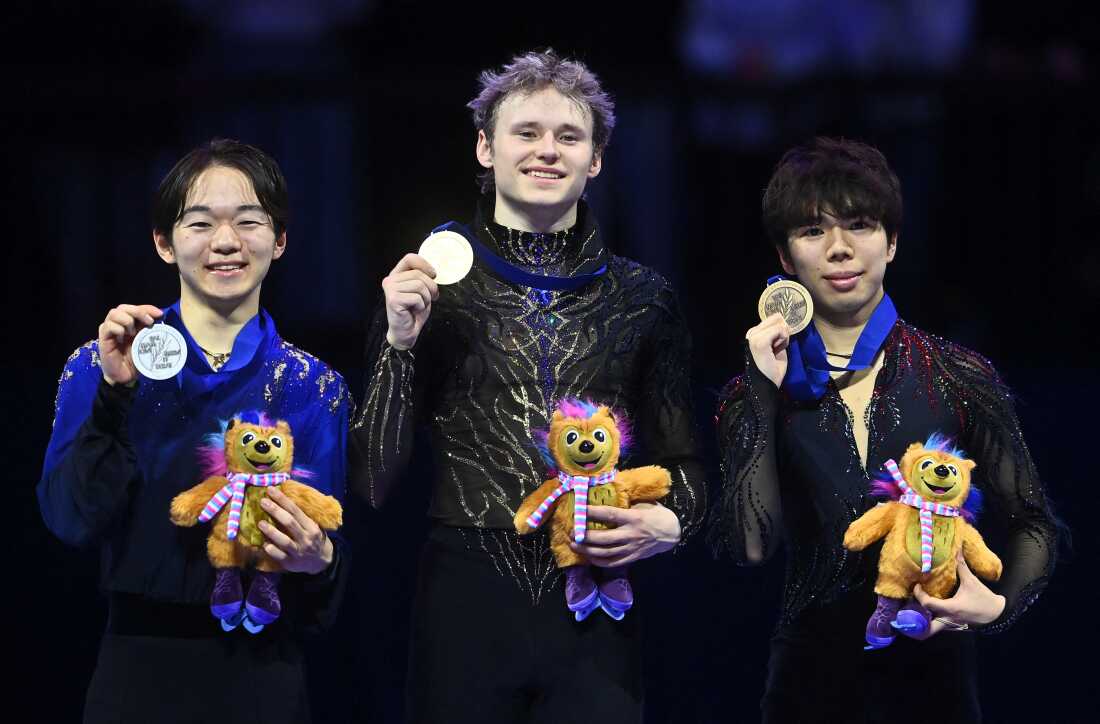
Men’s world medalists Yuma Kagiyama, Ilia Malinin and Shun Sato (L-R) celebrate on the podium in Prague, Czech Republic on Saturday.
Michal Cizek/AFP via Getty Images
hide caption
toggle caption
Michal Cizek/AFP via Getty Images
Japan’s Yuma Kagiyama won silver and Shun Sato won bronze, in a repeat of the Olympic podium. (Mikhail Shaidorov, the panda-cosplaying Kazakh skater who shocked the world and himself with a gold medal in Milan, withdrew from worlds as is common practice for freshly-crowned Olympic champions who tend to prioritize rest, recovery and other obligations.)
“This was a competition where I wanted to just relieve all the pressure from the Olympics, to just come here with a fresh new mindset and just enjoy everything that I love about this sport,” Malinin told Olympics.com, adding that it was “probably one of the easier world championships I’ve been to” for that reason.
Malinin didn’t attempt a quadruple axel — the jump that only he can do — in competition in Prague, as was the case in Milan. But he did bust one out at the exhibition gala on Sunday, to onlookers’ surprise and delight.

There, Malinin was crowned the International Skating Union’s “Trailblazer on Ice” for his record-breaking seven-quad program (he also won “best costume” at its awards show later that day). The 21-year-old from Virginia, who is also the four-time reigning U.S. champion, reflected on the highs and lows of his season in an interview shortly afterward.
“Part of it was just knowing that it’s part of the deal,” Malinin said. “It’s part of what we signed up to do as figure skaters and athletes … There’s always going to be disappointing times and things that don’t go your way, but we always have to learn to get up and use that as motivation or information to understand what we can do better in the future, and that’s exactly what I did.”
A mixed bag for other Americans
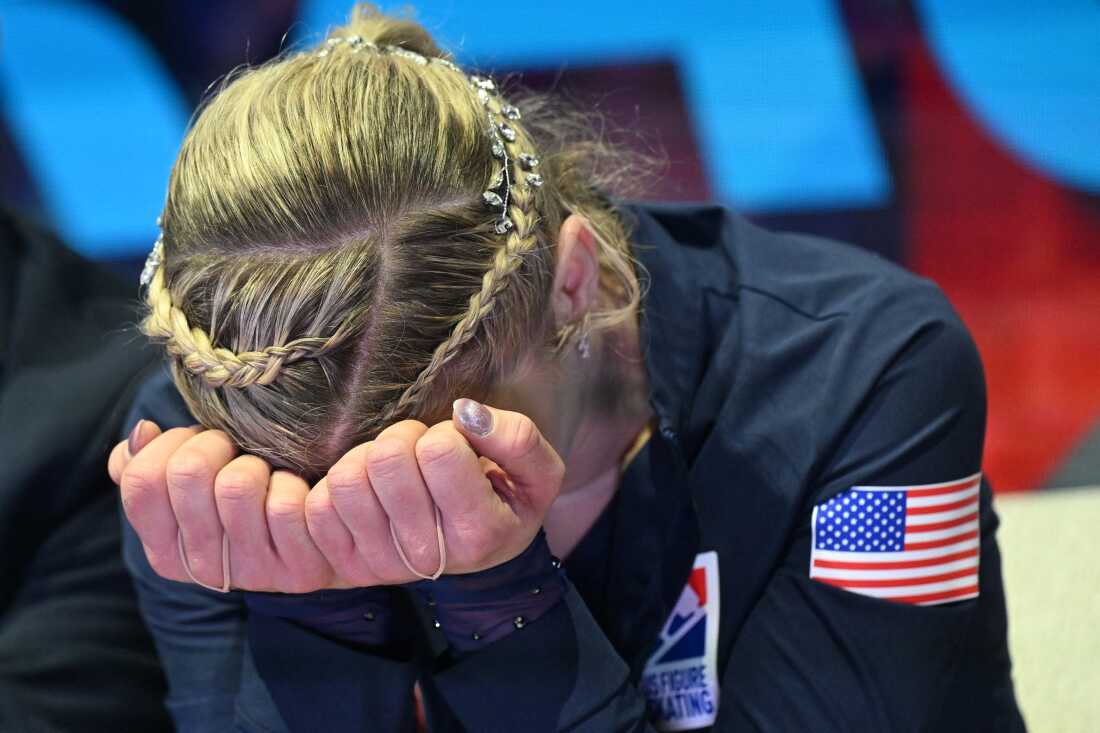
Amber Glenn was emotional after a series of mistakes in her free skate in Prague, where she ultimately placed sixth in women’s singles.
Michal Cizek/AFP via Getty Images
hide caption
toggle caption
Michal Cizek/AFP via Getty Images
Malinin wasn’t the only American aiming for redemption after Milan.
Amber Glenn, the reigning three-time U.S. champion who is beloved for her outspoken LGTBQ and mental health advocacy, had hoped to recover from her Olympic disappointment.
The medal favorite missed the podium in Milan due to a costly mistake in her short program that put her in 12th place. She followed it up with a sensational free skate that catapulted her into a fifth-place finish.
Unfortunately for Glenn, the reverse happened in Prague.
She nailed her short program — including the jump that gave her trouble at the Olympics — and headed into the free skate in third place. On Friday, she started strong with a triple axel but under-rotated several jumps as a pained crowd cheered her to the end of the song, at which point she knelt down on the ice, covering her face.
Glenn finished in sixth place overall, but quickly took to social media to reassure her fans.
“I’m okay! If anything I’m mentally, emotionally, physically exhausted after a season of extreme highs and lows,” wrote the 26-year-old. “I did what I set out to do 6 years ago. Land a Triple axel and go to the Olympics and nothing will take that away from me.”
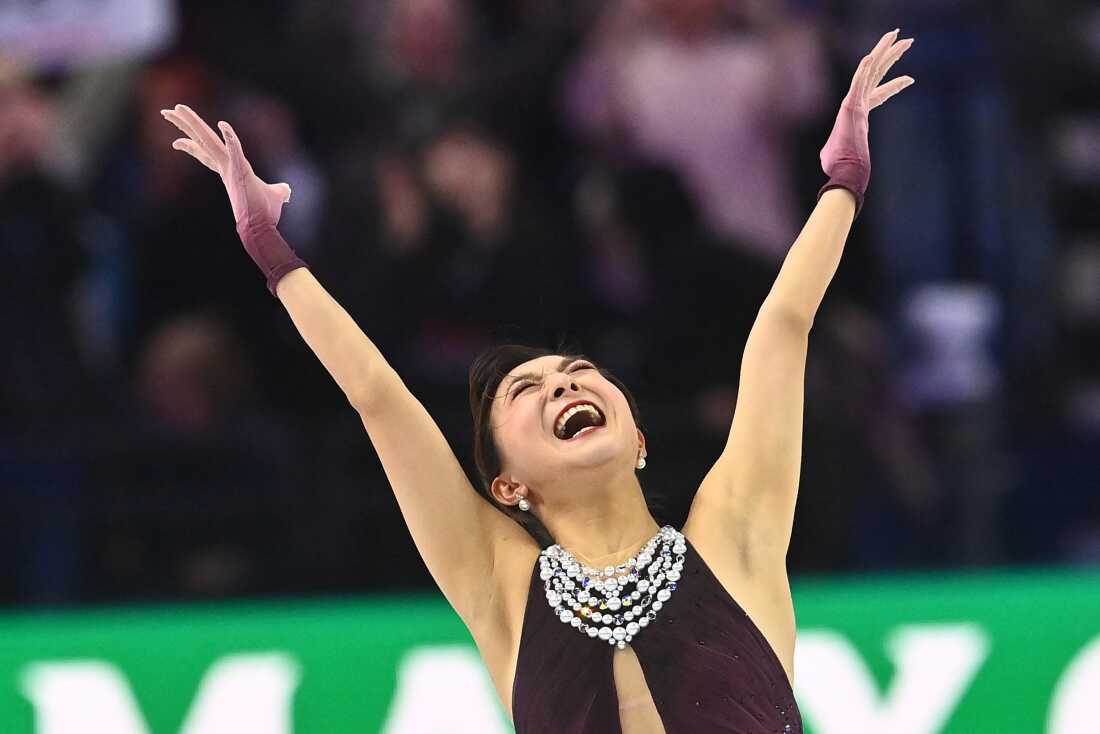
Japan’s Kaori Sakamoto reacts after her triumphant farewell free skate on Friday. She leaves Prague with her fourth and final world title.
Michael Cizek/AFP via Getty Images
hide caption
toggle caption
Michael Cizek/AFP via Getty Images
The women’s gold medal went to beloved Japanese skater Kaori Sakamoto, who now retires as the four-time reigning world champion. She earned a personal best score in the final skate of her competitive career, to an Édith Piaf medley including “Non, Je Ne Regrette Rien” — “I regret nothing.”
The 25-year-old, who is known for her endearingly emotive reactions to her scores, jumped up and ran around the “kiss and cry” before breaking down in relieved tears as her coach plied her with tissues.

Sakamoto was a favorite for gold, having won three straight world titles, until American Alysa Liu broke her streak last year and then won gold to her silver at the Olympics. Sakamoto has spoken about being disappointed with her results in Milan.
“This season was much harder than I had ever imagined,” Sakamoto told Olympics.com after her win in Prague. “There were times when things didn’t go the way that I wanted, but at the end, really at the end of this season, everything came together. I’m very happy to be able to put this closure on my career.”
Sakamoto’s fellow Japanese skater Mone Chiba finished second, and Nina Pinzarrone of Belgium finished third. Just off the podium in fourth place was Isabeau Levito of the U.S. — a marked improvement from her 12th-place spot in Milan.
(Reigning Olympic champion Liu didn’t compete; she was busy with post-gold medal opportunities like presenting Taylor Swift with the Artist of the Year Award at the iHeartRadio Music Awards.)
In ice dance, American duo Emilea Zingas and Vadym Kolesnik won bronze in their world championship debut, capping off a breakthrough season that saw them finish fifth at the Olympics.
According to U.S. Figure Skating, this is the 11th straight World Championships where at least one U.S. ice dance duo has won a medal. The most recent three went to Madison Chock and Evan Bates, who withdrew from worlds after taking silver at the Olympics.
What’s next for figure skaters (and their fans)

Alysa Liu, pictured presenting Taylor Swift with an award at the iHeartRadio Music Awards in Los Angeles on Thursday, started her off-season early after her Olympic victory.
Jon Kopaloff/Getty Images
hide caption
toggle caption
Jon Kopaloff/Getty Images
The World Championship marks the end of competition for the 2025-2026 figure skating season and this “quad,” as the skating community refers to the four-year cycle culminating in a Winter Olympics.
This is the window, especially in an Olympic year, when skaters traditionally take at least some time off to rest and recover.
Many will return to the rink later this spring for shows and tours. The most prominent one, Stars on Ice, will visit cities throughout the U.S. from mid-April through the end of May. Malinin, Liu, Glenn, Leviteau, Chock and Bates are already on the roster.
“I’m definitely going to celebrate this moment by doing a bunch of shows and starting so many new projects off the ice and on the ice,” Malinin said this weekend.
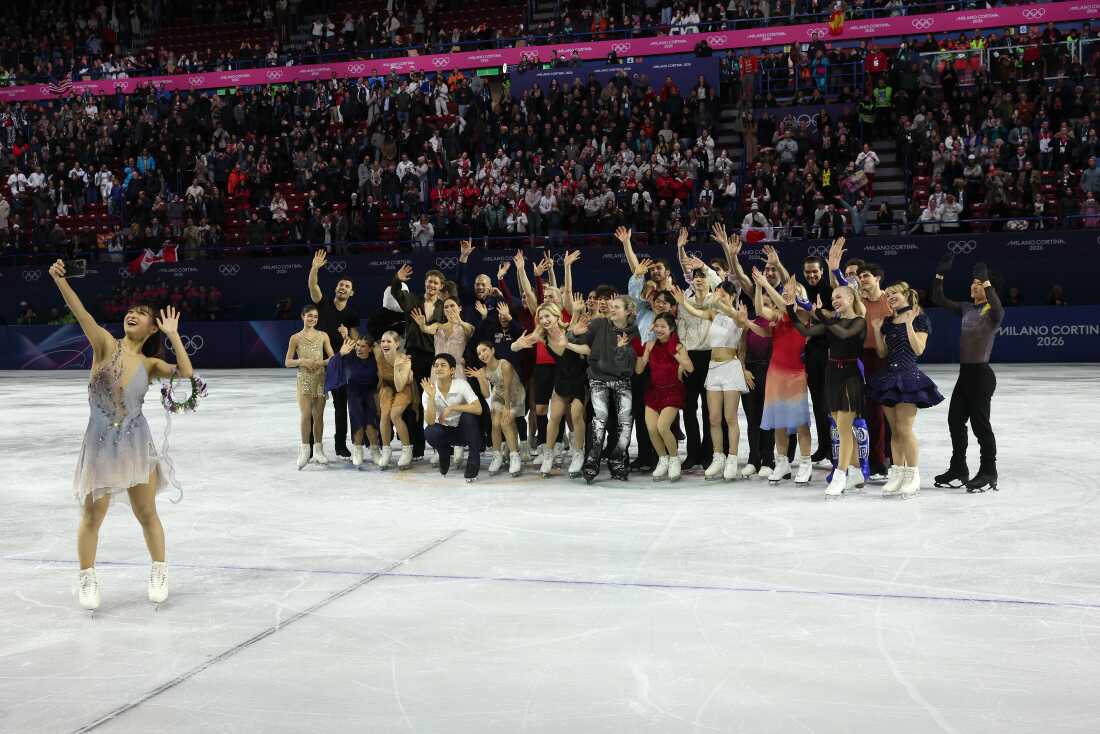
Kaori Sakamoto takes a selfie with fellow figure skaters at the Olympics exhibition gala in Milan last month.
Jamie Squire/Getty Images
hide caption
toggle caption
Jamie Squire/Getty Images
Summertime is when skaters typically develop new skills and routines (and change coaches as needed) for the upcoming season, which officially starts on July 1.
U.S. Figure Skating has announced nearly two dozen qualifying events across the country from July through October, with its finals in November serving as one of the main pipelines to the U.S. Figure Skating Championships. Those will be held in Salt Lake City in January 2027.

There are also six International Skating Union (ISU) Grand Prix events every season, each hosted by a different country, including the U.S. This Grand Prix season will kick off with “Skate America” in Everett, Wash., in late October, and culminate in a final that is typically held in December (details for the upcoming season have not yet been announced).
The second half of the season, in early 2027, sees other major ISU events, including European Championships, which are headed to Lausanne, Switzerland, in late January. There’s also the Four Continents Figure Skating Championships, featuring top skaters from America, Asia, Africa and Oceania. World Championships in Tampere, Finland, will cap it all off in March 2027.
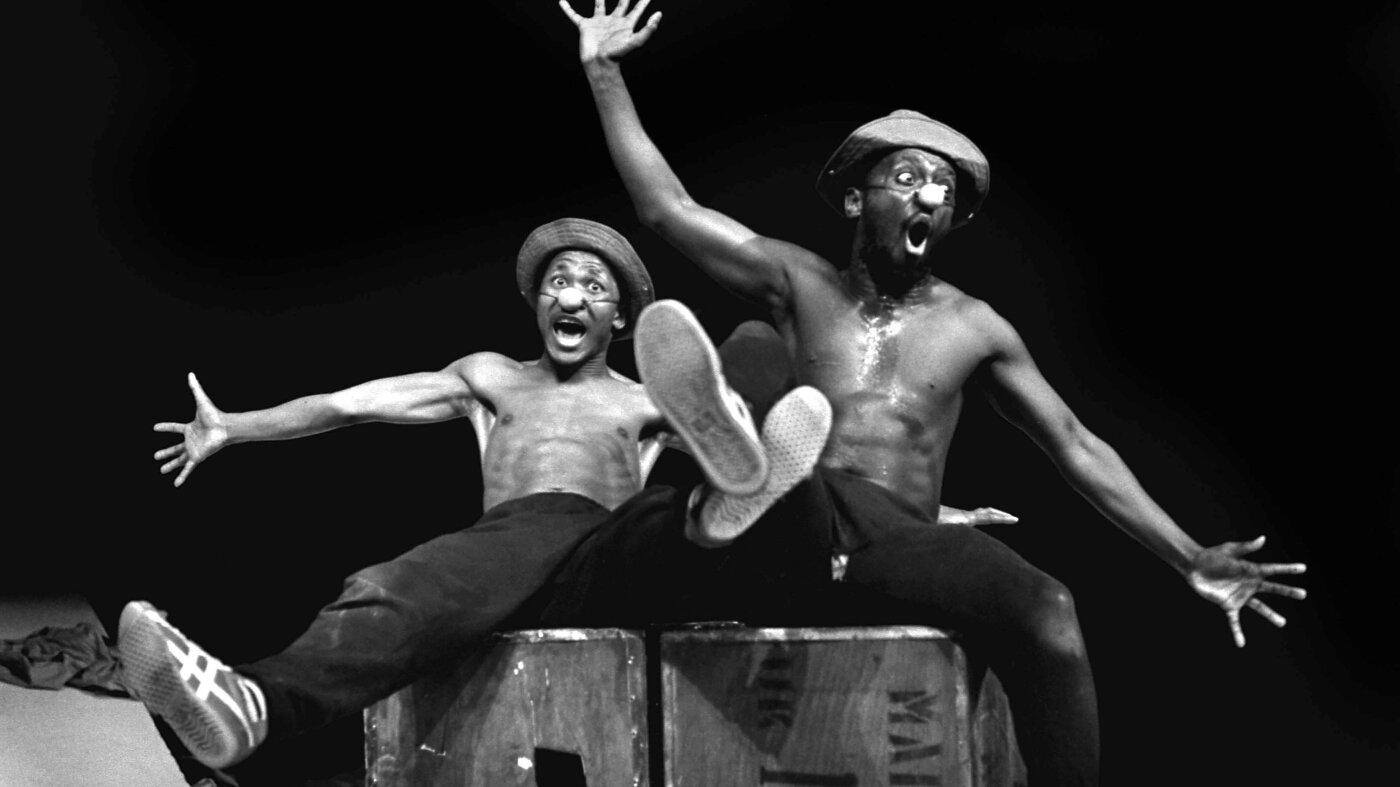
Performers Percy Mtwa, left, and Mbongeni Ngema in a scene from “Woza Albert” at the Market Theatre in Johannesburg, South Africa, in 1981.
Ruphin Coudyzer/AP
hide caption
toggle caption
Ruphin Coudyzer/AP
JOHANNESBURG, South Africa—When it first started in the 1970s, South Africa’s Market Theatre staged plays considered to be so subversive that it became a regular target of the apartheid government’s zealous censors.
Even the fact that its audiences were made up of Black and white South Africans mingling together was unheard of in a city where the law separated areas and people by race.
The theater, established in an old fruit and vegetable market in central Johannesburg, was born at a pivotal time in “the Struggle” — the fight against the apartheid government. It opened its doors just days after the 1976 Soweto uprising changed the country forever.
Youth took to the streets to protest schools teaching in the Afrikaans language and the ensuing government crackdown saw hundreds killed.
“So, we opened our doors three days after that event,” says the theater’s current artistic director Greg Homann. “The Market Theatre has been forged in those days of June 16 and now has really carried the weight of telling the national story of South Africa all the way through the dark years of apartheid.”
This year, the theater, where legendary South Africans like actor John Kani and playwright Athol Fugard made their names, is celebrating its 50th anniversary.
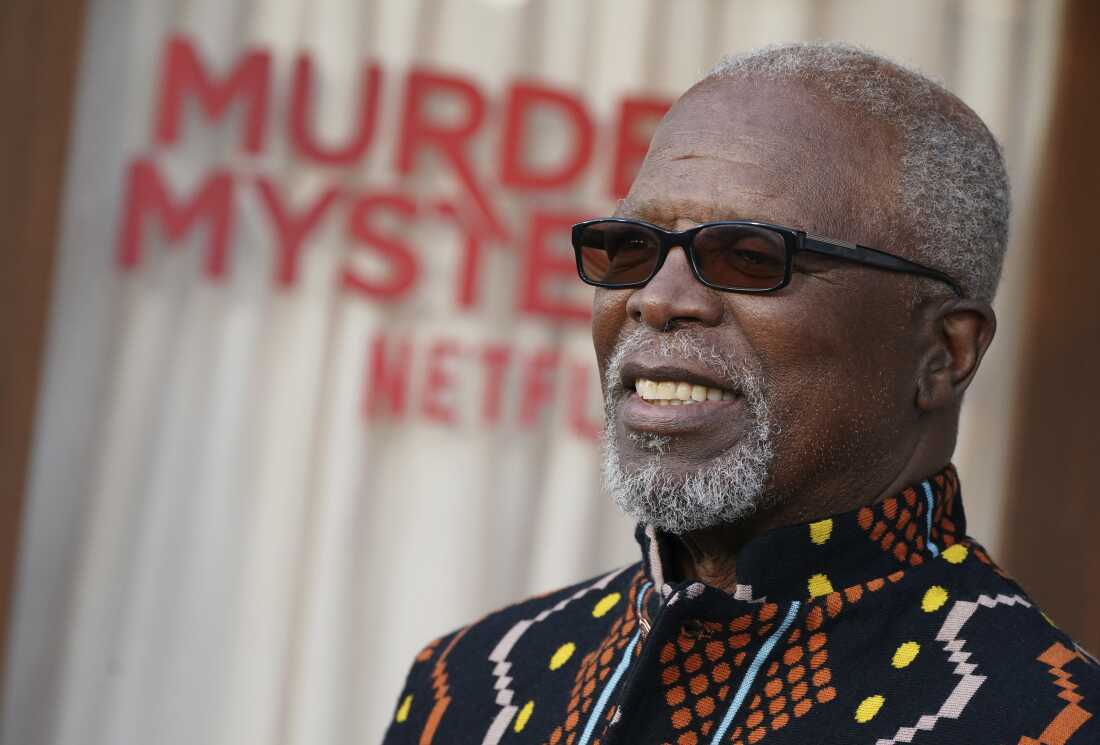
John Kani arrives at the premiere of “Murder Mystery 2” on Tuesday, March 28, 2023, at the Regency Village Theatre in Los Angeles.
Jordan Strauss/Invision/AP
hide caption
toggle caption
Jordan Strauss/Invision/AP
In that half century it produced plays of international renown, including “Woza Albert,” “Sophiatown,” and “Sizwe Banzi is Dead,” and the hit musical “Sarafina” — about the Soweto uprising.
“Sarafina,” written by jazz musician Hugh Masekela, went on to Broadway and became a Hollywood movie starring Whoopie Goldberg.
But many initially doubted it would survive. Tony-award-winning actor John Kani said he was stunned when the theatre’s founders Barney Simon and Mannie Manim first told him their vision.
“I thought these two whities were nuts, it’s not going to work, and they said to me and Athol Fugard that it’s going to be open to all. I said what are you talking about, it’s ’75, ’76” Kani recalled in a 2014 interview.
But despite his initial reservations, Kani said, “my entire career fell in place on this stage.”
Still, there were times when it was touch and go.
The theater “was often raided. Actors were sometimes in some kind of danger,” Homann says.
And often, apartheid government censors turned up.
“They would then go onto stage and they would start doing their censorship in front of the audience,” he continues. “And it almost became like a second act of the production where the censorship was actively part of the work.”
‘No Black, no white’
Then there was the fact it was a place where all races could mix, with the theater’s directors cleverly finding loopholes to circumvent the law.
“At one point our bar was sold for one rand, so, you know, the equivalent of 50 American cents, so that it was privately owned,” says Homann.
Being privately owned meant that audience members of color “could stand in that space legally,” he explains. “But if they stepped one meter into the foyer they were illegal by apartheid laws.”

United States First Lady Hillary Rodham Clinton, left, and Vice President Al Gore applaud during a variety musical performance of “Sophiatown” by members of the Market Theatre Company on Monday, May 9, 1994 in Johannesburg. Rev. Jesse Jackson is seated behind Gore.
Michael Yassukovich/AP
hide caption
toggle caption
Michael Yassukovich/AP
While the theater’s work helped spread the message of the anti-apartheid movement at home and abroad, some white audience members were triggered.
“Quite a number of times I’ve seen them whites. You know, they get up,” recalls director Arthur Molepo, a theater veteran who has been involved with the Market since its inception.
“You see a man grabbing a woman and just walking out during the play, meaning they were angry, of course, or they’re not agreeing or believing what we’re saying,” said Molepo.
Still, he remembers the early years of the market as a heady time.
“There was no black, there was no white. We were just a whole group, a whole bunch. So we were making things, making theater,” he says.

An image from the February 2026 production of “Marabi” at the Market Theatre.
Ngoma Ka Mphahlele/Market Theatre
hide caption
toggle caption
Ngoma Ka Mphahlele/Market Theatre
This year Molepo directed a new production of an apartheid-era play — “Marabi.”
From the applause and standing ovation it was clear the subject matter still resonated, even with what appeared to be a mainly Gen Z and millenial audience who never knew life under apartheid.
The story follows a Black family’s struggles in the first half of the twentieth century and ultimately ends with their forced removal from their home under the white government’s racial segregation laws.
Gabisile Tshabalala, 35, played the lead role in Marabi, but she grew up in a free South Africa and doesn’t remember apartheid.
However, the actress says: “Theater is extremely important for young South Africans….especially as Black people…we get to tell our stories.”
And the theater isn’t content to rest on it’s historic laurels.
It “tells the South African story,” says Homann. “whatever that might be of its day.”
“So during the ’80s, that was the story of the fight against apartheid. More recently, it’s the challenges of a young democracy.”
Issues like access to education, corruption, and gender-based violence are all being tackled on stage as the Market turns 50, with South Africans hoping for many more years of thought-provoking theater.
Lifestyle
L.A. Times Concierge: I live in O.C. My kids live in Santa Clarita. Looking for nice spots to meet halfway.
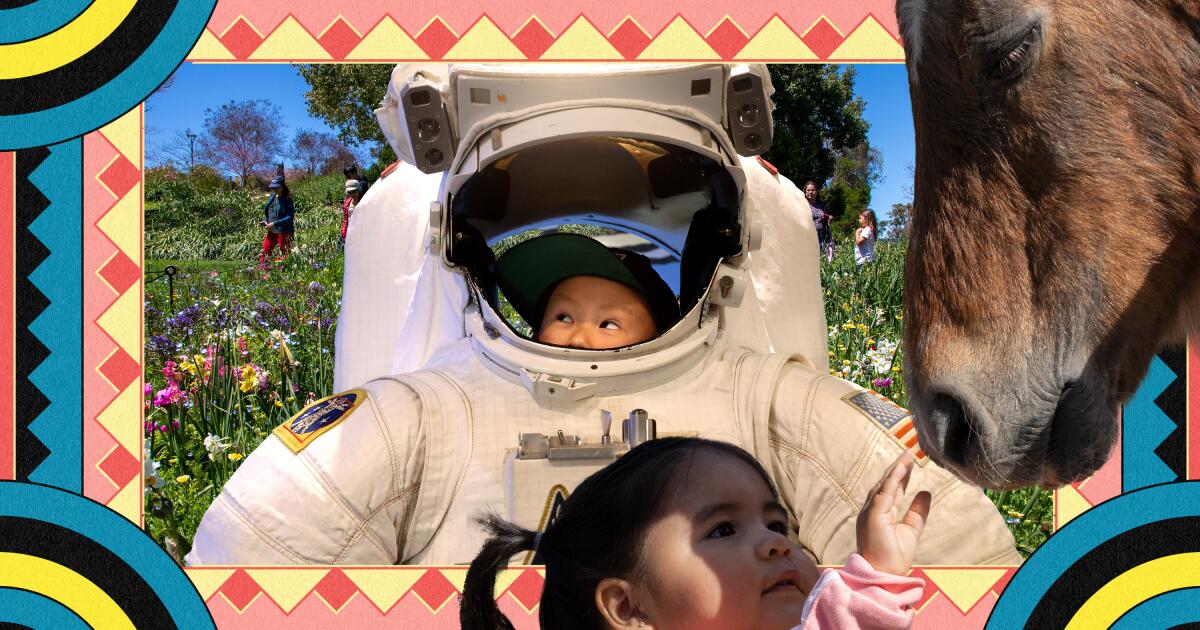
My husband and I live in Mission Viejo. Our older son, his wife and two children (ages 5 and nearly 4) live in Newhall. We love spending time together, but it’s quite a trek on the 5 Freeway. Last year, we went to the aquarium in Long Beach, which was great fun. Another day, we enjoyed a day of hiking and a picnic at Placerita Canyon Nature Center near my son’s home. We would love some suggestions about other places to visit which would maybe be a little more centrally located and fun for the whole family. Thanks
— Cathy McCoy
Looking for things to do in L.A.? Ask us your questions and our expert guides will share highly specific recommendations.
Here’s what we suggest:
Cathy, I understand your pain. Driving 80 miles can feel like an odyssey, especially in SoCal. Thankfully, there are loads of fun places where your family can meet in the middle (or close to it). I’ve rounded up some solid options. By the way, the driving times mentioned here are a rough estimate for a weekend day without traffic, but as you probably know, your actual time may vary.
Since you all enjoyed the Aquarium of the Pacific in Long Beach, how about switching it up and spending the day with a different set of animals at the Montebello Barnyard Zoo for your next outing? That would be about a 40- to 50-minute drive for both of you. Open since 1968, the zoo is home to horses, goats, sheep and donkeys that you can pet (and feed for an extra $3). If you’re feeling adventurous, you can ride a pony or take a leisurely trip on a John Deere tractor train. “It’s a great place for young ones to learn that animals outside the home need and deserve the same kind of care that we show our pets,” Etan Rosenbloom writes in a Times guide to things to do with kids around L.A. General admission is $11, and you can sometimes find deals on Groupon as well. Afterward, head to Blvd Mrkt, a food hall in downtown Montebello that sells a variety of food so everyone can get what they want.
Another great option is the South Coast Botanic Garden on the Palos Verdes Peninsula, which might be about an hour drive for both of you. I learned about this spot from my dear late colleague Jeanette Marantos, who was a gardening expert in her own right. The garden, which has more than 2,500 species of plants and five miles of trails, also includes a kids area, which features “a nursery rhyme theme with a large dollhouse, a charming bridge and plants matched to the stories,” Marantos wrote. My editor Michelle Woo also loves this garden. “You can take a leisurely walk along the accessible loop trail or get really into the nooks and crannies of the place, discovering trees with giant roots that kids love to climb on and koi fish swimming in a shaded pond,” she says, adding that she’s excited for Thomas Dambo’s trolls exhibit that opens Sunday. If you get hungry, you can stop by Dottie’s at the Koi Pond, which sells food, beer, wine and specialty cocktails on Saturdays and Sundays. Carry-in food is permitted if pre-prepared.
If you’re interested in space travel, you should visit the Columbia Memorial Space Center, which is the ultimate cosmic playground. Located in Downey (known as “home of the Apollo”) — about a 40-minute drive for you and a 50-minute drive for your son’s family — the recently renovated museum features a play area, robotics lab and interactive exhibits on space exploration, including a shuttle landing simulator. Admission is $5 for adults and kids, $3 for seniors ages 65 and up and free for children ages 3 and under.
Speaking of aviation, another spot worth checking out is the Proud Bird in El Segundo, about a 45- to 50-minute drive for both of you. Here, you can enjoy delicious bites as you watch planes land at Los Angeles International Airport, which is just a couple of miles away. Woo calls it “the perfect spot for a multigeneration gathering.” “Our extended family once celebrated Christmas there when everyone was too tired to cook,” she adds. “You can order solid barbecue from Bludso’s, have a drink by a bonfire pit and let the kids play on the playground as planes fly by.” She also suggests the Point in El Segundo. It’s an open-air shopping and dining center that has a large lawn where the kids can play and the grownups can grab a drink from Lil’ Simmzy’s.
I hope these recommendations are useful as you plan your next family outing (and that they also save you some gas money). Whatever you end up doing together, I’m sure that your family, especially the little ones, will just be grateful to spend quality time with you. Have fun!

DC Streetcar coming to a final stop after a decade on the H Street corridor

WATCH: Teen ‘takeover’ turns violent as fights break out, arrests follow chaos at Wisconsin mall | Fox News Video

W.Va. courts data centers statewide, touting billions in investment amid AI demand

Lander, Fort Washakie compete at state esports championships in Torrington

Washington State Targets Kalshi in Illegal Online Betting Lawsuit

Florida High School Football Rankings: Top 25 teams – Oct. 21

How old is Bo Nix? What to know about Oregon quarterback ahead of 2024 NFL Draft

Cleary's 21 help Le Moyne down Central Connecticut State 69-64 in OT

99th annual Pony Swim held in Virginia

Indiana Members Credit Union announced as new anchor tenant at Bottleworks District

Emanuel pushes back on ‘straight White man’ question, says ideas matter most in 2028

French police make two more arrests over foiled attack on Bank of America

‘What’s going on?’: US judge calls aspects of new Pentagon press policy ‘weird’

Video: Iran to Allow More Oil Ships Through Strait of Hormuz, Trump Says

Dem senator warns deportation could let Virginia woman’s illegal immigrant killer ‘escape accountability’
-

 Sports1 week ago
IOC addresses execution of 19-year-old Iranian wrestler Saleh Mohammadi
-

 Miami, FL4 days ago
Jannik Sinner’s Girlfriend Laila Hasanovic Stuns in Ab-Revealing Post Amid Miami Open
-

 New Mexico1 week ago
Clovis shooting leaves one dead, four injured
-

 South-Carolina1 day ago
South Carolina vs TCU predictions for Elite Eight game in March Madness
-

 Politics1 week ago
Schumer gambit fails as DHS shutdown hits 36 days and airport lines grow
-

 Tennessee1 week ago
Tennessee Police Investigating Alleged Assault Involving ‘Reacher’ Star Alan Ritchson
-

 Minneapolis, MN4 days ago
Boy who shielded classmate during school shooting receives Medal of Honor
-

 Science1 week ago
Record Heat Meets a Major Snow Drought Across the West