Lifestyle
Gen Z wants to quit vaping. Can a new wave of trendy products help?

When model Josephine Lee, known online as Princess Gollum, arrived in Studio City for a skincare brand photo shoot in November 2021, she had all her signature accessories in tow. An eerie-chic partially shaved head, spooky colored contacts and a green, matcha-flavored vape in the grasp of her long fingernails.
Despite a recent health scare and an order from her doctor to stop vaping, everytime the camera was down, the candy colored device was back in her mouth. On set, she confided in Julie Schott about her desire to quit. Los Angeles-based Schott, who is the owner of Starface, the wildly popular pimple patch brand Lee was shooting for, immediately felt her business brain buzzing. She’s made her career destigmatizing clinical products like acne treatments to the morning after pill through millennial and Gen-Z friendly marketing. By the end of the photo shoot, Schott and Lee were inspired to reinvigorate the nicotine replacement therapy (NRT) industry.
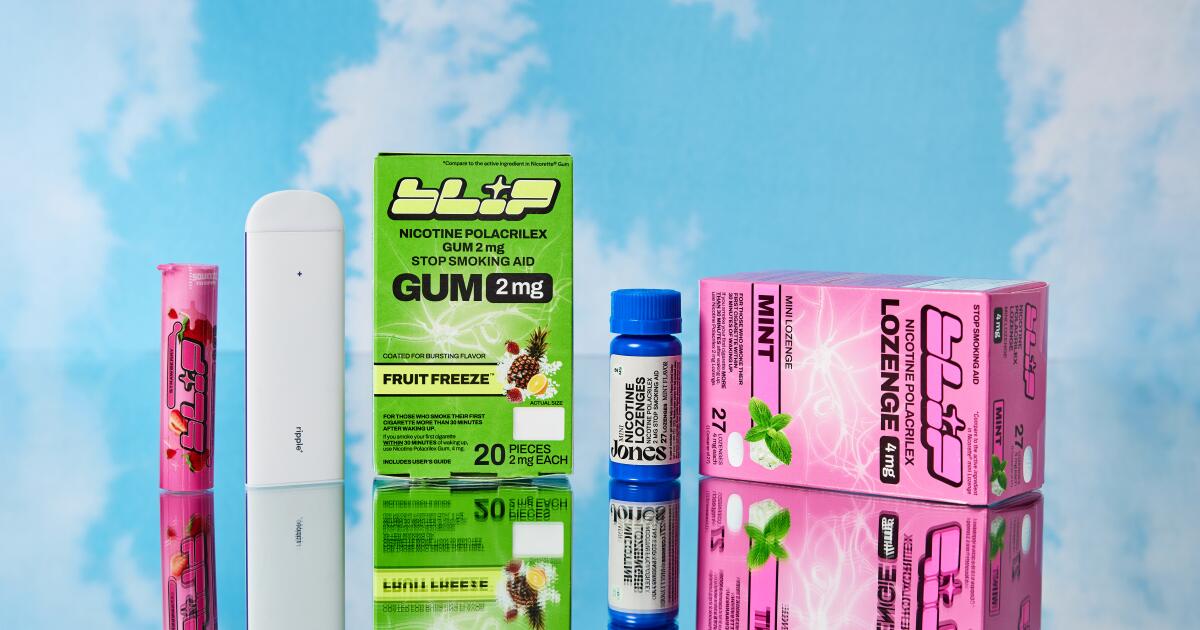
Others have followed suit. A rush of aesthetically minded products with Instagram-approved branding have flooded the NRT market over the last few years, including companies with nicotine replacement products like BLIP and Jones and nicotine-free devices like Luvv and Ripple. They have a new audience in mind: vapers.
In 2021, 4.5% percent of all Americans over 18 used vapes, according to the Centers for Disease Control and Prevention, while 10% percent of high schoolers vaped, according to a 2023 study. As younger nicotine consumers confront the health downsides of their habits, these companies are advertising photogenic solutions that dress up versions of an old formula by catering to both young vapers’ consumption habits and style.
Lozenges, gum, flavored toothpicks and nicotine-free vapes aimed at helping a younger generation quit vaping.
(Jessica Miller/For The Times)
When Nicorette was invented in Sweden in the late 1970s, it was the first NRT available to smokers who wanted to quit. As popularity increased, their product range expanded from chewing gum to include the five other antismoking products approved by the Food and Drug Administration: lozenges, patches, inhalers and nasal sprays. Look on any drug store shelf today and you’ll find a handful of brands in the space selling five products with nearly the same ingredients, but with different names and branding. But while NRTs have helped millions of cigarette smokers cut down on the habit, until recently, they’ve looked drab and medicinal, something Schott and Lee believes intimidates younger generations of nicotine users from giving them a shot.
In August 2023, nearly two years after Schott and Lee’s connection at the photo shoot, BLIP was born. It set itself apart in the market with colorful packaging, futuristic fonts and Instagram and TikTok content featuring Princess Gollum and her internet famous fashion friends. Their tagline? “Die another way.”
“No one in this space was trying to do anything new,” said Lee, who alongside the brand’s third L.A.-based co-founder Alyson Lord, used BLIP lozenges and gum to successfully quit.
“When I spoke to my friends who wanted to quit vaping, the general consensus was that it was impossible. The ones who quit went back to cigarettes. I didn’t understand how to use the products that were out there [to quit],” said Lee.
Because traditional NRT products largely cater to consumers who are addicted to smoking cigarettes rather than vaping, it can be hard for vapers to know how to use them. Per the FDA’s regulations of NRT products, which has not yet approved any methods for specifically quitting vaping, dosing instructions on both legacy products like Nicorette and new brands must be based on how many cigarettes a user smokes per day. These instructions can make it harder for vape users — who, at best, may know how often they buy a new vape or cartridge, but not how often they pick up the device — to use NRTs to quit without additional information. (Reached for comment, FDA spokesperson Cherie Duvall-Jones said the government agency “recognizes that vaping is a common method of nicotine use,” and welcomes groups to engage with it to develop products that will help people quit the habit.)
“No one in this space was trying to do anything new.”
— Josephine Lee, model and co-founder of BLIP
BLIP’s lozenges and gum (both $17.99 for a 20-pack) contain the same FDA-regulated ingredients as legacy NRT products. The difference lies in the slick branding and educational language that targets vape users specifically. While the company’s packaging follows strict FDA guidelines by advising usage based on the number of cigarettes a consumer smokes per day, its online marketing efforts provide additional information geared toward vapers on how to best use NRTs to suit their needs. A free quiz on the BLIP website, for example, suggests treatment plans based on how frequently a customer vapes, and whether they prefer disposable vapes (like Elf Bars) or pod-based vapes (like JUUL).
The tweak in messaging is working. In BLIP’s first year, across 79 CVS stores, 59% of BLIP buyers were purchasing NRT products for the first time. According to Schott, last month, the brand expanded its availability to 3,500 retail CVS stores. Schott said she hopes to get BLIP products where people are vaping or struggling to resist, like airports, nightclubs and, most recently, New York Fashion Week.
The brand’s sleeper hit? Toothpicks with fruity vape-like flavors like strawberry and blue raspberry that contain no NRT ingredients at all ($17.99 for a pack of three flavors). The brand recommends using them in tandem with NRTs to satiate the hand-to-mouth habit of vaping. After Doja Cat was spotted with one at this year’s Grammys, the brand says they saw a 1,200% sales boost.

Josephine Lee partnered with Julie Schott to create BLIP, a company that makes colorful, edgy nicotine replacement therapy products.
(Jason Armond/Los Angeles Times)
Timothy Flach, a 33-year-old hairstylist in Hollywood used BLIP to quit vaping. Flach smoked a pack of cigarettes a day for 15 years before switching to vaping all day. He had never tried quitting nicotine entirely, but he knew he didn’t want to carry a vape around his own wedding this past March. Using BLIP gum and lozenges, he successfully quit a year before the big day.
“BLIP tastes better than the other [NRT brand] gums, which I used when I would run out of BLIP and needed support,” he said. “It’s very eye-catching and cool. I like seeing people that I have admired for years like Cobra Snake and Doja Cat using it, too.”
Los Angeles model and actor Aaliyah Ei, 27, quit smoking in 2020 but quickly turned to vaping. Schott said she hopes to get BLIP products everywhere people are vaping or struggling to resist, like airports, nightclubs and, most recently, New York Fashion Week.
“BLIP was the first to educate me that I was using the gum wrong,” said Ei. She learned about the ‘park’ method from BLIP’s instructions, in which one ‘parks’ the chewing gum in their gums to ensure the ingredients absorb fully. She brings BLIP toothpicks with her on nights out.
“They’re a huge vibe and when I’m out, people are so interested in them,” she said.
While BLIP is bright, flashy and associated with nightlife, Jones is its understated, aspirational GOOP-like foil. Jones was founded in November 2023 by Los Angeles-born childhood friends Hilary Dubin and Caroline Huber. The two twenty-somethings, now based in New York City, developed vaping addictions while working in tech and politics, respectively. Their brand sells only one product: NRT lozenges — often referred to by the brand as mints — that come in an embossed, mint green tin ($69 for 81).

Jones founders Caroline Huber, left, and Hilary Dubin.
(Quit with Jones)
Like BLIP, Jones lozenges use the same FDA-approved ingredients as Nicorette, but hope to reach consumers who are looking for a more subtle, feel-good solution to their addiction. The brand’s packaging also offers usage instructions based on cigarette use in accordance with FDA guidelines. But they’re also operating in a vape-forward gray area, tailoring their social media posts to focus on lesser-known side effects of vaping, like reduced sense of taste and smell. The company also has a free app that uses AI to create custom quit plans for users and provide support from a community of “quitters” — a word used heavily in their branding.
“Our target is the health-conscious customer,” said Dubin. “A lot of the other companies in this space are leaning into this kind of negative or cheeky messaging or their brand is a bit intimidating.”
Both founders used Nicorette when trying to quit, but had the same issues understanding the dosing instructions and felt embarrassed carrying the product with them.
“It felt so backwards,” Dubin said. “I would vape openly or I’d have a cigarette at a party, but I would hide my Nicorette in my bag because it was in this ugly pill bottle. So for Jones, the tin was No. 1.”
“I would hide my Nicorette in my bag because it was in this ugly pill bottle.”
— Hilary Dubin, co-founder of Jones

Jones mini nicotine lozenges, which the brand refers to as “mints,” come with a discrete tin.
(Jessica Miller/For The Times)
This was a selling point for 30-year-old interior designer Kelly Maguire in Brooklyn. Maguire used Jones mints in tandem with their app and an audio book about quitting to successfully give up her years-long vaping habit.
“I chose Jones because the branding was chic and pretty non-descriptive,” Maguire said “I didn’t want to have to talk about the fact I was quitting and other NRT products were pretty obvious.”
Since launching, the brand has received 12,000 orders on its website and its app has been downloaded 16,000 times, according to Dubin, the product is available in two New York City boutiques and has hosted pop up events with Gen-Z editorial platform Byline. They hope to expand to more online and in person retailers.
Meanwhile, some vape users are also turning to nicotine-free vapes from brands like Luvv and Ripple to reduce or quit vaping while satiating their oral fixation and love for fruity flavors. Both products attempt to tap into wellness-centric branding. Luvv advertises “vitamins and naturally occurring compounds” in a berry mint flavored vape with B-12 and a citrus flavored vape infused with caffeine. Ripple calls their vapes “aromatic diffusers” and notes they are vegan and cruelty free.
While the FDA has yet to approve any methods for quitting vaping — companies like BLIP and Jones have succeeded in competing with vaping on one crucial aspect: a certain cool factor. This generation of vapers wants quitting to be as photogenic, chic and flavorful as vaping itself. And in the thick of a larger self-care and wellness movement, these new NRT products are just one more stylish supporting accessory in conversations (and TikToks) around one’s self-improvement journey.

For Iris van Herpen, couture is a laboratory as much as a runway. Our chief fashion critic, Vanessa Friedman, takes us inside this Dutch designer’s latest Paris show — from sci-fi-inspired gowns to an audacious attempt at a dress made of charged plasma.
Lifestyle
The BoF Podcast | Decoding Paris Haute Couture: Wonder, Restraint and the Call of the Void


-

 Texas6 minutes ago
Texas Rangers investigating City of Trinidad after water issues, controversial arrests, firings
-

 Utah9 minutes ago
President Trump expected to reduce the size of Utah monuments
-

 Vermont14 minutes ago
Vermont marks fourth straight year of July flooding as recovery drags on
-

 Virginia21 minutes ago
Vance leasing part of multimillion-dollar Virginia farm as an additional residence | CNN Politics
-

 Washington24 minutes ago
Washington State Democratic Party draws criticism over reparations, antisemitism language
-

 Wisconsin29 minutes ago
What’s new to eat and drink at the 2026 Wisconsin State Fair?
-

 West Virginia36 minutes ago
West Virginia to launch school clothing allowance program
-

 Wyoming39 minutes ago
Election Q&A: Laurie Longtine for Wyoming House District 59

