World
2 US Army soldiers, interpreter killed in Syria ambush attack, Trump warns of ‘very serious retaliation’


NEWYou can now listen to Fox News articles!
President Donald Trump warned Saturday that there will be “very serious retaliation” after a lone Islamic State gunman in Syria killed two U.S. Army soldiers and a U.S. interpreter in an ambush attack.
Chief Pentagon spokesperson Sean Parnell announced earlier that the soldiers and interpreter were targeted in the central Syrian town of Palmyra in an attack that left three others wounded. U.S. Central Command said the deaths and injuries were a “result of an ambush by a lone ISIS gunman in Syria.”
“We mourn the loss of three Great American Patriots in Syria, two soldiers, and one Civilian Interpreter. Likewise, we pray for the three injured soldiers who, it has just been confirmed, are doing well. This was an ISIS attack against the U.S., and Syria, in a very dangerous part of Syria, that is not fully controlled by them,” Trump wrote on Truth Social.
“The President of Syria, Ahmed al-Sharaa, is extremely angry and disturbed by this attack. There will be very serious retaliation,” he added.
SYRIANS MARK FIRST YEAR SINCE ASSAD’S FALL AS US SIGNALS NEW ERA IN RELATIONS
U.S. forces patrol in Syria’s northeastern city of Qamishli in the Hasakeh province, on Jan. 9, 2025. (Delil Souleiman/AFP via Getty Images)
In comments to reporters outside of the White House on Saturday, Trump also said, “This was an ISIS attack on us and Syria. And again, we mourn the loss and we pray for them and their parents and their loved ones.”
Parnell wrote on X that the attack happened as the soldiers “were conducting a key leader engagement.”
“Their mission was in support of ongoing counter-ISIS/counter-terrorism operations in the region,” he added, noting that “The soldiers’ names, as well as identifying information about their units, are being withheld until 24 hours after the next of kin notification. “
Secretary of War Pete Hegseth said that, “The savage who perpetrated this attack was killed by partner forces.”
“Let it be known, if you target Americans — anywhere in the world — you will spend the rest of your brief, anxious life knowing the United States will hunt you, find you, and ruthlessly kill you,” Hegseth also said in a post on X.
Parnell said the attack is currently under investigation. A Pentagon official told Fox News Digital that the attack unfolded in a place where the Syrian President Ahmed al-Sharaa does not have control.
President Donald Trump meets with Syrian President Ahmed al-Sharaa at the White House on Nov. 10, 2025. A Pentagon official told Fox News Digital that the attack on the soldiers on Saturday, Dec. 13, 2025, unfolded in a place where the Syrian President Ahmed al-Sharaa does not have control. (Syrian Presidency/Anadolu via Getty Images)
“I’m praying for the brave U.S. soldiers and civilian who lost their lives, those who were injured in this attack, and the families who bear this profound loss,” Army Secretary Daniel Driscoll wrote on X. “The men and women who serve our country represent the very best of our nation. We mourn the passing of these heroes and honor their service and sacrifice.”
A senior U.S. official earlier confirmed to Fox News there were multiple injuries after American service members were ambushed in Syria.
“The United States, CIA and military forces are reportedly deeply involved in securing and stabilizing the situation in Syria,” Dan Diker, president of the Jerusalem Center for Security and Foreign Affairs, recently told Fox News Digital.
The injured in Saturday’s attack were taken by helicopters to the al-Tanf garrison, which is near the border with Iraq and Jordan, The Associated Press reported, citing Syrian state media.
ISRAELI OFFICIAL ISSUES STARK WARNING AFTER CHILLING SYRIAN MILITARY CHANTS RESURFACE
U.S. Army soldiers prepare to go out on patrol from a remote combat outpost on May 25, 2021, in northeastern Syria. (John Moore/Getty Images)
There are currently around 900 U.S. troops in Syria.
The U.S. had eight bases in Syria to keep an eye on ISIS since the U.S. military went in to prevent the terrorist group from setting up a caliphate in 2014, although three of those bases have since been closed down or turned over to the Syrian Democratic Forces.
On Monday, tens of thousands of Syrians flooded the streets of Damascus to mark the first anniversary of the Assad regime’s collapse.
U.S. Army soldiers stand near an armored military vehicle on the outskirts of Rumaylan in Syria’s northeastern Hasakeh province, bordering Turkey, on March 27, 2023. (Delil Souleiman/AFP via Getty Images)
CLICK HERE TO DOWNLOAD THE FOX NEWS APP
Those celebrations came a year after former Syrian dictator Bashar al-Assad fled the capital as rebel forces swept through the country in a lightning offensive that ended five decades of Assad family rule and opened a new chapter in Syrian history.
Fox News’ Lucas Tomlinson, Ashley Oliver, Jennifer Griffin, Benjamin Weinthal and Ashley Carnahan contributed to this report.



Published on
Russia is planning attacks on critical infrastructure in the Baltic states or Poland, Lithuanian and Latvian presidents warned on Wednesday, citing intelligence reports.
ADVERTISEMENT

ADVERTISEMENT
“We are talking about energy and transport infrastructur, facilities where damage could… disrupt the functioning of the entire energy system,” Lithuanian President Gitanas Nauseda said at a joint press conference in Vilnius with his Latvian counterpart, Edgars Rinkevics.
“This planning is taking place at the highest level, effectively in Moscow,” he added.
Rinkevics warned that Estonia, Latvia, Lithuania and Poland, all EU and NATO members, must be prepared for provocative actions by Russia as it seeks to “test” the alliance’s mutual defence pact amid its war in Ukraine.
“Even without a total Ukrainian victory, Russia may indirectly test Article 5 and response mechanisms at the alliance and European Union levels,” he said.
In late June, Polish Prime Minister Donald Tusk told a press conference “various types of escalation can be expected in the coming weeks and months”, calling the situation “very unstable”.
Baltic and Polish officials have already linked Russia to several incidents including arson, cyberattacks and diversions on railway lines.
The Lithuanian president said his country had strengthened protection of its transport and energy infrastructure in response to the threats.
Kremlin spokesman Dmitry Peskov disputed the claims.
“This is just another fresh batch of scare stories designed to keep the brainwashing going and prepare the population for further militarisation,” he said.
Located along the Baltic Sea and bordering Russia and its close ally, Belarus, Lithuania has been a key ally to Ukraine since the beginning of the full-scale invasion in 2022.
Lithuania is NATO’s highest security spender in relative terms, allocating 5.33%of its GDP to defence.
World
FBI snares an American heir indicted for allegedly bankrolling anti-cop, pro-Hamas communist revolution

NEWYou can now listen to Fox News articles!
The Justice Department and FBI have a new communist financier in their crosshairs for alleged financial crimes: James “Fergie” Cox Chambers Jr., the estranged bad-boy heir to the Cox cable empire.
On Friday, Spanish police detained Chambers on the luxury island of Ibiza, in response to an international arrest warrant, according to sources. Chambers is allegedly wanted for money laundering and providing support to Hamas, following years of financing anti-Israel and anti-West organizations and protests. The transnational network he helped fund and support is kicking in to cast him as a victim of the Trump administration’s “fascism,” while critics are cheering the arrest as long overdue.
A spokesman for Spain’s Balearic Islands police branch, which includes Ibiza in its jurisdiction, told Fox News Digital that a U.S. citizen was arrested on charges tied to an international arrest warrant Friday under an international arrest warrant seeking his extradition to the United States. The spokesman did not confirm the identity of the citizen, but sources told Fox News Digital that the individual is Chambers.
Fergie Chambers poses for pictures in Tunis, Tunisia, on Feb. 8, 2024. (Chedly Ben Ibrahim/NurPhoto)
FBI SAYS NEW MISSION CENTER HAS IDENTIFIED ‘NEFARIOUS’ PROTEST FUNDING AND SUBJECTS
The police spokesman added that the individual is being held at the central jail in Ibiza pending a judicial decision that will be conducted by videoconference. Supporters now plan a “Free Fergie Chambers” protest on Tuesday at 7 p.m. outside the prison in Ibiza, demonstrating against “DEL FASCISMO DE TRUMP,” or the “TRUMP’S FASCISM IN PERSECUTING DEFENDERS OF THE PALESTINIAN PEOPLE.”
A spokesperson for the FBI declined to comment. Chambers and his representatives couldn’t be reached for comment.
A convert to Islam, Chambers represents the fusion of socialist and communist activists with Islamist interests that seek the destruction of the West, free enterprise and the state of Israel and the rise of political Islam, communism and a new Palestinian state.
General view of Centro Penitenciario de Ibiza, in Ibiza, Spain, Tuesday, July 14, 2026. (Photo for Fox News Digital)
Chambers’ ideological comrades leaked news of the detention to trusted colleagues on far-left media platforms – some of which Chambers funds – and his communist, socialist and Islamist comrades are flooding social media to frame the narrative around the arrest as the Trump administration unfairly targeting Chambers.
The arrest is a significant move by the Trump administration as it targets far-left financiers allegedly engaged in supporting political violence. In this case, as in other investigations, federal authorities are following the money and investigating potential tax and financial crimes.
FBI Co-Deputy Director Chris Raia recently told Fox News Digital that investigators at the FBI’s Joint Mission Center have identified subjects tied to financing violent protest activity and have been building prosecutable cases.
General view of Centro Penitenciario de Ibiza, in Ibiza, Spain, Tuesday, July 14, 2026. (Photo for Fox News Digital)
Like Neville Roy Singham, the American tech tycoon accused of financing communist and far-left nonprofit organizations from his base in Shanghai, China, Chambers has made a name for himself as a financial backer of anti-Israel and anti-American causes around the world. As reported exclusively at Fox News Digital, the Justice Department has launched a grand jury investigation into Singham for alleged money laundering and other financial improprieties. It is currently prosecuting the Southern Poverty Law Center for alleged money laundering, bank fraud and wire fraud.
DOJ LAUNCHES GRAND JURY PROBE INTO MARXIST MOGUL NEVILLE ROY SINGHAM’S FUNDING OF LEFTIST GROUPS
Fergie Chambers walks near a mosque in Tunis, Tunisia, on Feb. 8, 2024. (Chedly Ben Ibrahim/NurPhoto)
Fergie Chambers walks near a mosque in Tunis, Tunisia, on Feb. 8, 2024. (Chedly Ben Ibrahim/NurPhoto)
Fergie Chambers performs the Muslim prayer in Tunis, Tunisia, on Feb. 8, 2024. (Chedly Ben Ibrahim/NurPhoto)
Fergie Chambers smokes a cigarette while posing for photos in Tunis, Tunisia. (Chedly Ben Ibrahim/NurPhoto)
Chambers was born in 1985 in Brooklyn as James Cox Chambers Jr. to his father, James Cox Chambers, and mother, actress Lauren Hamilton. He is the great-grandson of James M. Cox, a former Ohio governor, 1920 Democratic presidential nominee and founder of the media company that became Cox Enterprises. Forbes estimates the Cox family empire is worth about $27 billion.
Chambers is now the estranged heir of Cox Enterprises, walking away from the family company in 2023 with a payout estimated at about $250 million after a falling out with his family over the company’s support for Atlanta’s controversial public safety training center, known by critics as “Cop City.” In April, a grand jury indicted three alleged Antifa-linked protesters accused of throwing firebombs at the general contractor of the Atlanta police training center.
Protestors rush a police line during a demonstration against the so-called “Cop City” training facility in Atlanta, Monday, Nov. 13, 2023. (Mike Stewart/AP Photo)
Chambers openly redirected his fortune into communist collectives, bail and legal underwriting and groups engaged in hard-edged protest and property disruption.
Raised mostly in Brooklyn after his parents divorced, Chambers attended Saint Ann’s School and later enrolled at Bard College but didn’t graduate. He briefly worked for a Cox Enterprises subsidiary before operating gyms in Georgia and later became increasingly involved in left-wing activism following the anti-police protests in Ferguson, Mo., in 2014 and the demonstrations in Standing Rock, S.D., in 2016 against an oil pipeline.
Around 2019, Chambers established the “Berkshire Communists” collective in Alford, Mass., in a wealthy corner of western Massachusetts, where he built a commune, operated the Berkshire People’s Gym and launched a publication called “Combat Liberalism.”
THREE ALLEGED ANTIFA-LINKED PROTESTERS INDICTED IN ATLANTA POLICE TRAINING CENTER CONTRACTOR FIREBOMBING
Police detain Palestine Action activists at the entrance of APCO Worldwide offices in London, where the building is covered in red paint, on Sept. 3, 2024. (Rasid Necati Aslim/Anadolu)
Following the Oct. 7, 2023, Hamas terrorist attacks, Chambers became one of the most prominent financial backers of “Palestine Action,” later renamed “Unity of Fields,” while also funding legal defense efforts for activists involved in anti-Israel demonstrations and direct-action campaigns in the United Kingdom and the U.S.
He praised the Oct. 7 Hamas attacks as a “moment of hope and inspiration,” told Mother Jones that “the most important thing for the prosperity of humanity is the destruction of the US” and said, “I chant death to America every day.”
Local and national reporting place him behind the “Stop Cop City” opposition, bail after occupations and protests against Elbit Systems, a company that provides services to Israel, in Merrimack, N.H., and the U.K., and ongoing legal support for networks in the U.S. and U.K. led by the controversial “Palestine Action.”
Communist tattoos are visible on Fergie Chambers’ hands and fingers while he sits in a cafe in Tunis, Tunisia, on Feb. 8, 2024. (Chedly Ben Ibrahim/NurPhoto)
After Alford, Mass., shut his Berkshire People’s Gym for zoning violations and law-enforcement scrutiny intensified, Chambers relocated to Tunis, in the North African nation of Tunisia.
In early February 2024, Chambers was photographed in his newly adopted city of Tunis in the North African nation of Tunisia, framing his narrative as a pious Muslim convert, with a red-and-white Palestinian kefiyyeh scarf draped over his shoulders, a black Muslim prayer cap on his head and a small beard on his face, a tradition that follows the sunnah, or practice, of Muhammad, the prophet of Islam.
The photo shoot included images of Chambers in Muslim prayer, at one point with his hands on his chest and at another point in “ruku” position, bent forward with his hands on his knees, staring at a point of concentration in front of him. In other shots, he walked by a local mosque, sat behind the wheel of a car with orange and green Muslim prayer beads, called “tazbi,” hanging on the rearview mirror. A pair of decorative boxing gloves with “RUSSIA” across the wrists, positioned on a red-and-white kefiyyeh spread along the dashboard.
Fergie Chambers walks his dogs in Tunis, Tunisia, on Feb. 8, 2024. (Chedly Ben Ibrahim/NurPhoto)
Unconventional for traditional Muslims, who don’t often have dogs as pets because of a fundamentalist interpretation of Islam that bars dogs as pets in the home, Chambers also was photographed smoking a cigarette and walking on the beach with two small dogs who look like bulldogs. He also wore tattoos, including a sickle-and-barbells on his left hand.
By May 2026, his social media posts placed him in Ireland. This month, the self-declared communist vacationed among the wealthy in Ibiza, is now sitting in prison.
CLICK HERE TO DOWNLOAD THE FOX NEWS APP

Iran’s bridges, power plants possible targets, Trump says, adding that strikes on Iran will continue until he says.
Published On 15 Jul 2026
-
 Lifestyle5 minutes ago
They just completed all of L.A. Times’ 101 Best California Experiences — and we’ve got questions!
-
 Politics11 minutes ago
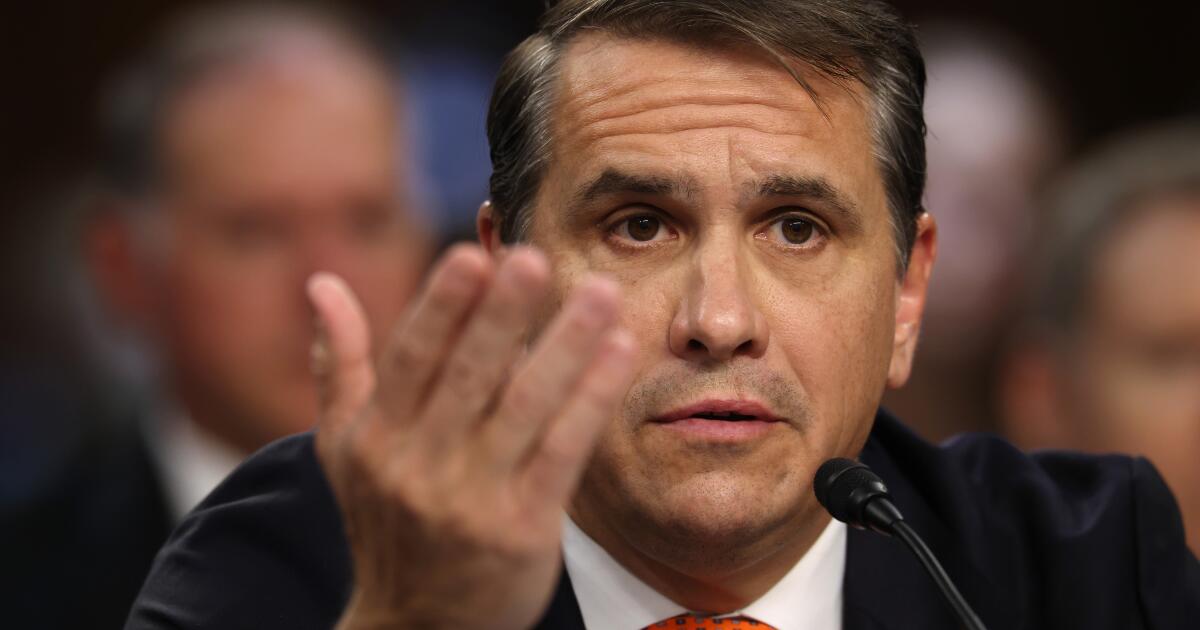
Blanche to face questions about his independence at attorney general confirmation hearing
-
 Sports23 minutes ago
How World Cup senior citizens like Lionel Messi have bio-hacked longer careers
-

 World35 minutes ago
Baltic presidents warn of Russian infrastructure attack plans
-
News1 hour ago
ICE should do traffic stops despite recent shootings, Trump says, seeming to oppose new suspension
-

 Los Angeles, Ca3 hours ago
Southern California hits hottest day of its extreme heat warning
-

 Detroit, MI3 hours ago
Steve Yzerman out as Detroit Red Wings GM, moves to senior advisor role
-
 San Francisco, CA3 hours ago
Supervisors urge California to expand S.F. speed-camera program


