Business
California, other states sue Trump administration over $100,000 fee for H-1B visas


California and a coalition of other states are suing the Trump administration over a policy charging employers $100,000 for each new H-1B visa they request for foreign employees to work in the U.S. — calling it a threat not only to major industry but also to public education and healthcare services.
“As the world’s fourth largest economy, California knows that when skilled talent from around the world joins our workforce, it drives our state forward,” said California Atty. Gen. Rob Bonta, who announced the litigation Friday.
President Trump imposed the fee through a Sept. 19 proclamation, in which he said the H-1B visa program — designed to provide U.S. employers with skilled workers in science, technology, engineering, math and other advanced fields — has been “deliberately exploited to replace, rather than supplement, American workers with lower-paid, lower-skilled labor.”
Trump said the program also created a “national security threat by discouraging Americans from pursuing careers in science and technology, risking American leadership in these fields.”
Bonta said such claims are baseless, and that the imposition of such fees is unlawful because it runs counter to the intent of Congress in creating the program and exceeds the president’s authority. He said Congress has included significant safeguards to prevent abuses, and that the new fee structure undermines the program’s purpose.
“President Trump’s illegal $100,000 H-1B visa fee creates unnecessary — and illegal — financial burdens on California public employers and other providers of vital services, exacerbating labor shortages in key sectors,” Bonta said in a statement. “The Trump Administration thinks it can raise costs on a whim, but the law says otherwise.”
Taylor Rogers, a White House spokeswoman, said Friday that the fee was “a necessary, initial, incremental step towards necessary reforms” that were lawful and in line with the president’s promise to “put American workers first.”
Attorneys for the administration previously defended the fee in response to a separate lawsuit brought by the U.S. Chamber of Commerce and the Assn. of American Universities, arguing earlier this month that the president has “extraordinarily broad discretion to suspend the entry of aliens whenever he finds their admission ‘detrimental to the interests of the United States,’” or to adopt “reasonable rules, regulations, and orders” related to their entry.
“The Supreme Court has repeatedly confirmed that this authority is ‘sweeping,’ subject only to the requirement that the President identify a class of aliens and articulate a facially legitimate reason for their exclusion,” the administration’s attorneys wrote.
They alleged that the H-1B program has been “ruthlessly and shamelessly exploited by bad actors,” and wrote that the plaintiffs were asking the court “to disregard the President’s inherent authority to restrict the entry of aliens into the country and override his judgment,” which they said it cannot legally do.
Trump’s announcement of the new fee alarmed many existing visa holders and badly rattled industries that are heavily reliant on such visas, including tech companies trying to compete for the world’s best talent in the global race to ramp up their AI capabilities. Thousands of companies in California have applied for H-1B visas this year, and tens of thousands have been granted to them.
Trump’s adoption of the fees is seen as part of his much broader effort to restrict immigration into the U.S. in nearly all its forms. However, he is far from alone in criticizing the H-1B program as a problematic pipeline.
Critics of the program have for years documented examples of employers using it to replace American workers with cheaper foreign workers, as Trump has suggested, and questioned whether the country truly has a shortage of certain types of workers — including tech workers.
There have also been allegations of employers, who control the visas, abusing workers and using the threat of deportation to deter complaints — among the reasons some on the political left have also been critical of the program.
“Not only is this program disastrous for American workers, it can be very harmful to guest workers as well, who are often locked into lower-paying jobs and can have their visas taken away from them by their corporate bosses if they complain about dangerous, unfair or illegal working conditions,” Sen. Bernie Sanders (I-Vt.) wrote in a Fox News opinion column in January.
In the Chamber of Commerce case, attorneys for the administration wrote that companies in the U.S. “have at times laid off thousands of American workers while simultaneously hiring thousands of H-1B workers,” sometimes even forcing the American workers “to train their H-1B replacements” before they leave.
They have done so, the attorneys wrote, even as unemployment among recent U.S. college graduates in STEM fields has increased.
“Employing H-1B workers in entry-level positions at discounted rates undercuts American worker wages and opportunities, and is antithetical to the purpose of the H-1B program, which is ‘to fill jobs for which highly skilled and educated American workers are unavailable,’” the administration’s attorneys wrote.
By contrast, the states’ lawsuit stresses the shortfalls in the American workforce in key industries, and defends the program by citing its existing limits. The legal action notes that employers must certify to the government that their hiring of visa workers will not negatively affect American wages or working conditions. Congress also has set a cap on the number of visa holders that any individual employer may hire.
Bonta’s office said educators account for the third-largest occupation group in the program, with nearly 30,000 educators with H-1B visas helping thousands of institutions fill a national teacher shortage that saw nearly three-quarters of U.S. school districts report difficulty filling positions in the 2024-2025 school year.
Schools, universities and colleges — largely public or nonprofit — cannot afford to pay $100,000 per visa, Bonta’s office said.
In addition, some 17,000 healthcare workers with H-1B visas — half of them physicians and surgeons — are helping to backfill a massive shortfall in trained medical staff in the U.S., including by working as doctors and nurses in low-income and rural neighborhoods, Bonta’s office said.
“In California, access to specialists and primary care providers in rural areas is already extremely limited and is projected to worsen as physicians retire and these communities struggle to attract new doctors,” it said. “As a result of the fee, these institutions will be forced to operate with inadequate staffing or divert funding away from other important programs to cover expenses.”
Bonta’s office said that prior to the imposition of the new fee, employers could expect to pay between $960 and $7,595 in “regulatory and statutory fees” per H-1B visa, based on the actual cost to the government of processing the request and document, as intended by Congress.
The Trump administration, Bonta’s office said, issued the new fee without going through legally required processes for collecting outside input first, and “without considering the full range of impacts — especially on the provision of the critical services by government and nonprofit entities.”
The arguments echo findings by a judge in a separate case years ago, after Trump tried to restrict many such visas in his first term. A judge in that case — brought by the U.S. Chamber of Commerce, the National Assn. of Manufacturers and others — found that Congress, not the president, had the authority to change the terms of the visas, and that the Trump administration had not evaluated the potential impacts of such a change before implementing it, as required by law.
The case became moot after President Biden decided not to renew the restrictions in 2021, a move which tech companies considered a win.
Joining in the lawsuit — California’s 49th against the Trump administration in the last year alone — are Arizona, Colorado, Connecticut, Delaware, Hawaii, Illinois, Maryland, Massachusetts, Michigan, Minnesota, North Carolina, New Jersey, New York, Oregon, Rhode Island, Vermont, Washington and Wisconsin.


Robotaxis could be turning into robocops.
A self-driving Waymo reported two teens to San Mateo, Calif., police on Monday after they were found drinking alcohol and shooting toy guns in the back of the vehicle.
According to a social media post from the San Mateo Police Department, officers detained two 15-year-olds after the Waymo they were riding in contacted the department and stopped in a parking lot until law enforcement arrived.
“Parents do you know where your teens are?” the San Mateo Police Department wrote on Facebook following the incident. “Waymo does!”
Officers removed both teens from the vehicle and determined they were using toy guns to shoot Orbeez out the windows. Orbeez are small, water-absorbing beads sold at toy stores.
“Toy guns, water guns, and BB guns all pose real dangers, especially to an untrained eye,” the Police Department said. “The simple handling of them can cause fear in [passersby].” “
A video posted on Facebook shows at least five officers and a police dog responding to the scene and approaching the Waymo with their weapons raised.
Waymo did not immediately respond to a request for comment.
Waymo vehicles have internal cameras and microphones that may be used in an emergency or to “promote safety and security,” according to Waymo’s online support page.
The cameras are also used to ensure the vehicles are clean and to help find lost items, according to the support page.
The company said it does not use facial recognition or other biometric identification technologies to identify individuals.
“In more urgent circumstances, support may access live video during a trip,” the Waymo page said.
The San Mateo Police Department’s Facebook post has garnered nearly 60 comments, with one user accusing Waymo of “snitching.”
“At least they got a designated driver?!” one user commented.
Business
Commentary: How right-wing anti-transgender attacks led to a Supreme Court ruling upholding sex discrimination
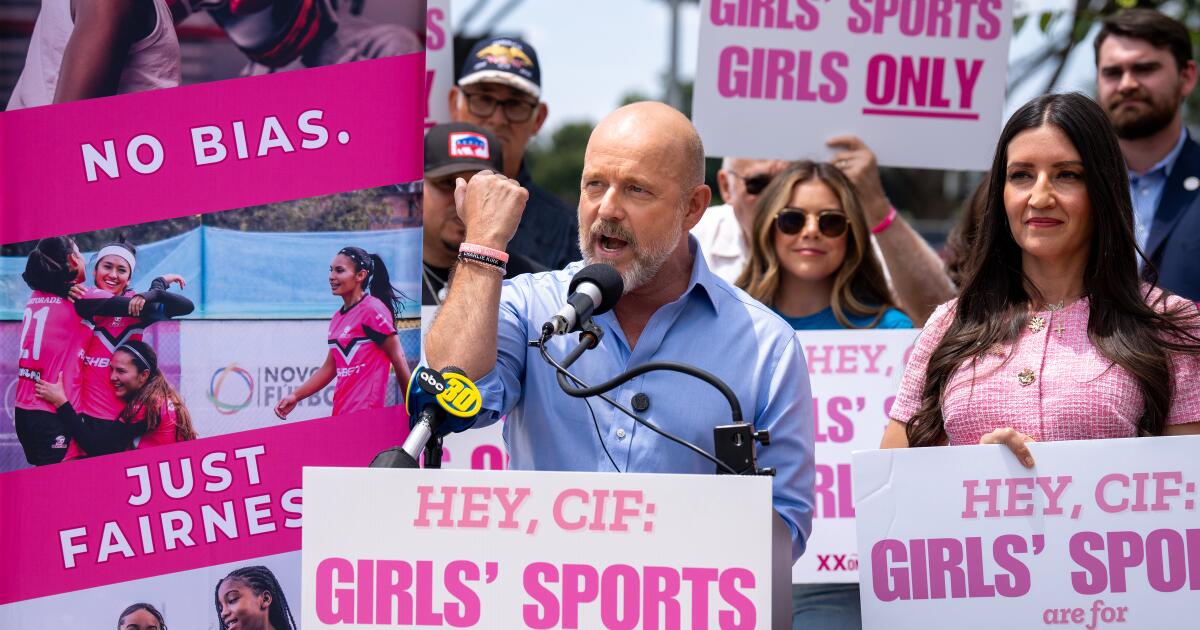
At the Supreme Court, the unfounded fear of boys masquerading as girls in youth sports rolled the clock back on gender equality.
On the surface, the Supreme Court’s June 30 opinion upholding state laws barring transgender girls from women’s and girl’s sports teams looks like a victory for women’s rights.
The 6-3 opinion by Justice Brett M. Kavanaugh certainly presents itself that way. “Females and males have inherent physical differences relevant to athletic performance,” Kavanaugh wrote. “Therefore, in contact sports, forcing female athletes to compete against males can create significant safety risks.” He also asserted that “forcing female athletes to compete against males can undermine competitive fairness.”
The ruling applied to prohibitions enacted in Idaho and West Virginia against “biological” males’ participation on women’s teams in public schools. Federal judges in both states overturned the bans. The Supreme Court majority restored them. The ruling essentially upholds similar bans enacted in 25 other states.
There was no record of any transgender person participating in school sports in the State, let alone any ‘problem’ with transgender students … creating unfair competition or unsafe conditions.
— Justice Sonia Sotomayor, demolishing the Supreme Court’s argument in favor of banning transgender girls from girl’s sports
Kavanaugh, like Donald Trump and others in the anti-transgender camp, maintained that one’s gender is an immutable fact of life, established even before birth.
Anything else, Trump stated in an executive order he issued on inauguration day 2025, could only be the product of “gender ideology extremism.” The U.S., his order stated, recognizes “two sexes, male and female. These sexes are not changeable and are grounded in fundamental and incontrovertible reality.” That’s a “biological truth,” he declared.
In his own version of this overconfident and factually insupportable conclusion, Kavanaugh wrote: “As all agree, females and males have inherent physical differences relevant to athletic performance.”
Science recognizes that some people are “born with sex traits that don’t fit into typical male or female patterns,” to cite a discussion on the Cleveland Clinic web page on the topic “intersex.” The condition “may involve chromosomes, hormones, reproductive organs or genitals.”
From a psychological standpoint, medical science recognizes “gender dysphoria” as a real condition often requiring counseling and medical intervention such as the use of puberty blockers and hormones to stave off the development of secondary sex characteristics until the condition can be resolved.
No one disputes that there are physical differences between the sexes. Few would dispute that on average or even at the median, males may be bigger and more powerful than females, or that in certain contact sports the difference may be telling and on occasion dangerous.
But that’s not the same as asserting that the physical differences between males and females invariably mean that men will invariably prevail over women in all competitions or that their participation will endanger women.
The International Olympic Committee — in a policy statement Kavanaugh cited incompletely — says that in “most running and swimming events,” males have a 10% to 12% advantage over women. That’s a range that would accommodate the full spectrum of outcomes — transgender females win, cisfemales win, they tie. (The “cis” prefix denotes those living consistent with their birth gender.)
West Virginia and Idaho addressed this ambiguity by banning transgender women from all girls’ teams. So under their rules transgender girls can’t play football or soccer with cisgirls. But what’s the argument in favor of banning them from the 100-yard dash, or cross-country track, or diving, or archery?
But something else is going on here. The Supreme Court’s ruling was almost preordained, given the years-long campaign by conservatives to demonize transgender individuals as if they’re members of an alien species.
It will be recalled that during his presidential campaign, Trump spun a despicable fantasy in which children were kidnapped in school and secretly subjected to sex-change operations.
Trump’s executive order wiped out policies aimed at protecting transgender adults from discrimination. He moved to outlaw gender-affirming medical therapies for anyone under 19 by cutting off federal funding for healthcare institutions that provide such care.
He banned transgender individuals from serving in the military and ordered federal prison officials to move transgender inmates into the general populations consistent with their birth genders, which exposes them to physical assault. (Federal Judge Royce Lamberth of Washington, D.C., has blocked the government from transferring three transgender women into the male prison population or terminating their hormone treatments.)
I wrote during Trump’s first term, when his anti-transgender policies were still gestating, that the goal was to show that “one can target any community, as long as it doesn’t have a strong political voice or political power. These are the actions of bullies and cowards, pretending to be strong.”
Last year, the Supreme Court struck its first blow against transgender rights by upholding a Tennessee law banning transgender care, including puberty blockers and hormone therapy, for minors. Similar laws have been enacted in 25 other states. The majority in that ruling by Chief Justice John G. Roberts Jr. was identical to the one in the June 30 ruling — Roberts, Kavanaugh, and Justices Clarence Thomas, Samuel A. Alito Jr., Neil M. Gorsuch and Amy Coney Barrett.
Who are the targets of this ideological campaign? They number only about 1.6 million U.S. adults, or one-half of 1% of the U.S. population. About 300,000 adolescents ages 13 to 17, or 1.4%, identify as transgender, according to a study by UCLA School of Law.
In West Virginia, as Justice Sonia Sotomayor observed in her dissenting opinion, “there was no record of any transgender person participating in school sports in the State, let along any ‘problem’ with transgender students … creating unfair competition or unsafe conditions.”
In endorsing the flat bans directed at transgender women in Idaho and West Virginia, Kavanaugh argued that any attempt to implement case-by-case judgments of students’ requests to join sports teams inconsistent with their biological gender would create “an enormous practical and administrability problem.”
Is that so? That wasn’t the case in Maine, where the annual K-12 population is more than 170,000. There, a committee was charged with determining whether a student’s participation in a sport consistent with their gender identity but inconsistent with their biological sex would “result in an unfair athletic advantage” or present a risk of injury to others. The committee held 56 hearings from 2013 through 2021, or an average of seven per year. During the entire time span, only four involved transgender girls. (The outcome of those hearings couldn’t be learned.)
It was Maine’s policy, one might recall, that provoked a confrontation between Trump and Maine Gov. Janet Mills at the White House last year, when Trump threatened to withhold federal funding from the state unless it barred transgender students from competing on women’s sports teams. “We’ll see you in court,” Mills snapped.
Whether the Idaho and West Virginia laws genuinely protect girls from unfair competition is questionable. (The Idaho law is styled the “Fairness in Women’s Sports Act.”) In practice, the laws may subject women in public schools to “invasive sex verification procedures,” as educational expert George Theoharis of Syracuse University wrote after the court ruling.
They’re also based on a retrograde view of women as fragile creatures needing men’s protection, Theoharis wrote — “the same logic that has historically been used to justify excluding women from making their own healthcare decisions and girls from rigorous math and science; that physically demanding work is simply beyond them.” (There don’t appear to be any state laws barring transgender women from competing in men’s sports.)
Becky Pepper-Jackson, the plaintiff in the West Virginia case, in which she is identified only as B.P.J., is the only transgender girl who sought to join girl’s teams — track and cross-country — in the state. That was in 2021, just after West Virginia passed its law and she was about to enter sixth grade. She didn’t appear to pose any competitive risk to others on the track and cross-country teams she applied to join — her lawyers told the Supreme Court that on those no-cut teams, she “came in near the back.”
Anyway, she had not gone through male puberty, which theoretically might have endowed her with a competitive advantage, because she had been taking puberty blockers and female hormones.
Thanks to the court’s ruling, Sotomayor observed in a dissent joined by Justices Elena Kagan and Ketanji Brown Jackson, West Virginia can deny Becky access to school sports “because it thinks they have an inherent athletic advantage, even if the facts show that they do not.”
B.P.J., Sotomayor wrote, “cannot practice on girls’ teams, even if she would not take anyone’s spot in an eventual competition, even if everyone who tries out for the team makes it, and even if having the chance to participate could aid immensely in treating B. P. J.’s gender dysphoria.”
So whose interest was really protected by the Supreme Court?

An Orange County real estate investor accused of criminally defrauding an Arizona bank of nearly $100 million pleaded not guilty Monday and remains in custody.
Mahender Makhijani, 44, of Corona del Mar — who also was ordered by an arbitrator to pay $1.34 billion in a separate civil fraud case — was arraigned in Santa Ana federal court on two charges.
He is accused of bank fraud and making a false statement to a bank in a June 8 case involving a $100 million real estate loan made by Phoenix-based Western Alliance Bank. He was taken into custody on June 10.
Makhijani is accused of providing bogus collateral for the October 2024 loan now in default. In a civil lawsuit, Western Alliance said the outstanding balance as nearly $99 million.
Prosecutors say he falsified title insurance policies that showed the bank would have a first lien on the underlying collateral if the loan went bad, when in fact it did not.
A trial was set for August 11 before U.S. District Judge David O. Carter in Santa Ana.
Michael Schachter, his criminal defense attorney, did not respond to messages seeking comment.
In the civil case, an arbitrator in May ordered Makhijani to pay Laguna Beach real estate mogul Mohammad Honarkar $1.34 billion after ruling he had fraudulently induced him into a 2021 joint venture — and then wrested control and lost to creditors more than two dozen properties Honarkar had owned.
Makhijani has not been criminally charged in that case, but prosecutors alleged in an affidavit in support of the bank fraud charges that he used “force and threats” in his dealings with Honarkar and others — including taking over the landmark Hotel Laguna in 2023 that Honarkar was renovating.
Prosecutors sought to hold Makhijani without bail after his arrest.
The affidavit noted he is a legal Indian immigrant with a home and bank accounts in that country, has access to private jets and threatened to “run away” if caught in a difficult situation.
The request was denied and he was granted $500,000 bail.
However, Makhijani remains in custody after a hearing sought by prosecutors last month before Magistrate Judge Autumn Spaeth.
The judge declined to accept a $450,000 cashier’s check submitted by a Makhijani associate for the bail, finding insufficient proof the source of the funds was legitimate, according to court records.
Makhijani is not prominent outside Orange County real estate circles, but he established a thriving distressed-assets business over the last decade that attracted prominent Southern California real estate investors.
Prosecutors said it paid for a lifestyle that included two multimillion-dollar homes in Corona del Mar, a luxury apartment in Newport Beach and various luxury vehicles.
As of last month, prosecutors had not fully traced his assets, which they believe are not held in his name and some of which may be in India.
The businessman employed an array of shell companies and strawmen to sign documents on his behalf, and to stand in for him as operators of his companies, according to the affidavit.
Makhijani told an associate he took extra precautions because wanted to insulate himself from litigation and that “they were sharks in the distressed world who took advantage of people,” the affidavit stated.
-

 Oregon15 seconds ago
A Song Gives a Look Into Oregon’s Largest Juvenile Corrections Facility
-

 Pennsylvania5 minutes ago
Federal lawsuit: Conviction for small amount of marijuana should not preclude getting a license to carry a firearm
-

 Rhode Island12 minutes ago
What will happen at the 2026 Rhode Island State Amateur? History.
-

 South-Carolina15 minutes ago
Oh, Goodbye: Four-Star South Carolina RB Aiden Gibson Flips To Rutgers
-

 South Dakota20 minutes ago
South Dakota governor’s office reports helping with over 800 deportations as feds deliver funding
-

 Tennessee27 minutes ago
A Tennessee woman was heard screaming, ‘he’s got a gun.’ Now her husband is pleading guilty to her murder.
-

 Texas30 minutes ago
US immigration officer shoots and kills man in Texas
-

 Utah35 minutes ago
Chicago man guilty of trafficking 25 lbs of cocaine through Utah with gun, $14k in cash

