Lifestyle
From soap operas to new hobbies, check out these podcasts


NPR; GPB; KQED; WBEZ; KGOU; KUT
This month brings a shower of new podcasts for your playlist. The NPR One team gathered a few returning favorites as well as some fresh releases from across public media.
The podcast episode descriptions below are from podcast webpages and have been edited for brevity and clarity.
Short Wave – NPR

Short Wave just released a three-part mini-series on the science of drugs like ketamine and psychedelics. Researchers are studying psychedelics and ketamine for a long list of conditions. But scientists still don’t know exactly how they work. The answer to that question could help inform the future of research and innovation in the field, and how the healthcare industry approaches mental health treatment. Each episode in the series covers a different aspect of the science behind these drugs: Including how some researchers are making new compounds inspired by psychedelics … without a trip.
Start listening to part one, “Why it’s hard to study the neuroscience of psychedelics.”
Manufacturing Danger: The BioLab Story – GPB

When a chemical fire broke out at the BioLab facility in Conyers, Georgia in 2024, a plume of smoke blanketed the area, triggering evacuations and urgent warnings to stay indoors. But for many residents, this wasn’t just an isolated emergency — it was part of a larger pattern of industrial incidents that raised serious concerns about safety and oversight. In Manufacturing Danger: The BioLab Story, Pamela Kirkland investigates what led to the fire, how officials and the company responded, and the lingering questions about its impact on the community. Through firsthand accounts, expert analysis and newly uncovered details, this series explores the broader implications of chemical safety, regulation, and corporate responsibility — while giving voice to those living with the consequences.
Start listening to episode one, “Chemical Smoke Everywhere.”
This is My Thing – KUT

This Is My Thing explores the ways we find and bring joy into our lives. It’s about the things we do not because it’s a job or a necessity, but simply because we love to do them. You’ll meet a guy who finds satisfaction in using his metal detector to find other people’s lost objects and you’ll hear from a group of retired ladies who started a ukulele band just because it sounded fun. And that’s just the start.
Listen to, “Lumber Milling!”
Making: Stories Without End – WBEZ

Soap operas are the foundation of American television storytelling. From early radio days in the 1930s to the invention of TV to streaming, soaps have endured by telling intergenerational family stories. Daytime dramas are an important part of American television history and popular culture. It’s been said that television is socially ahead of movies. Soap operas take that social consciousness a step further. Rape, abortion, AIDS, LGBTQ+ storylines — before primetime or even mainstream America was ready. But soaps have been written off as low-brow drivel for women. For decades, soaps routinely pushed serious social issues the general public didn’t even know about because they weren’t paying attention to them. Take this journey to learn the history of soaps, the innovative creators who pushed social impact and how the genre was the moneymaker for networks for decades. This is television’s unique immersive storytelling.
Start listening to, “Meet Irna Phillips: The Queen of Daytime.”
Hyphenación – KQED

Hey, que onda? Welcome to Hyphenación, a podcast hosted by Xorje Andrés Olivares where conversation and cultura meet. What kind of no sabo word is Hyphenación? For us, it’s about living within a hyphenation. Like being a third-gen Mexican-American from the Texas border now living that Bay Area Chicano life — like Xorje! Each week we bring together a couple of hyphenated Latinos to talk all about personal life choices: family, careers, relationships, belonging … everything is on the table. We love listening to shows about culture and identity like Tamarindo, It’s Been a Minute, Latina to Latina, Vibe Check, Locatora Radio and Dear Millennial. If you like them, too, then you’ll enjoy Hyphenación! So start listening!
Listen to, “Who Gets to Be Latino?”
Terrestrials – WNYC

This spring, we’re diving into the wonderfully weird. Get ready to meet some of the fiercest, strangest creatures on Earth — from Hawaiian jungle goblins to New York City’s elusive sewer beasts to nine-foot-tall misunderstood snow monsters. When we take a closer look at the creatures we usually fear, we often discover a little magic, wonder, even friendship! Join host Lulu Miller and Songbud Alan Goffinski for our wildest season yet — a nature walk packed with jaw-dropping stories, unforgettable guests, and original music. Listen with your family, or just by yourself. Either way, you’re in for an adventure. New episodes drop every Thursday — keep your eyes on the feed!
Start listening to, “The Shadow Creature: Rats Who Save Human Lives.”
How Curious – KGOU

It’s almost impossible to imagine life without the shopping cart today. However, it was invented less than a hundred years ago. Rachel Hopkin explores how it came about, its pervasive impact, and the role that the Oklahoma inventor/entrepreneur/philanthropist Sylvan Goldman played in its success.
Listen to, “Was the shopping cart invented in Oklahoma?”
NPR’s Jessica Green and Jack Mitchell curated and produced this piece.



In the 1998 World War II film “Saving Private Ryan,” Tom Hanks played Captain John H. Miller, a citizen-soldier willing to die for his country. In real life, Mr. Hanks spent years championing veterans and raising money for their families. So it was no surprise when West Point announced it would honor him with the Sylvanus Thayer Award, which goes each year to someone embodying the school’s credo, “Duty, Honor, Country.”
Months after the announcement, the award ceremony was canceled. Mr. Hanks, a Democrat who had backed Kamala Harris, has remained silent on the matter. On Truth Social, President Trump did not hold back: “We don’t need destructive, WOKE recipients getting our cherished American awards!!!”

Keiko Agena likes to create moments of coziness — not just on Sundays, but whenever she possibly can.
“Oh, there’s my rice cooker,” she says when she hears the sound in her Arts District home. “We’re making steel-cut oatmeal in the rice cooker, which by the way, is a game changer. I used to have to baby it and watch it, but now I can just put it in there and forget it.”
In Sunday Funday, L.A. people give us a play-by-play of their ideal Sunday around town. Find ideas and inspiration on where to go, what to eat and how to enjoy life on the weekends.
The 52-year-old actor, who played music-loving bestie Lane Kim in the beloved series “Gilmore Girls,” delights in specific comforts like a bowl of warm oats, talking about Enneagram numbers and watching cooking competitions with her husband, Shin Kawasaki.
“It sounds so simple, but I look forward so much to spending time on the couch,” Agena says with a laugh.
It is time that she’s intentional about protecting, especially amid her kaleidoscope of projects. Over the last couple of years, Agena starred in Lloyd Suh’s moving play “The Chinese Lady” in Atlanta, acted in Netflix’s “The Residence,” showcased her artwork in her first feature exhibit, “Hep Tones” (some of her ink and pencil drawings are still for sale), and performed regularly on the L.A. improv circuit. And her work endures with “Gilmore Girls,” which turns 25 this year. Agena narrated the audiobook for “Meet Me at Luke’s,” a guide that draws life lessons from the series, and is featured in the upcoming “Gilmore Girls” documentary “Drink Coffee, Talk Fast.”
She shares with us her perfect Sunday in L.A., which begins before sunrise.

5 a.m.: Morning solitude
I like to be up early-early, like 5 a.m. I like that feeling of everything being quiet. I’ll go into the other room and do Duolingo on my phone. I am a little addicted to social media, so the Duolingo is not just to learn Japanese, but also to keep me from scrolling. Like, if I’m going to do something on my phone, this is better for me. I think my streak is 146. Shin is Japanese, from Toyama. So I’ve been meaning to learn Japanese for a while. For him and his mom.
Then I’ll do [the writing practice] Morning Pages. I don’t know when I learned about Julia Cameron’s book [“The Artist’s Way”] — probably around 2000. I know a lot of people do it handwritten, but I’m a little paranoid about people, like, finding it after I die. So if I have it on my computer and it’s password protected, I can be really honest.
Then a lot of times, I’ll go back to bed. Shin, as a musician, works at night, and so he wakes up a lot later. So I’ll fall back asleep and wake up with him.

9 a.m.: Gimme that bread
I don’t do coffee anymore because it’s a little too tough for my system, but I’ll walk with Shin to Eightfold Coffee in the Arts District. It’s tiny but very chill. Then we’re going to Bliss Bakery inside the Little Tokyo Market Place. We get these tapioca bread balls. If you make any kind of sandwich that you would normally make, but use that bread instead, it ups the game. It’s life-changing. The Little Tokyo Market Place is not fancy or anything, but it has everything that you would want. There’s Korean food. They have a little sushi place in there. You can get premade Korean banchan and hot food in their hot food section. They also have a really good nuts section. It’s just one big table with all these nuts, just piles and piles.

10 a.m.: Nature without leaving the city
We’ll go to Los Angeles State Historic Park near Chinatown. I like that place just because it’s very accessible. Like, they have accessible bathrooms and I’m always checking out whether a place has good bathrooms. We call it Flat Park because it’s a great walk. Like, you’re not really out in nature, but there’s a lot of greenery. You can take your shoes off and at least touch grass for a second.

11:30 a.m.: Lunch and TV cooking shows
One of my favorite salad-sandwich combos is at Cafe Dulce in Little Tokyo. A Korean cheesesteak and a kale salad. That’s always like a — bang, bang — good combo. So we might go there or Aloha Cafe, though it’s not fully open on Sundays. But I love it because I grew up in Hawaii. They have this great Chinese chicken salad and spam musubi and other Hawaiian food that is so good.
We’ll bring home food and watch something. Cooking competition shows are my cream of the crop. My favorite right now is “Tournament of Champions” because it’s blind tasting. To me, that’s the best way to do it. “The Great British Bake Off” is Shin’s favorite. He loves the nature and the accents as much as the actual cooking. He just loves the vibe, the slow pace of the whole thing.
I’m such a TV girl. I love spending time on the couch and eating a meal and watching something that’s appetizing with my favorite person in the world. I’m lucky because I get to do that a lot.

2 p.m.: Browse the aisles
I’ll go to this bookstore called Hennessey + Ingalls. I love art and architecture and design, but you can’t always buy these massive books. But you can go into this bookstore and look at them and it’s always chill.
If I have time, I’ll walk around art supply stores. Artist & Craftsman Supply is a good one. I’ll look at pens, pencils, stickers, tape, washi tape, different kinds of paper, charcoals. In my art, I try to find things that aren’t meant for that particular purpose, like little things in a hardware store that I’ll use it in a different way.

5 p.m.: Downtown L.A. in its glory
We really love to walk the Sixth Street Bridge. It’s architecturally beautiful and they’re building a huge park over there, so we’ll walk around and check it out, like, ‘Which trees are they planting? Can you see?’ We sort of dream about how it’s coming together. But the other beautiful thing about that walk is that if you go at sunset and you walk back toward downtown, it’s just gorgeous. Los Angeles doesn’t have the most majestic skyline, but it’s so picturesque in that moment.
6:30 p.m.: Cornbread and Enneagrams
I’ll head to the Park’s Finest in Echo Park. It’s Filipino barbecue. It’s just so savory and rich and a special hang. Their cornbread is really good. Oh, and the coconut beef, but I’m trying to eat less beef. They have a hot link medley. Oh my gosh, just looking at this menu right now, my mouth is watering. OK, I’ll stop.
One of my favorite things to do is ask friends about their Enneagram number. So the idea of sitting with friends over a good meal and asking them a bunch of personal questions about their childhood and what motivates them and what their parents were like and what their greatest fear is and then figure out what their Enneagram number is? That is a top-tier activity for me.

9 p.m.: Rally for improv
Because I get up so early, if 9 o’clock, I’m ready to go to sleep. But I am obsessed with improv, so on my ideal day, there’d be a show to do. There’s this place called World’s Greatest Improv School in Los Feliz. It’s tiny and they just opened a few years ago, but the vibe there is spectacular.
Then there’s another place where my heart is so invested in now called Outside In Theatre in Highland Park. Tamlyn Tomita and Daniel Blinkoff created it together and not only is the space gorgeous — I mean, they built it from scratch — they have interesting programming there all the time. They’re so supportive of communities that are not seen in mainstream art spaces. It’s my favorite place. Sometimes I’ll find myself in their lobby till 12 o’clock at night. The kind of people I like to hang around are the people that hang out in that space.
11 p.m.: Turn on the ASMR and shut down
I am firmly an ASMR girl and I have been for years. I have to find something to watch that will slow my brain down. Then it’s pretty consistent. I don’t last very long once I turn something on. My eyelids get heavy and it chills me out.
Lifestyle
Cheddar bay biscuits, cheap margs and memories: Readers share their nostalgia for chain restaurants

Affordable, familiar and reassuring are the features that make American chain restaurants a near-ubiquitous presence throughout the country; it is almost as if they are baked into our roadside culture.
Despite well-documented financial struggles, a tough economy and shifting diet trends, these restaurants withstand time.
This series explores why these places have such strong staying power and how they stay afloat at a time of rapid change.
Read our first three pieces in this series, including how these restaurants leverage nostalgia to attract diners, how they attempt to keep costs affordable, and how social media has changed the advertising game – and become a vital key to restaurants’ success.
America’s chain restaurants are not the most glamorous places to eat. And yet, as we’ve reported, they hold a special place in many Americans’ hearts.
We asked readers what comes to mind when they think of restaurants like Olive Garden, Applebee’s or Texas Roadhouse — and you shared plenty of stories.
Not all of the respondees waxed poetic about the merit of these restaurants. David Horton, 62, from New York, for example, said: “The food is mostly frozen and only has flavor from the incredible amounts of sodium they use.”
But overwhelmingly, responses described vivid childhood memories shared in booths looking excitedly over laminated menus and the type of adolescent rites of passage that seem right at home in the parking lot of a suburban chain restaurant.
There’s a science behind why these sorts of memories have such a hold on us.

The feeling of nostalgia is linked closely to food and smell, and these restaurant chains are often where core memories – like graduation celebrations or first dates – are made.
Chelsea Reid is an associate professor at the College of Charleston who studies nostalgia. And she’s no more immune to nostalgic feelings than anyone else even though she has a better understanding of the chemistry behind the feeling.
“Even just saying Red Lobster, I can kind of picture the table and the things that we would do and the things we’d order, and my mom getting extra biscuits to take home,” she said.

A Red Lobster restaurant is seen in Fairview Heights, Ill., in 2005.
James A. Finley/AP
hide caption
toggle caption
James A. Finley/AP
Her nearest Red Lobster closed down, but a local farmers’ market sells a scone reminiscent of Red Lobster’s famed Cheddar Bay Biscuits – a scent she says immediately transports her back to those childhood family outings to the seafood chain.
“I can see my mom wrapping these up in a napkin and putting them in her purse for when we would be like, ‘hey, we’re hungry,’ and she pulls out a purse biscuit.”
Full disclosure: Your intrepid reporters are not without sentimentality. Before launching this project, when it was just a kernel of an idea, we talked frequently about the role these restaurants played in our own lives.
Jaclyn: I distinctly remember cramming into a booth at my local Chili’s in my hometown, Cromwell, Ct., for most birthday dinners until the age of 13 or so.
I’d be surrounded by my mom, dad and brother, and I got to pick whatever I wanted. Except I always chose the same thing: Chicken crispers with a side of fries, topping the night off with the molten lava chocolate cake we’d share as a family.
I can picture it so clearly, down to the booth we’d sit in. Now, my family is spread out. But my love for Chili’s runs deep, and I still get warm and fuzzy when I think about it.
These days, I’m in my 30s, and I need to worry about my health and getting in 10,000 steps a day. So, no, I don’t regularly go to Chili’s now.
But when I do? Those chicken crispers I had as a kid are still on the menu, and yes, I’m likely to order them today (even if on my adult tastebuds, the salt content quickly turns my mouth into the Sahara Desert).
And it’s not to celebrate my birthday. It’s because one of my best friends is telling me she’s getting a divorce over cheap, and sugary, margaritas.
Alana: When the pandemic struck in 2020 and much of the country went into lockdown, there I was mostly alone in my one bedroom apartment, staring at the walls.
After what seemed like a lifetime, I was finally able to expand my tiny COVID bubble.
One of my first “dining out” experiences during that time was in the parking lot of the Hyattsville, Md., Olive Garden where my friend and I sat in absolute glee to be reunited – not just with one another, but also the chain’s staple soup (zuppa toscana for me, please), salad and breadsticks (you can have all the breadsticks if I can have your share of the salad tomatoes).
Since then, that friend and many others have moved away – too far to meet up for a sit-down over a (mostly) hot meal at a reasonably priced restaurant in a city not famed for being cheap.
I recently revisited the Hyattsville Olive Garden for this story. And even though my life is now different, my friends have moved away, and the world has shifted, there it was, exactly the same.
And I liked it.
Many readers said that these restaurants were the type of place a family who could rarely afford to eat outside a home could treat themselves on rare occasions.
Like Julie Philip, 51, from Dunlap, Ill., who wrote: “Growing up in the 70’s and 80’s, Red Lobster was an Easter tradition. We would dress up, go to church, then drive close to an hour to Red Lobster.”

She continued, “It was one of only a few days a year that we could afford to eat at a ‘fancy restaurant.’ I remember my parents remarking that they had to spend $35 for our family of four. I no longer consider Red Lobster a ‘fancy restaurant,’ but as an adult, my family and I often still eat there at Easter. I remind my kids that we are keeping up a family tradition and I tell them stories of my childhood while eating.”
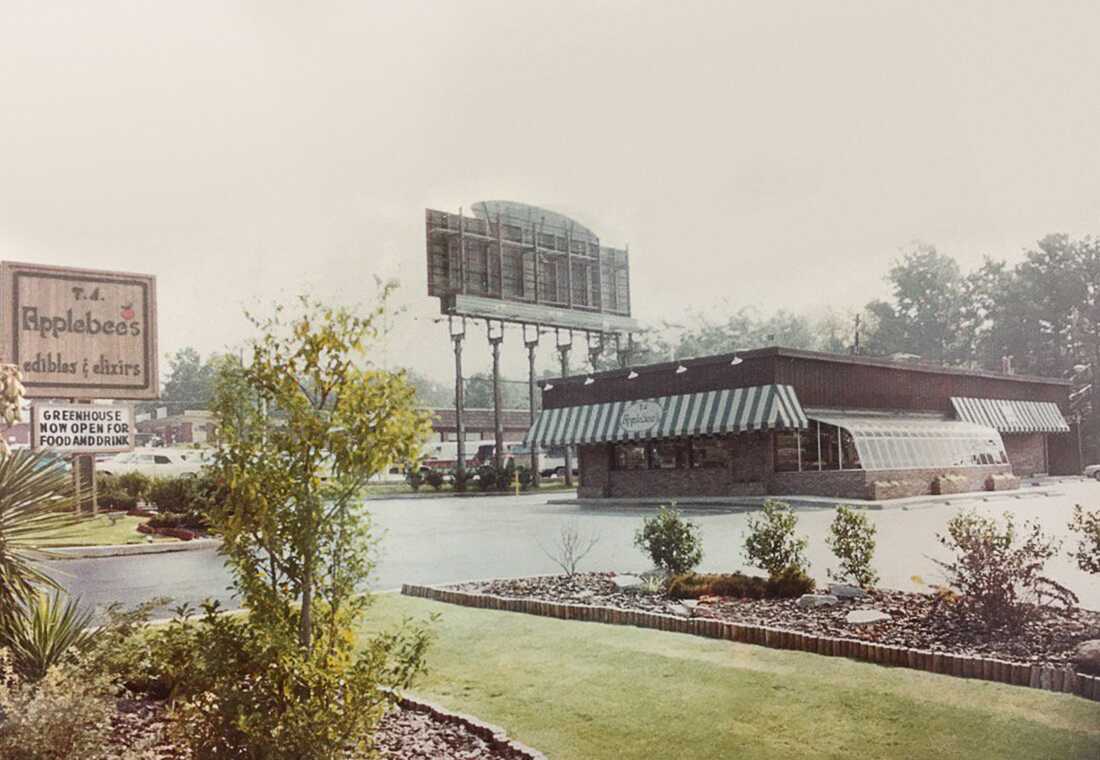
The original Applebee’s restaurant was called T.J. Applebee’s Rx for Edibles & Elixirs and it opened in Decatur, Ga., in 1980.
Applebee’s
hide caption
toggle caption
Applebee’s
For Sarah Duggan, an Applebee’s parking lot evokes a key memory from young adulthood.
Duggan, 32, from North Tonawanda, N.Y., wrote that every time she sees an Applebee’s, she remembers the time her friend, in an act of teenage rebellion, got her belly button pierced in the parking lot of a Long Island Applebee’s — inside the trunk of the piercer’s “salvage-title PT Cruiser.”
Duggan held the flashlight.
She wrote, “I can’t picture those sorts of college kid shenanigans happening in the parking lot of a regular Long Island diner or other independent restaurant, but it seems right that it was at Applebee’s.”
She continued, “It makes me think about how nobody, from riotous camp counselors to your spouse’s grandparents, looks or feels out of place at a chain restaurant.”


Tell us your Maine hunting hot takes

Maryland dentist to serve 10 years for pill-splitting scheme with assistant

Michigan Lottery Daily 3, Daily 4 results for Dec. 19, 2025

Massachusetts Removes LGBT Ideology Requirements for Foster-Care Parents

Finland picks up where it left off in Minnesota, beats Germany

Florida High School Football Rankings: Top 25 teams – Oct. 21

Cleary's 21 help Le Moyne down Central Connecticut State 69-64 in OT

How old is Bo Nix? What to know about Oregon quarterback ahead of 2024 NFL Draft

99th annual Pony Swim held in Virginia

Video: ‘It Didn’t Have to Happen This Way:’ U.Va. Faculty Call for Review of Police Response to Protests

Trump administration touts ‘most secure border in history’ as 2.5 million migrants exit US

How the reparations loan for Ukraine fell apart at the eleventh hour

Trump’s push to end transgender care for young people opposed by pediatricians

Takeaways from an eventful 2025 election cycle

Judge tosses Trump-linked lawsuit targeting Chief Justice Roberts, dealing setback to Trump allies
-

 Iowa5 days ago
Addy Brown motivated to step up in Audi Crooks’ absence vs. UNI
-

 Iowa7 days ago
How much snow did Iowa get? See Iowa’s latest snowfall totals
-

 Maine4 days ago
Elementary-aged student killed in school bus crash in southern Maine
-

 Maryland5 days ago
Frigid temperatures to start the week in Maryland
-

 Technology1 week ago
The Game Awards are losing their luster
-

 South Dakota6 days ago
Nature: Snow in South Dakota
-

 New Mexico3 days ago
Family clarifies why they believe missing New Mexico man is dead
-

 Nebraska1 week ago
Nebraska lands commitment from DL Jayden Travers adding to early Top 5 recruiting class