Lifestyle
Far from the front lines, Ukrainians fight a war to preserve their culture


In a remote region of western Ukraine, far from where the violent conflict of war with Russia is taking place and destroying human lives, Ukrainians are fighting a different type of battle: for culture and dignity.
In this area of Transcarpathia, a historical region in Eastern Europe that is now primarily part of modern-day Ukraine, there are local residents holding onto their history, traditional lifestyle, crafts and cultural identity. After coming under threat during Soviet times, they face stark new dangers. Since Russian President Vladimir Putin launched a full-scale invasion of Ukraine in February 2022, Ukrainians have feared that he is determined to wipe out their culture and statehood. Millions of Ukrainians have left the country. Many others have joined the army — with many killed on the front lines — and war efforts have soaked up people’s energy and resources. As they defend their territory from advancing Russian forces, many in Ukraine are also fighting to preserve a cultural heritage in peril.
The Transcarpathian Folk Choir performs a song and dance for a music video that they are working on to share their music. Ukraine’s St. Miklos Castle, which is now an arts exhibit space, a meeting place and museum for local history, provides the backdrop.
Claire Harbage/NPR
hide caption
toggle caption
Claire Harbage/NPR
Like many in this region, Joseph Bartosh, 67, believes he’s fighting on a sort of cultural front line. “In 2000,” Bartosh says, “my war actually started that year.” That was when Bartosh started his effort to preserve the medieval St. Miklos Castle in the town of Chynadiiovo, Ukraine. When he began the project, the castle was in disrepair. He says he found signs that in Soviet times, it had been used as a horse stable, with a lack of respect given to its history.

St. Miklos Castle in Chynadiiovo, Ukraine, was in disrepair when Joseph Bartosh decided to work on restoring it. He says that during Soviet times, it was used as a horse stable. Even now, more than 20 years since he started the project, there is still more work to be done to preserve parts of the castle.
Claire Harbage/NPR
hide caption
toggle caption
Claire Harbage/NPR

Joseph Bartosh stands in a patch of window light at St. Miklos Castle in Chynadiiovo, a town in western Ukraine. Since 2000, he’s taken on the effort of restoring the medieval castle, whose earliest known mention is believed to be around 1450.
Claire Harbage/NPR
hide caption
toggle caption
Claire Harbage/NPR
With the restoration well underway, the inside has already been transformed into a space for art exhibitions, community events and a museum where people can learn about the castle’s history. During this visit by NPR, the Transcarpathian Folk Choir is performing in the castle’s yard and filming for a music video, as Bartosh closes up for the day.
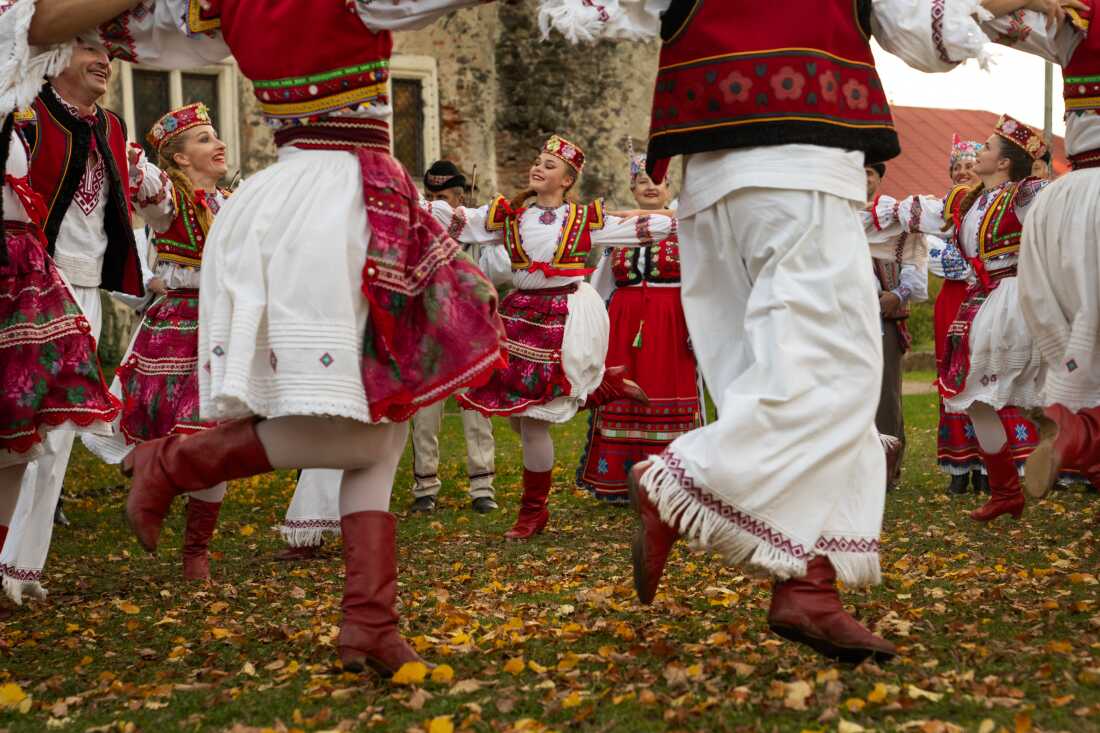
The Transcarpathian Folk Choir performs a dance while filming a music video.
Claire Harbage/NPR
hide caption
toggle caption
Claire Harbage/NPR
There are instances throughout Ukraine’s history in which the people were spurred into action to preserve their culture. Villagers here remember the Soviet history of Ukraine as a time of erasure of unique regional traditions. Hanna Haiduk recalls her relatives having to hide their embroidered shirts, called a vyshyvanka, to save them from being destroyed by Soviet troops. “People were putting [vyshyvankas] inside of glass jars, sealing those jars, digging holes underground trying to hide those vyshyvankas there. And people were trying to save vyshyvanka for years for the next generations in this way,” Haiduk recounts over tea in her kitchen.

Hanna Haiduk grew up learning traditional Hutsul embroidery techniques. She is part of the Hutsul ethnic group from the Transcarpathian region, which is mainly part of modern-day Ukraine.
Claire Harbage/NPR
hide caption
toggle caption
Claire Harbage/NPR
Haiduk, 60, is from the Hutsul ethnic group, from a village in the Carpathian Mountains called Kosivska. She remembers learning to embroider as a child, alongside her whole community. They would often gather under one large tree in the village to work on communal projects, chatting and laughing together as she and other kids would help, and learning different embroidery techniques as their parents directed them. They embroidered towels, rugs and vyshyvankas.

Hanna Haiduk uses a needle and thread to form intricate designs, many of which she copies from historical works she finds in books or those she saved from her family’s past work.
Claire Harbage/NPR
hide caption
toggle caption
Claire Harbage/NPR
Haiduk passed her love of tradition to her eldest son, Taras. He was a tour guide, showing off regional culture to people from around the world. He was killed while serving in the Ukrainian army, just one month after the war began in 2022, at age 34. He was supportive of her work and, before his death, he was building a website for Haiduk, to help her sell her vyshyvankas. But he never got to finish it, she says. She recounts all this with tears in her eyes.
“The war touches everywhere in this country; it’s a misconception that we are free from it here,” Haiduk says.

Hanna Haiduk does her embroidery mostly at home in Uzhhorod, a city in western Ukraine. She lost her son when he went to fight at the beginning of Russia’s full-scale invasion in 2022.
Claire Harbage/NPR
hide caption
toggle caption
Claire Harbage/NPR
But not every part of the region’s cultural heritage has been successfully preserved, as the war has taken its toll.
Richka is known locally as the village that makes hunias, traditional fluffy wool coats. Olha Mys and her mother and sisters used to make hunias, but the tradition is dying out. Even before the war, Mys says, fewer people were producing and wearing hunias because of how time-consuming and meticulous it is to make them.
“It’s not easy work to do this,” Mys says.

Olha Mys, wearing a fluffy wool hunia coat, and her sister walk near their house in Richka, Ukraine, down to where a valylo is built into the side of a stream. They use the valylo to wash wool and then to wash hunias for hours after they are woven.
Claire Harbage/NPR
hide caption
toggle caption
Claire Harbage/NPR
Making a hunia takes months just to complete one coat. After gathering the sheep’s wool, it is washed and dried in the sun, then combed and woven on a loom that takes up an entire room. The woven fabric is then washed for multiple hours in a valylo, a kind of natural washing machine that people construct on the side of a mountain stream. Valylos can only be used when the stream is very full and the water runs clear to keep dirt out of the materials. The hours of washing in the valylo helps with felting the woven fabric, creating a material that is dense and spongy.

Olha Mys shows a photo of her grandmother wearing a hunia. The tradition of crafting the coats has been in the family for generations.
Claire Harbage/NPR
hide caption
toggle caption
Claire Harbage/NPR

Many people have moved out of Richka, a small village in western Ukraine. Villagers estimate more than half of the population has left since Russia’s invasion of Ukraine in 2022.
Claire Harbage/NPR
hide caption
toggle caption
Claire Harbage/NPR
Adding to the difficulties, the war has shrunk the population of Richka, as people have fled Ukraine altogether. Many people in the village, roughly counting their neighbors, estimate that over half have left since the war started nearly three years ago.
Lubov Hychka, who still occasionally makes hunias, says that this population drop affects the materials she needs for the process.
“All those people that left because of the war, many of them had sheep, even despite the fact they weren’t producing hunias,” Hychka says. “When they left they sold their sheep or rented them to people in other villages, in other areas. Now if you want to start to produce hunia, you don’t have this amount of choice [in wool].”

Wool from local sheep is used in making a hunia.
Claire Harbage/NPR
hide caption
toggle caption
Claire Harbage/NPR

Lubov Hychka demonstrates how to weave the hunia fabric while Vasyl Hychka (unrelated), who takes care of the property where the loom is housed, helps with the rickety old machine.
Claire Harbage/NPR
hide caption
toggle caption
Claire Harbage/NPR
Traditionally, large flocks of sheep used to ramble through the Carpathian Mountains, spending summers on wide alpine meadows while shepherds lived alongside them. Now they dot the area, with usually just a few nibbling on grasses together on the outskirts of each village.

Mikhailo Bilak sits to smoke a cigarette after walking all morning with his flock of sheep. Mykola Yakbuk (right) has come to take one of the ewes and her lambs back to a barn where they can be more closely cared for.
Claire Harbage/NPR
hide caption
toggle caption
Claire Harbage/NPR
Mikhailo Bilak, a man wearing knee-high mud boots, watches over his flock of more than a hundred sheep. He says he and his friend, Mykola Yakbuk, are some of the rare shepherds who still raise sheep in this way, grazing them near the village of Yavoriv.

Mikhailo Bilak holds two lambs while their mother looks on.
Claire Harbage/NPR
hide caption
toggle caption
Claire Harbage/NPR
Even on this remote mountaintop, the war still looms. At 59, Bilak has nearly aged out of the military draft, which goes up to 60, but the country’s mobilization remains a threat.
“Pretty much if they mobilize me, these sheep will be packed immediately for slaughterhouse. Nobody will take care of them,” Bilak says bluntly, before he runs after his moving flock down the mountain, waving goodbye and apologizing at the hasty exit.
A few villages away in Krasnoillya, a small wooden museum is tucked into a valley that curls around a flowing stream, between the pine-covered peaks of the mountains. In the museum, actors who perform Hutsul theater are having a modest feast after rehearsal. A variety of cured meats and cheeses are stacked on thick, buttered slices of white bread.

Vasyl Zhykaliak, 15, and his 11-year-old brother, Dmytro, prepare to rehearse a play at Hutsul Theater.
Claire Harbage/NPR
hide caption
toggle caption
Claire Harbage/NPR
Their kind of theater was created over 100 years ago based on the culture and stories of the Hutsul ethnic group, who live in these mountains. The theater nearly went extinct during both World War I and II, but each time, after a long hiatus, dedicated enthusiasts revived it once the wars ended. During the current war, they have fewer shows and rehearsals, but still on an average Sunday in early November they were able to gather a handful of performers to rehearse.

Volodymyr Sinitovych, director of the Hutsul Theater, greets his son and grandchild outside the small museum in Krasnoillya, where the history of Hutsul theater is documented and sometimes performed.
Claire Harbage/NPR
hide caption
toggle caption
Claire Harbage/NPR
“I don’t think that it can cease to exist this time,” says Roman Sinitovych, the museum director and one of the actors in the troupe. He says this is because people have learned from the past. They care more about preserving cultural identity during this war. Sinitovych served in the territorial defense in eastern Ukraine’s Donetsk region during the first year of Russia’s full-scale invasion, but upon returning home, he went straight back to acting.
The difficulties during wartime never dampen his optimism.
“Many people say, ‘Oh, it’s a war now, it’s a difficult time. Why do you need plays? Why do you need to perform?’ But you know actually we need, because those are the things that unite us, that keep us together.”
They pour shots of a local alcohol made with galangal, making enthusiastic toasts to meeting, to friendship and to love. And one last time before parting, the sweet notes of a flute waft through the air. The group embraces, singing and spinning in a large circle, round and round until they merge into a blur.

Volodymyr Sinitovych ties up traditional shoes that are part of his costume.
Claire Harbage/NPR
hide caption
toggle caption
Claire Harbage/NPR

After rehearsal, the theater troupe has drinks and shares some meats and cheeses together.
Claire Harbage/NPR
hide caption
toggle caption
Claire Harbage/NPR


Lifestyle
L.A. Affairs: It’s hot when a man drives to me. But would this new guy make the trek from the Valley?

I met Dan on Hinge.
He lives in Woodland Hills, and I live in Venice. In Los Angeles, this is considered a long-distance relationship. In another city it might be nothing. Here, it’s a factor.
But I believe that with the right person, you can make anything work, so I stay open. I’m a native New Yorker, and if I were living in Brooklyn and a guy lived on the Upper West Side, that would be a 45-minute subway ride, which is truly nothing in New York. So with that same logic, I try to have flexibility with men in L.A.
When we started planning our first date, Dan suggested three options: a hike on mushrooms, a wine tasting or a walk on the beach.
A hike on mushrooms is something I’d only do with someone I already trust, not someone I just met online. I don’t do first-date hikes because I don’t like feeling trapped if the guy’s a dud. So I chose the wine tasting.
Then I learned the wine tasting was in West Hills.
On a Friday night, driving there from Venice would be insane. So I said I didn’t want to meet there because of the traffic. He suggested Malibu. That was also not ideal on a Friday.
I was getting annoyed — this was a pink flag because in my dating world, the guy is supposed to come to the woman’s neighborhood in the early days. I’ve gone out with plenty of men from the Valley who effortlessly suggested they come to me. It’s not rare or impossible.
I suggested he come to the Westside. I didn’t specifically say Venice, and in hindsight, I probably should have. He landed on Brentwood, which was manageable for both of us. On our first date, we met at an Irish pub on Wilshire Boulevard. He was cuter and more interesting than I had expected, and with the Guinness flowing, we had fun.
When I got home, he texted me: “Well, I like you 🙂 Less the tik tok and the lack of rock music in your life, but it’s not a deal breaker — there are other qualities 🙂 What are your thoughts?”
I noticed the slight negativity but was mostly dazzled that a man texted immediately after the date to say he liked me. In the modern dating economy, this felt rare.
The next day, both of our evening plans fell through, so we made a last-minute date. The wine tasting he originally suggested still sounded like fun, and although it meant me driving to the Valley, I was up for it now that we’d met.
We sipped flights at Malibu Wines & Beer Garden in its airy, romantic courtyard and played a flirty version of Truth or Dare. Halfway through, he dared me to kiss him.
We ended with sushi on Ventura Boulevard and a short make-out session in his car. He invited me to Thanksgiving at his uncle’s, which felt too soon, but also sweet.
After the second date, he texted and said he had his kids that week and was also hosting an event on Thursday, so his only day to meet was Wednesday. I said great.
On Tuesday night, he checked if we were still on, and I said yes.
Then he texted: “I’m flexible on time but not on location. I have a big event on Thursday, hopefully you can come to me again.”
My stomach tightened. This again?
So I texted back: “I drove to you last time, which was a bit of an exception for me especially in the early days, but the wine tasting location sounded special. Usually guys come to my area. How about we switch it up this time?”
He replied: “I appreciate the effort! Because of my event, I’d rather be close to a computer just if needed … Here is what i offer:
— I’ll come to your area anytime next week/end
— Lunch/dinner on me
I want to continue where we stopped last time 😉 No pressure of course, but let’s snuggle”
I responded: “Ok let’s meet next week. Snuggles sound nice … let’s see what happens …”
Then he wrote: “So I won’t see you tomorrow?”
I replied: “Unless you wanna come to me and bring your laptop along, let’s rain check until you have more flexibility.”
He said: “Dang, you are hard. I’ll let you know tomorrow around midday if it’s ok.”
And then — surprise — he decided to come.
He drove to Venice for a 5 p.m. date. He said his ETA was 5 p.m., and it ended up being 5:25 p.m., typical 405 Freeway.
When he showed up, he was in a cranky mood. On our way to KazuNori in Marina del Rey, I thanked him for picking me up and told him I think it’s hot when the guy comes to the girl.
“You’re just saying that because you want me to come to you more,” he said, not playfully, but aggressively.
That was basically the end for me. But there I was, in his car, heading to dinner. So I stayed pleasant and tried to make the best of it.
I shared that in the early stages of dating, I find it’s good etiquette for the guy to come to the woman’s neighborhood. He immediately disagreed and started ranting about how dating rules are ridiculous and how they swing in women’s favor. He resented paying for dates and declared he wasn’t looking to “sponsor a woman’s life.”
“If women want equality and equal rights,” he said, “then it should apply all across the board, including dating, and the man shouldn’t have to pay.”
I said women don’t actually have equal rights because we get paid less than men and often receive lower salaries than men in the same position.
I tried to change the subject and reset the mood, but he insisted we keep hashing it out.
I tried to explain masculine/feminine dynamics: providing and protecting, giving and receiving.
“What does the man get out of this arrangement?” he asked.
It was like watching someone’s personality warp into Mr. Hyde. Then he brought up another point: He’s a single dad of two kids, so he gets tired; and because I don’t have kids, that should factor into who drives where.
At this point, I was barely engaging and focused on eating my hand rolls, and I couldn’t wait to get home.
The check came, and I happily split it, wanting nothing further from him.
In the car back to my place, he remarked: “It’s obvious we’re never gonna see each other again.”
Obvious, but did it need to be stated?
Then he showed me a Spotify playlist he’d made for me of his favorite electronic music, because he knows I like EDM.
“Oh, that’s sweet,” I said.
“Yeah, that’s how I show interest. Through things like this, not who drives to who,” he replied.
When I got out of the car, we wished each other luck, and I headed inside and shut the door.
Two hours later, he sent me the playlist. I’ve yet to listen to it.
It wasn’t the distance that ruined it. It was the resentment. I’m not looking for a man who feels burdened by the effort. I’m looking for a man who sees the value of courting a woman in the first place.
The author is a writer, comedian and former psychologist who lives in Venice. She is the creator of the new vertical series “Manfari.” She’s on Instagram: @solange_neue and @manfari.show.
L.A. Affairs chronicles the search for romantic love in all its glorious expressions in the L.A. area, and we want to hear your true story. We pay $400 for a published essay. Email LAAffairs@latimes.com. You can find submission guidelines here. You can find past columns here.

Lonnie Bunch III is the 14th Secretary of the Smithsonian. He’s pictured above in September 2017.
J. Scott Applewhite/AP
hide caption
toggle caption
J. Scott Applewhite/AP
In a memo addressed to staffers sent Tuesday, the secretary of the Smithsonian, Lonnie G. Bunch III, defended the institution after the White House issued a 162-page report that characterizes the National Museum of American History as a place which has become “subject to institutional capture by a radical, activist ideology that is fundamentally opposed to telling the noble, honest story of the great country we know and love.”
In his email, which NPR has obtained, Bunch wrote in part: “While there will always be room for improvement, this report is not a fair characterization of the work and totality of the National Museum of American History. At the Smithsonian, our work is driven by scholarship, accuracy and an uncompromising commitment to tell the fullness of America’s story. As public servants and the keepers of this institution, we are charged with helping a nation find understanding, hope and clarity and as part of that duty, we are dedicated to excellence, reflection and growth.”

He continued: “We remain focused on what grounds us: a steadfast commitment to scholarship, nonpartisanship, independence, accuracy and integrity. For nearly 180 years, the Smithsonian has worked alongside partners across government — from the White House to Congress to our governing Board of Regents — guided by our enduring mission to increase and diffuse knowledge. That purpose remains: to pursue knowledge with rigor and to serve the American public with clarity and care.”
The White House report was issued on July 4 by the Domestic Policy Council under the title “Saving America’s Story: How Ideological Capture at the Smithsonian Institution’s National Museum of American History Erases Our Heritage.”

The council faults the National Museum of American History on a multitude of fronts, saying it underemphasized the Founding Fathers and early colonial and Revolutionary history; was not sufficiently celebratory of the country’s 250th anniversary; and that it engaged in “anti-white,” “illegal alien” and transgender activism.
It also accuses the museum of trying to “indoctrinate” teachers and students through its exhibitions, programming and teaching resources.
In the report, the council also specifically criticizes museum director Anthea Hartig, who has led the National Museum of American History since 2019 and is concurrently the president of the Organization of American Historians, calling her “an activist advancing an ideological agenda contradictory to the museum’s founding purpose of fostering patriotism.”

The Trump administration has made the Smithsonian museums one of its primary targets in its efforts to reshape cultural narratives to align with its viewpoints. In August 2025, the White House requested a “comprehensive internal review” of eight Smithsonian museums, including the National Museum of American History, following an executive order issued by President Trump in March 2025 in which he called for the removal of “improper ideology” from the Smithsonian’s offerings.
According to the Smithsonian’s charter, all of its 21 museums, 14 education and research centers, and the National Zoo are meant to be run independently of the federal government. The Smithsonian is overseen by Bunch and a board of regents, which includes Vice President Vance, Supreme Court Chief Justice John Roberts and other members appointed by Congress.
In an interview with NBC’s Meet the Press on Sunday, Bunch spoke about the Smithsonian’s 250th anniversary special exhibition at the Smithsonian Castle, which is called “American Aspirations.”
He told NBC: “It’s really important for people to understand that America is much an ideal as it is a place, that it’s a series of aspirations that have really shaped who this country is. And so for me, what is so powerful is to say, ‘Let us honor the words of Thomas Jefferson and the founders, but let us use those to challenge us to be better.’”
Jennifer Vanasco edited this story.

-

 Los Angeles, Ca1 hour ago
Knee irritation forces Shohei Ohtani out of Friday start, All‑Star game
-

 Detroit, MI1 hour ago
Detroit Evening Report: Waymo cars blocking first responders – WDET 101.9 FM
-

 San Francisco, CA2 hours ago
San Francisco Mayor Daniel Lurie Blocks Vacant Grocery Store Tax Proposal | KQED
-

 Miami, FL2 hours ago
Oregon Battling Miami, Mario Cristobal for Four-Star EDGE Recruit
-

 Dallas, TX2 hours ago
FC Dallas Forward Logan Farrington Inks Contract Extension
-

 Boston, MA2 hours ago
Red Sox face lengthy travel issues ahead of series vs. Mets
-

 Denver, CO2 hours ago
What’s going on with the Nuggets? Unpacking an NBA offseason on hold
-

 Seattle, WA2 hours ago
Seattle Kraken Sign Goaltender Victor Östman and Defenseman Ville Ottavainen to One-Year Deals | Seattle Kraken

