Lifestyle
Everything you need to know about Disneyland's biggest event of the decade


The Disneyland Resort is turning 70 in July, and it has never missed an opportunity to throw a party — especially one rooted in nostalgia. For the year-long event, a number of fan favorites are making their return, in addition to some new shows and tweaks to favorite attractions.
The festivities officially launch May 16, although not all offerings will be available right away. Some will be rolled out to coincide with Disneyland’s official birthday on July 17. The celebration is planned to last through summer 2026.
Here’s everything you need to know about the Disneyland Resort 70th Celebration — including details on a ticket deal.
Disneyland Park
The return of a fan-favorite parade. Evening parade Paint the Night made its debut in Anaheim during Disneyland’s 60th anniversary a decade ago, and it’s back for the 70th. A sort of spiritual successor to the on-again/off-again Main Street Electrical Parade, Paint the Night has a fast-moving soundtrack, more than 1 million LED lights and glittering, shimmering floats that honor franchises such as “Toy Story,” “Frozen” and “Cars.” Paint the Night is a vibrant, high-energy show that intersperses dance, tech and the requisite amount of evening sparkle.
Anna and Elsa will rejoin the Paint the Night parade on the float inspired by “Frozen.”
(Paul Hiffmeyer / Disneyland Resort)
A legendary ride gets an update. It’s a Small World is so filled with details — playful dolls, adorable creatures, colorful vignettes, all of it designed in the style of artist Mary Blair — that it’s impossible to see all of it on one ride through. And when the attraction reopens on May 9, it will have even more characters, as Disney is adding Miguel and Dante from the film “Coco” to the ride’s Mexico section. That’s not the only tweak planned for this legendary ride. Coming in July will be an additional verse to its memorable song, this one written by original co-composer Richard Sherman shortly before his death in 2024. Sherman wrote the verse to celebrate the song’s 60th anniversary, as the attraction opened at the New York World’s Fair in 1964 before being installed at Disneyland in 1966.

Miguel and Dante from the Disney/Pixar film “Coco” will be added to classic It’s a Small World when the ride repoens in May.
(Disney concept art)
A new projection show comes to It’s a Small World. The work and style of Blair also will be honored via a new projection experience that will unfold on the façade of It’s a Small World. Titled “Tapestry of Happiness,” this nighttime show, described by Disney as an “animated mosaic of Disneyland attractions, moments and memories,” will include many songs associated with the park as well as the new tune “Celebrate Happy.” Expect a projection show that digs into Disneyland history and is high on nostalgia, with no doubt a moment or two designed to bring longtime fans to tears.
An evening performance that celebrates animation. The fireworks show “Wondrous Journeys” will return for Disneyland’s 70th. Introduced for the 100th anniversary of the Walt Disney Co., “Wondrous Journeys” focuses on the history of the company’s animated works. Some fine print: Not every night of “Wondrous Journeys” will feature fireworks, but it remains one of Disney’s better-received evening shows, as it features snippets of more than 60 films as well as nods to many shorts that helped define the studio.

A new character cavalcade will launch May 16 and continue throughout the year. Characters such as Duffy and ShellieMay, rarely seen in Anaheim, will take part.
(Artist concept / Disneyland Resort)
Say hello to Duffy. First, the bad news: The terrific, contemporary dance-focused parade Magic Happens is currently not slated to run during Disneyland’s 70th anniversary. The consolation prize? Disneyland is introducing a new afternoon character cavalcade that will feature some 70th-anniversary attire and the arrival of rarely seen characters at Disneyland, such as Duffy and ShellieMay. The teddy bear characters are international Disney superstars, and cult favorites among American Disney fans.
Take a tour that honors Disneyland history. Disneyland will launch a new guided tour for its 70th anniversary, this one focused squarely on the history and development of the park. The two-hour experience, available for an additional charge, will be available for booking beginning April 24. Disney says the tour will place a special emphasis on the park’s opening-day attractions, as well as Walt Disney’s original vision for the park.
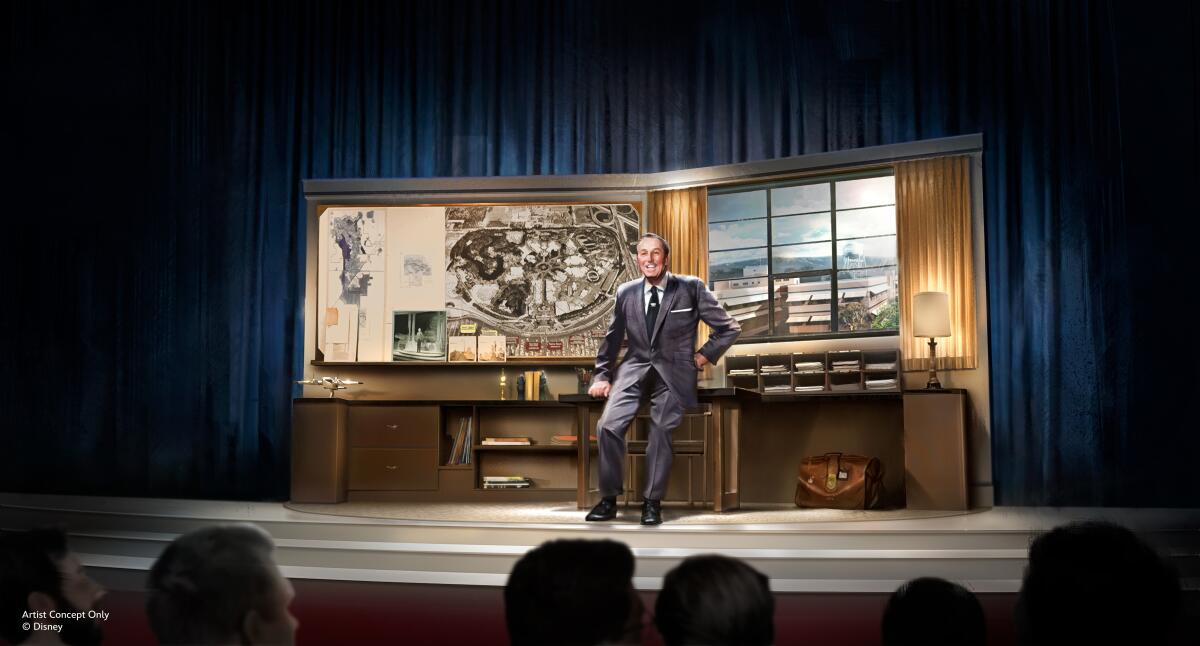
An audio-animatronics figure of Walt Disney will appear in the show “Walt Disney — A Magical Life,” which will debut in the Main Street Opera House at Disneyland in July.
(Disneyland)
Speaking of Walt … Opening July 17 will be a show in the Main Street Opera House that will celebrate the life and legacy of the park’s patriarch. “Walt Disney — A Magical Life” will for the 70th anniversary displace the show centered on Abraham Lincoln, and will feature the first-ever audio-animatronic of Disney, which the company has teased is its most lifelike figure to date. The figure, images of which the company is currently keeping under wraps, will be brought to life via audio recordings and will be situated in a setting designed to evoke Walt’s office. After the show’s initial run during the 70th, it will play in tandem with “Great Moments With Mr. Lincoln.” The exit hall for the attraction will feature concept art for Disneyland attractions in the works.
Explore Disney tech at a historical art exhibit. Guests likely will want to arrive early for “Walt Disney — A Magical Life” once the show launches, as the gallery in the Opera House will be filled with a new exhibit developed by the company’s archives department in collaboration with San Francisco’s Walt Disney Family Museum as well as Walt Disney Imagineering, the secretive arm of the company devoted to theme park experiences. First, explore a selection of photographs and artifacts from before and during the Walt era that helps tell the Disneyland development story. Many items, including never-before-shown artifacts from Disney’s private Disneyland apartment, are on loan from the Walt Disney Family Museum. A final section will be dedicated to the development of audio-animatronic figures, looking at Walt’s passion for the creations and how they have evolved over the decades.
Disney California Adventure
A brand-new “World of Color” show that you can vote on. “World of Color Happiness!” is a new lagoon-based show for the 70th anniversary, this one inspired by Walt Disney’s original dedication for the park. “To all who come to this happy place, welcome,” Disney said in July 1955. “Disneyland is your land. Here age relives fond memories of the past, and here youth may savor the challenge and promise of the future. Disneyland is dedicated to the ideals, the dreams, and the hard facts that have created America.” Although here’s betting the World of Color show — sure to feature impressive fountains, projections and pyrotechnics — doesn’t delve too heavily into any “hard facts.”

The new “World of Color Happiness!” will debut in Disney California Adventure in May to celebrate Disneyland’s 70th anniversary.
(Artist concept / Disneyland Resort)
Some of the animated works featured in the performance include “Turning Red,” “A Goofy Movie,” “Tangled” and “The Lion King,” and it will be hosted by the blue-haired character of Joy from the “Inside Out” films. Arrive early and vote via the Disneyland app to see various “Inside Out” characters — Sadness, Anger, Disgust or Envy — given greater prominence during the show. A new song from Fitz of Fitz and the Tantrums fame will be featured in the production, and Boyz II Men have recorded a rendition of “Rainbow Connection” for it.
Carthay Circle will spring to life each night. The façade of the park’s upscale restaurant, Carthay Circle, will morph into a performance space. While Disney hasn’t detailed too heavily what audiences may expect to see on the building, expect a projection-based show with inventive lighting and music. The projections and lighting will be set to the 70th-anniversary theme song, “Celebrate Happy,” which is to be recorded by the Jonas Brothers.

Toy Story Midway Mania! will be updated with animations that nod to the 70th anniversary.
(Artist concept / Disneyland Resort)
New surprises adorn Toy Story Midway Mania! While not the first video game-inspired ride, Toy Story Midway Mania! was quite possibly the first successful implementation of one. The ride works well with what is now known as Pixar Pier, a land full of carnival rides and games. It still holds up thanks to its simplicity. Of course, a unique ride vehicle — a carnival car with a spring-action launcher — doesn’t hurt. Now, the 2008 attraction will receive an ever-so-slight makeover for the 70th. Look for new animations that nod to the festivities peppered throughout the ride’s digital games.
A Pixar-focused daytime parade makes a comeback. Last year California Adventure unveiled a new daytime parade, “Better Together: A Pixar Pals Celebration,” and it’s returning for the 70th. Colorful floats that nod to recent films like “Luca” and “Turning Red,” the latter complete with a larger-than-life red panda Mei, are contrasted with smaller, more playful units that touch on “Toy Story” and “Monsters, Inc.” Throughout, there’s an underlying theme of friendship.
Dining, merchandise and more
A barbecue buffet, with a side of duck. Duck isn’t on the menu, but a certain waterfowl is the star of this dinner at the Grand Californian’s Storytellers Cafe. Donald’s Tales of Adventure Dinner Buffet launches May 16 and features what’s described a a campfire-style barbecue. Expect spareribs, fried chicken, prime rib and more, and look for the likes of Donald, Daisy, Clarabelle, Goofy and Pluto in new adventure-inspired outfits. Reservations are recommended and the meal starts at $62 for adults and $36 for children.

Storytellers Cafe at Disney’s Grand Californian will host a new Donald Duck-led character dinner buffet.
(David Nguyen / Disneyland Resort)
Specialty merchandise abounds. Disneyland is launching multiple merchandising lines for its 70th anniversary, some of which have already started to infiltrate the parks. The so-called “celebration collection” features brash colors and new collaborations with Loungefly and Dooney & Bourke. The “castle collection” is just that, featuring regal wear and jewelry inspired by Sleeping Beauty Castle, while the “vault collection” is where all those seeking Disneyland nostalgia will want to head. The vault collection will be released in waves throughout the year, the first rendition looking at Disneyland maps. The “Disneyland Resort 70th Anniversary Walt Disney Nostalgia Collection” is said to boast vintage-style accessories and attire outfitted in some of Walt’s famous quotes. There’s plenty more, including pocket watches and charms, and a giant interactive key that will light up and play music as guests explore the park.

Disneyland is launching multiple new merch lines for the 70th anniversary, including one that features quotes from Walt Disney.
(Disneyland Resort)
And you can see it all for a (slight) discount. Disneyland fans willing to commit to more than a day in the park can take part in a limited-time ticket offer. An anniversary ticket is on sale now, good for visits from May 16 to Aug. 14. It’s a three-day, one-park-per-day ticket that sells for $360, which works out to $120 per day. That’s a slight savings, as peak spring and summer tickets typically can’t be found for less than $142 per day and can run as high as $206. Those who opt in for a four-day $400 ticket will be able to access the parks for $100 per day. The tickets do not have to be used on consecutive days.

Throughout the event, look for popular characters in new celebratory attire.
(Christian Thompson / Disneyland Resort)

Lifestyle
Terry Tempest Williams on why women with big ideas get labeled ‘crazy’ : Wild Card with Rachel Martin
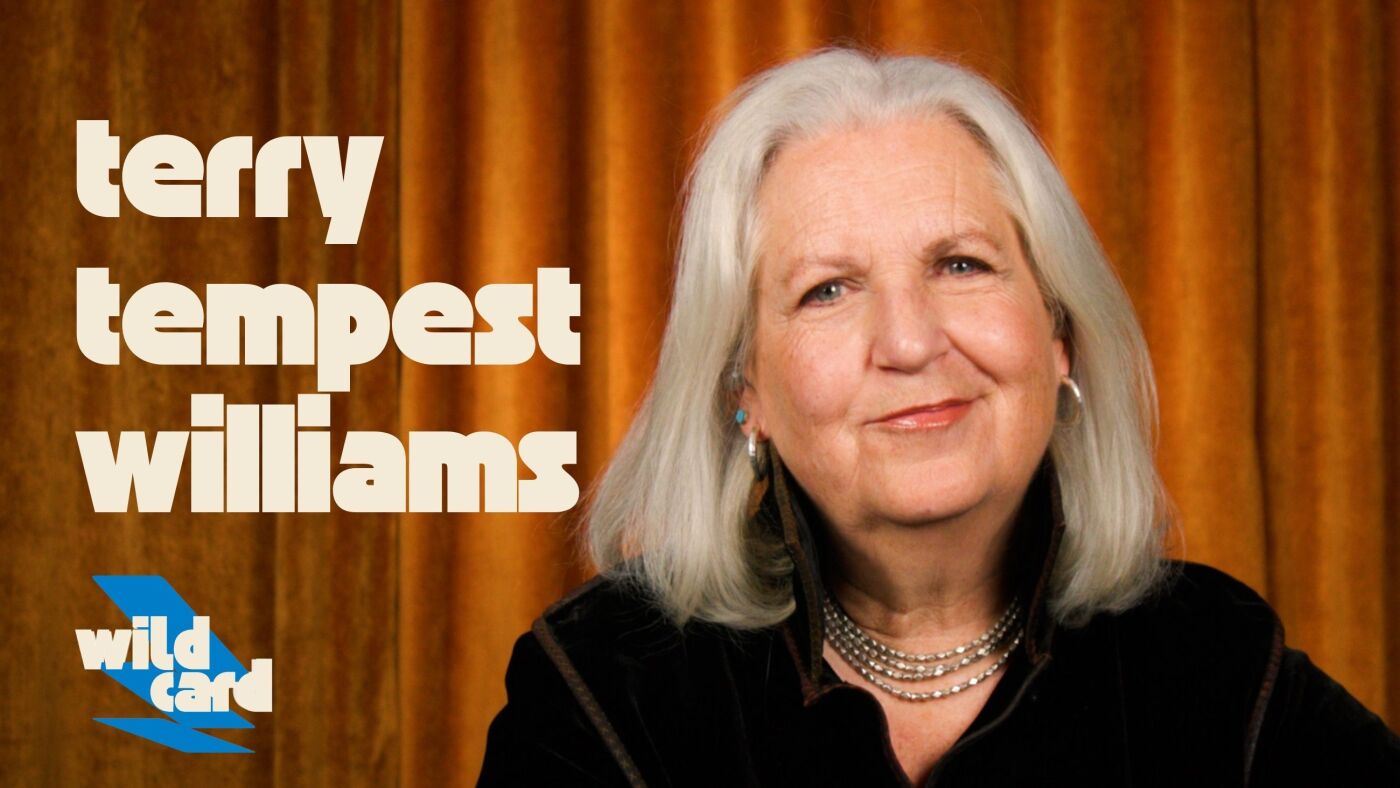
A note from Wild Card host Rachel Martin: I met Terry Tempest Williams about 25 years ago at a writer’s conference in Yosemite Valley. I was a young reporter who was there to do a story about how literature was addressing climate change and she made such a huge impression on me. I had never heard someone talk about the natural world the way Terry did and she had a spiritual depth I hadn’t encountered in my life at that point.
To this day, Terry’s writing always reorients me towards what is good, what is beautiful, and what is true. Her newest book is called “The Glorians.”

For its upcoming Los Angeles venue, experiential art firm Meow Wolf will focus on the art of storytelling, with a specific eye toward skewering our city’s moviemaking magic. To help bring that vision to life, Meow Wolf has entered into a creative partnership with Titmouse, one of L.A.’s most renowned independent animation houses.
The Hollywood-based studio behind popular series such as “Big Mouth” and “Star Trek: Lower Decks” will create animation that will be shown throughout the West L.A. venue, which is on target for a late 2026 opening at the Howard Hughes entertainment complex.
It’s a move that represents a shift for Santa Fe, N.M.-based Meow Wolf. Over the last decade-plus, the art collective has grown beyond its anything-goes, punk-meets-psychedelic roots into an organization with full-scale, maximalist installations in its hometown, Denver, Las Vegas, Houston and the Dallas suburbs. In the past, Meow Wolf kept most of its media in-house.
As part of its larger-than-life participatory art installations, Meow Wolf L.A. will feature a mix of live action and animation, the former filmed by Meow Wolf in its Santa Fe studio. Meow Wolf’s James Stephenson, a senior VP with the company and its creative director of emerging media, said the degree to which the L.A. exhibition will lean into various animation styles necessitated an outside partner. Titmouse’s work, in development by a number of directors with contrasting tones, will be shown on a variety of formats, ranging from cinema screens to full-room projections.
“I really believe in animation as an art form, and I know the Titmouse folks do too,” Stephenson says. “Animation is made by artists. It’s made by artists with their own hands. It’s something that is still very rooted in craft.”
Meow Wolf’s L.A. space is set in a former cinema complex, and will champion its location, taking guests on a journey through a converted movie house and beyond, into a sci-fi-inspired fantasyland with sentient spaceships and a 30-foot-tall mushroom tower. Meow Wolf creatives have spoken of the fantastical movie theater as one that will feature animated, self-aware candy before attendees enter the main exhibition space, making Titmouse’s work some of the first art guests will encounter. Titmouse co-founder Chris Prynoski has said the studio has lined up at least six directors for the exhibit.
An in-progress art installation destined for Meow Wolf L.A. at the art collective’s Santa Fe, N.M., headquarters. The L.A. exhibition will feature animation from Titmouse.
(Gabriela Campos / For The Times)
Titmouse, says Stephenson, is the right partner because “they’re known less for a house style, and more for a house vibe.” Over the years, Titmouse has been behind such diverse shows as “Scavengers Reign,” owning a Jean Giraud influence rooted in French and Spanish surrealism, the lively “Jentry Chau vs. the Underworld,” with an unique color palette that took inspiration from anime and Chinese mythology, the exaggerated comic book feel of Adult Swim’s “Metalocalypse,” and the approachable yet expressive tone of “Star Trek: Lower Decks.”
“Meow Wolf’s vibe is similar to Titmouse’s vibe,” Stephenson says. “It’s artist-first, artist-driven, independent and kinda edgy. They are always trying to find the edge of what’s possible. They try to see how far they can go, and it’s done for fun and in the spirit of taking risks.”
Prynoski says working with Meow Wolf will give Titmouse a sense of artistic freedom it doesn’t always have when delivering content for more traditional Hollywood partners. He says the multi-director approach is a callback to the early days of Warner Bros. Animation, when individual creators put their own stamp on Looney Tunes material.
“I use Bugs Bunny as an example,” Prynoski says. “You’ve got a Friz Freleng Bugs Bunny short. You’ve got a Chuck Jones Bugs Bunny short. You’ve got a Tex Avery Bugs Bunny short. They’re all different versions of Bugs Bunny, and people who are really paying attention can tell which director directed each one. Even though to the layman, these are all Bugs Bunny, but if you lined them up, they are drawing in different styles, sensibilities and techniques.”
Prynoski says that was a centerpiece of his pitch to Meow Wolf, noting that characters will reappear in multiple installations, each handled by a different artist. Meow Wolf L.A., in fact, will be the firm’s most character-driven exhibition, as guests will follow the storylines of three main protagonists throughout the space.
In announcing the partnership, Meow Wolf and Titmouse released an image from an animated work directed by Luca Vitale. It features a key character having a moment with a hummingbird and it’s done in an elegant, slightly anime-influenced style. It’s an image full of movement, reflecting a character in transition with inviting pastels and bold dashes.
“I like that image because I think it captures some of the sense of wonder that we want people to feel,” Stephenson says. “The character is having an encounter with the elusive nature of creativity and reality in a way that makes them have a different perspective of what’s possible.”
Other contributing animation directors to Meow Wolf L.A. include Space Dawg, Felix Colgrave, Alexander Vanderplank and Phimémon Martin, and Jun Ioneda.
Titmouse’s partnership with Meow Wolf will extend beyond the L.A. exhibition. The two will be working on the development of Meow Wolf New York, which is slated to open some time after Los Angeles, and are collaborating on a planned animated series, which Prynoski is spearheading.
Meow Wolf exhibits are the result of sometimes hundreds of disparate artists coming together in a shared space. Distilling that into a signature, singular style for a series could be a challenge. Stephenson pinpoints some guiding principles.
“You really need to feel the hand of the artist,” he says. “You need to feel a DIY aesthetic. You need to feel the materiality. Those are very specific to what we are.”

The Kennedy Center on June 28, with its facade signage still covered by a tarp and scaffolding.
Alex Wroblewski/AFP via Getty Images
hide caption
toggle caption
Alex Wroblewski/AFP via Getty Images
On Wednesday, a federal appeals court denied President Trump’s request to stop the removal of his name from Washington, D.C.’s Kennedy Center. The signage on the building has been covered with tarp and scaffolding since June 13, but in a court filing last month, the center’s current executive director said that Trump’s name has been removed.
In their decision, three judges from the U.S. District Court of Appeals for the District of Columbia Circuit said that the president had failed to prove that the arts center would be “irreparably injured” without Trump’s name attached to it.
NPR requested comment from the Kennedy Center, but did not receive an immediate reply.
This latest round of court decisions is part of the ongoing litigation filed by Rep. Joyce Beatty, D-Ohio, against President Trump and the board of the Kennedy Center. In a statement emailed Wednesday to NPR, Beatty said: “Today’s ruling again affirms that this administration’s efforts to rename the Kennedy Center were unlawful. His name no longer desecrates this sacred memorial, which belongs to the American people. Now it is time for the Trump administration to accept this, comply with the law, and take the tarps down.”
In previous court filings, Trump’s legal team had asserted that removing the president’s name from the arts complex, both on the physical building and in its digital materials, would inflict irreparable harm in both time and money already spent. In the denial, the three judges — Patricia Millett, Robert Wilkins and Gregory Katsas — wrote that since Trump’s name has already been removed, “a stay would not avert those harms.”
Furthermore, Trump had claimed that without his name attached, future fundraising would be threatened “and [will] contribute to the financial decline of the Center.” In response, the appeals judges wrote: “Appellants, however, have failed to support this assertion with any specific facts or evidence. They offer only the conclusory assertions of the Kennedy Center’s Executive Director that were made in a factually unsupported declaration.” The center’s current executive director, Matt Floca, specializes in physical plant management.
The presiding judge in the case, Christopher R. Cooper, has ordered that the center provide him a status report on the center’s operation and programming before the end of this month. As of Wednesday, the center’s calendar lists a small roster of programs, including outdoor free movie screenings, workshops for children, and five free live performances in July on its Millennium Stage. In the past, the Kennedy Center presented over 2,000 arts and education events each year, including free daily Millennium Stage performances.
-

 Iowa5 minutes ago
Iowa WWII veteran approaching 100th birthday honored in Cedar Rapids
-

 Kentucky10 minutes ago
Exantus may be subject to involuntary hospitalization due to Kentucky law
-

 Louisiana20 minutes ago
Parasitic stomach illness that can cause explosive diarrhea rises in Louisiana
-

 Maine27 minutes ago
Is prison in play for Graham Platner?
-

 Maryland30 minutes ago
Office building in Glen Burnie evacuated after shift in parking garage floor
-

 Michigan35 minutes ago
Menominee, Michigan man arrested on sexual assault charges involving a minor
-

 Massachusetts42 minutes ago
Healey administration vows to appeal as Trump rejects Massachusetts blizzard aid request – The Boston Globe
-

 Minnesota45 minutes ago
Minnesota Looks to Add 1,100 Child Care Slots, With Melrose Among the 11 Funded Communities

