Lifestyle
Centuries-old cherries were found at George Washington's home. What can they tell us?

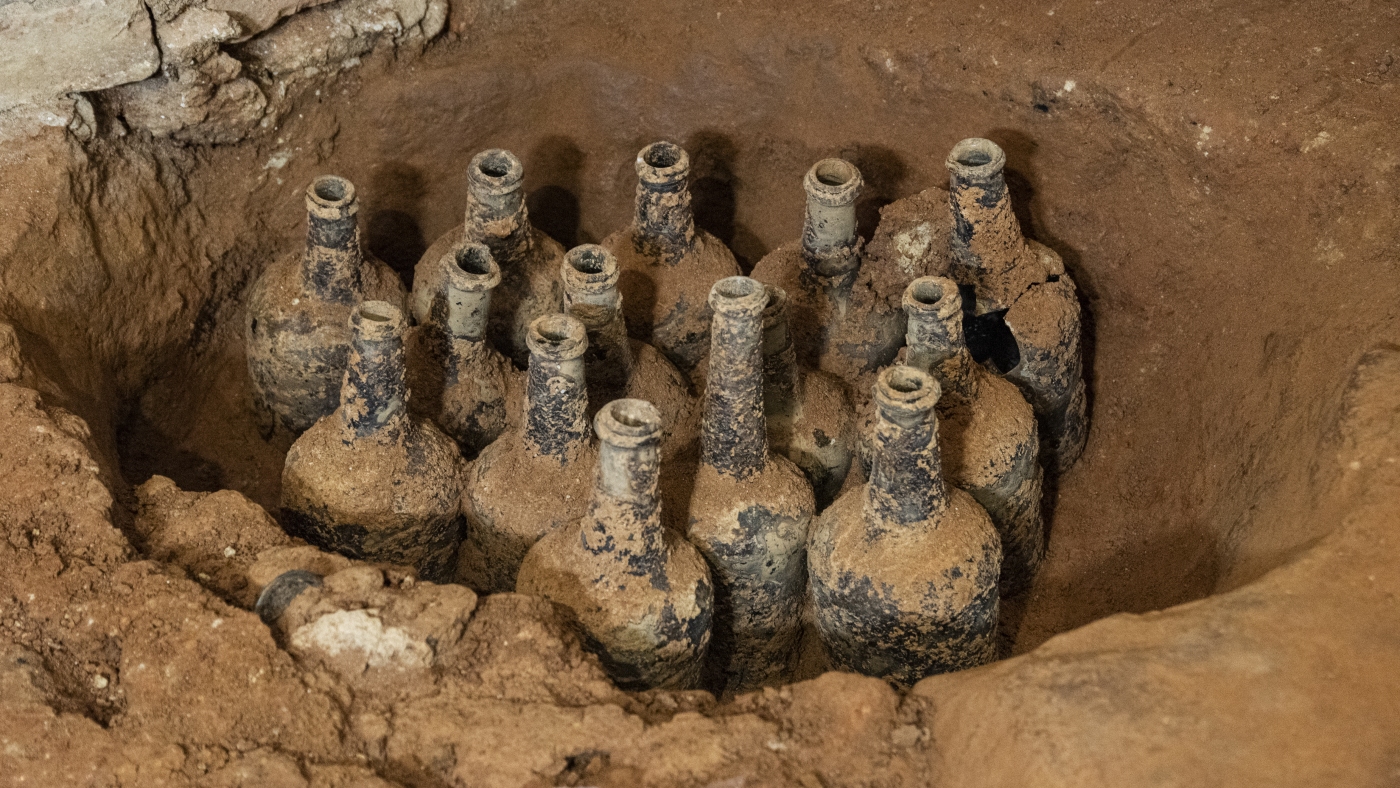
Archaeologists on a multi-year restoration project found 35 bottles of cherries and berries in five different pits in the Mount Vernon cellar.
George Brown/Mount Vernon Ladies’ Association
hide caption
toggle caption
George Brown/Mount Vernon Ladies’ Association
Archeologists at George Washington’s historic Virginia home have unearthed more than two dozen bottles of cherries and berries dating back to the 18th century in a particularly juicy find.
Officials first announced in April that they had discovered two glass jars of cherries, liquid and pits while excavating the cellar of Mount Vernon, the residence, plantation and final resting place of the nation’s first president.
Further sweetening the deal, last week they announced the discovery of 35 more fruit-filled vessels. Officials say 29 of the bottles are intact and contain “perfectly preserved cherries and berries, likely gooseberries or currants.”
“To our knowledge, this is an unprecedented find and nothing of this scale and significance has ever been excavated in North America,” Mount Vernon President and CEO Doug Bradburn said in a statement.
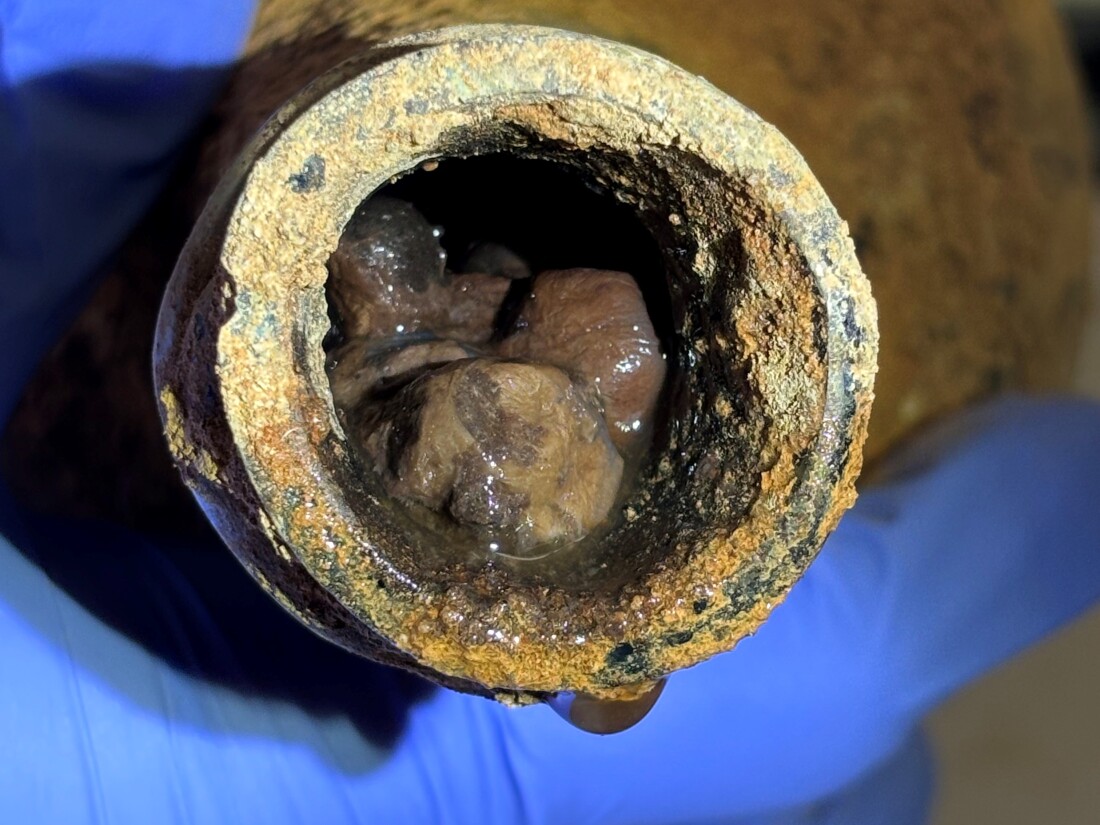
A view of preserved cherries inside one of the bottles found at Mount Vernon.
Mount Vernon Ladies’ Association
hide caption
toggle caption
Mount Vernon Ladies’ Association
The bottles, whose shapes are characteristic of styles from the 1740s and 1750s, were discovered in five storage pits throughout the cellar.
“These artifacts likely haven’t seen the light of day since before the American Revolution, perhaps forgotten when George Washington departed Mount Vernon to take command of the Continental Army,” Bradburn added.
That was in 1775.
Archaeologists revisited the site as part of a privately funded $40 million preservation project, aimed at ensuring Mount Vernon’s structural integrity and slated for completion in 2026 — just in time for America’s 250th birthday.
Now, fresh off this well-preserved discovery, researchers hope that modern technology will allow them to learn more about the cherries and, by extension, the world from which they came.

Jason Boroughs, the principal archaeologist at Mount Vernon, called the discovery “beyond extraordinary.” He told NPR and WBUR’s Here & Now in April that “intact 18th-century food remains is just not something that’s typically found.”
The cherries, he added, can serve as a window into the environment and cuisine of the period, as well as the entire Mount Vernon community — and not just the first first family.
“The bottles and the contents are actually material items that were connected to real lives and real people in the past,” Boroughs said. “They may have been intended for the Washingtons’ table, but they were certainly picked and packaged and stored by members of the enslaved community here.”
The cherries can teach us about life at Mount Vernon
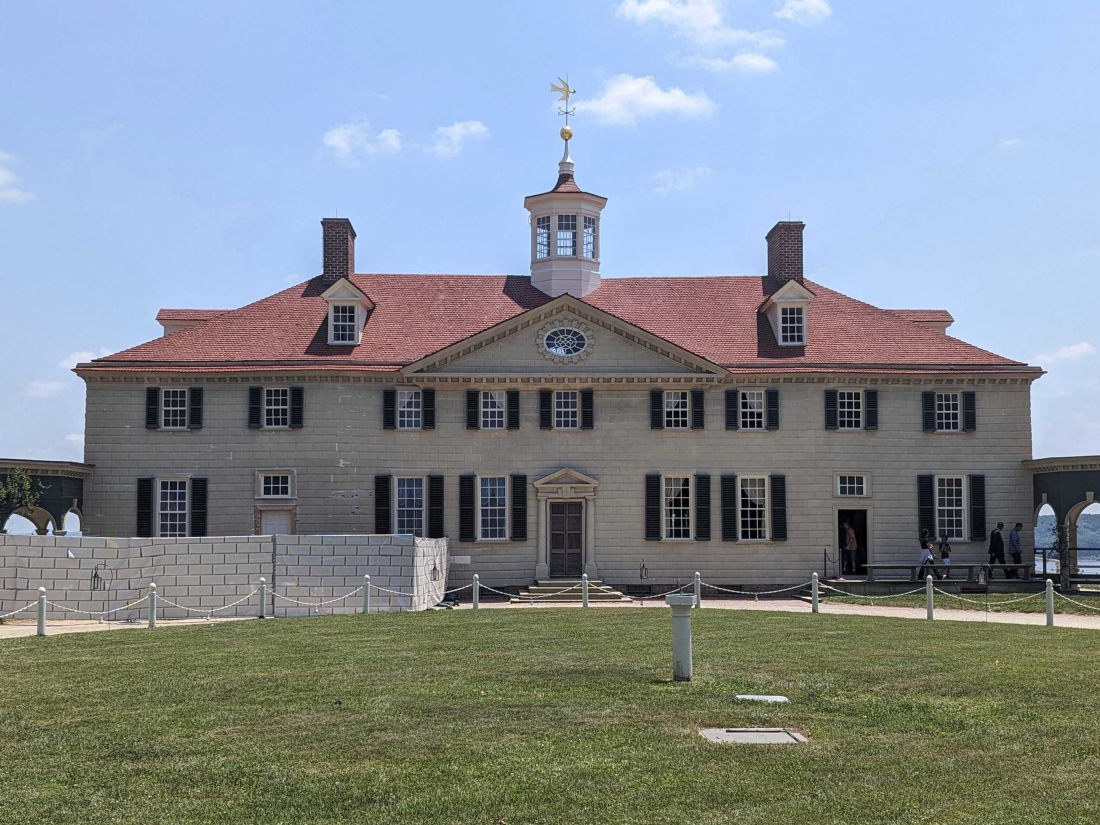
George Washington’s residence in Mount Vernon, Va.,
Nathan Ellgren/AP
hide caption
toggle caption
Nathan Ellgren/AP
Boroughs said this month the bottles and their contents are a “testament to the knowledge and skill of the enslaved people who managed the food preparations from tree to table” at Mount Vernon.
At least 577 enslaved people lived at Mount Vernon during the course of Washington’s life, according to the institution. Washington left instructions in his will for the eventual emancipation of those he owned.
Among them was Doll, who was 38 in 1759 when Martha Washington brought her and her five children to the estate and placed her in charge of the kitchen.
Doll likely no longer had a formal work assignment in her later years, but continued to “use the kitchen to distill rose and mint water for medicinal purposes and to dry fruits such as cherries,” historians say.
In fact, a 1795 letter from Martha Washington to her niece, Fanny Bassett, appears to acknowledge Doll’s expertise in that area.
Martha Washington, writing from Philadelphia to Bassett, who lived at Mount Vernon, mentions that she would like “some of the morelly cherrys” dried, adding, “I should think old Doll cannot have forgot how to do them.”
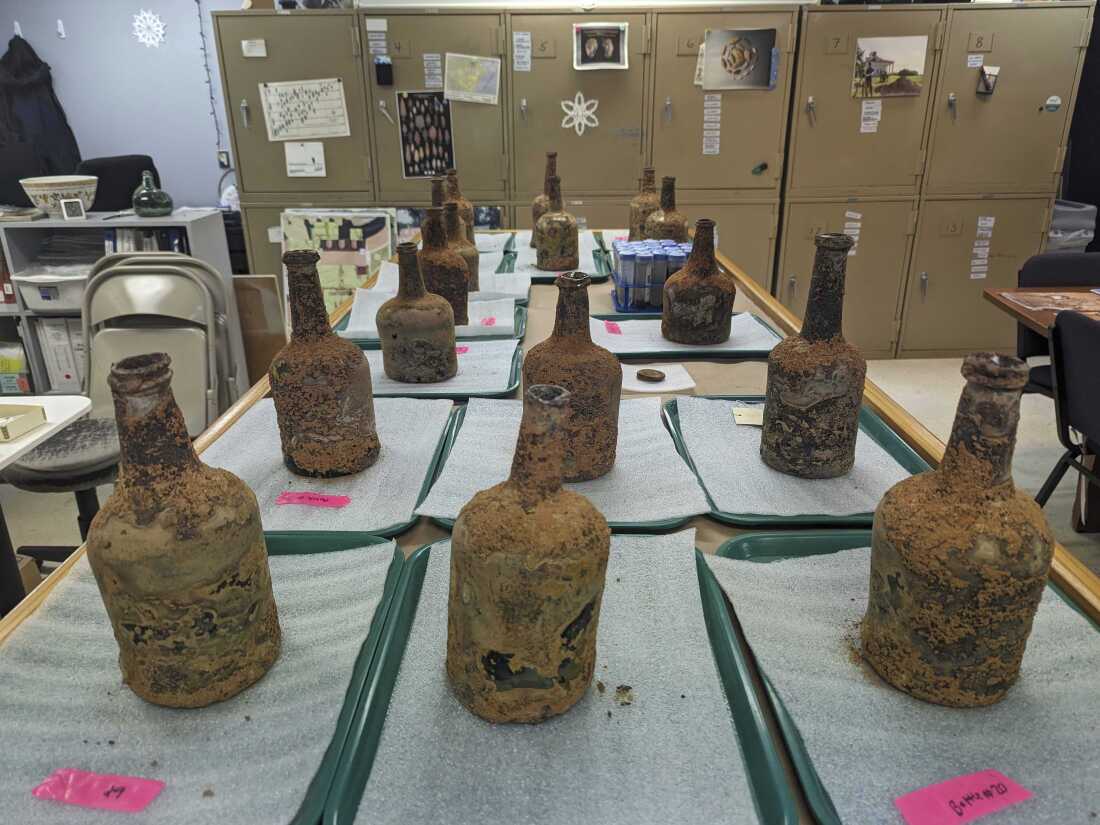
18th-century bottles that contained fruit sit inside an archaeology lab near George Washington’s residence in Mount Vernon, Va., on Monday.
Nathan Ellgren/AP
hide caption
toggle caption
Nathan Ellgren/AP
It’s not the only clue that the Washingtons were fans of cherries.
Historians at Mount Vernon say the family often enjoyed a popular brandy-based drink called “Cherry Bounce,” made from cherry juice infused with spices over the course of two weeks.
Washington was apparently such a fan of the cordial that, as general, he packed a “canteen” of it — as well as Madeira and port — for a 1784 journey across the Allegheny Mountains.
Boroughs told Here & Now that there is also evidence — including from letters and diaries of Chesapeake planters — that families in the area would enjoy bowls of preserved cherries with meals.
“So it’s quite likely that these bottles had been on the Washingtons’ table more than once,” he said.
The 18th-century preservation process involved placing the cherries in dry bottles, corking them and then burying them under heavy clay, to protect the fleshy fruits from elements like mold and fungus.
Normally, Boroughs said, they were only intended to be stored as such for about a year.
“But it’s because of the way that they were placed in the ground and there they remained until this year that they were able to survive, basically, the ravages of time,” he explained.
Scientists hope the discovery might bear fruit
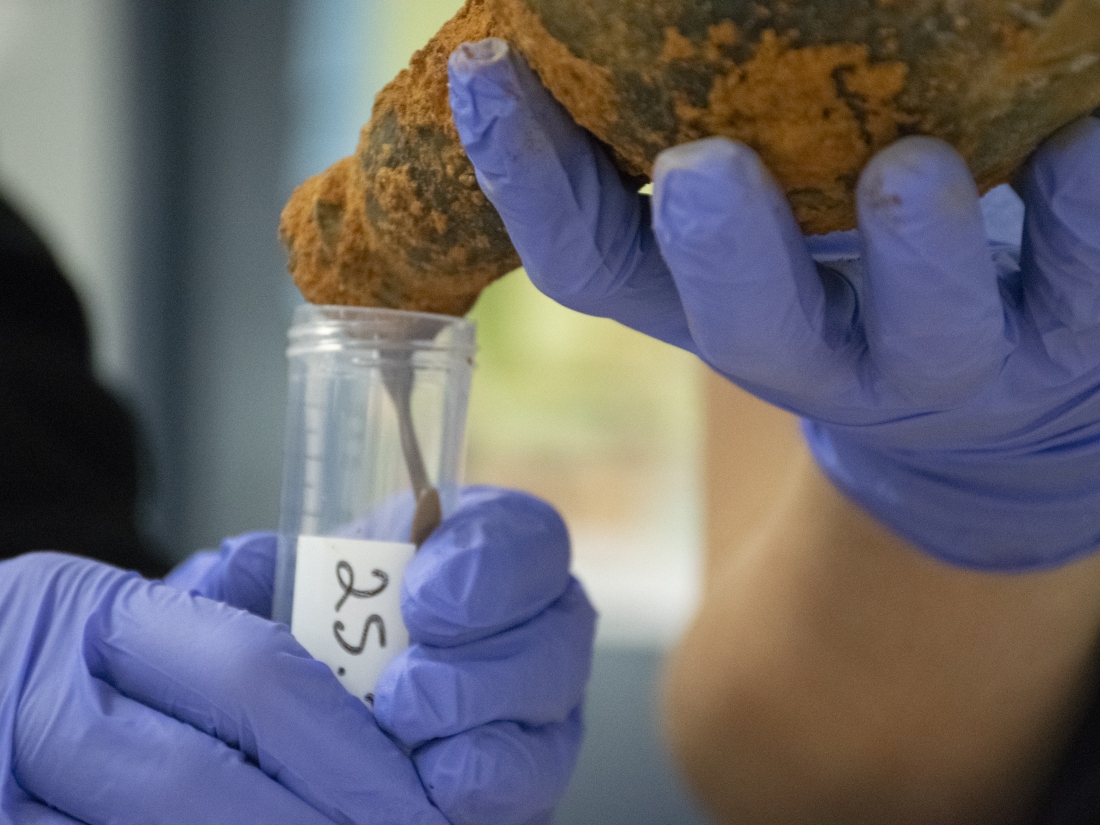
Fruit substance is carefully extracted from a bottle.
Tess Ostoyich/Mount Vernon Ladies’ Association
hide caption
toggle caption
Tess Ostoyich/Mount Vernon Ladies’ Association
Experts have extracted the contents of the bottles and refrigerated them at Mount Vernon, where they will undergo scientific analysis. The bottles themselves are “slowly drying” in the lab and will be sent off-site for conservation, officials say.
Mount Vernon is partnering with the United States Department of Agriculture’s Agricultural Research Service (ARS) to analyze the 250-year-old produce.
Benjamin Gutierrez, a plant geneticist and the apple and tart cherry curator at the USDA-ARS Plant Genetic Resources Unit in New York, told NPR that the first thing his team did was advise the archeologists on how to extract the substance from the bottles in the hopes of best “capturing that moment of the last hands that put them in the earth.”
“We had anxiety,” he said. “You hear ‘fruit remains’ and you’re picturing what’s in the back of your fridge, right? It’s slowly degrading now that it’s out in the open, we’ve got to get to this before it turns to pulp.”
Gutierrez says their main priority is to extract DNA from the cherry tissue and compare it to their robust tart cherry database to try to identify — or at least narrow down — which variety the Washingtons grew and enjoyed at Mount Vernon. That could, in turn, shed light on how the Virginia climate has changed since.
Researchers suspect the cherries are of a tart variety, with a relatively acidic composition that likely helped aid in their preservation.
So far, Gutierrez says they have identified 54 cherry pits and 23 stems from sifting through just the first two vessels — which would suggest that each bottle was at least originally chock full of some 50 to 70 cherries.
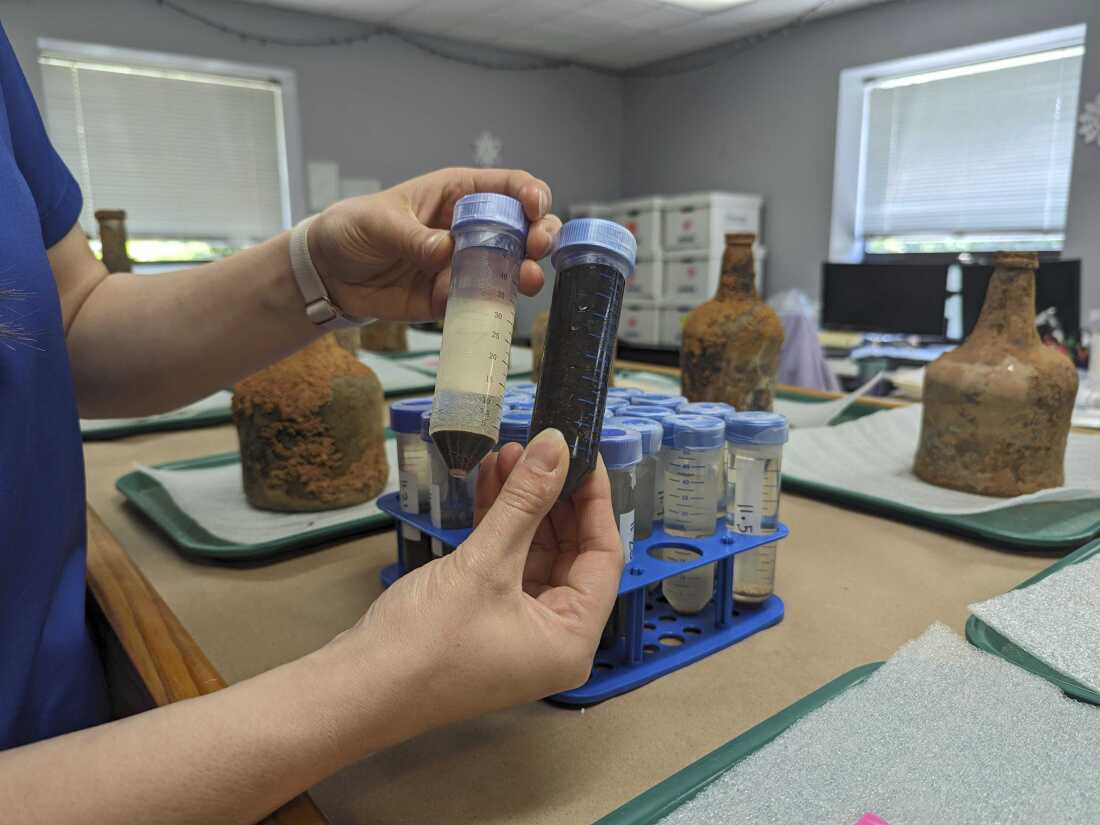
Curator Lily Carhart holds up different samples of liquid they extracted from a few dozen bottles.
Nathan Ellgren/AP
hide caption
toggle caption
Nathan Ellgren/AP
The sheer amount of material, he adds, means researchers can be a little bit more “adventurous” in what they do to some of it while carefully preserving the rest.
“Who knows in another 100 years what other tests they might want to do,” he says.
In the nearer-term, his team hopes to have more answers within six months or a year. One of the biggest questions is whether they can germinate seeds from any of the cherry pits to grow a new tree.
Gutierrez says it’s somewhat of a long shot, since many of the pits are waterlogged. And even if germination is possible, the seeds wouldn’t produce the same exact “mother tree,” but rather the next generation of it.
Still, he says, it would be really something to plant a new tree out of historic cherry pits.
“We work so much with heirloom groups conserving grandma’s apple tree in their backyard,” he adds. “Fruit somehow captures our imagination and our culture more than any other crop, I feel like.”
And one could argue that would be the cherry on top for Washington of all people, given one of the most enduring myths about him centers on chopping down that very type of tree.


Director James Burrows attends the “Will & Grace” start of production kick off event and ribbon cutting ceremony at Universal City Plaza on August 2, 2017 in Universal City, California.
Jason LaVeris/Getty Images
hide caption
toggle caption
Jason LaVeris/Getty Images
LOS ANGELES — James Burrows, who helped create volumes of laughter as director of more than a thousand episodes of such classic television comedies as “Cheers,” “Taxi,” “Friends” and “Will and Grace,” died Friday. He was 85.
His family confirmed his death in a statement to People, saying he “passed away peacefully today surrounded by his family.” No location or cause of death was provided.
Burrows spent his career behind the camera specializing in situation comedies. Few viewers recognized him or knew his name, other than to see it flash quickly on the screen in the opening credits. But they knew his work.
Burrows got his start in television relatively late at age 35 in 1974, directing episodes of “The Mary Tyler Moore Show,” “The Bob Newhart Show,” and “Laverne & Shirley.”
He co-created “Cheers,” directing 243 of the 273 episodes, as well as all 246 episodes of “Will and Grace.”
He also helmed multiple episodes of such hits as “Frasier,” “Friends” and “Mike & Molly,” and the pilots of “Two and a Half Men” and “The Big Bang Theory.”
“When I direct a television show, I try to reach that sweet spot where the best script meets the best performance and the best chemistry between performers,” Burrows wrote in his 2022 memoir “Directed by James Burrows.” “Hitting that exact moment, where these factors land in combination, results in the sweetest and most enduring laugh.”
His family said, “Burrows understood that great comedy was never simply about laughter. It was about humanity, connection, and truth. That understanding became the foundation of a career that forever changed television.
“But beyond his remarkable achievements, Burrows will be remembered for something even greater: his kindness, generosity, and unwavering belief in the people around him. He possessed a rare ability to make everyone better and was known for remembering every person he met by name, making colleagues at every level feel seen, valued, and appreciated,” the family statement said.
Born James Edward Burrows on Dec. 30, 1940, in Los Angeles, he moved to New York when he was 5 years old. He spent five years in the Metropolitan Opera Children’s Chorus until his voice started to change. He attended LaGuardia High School of Music & Art.
His father was writer, director and producer Abe Burrows, whose Broadway hits included “Guys and Dolls” and “Can-Can.” The elder Burrows also mentored Larry Gelbart, future creator and producer of the TV show “M(asterisk)A(asterisk)S(asterisk)H.”
The younger Burrows spent hours of his youth in theaters and studios watching his father work, dining with him at such famed New York haunts as Sardi’s and Gallagher’s and meeting celebrities who attended his father’s New Year’s Eve parties.
After earning a bachelor’s degree from Oberlin College, Burrows attended the graduate program of the Yale School of Drama, where his classmates included actor-comedian Robert Klein, playwright John Guare and film director John Badham.
At Yale, he was required to take directing classes and he got hooked.
Burrows’ first sitcom experience was as Burl Ives’ dialogue coach on “O.K. Crackerby!” which was directed by his father and ran for one season on ABC in 1965.
From there, he was an assistant on “The Patty Duke Show.” He moved back to New York and worked for Broadway producers Lee Guber, Frank Ford and Shelly Gross. He first met actor Moore while working on the Broadway production of “Holly Golightly,” an adaptation of “Breakfast at Tiffany’s” that was directed by his father.
Burrows eventually worked as a stage manager for various road productions, where he met such actors as Hugh O’Brien, Zsa Zsa Gabor and Julie Harris.
By 1974, after working in dinner theater and summer stock, he turned on his television and saw Moore’s eponymous TV show. He wrote her a letter asking if there was any opening “small or smaller” at her production company that he could fill, according to his memoir.
Moore’s husband and business partner, Grant Tinker, invited Burrows to Los Angeles to direct an episode of the comedy. He apprenticed for MTM Enterprises, which had four sitcoms on the air at the same time.
Burrows cited his theater background for learning how to give actors direction and block out scenes. He’s credited for being one of the first sitcom directors to increase the typical multi-camera television shoot from three to four cameras.
The common thread between Burrows’ shows were the bonds between friends and unrelated families, whether it was the motley crew of regulars meeting at the bar in “Cheers” or the drivers working toward a better life in “Taxi” or the 20-somethings sharing the same apartment building in “Friends.”
“The best sitcoms transcend the screen and reach out and grab the audience by the throat and by the heart,” Burrows wrote in his memoir.
He relished discovering new acting talent while directing more than 75 pilots that were picked up as series.
“Having directed over a thousand shows means that almost any night you can turn on your television or go online and find a show that I directed. I’m very proud of that,” he wrote in his memoir.
In 2019, Burrows was an executive producer on live productions of “All in the Family” and “The Jeffersons” with famous actors re-creating episodes of those 1970s comedies.
Burrows was married in 1997 to Debbie Easton, whom he met when she worked as a hairstylist on “Frasier.” Daughters Kat Schatzow, Ellie Gluck and Maggie Burrows, who followed her father into directing, are from his first marriage to Linda Solomon, who died in 2004. His stepdaughter Paris is from his wife’s previous marriage. He has a sister, Laurie Burrows Grad, and seven grandchildren.

GOLETA — For a few minutes, the atmosphere inside Captain Fatty’s Brewery in Santa Barbara County was quiet, different from the usual Friday night clamor.
On this late May evening, the 15 men gathered there were contemplating tackling something few had previously had the courage or skill to take on. Austin Nieves, a recent transplant to the area and the man who had brought this brave group together, broke the strained silence by handing out beers.
Within minutes, the men, who ranged in age from 30 to 60, began chatting among themselves.
Then they started braiding hair.
The May 22 event — Goleta’s version of the viral U.K.-inspired “Pints and Ponytails” night — was sold out. The idea is to have expert hairstylists train uninitiated or intimidated fathers on how to comb and braid their kids’ hair, using salon-type head mannequins but in a setting for bros.
“When the first guys got there, they were stiff,” said Nieves, a Pasadena native who moved to Santa Barbara in April 2025. “Then after that first beer, they went from sitting around the edge of the bar to jumping right into learning and giving it a shot.”
Dads group members Dan Ucko, left, and Eric Schalla participate in the hairstyling event at Captain Fatty’s Brewery in Goleta.
The gathering was one of several father functions by the Santa Barbara Dads group, which Nieves founded last spring.
May’s papa party offered, along with the suds, a learning experience and camaraderie among fathers, which Nieves believes is much needed.
“When my wife had our son, she immediately became part of at least five mom groups and classes that offered her help, advice, friendship and training,” Nieves said. “As a first-time father, I really only had my brothers, who had children themselves, to turn to.”
Scientific studies have shown that as fathers have taken a more active role in child rearing, they’ve faced loneliness, doubt and confusion.
Researchers Chris Knoester and David J. Eggebeen wrote in 2006 in the “Journal of Family Issues” that fatherhood leads “to declines in feelings of well-being and participation in social activities” as fathers spend less time with friends.
Clinical psychologists Hillary Halpern and Maureen Perry-Jenkins documented that the transition from single life to fatherhood is often accompanied by a roller coaster of emotions. And researchers from Stockholm’s Karolinska Institute determined in a 2021 study that fathers might require help “during their transition to fatherhood.”

Eric Drachman, of Santa Barbara, center, pays close attention as hair stylist Chi Jou Lin, left, teaches a group of dads how to style their daughters’ hair.

A detail of one of the mannequin heads.
One such way to assist men is specifically a fathers group, according to the 2021 study.
Most men “were mostly satisfied with participating in father groups and described that they positively impacted their relationship with their partner and child.”
The increased contact also helped improve “their self-confidence and family equality and decreased their loneliness.”
Nieves agreed that his leisure time and focus changed sharply after the birth of his child, Hudson, now 3 years old, as did his friend group updates.
“They were talking about all this crazy fun or TV shows and I was talking about my son being able to lift his head,” Nieves said. “That’s when I knew I had to branch out.”
Nieves, then living in Costa Mesa with his wife, Katie, created the Orange County Dads club in October 2023.

Scientific studies have shown that as fathers have taken a more active role in child rearing, they’ve faced loneliness, doubt and confusion.
His group of merry men held meetups at coffee shops, beer halls and the zoo, hosted holiday hootenannies and even offered CPR classes.
Its success helped spawn a chapter in the Whittier area.
Though strictly a fathers club, the group, Nieves said, has grown thanks to wives and partners sharing his social media posts with their husbands.
Mikhail Alfon, founder of Blue Light Media, a social media strategy agency, took his son, Santos, to multiple Orange County meetups.
“This is our first child and obviously life changes a lot,” said Alfon in a social media post. “Finding peers and friends that are in the same stage of life is great.”
That sense of community, however, faced a challenge as Nieves and his family purchased a home in Santa Barbara and moved in April 2025.

Peter Aguilar, left, and Fredy Medel work on their technique. Medel’s partner, Daniela Fajardo, holding their 1-year-old daughter, Faylani, records the event.
Within a month, however, he had established a Santa Barbara-based dads group. Their first meetup was in May 2025, and they’ve made a point to gather once a month.
Austin Jones, a Santa Barbara-based real estate agent and investor, found Nieves through Instagram.
“I’m a husband, a dad and businessman, and it ends up being a lot of hats but very little support, at times,” Jones said. “It’s nice to find people in the trenches with you.”
Jones was intrigued by Pints and Ponytails as he’s battled the hair-care needs of his 2 ½-year-old daughter, Noa, and her textured, curly locks.
In a short while, Jones had gained enough confidence in whipping his mannequin’s hair into a ponytail that he vowed to try with his daughter soon.
“I was only pretty good at putting on a headband before this,” he quipped.
The six mannequin heads and the hour of instruction came courtesy of Santa Barbara cosmetologist Chi Jou “Belle” Lin, who offers area mobile services.
“I saw the social media post and a lot of people reached out to me to teach the class,” Lin said. “I had to help.”
Lin said the mannequins she brought varied in hair length and type, from straight to coily, but also fine in texture, as she tried to replicate young children’s hair.

A pint of beer, hairstyling tools and sprays.
She also taught the fathers basic hair-care techniques, including shampooing, detangling, checking for lice and how to tie ponytails and braids.
Even if they started out reticent, the fathers became active participants, asking questions about creating a neat French braid, what to do about tangled ponytails and how to deal with frightened children, Lin said.
“I was really impressed with the dads and their skills and the real-life questions,” said the stylist, who has personal experience at home in her 2 ½-year-old daughter, Lotus. “Not all men have the courage to ask questions.”
For Nieves, the secret in gaining new dads and retaining others is simplicity.
“If you open the door, the fathers will follow because everyone can use some help,” Nieves said. “But they just need to know it exists and they’re not alone.”

Dads Gabriel Sandoval, left, Jose Guerrero and David Talavera toast one another at the May 22 Santa Barbara County Dads’ “Pints and Ponytails” event in Goleta.
Days after the Goleta get-together, Santa Barbara dad Eric Drachman became a celebrity at the preschool of his daughter, Noa, who is soon to be 3.
“When the videos of the event were posted, the teachers at the school recognized me,” Drachman said. “They would ask my daughter, ‘Who did your hair?’”
The query that means most, however, is when Noa asks her father to fix her hair.
“She asks occasionally,” he said. “It‘s such a fun dynamic we have.”

Stacy Clausen and Joe Bird in Leviticus.
NEON
hide caption
toggle caption
NEON
Summer movies aimed at high-schoolers — comedies, romances, horror flicks — have been a tradition for ages. Think Fast Times at Ridgemont High, Dirty Dancing and the original Friday the 13th, which all drew hot-weather crowds back in the 1980s.
This summer, the movies are queer — not just in casting, but in method and purpose. These three teen flicks transform familiar movie styles by bringing them an LGBTQ sensibility.
A raunchy comedy: She’s the He
YouTube
You know the drill: a bonkers lose-my-virginity plan is hatched by inseparable high-school best buds who are so eager to get girls to notice them, they can hardly think straight.
So, they don’t think … straight. For reasons that could only make sense to horny 17-year-olds, Ethan and Alex decide the way to catch the attention of the school’s hottest girls is to pretend to be trans.
Filmmaker Siobhan McCarthy uses that premise to tell a sweet story about Ethan (who realizes mid-scam that she really is trans), while also mocking some of the more ridiculous transphobic notions — “bathroom scare,” anyone? — that have been politically weaponized recently.
When the whole football team decides that donning women’s attire is a small price to pay to get access to the girls’ locker room, McCarthy prompts boisterous laughs while also establishing how idiotic and unlikely this scenario would be in real life. Casting trans men — say, team captain played by Emmett Preciado — as the cis male characters allows McCarthy to further poke at conservative anxieties.
As leads Alex and Ethan, Nico Carney (a sharp trans comic whose read on toxic masculinity proves hilarious), and Misha Osherovich (sweetly affecting as Ethan discovers her true self) head a terrific, mostly trans and non-binary cast. And a similarly queer team behind the camera helps make She’s the He a raucous, touching, seriously fun charmer — think Some Like It Hot meets American Pie with a Heartstopper vibe.
The romance: Girls Like Girls
YouTube
This gentle teen love story sprang from a hit song Hayley Kiyoko released in 2015. The music video that accompanied the song pictured a budding lesbian romance and has since racked up over 160 million YouTube views. In 2023, Kiyoko penned a young adult book version, which debuted at the top of bestseller lists. Now, she’s brought all of those elements together in a movie about Coley (Maya da Costa) and Sonya (Myra Molloy), two 17-year-old girls navigating a summer romance that takes both of them by surprise.
First-time filmmaker Kiyoko seems content to honor teen romance conventions in a more or less by-the-book tale of first love that has been through enough permutations to feel vaguely workshopped. Still, she’s gotten engaging performances from her leads, as well as from a supporting cast that includes Zach Braff as a loving dad, and Levon Hawke (son of Ethan Hawke and Uma Thurman) as Sonya’s jealous boyfriend.
The horror thriller: Leviticus
YouTube
First-time feature writer/director Adrian Chiarella uses horror conventions in this Australian thriller to explore the trauma caused by a particularly callous strain of homophobic cruelty. The story is centered in a small mill town where high school boys Naim (Joe Bird) and Ryan (Stacy Clausen) fall for each other, only to run afoul of the conservative teachings of their religious community.
Chiarella imagines a Christian sect that has put conversion therapy on steroids, curbing queer desire with a scare-away-the-gay ritual that conjures supernatural demons. The boys smirk as church leaders conduct the ritual, but later discover that when they’re left alone, they’re attacked by murderous entities that take the form of the person they love — each other. Soon, reaching out to — even just seeing each other in school hallways fills them with anxiety. This is, of course, the design: the church leaders want them to be scared. And it will never end.
It’s a conversion therapy metaphor as apt for gay kids as the metaphor in Jordan Peele’s thriller Get Out was for victims of racial bigotry.
Breathtakingly well-crafted, Leviticus clearly has queer teen audiences in mind — all three of these films do — but not exclusively. Yes, Leviticus fills a representation gap. It’s also freakin’ scary.


-

 Alaska6 minutes ago
Pilot dies in small plane crash southeast of Cordova
-

 Arizona9 minutes ago
Arizona’s Rugged Wilderness Area Has Gorgeous Mountain Trails And Scenic Camping Spots – Islands
-

 Arkansas14 minutes ago
Tulsa downs Northwest Arkansas | Northwest Arkansas Democrat-Gazette
-

 California21 minutes ago
California man arrested for alleged lewd acts, exploitation involving juveniles
-

 Colorado24 minutes ago
Colorado neighbors lament likely closure of Roxborough library; $22 million regional library breaks ground nearby
-

 Connecticut29 minutes ago
Diesel fuel spill shuts two lanes on I-91 north in Wethersfield
-

 Delaware36 minutes ago
Delaware history in News Journal archives June 21-27: Sussex flood
-

 Florida39 minutes ago
7 of our favorite Florida restaurants in Vero Beach and Fellsmere

