Lifestyle
A fire closed a bookstore named Friends to Lovers. Romance readers kept it afloat


Owner Jamie Fortin opened Friends to Lovers book store on Nov. 14. Three days later, a fire closed her to close the shop.
Suhyoon Wood with AEDP
hide caption
toggle caption
Suhyoon Wood with AEDP
When Jamie Fortin moved to Washington, D.C., five years ago, she fell in love with the Virginia neighborhood of Alexandria and vowed to open a small business there. Last month, Fortin’s promise to herself became a reality. She opened Friends to Lovers, a romance-themed bookstore inspired by Meet Cute, a romance bookstore in her hometown of San Diego.
Friends to Lovers celebrated its grand opening on Nov. 14. “It was honestly just so joyful,” Fortin said. “We had a line around the block, which is not something I expected.”

Before the fire, Fortin estimated that Friends to Lovers offered around 800 romance titles.
Suhyoon Wood with the AEDP
hide caption
toggle caption
Suhyoon Wood with the AEDP
Just three days later, though, Fortin’s excitement went up in smoke after the building caught fire. The store sustained smoke damage, leaving the entire stock of books and merchandise unsafe to sell. Fortin was forced to close the store and go into what she described as “solutions mode.”
Fortin created the Friends and Lovers bookstore to be a space where women and queer people, who make up the overwhelming majority of romance readers, could feel safe.

In the U.S., the demand for romance books is booming. According to Publisher’s Weekly, seven of the top 10 books of the year fell under this category. In August, 550 bookstores across the U.S., U.K. and Canada participated in Bookstore Romance Day — the biggest celebration yet. Many readers have also taken to the internet to share their passion. Romance books dominate the #BookTok, a TikTok community with over 100 billion views. Creators like @listenwithbritt and @kendra.reads share their recommendations and reviews with hundreds of thousands of followers. Their videos have garnered millions of likes and views. Despite the genre’s popularity, Fortin says most of the bookstores she frequented didn’t dedicate much space to the genre. “Even though it may be their most popular selling genre, most bookstores have one or two shelves of romance,” she said.

At the grand opening of Friends to Lovers, many readers expressed the same sentiment. Some traveled more than an hour to browse the shelves. Readers came from Charlottesville, Va., Baltimore, Md. and more.
“Romance-centered bookstores are sorely lacking,” said Kayla Lloyd, who traveled from Annapolis to check out the bookstore. “We can go to Barnes & Noble and we can see the romance section, but you’re not going to get the selection that’s here.” Fortin says she stocks local and independent authors as well as bestsellers. She estimates that the bookstore offered about 800 titles before the fire.
“Outside of gay bars in the area, I think that there is definitely a lack of third spaces for people of color and queer people to hang out,” said Eleanor Bodington, a customer at Friends to Lovers.
Fortin partnered with two women who owned small businesses in the area to help launch their brands at the grand opening event. Women and queer-owned businesses also make all of the store’s non-book merchandise, including bags, hats and more. Even her store’s location was intentional, Fortin says. She wanted Friends to Lovers surrounded by other small businesses so that readers would be encouraged to support other entrepreneurs like her after they came to her store. “When I woke up [after the fire], I felt like I needed to live up to this space that I created that people are now relying on as a space they feel at home and safe,” Fortin said.
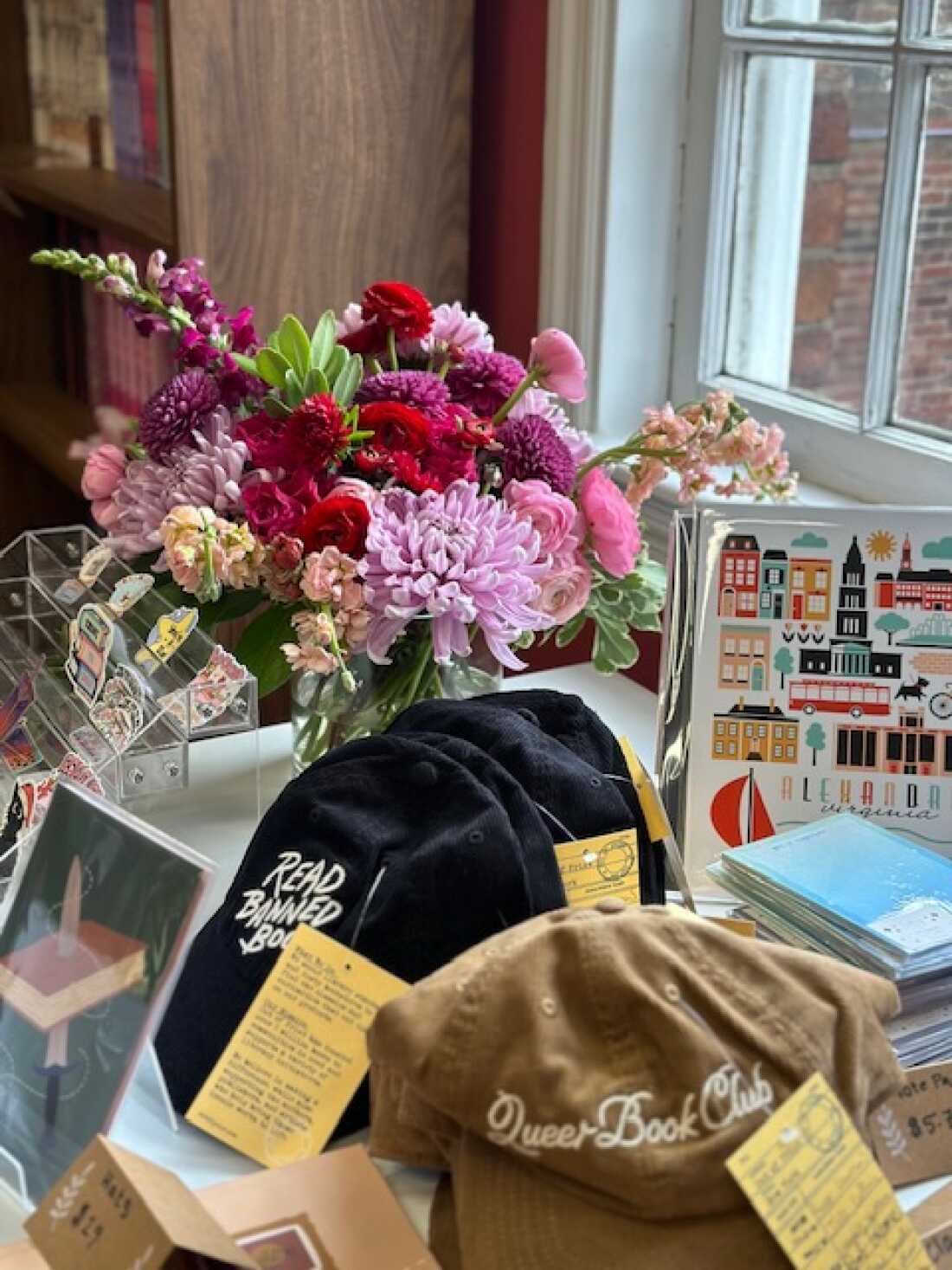
Fortin partnered with women and queer-owned businesses to create merchandise for her bookstore, including hats and stickers.
Courtesy of Maryam Bami
hide caption
toggle caption
Courtesy of Maryam Bami
Despite being open for just a few days, the community Fortin hoped to reach rallied around her business. Donations flooded in, surpassing Fortin’s $20,000 GoFundMe goal in 24 hours. After assessing the full extent of the damage, Fortin increased her donation goal to $45,000, eventually surpassing that one as well.
Fortin says she believes that her dedication to her goal of supporting women and queer businesses, combined with the tight-knit nature of the romance reading community, helped her rebuild quickly. “The community support has really buoyed me and pushed me to create something better out of the ashes, as it were,” she said. “There were more people than I ever expected that cared about my little bookstore.”
“When you set your mission, and you really stand by it, people say, ‘We love that mission. We’ll live that out as well,”‘ Fortin said.
Fortin opened a long-term pop-up location for Friends to Lovers on Dec. 7 at a nearby business. She continues to search for a new permanent location for the shop.
“It has been so overwhelming. I feel like the community is not letting me sit and wallow in my grief. Instead, they’ve said, ‘We’re going to fix this. We’re going to make sure it’s successful.”‘
Fortin says that because the romance community is used to their traditionally feminine interests not being respected, it doesn’t take the brick-and-mortar location for granted.
“I think we haven’t always had a lot of overwhelming support for things that women love,” Fortin said. “We love to say that things are ridiculous when women love them. There’s a lot of things that men love that we don’t consider ridiculous.” Fortin points out that teenage girls were the ones who loved the Beatles first before they became a household name. “Romance is one of the genres with the most staying power, that’s always been the least respected.”
“We’re creating a safe space to talk about things that are not celebrated in regular spaces,” she said. “Once women and queer people saw that, everyone said ‘let’s all stand behind this together.”‘
“The outpouring of support has been amazing as a bystander to watch,” said Maryam Bami, owner of Old Town Flower Gal. Bami launched her floral business at the Friends to Lovers grand opening. “I thought I was a fan of romance until I met some of the supporters of the bookstore.” Bami is one of several woman-owned businesses Fortin intentionally collaborated with. “She really just took a chance on all of us and really elevated us in the process,” she said.

Maryam Bami was one of several female entrepreneurs who launched their brand at the Friends to Lovers grand opening. Bami owns Old Town Flower Gal, a floral shop that specializes in “flower bombs.”
Courtesy Maryam Bami
hide caption
toggle caption
Courtesy Maryam Bami
As Fortin writes a new chapter for Friends to Lovers, she still views her community of business owners as vital to the bookstore’s success. She hopes readers supporting her rebuilding efforts will also patronize the nearby businesses that were also affected by the fire. She’s also encouraged supporters to donate to fundraisers for other businesses affected by the fire. “Women have constantly had to lift each other up and be each other’s solid ground,” she said. “If [my business] has all this hype and support and encouragement, I need to use that to build up other women and other brands.”


When Marian Sherry Lurio and Jonathan Buffington Nguyen met at a mutual friend’s wedding at Higgins Lake, Mich., in July 2022, both felt an immediate chemistry. As the evening progressed, they sat on the shore of the lake in Adirondack chairs under the stars, where they had their first kiss before joining others for a midnight plunge.
The two learned that the following weekend Ms. Lurio planned to attend a wedding in Philadelphia, where Mr. Nguyen lives, and before they had even exchanged numbers, they already had a first date on the books.
“I have a vivid memory of after we first met,” Mr. Nguyen said, “just feeling like I really better not screw this up.”
Before long, they were commuting between Philadelphia and New York City, where Ms. Lurio lives, spending weekends and the odd remote work days in one another’s apartments in Philadelphia and Manhattan. Within the first six months of dating, Mr. Nguyen joined Ms. Lurio’s family for Thanksgiving in Villanova, Pa., and, the following month, she met his family in Beavercreek, Ohio, at a surprise birthday party for Mr. Nguyen’s mother.
Ms. Lurio, 32, who grew up in Merion Station outside Philadelphia, works in investor relations administration at Flexpoint Ford, a private equity firm. She graduated from Dartmouth College with a bachelor’s degree in history and psychology.
Mr. Nguyen, also 32, was born in Knoxville, Tenn., and raised in Beavercreek, Ohio, from the age of 7. He graduated from Haverford College with a bachelor’s degree in political science and is now a director at Doyle Real Estate Advisors in Philadelphia.
Their long-distance relationship continued for the next few years. There were dates in Manhattan, vacations and beach trips to the Jersey Shore. They attended sporting events and discovered their shared appreciation of the 2003 film, “Love Actually.”
One evening, Mr. Nguyen recalled looking around Ms. Lurio’s small New York studio — strewed with clothes and the takeout meal they had ordered — and feeling “so comfortable and safe.” “I knew that this was something different than just sort of a fling,” he said.
It was an open question when they would move in together. In 2024, Ms. Lurio began the process of moving into Mr. Nguyen’s home in Philadelphia — even bringing her cat, Scott — but her plans changed midway when an opportunity arose to expand her role with her current employer.
Mr. Nguyen was on board with her decision. “It almost feels like stolen valor to call it ‘long distance,’ because it’s so easy from Philadelphia to New York,” Mr. Nguyen said. “The joke is, it’s easier to get to Philly from New York than to get to some parts of Brooklyn from Manhattan, right?”
In January 2025, Mr. Nguyen visited Ms. Lurio in New York with more up his sleeve than spending the weekend. Together they had discussed marriage and bespoke rings, but when Mr. Nguyen left Ms. Lurio and an unfinished cheese plate at the bar of the Chelsea Hotel that Friday evening, she had no idea what was coming next.
“I remember texting Jonathan,” Ms. Lurio said, bewildered: “‘You didn’t go toward the bathroom!’” When a Lobby Bar server came and asked her to come outside, Ms. Lurio still didn’t realize what was happening until she was standing in the hallway, where Mr. Nguyen stood recreating a key moment from the film “Love Actually,” in which one character silently professes his love for another in writing by flashing a series of cue cards. There, in the storied Chelsea Hotel hallway still festooned with Christmas decorations, Mr. Nguyen shared his last card that said, “Will you marry me?”
They wed on April 11 in front of 200 guests at the Pump House, a covered space on the banks of Philadelphia’s Schuylkill River. Mr. Nguyen’s sister, the Rev. Elizabeth Nguyen, who is ordained through the Unitarian Universalist Association, officiated.
Although formal attire was suggested, Ms. Lurio said that the ceremony was “pretty casual.” She and Jonathan got ready together, and their families served as their wedding parties.
“I said I wanted a five-minute wedding,” Ms. Lurio recalled, though the ceremony ended up lasting a little longer than that. During the ceremony, Ms. Nguyen read a homily and jokingly added that guests should not ask the bride and groom about their living arrangements, which will remain separate for the foreseeable future.
While watching Ms. Lurio walk down the aisle, flanked by her parents, Mr. Nguyen said he remembered feeling at once grounded in the moment and also a sense of dazed joy: “Like, is this real? I felt very lucky in that moment — and also just excited for the party to start!”

He always texted when he was outside. No call, no knock. It was just a message and then the soft sound of my door opening. He moved like someone practiced in disappearing.
His name meant “complete” in Arabic, which is what I felt when we were together.
I met him the way you meet most things that matter in Los Angeles — without intending to. In our senior year at a college in eastern L.A. County, we were introduced through mutual friends, then thrown together by the particular gravity of people who recognized something in each other. He was a Muslim medical student, conservative and careful and funny in the dry, precise way of someone who has always had to choose his words. I was loud where he was quiet, messy where he was disciplined. I was out. He was not.
I understood, or thought I did. I thought that I couldn’t get hurt if I was completely conscious throughout the endeavor. Los Angeles has a way of making you feel like the whole world shares your freedoms — until you realize the city is enormous, and not all of it belongs to you in the same way.
For months, our world was confined to my apartment. He would slip in after dark, and we’d stay up late talking about his family in Iran, classical music and the particular pressure of being the son someone sacrificed everything to bring here. He told me things he said he’d never told anyone, and I believed him.
The orange glow from my Nesso lamp lit his face while the indigo sky pressed against the window behind him. In our small little world, we were safe. Outside was another matter.
On our first real date, I took him to the L.A. Phil’s “An Evening of Film & Music: From Mexico to Hollywood” program. I told him they were cheap seats even though they were the first row on the terrace. He was thrilled in the way only someone who doesn’t expect to be delighted actually gets delighted — fully, without guarding it. I put my arm around his shoulders. At some point, I shifted and moved it, and he nudged it back. He was OK with PDA here.
I remember thinking that wealth is a great barrier to harm and then feeling silly for extrapolating my own experience once again. Inside Walt Disney Concert Hall, we were just two people in love with the same music.
Outside was still another matter.
In February, on Valentine’s Day, he took me to a Yemeni restaurant in Anaheim. We hovered over saffron tea surrounded by other young Southern Californians, and we looked like friends. Before we went in, we sat in the parking lot of the strip mall — signs in Arabic advertising bread, coffee, halal meats, the Little Arabia District — hand in hand. I leaned over to kiss him.
“Not here,” he said. His eyes shifted furtively. “Someone might see.”
I understood, or told myself I did, but I was saddened. Later, after the kind of reflection that only arrives in the wreckage, I would understand something harder: I had been unconsciously asking him to choose, over and over, between the people he loved and the person he loved. I had a long pattern of choosing unavailable men, telling myself it was because I could handle the complexity. The truth was more embarrassing. I thought that if someone like him chose me anyway — chose me over the weight of societal expectations — it would mean I was worth choosing. It took me a long time to see how unfair that was to him and to me.
We went to the Norton Simon Museum together in November, on the kind of gray Pasadena day when the 210 Freeway roars in the background like white noise. He studied for the MCAT while I wrote a paper on Persian rugs. In between practice problems, he translated ancient Arabic scripts for me. I thought, “We make a good team.” Afterward, we walked through the galleries and he didn’t let go of my arm.
That was the version of us I kept returning to — when the ending came during Ramadan. It arrived as a spiritual reflection of my own. I texted: “Does this end at graduation — whatever we are doing?”
He thought I meant Ramadan. I did not mean Ramadan.
“I care about you,” he wrote, “but I don’t want you to think this could work out to anything more than just dating. I mean, of course, I’ve fantasized about marrying you. If I could live my life the way I wanted, of course I would continue. I’m just sad it’s not in this lifetime.”
I was in Mexico City when these texts were exchanged. That night I flew to Oaxaca to clear my head and then, after less than 24 hours, flew back to L.A. No amount of vacation would allow me to process what had just happened, so I threw myself back into work.
My therapist told me to use the conjunction “and” instead of “but.” It happened, and I am changed. The harm I caused and the love I felt. The beauty of what we made and the impossibility of where it could go. She gave me a knowing smile when I asked if it would stay with me forever. She didn’t answer, which was the answer.
I think about the freeways now, the way Joan Didion called them our only secular communion. When you’re on the ground in Los Angeles, the world narrows to the few blocks around you. Get on the freeway and you understand the whole body of the city at once: the arteries, the pulse, the scale of the thing.
You understand that you are a single cell in something enormous and moving. It is all out of your control. I am in a lane. The lane shaped how I drive. He was simply in a different lane, and his lane shaped him, and those two facts can coexist without either of us being the villain of the sad story.
He came like a secret in the night, and he left the same way. What we made in between was real and complicated and mine to hold forever, hoping we find each other in the next life.
The author lives in Los Angeles.
L.A. Affairs chronicles the search for romantic love in all its glorious expressions in the L.A. area, and we want to hear your true story. We pay $400 for a published essay. Email LAAffairs@latimes.com. You can find submission guidelines here. You can find past columns here.

The art industry is increasingly shaped by artists’ and art businesses’ shared realization that they are locked in a fierce struggle for sustained attention — against each other, and against the rest of the overstimulated, always-online world. A major New York art fair aims to win this competition next month by knocking down the increasingly shaky walls between contemporary art and fashion.
When visitors enter the Independent art fair on May 14, they will almost immediately encounter its open-plan centerpiece: an installation of recent couture looks from Comme des Garçons. It will be the first New York solo presentation of works by Rei Kawakubo, the brand’s founder and mastermind, since a lauded 2017 survey exhibition at the Metropolitan Museum of Art’s Costume Institute.
Art fairs have often been front and center in the industry’s 21st-century quest to capture mindshare. But too many displays have pierced the zeitgeist with six-figure spectacles, like Maurizio Cattelan’s duct-taped banana and Beeple’s robot dogs. Curating Independent around Comme des Garçons comes from the conviction that a different kind of iconoclasm can rise to the top of New York’s spring art scrum.
Elizabeth Dee, the founder and creative director of Independent, said that making Kawakubo’s work the “nerve center” of this year’s edition was a “statement of purpose” for the fair’s evolution. After several years at the compact Spring Studios in TriBeCa, Independent will more than double its square footage by moving to Pier 36 at South Street, on the East River. Dee has narrowed the fair’s exhibitor list, to 76, from 83 dealers in 2025, and reduced booth fees to encourage a focus on single artists making bold propositions.
“Rei’s work has been pivotal to thinking about how my work as a curator, gallerist and art fair can push boundaries, especially during this extraordinary move toward corporatization and monoculture in the art world in the last 20 years,” Dee said.
Kawakubo’s designs have been challenging norms since her brand’s first Paris runway show in 1981, but her work over the last 13 years on what she calls “objects for the body” has blurred borders between high fashion and wearable sculpture.
The Comme des Garçons presentation at Independent will feature 20 looks from autumn-winter 2020 to spring-summer 2025. Forgoing the runway, Kawakubo is installing her non-clothing inside structures made from rebar and colored plastic joinery.
Adrian Joffe, the president of both Comme des Garçons International and the curated retailer Dover Street Market International (and who is also Kawakubo’s husband), said in an interview that Kawakubo’s intention was to create a sculptural installation divorced from chronology and fashion — “a thing made new again.”
Every look at Independent was made in an edition of three or fewer, but only one of each will be for sale on-site. Prices will be about $9,000 to $30,000. Comme des Garçons will retain 100 percent of the sales.
Asked why she was interested in exhibiting at Independent, the famously elusive Kawakubo said via email, “The body of work has never been shown together, and this is the first presentation in New York in almost 10 years.” Joffe added a broader philosophical motivation. “We’ve never done it before; it was new,” he said. Also essential was the fair’s willingness to embrace Kawakubo’s vision for the installation rather than a standard fair booth.
Kawakubo began consistently engaging with fine art decades before such crossovers became commonplace. Since 1989, she has invited a steady stream of contemporary artists to create installations in Comme des Garçons’s Tokyo flagship store. The ’90s brought collaborations with the artist Cindy Sherman and performance pioneer Merce Cunningham, among others.
More cross-disciplinary projects followed, including limited-release direct mailers for Comme des Garçons. Kawakubo designs each from documentation of works provided by an artist or art collective.
The display at Independent reopens the debate about Kawakubo’s proper place on the continuum between artist and designer. But the issue is already settled for celebrated artists who have collaborated with her.
“I totally think of Rei as an artist in the truest sense,” Sherman said by email. “Her work questions what everyone else takes for granted as being flattering to a body, questions what female bodies are expected to look like and who they’re catering to.”
Ai Weiwei, the subject of a 2010 Comme des Garçons direct mailer, agreed that Kawakubo “is, in essence, an artist.” Unlike designers who “pursue a sense of form,” he added, “her design and creation are oriented toward attitude” — specifically, an attitude of “rebellion.”
Also taking this position is “Costume Art,” the spring exhibition at the Costume Institute. Opening May 10, the show pairs individual works from multiple designers — including Comme des Garçons — with artworks from the Met’s holdings to advance the argument made by the dress code for this year’s Met gala: “Fashion is art.”
True to form, Kawakubo sometimes opts for a third way.
“Rei has often said she’s not a designer, she’s not an artist,” Joffe said. “She is a storyteller.”
Now to find out whether an art fair sparks the drama, dialogue and attention its authors want.
-

 Connecticut2 minutes ago
Connecticut Diocese Debuts ‘Maria,’ an AI Fundraising Personality ‘Rooted in the Church’s Mission’
-

 Delaware8 minutes ago
Man shot on Delaware Ave.
-

 Florida14 minutes ago
Growing wildfires blamed for death of Florida firefighter, destruction of 120 Georgia homes
-

 Georgia20 minutes ago
Ole Miss baseball vs Georgia opener postponed due to forecast, doubleheader planned
-

 Hawaii26 minutes ago
Hawaii Traveler Just Found This 186% Hawaiian Airlines Fee Hike
-

 Idaho32 minutes ago
Lab Findings Reveal Idaho Trout May Swim Further On Cocaine
-

 Illinois38 minutes ago
Illinois expands ABLE accounts to more residents with disabilities
-

 Indiana44 minutes ago
Indiana State Senate District 23 candidates discuss top voter issues