Finance
Changing The Tune On Tokenization


Businesses are finding value in putting real-world assets on blockchains.
For years, tokenization—creating a digital representation of a tangible asset like real estate—was just a finance-sector buzzword. But lately, more companies are making it a reality by weaving it into their corporate finance strategies (i.e., smart contracts, stablecoins and tokenized US Treasury bills).
The bet is that after a two-year stretch of economic turbulence and sticky inflation, tokenization can help increase liquidity, facilitate faster payments, lower costs, and improve risk management. And while big-name firms are still in the early phases of adopting this Web3 tech, they’re already boasting about viable use cases.
Look at Citi’s new pilot program with global logistics company Maersk. The third-largest US bank tokenized a smart contract to serve the same purpose as bank guarantees and letters of credit, reducing transaction processing times “from days to minutes.”
Big-picture, the firm predicts that tokenized assets will grow by a factor of 80 in private markets and reach up to almost $4 trillion in value by 2030.
“Partnerships like the one made by Citi and Maersk are a significant step forward in showcasing the potential of tokenization for streamlining cash management and trade finance,” says Paul Turner, an Abu Dhabi-based executive director at multi-asset fintech provider Capex.
Visa is testing tokenization, too. In September, the payments giant teamed up with Paysafe in London to integrate a tokenization service that, it expects, will better protect customers.
Within the same month, Visa led a $12.5 million funding round for Agrotoken. The Argentina-based startup is touted as the first platform to convert physical grains into a digital counterpart via tokenization.
Like other real-world assets [RWAs], the grain goes from being a “real-world asset” to an investment instrument. Once ownership is registered on the blockchain, it becomes tradable, and can be divided into fractions, or securely held.
“There’s a whole drumbeat around wanting to get tokenized real-world assets on chain,” Richard Johnson, CEO of Texture Capital, a broker-dealer specializing in tokenized assets, says.
In the case of Agrotoken, farmers can exchange their tokenized grain for things like supplies, machinery or fuel. The “grain tokens” can also be used to generate a guarantee to request loans, exchanged for local currency, or as a hedge against inflation.
Tokenization projects are also taking off at Johnson’s former company, Société Générale. The French multinational bank, where he was once head of quantitative electronic services, is “busy putting more institutional assets on chain.” In December, SocGen grabbed headlines when its Ethereum-based stablecoin, the EUR CoinVertible, started trading on European cryptocurrency exchange Bitstamp.
Afterward, the asset management arm of Paris-based insurance firm AXA used the SocGen stablecoin to buy 5 million euros ($5.4 million) worth of tokenized green bonds. According to AXA, this format bolsters transparency and traceability, and speeds up transactions and settlements.
Also in December, DWS Group (formerly Deutsche Asset Management) confirmed partnering with blockchain firm Galaxy Digital to launch a euro-denominated stablecoin that will “accelerate mass market adoption of digital assets and tokenization.”
Scenarios like these are going to inspire more C-suite executives to embrace tokenization in 2024, if they haven’t already, says Caitlin Long, founder and CEO of Custodia Bank. “Every bank CEO knows this technology is coming, and if they’re not planning for it now, they’re already behind,” she adds. “Watch what they do, not what they say.”
Among the new use cases Long notices, many revolve around tokenized dollars, which can serve as a cash equivalent for accounting and for liquidity coverage ratio purposes. One of the significant benefits of tokenized dollars is that they’re programmable, and “can be embedded into all kinds of software applications, including smart contracts and artificial intelligence,” she explains.
Tokenized securities are also helpful because of their believed narrower margin for error. “I’m always amazed at the inaccuracies in corporate stockholder or bondholder lists,” Long says. “Tokenization will help fix those inaccuracies while also cutting costs.”
Token Economies
Observers of the “token economy” trend say clashing attitudes could possibly hinder the momentum of mainstream adoption. On one end there are proponents like BlackRock’s Larry Fink. On January 12, the CEO of the world’s largest asset management firm praised the US Securities and Exchange Commission (SEC) for finally approving a bitcoin exchange-traded fund, or ETF, after years of back-and-forth.
BlackRock’s iShares Bitcoin Trust was among the crypto ETFs that made their trading debut in the US last month. Fink now wants Ethereum ETFs to win SEC approval, but so far, the Gary Gensler-led agency has refused.
“These ETFs are stepping stones toward tokenization, and I believe that’s where we’re headed,” Fink said in a TV appearance.
In contrast, there’s JPMorgan Chase CEO Jamie Dimon, who told lawmakers during a December 6 Senate hearing that he has “always been deeply opposed to crypto, bitcoin, etc.”
Dimon didn’t delineate whether the “etcc” included all tokenization, but it’s worth noting that his firm claims to handle $1 billion in daily transactions on its private blockchain network.
This “hot and cold” tone underscores a lack of focus on the utility of the technology, Jack O’Holleran, CEO of San Francisco-based blockchain startup Skale Labs, says. “The beauty of web3 is that it brings power, transparency, and ownership to users and workers of networks and marketplaces,” he adds. “Web3 will happen with or without the support of centralized banking leaders.”
Abroad, it’s a different vibe. On a recent visit to the Token 2049 event in Singapore, O’Holleran noticed that his Asia-Pacific counterparts are actively encouraged to adopt tokenization.
“APAC projects” enjoy an “innovative ecosystem, supportive regulatory frameworks, and a vibrant community that actively fosters blockchain and tokenization initiatives,” he says. “The US is falling behind in the race to grab Web3 global market share. I’m hoping this will change.”
Capex’s Turner shares a similar sentiment. “The US regulatory landscape is still evolving, with various agencies overseeing different aspects, leading to uncertainty and hindering clear implementation guidelines,” he adds. “The large size of the US economy and its financial markets could hinder the incentives to be a first mover in this area.”
Meanwhile, Turner notes, countries like Singapore are “more proactive and supportive of regulatory frameworks for tokenization in a bid to attract startups and companies to explore the technology and become a global hub for the industry.”
In November, the Monetary Authority of Singapore launched several tokenization pilots. The campaign attracted marquee US firms, including Citi, T. Rowe Price Associates, Fidelity International, BNY Mellon, Franklin Templeton, Apollo and, yes, even JPMorgan Chase.
The EU is also warming up to tokenization, Johnson says, citing regulators “coming up with a new rule book.” In May, the EU adopted its Markets in Crypto-Assets Act (MiCAR), establishing an overall framework for markets in crypto-assets across the region.
That’s a positive, Johnson says, “whereas here in the US, the mantra has been that [regulators] don’t need any new rules. “I think that’s wrong.”
Skeptics also cite the shady goings on at some of the crypto industry’s most prominent companies. In 2022, there was the $32 billion “fiasco,” as Johnson calls it, that enveloped crypto exchange FTX.
Less than a year later, the stablecoin issuer Terraform Labs collapsed and crypto lender Celsius underwent a $4.7 billion bankruptcy. And, like FTX’s Sam Bankman-Fried, Celisus’ founder and former CEO Alex Mashinsky faced fraud charges.
On-chain security is also an issue. According to research from blockchain firm CertiK, more than $1.8 billion in digital assets went missing last year. That’s high, despite being a 51% drop from 2022, when losses to hacks and other incidents totaled $3.7 billion.
For Betsabe Botaitis, CFO of blockchain software developer Hedera, the advice is simple: “Prioritize cybersecurity measures to protect your company’s assets and sensitive information.”
“CFOs need to begin realizing that their companies will sooner or later use digital assets as an embedded part of their operations,” Botaitis says. Their teams “will need to anticipate and be ready to account for, and report on, any digital asset position.”


MEDINA, Ohio — In an effort to ensure the city has funds available for capital improvements, the city’s finance committee has agreed to amend the allocation of income tax dollars.
“After spending time talking about sidewalk improvements, I think it makes sense that we need to have money in our account for capital improvements,” Council President John Coyne said.
Coyne said that the city’s current income tax collection is around $21 million and 40 percent of that collection, or roughly $8.4 million goes to the police department. Coyne recommended changing the allocation to the police department to 38 percent and reallocating an additional 1 percent to the general fund and the other 1 percent to general purpose capital expenses.
“The police department would still get an ample amount for their budget, and they do have ample saved up in carry forward funds,” he said.
Coyne said he wants to make sure all departments are properly funded but added that with income tax revenue increasing over the years, he thinks it makes sense to put some money aside for capital improvement projects.
“We need to take a look at this every year and make sure we plan correctly going forward so we don’t reach financial issues in the future,” he said.
Mayor Jim Shields said he has talked to Police Chief Ed Kinney, and he said they understand the reasoning behind the reallocation.
“We used to have a list of all the capital improvement projects we wanted to focus on and there are other things in the city I want to start getting in front of you,” Shields told council.
Coyne said he thought it makes sense to spend the next couple of months to schedule committee of the whole meetings so council can discuss potential capital improvement projects that are needed in the city.


Where AP voters ranked South Carolina women’s basketball after another top 10 victory

From Smithfield to Sanford, what we know about the ‘monumental’ change

Tennessee Republicans push bills targeting LGBTQ+ community

Trump says he hasn’t decided endorsement in Texas Senate race

Utahns wake up to power outages statewide as strong winds impact Utah

Florida High School Football Rankings: Top 25 teams – Oct. 21

Cleary's 21 help Le Moyne down Central Connecticut State 69-64 in OT

How old is Bo Nix? What to know about Oregon quarterback ahead of 2024 NFL Draft

99th annual Pony Swim held in Virginia

Indiana Members Credit Union announced as new anchor tenant at Bottleworks District

‘ShamWow Guy’ reveals what is motivating him to run for Congress: ‘This woke mess won’t clean itself’

Mapping forced displacements and settler attacks by Israel in the West Bank

Rev. Jesse Jackson, a civil rights icon, dies at 84

Video: At Least 2 Killed During High School Hockey Game in Rhode Island

Tom Emmer blasts Democrats’ double standard on SAVE Act: ‘They require photo IDs’ at their own DNC
-

 Alabama1 week ago
Geneva’s Kiera Howell, 16, auditions for ‘American Idol’ season 24
-

 Illinois1 week ago
2026 IHSA Illinois Wrestling State Finals Schedule And Brackets – FloWrestling
-

 Culture1 week ago
Try This Quiz on Passionate Lines From Popular Literature
-
 Science1 week ago
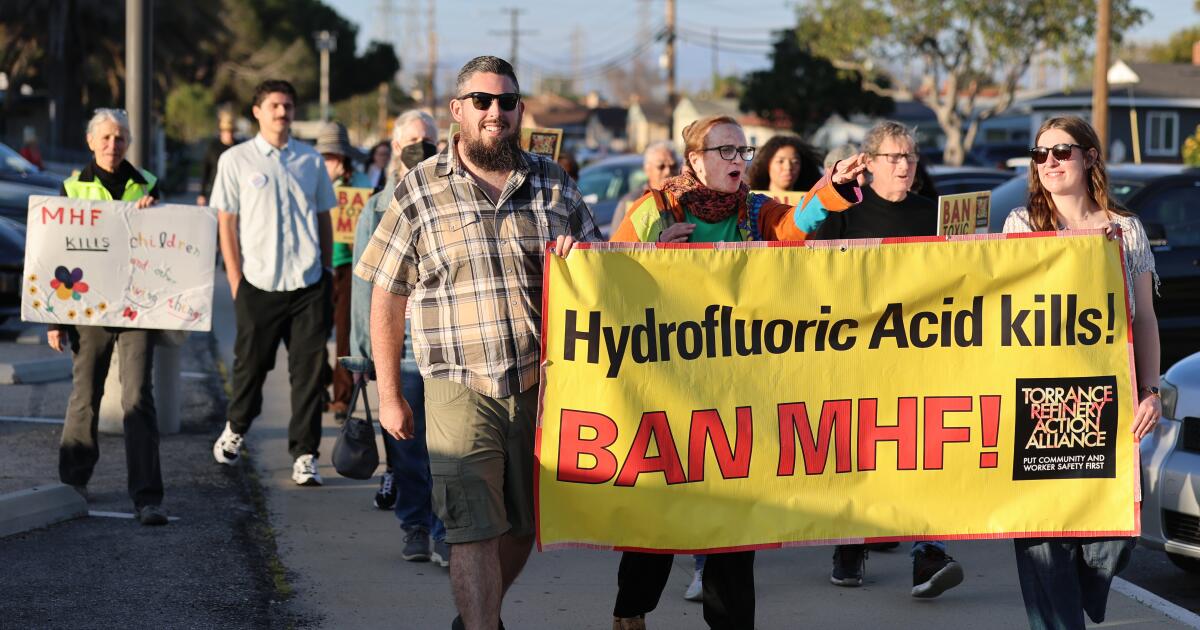
Torrance residents call for the ban of ‘flesh-eating’ chemical used at refinery
-

 Politics1 week ago
West Virginia worked with ICE — 650 arrests later, officials say Minnesota-style ‘chaos’ is a choice
-
 Science1 week ago
TrumpRx is launched: How it works and what Democrats say about it
-

 Fitness1 week ago
13 best fitness watches for 2026, tried and tested
-

 Health6 days ago
James Van Der Beek shared colorectal cancer warning sign months before his death