Entertainment
The team behind the Trump biopic ‘The Apprentice’ talks politics, power and peril

It is hardly unusual for a director introducing their movie at a film festival to express some anxiety. But as he spoke to the crowd before a packed late-night Telluride screening of his controversial Donald Trump biopic “The Apprentice” on Saturday, director Ali Abbasi felt himself sweating with his own unique brand of jitters.
The screening, which had been kept under tight wraps heading into the festival, would be the first time a U.S. audience got a look at the film that ignited a firestorm at the Cannes Film Festival in May, where “The Apprentice” earned an 11-minute standing ovation even as it drew threats of lawsuits from the Trump campaign.
“I don’t get nervous often but I am actually nervous,” the Iranian-born Abbasi (“Holy Spider”) told the Telluride crowd. “This [film] has been some years in the making, and now it’s coming back home to you guys.”
“The Apprentice” charts Trump’s rise to fame and power in the New York of the 1970s and ’80s, with Sebastian Stan portraying the real estate developer and future reality TV star and politician alongside Jeremy Strong as his ruthless attorney and mentor Roy Cohn. Scripted by journalist Gabriel Sherman, who wrote a 2014 bestseller about late Fox News chief Roger Ailes, the darkly comic film presents Trump as a sleazy and callous, if charismatic, social climber who learns the art of achieving power through aggressive attacks, ethical disregard and the strategic manipulation of the the media under the tutelage of the amoral and deeply flawed Cohn.
After the film’s unveiling at Cannes, Trump campaign communications director Steven Cheung blasted it as “garbage” and “pure fiction” and vowed to file a lawsuit against the filmmakers in an effort to derail its release. Studios, streamers and indie distributors were understandably wary of picking up such a political hot potato. But ultimately Briarcliff Entertainment stepped in to distribute the film domestically, scheduling its release less than a month before a presidential election that has already been among the most tumultuous and fiercely contested in U.S. history.
The morning after the Telluride screening — and just 64 days before the election — The Times sat down with Abbasi, Sherman, Stan and Strong to discuss the film’s journey, the challenges of portraying such a polarizing figure and the impact they hope “The Apprentice” will have as the country braces for the final stretch of a deeply divisive election season.
This interview has been condensed and edited.
Ali, when you introduced the movie last night, you said, “This is not a political hit piece. This is a mirror and it is intended to show you an image of yourselves as a community.” Can you elaborate on that?
Abbasi: This not a political hit piece. It’s in the nature of politics that you sort of streamline things to get a certain effect, in order to gain power or regain power. And that is really not the project here. We are all interested in exploring the complexities.
People ask, “Why are we going to watch this movie? What are you going to tell us that we don’t already know about Trump?” If you think you can get to know a character by reading a Wikipedia page, be my guest. But this is not information. This is an experience and it’s an experience of the complexity of these characters. Also, for me as an outsider, this was my chance to look at the American system and the utter corruption that has been an institutionalized part of it, at least from my perspective.
Strong: Of course, political machinations are part of what the film explores and examines. But really it’s a psychological investigation and, I think, a humanistic interrogation of these people.
Every great movie is about a relationship, I think, and this movie is about this relationship and the sort of formative aspects of it. Emerson said every institution is the shadow of a man. And I feel like this is looking at the very long shadow of this man [Cohn] refracted through that man [Trump]. It’s looking at that shadow that is casting its dark light on us now.
Ali makes these sort of phantasmagoric horror films, in a way. This is a monster movie. It’s a Frankenstein movie. It’s sort of the origin story of the birth of a mindset. With the combination of Gabe’s journalistic veracity and Ali’s Lynchian punk-rock filmmaking, we ended with something that is not “one plus one equals two.” All the politics aside, that’s the thing I feel excited for people to see.
The Trump in this film is very different from the one we see today. He’s younger and more vulnerable and still figuring out how he’s going to project himself onto the world. Sebastian, how did you find your way into him?
Stan: When I first read the script in 2019, it reminded me of “The Godfather Part II,” weirdly. I got this feeling that if I just forgot the character names and just looked at what was on the page — which is what ultimately you had to do — it felt like I was witnessing the solidifying of a person into stone. It reminded me of Michael Corleone’s arc in a lot of ways. Once you removed your subjective judgment of the thing, then you could see it in different ways.
Strong: As a fellow actor, I thought what Sebastian did is just a remarkable achievement. I didn’t ever see the stitching. It was just completely lived-in. I got to know a very different Donald until a certain point in the script where there were intimations of the person we know today, sort of Darth Vader. And when I met that Trump, that’s when I really understood the arc of what he was doing.
Sherman: For me, when I sat down to write the film, one of the things I really wanted to explore is, how do we humanize him? He’s this larger-than-life figure that lives in our imaginations but he’s also just a human being. I love the scene where Roy calls Donald and he’s asleep on the couch. There’s no superpower there — he’s just a guy who passed out on his couch. To normalize him as much as possible, I think, is something that is so rarely done with his character.
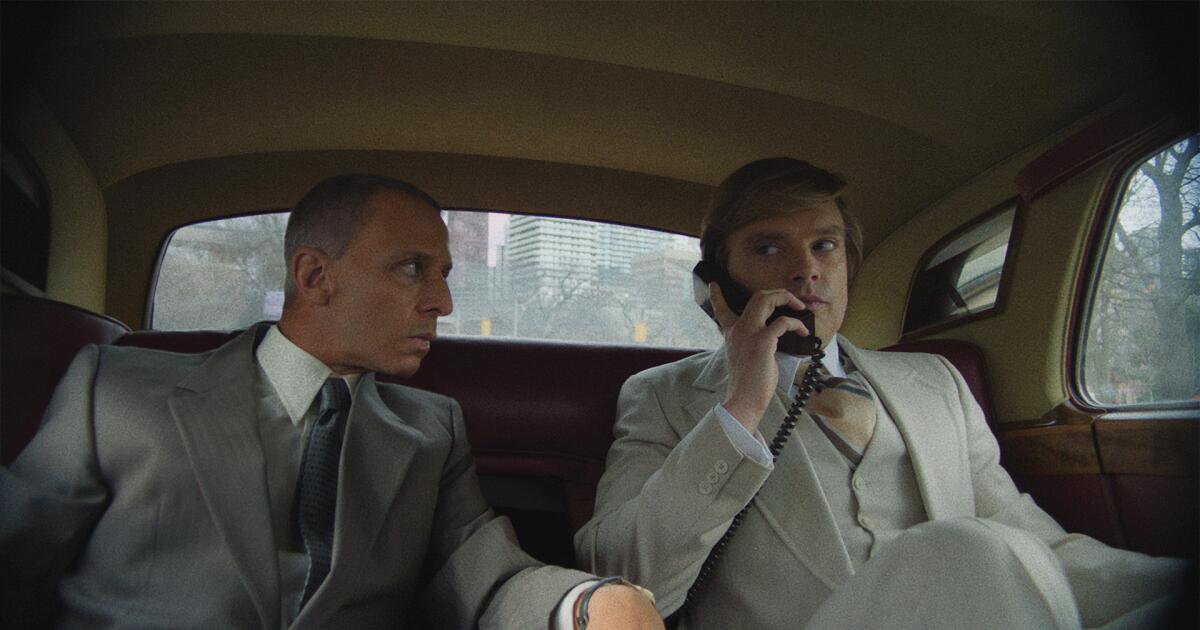
Stan, left, and Strong in a scene from “The Apprentice.”
(Pief Weyman / Apprentice Productions)
The Trump camp is alleging not only that the film is defamatory but that its release constitutes a form of election interference. Was the hope always that it would come out before the election?
Abbasi: I think it’s actually quite important to talk about the timing. I mean, I’m happy about the timing — it’s exciting, obviously. But we tried to make this movie since 2018 and every year it was like, “We’re almost there.” When Jan. 6th happened, we had some of the financing and everything, and then everyone was like, “No, thank you. Bye-bye.”
Sherman: I had a very prominent Hollywood executive come up to me at an event, I think in 2019, and said something like, “When Trump loses, call us. We’ll be interested.” We didn’t plan to have this out in a political sense. It was just a battle to get it made.
The film includes a scene in which Trump rapes his wife Ivana on the floor of their apartment, along with other scenes showing him getting liposuction and cosmetic surgery for his baldness. Why was it important to include those particular moments and how did you decide where to draw the line between what was fair game and what was too salacious?
Sherman: To me, the Ivana scene was a touchstone of the film because we are asking the audience to spend time with this character and we have to show all sides of him. We would be failing ourselves — I’d be failing myself as a writer and journalist — if we didn’t include that. He has been credibly accused of sexual assault by more than a dozen women. He was found liable by a New York jury of committing sexual assault and defamation against E. Jean Carroll. This is an aspect of his character and it would be just a glaring omission if it was not in there, especially in this [post-#MeToo] climate.
Ivana made those allegations in a divorce deposition under the threat of perjury, under oath, and whenever she amended her statements, it was always because Trump’s lawyers were pressuring her before a book came out, or while he was running for president in 2016. So if you’re trying to assess the truth of something, if she says one thing and then later walks it back because his lawyers are threatening her, what seems more true to you? To me, her first statement feels more true. That is why we felt that was the most honest way to show the scene.
Given the stakes of the election, and knowing the ethos Trump learned from Cohn of “attack, attack, attack,” how are you preparing yourselves for what might come from him and his supporters when this movie opens?
Strong: I feel like the stakes with this are much bigger than whatever our individual stakes might be. Our role as artists is always to hold a mirror up to nature, and that might come with some risk. This is not the type of film that is getting made, for the most part. But I do feel like, in this age of alternative facts and fantasy, it’s more important than ever that art speaks the truth and interrogates that without fear. Neither of us are interested in judging or demonizing or vilifying these people. We attempted to understand them. Which would behoove all of us right now.
Stan: I think people that support and admire him will certainly see what they want to see in this movie. But we’ve been taking one day at a time, and it feels pretty nice to enjoy this day in this moment. We live in an uncertain time. I mean, look at the very different weekends we experienced where you went from an assassination attempt to a president stepping down. So who holds the answer? I don’t know.
Abbasi: When we did “Holy Spider,” I went through a version of this. Very much like the Trump campaign not watching this movie and coming with all these [attacks and threats], in Iran they watched the teaser of “Holy Spider” and were like, “This is blasphemy. This guy should be executed for it.” I don’t know how much was really meant but you never know. My parents still live in Iran and my mom was calling me and crying and begging me to take some things out of the movie for their safety. I was like, we’re riding on the back of the dragon. There’s no way to control the dragon. So let’s enjoy the ride at least as much as we can.
I don’t have this feeling like we have done something really dangerous and terrible and now we need to extend our security and hire two people with guns [for protection]. There’s a complexity there. The experience of the film and the performances are superlative to the political messaging or whatever. I ultimately think people will see it that way.
You know how “Barbie” worked, right? They said, “If you love Barbie, it’s a movie for you. If you hate Barbie, it’s a movie for you.” So we say the same thing. If you love Trump, it’s a movie for you. If you hate Trump, it’s also a movie for you.

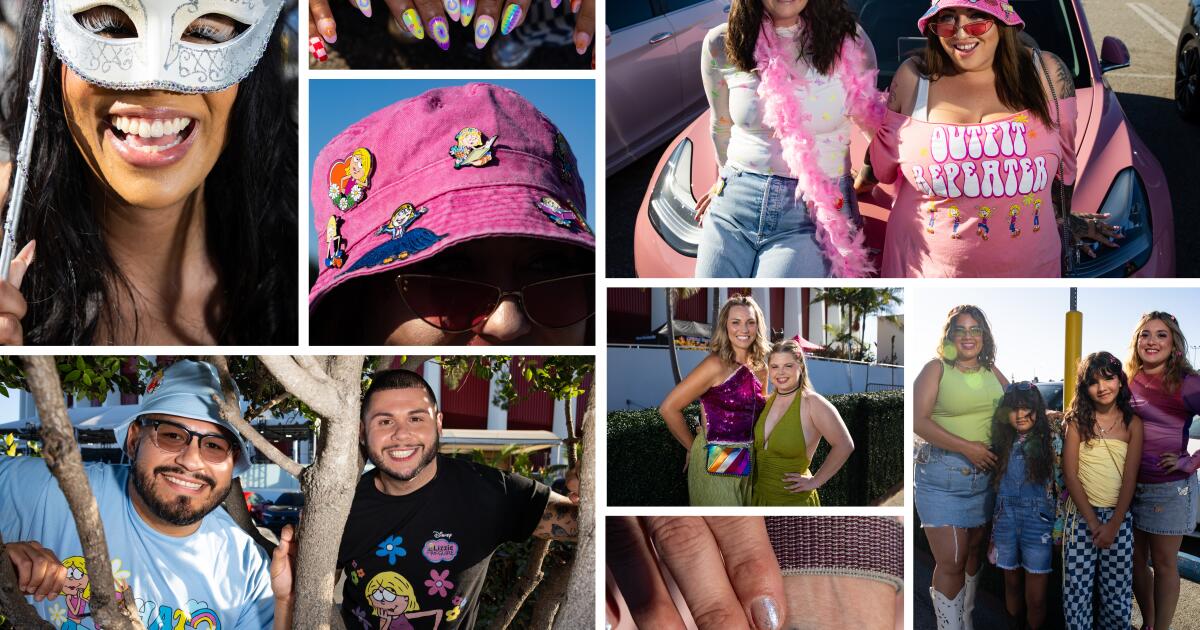
Chunky platform sandals, fitted baby tees, butterfly clips on perfectly crimped hair, brightly patterned skirts and tons of sparkles. Pure Y2K-fueled nostalgia filled the Kia Forum on Wednesday night in celebration of all things Hilary Duff.
-
Share via
Duff graced the stage at the Inglewood venue as part of her Lucky Me tour, her first global headlining tour in nearly two decades. And her fans couldn’t have been more thrilled. The pop singer and actor, who released her sixth studio album “Luck… or Something” in February, performed two back-to-back sold-out shows.
Before the final L.A. show, we caught up with fans to talk about their outfits (many of which were inspired by Duff’s most famous roles such as Sam in “A Cinderella Story” and the title role in “The Lizzie McGuire Movie”), the memories her music brings up for them and why her work still resonates with them. Here’s what they had to say.

(Kayla Bartkowski/Los Angeles Times)
Tristan Hallam, 36, of Chicago
Tell us about your outfit.
This is my wedding dress that I had stuffed in a suitcase. She’s been in a suitcase for 10 years, and I still fit into her, which is nice. People ask me why I keep stuff and this is exactly why: You might get divorced and use it as a costume. My outfit is inspired by “A Cinderella Story.” It’s my favorite Hilary Duff movie. She plays diner girl Cinderella. She disguises herself with a mask and a L.A. Dodgers cap. I did have a tiara, but I didn’t bring it because I didn’t want to be too much. So I figured, you know what, why not buy an apron and a little black crop top, and rep L.A.
I have a tattoo of her signature. It’s a little faded because it’s like 10 years old, maybe older than that now. It was at a book signing at Barnes and Noble at like the Grove or something. I asked her if she would initial my wrist, and I got it tattooed the same night. I literally drove to the tattoo shop on Hollywood Boulevard with my arm out the window because I’m so clumsy and I didn’t want to smudge it. Then the next time I saw her, she asked me, what did your parents say? I said, “My mom asked me how long I kept the Sharpie on so long.”
How long have you been a fan?
I think I was like 8 or 9 years old when I saw “Casper Meets Wendy” for the first time. My grandma took me to like a K-Mart or something, and told me that I could get any movie that I wanted. Then I was into “Lizzie McGuire,” but as soon as Hilary started doing all her like movies and independent work, obviously the music is great. I used to live in L.A., so I went to a bunch of her book signings. I’ve done a lot of meet and greets for her concerts, and right now I’m traveling around. I’m going to 18, technically 19 shows now, and I’m gonna see her in New Zealand, Australia and some other places. I’m actually really excited because one of my friends, I met her in a Hilary Duff fan club chat room in 2005 on MSN Messenger, and we are still friends, so we are going to a ton of shows together.
Why does her work still resonate with you today?
The fact that we’re around the same age, there’s been a lot of relationship similarities. I don’t have any kids, but the struggles with family, with your dad, with your siblings. She’s got some songs that are more mature and relatable for people our age. People who have gone through ups and downs in relationships, struggles with family and figuring out who your real family is, not just by blood but who your chosen family is. I think that’s really important.

(Kayla Bartkowski / Los Angeles Times)
Leilanie Martinez, 30, of South Gate
Tell us about your outfit and the inspiration behind it?
It’s my quinceañera dress. It’s supposedly very traditional to wear a white dress, like young women coming of age. For mine, I wanted to wear something that I didn’t see a lot of people wearing and I was very firm that if I didn’t find the love of my life, I was going to wear a white dress and this was my moment. My quinceañera was such a precious time. It really was a labor of love, and I think it’s one those memories I hold very near and dear. I think it’s an ode to her history, her legacy.
How long have you been a fan?
I remember I was 5 and I was running around in my neighborhood, playing with Barbies and watching “Lizzie McGuire.” I’m here today with my neighborhood and childhood friends. We used to watch it together and now we’re reliving our nostalgia and childhood.
Thinking back on when you first fell in love with her work, why does it still resonate with you today?
There’s a lot of power in her being a woman and she’s going through so many milestones that a lot of people my age are going through like having children and growing her career. Sometimes I think people “wash out” and I think it’s wonderful how she’s combating that narrative in so many ways, and that people are out here supporting her. I think there’s a lot of beauty in being able to be together as young women and relive some of these memories, but also cheer her on as she continues developing further.

(Kayla Bartkowski / Los Angeles Times)
Crystal Chesher, 33, of Mar Vista and Isabella Sanchez, 33, of Culver City
Tell us about your outfit.
Sanchez: We’re channeling “The Lizzie McGuire Movie.” My actual name is Isabella. She gives more Lizzie vibes and I give more Isabella vibes. It’s funny because I’ve literally saved [looks] of Isabella and Lizzie on my Pinterest board and I’ve always wanted to dress up like this. It’s not 100% of what I wanted, but it’s giving what it’s supposed to.
How long have you been a fan?
Chesher: Since I was little. I remember watching “Lizzie McGuire” since the age of 10 at the very least so I’ve been growing up with her movies and shows. She’s definitely my idol.
Sanchez: Same. Growing up, I was bullied so she was a very big part of me being more positive about myself. I can relate to her and she really helped me. It just feels full circle to be able to see her at 33 when I wanted to see her when I was like 10.
Thinking back on when you first fell in love with her work, why does it still resonate with you today?
Chesher: She has a heavy influence in the LGBT community as well especially with the [anti-gay speech campaign]. I loved that. With her movies and her music, it’s all relatable and it resonates with you, the lyrics, the storyline and even her new album that just came out.
Sanchez: She’s just that girl. I’ve never even met her, but I feel like she’s so genuine and real and she’s always stayed consistent with who she is. She’s not like your typical celebrity. She’s just awesome. I’m literally probably going to tear up seeing her on stage.

(Kayla Bartkowski / Los Angeles Times)
Lucca Petrucci, 33, of Santa Monica
Tell us about your outfit.
This is a last-minute choice. It’s very like ’70s or retro. I feel like I’ve seen her wear something like this. I’m wearing wide-legged pants, Doc Martens, platform, new haircut, facial. The inspiration for this fit was elegant pop star like confidence, grounded, a baddie. I’m a baddie who knows my worth and that’s what I wanted to embrace. I feel like she’s like doing that. She has a lyric that’s like ‘I look in the mirror, like I’m a bad b—.”
How long have you been a fan?
Since third grade. I thought she was my crush, but I think I just wanted to be her. So many of my core childhood memories are with her.
Why was tonight a non-negotiable for you?
I wanted to experience with my bestie and her sister. I feel like as a kid I didn’t allow myself to fully embrace it because it would be too girly, too much, too gay. So I feel like as a 33-year-old, I’m reclaiming that experience. I’m so excited just to hear everybody in the Forum sing “So Yesterday” and “Come Clean.” She has always been my number one pop star, to this day, and I’ve never seen her perform.
Why does her work still resonate with you today?
I feel like, especially when she was on “Lizzie McGuire,” she was figuring out who she was, but was open to being her authentic self. So I think that just like hit me when I was like in third and fourth grade, like figuring out myself. I felt so seen by her, and her music just brings back like such good feelings. Younger version of me, life wasn’t always great, but, I don’t know, she made things better.

(Kayla Bartkowski/Los Angeles Times)
Liv Guardado, 8, Priscilla Cruz, 38, Ava Guardado, 10 and Jezelle Velasco of Costa Mesa
Tell us about your outfit.
Cruz: We went thrifting for the first time for this. I’m plus-size, so thrifting is not easy in my size, so we did what we could. We got some overalls from Goodwill. And then we got some cowboy boots because we just wanted to be comfy.
Velasco: I probably stressed the most. I ordered so many pieces and it just kind of came together. I think the nails took the longest. One of my friends did my nails. It took some time but we got it done.
How long have you been a fan?
Velasco: Probably since I was their age. I never got to go to a concert, so this is my first time seeing her live.
Cruz: I definitely got inspired around middle school. I had a friend who was like Lizzie, and I was the best friend, Miranda. People would always say I was Miranda. I was a little older than [my girls], but I definitely have kept tabs on her life, and we love her.
Why does her work still resonate with you today?
Cruz: It definitely feels like memories and home when you think of her music from back then. And now she’s obviously stepped into a different phase of her life, and it matches where we’re at in our phase too so it’s nice.
Velasco: It just brings back the nostalgia from back when we were younger and now being parents, and being able to relate to her and her new music.

(Kayla Bartkowski/Los Angeles Times)
Paige Beard, 34, and Tayler Nelson, 27, of Bakersfield
Tell us about your outfits.
Beard: I was supposed to be wearing purple and she was going to wear green, and we were going to do the Isabella and Lizzie look at the end of “The Lizzie McGuire Movie.” It turned out more pink, but we ran with it.
Nelson: I was all about that performance, so I was like green. Gotta go green. We’ve been planning for a while, like two months.
How long have you been a fan?
Beard: I’ve been a fan for a long, long time, probably since “Casper Meets Wendy.” I was also a really big “Lizzie McGuire” fan, so I got into her acting as well as her music.
Nelson: Same. I was all about the Cinderella movie though, so it’s probably been 10 years for me.
Why does her work still resonate with you today?
Beard: I was telling my sister that I really liked “Lizzie McGuire” because it was one of the first times I saw somebody’s inner dialogue acted out in cartoon form. It showed me that I’m not too much. She’s a little bit older than me and I see her crying on stage and I’m like “OK, it’s OK.”
Nelson: “The Lizzie McGuire Movie” was a big turning point for me. I just loved how she expressed herself with what she wore and how she acted. I feel like I understood her in different ways. I enjoyed the dancing and the singing for sure. She felt free and I’m like, “Dang, I want that.”

(Kayla Bartkowski/Los Angeles Times)
Freddy Lopez, 38, and Raymond Lockwood, 36, of San Bernardino
Tell us about your outfits.
Lopez: Just a ’90s vibe. I guess a little old-school.
Lockwood: The outfits are a little last-minute because we were like we should’ve done diner girl [from “A Cinderella Story”] or one of her other movies, but we chose the little cartoon character from the show.
How long have you been a fan?
Lopez: I’ve been a fan since “Lizzie McGuire” and her movies.
Lockwood: For the past 20 something years. We grew up watching “Lizzie McGuire” and got introduced to Hilary Duff when she started singing.
Why was tonight a non-negotiable for you?
Lopez: We don’t know if she’s going to come back after this, so you’ve gotta take every opportunity. There’s other artists who cannot come back to perform right now. So when she said I’m coming back, we had to.
Lockwood: We’re healing our inner child. As a kid, we didn’t know she was having tours or we couldn’t afford to come out. Now, we’re like we don’t have to ask our mom and dad for anything.
Why does her work still resonate with you today?
Lockwood: For me, it’s being a teenager, watching the “Lizzie McGuire” show and watching the movie and then learning her songs. My favorite song is from the movie, “What Dreams Are Made Of.” It’s just us getting to live back in the past and kind of understanding it a little bit more. As a kid, our dreams are not what they realistically are today. I ended up becoming a nurse. As a kid, I didn’t sit on the couch like “Oh, I’m going to be a nurse,” but that’s what my dream ended up being.
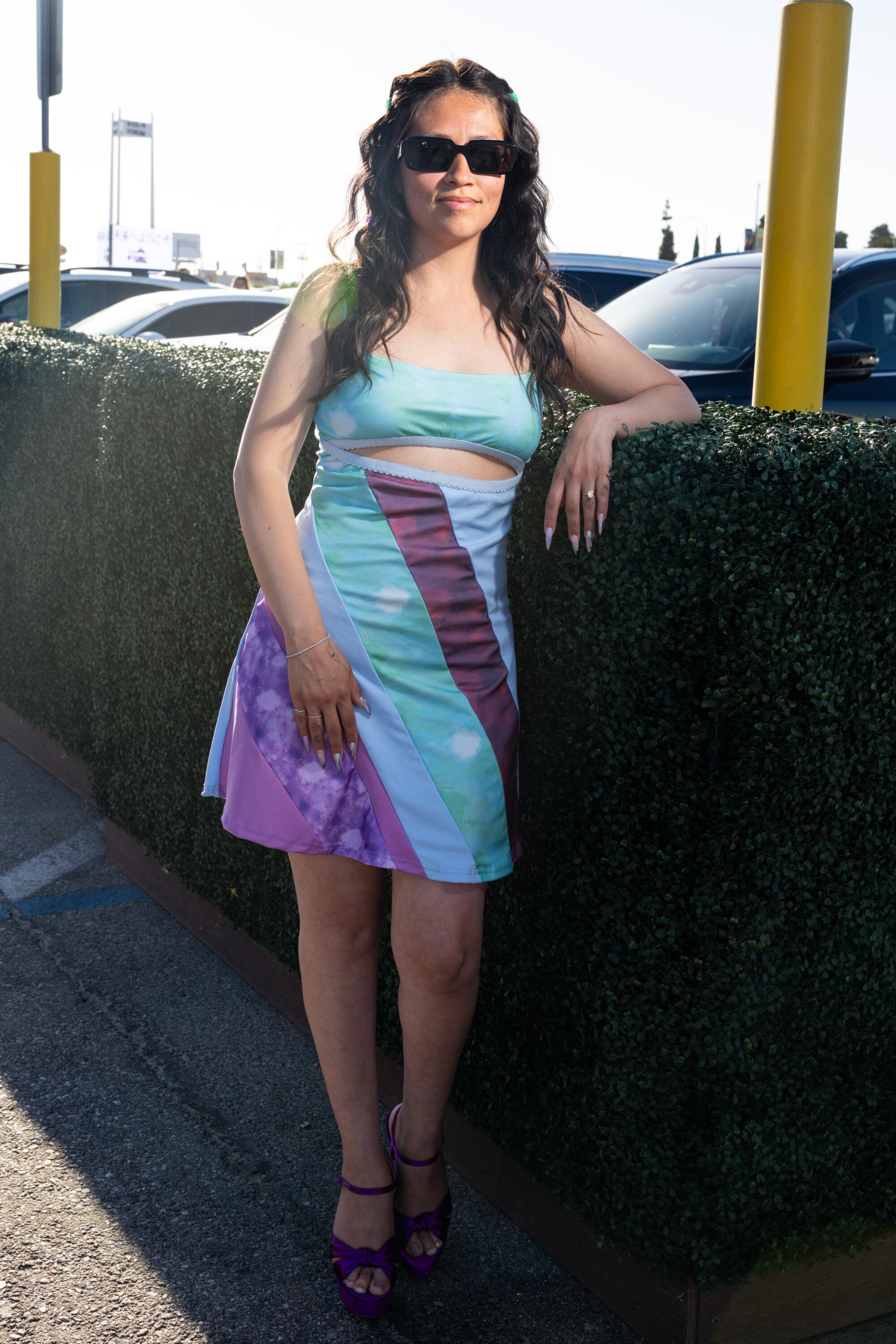
(Kayla Bartkowski/Los Angeles Times)
Stephanie Rodriguez, 32, High Desert
Tell us about your outfit.
If you ask my fiancé, I was hunting for outfits and last-minute I was like, “I’m just gonna order something on Amazon.” When I saw this, I was like, “That’s it.” Total nostalgia with “13 Going on 30.” We went shoe shopping at the South Coast Plaza over the weekend. The metallic is pulling it all together and the butterfly clips.
How long have you been a fan?
Probably since I was like 8 or younger, pretty much very much obsessed. All of my holiday gifts were Hilary Duff. I had her K-Mart home products. Any magazines she was in, I got. Any outfits that I could try and replicate, I would. My first Hilary show was either Wango Tango or a Jingle Ball with KIIS-FM, so it was just a festival with a bunch of different artists but I went specifically for her.
Why does her work still resonate with you today?
I think a lot of us feel like we grew up with Hilary, so all of her music resonated with us then, and now, now that we’re older, through relationships or divorces or motherhood. It’s pretty cool to see just how we’re all kind of growing up together. The first time I think I found out about her was at the Glendale Galleria. I was recently telling my fiancé that my dad had me on his shoulders because she did a meet and greet and the entire mall was packed.

(Kayla Bartkowski/Los Angeles Times)
Kelsie Wagner, 35, of Temecula and Tyler Walsh, 35, of Long Beach
Tell us about your outfit.
Wagner: I’m channeling Lizzie McGuire. My favorite part is the butterfly clips.
Walsh: This is from Company D, which is a discount store for Disneyland. I was like let me get the biggest shirt and make it into a dress, but I’m wearing shorts — it’s still appropriate. I have like six authentic Disney pins here. This is about $200 on my hat. I was like I have to do something that represents. It’s a big hobby, pin trading, that I picked up in 2023. Then I wore my Lisa Franks. I figured I would channel everything from the ’90s and 2000s.
How long have you been a fan?
Wagner: Whenever the “Lizzie McGuire” show came out.
Walsh: I remember going to sleepovers with all of my friends and we would do Lizzie nights. I was on a soccer team and on Saturday nights, we’d go watch the newest episode. It was just so fun because I feel like I had a little clan that loved Lizzie. We went to her concert at the Grove together and it was back when you paid $50 to get in. We were front row and we like smelled her. It was wonderful.
Why does her work still resonate with you today?
Wagner: For me, especially her new album, she talks about marriage, relationships, motherhood, so it’s still relatable in that sense of that stage of life that we’re in.
Walsh: For me, it’s just nostalgia, because I’m not married, I have no kids, like I’m that fun aunt. And I will say, like, because she goes to Disneyland a lot, so I luckily got to meet her too. I asked her for a picture, and she’s like “Yeah, of course, honey.” It’s the most embarrassing photo of me ever though.
Wagner: I told her she should get it printed and wear it to the concert.
Walsh: I should have.

Sam Raimi‘s Evil Dead films and TV series are a fine example of creativity within constraints, playfulness, self-awareness and outright slapstick comedy. The Evil Dead series after Raimi is very, very different. Starting with 2013’s Evil Dead by Fede Álvarez, followed by Evil Dead Rise by Lee Cronin, the new series takes itself more seriously and emphasises pure horror, violence and gore. Some have considered this praiseworthy as it avoids being a mere retread of the old films, but the reception has been mixed.
In Sébastien Vanicek’s Evil Dead Burn, Alice (Souheila Yacoub) loses her abusive husband (George Pullar) to a motor accident. When she goes home to stay with his family, the consequences of the work of their dead grandfather researching the Necronomicon and the Deadites manifest in terrible ways. One by one, the family are turned into the Evil Dead.
Horror is a genre that depends on you relating to the protagonists so you care what happens to them. In the case of Evil Dead Burn, Yacoub does a decent job with the character she’s given, but the gonzo horror elements manifest so early in the film that she may as well be collateral damage in the onslaught, especially as the film’s early point of view is that of her brother-in-law (Hunter Doohan).
Fans of gory violence will get their money’s worth here, but there’s not a lot going on besides that. The film is a descent into madness and carnage that is so resolutely unpleasant that, after some of the early kills, it becomes numbing. It’s hard to gather what the tone is supposed to be, with lots of callbacks to the early films’ style by setting up inevitable kills with Chekhov’s weed trimmer, Chekhov’s fork and every other potentially dangerous prop the camera lingers on. The family are all deeply unpleasant at some level and so their deaths register as meaningless. Yes, the film has the obligatory something to say about how our tendency to ignore domestic abuse creates demons that destroy families, but then absolutely panders to bloodlust by absolutely revelling in some of the most extreme violence imaginable between family members (and a pet). To say this is not a film for the sensitive is to understate things considerably. This is a film that absolutely earns its content guidance warnings.
Is there any comedy? Some, but it feels out of place given the absolute brutality inflicted on the cast. While most of the other films were self-aware about setting up a ludicrously grisly end for a villain as a payoff, in Evil Dead Burn,the kills have very little flair. It’s also hard to know what the rules for getting rid of a Deadite are, as some of them are still upright and chatty after losing most of the contents of their skull and some are dispatched by the repeated application of a blunt object to the head. Towards the end, a McGuffin is added to make the kills final, but before that, who knows?
Should you watch Evil Dead Burn,? It certainly gets vocal reactions from audiences in a cinema, and if you’re a gorehound you’ll be in for a ride. If you’re a horror fan, it’s certainly a horror film, but violent instead of scary. If you’re just a fan of cinema who likes good films whether or not they’re horror films, then this will be an alienating watch. In Evil Dead Rise the decay of the family was more than background noise and factored into the circumstances of the individual deaths, but not here. It has slight pretences of being a film with Themes and Ideas, but in the end it just feels like an excuse to serve up limbs being mutilated, skulls being crushed and any number of stabbings, slicings and gougings rendered with psychopathic visual fidelity. If that’s what you’re after, that’s what it’s got.
Entertainment
‘Children of Blood and Bone’ author won’t see film after feud with star Amandla Stenberg

Tomi Adeyemi, the author of the bestselling fantasy “Children of Blood and Bone,” isn’t planning to see the forthcoming film adaptation — even though she co-wrote it.
Over the weekend, the Nigerian American author posted a video on TikTok addressing fans who have been asking her the same question, “Why don’t you post about the adaptation of your first film adaptation anymore?”
“There is a reason I will not post anything about the adaptation of my work,” the author wrote in what appear to be screenshots of a group chat. “I have not seen the film, and I will not watch it.”
The adaptation of the first installment of Adeyemi’s “Legacy of Orïsha” fantasy trilogy is slated to hit theaters in January 2027. Gina Prince-Bythewood — who wrote and directed “Love & Basketball” and helmed “The Woman King” — is directing. The film stars Amandla Stenberg, Thuso Mbedu, Tosin Cole, Damson Idris, Cynthia Erivo, Lashana Lynch, Regina King, Idris Elba, Chiwetel Ejiofor and Viola Davis.
Alongside the screenshots of her comments in the group chat, she shared a February 2025 exchange with Stenberg that shows the author severing ties with the actor.
Adeyemi shared only her final message to Stenberg, which reads, “Do not ever use my name in an interview or video again. Do not text me. Do not call me.” That exchange is followed by a notification that she blocked Stenberg, who plays Princess Amari in the upcoming fantasy flick.
The message from Stenberg that preceded Adeyemi’s reply is not shown in full.
Stenberg, who played Rue in “Hunger Games,” Starr Carter in “The Hate U Give” and, recently, Verosha “Osha” Aniseya and Mae-ho “Mae” Aniseya in Disney’s “Star Wars” series “The Acolyte,” had been getting flack from readers of the series, who claimed colorism was an issue while casting the movie.
In February 2025, Stenberg posted a since-deleted nine-minute TikTok addressing the controversy and told followers that Adeyemi had given the actor her blessing when cast as the series’ princess.
“I am four months into training for ‘Children of Blood and Bone’ and I am getting my ass whooped,” Stenberg joked in the video, per BET.
“This year was mostly defined for me, honestly, by contending with what it felt like to receive racist death threats just for existing in the ‘Star Wars’ universe, and that was a really difficult thing for me to move through,” she continued. “But honestly, it feels so much more painful for me to feel like I’m at odds with my own community.”
Stenberg said that she considers her skin tone when navigating her career choices and would “never go after a role” she didn’t feel well suited for. “I know that colorism is an insidious system that relentlessly impacts every facet of entertainment.”
The actor continued that it was actually a meeting with the “Children of Blood and Bone” author that gave her the confidence to pursue the role.
“I had the opportunity to meet Tomi, the novelist, for the first time. … And she goes, ‘Amandla, I want you to know that when you were a little girl and you were cast as Rue in “The Hunger Games,” and people said that Rue’s death wouldn’t be as sad because you’re a Black girl — that inspired me to write this series so that Black girls like you and Black girls of all shades could have a story written about them,’” Stenberg said in the video. “We started crying, and I said to myself, ‘God wants me here.’”
Representatives for Stenberg, Adeyemi and Prince-Bythewood did not immediately respond to The Times’ request for comment.
-

 Health1 minute ago
GLP-1 Users’ Guide to Protein Snacks: Here’s What a Dietitian Actually Recommends
-
 Lifestyle16 minutes ago
‘The Invite’ is a marriage comedy with sex and heart
-

 Technology28 minutes ago
I spent a week using the Trump phone — it sucks
-

 World31 minutes ago
With US unleashing attacks, Iranian official threatens that the Islamic Republic will deliver a ‘hard slap’
-

 Politics36 minutes ago
WATCH: Trump’s Energy chief reveals what escalating Iran tensions could mean for gas prices
-

 Health43 minutes ago
Coffee may have powerful effect on liver health, major study suggests
-

 Sports46 minutes ago
Oba Femi vs Brock Lesnar at SummerSlam is a ‘generational matchup,’ WWE legend JBL says
-
 Business58 minutes ago
Billionaire exodus? California drew 10 times more venture capital than any other state this year

