

Connect with us

Entertainment

The novel 'Old King' explores the meaning of 'Unabomber' Ted Kaczynski today

Published

on

The novel 'Old King' explores the meaning of 'Unabomber' Ted Kaczynski today

Book Review

Old King

By Maxim Loskutoff
Norton: 304 pages, $27.99
If you buy books linked on our site, The Times may earn a commission from Bookshop.org, whose fees support independent bookstores.

Advertisement

When Ted Kaczynski killed himself in a federal prison last June, it closed a confounding chapter in the history of American domestic terrorism. Unlike fascists, white supremacists and antigovernment conspiracists, Kacyzinski espoused righteous principles: protecting the environment and facing the destructive role of technology. “[T]hreats to the modern individual tend to be MAN-MADE,” he wrote in a 35,000-word manifesto that ran in the New York Times and Washington Post in 1995. “They are not the result of chance but are IMPOSED on him by other persons whose decisions he, as an individual, is unable to influence.”

He wasn’t wrong. But the papers only published his words on the recommendation of the FBI and U.S. attorney general to prevent him from doing more harm — beyond the three people he’d murdered and nearly two dozen he’d injured with mail bombs.

Maxim Loskutoff’s second novel, “Old King,” is an attempt to sort through Kaczynski’s contradictions, to acknowledge the manifesto’s prophetic elements while stressing it’s the product of a sociopath. That’s fine fodder for a novel — the stuff of Dostoyevsky, even — though Loskutoff isn’t trying to deliver a “Karamazov”-grade philosophical tale. Rather, “Old King” is a more modest blend of police procedural and great-outdoors yarn.

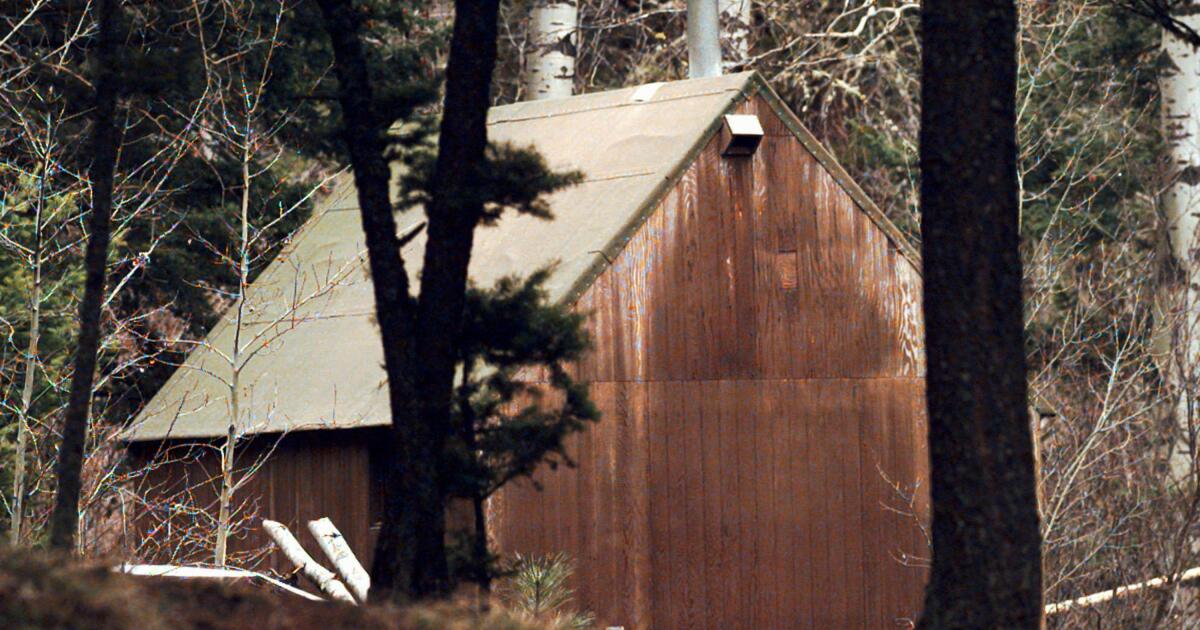
Set largely in the Montana wilderness where Kaczynski holed up, the novel explores the line where independence becomes so distant from empathy that it’s toxic. Loskutoff writes beautifully about nature — “Old King” refers to a massive tree towering over the Montana landscape. But nature on its own, he observes, can be menacing and brain-scrambling as well.

Advertisement

Before Kaczynski claims the novel’s stage, Loskutoff introduces a set of characters who evoke his crisis in miniature. In 1976, Duane is a young father who has just left his marriage and home in Utah to move to Lincoln, Mont., for work. He’s not especially skilled, and nature alienates him at first. (“Branches rustled, reaching toward him, offering up his failures.”) But he soon lands a logging job and gets to know the locals: Mason, a forest ranger; Hutch, owner of an ad hoc animal rescue; the Carter family, a clan of cranky separatists; and Jackie, Mason’s ex and a diner waitress. Settling in, Duane gifts Jackie with a microwave he liberated from his broken marriage, a small symbol of both warm domesticity and cold technology.

Indeed, it’s likely no other microwave in the history of American literature has been asked to carry so much metaphorical weight. Even without dwelling on the device, it’s clear that everybody in the area is trying to figure out to what degree they can balance the wilderness’ capacities for wonder and alienation. Mason, the ranger, is the most sophisticated thinker on the matter, questioning whether his job is preserving the environment or helping to accelerate a land rush: “By arresting poachers and running old trappers out of business, he’d clear the way for rich tourists to build second homes… Their contracting crews killed animals by the score with bulldozers, and the cement they poured left no way for the trees to grow back.”

Portrait of long-haired man looking away from camera

Maxim Loskutoff, author of “Old King.”

(Cinna Cuddie)

As the narrative moves into the ’80s, Mason is increasingly troubled by the irony of his work. Duane, meanwhile, acknowledges the healthy fear the environment puts in him: Seeing a grizzly, he falls into a “wild, plunging panic, as if he’d come here to be eaten, having finally crossed the line between civilization and his dreams.” Both responses qualify as a kind of wilderness intelligence. By contrast, Kaczynski, a brilliant mathematician before becoming the Unabomber, is rendered as a more crazed, lunkheaded type: “The bear was the first real killer he’d ever encountered. He wanted to be a killer.”

Advertisement

There’s an unwritten law that literary fiction set in the high plains be sturdy and simple — sentences firm as fence posts, commas hammered in as clean as barn nails. Kent Haruf’s novels are the exemplar of the form, but the sensibility runs through books by Thomas McGuane, Marilynne Robinson, Peter Heller, Ivan Doig and more. Loskutoff, who set both his novel “Ruthie Fear” and story collection “Come West and See” at least partly in Montana, has mastered his own take on the form. He deftly captures how the environment is both enchanting and fearsome, and though his set pieces have a familiar ring — bar fights! dangerous animals! — he focuses more on what’s troubling his characters than overselling some myth of rough-and-ready swagger.

Still, the plainspoken approach means some characters lack depth. Jackie, the waitress, rarely rises above the trope of the straight-talking done-wrong Western woman who can’t find a good man. The trouble is more acute in Kaczynski’s case. Luskatoff introduces a postal inspector, Nep, who’s trying to chase down the Unabomber and grasps the threat he poses to America’s sense of self, then and now. (“Race riots, serial killers, assassinations, superfund sites. The great ship of America going down with all the lights blazing.”) But Nep is basically a stock detective, and Kaczynski little more than an angry narcissist who derides everyone around him as fools. His contempt for humanity is clear. But then why was he concerned for it?

For Loskutoff’s purposes, Kaczynski serves less as a character than a warning. The Unabomber was more than a ’90s headline; his past is closer to our present than we think. When a Montana local tells Mason about a brutal act of violence that happened in the ’20s, Mason brushes it off: “That was fifty years ago.” The man scoffs: “You think that’s a long time?”

Mark Athitakis is a writer in Phoenix and author of “The New Midwest.”

Advertisement

Movie Reviews

Review | Hoppers: Pixar’s new animation is a hilarious, heartfelt animal Avatar

Published

on

Review | Hoppers: Pixar’s new animation is a hilarious, heartfelt animal Avatar

4/5 stars

Bounding into cinemas just in time for spring, the latest Pixar animation is a pleasingly charming tale of man vs nature, with a bit of crazy robot tech thrown in.

The star of Hoppers is Mabel Tanaka (voiced by Piper Curda), a young animal-lover leading a one-girl protest over a freeway being built through the tranquil countryside near her hometown of Beaverton.

Because the freeway is the pet project of the town’s popular mayor, Jerry (Jon Hamm), who is vying for re-election, Mabel’s protests fall on deaf ears.

Everything changes when she stumbles upon top-secret research by her biology professor, Dr Sam Fairfax (Kathy Najimy), that allows for the human consciousness to be linked to robotic animals. This lets users get up close and personal with other species.

Advertisement
“This is like Avatar,” Mabel coos, and, in truth, it is. Plugged into a headset, Mabel is reborn inside a robotic beaver. She plans to recruit a real beaver to help populate the glade, which is set to be destroyed by Jerry’s proposed road.
Continue Reading

Entertainment

Kurt Cobain’s Fender, Beatles drum head among $1-billion collection going to auction

Published

on

Kurt Cobain’s Fender, Beatles drum head among -billion collection going to auction

In the summer of 1991, Nirvana filmed the music video for “Smells Like Teen Spirit” on a Culver City sound stage. Kurt Cobain strummed the grunge anthem’s iconic four-chord opening riff on a 1969 Fender Mustang, Lake Placid Blue with a signature racing stripe.

Nearly 35 years later, the six-string relic hung on a gallery wall at Christie’s in Beverly Hills as part of a display of late billionaire businessman Jim Irsay’s world-renowned guitar collection, which heads to auction at Christie’s, New York, beginning Tuesday. Each piece in the Beverly Hills gallery, illuminated by an arched spotlight and flanked by a label chronicling its history, carried the aura of a Renaissance painting.

  • Share via

    Advertisement

Advertisement

Irsay’s billion-dollar guitar arsenal, crowned “The Greatest Guitar Collection on Earth” by Guitar World magazine, is the focal point of the Christie’s auction, which has split approximately 400 objects — about half of which are guitars — into four segments: the “Hall of Fame” group of anchor items, the “Icons of Pop Culture” class of miscellaneous memorabilia, the “Icons of Music” mixed batch of electric and acoustic guitars and an online segment that compiles the remainder of Irsay’s collection. The online sale, featuring various autographed items, smaller instruments and historical documents, features the items at the lowest price points.

A portion of auction proceeds will be donated to charities that Irsay supported during his lifetime.

The instruments of famous musicians have long been coveted collector’s items. But in the case of the Jim Irsay Collection, the handcrafted six-strings have acquired a more ephemeral quality in the eyes of their admirers.

Amelia Walker, the specialist head of private and iconic collections at Christie’s, said at the recent highlight exhibition in L.A. that the auction represents “a real moment where these [objects] are being elevated beyond what we traditionally call memorabilia” into artistic masterpieces.

“They deserve the kind of the pedestal that we give to art as well,” Walker said. “Because they are not only works of art in terms of their creation, but what they have created, what their owners have created with them — it’s the purest form of art.”

Advertisement

Cobain’s Fender was only one of the music history treasures nestled in Christie’s gallery. A few paces away, Jerry Garcia’s “Budman” amplifier, once part of the Grateful Dead’s three-story high “Wall of Sound,” perched atop a podium. Just past it lay the Beatles logo drum head (estimated between $1 million and $2 million) used for the band’s debut appearance on “The Ed Sullivan Show,” which garnered a historic 73 million viewers and catalyzed the British Invasion. Pencil lines were still visible beneath the logo’s signature “drop T.”

A drum head.

Pencil lines are still visible on the drum head Ringo Starr played during the Beatles’ debut appearance on “The Ed Sullivan Show.”

(Christie’s Images LTD, 2026)

It is exceptionally rare for even one such artifact to go to market, let alone a billion-dollar group of them at once, Walker said. But a public sale enabling many to participate and demonstrate the “true market value” of these objects is what Irsay would have wanted, she added.

Dropping tens of millions of dollars on pop culture memorabilia may seem an odd hobby for an NFL general manager, yet Irsay viewed collecting much like he viewed leading the Indianapolis Colts.

Advertisement

Irsay, the youngest NFL general manager in history, said in a 2014 Colts Media interview that watching and emulating the legendary NFL owners who came before him “really taught me to be a steward.”

“Ownership is a great responsibility. You can’t buy respect,” he said. “Respect only comes from you being a steward.”

The first major acquisition in Irsay’s collection came in 2001, with his $2.4-million purchase of the original 120-foot scroll for Jack Kerouac’s 1957 novel, “On the Road.” He loved the book and wanted to preserve it, Walker said. But he also frequently lent it out, just like he regularly toured his guitar collection beginning 20 years later.

A scroll of writing.

Jim Irsay purchased the original 120-foot scroll manuscript of Jack Kerouac’s “On the Road” for $2.4 million in 2001.

(Christie’s Images)

Advertisement

“He said publicly, ‘I’m not the owner of these things. I’m just that current custodian looking after them for future generations,’ ” Walker said. “And I think that’s what true collectors always say.”

At its L.A. highlight exhibition, Irsay’s collection held an air of synchronicity. Paul McCartney’s handwritten lyrics for “Hey Jude” hung just a few steps from a promotional poster — the only one in existence — for the 1959 concert Buddy Holly, Ritchie Valens and J.P. “The Big Bopper” Richardson were en route to perform when their plane crashed. The tragedy spurred Don McLean to write “American Pie,” about “the day the music died.”

Holly was McCartney’s “great inspiration,” Christie’s specialist Zita Gibson said. “So everything connects.”

Later, the Beatles’ 1966 song “Paperback Writer” played over the speakers near-parallel to the guitars the song was written on.

Irsay’s collection also contains a bit of whimsy, with gems like a prop golden ticket from 1971’s “Willy Wonka & the Chocolate Factory” — estimated between $60,000 and $120,000 — and reading, “In your wildest dreams you could not imagine the marvelous surprises that await you!”

Advertisement

Another fan-favorite is the “Wilson” volleyball from 2000’s “Cast Away,” starring Tom Hanks, estimated between $60,000 and $80,000, Gibson said.

Historically, such objects were often preserved by accident. But as the memorabilia market has ballooned over the last decade or so, Gibson said, “a lot of artists are much more careful about making sure that things don’t get into the wrong hands. After rehearsals, they tidy up after themselves.”

If anything proves the market value of seemingly worthless ephemera, Walker added, it’s fans clawing for printed set lists at the end of a concert.

“They’re desperate for that connection. This is what it’s all about,” the specialist said. It’s what drove Irsay as well, she said: “He wanted to have a connection with these great artists of his generation and also the generation above him. And he wanted to share them with people.”

In Irsay’s home, his favorite guitars weren’t hung like classic paintings. Instead, they were strewn about the rooms he frequented, available for him to play whenever the urge struck him.

Advertisement

Thanks to tune-up efforts from Walker, many of the guitars headed to auction are fully operational in the hopes that their buyers can do the same.

“They’re working instruments. They need to be looked after, to be played,” Walker said. And even though they make for great gallery art, “they’re not just for hanging on the wall.”

Continue Reading

Movie Reviews

Film reviews: ‘How to Make a Killing,’ ‘Pillion,’ and ‘Midwinter Break’

Published

on

Film reviews: ‘How to Make a Killing,’ ‘Pillion,’ and ‘Midwinter Break’

‘How to Make a Killing’

Directed by John Patton Ford (R)

★★

Continue Reading

Trending
