Entertainment
The Altons proudly share the oldies sound of East L.A. with the world, even as their hometown is 'targeted' by ICE


It’s a summery, late-afternoon Saturday on the backyard lawn of LA Plaza de Cultura y Artes, with the kind of warmth and variety of sounds, sights and smells that have defined weekends in many Los Angeles neighborhoods for generations. This one happens to be for a KCRW Summer Nights event headlined by East L.A. soul revivalists the Altons, but the blend of demographics, cultures and backgrounds on display gives it an authentically local feel that could be mistaken for an informal block party in any decade — except perhaps for the screen printer creating band merch and a design of Snoopy humping an ice cube with an expletive about Immigration and Customs Enforcement.
That same blend of history and cultures that has brought Los Angeles together across generations is also what’s given the Altons their signature sound and made them one of the city’s latest breakout stars. When they go on tour and bring their unique blend of soulful “oldies,” modern rock and bilingual R&B around the world, they aren’t just sharing their music but also their culture.
“On any given weekend, you can have some party down the street playing cumbia or music that your parents grew up on, their next door neighbor might have a punk rock show, and another guy down the street that’s just listening to oldies and Art Laboe,” vocalist and guitarist Bryan Ponce explains about the roots of the Altons’ diverse sound stemming from their collective Los Angeles childhoods. “We all grew up on all of this music that we’d hear in our neighborhoods, so all of our influences just came together and came out in our music.”
The Altons members Adriana Flores, Caitlin Moss, Bryan Ponce and Joseph Quinones perform at LA Plaza de Cultura y Artes on June 28.
(Brian Feinzimer / For The Times)
For a band that started with modest expectations nearly a decade ago, the Altons now find themselves heading out on international tours and playing to thousands of people at a time — as they will Saturday when they rock the Oldies 2 Souldies show with Los Lonely Boys at the Greek Theatre. And while their rise has been more of a gradual incline than anything particularly stratospheric, they’ve carved their own path without compromise. They’re willing to fuse genres, languages, tempos and sounds as they see fit and based on what they feel will work best for the songs and messages they’re wanting to deliver instead of catering to what may be popular in the moment, a choice that’s made them the face of the “oldies revival” now that millennials and Gen Z are falling back in love with tunes from their grandparents’ day.
“It’s incredible to play a show where a grandmother’s there with her daughter and grandkids, and just have multiple generations of people come together,” vocalist Adriana Flores says. “There’s not a lot of shows that I would even take my dad to, so I think it makes the music even more special and I’d like to be one of the bands shedding the light on what’s been happening in L.A. We’ve been doing it for years and just sharing the types of music we like — which is the retro sound of soul mixed with other elements. We like to show people what’s been happening in L.A. that’s not just Hollywood.”

The Altons’ Adriana Flores and Bryan Ponce perform at LA Plaza de Cultura y Artes in late June.
(Brian Feinzimer / For The Times)
That desire to show the “real” L.A. that they know and love is a driving force for the Altons, particularly as they go further and further from home. All of them — Flores and Ponce along with Joseph Quinones on guitar/backup vocals, Chris Manjarrez on bass, Christian “Elyzr” Meraz on keyboards and drummer Caitlin Moss — are proud to represent their East L.A. roots for those who only see the California that gets presented on television. The group eagerly reminisces about a fan they met at a show in France who had never set foot in California but loved the culture so much that he dressed the part of a classic cholo. “He looked like he could have been related to me or went to school with me,” Ponce says with a laugh. “He was bald, he had the Locs on, the Pendleton on and he was screaming our neighborhoods.” They recall the times they’ve felt like cultural ambassadors bringing their hometown heritage to cities like Boston.
But the self-placed weight of representing and sharing their lifelong culture isn’t always all fun and games. Just a matter of weeks before they were walking through the halls of LA Plaza’s museum to see their brand-new exhibition on the importance of East L.A. musicians, they were on tour in the U.K. feeling helpless as they watched the ICE raids and protests flood the city.

Bryan Ponce and Adriana Flores onstage at LA Plaza de Cultura y Artes.
(Brian Feinzimer / For The Times)
“You couldn’t really grasp what was going on,” Ponce says. “I would watch videos and see stuff online, but I didn’t really see it until we came home for a couple of days before we left again. [Manjarrez] and I live close to each other, and we started seeing videos of all these places and stores and people in our community. It was just devastating to have to leave again and see that they’re getting even closer to your house and seeing it happening on your street. You’re trying to go and play music to entertain people, but you’re also trying to find a balance. It’s like ‘Are we going to speak on what’s going on?’ Because some people thought that L.A. was burning down, and that’s not really the case.”
“Watching the community go through something so heartbreaking while being away was really difficult,” Flores adds. “It was really tough seeing our community being targeted, but I’d like to believe that music and being creative and spreading joy is a form of resistance. I hope that people can come to our shows and escape. Even though this is way bigger than us, we have to use our platform to be vocal about what’s going on. It’s scary times, but another scary time was the ‘60s when the whole civil rights movement was happening, and some of the best music came out of that because people were finding that outlet and creating.”







An orphaned girl hires her hitman next-door neighbor to kill the monster under her bed. This R-rated action/horror movie mashup has lots of violence but surprisingly little gore. However, there are still many gruesome moments, even if they’re just offscreen. And some language and a strange portrayal of Christian worship come up, too.
Entertainment
Review: ‘Resurrection’ is a sumptuous, transporting dive into the pure pleasures of the image
One of the downsides of our movie-mad filmmakers — the Quentin Tarantinos who happily plunder from cinema’s illustrious past — is that their worldview can be myopic beyond what’s up there on the screen. For all their technical acumen, the hum and whir of life remains absent in their work, which merely mimics the semblances of behavior they’ve observed from other films. These directors can synthesize the architecture of cinema but not the underlying humanity that transforms movies into something that resonates.
What’s so impressive about Bi Gan’s excellent third feature is that he manages to have it both ways. The Chinese director behind 2015’s “Kaili Blues” and 2018’s “Long Day’s Journey Into Night” makes movies besotted with the act of making movies. They include accomplished long takes and sensuous riffs on well-defined genres.
And yet he’s never lost sight of the fragile characters at the center of his spectacles. With “Resurrection,” Bi delivers something uncommonly rich, boldly conceiving his latest as a salute to the history of film. Still, his focus remains on people — whether they be in his stories or watching in the theater.
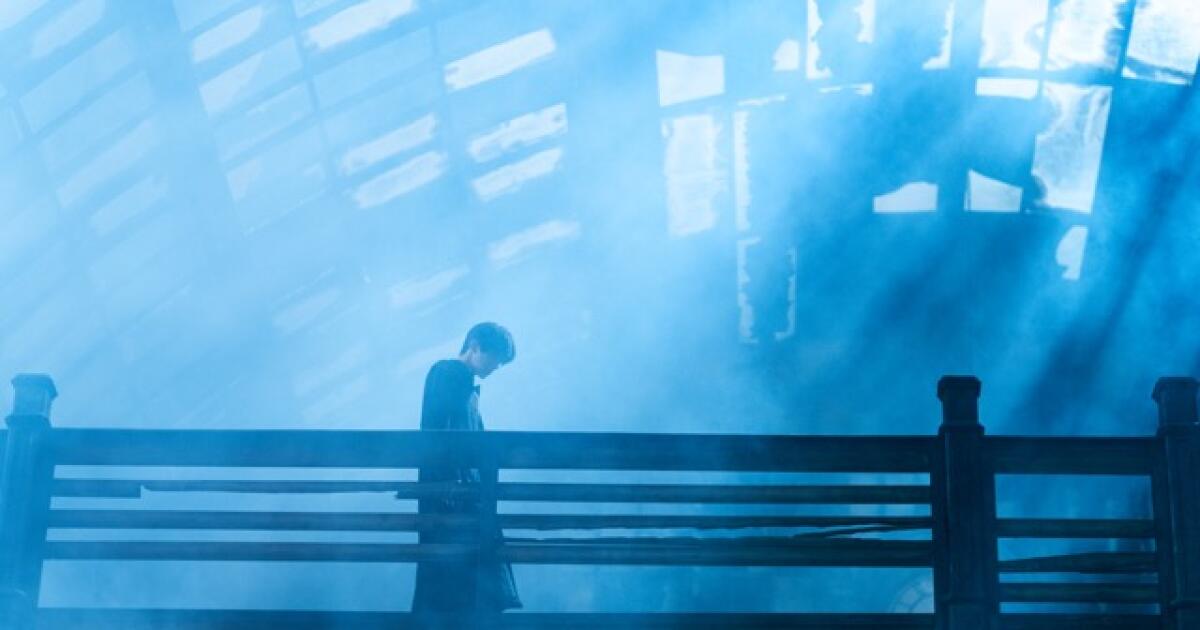
Premiering at Cannes, where it won a Special Award, “Resurrection” imagines a fantastical alternate reality in which society has chosen to stop dreaming in order to live forever. However, an unnamed “deliriant” (Jackson Yee) rejects that arrangement, preferring the chaos and pain of a human life. He escapes into a mystical realm that is shown in a series of short films which span the 20th century, each vignette starring him in a different guise. In one, he plays Qiu, who is accused of murder as part of a noirish thriller. In another, he’s Apollo, a small-time crook celebrating New Year’s Eve in 1999, lured by a temptress, Tai Zhaomei (Li Gengxi), who’s also a vampire.
Traipsing through genres and time periods, these excursions are an opportunity for Bi and his creative team to frolic in various cinematic sandboxes. When we meet Yee’s shifting character, he first resembles a hideous beast reminiscent of F.W. Murnau’s title character from 1922’s “Nosferatu.” The segment expertly samples the jagged production design and theatrical lighting of German Expressionism’s heyday.
But Bi is after more than elaborate dress-up, conceiving each episode as an exploration of how movies amplify and comment on life’s cavalcade of emotions. Later, Yee’s monster is reborn as a stoic con artist who recruits a young girl (Guo Mucheng) to be his partner in crime. This wistful chapter evokes classics like “Paper Moon,” but Bi lands on a resolution that’s uniquely heartbreaking, connecting the illusion of movies with the delusions we cling to in the real world.
As he has done in his previous films, Bi creates a climax for “Resurrection” that culminates in a masterfully orchestrated long take, one lasting just under 30 minutes, as we follow Apollo and Tai Zhaomei on an electric adventure through a New Year’s Eve involving gangsters, karaoke bars and random bloodsucking. The segment is easily the film’s showiest, Bi’s camera snaking through streets and darting into different buildings. But the audaciousness is always in service of capturing the headlong rush of new love, the characters as giddy as the filmmaking. Even here, though, “Resurrection” drills down into something unbearably moving, turning the century’s end into an apocalyptic occurrence, the future perilously uncertain for these impetuous lovers.
The 20th century that “Resurrection” chronicles was a pivotal period for China, bringing to a close the Qing Dynasty and ushering in the rise of a communist superpower. It was also a century that heralded cinema’s ascension as the dominant popular art form worldwide. Bi is far more invested in that latter revolution and consequently, “Resurrection” can be seen as an elegy for a medium whose cultural relevance has somewhat slipped. No wonder, then, that the film’s genre-hopping dexterity is laced with a hint of melancholy.
It’s a cliché to say that movies are a form of dreaming, but people who love them understand that as a foundational truth. The wonder of being alive is to grapple with mortality — to know that everything, including a movie, fades away. Bi throws his lot in with the monsters and “Resurrection” concludes with a personal and artistic reckoning that’s as defiant and emotional as anything cinema has produced in recent years.
Turns out, the world did not, in fact, stop spinning when we entered the 21st century. But Bi’s journey through cinema’s past argues that a movie’s greatness stems not from spectacle but, rather, a belief that we can see ourselves in its story. “Resurrection” is the work of a vivid soul who has kept the faith. He invites us to dream along.
‘Resurrection’
In Mandarin, with subtitles
Not rated
Running time: 2 hours, 40 minutes
Playing: Opens Friday, Dec. 12 at Laemmle Royal

Across the three feature films he’s made to date, the 36-year-old Chinese filmmaker Bi Gan has proven himself prodigiously gifted at manipulating the parameters of time and space through moving images, resulting in visually astonishing, narratively diffuse feats of showmanship that drift and shift in accordance with a self-consciously slippery dream logic.
In his 2015 debut, “Kaili Blues,” which maps the contours of the area around his hometown, Kaili City, in southwestern Guizhou province, Bi traced the psychic and physical geography of his own youth to reflect on rural China’s relationship to the country’s rapidly advancing modernity. Wandering the streets and alleys of a riverside village in a bravura long take that collapsed its past, present, and future in a swirl, he announced himself as a boldly cinematic voice, one for whom restless yearning to escape from existentially impoverished realities into fantastic, subconscious realms was clearly a formal and thematic imperative.
His elliptical debut turned out to be mere table-setting for “Long Day’s Journey Into Night,” a labyrinthine neo-noir that—despite unfurling across Guizhou province—was a more baroque, impersonal affair. Following another drifter in search of a missing person, Bi reinterpreted this generic premise as a jumping-off point to meditate at large on time, memory, and cinema’s role in shaping both, enumerating his influences—among them Hou Hsiao-hsien, Wong Kar-wai, and Andrei Tarkovsky, the latter of whom Bi has openly referred to as a formative inspiration—while burnishing his international reputation as a filmmaker capable of traversing stylistic boundaries with supreme confidence. Again came a fluid long take, this time in the form of an hour-long 3D sequence shot that started once its protagonist took his seat at a run-down movie house.
This sophomore effort—technically a leap forward, one achieved with a surfeit of production resources—brought Bi toward other issues, none unfamiliar for an emerging auteur with his emphases. Most glaringly, for all the puzzling surface pleasures wrought by its heightened stylization and oblique storyline, the film felt consciously artificial, all but completely lacking its predecessor’s tactility. If “Kaili Blues” laid the groundwork for Bi’s cineastic language, it also grounded him in a localized context where his abstractions could still accrue atmospheric density. “Long Day’s Journey Into Night” might be seen as unburdened by its aversion to narrative or emotional clarity, but its flourishes felt curiously weightless and inconsequential.
“Resurrection,” Bi’s third feature, is no less staggering than his last two, and it’s saturated with some of the more striking images you’re likely to see in a theater this year. Still, its onerously oneiric progression is a disappointing development, signaling a greater shift from the yearning poetics of Bi’s past work toward circular meta-cinematic pastiche. If his previous films were concerned with exploring time and memory, the subject of dreaming is what most moves Bi in “Resurrection” — but in all three instances, his thesis is essentially the same self-reflexive assertion of belief in cinema’s power to reflect the experience of our inner journeys.
Styled as a love letter to the grand illusion of cinema, albeit one to be read upon its deathbed, “Resurrection” opens in a fitfully imagined alternate reality where imagination itself has become imperiled. People have discovered that the secret to immortality lies in no longer dreaming. However, a small subset of the population has defied this anti-dreaming decree, preferring to still revel in fantasies despite the fact that this significantly shortens their lifespans. (A series of intertitles, styled to emulate those of the silent-film era, compares people not dreaming to “candles that do not burn,” and Bi consistently returns to this metaphor across each of the film’s chapters.)
Dream dissidents, known as “Deliriants,” are summarily outcast from society and hunted down by “Other Ones,” who are capable of entering their dreams and do so to extinguish them, lest these outliers become monstrous. “Resurrection” follows one Deliriant, played by Chinese pop star and actor Jackson Yee, as he shapeshifts from dream to dream at the behest of an Other One (Shu Qi), who installs a film projector inside him as a seeming act of mercy, allowing him a few reveries more before his inevitable death. Comprising the rest of the film, each of the Deliriant’s dream scenarios is linked to a different era of moviemaking, from German expressionism to neon-streaked, Wong Kar-wai-indebted romanticism; Bi also connects each vignette to one of the five senses and places them in distinct periods of 20th-century Chinese history.
The most spellbinding section comes first, through Bi’s tribute to silent melodrama, as the Other One hunts Yee’s Deliriant through what appears to be a Chinese opium den but soon transforms into a byzantine maze of exaggerated, crooked film-set backdrops. Evoking memories of both Murnau and Méliès, the accomplished production design of “Resurrection”—by Liu Qiang and Tu Nan—shines brightest here. Through its successive sections, the film then morphs into a war-time espionage thriller, adrift in smoke and mirrors; a folktale set in the ruins of a Buddhist temple, involving a thief and a trickster god; a tragicomic riff on “Paper Moon,” about a con artist and his orphan apprentice who allege they can identify playing cards by smell; and, finally, a woozy romance between two young lovers—one seemingly a vampire—on the eve of the new millennium, this last part playing out as another of Bi’s virtuosic long takes.
The ambition, as we’ve come to expect from him, is overpowering. “Resurrection” is alternately a sci-fi picture, a monster movie, a film noir, a cryptic parable, a crime caper, and a gangland romance — and it’s sometimes all of the above, blurring tones and textures to suggest a certain metamorphic potential within each of the stories as the Deliriant experiences them. Yet there’s a curiously draining quality to Bi’s film as well, one that feels related less to its sprawling scope than to the repetitive, riddling nature of the segments therein. As a procession of characters is transmogrified in strange ways, or otherwise meet surprising ends, across a series of abstruse set pieces that function primarily to pay homage to various techniques, Bi’s dominant mood is one of plaintive desolation, and this wears thin as quickly as all the willfully ersatz dialogue he invites audiences to puzzle over.
Bi’s reverence for the century of cinema he references throughout “Resurrection” is indisputable, and the sheer opulence on display will leave some enraptured. Certainly, in terms of production design and cinematography, he’s assembled an intimidating contraption made up of far too many moving parts to track upon initial viewing. But the effect of this outsized ambition is often mannered, even mechanistic.
For all its waxing lyrical about the need for humanity to keep dreaming through cinema, all its technically polished tributes to film history, its showmanship lacks emotional substance. If imitation is the sincerest act of flattery, here it also proves flattening; as in “Long Day’s Journey Into Night,” Bi enshrines his influences through recurrent motifs and symbols, through one assured demonstration of a recognizable style after another, but in doing so he also entombs them, creating a film that feels like less a work of imaginative possibility from an ascendant master than an act of preservation by a dutiful curator.
Paradoxically, for a film about the undying essence of the movies, what’s missing is any more molten, organic sense of processing that would evoke the true surreality of dream states. In place of an artist’s passion, Bi’s cold touch carries an undertaker’s sense of ceremony. Without a deeper subconscious drive behind his construction, it also lacks the intense aura of mystery and desire one would welcome in a grand monument like this. Instead, Bi has erected a series of simulacra, a hall of mirrors that reflect one another endlessly yet also indifferently; its images only seem to grow smaller and smaller as they recede into infinite distance. “Resurrection” is ravishing in its command of shadow and light, but it studiously hollows out any sense of soul beneath the surface.
“Resurrection” is now in theaters, via Janus Films.

Ohio surgeon allegedly forced abortion pills into sleeping girlfriend’s mouth after learning of pregnancy

Oklahoma man accused of threatening federal agents online

Iron Academy and Academy31 prove America can still revive its failing education system

Luigi Mangione case: DOJ demands potential death penalty stay on table for accused assassin

Detroit-area teen charged in carjacking at Applebee’s restaurant bound over to circuit court

Florida High School Football Rankings: Top 25 teams – Oct. 21

Cleary's 21 help Le Moyne down Central Connecticut State 69-64 in OT

How old is Bo Nix? What to know about Oregon quarterback ahead of 2024 NFL Draft

99th annual Pony Swim held in Virginia

Video: ‘It Didn’t Have to Happen This Way:’ U.Va. Faculty Call for Review of Police Response to Protests

Republican House leader signals plan to begin contempt proceedings against Bill and Hillary Clinton

Three years on, former MEP Kaili remains in limbo still awaiting trial

Afghan CIA fighters face stark reality in the U.S. : Consider This from NPR

Video: Behind the Supreme Court’s Push to Expand Presidential Power

Kilmar Abrego Garcia seen for first time since release, pledges to ‘continue to fight’ Trump admin
-

 Alaska7 days ago
Howling Mat-Su winds leave thousands without power
-

 Texas7 days ago
Texas Tech football vs BYU live updates, start time, TV channel for Big 12 title
-

 Ohio1 week ago
Who do the Ohio State Buckeyes hire as the next offensive coordinator?
-

 Washington4 days ago
LIVE UPDATES: Mudslide, road closures across Western Washington
-

 Iowa6 days ago
Matt Campbell reportedly bringing longtime Iowa State staffer to Penn State as 1st hire
-

 Miami, FL6 days ago
Urban Meyer, Brady Quinn get in heated exchange during Alabama, Notre Dame, Miami CFP discussion
-

 Cleveland, OH6 days ago
Man shot, killed at downtown Cleveland nightclub: EMS
-
World5 days ago
Chiefs’ offensive line woes deepen as Wanya Morris exits with knee injury against Texans

