

Entertainment
Review: ‘Resurrection’ is a sumptuous, transporting dive into the pure pleasures of the image
One of the downsides of our movie-mad filmmakers — the Quentin Tarantinos who happily plunder from cinema’s illustrious past — is that their worldview can be myopic beyond what’s up there on the screen. For all their technical acumen, the hum and whir of life remains absent in their work, which merely mimics the semblances of behavior they’ve observed from other films. These directors can synthesize the architecture of cinema but not the underlying humanity that transforms movies into something that resonates.
What’s so impressive about Bi Gan’s excellent third feature is that he manages to have it both ways. The Chinese director behind 2015’s “Kaili Blues” and 2018’s “Long Day’s Journey Into Night” makes movies besotted with the act of making movies. They include accomplished long takes and sensuous riffs on well-defined genres.
And yet he’s never lost sight of the fragile characters at the center of his spectacles. With “Resurrection,” Bi delivers something uncommonly rich, boldly conceiving his latest as a salute to the history of film. Still, his focus remains on people — whether they be in his stories or watching in the theater.
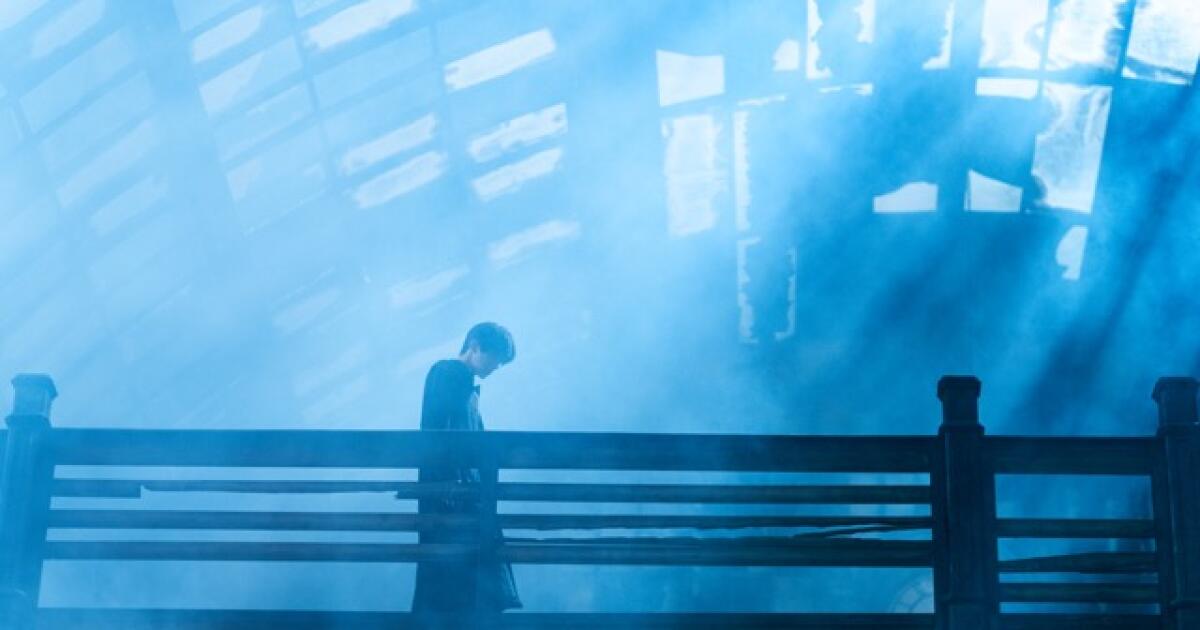
Premiering at Cannes, where it won a Special Award, “Resurrection” imagines a fantastical alternate reality in which society has chosen to stop dreaming in order to live forever. However, an unnamed “deliriant” (Jackson Yee) rejects that arrangement, preferring the chaos and pain of a human life. He escapes into a mystical realm that is shown in a series of short films which span the 20th century, each vignette starring him in a different guise. In one, he plays Qiu, who is accused of murder as part of a noirish thriller. In another, he’s Apollo, a small-time crook celebrating New Year’s Eve in 1999, lured by a temptress, Tai Zhaomei (Li Gengxi), who’s also a vampire.
Traipsing through genres and time periods, these excursions are an opportunity for Bi and his creative team to frolic in various cinematic sandboxes. When we meet Yee’s shifting character, he first resembles a hideous beast reminiscent of F.W. Murnau’s title character from 1922’s “Nosferatu.” The segment expertly samples the jagged production design and theatrical lighting of German Expressionism’s heyday.
But Bi is after more than elaborate dress-up, conceiving each episode as an exploration of how movies amplify and comment on life’s cavalcade of emotions. Later, Yee’s monster is reborn as a stoic con artist who recruits a young girl (Guo Mucheng) to be his partner in crime. This wistful chapter evokes classics like “Paper Moon,” but Bi lands on a resolution that’s uniquely heartbreaking, connecting the illusion of movies with the delusions we cling to in the real world.
As he has done in his previous films, Bi creates a climax for “Resurrection” that culminates in a masterfully orchestrated long take, one lasting just under 30 minutes, as we follow Apollo and Tai Zhaomei on an electric adventure through a New Year’s Eve involving gangsters, karaoke bars and random bloodsucking. The segment is easily the film’s showiest, Bi’s camera snaking through streets and darting into different buildings. But the audaciousness is always in service of capturing the headlong rush of new love, the characters as giddy as the filmmaking. Even here, though, “Resurrection” drills down into something unbearably moving, turning the century’s end into an apocalyptic occurrence, the future perilously uncertain for these impetuous lovers.
The 20th century that “Resurrection” chronicles was a pivotal period for China, bringing to a close the Qing Dynasty and ushering in the rise of a communist superpower. It was also a century that heralded cinema’s ascension as the dominant popular art form worldwide. Bi is far more invested in that latter revolution and consequently, “Resurrection” can be seen as an elegy for a medium whose cultural relevance has somewhat slipped. No wonder, then, that the film’s genre-hopping dexterity is laced with a hint of melancholy.
It’s a cliché to say that movies are a form of dreaming, but people who love them understand that as a foundational truth. The wonder of being alive is to grapple with mortality — to know that everything, including a movie, fades away. Bi throws his lot in with the monsters and “Resurrection” concludes with a personal and artistic reckoning that’s as defiant and emotional as anything cinema has produced in recent years.
Turns out, the world did not, in fact, stop spinning when we entered the 21st century. But Bi’s journey through cinema’s past argues that a movie’s greatness stems not from spectacle but, rather, a belief that we can see ourselves in its story. “Resurrection” is the work of a vivid soul who has kept the faith. He invites us to dream along.
‘Resurrection’
In Mandarin, with subtitles
Not rated
Running time: 2 hours, 40 minutes
Playing: Opens Friday, Dec. 12 at Laemmle Royal
Movie Reviews
FILM REVIEW: ROSE OF NEVADA – Joyzine
‘4’, the opening track on Richard D James’ (Aphex Twin) self titled 1996 album is a piece of music that beautifully balances the chaotic with the serene, the oppressive and the freeing. It’s a trick that James has pulled off multiple times throughout his career and it is a huge part of what makes him such an iconic and influential artist. Many people have laid the “next Aphex Twin” label on musicians who do things slightly different and when you actually hear their music you realise that, once again, the label is flawed and applied with a lazy attitude. Why mention this? Well, it turns out we’ve been looking for James’ heir apparent in the wrong artform. We’ve so zoned in on music that we’ve not noticed that another Celtic son of Cornwall is rewriting an art form with that highwire balancing act between chaos and beauty. That artist is writer, director and composer Mark Jenkin who over his last two feature films has announced himself as an idiosyncratic voice who is creating his very own language within the world of cinema. Jenkin’s films are often centred around coastal towns or islands and whilst they are experimental or even unsettling, there is always a big heart at the centre of the narrative. A heart that cares about family, tradition, culture, and the pull of ‘home’. Even during the horror of 2022’s brilliant Enys Men you were anchored by the vulnerability and determination of its main protagonist.
This month sees the release of Jenkin’s latest feature film, Rose of Nevada, which is set in a fractured and diminished Cornish coastal town. One day the fishing boat of the film’s title arrives back in harbour after being missing for thirty years. The boat is unoccupied. And frankly that is all the information you are going to get because to discuss any more plot would be unfair on you and disrespectful to Jenkin and the team behind the film. You the viewer should be the one who decides what it is about because thematically there are so many wonderful threads to pull on. This writer’s opinions on what it is about have ranged from a theme of sacrifice for the good of a community to the conflict within when part of you wants to run away from your roots whilst the other half longs to stay and be a lifelong part of its tapestry. Is it about Brexit? Could be. Is it about our own relationships with time and our curation of memory? Could be. Is it about both the positives and negatives of nostalgia? Could be. As a side note, anyone in their mid-40s, like me, who came of age in the 1990s will certainly find moments of warm recognition. Is the film about ghosts and how they haunt families? Could be…I think you get the point.
The elements that make the film so well balanced between chaos and calm are many. It is there in the differing performances between the brilliant two lead actors George MacKay and Callum Turner. It is there in the sound design which fluctuates from being unbearably harsh and metallic, to lulling and warm. It is there in the editing where short, sharp close ups on seemingly unimportant factors are counterbalanced with shots that are held for just that little bit too long. For a film set around the sea, it is apt that it can make you feel like you’re rolling on a stomach churning storm one minute, or a calming low tide the next. Dialogue can be front and centre or blurred and buried under static. One shot is bathed in harsh sunlight whilst the next can be drowned in interior shadows.
Rose of Nevada is Mark Jenkin’s most ambitious film to date yet he has not lost a single iota of innovation, singularity of vision or his gift for telling the most human of stories. It is a film that will tell you different things each time you see it and whilst there are moments that can confuse or beguile, there is so much empathy and love that it can leave you crying tears of emotional understanding. It is chaotic. It is beautiful. It is life……
Rose of Nevada is released on the 24th April.
Mark Jenkin Instagram | Threads
Released through the BFI – Instagram | Facebook
Review by Simon Tucker
Keep up to date with all new content on Joyzine via our
Facebook | Bluesky | Instagram | Threads | Mailing List
Related
Entertainment
Larry David discusses ‘Curb Your Enthusiasm,’ ‘Seinfeld’ legacies and new HBO series
Inside the ornate Bovard Auditorium, Larry David kept a full audience in stitches as he discussed the creation and legacy of his improv hit, “Curb Your Enthusiasm,” which concluded in 2024 after 12 seasons.
In a conversation with Lorraine Ali — who wrote “No Lessons Learned: The Making of Curb Your Enthusiasm,” which retraces the show’s 24-year run with cast interviews, episode guides and behind-the-scenes material — David reflected on the separation between himself and the abrasive on-screen persona he adopted for more than two decades.
“I wish I was that Larry David,” he said.
David spoke about the outrageous audition process for “Curb,” wherein actors tried to navigate a brief written scenario without any dialogue to guide them as David lambasted them in character. Out of this process came iconic one-liners and beloved characters, such as Leon, played by J.B. Smoove.
“People bring out certain things, and when I would act with them, some of them would make me seem funny,” David said. “I go, ‘Oh, that’s good — let’s give him a part.’”
David cited “Palestinian Chicken” as one of his favorite episodes of the show. In the episode, David is caught between a delicious new Palestinian chicken restaurant, a Palestinian girlfriend and an outraged inner circle of Jewish friends.
He also spoke briefly about his upcoming episodic HBO series, “Life, Larry and the Pursuit of Happiness,” a historical spoof that will retrace United States history for the country’s 250th founding anniversary. The series will premiere on Aug. 7.
“A lot of wigs, costumes, beards — fake beards,” David said. “Nothing worse than fake beards.”
The controversial ending of “Seinfeld,” which David co-wrote with comedian Jerry Seinfeld, was polarizing among fans when it was released, David said. After a recent rewatch, however, David said he thought it was “pretty good,” to a round of applause from the audience.
Near the end of the panel, an audience member asked a question some definitely had on their mind: Will “Seinfeld” ever get a reunion?
“No,” David replied without missing a beat.
Movie Reviews
‘Hen’ movie review: György Pálfi pecks at Europe’s migrant crisis through the eyes of a chicken
A rogue chicken observes the world around it—and particularly the plight of immigrants in Greece—in Hen, which premiered at last year’s Toronto International Film Festival and is now playing in Prague cinemas (and with English subtitles at Kino Světozor and Edison Filmhub). This story of man through the eyes of an animal immediately recalls Robert Bresson’s Au Hasard Balthazar (and Jerzy Skolimowski’s more recent EO), but director and co-writer György Pálfi (Taxidermia) maintains a bitter, unsentimental approach that lands with unexpected force.
Hen opens with striking scenes inside an industrial poultry facility, where eggs are laid, processed, and shuttled along assembly lines of machinery and human hands in an almost mechanized rhythm of production. From this system emerges our protagonist: a black chick that immediately stands apart from the others, its entry into the world defined not by nature, but by an uncaring food industry.
The titular hen matures quickly within this environment before being loaded onto a truck with the others, presumably destined for slaughter. Because of her black plumage, she is singled out by the driver and rejected from the shipment, only to be told she will instead end up as soup in his wife’s kitchen. During a stop at a gas station, however, she escapes.
What follows is a journey through rural Greece by the sea, including an encounter with a fox, before she eventually finds refuge at a decaying roadside restaurant run by an older man (Yannis Kokiasmenos), his daughter (Maria Diakopanayotou), and her child. Discovered by the family’s dog Titan, she is placed in a coop alongside other chickens.
After finding a mate in the local rooster, she lays eggs that are regularly collected by the man; in one quietly unsettling scene, she watches him crack them open and cook them into an omelet. The hen repeatedly attempts to escape, as we slowly observe the true function of the property: it is being used as a transit point for migrants arriving in Greece by boat, facilitated by local criminal figures.
Like Au Hasard Balthazar and EO, Hen largely resists anthropomorphizing its animal protagonist. The hen behaves as a hen, and the humans treat her accordingly, creating a work that feels unusually grounded and almost documentary in texture. At the same time, Pálfi allows space for the audience to project meaning onto her journey, never fully closing the gap between instinct and interpretation.
There are moments, however, where the film deliberately leans into stylization. A playful montage set to Ravel’s Boléro captures her repeated escape attempts from the coop, while a romantic musical cue underscores her brief pairing with the rooster. These sequences do not break the realism so much as refract it, gently encouraging us to read emotion into behavior that remains, on the surface, purely animal.
One of the film’s central narrative threads is the hen’s search for a safe space to lay her eggs without them being taken away by the restaurant owner. This deceptively simple instinct becomes a powerful thematic mirror for the film’s human subplot involving migrant trafficking. Pálfi draws a stark, often uncomfortable parallel between the treatment of animals as commodities and the treatment of displaced people as disposable bodies moving through a similar system of exploitation.
The film takes an increasingly bleak turn toward its climax as the migrant storyline comes fully into focus, sharpening its allegorical intent. The juxtaposition of animal and human vulnerability becomes more explicit, reinforcing the film’s central critique of systemic indifference and violence. While effective, this escalation feels unusually dark, and our protagonist’s unknowing role feels particularly cruel.
The use of animal actors in Hen is remarkable throughout. The hen—played by eight trained chickens—is seamlessly integrated into the film’s world, with seamless editing (by Réka Lemhényi) and staging so precise that at times it feels almost impossible without digital augmentation. While subtle effects work must assist at certain moments, the result is convincing throughout, including standout sequences involving a fox and a dog.
Zoltán Dévényi and Giorgos Karvelas’ cinematography is also impressive, capturing both the intimacy of the hen’s low vantage point and the broader Greek landscape with striking clarity. The camera’s proximity to the animal world gives the film a distinct visual grammar, grounding its allegory in tactile observation rather than abstraction.
Hen is a challenging but often deeply affecting allegory that extends the tradition of animal-centered cinema while pushing it into harsher political territory. Pálfi’s approach—unsentimental, patient, and often confrontational—ensures the film lingers long after its final images. It is not an easy watch, nor a comfortable one, but it is a strikingly original piece of filmmaking that uses its unusual perspective to cast familiar human horrors in a stark, unsettling new light.
-
Rhode Island3 minutes agoThe Real Housewives of Rhode Island Recap: Wrong Side of the Tracks
-
South-Carolina9 minutes agoSouth Carolina Lottery Pick 3, Pick 4 results for April 19, 2026
-
South Dakota15 minutes agoFCS Football Recruiting Roundup: South Dakota, Montana State Target 2027 Defensive Standouts
-
Tennessee21 minutes agoNashville Sounds and Autism Tennessee partner to host inclusive Beyond the Label Day for local children
-
Texas27 minutes agoTexas A&M Forward Transfer Seemingly on Visit to See Lady Vols Basketball | Rocky Top Insider
-
Utah33 minutes agoGolden Knights vs. Mammoth Game 1 prediction: NHL odds, picks, best bets for Stanley Cup Playoffs
-
Vermont39 minutes agoVermont lawmakers reject digital lottery initiative – Valley News
-
Virginia45 minutes agoVirginia’s special election redistricting battle is next week and has national impacts
