Entertainment
Taylor Swift searches get 'temporary' block on X after deepfakes. It's a flawed solution

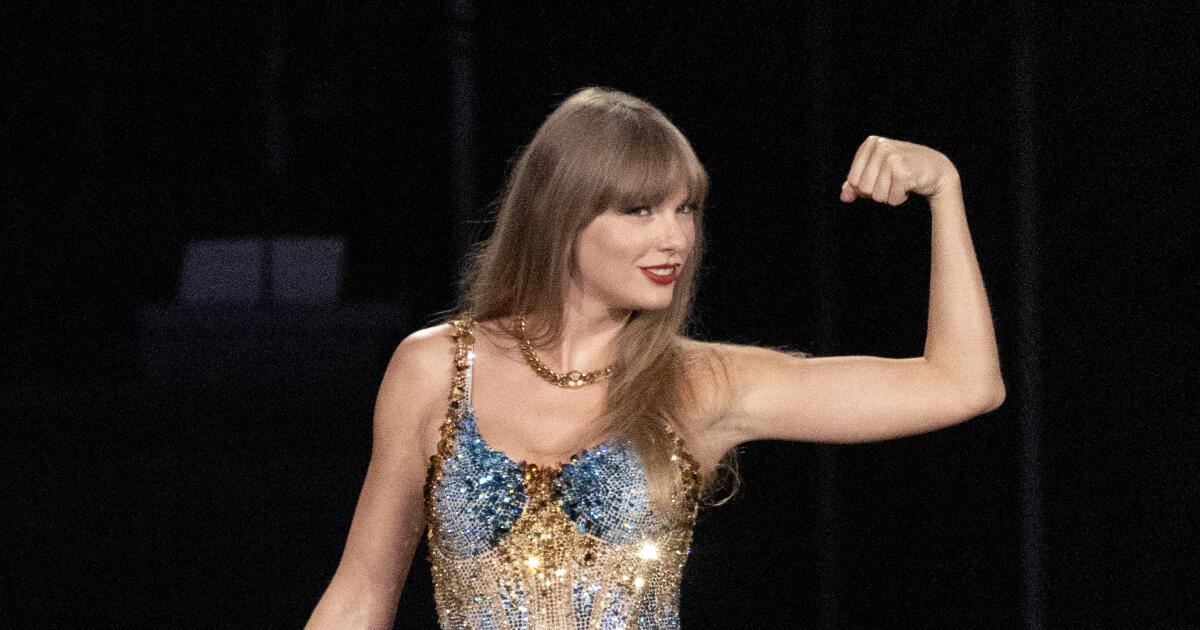
The social media platform X, formerly known as Twitter, has taken steps to limit the further spread of explicit deepfake images of Taylor Swift after they went viral last week.
Amid outcry from Swift’s fans on social media, lawmakers and the actors’ union SAG-AFTRA, X made the Grammy winner’s name unsearchable on its platform over the weekend. As of Monday afternoon, searching Swift’s name without quotes results in an error page that reads: “Something went wrong. Try reloading.”
“This is a temporary action and done with an abundance of caution as we prioritize safety on this issue,” Joe Benarroch, head of business operations at X, said in a statement shared with the Associated Press.
Last week, several explicit AI-generated images of the “Bejeweled” and “Cruel Summer” singer circulated on X. The doctored pictures were pornographic and referenced the 34-year-old’s high-profile romance with Kansas City Chiefs tight end Travis Kelce.
Hours after the images surfaced on Thursday, X’s safety team reminded users of its “zero-tolerance policy” on sharing “Non-Consensual Nudity (NCN) images.” The statement, which did not explicitly mention Swift, also said that users who posted the images would be held accountable.
“We’re closely monitoring the situation to ensure that any further violations are immediately addressed, and the content is removed,” X’s safety account added. “We’re committed to maintaining a safe and respectful environment for all users.”
X’s new restricted search action isn’t without fault. As of Monday afternoon, searching Swift’s full name in quotes or adding additional words at the end of the search phrase “Taylor Swift” conjures up posts, replies and images as usual — including graphic deepfakes of Swift.
Tesla Chief Executive Elon Musk, who officially took over Twitter in October 2022, made cuts to the platform’s moderation team, which was tasked to enforce rules against harmful content.
A representative for X did not immediately respond Monday to The Times’ request for comment.
Swift has not yet publicly addressed the explicit images, but the controversy reignited conversations about artificial intelligence and the need for more oversight, especially as the creation of AI images continues to overwhelmingly affect women and children.
“The spread of AI-generated explicit images of Taylor Swift is appalling — and sadly, it’s happening to women everywhere, every day,” New York Rep. Joe Morelle said in a Thursday tweet.
“It’s sexual exploitation,” he added, before touting his proposed Preventing Deepfakes of Intimate Images Act, a bill that would make it illegal to share deepfake pornography without the consent of individuals being portrayed.
News of the Swift AI images raised bells, as Microsoft Chief Executive Officer Satya Nadella and White House Press Secretary Karine Jean-Pierre separately addressed the controversy on Friday.
“This is very alarming. And so, we’re going to do what we can to deal with this issue,” Jean-Pierre said during a press briefing, according to Reuters. “So while social media companies make their own independent decisions about content management, we believe they have an important role to play in enforcing, enforcing their own rules to prevent the spread of misinformation, and nonconsensual, intimate imagery of real people.”
SAG-AFTRA, which laid out terms concerning artificial intelligence in its 2023 contract, dubbed the AI images of Swift “upsetting, harmful, and deeply concerning.”
“The development and dissemination of fake images — especially those of a lewd nature — without someone’s consent must be made illegal,” the union said in a Friday statement. “As a society, we have it in our power to control these technologies, but we must act now before it is too late.”


![“Redux Redux”: A Mind-Blowing Multiverse Movie That Will Make You Believe in Cinema Again [Review]](https://i1.wp.com/www.thathashtagshow.com/wp-content/uploads/2026/02/Redux-Redux-Review.png?w=400&resize=400,240&ssl=1 "“Redux Redux”: A Mind-Blowing Multiverse Movie That Will Make You Believe in Cinema Again [Review]")


Movie Reviews
“Redux Redux”: A Mind-Blowing Multiverse Movie That Will Make You Believe in Cinema Again [Review]
![“Redux Redux”: A Mind-Blowing Multiverse Movie That Will Make You Believe in Cinema Again [Review]](https://i3.wp.com/www.thathashtagshow.com/wp-content/uploads/2026/02/Redux-Redux-Review.png?ssl=1 "“Redux Redux”: A Mind-Blowing Multiverse Movie That Will Make You Believe in Cinema Again [Review]")
GET READY FOR YOUR MIND TO BE BLOWN…
In 2020, the McManus brothers came out with a film called The Block Island Sound that became a bit of an underground cult hit. I found it to be a compelling little mystery, that put this directing duo on my radar. Five years later they have returned with another highly original film, that improves upon that picture in every way and cements these brothers as independent cinema royalty in my book.
Redux Redux follows Irene, a mother who uses a mechanical box to travel to different parallel worlds. Her daughter was murdered by a serial killer years ago and she has made it her mission to travel to every alternate universe, to kill this man in every one. But, when she comes upon a girl who has been kidnapped by the killer; Irene is forced to change this perpetual cycle or else they both will be condemned for life.
IF YOU THOUGHT TRULY “ORIGINAL FILMS” WERE DEAD… THINK AGAIN.
I have spent the last five years reviewing films, covering hidden gems to try and share them with the rest of the world. There’s a lot of really shitty movies out there, especially in this new age of streaming; so when I find a truly special, original film that I know not many people have heard of, all I want to do is sing its praises to anyone who will listen. It doesn’t happen often, maybe a couple of times a year, but when one of those movies comes along… the pure joy I get from it, is what makes this career worth it. And I got that feeling with Redux Redux.

The McManus Brothers have crafted a film that is hitting on all cylinders. And it really proves that there are no limitations in independent cinema, only the ones that are put on by its creators. And this directing duo take their highly ambitious screenplay and with just a shoestring budget, make it look easy. There are some extremely insane ideas in their script, as this is a sci-fi film through and through, but it’s so grounded in this gritty realism that sometimes you forget you’re watching a film about multiverses.
ITS ACTION-PACKED, EXCEPTIONALLY PERFORMED…
I can’t think of a recent film that has put me on the edge of my seat as much as Redux Redux. The action scenes are pulse-pounding, the tension is palpable, and there are some extremely brutal moments that are shockingly violent. My eyes were glued to the screen from beginning to end, I never checked my phone or even looked at the time… I was locked in. I think it also helps that this movie has an air of mystery surrounding it and you just want to learn more. How does this parallel-universe hopping work? Is there a universe where Irene’s daughter wasn’t murdered? Where did the serial killer hide all of the bodies? There’s just so many layers to the plot, there’s no chance that you would want to look away.

I also have to shout-out the acting, which is way above what one normally expects from a film in this genre. Michaela McManus, sister to the writer/directors of the film, is exceptional as Irene. She is a no-nonsense bad-ass that fucks this guy up from universe to universe. But, she’s also a woman grappling with intense grief and depression, completely worn out by this world, no matter which one she is in. She handles all of the complexities to this character with ease. I genuinely cared for Irene, and without that care, this film would not have worked. Indie Darling Jim Cummings also from The Block Island Sound, as well as The Beta Test and The Last Stop in Yuba County, is an integral supporting player here and if he shows up in a film… you know, almost certainly, that it’s going to be a banger.
…AND THOUGHT-PROVOKING.
Lastly, Redux Redux is also surprisingly deep. It tackles the idea of what happens when a person loses their humanity, someone who has become completely numb to violence and closed themselves off to the rest of the world, in a way that is thoroughly thought-provoking. It leaves the audience with the sort of questions that make you ponder where you stand in your humanity. And any movie that can make you pause and take a good hard look on your insides… is a winner in my book.
THIS IS A RECOMMENDATION FOR ANY LOVER OF CINEMA…

The McManus brothers have crafted a mean, brutal, nail-biting action film that is wrapped in a horrific serial killer thriller and then wrapped up again in a heady, profound sci-fi drama. Redux Redux is a bold, original vision that is so confidently made, you know from the get-go you are in the hands of master storytellers. I have no idea how they pulled this movie off, but holy shit, did they do the damn thing. I 100% recommend Redux Redux to any lover of cinema. Period.
For More Reviews, Make Sure to Stay Tuned to That Hashtag Show.
Keep Reading:
Entertainment
Chad Michael Murray, ‘Dawson’s Creek’ stars react to James Van Der Beek’s death as friends launch GoFundMe

James Van Der Beek, whom audiences first met as the young, floppy-haired lead in the melodrama “Dawson’s Creek,” died Wednesday at 48. The actor’s co-stars and collaborators paid tribute to the actor.
Van Der Beek’s wife, Kimberly, announced the news in an Instagram post and asked for “peaceful privacy as we grieve our loving husband, father, son, brother, and friend.”
“He met his final days with courage, faith, and grace. There is much to share regarding his wishes, love for humanity, and the sacredness of time. Those days will come,” the statement read.
The actor battled colorectal cancer, a condition he revealed in November 2024. Van Der Beek’s friends organized a GoFundMe campaign, which had collected almost $340,000 of its $550,000 goal as of early Wednesday afternoon.
Van Der Beek’s wife and their six children “are facing an uncertain future” following the actor’s death, the GoFundMe page reads. The cost of Van Der Beek’s medical care “left the family out of funds. They are working hard to stay in their home.”
Droves of celebrities paid tribute to the “Dawson’s Creek” star in the comments section of the post, including Chad Michael Murray, who appeared alongside Van Der Beek in “Dawson’s Creek” and later “One Tree Hill.”
“James was a giant,” Murray wrote. “We’re so so so sorry for what you’re going through. His words, art and humanity inspired all of us — he inspired us to be better in all ways. God bless you guys.”
Kerr Smith, who starred alongside Van Der Beek in “Dawson’s Creek,” also paid tribute to the actor.
“I’m so grateful for being able to call James a brother. I’ll miss him deeply. Rest easy,” Smith wrote in a comment under an Instagram post announcing his death.
Stacy Keibler, a retired wrestler and cheerleader, got to spend Van Der Beek’s final days with him, which she described as “a true gift from God.”
“In these past days, you taught me more about being present than any book ever could,” Keibler wrote in a touching tribute on Instagram. “You showed me what it looks like to trust God’s plan, even when it breaks your heart. Especially when it breaks your heart.”
Despite the cancer diagnosis and traveling “the world battling so much…that smile never left you,” Keibler wrote.
Austin Nichols, who also starred in “One Tree Hill” and had a background role in “Varsity Blues,” paid tribute to Van Der Beek in an Instagram post.
“James represented something to aspire to,” Nichols wrote. “As a friend, husband and father, I know he was even more powerful and inspiring. You will be missed.”
Emma Slater, a professional dancer on “Dancing With the Stars” who was partnered with Van Der Beek for Season 28, expressed devastation over the actor’s death, adding that “he is and will always be family to me.”
“Love you so much James,” Slater wrote. “The man that you are, you can be proud of. So grateful that I got to be there to say goodbye to you.”
Roger Avary, who directed “The Rules of Attraction,” a 2002 film that Van Der Beek starred in, wrote on X that the actor was “a pillar of strength to me and my family during the hardest of times.”
The pair had recently had “a very philosophical and existential phone conversation, Avary wrote.
“I have never known anyone else quite like him, and rarely felt so close a working connection, and my heart is broken at the loss, and my thoughts and prayers are with his wife and children,” Avary wrote. “God bless you, James. I love you forever.”
Other stars across entertainment, including “Modern Family” star Eric Stonestreet, “Teen Wolf” actor Tyler Posey and “Grey’s Anatomy” actor Kate Walsh all shared their condolences in the comments section of the family’s Instagram announcement.
“I’m so sad for your beautiful family. While James legacy will always live on, this is a huge loss to not just your family but the world. F— Cancer,” Sarah Michelle Gellar, widely known for her lead role in “Buffy the Vampire Slayer,” another seminal late-’90s WB high school drama, wrote in the comments section of the post announcing his death.
Joseph Kahn, who co-wrote with Van Der Beek “Power/Rangers,” a superhero fan short film based on the Power Rangers franchise, shared a tribute to the actor on X.
“There’s a shot in here where he lifts his boot on the table and the camera spins with him. He smiled approvingly when I blocked it and played to the camera. He knew,” Kahn wrote. “He gave me his time and support graciously. Thank you James.”
“Rest in Peace dear James Van Der Beek,” Marlee Matlin wrote on X. The two never worked on a project together, but both separately guest starred on “Law & Order: Special Victims Unit” and were part of a panel for the Paley Center for Media honoring the show in 2020.
Actor Paul Walter Hauser shared a picture of the amount of money he had helped raise for Van Der Beek’s cancer treatment in an Instagram post.
“I know you’re in Heaven being pampered with love. The Van Der Beeks will be in our daily prayers and we’ll be drumming up some money to support your beautiful family,” Hauser wrote. “Thanks for the body of work and for being one of the good guys.”
“What a heartbreaking loss. So much love to you, Kimberly, and to your kids, as you navigate this tender time,” Jennifer Garner commented in the post announcing his death.
Van Der Beek’s last acting credit was for his role in the Tubi YA movie “Sidelined: The QB and Me,” and its sequel, which came out last year. The actor played Leroy Lahey, the father of the movie’s protagonist, Drayton, played by Noah Beck.
Beck posted a tribute to Van Der Beek on his Instagram story, adding that the actor was “the best mentor I could ask for.”
“James u were the best. So kind, so caring, so thoughtful, so talented, great father, and just an absolute inspiration of a human being,” Beck wrote. “I feel so incredibly lucky to have met u and share the screen with u as my father.”

2026/136 minutes/rated R (for “sexual content”)
Written and directed by Emerald Fennell
Produced by Emerald Fennell, Josey McNamara and Margot Robbie
Starring: Margot Robbie, Charlotte Mellington, Jacob Elordi, Owen Cooper, Hong Chau, Vy Nguyen, Shazad Latif, Alison Oliver, Martin Clunes, Ewan Mitchell
Cinematography by Linus Sandgren
Edited by Victoria Boydell
Score by Anthony Willis
Songs by Charli XCX
Production Companies: MRC, Lie Still and Lucky Chap Entertainment
Opening theatrically on February 12 courtesy of Warner Bros.
I only read “Wuthering Heights” once, in high school. I appreciated its cultural impact and continued popularity. However, regarding mid-1800s literary classics that blend gothic horror sensibilities with romantic melodrama, I honestly preferred Daphne du Maurier’s Rebecca. I say this only to note that I have no strong feelings about Emily Brontë’s 1847 novel that would leave me unduly vexed at a potentially “unfaithful” adaptation. “Wuthering Heights” is, as explicitly promised by the filmmakers, less a straight-up retelling than a glorified Elseworld. As a movie, or even an example of a singular filmmaker taking an oft-told tale and making it her own, it’s a pretty darn terrific romantic tragedy. Emerald Fennell has crafted a cinematically scrumptious and erotically flavored bodice-ripper of the highest order.
Opening on Thursday night courtesy of Warner Bros., this $85 million, R-rated, 2.25-hour melodrama is a passionate and unapologetically “problematic” epic that uses big bucks and Hollywood movie magic to make this small-scale drama feel like a 1950s biblical epic. It leads with its emotions and thinks with its feelings, diving headfirst into what is never presented as anything less than a doomed, impossible romance between two deeply flawed, traumatized young adults. I won’t pretend that this new movie is terribly outrageous compared to what used to be par for the course for big-budget, just-for-grownups Hollywood erotic dramas. However, it gleefully plays in the blood-and-thunder sandbox. It will likely scandalize (in a healthy way) the multiple generations not used to such unapologetic, adult-skewing, PLF-worthy cinema.
Writer/director Fennell’s latest offering focuses on the core “Catherine and Heathcliff” relationship, which is little different from, frankly, most filmed adaptations going back to William Wyler’s 1939 adaptation. Shel has crafted a (my words, not hers) spiritually faithful variation on how the book resonated with her when she first read it. That said, it is no less accurate to the respective text than Guillermo del Toro’s acclaimed and Oscar-nominated Frankenstein. Moreover, if I were a cynical sonuvabitch, and I currently am, I’d note that this latest incarnation, sans even a future-tense framing device, is constructed not unlike It Chapter One. Presuming fortune and glory, WB, Lucky Chap and MRC could justify a second film chronicling what happened after Manderley burned to the… sorry, wrong book.

You’re not burning as many calories as you think you are with exercise — here’s why
![“Redux Redux”: A Mind-Blowing Multiverse Movie That Will Make You Believe in Cinema Again [Review]](https://i1.wp.com/www.thathashtagshow.com/wp-content/uploads/2026/02/Redux-Redux-Review.png?w=80&resize=80,80&ssl=1 "“Redux Redux”: A Mind-Blowing Multiverse Movie That Will Make You Believe in Cinema Again [Review]")
“Redux Redux”: A Mind-Blowing Multiverse Movie That Will Make You Believe in Cinema Again [Review]

Video: Police Identify Suspect in Mass Shooting in Canada

Video: F.A.A. Said to Have Closed El Paso Airspace Over Military’s Use of Anti-Drone Technology
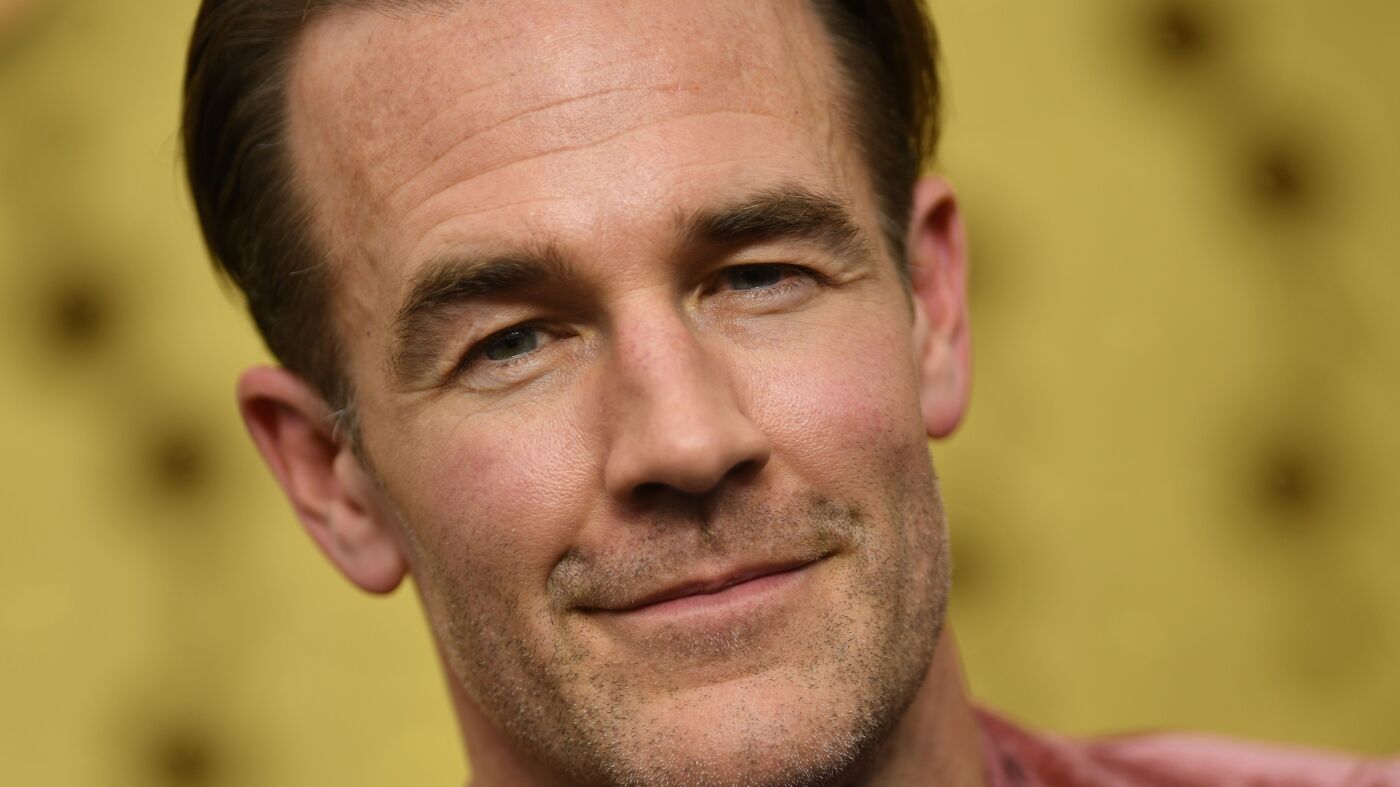
‘Dawson’s Creek’ star James Van Der Beek has died at 48

Florida High School Football Rankings: Top 25 teams – Oct. 21

Cleary's 21 help Le Moyne down Central Connecticut State 69-64 in OT

How old is Bo Nix? What to know about Oregon quarterback ahead of 2024 NFL Draft

99th annual Pony Swim held in Virginia

Indiana Members Credit Union announced as new anchor tenant at Bottleworks District
Video: F.A.A. Said to Have Closed El Paso Airspace Over Military’s Use of Anti-Drone Technology

Only one House Dem voted in favor of voter ID, proof of citizenship in US elections
Who decides who belongs in Europe? The migration debate returns

‘You’re a washed-up loser lawyer’: Pam Bondi taunts Democrats over Epstein

Video: Will Trump’s Order on Housing Help?
-

 Politics6 days ago
White House says murder rate plummeted to lowest level since 1900 under Trump administration
-

 Indiana1 week ago
13-year-old rider dies following incident at northwest Indiana BMX park
-

 Alabama4 days ago
Geneva’s Kiera Howell, 16, auditions for ‘American Idol’ season 24
-

 Indiana1 week ago
13-year-old boy dies in BMX accident, officials, Steel Wheels BMX says
-

 Politics1 week ago
Trump unveils new rendering of sprawling White House ballroom project
-

 Culture1 week ago
Try This Quiz on Mysteries Set in American Small Towns
-

 San Francisco, CA1 week ago
Exclusive | Super Bowl 2026: Guide to the hottest events, concerts and parties happening in San Francisco
-

 Massachusetts1 week ago
TV star fisherman’s tragic final call with pal hours before vessel carrying his entire crew sinks off Massachusetts coast