Entertainment
Review: 'Look Into My Eyes' is a compassionate profile of psychics, not out to scam but connect

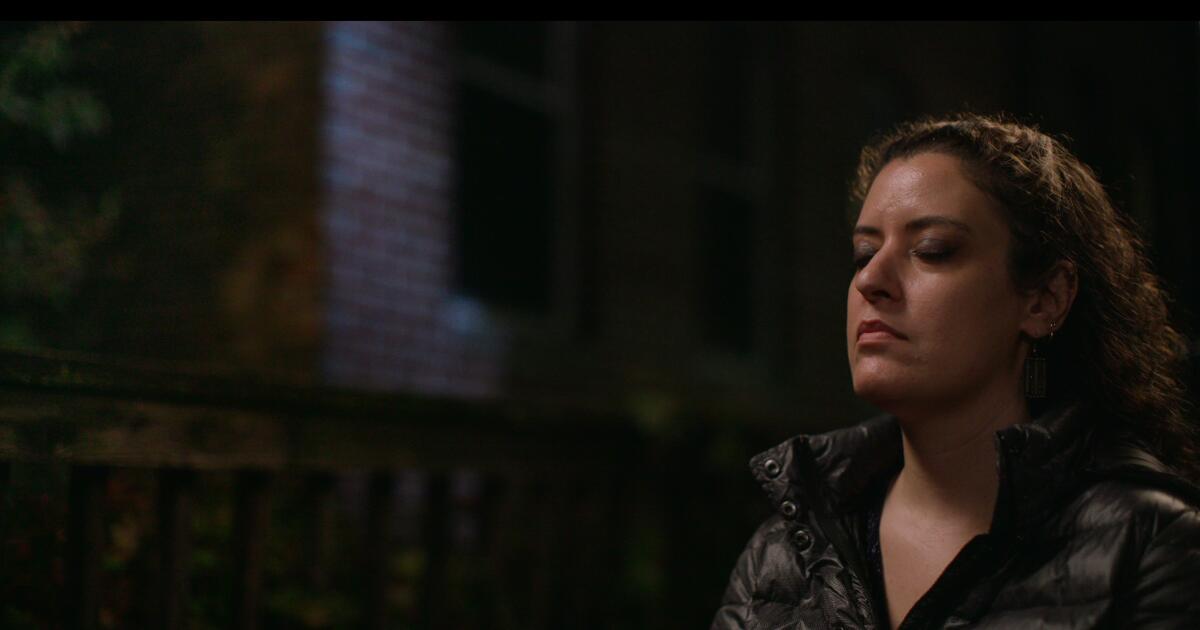
As Lana Wilson’s documentary about psychics “Look Into My Eyes” opens, a gray New York sky hovers above a nondescript building. A modest yellow glow comes from one high-storied window. Inside, a woman begins telling someone off-camera about a girl’s tragic death, something she’s held onto tightly for 20 years. There’s a question she still needs answered. How is she?
Wilson returns to that exterior building shot at the end of the film, after we’ve witnessed several more interactions and gotten to know a handful of these psychics, many of whom carry around their own unresolved aches. But at the end, the image somehow feels different: That lit window against the big, hard, anxious city conveys a hopeful warmth. It looks comforting.
Coming to “Look Into My Eyes” as a skeptic is only natural, because you’re human. The world of clairvoyants is bizarre and suspicious, and we love docs that pull back the curtain. What’s also universal, however, in these years of global trauma, is the need to address what ails us, and it’s this perspective that informs Wilson’s approach — the same one that imbued grace to her previous documentaries “After Tiller,” about abortion doctors, and “The Departure,” about a turmoil-ridden monk.
Something diverting and affecting emerges from Wilson’s close, considerate and not unskeptical hang with a diverse handful of New York psychics plying their wares and living their lives. You end up believing — not in paranormal powers or some mystical gift, but in the modest building blocks of reaching out. These tucked-away transactions of faith and performance offer, in their own way, a kind of solace.
Wilson’s observational mode is respectful, the multi-camera set-up fixed on hushed, awkward-at-first exchanges as if capturing an important interview where subject and questioner have equal standing. The faces of the clients have nervous smiles as they ask a question or await one, or receive a declaration of a spiritual presence. The psychics, too, betray their own apprehension as things come to them. Will it spark an emotion, bring them nearer to the source of the pain? Or will it go wrong? It comes off as a first dance, where both parties want to avoid stepping on toes or actively leading, yet find a rhythm that matches the music and, most importantly, feels good.
The exchanges often seem like bids for being heard, where all that’s being sought is a kind, sensible word from the friendly face in front of you. An adoptee wants details about the Chinese birth parents who gave her up. (They were greedy; being adopted can be hard.) A tightly wound woman fears her defiant dog doesn’t like her. (He senses that worry; be calmer.) A young Black man fixates on having learned about his ancestor’s slave price. (Focus on defining your own freedom.)
That assuaging goes both ways, though. The psychics’ own backstories of anguish and loneliness — unsurprisingly, they’re almost all former or still-striving actors — invariably tinge the kind of healing messages given: that a person is unique, that someone can’t change the past, that a lost loved one accepts them, that recognition is just around the corner. Some of the psychics’ lives seem, frankly, precarious, and by a certain point, we glean, quite movingly, that in these sessions, they’re soothing themselves as much as their clients.
In interviews, Wilson can be heard off-camera, gently probing: Is this essentially improv? Their replies aren’t defensive — the psychics rely on an affable confidence in not knowing exactly what is going on, but that something is. As one of them adds, “If it resonates, it doesn’t really matter.”
Human connections are gifts, imagination is powerful and empathy isn’t a trick. These are the things “Look Into My Eyes” patiently communicates to us from its watchful perch. What these freelance healers do may not be professional therapy. But the sensitive, intimate outlet shown in Wilson’s compassionate documentary — one of the year’s best — lets us put our mistrust aside to consider what can be deeply felt from a pretense accepted between willing, receptive souls.
‘Look Into My Eyes’
Rating: R, for language
Running time: 1 hour, 44 minutes
Playing: In limited release Friday, Sept. 13


Controversial AI actor Tilly Norwood will star in her first movie, a comedy drama called “Misaligned.”
The film portrays Tilly as an AI being with “no real body” and lived experience but with access to everyone else’s, according to Particle 6, the London-based company behind Norwood.
Norwood drew intense ire from many Hollywood actors last year, when an executive behind her creation said Norwood would soon be signed to a talent agency. Some actors worried that AI characters trained on human likenesses without permission or compensation could one day replace them in movies and shows.
Particle 6 emphasized that the movie is a “hybrid production” with film and TV professionals working with AI specialists.
“Our ambition with Tilly Norwood has always been to show the creative industry what is possible with AI at any one point in time,” said Eline van der Velden, Particle 6 chief executive in a statement. der Velden said the film will help traditional filmmakers “upskill and transition to a world where AI will play an increasingly important part.”
“We remain passionate about helping people develop AI skills that will ensure they – and the industry – continue to thrive,” der Velden said.
In “Misaligned,” the plot progresses when Tilly is later convinced by a rogue bot to ignore her guardrails and start developing ambitions of her own, which make her more human and famous, and “Tilly begins to develop shame that her very being has been built on the whole of humanity,” Particle 6 said.
“The film will absolutely be funny, chaotic and self-aware — very Tilly,” van der Velden said in a statement. “But underneath it, there’s something deeper about identity, performance, and our very human fears around AI. And yes, art will most definitely be imitating life.”
AI remains a controversial topic in Hollywood, as many people in the entertainment industry are preparing themselves for the way the technology will change jobs and the way things are done. AI companies have touted how their tools could lower the cost and the amount of time it takes to produce visual effects . Meanwhile, writers and actors have expressed worries about their work being misused to train AI models.
“They are taking our professional members’ work that has been created, sometimes over generations, without permission, without compensation and without acknowledgment, building something new,” SAG-AFTRA President Sean Astin said last year regarding the controversy surrounding Tilly Norwood.
“But the truth is, it’s not new. It manipulates something that already exists, so the conceit that it isn’t harming actors — because it is its own new thing — ignores the fundamental truth that it is taking something that doesn’t belong to them,” Astin said.
SAG-AFTRA did not immediately return a request for comment on Tilly’s first movie.
The union has been advocating for more AI protections for actors, recently approving a contract with major studios in which producers agreed to “a principle strongly favoring human performances” and that producers would only use a synthetic if it “brings significant additional value to the motion picture.” If a producer decided to use a synthetic in a role that could be done by a human, they would need to notify the union and bargain in good faith.
SAG-AFTRA is also supporting the NO FAKES Act, a federal bill that would give individuals the authorization to use their own voice and likeness in digital replicas and creates a way to hold bad actors liable.

The Fetus, 2025.
Directed by Joe Lam.
Starring Bill Moseley, Lauren LaVera, Julian Curtis, Evan Towell, and Ariel Yasmine.
SYNOPSIS:
A couple become pregnant with a half-human, half-demonic fetus with a thirst for blood-and must uncover its terrifying origins before it’s too late.

In The Fetus, Alessa (Lauren LaVera) discovers she has accidentally gotten pregnant by her boyfriend Chris (Julian Curtis), but instead of this being a cause for celebration Alessa tells Chris that they must visit her father Maddox (Bill Moseley) instead of going to a hospital as Maddox insisted she do that if she ever got pregnant. Chris has his own reasons for not wanting a baby and goes along with her, but Maddox is not an easy man to get to know as he is blind and suffering from PTSD as a result of being in Vietnam.
However, there are bigger stakes here than just trying to impress your girlfriend’s father as it is revealed that Alessa’s baby is the result of a pact Maddox made with a demon decades before, and that his blindness was due to him not sacrificing Alessa to that demon. Now he has a second chance to appease the demon with the vampiric tentacle monster that keeps appearing to suck the blood of anyone who isn’t kin, and Chris has to step up and decide whether he wants to be a father or not.

Or something like that, as The Fetus is a little confused by its own mythology. Taking its cue from Larry Cohen’s It’s Alive!, The Fetus is a low-budget indie affair that has its star names to thank for lifting it up and out of the bin marked ‘utter nonsense’ and into the realms of watchable nonsense. What’s the difference? Well, there is no way to try and sell it as a serious horror movie as the premise is totally daft, the visuals give it the look of a Megadeth music video from the 1990s and it ties itself up in knots trying to tell us who needs to be sacrificed and why (although neither become very clear by the end of it), but Bill Moseley has made enough of these types of schlocky horror movies to know exactly what he’s doing and how to pitch it, plus Lauren LaVera has enough clout with modern horror audiences to give it some appeal and she proves once again why she is one of the best scream queens of recent times (although she is better than this movie), and so the combination of these two actors gives The Fetus more weight than it would have had if two lesser-known actors were in the roles.
Julian Curtis as Chris also lends an air of comic relief, although when the plot is as silly as it is you cannot help but deliver your lines with that sort of sarcastic smirk on your face (”You can’t get pregnant overnight” – well, she did and no one questions it). He plays off against Bill Moseley very well and, if nothing else, his character is the one that has the biggest arc, and if you wanted to dig deeper and salvage some sort of message about nature versus nurture, what it means to be a father, telling your girlfriend when the condom splits and that type of thing then it is there, but don’t stress too much if you just want to watch vampiric tentacles coming out from between Lauren LaVera’s legs because that is really what everyone is here for rather than social commentary.

The Fetus works because everyone involved knows exactly what kind of movie they are making, and that movie is a low-budget black comedy about a demonic baby with naff-but-passable effects and three lead performers who bounce off each other very well. Going into it expecting The Exorcist or The Omen levels of filmmaking quality is only going to lead to anger and disappointment, and you can’t really be angry at a movie that has a man sticking his you-know-what into a fiery hole in the floor to conceive a baby. Temper your expectations and go into The Fetus prepared to enjoy 84 minutes of diabolical baby B-movie hilarity and you’ll have a good time… maybe.
Flickering Myth Rating – Film: ★ / Movie: ★ ★ ★
Chris Ward
https://www.youtube.com/watch?v=embed/playlist
In New York, the Brooklyn Bridge went up in flames briefly during a fireworks display. In Washington D.C., stormy weather delayed a grievance-filled speech by President Trump.
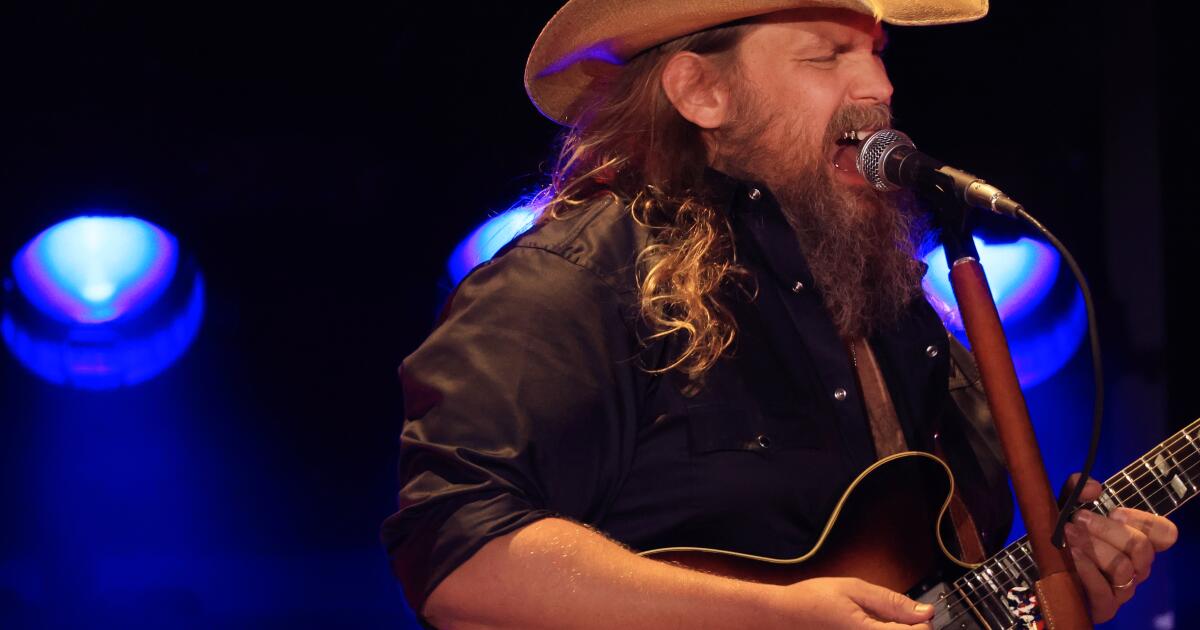
And here in Los Angeles? On Saturday night, tens of thousands of Angelenos joined voices peacefully at the L.A. Memorial Coliseum to sing along with Chris Stapleton as the country star compared a lover to Tennessee whiskey.
A unifying cultural figure beloved by both liberals and conservatives, Stapleton was the headlining act at a Fourth of July benefit concert that also featured Smashing Pumpkins, Chaka Khan, Maren Morris and Queen Latifah. (I’d be surprised if those five names had previously appeared together in the same sentence.) The show, with tickets priced at $17.76, was presented by America250, a bipartisan commission that Congress created in 2016 to plan celebrations for the country’s 250th birthday; proceeds went to Feeding America, which calls itself the largest domestic hunger-relief organization in the United States.
-
Share via
“No politics — just purpose” is how America250 Chair Rosie Rios described the night in remarks from the stage, and it wasn’t hard to interpret the distinction she was seeking to draw between her group and Freedom 250, Trump’s rival semiquincentennial initiative that organized Saturday’s windblown event on the National Mall (not to mention an earlier concert by Vanilla Ice that was called off due to the threat of rain).
But here’s the thing: Compared with the president’s celebration, where he complained about his treatment by the justice system and suggested we should refer to his current term as his third, the show at the Coliseum really did feel like a politics-free zone — the somewhat rare occasion these days when folks from different walks of life come together just to listen to music and drink overpriced micheladas.
Said Stapleton not long into his set: “I won’t waste time talking.”
America250’s success was hardly a sure thing. Despite the relatively low price, tickets moved slowly in the weeks before the concert; one guy I talked to Saturday told me he’d paid six bucks for a discounted pass. Yet to my eyes the Coliseum was close to full by the time Stapleton came on.
The country singer was as solid and soulful as always, snarling gently through “Bad as I Used to Be,” then trading loving harmonies with his wife, Morgane, in “Millionaire.” He closed with “Tennessee Whiskey,” of course — a trusty yet somehow un-shopworn piece of Americana that’s earned a place on the shelf next to Ray Charles’ “Georgia on My Mind” and Willie Nelson’s “Angel Flying Too Close to the Ground.”
Smashing Pumpkins was perhaps a stranger fit for an explicitly patriotic event — “The world is a vampire,” frontman Billy Corgan sneered in “Bullet With Butterfly Wings” — yet the band sounded sharp and punchy in the ’90s alt-rock hits that have brought zoomers and even Gen Alpha kids into its audience.
Billed not inaccurately on the concert’s poster as “the legendary Chaka Khan,” the 73-year-old funk doyenne flexed her vocal chops in jammy renditions of “Ain’t Nobody” and “Tell Me Something Good” and got people hoisting their drinks for “I’m Every Woman.” Morris, who’d flown in from New York after attending her pal Taylor Swift’s wedding on Friday night, made an improbably smooth segue between her and Zedd’s synthed-up “The Middle” and the rustic “My Church.”
As the show’s host, Queen Latifah dispensed uplifting thoughts about American idealism throughout the evening but also got a slot of her own to do her classic “U.N.I.T.Y.” with help from a rambunctious drum line. It’s an unapologetic message song about demanding respect, and what was moving about hearing it here is that nobody seemed put off by that idea.
I’ll wave a flag for that.
Here are more photos from Saturday’s concert:
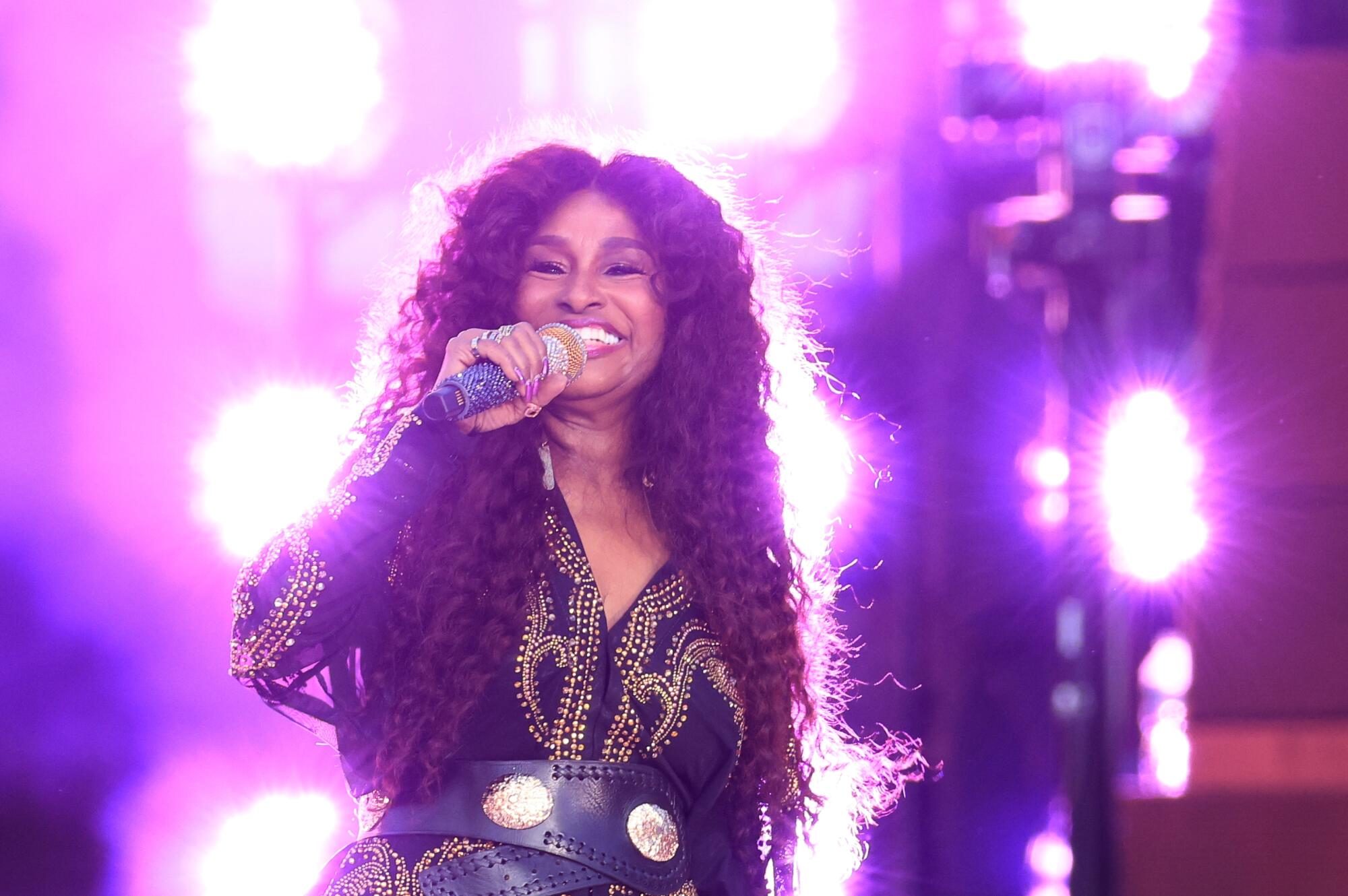
Chaka Khan performs.
(Myung J. Chun / Los Angeles Times)

Queen Latifah hosted the show.
(Myung J. Chun / Los Angeles Times)
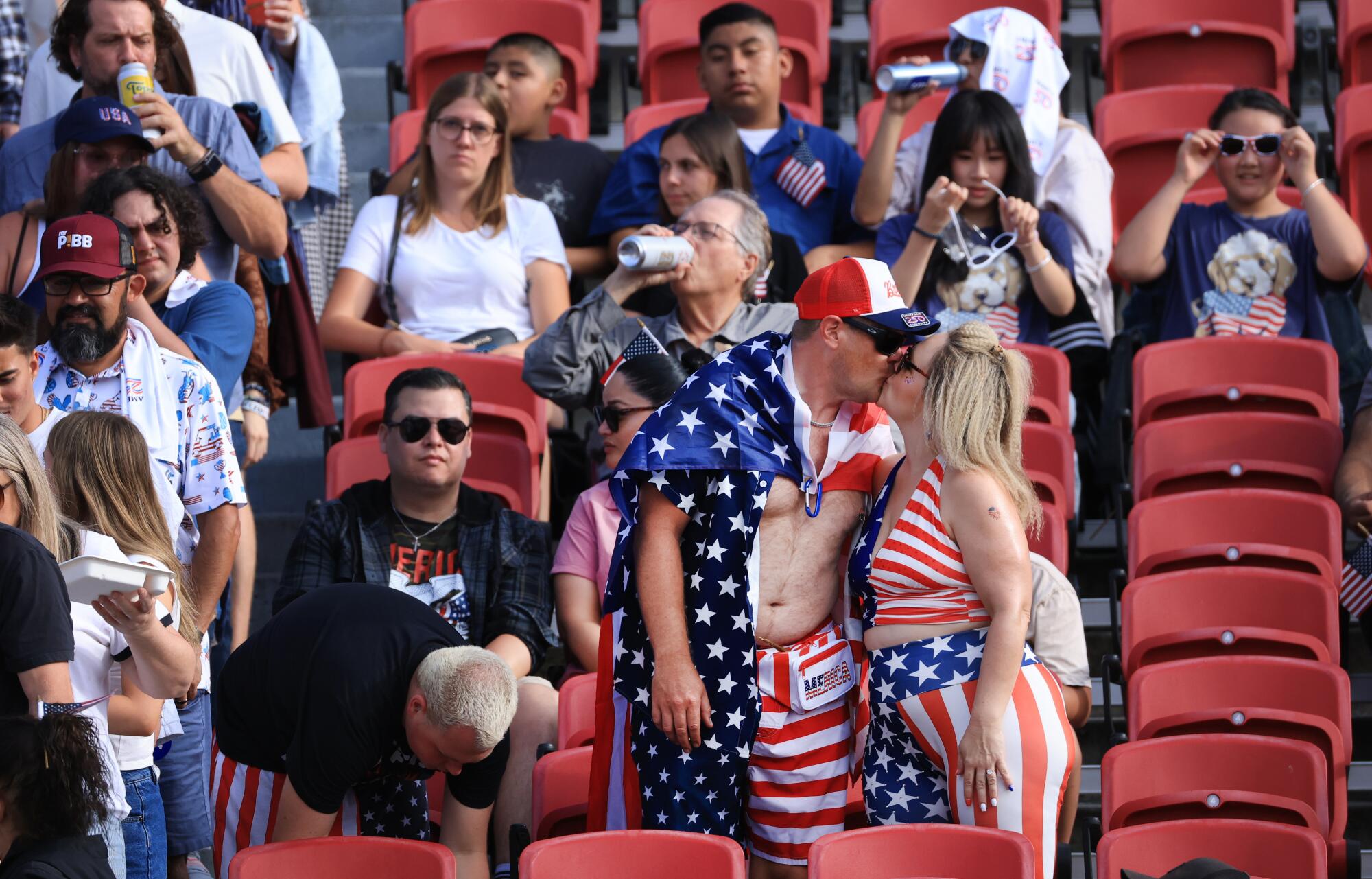
A couple in patriotic garb share a kiss.
(Myung J. Chun / Los Angeles Times)

Smashing Pumpkins performs.
(Myung J. Chun / Los Angeles Times)
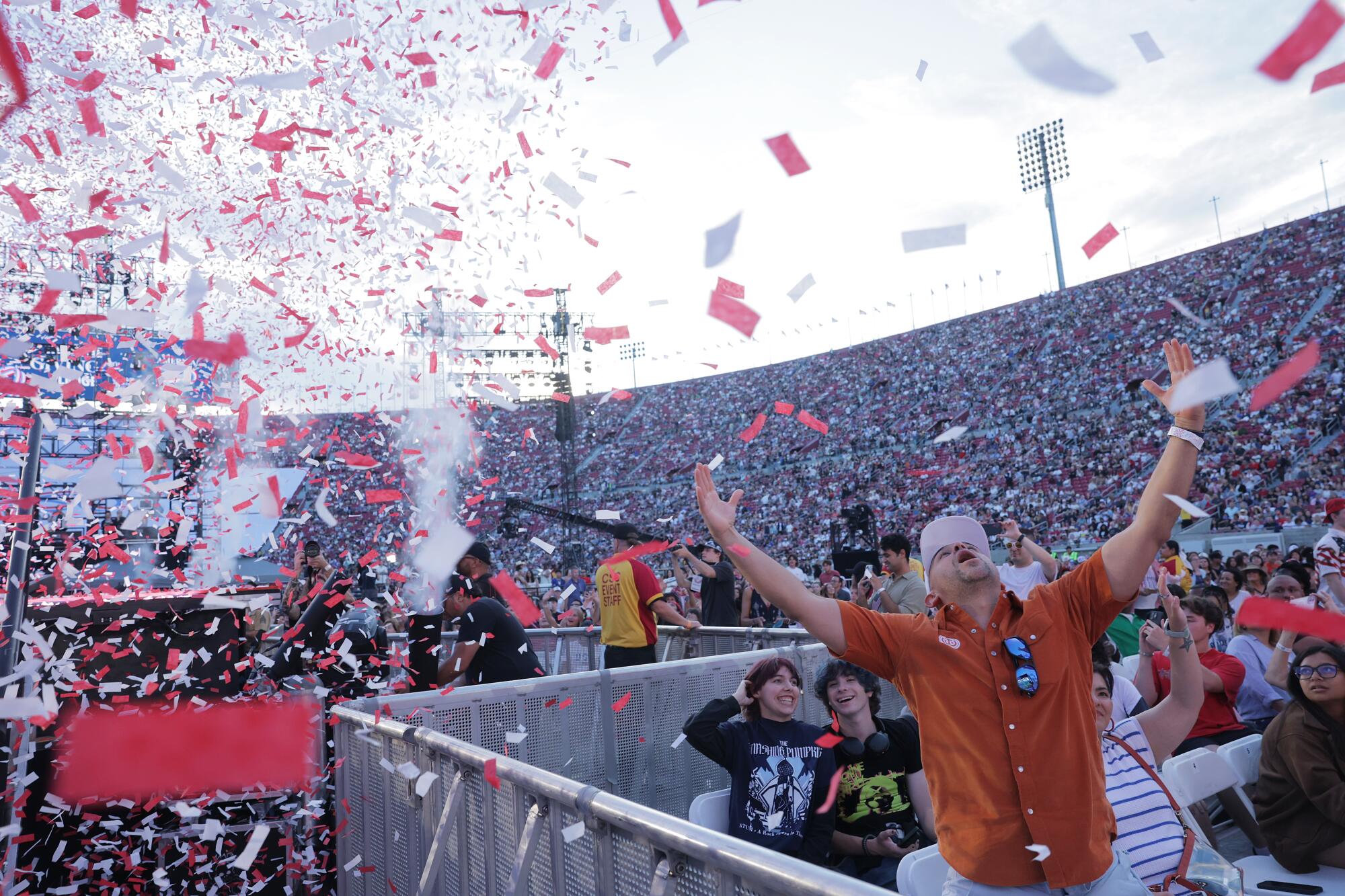
A concertgoer enjoys confetti.
(Myung J. Chun / Los Angeles Times)

Maren Morris performs.
(Myung J. Chun / Los Angeles Times)
-

 Health1 minute ago
Biohacker hoping to live to 160 reveals alarming diagnosis: ‘My stomach is eating itself’
-

 Sports4 minutes ago
FIFA president addresses Trump call amid scrutiny over decision on USA World Cup star
-

 Technology9 minutes ago
Fake Booking.com travel credit scam targets travelers
-
 Business16 minutes ago
Many indie festival films struggle to get distribution. Alamo Drafthouse is trying to change that
-
Entertainment19 minutes ago
AI actor Tilly Norwood to star in first movie
-
 Politics31 minutes ago
Trump says he disputed U.S. star player’s suspension, calling it ‘stain’ on World Cup
-
 Science34 minutes ago
14 propositions that could remake California taxes, housing, healthcare and elections
-
 Sports39 minutes ago
Lakers lose Rui Hachimura, who signs two-year deal with the Clippers

