Entertainment
Review: At the Huntington, the New Hollywood String Quartet recalls legendary studio musicians


When four top film studio musicians formed the Hollywood String Quartet in the late 1930s, its name was presumed an oxymoron. Exalted string quartet devotees belittled film soundtracks, while studio heads had a reputation for shunning classical music longhairs.
The musicians spent two intense years in rehearsal before disbanding when war broke out, and the quartet was brought back together in 1947 by two of its founders, Felix Slatkin (concertmaster of 20th Century Fox Studio Orchestra) and his wife, Eleanor Aller (principal cellist of the Warner Bros. Studio Orchestra). Oxymoron or not, Hollywood produced the first notable American string quartet.
Throughout the 1950s, the ensemble made a series of revelatory LPs for Capitol Records performing the late Beethoven string quartets and much else, while also joining Frank Sinatra in his torchy classic, “Close to You.” Everything that the Hollywood String Quartet touched was distinctive; every recording remains a classic.
The legacy of the Hollywood String Quartet is a celebration of Hollywood genre-busting and also of string quartet making. Today, the outstanding Lyris Quartet is one of many outstanding string quartets who can be heard in the latest blockbusters. Another is the New Hollywood String Quartet, which is devoting its annual four-day summer festival to honoring its inspiration as it celebrates its 25th anniversary.
The quartet’s festival began Thursday night and runs through Sunday in San Marino at the Huntington’s Rothenberg Hall. The repertory is taken from the earlier group’s old recordings. And the concerts are introduced by Slatkin and Aller’s oldest son, who as a young boy fell asleep to his parents and their colleagues rehearsing in his living room after dinner.
Conductor Leonard Slatkin speaks at the New Hollywood String Quartet concert at the Huntington.
(New Hollywood String Quartet)
The celebrated conductor Leonard Slatkin credits his vociferous musical appetite to his parents, who, he said Thursday, enjoyed the great scores written in this golden age of movie music and also championed new classical music as well as the masterpieces of the past. L.A. had no opera company in those days, and Slatkin said his parents likened film scores to modern opera scores.
Just about everyone has heard his parents in one film or another. Take “Jaws,” which is celebrating its 50th anniversary. That’s Aller’s cello evoking John Williams’ shark-scary earworm.
You’ve no doubt heard New Hollywood violinists Tereza Stanislav and Rafael Rishik, violist Robert Brophy and cellist Andrew Shulman on some movie. IMDb counts Brophy alone as participating on 522 soundtracks. You might also have heard one or more of the musicians in the Los Angeles Chamber Orchestra, Los Angeles Opera Orchestra or Los Angeles Philharmonic.

The New Hollywood String Quartet, from left: Rafael Rishik, Andrew Shulman, Tereza Stanislav and Robert Brophy.
(Sam Muller)
The New Hollywood’s programming may not encompass the original quartet’s range, but it is nonetheless a mixed selection of pieces that have somewhat fallen by the wayside, such as Borodin’s Second String Quartet. The original quartet’s performances and swashbuckling recording of the Borodin surely caught the attention of L.A. director Edwin Lester. In 1953 Lester created and premiered the musical “Kismet,” which adapts parts of the Borodin quartet, for Los Angeles Civic Light Opera, before it went on to be a hit on Broadway.
Times have changed and the New Hollywood brings a more robust tone and more overt interaction to its effusive interpretation compared with the silken and playful Slatkin and crew, who were all Russian-trained players. Hugo Wolf’s short “Italian Serenade,” which opened the program, was here lush and Italianate, while on an early 1950s disc it dances more lightly.
The big work was César Franck’s Piano Quintet. Slatkin noted that the recording, released in 1955, didn’t sell well, probably thanks to the album cover’s saturnine painting of a composer that few would recognize. Slatkin also noted that his parents weren’t enamored of their performance, but then again, he explained that they were temperamentally ever ready to find fault.
That recording, which features his uncle, Victor Aller, a graceful pianist, is slow and commanding. Jean-Yves Thibaudet was the right guest in every way for the big-boned performance at the Huntington. He is a French pianist with a flair for German music, well suited for the Belgian French composer’s Wagner-inspired score.
Thibaudet is also a longtime L.A. resident and an especially versatile performer who happens to be featured on the new soundtrack recording of Dario Marianelli’s “Pride & Prejudice,” which tops Billboard’s classical and classical crossover charts. He and Slatkin also go back decades, having performed together and become such good friends that the conductor turned pages for him in the Franck.
Seeing the 80-year-old Slatkin onstage evoked a remarkable sense of history, reminiscent of the roots to L.A.’s musical openness that his parents represented. On my drive home Thursday, I couldn’t resist following the route Albert Einstein would have taken after practicing his violin when he lived a 12-minute bike ride away during his Caltech years — the time Slatkin’s parents were making music history at the studios. Like them, Einstein played with the L.A. Philharmonic (although invited once not because he was a good violinist but because he was Einstein).
The New Hollywood and Thibaudet made no effort to relive the past in Franck’s quintet. Instead, in their opulence and expressive explosiveness, they showed Hollywood how to produce a remake that’s magnificent.
In the meantime, Leonard Slatkin, who is a former music director of the L.A. Phil at the Hollywood Bowl, returns later this month to the venue where his parents met in 1935 at a Hollywood Bowl Symphony competition. He will conduct a July 24 program that includes a recent work by the next generation of Slatkins. His son, Daniel, is a film and television composer.


It’s a good year when we get movies like Remarkably Bright Creatures and The Sheep Detectives at the same time. If there’s one type of emotional draw we’ll never say no to when it comes to the fiction we consume, it’s wholesome. The kind of movies and TV shows that leave you with a bit more hope than you expected. The kind of stories that make you believe that humanity isn’t as broken as it really is.
The Sheep Detectives is essentially tailor-made for anyone who loves a good whodunnit that’s rich with nuance and humor. The clever decision to shift the genre into something both kids and adults could appreciate together is no small feat, and that’s largely where its mass appeal lies. Murder is a heavy subject to deal with—as is grief—yet this story makes sitting with the weight of both a little easier. It could kickstart a number of thoughtful conversations while it simultaneously delivers plenty of laughs along the way.
For adults, there’s also a huge appeal in the casting—the voice actors especially. Anyone who knows me knows that Ted Lasso is the kind of show I’ll always put first, so hearing Brett Goldstein voice a sheep is the kind of A+ decision that’s effortless to appreciate. Hugh Jackman, Nicholas Galitzine, Molly Gordon, Nicholas Braun, Emma Thompson, Julia Louis-Dreyfus, Bryan Cranston, Bella Ramsey, Regina Hall, Rhys Darby, Patrick Stewart, Hong Chau, and the whole cast do an exceptional job as well, making every moment of The Sheep Detectives thoroughly entertaining.

It’s hard to imagine anyone coming out of the movie not thinking it’s one of the best things we’ll watch all year, and that’s a high compliment considering 2026 is full of gems like Project Hail Mary and the upcoming The Odyssey. It’s the exact kind of movie we could all use, but more than anything, the kind of story we could use more of. If there’s any sort of sequel, sign me up. Let’s make it a trilogy. Give us more of the sheep.
The cinematography is gorgeous, the writing is sharp, the performances are thrilling, and the message is a gem worth holding onto. The Sheep Detectives is the kind of feel-good treasure that does an excellent job of reminding us why movies like this will always matter. There’s a thoughtful message about how grief is meant to be shared and why it’s so important to carry those who’ve passed with us. Yes, it’d be convenient to forget our pain by sheer mental willpower, but we aren’t meant to do that. As humans and as animals, I imagine that the good, bad, and ugly are all part of what makes life beautiful, and that’s a comforting message to sit with.
The concept of a whodunnit featuring sheep solving a murder sounds so wild on paper, yet everything about it results in the kind of movie that should signal to Hollywood we want more creative approaches to what’s familiar. There’s a reason The Muppets are so popular, and we shouldn’t be afraid of making things that sound a bit too whimsical on paper. In other words, The Sheep Detectives embraces the whimsy, and it’s exactly what makes it so delightful.
The Sheep Detectives is now streaming on Prime Video.
First Featured Image Credit: ©Amazon MGM Studios
Related
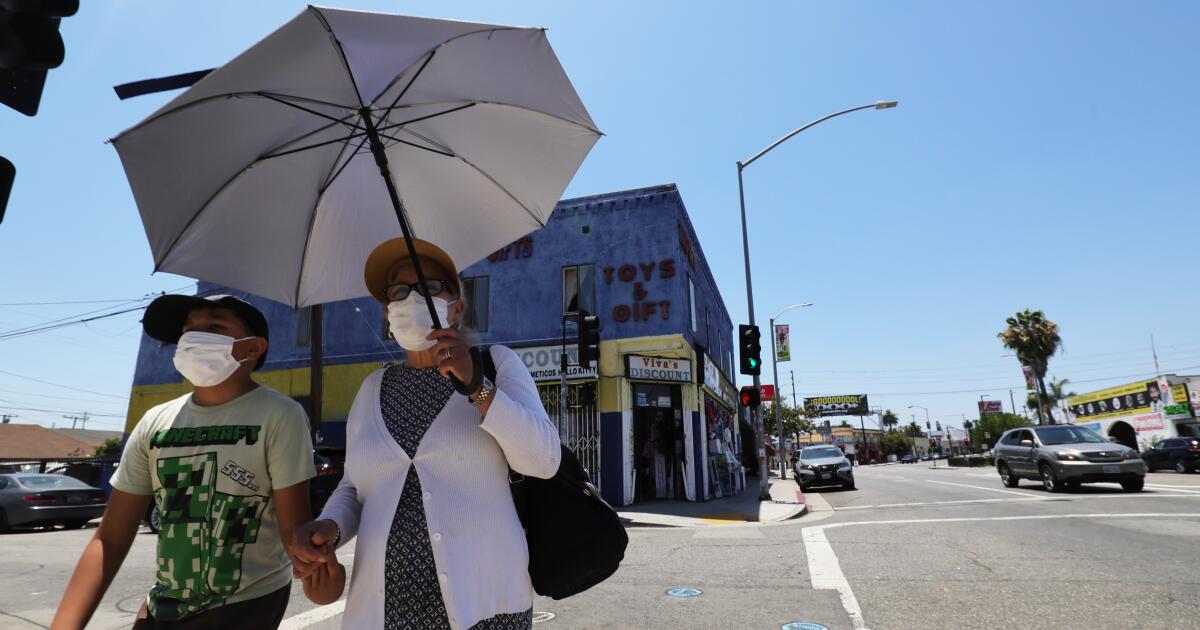
The National Weather Service has issued a heat advisory for this week that includes Los Angeles County and other parts of the Southland, especially in valleys and away from the coast.
Temperatures are expected to rise in the Santa Clarita Valley, the east and west San Fernando Valley, as well as parts of the San Gabriel Valley and northwest L.A. County mountains beginning Tuesday and lasting through Thursday, with warm, seasonably elevated fire weather conditions, according to the National Weather Service.
Forecasts indicate the mercury will reach 90 to 105 degrees in the interior, 80 to 90 degrees in the inland coastal plain — including downtown L.A. — with highs in the 80s and lower 90s in the foothills and canyons of southwest Santa Barbara County.
Rose Schoenfeld, meteorologist with the National Weather Service in Oxnard, said temperatures should be five to 10 degrees above normal for this time of year thanks to a high-pressure system building up over the region.
Though temperatures are expected to drop after Thursday, don’t expect that cooling to last.
“Looking ahead, you might be seeing some outlooks that look pretty favorable, but that heat will linger and redevelop with a pretty impressive heat wave for much of the west, that would be starting next weekend or so,” Schoenfeld said. “It doesn’t seem like we’re out of the woods, even if temperatures start to drop after Thursday.”
The rising mercury coincides a with major marine heat wave across the Pacific Ocean that has the potential to affect weather events around the world, bringing months of warmer oceans, which trigger thunderstorms and extreme heat thousands of miles away.
In recent weeks, record heat waves have baked parts of Europe, with temperatures hitting 104 degrees in some countries. France has reported more than 1,000 heat-related deaths.
In the U.S., record heat has gripped much of the Midwest and East Coast, with temperatures between 110 and 115 degrees in major metropolitan areas, with the National Weather Service issuing an extreme heat warning for much of the Midwest, Mid-Atlantic and Northeast.
The sweltering temperatures have disrupted travel and led to a number of cancellations planned for celebrations over the Fourth of July weekend, including Philadelphia’s Salute to Independence parade. The Great American State Fair, on the National Mall in Washington, was forced to shut down for a few hours.
Amtrak canceled some trains in the Northeast because of excessive heat that could affect the tracks.

The Isolate Thief, 2026.
Directed by John Suits.
Starring Mackenzie Foy, Odeya Rush, Joe Pantoliano, Sean Bean, Jack Kesy, Ty Simpkins, Bryan Martin, and Martin Sensmeier.
SYNOPSIS:
A young woman struggles to conceal the gold she stole from violent outlaws who have seized control of her remote outpost, outwitting them amid a deadly winter where survival becomes a game of cunning and betrayal.

Set at a Union outpost in frigid temperatures, John Suits’ The Isolate Thief transcends what was likely a small budget with a fittingly chilly, oppressive look, and an ensemble that sneaks up on you as not only packed but smartly cast. Front and center is Mackenzie Foy shedding her Twilight and Disney-oriented roots for gritty period-piece work that she handles capably and convincingly, whether it be fending off wolves at the outpost, bandaging a wound, playing a deceitful game for survival, or wielding a firearm.
That’s only the start, though, as Joe Pantoliano shows up as a harmless graverobber only to re-enter the picture as the hostage of a group of Union soldiers led by Sean Bean on a search for gold thought to be discovered by him, which in reality has been hidden away by Mackenzie Foy’s parentless (her father recently died in the war, meaning she is all alone at the outpost), grieving, underestimated caretaker waiting for the right moment to make a break with the gold for San Francisco. The merciless candor with which the Union soldiers are comfortable torturing the drifting graverobber should also be enough to signal that something is off about the group and that our hero probably shouldn’t trust them.

Without giving too much away, Ada (Mackenzie Foy) is up against a violent group of outlaws posing as Union soldiers under orders from Sean Bean’s Fiddler, who will stop at nothing for this gold (accompanied by fellow evildoers played by a range of underappreciated names such as Ty Simpkins and Jack Kesy). In the forest, she also stumbles across a badly injured Emily (Odeya Rush), who has a connection to these outlaws, reduced to being treated as a sex object (they refer to her as an unflattering term for a prostitute, which feels inaccurate given that such a term would imply she has a choice rather than having her agency regularly taken as it is here), so broken by her experiences with them that she advises Ada to give in to their demands as defying them typically results more horrifying outcomes.
Even if the screenplay from Kevin Lefler doesn’t necessarily crackle the way a pressure-cooker story like this should (there’s a lot of The Hateful Eight in the film’s DNA, but without anywhere near that level of character and thematic complexity), the cast elevates the material and provides a quiet intensity simmering underneath the casual conversations and deceptions that we know will eventually blow up in Ada’s face. It’s also a story that isn’t afraid to go to some fairly bleak places and put these women through the wringer as they fight back and try to make it out alive.

What it boils down to is a simplistic cautionary tale of ruthless, misogynistic outlaws underestimating the women they are up against. That is also desperately felt when the women turn the tables in the third act. Effectively accomplishing what it sets out to do. A freezing locale is used for atmospheric advantage (the ground is frozen solid, meaning graves can’t be dug, to give an idea of just how cold it is) while allowing Mackenzie Foy to tap into some new acting tools demonstrating resourcefulness, alongside Sean Bean believably going from calm to terrifying on a dime. The Isolate Thief is a feminist period-piece Western that organically empowers through familiar, albeit competent and engaging, storytelling, culminating in some tense battle-of-the-sexes action.
Flickering Myth Rating – Film: ★ ★ ★ / Movie: ★ ★ ★
Robert Kojder
https://www.youtube.com/watch?v=embed/playlist
-

 South Dakota8 minutes ago
One child dead following Hughes County fatal crash
-

 Tennessee20 minutes ago
Wild ride for temperatures: A look at Middle Tennessee’s first major heat wave of 2026
-

 Texas23 minutes ago
Riley Greene homers and triples for 4 RBIs as Tigers top Texas Rangers 6-3
-
 Utah28 minutes ago
Utah’s Venezuelan community gathers to honor victims, aid survivors after deadly earthquakes
-

 Vermont35 minutes ago
Vermont State Police seek missing Rutland man
-

 Virginia38 minutes ago
Way-Too-Early 2026 Virginia Tech Football Preview and Prediction: Week 12, @ Miami
-

 Washington43 minutes ago
Weather Alert: Storms move into DMV area
-

 Wisconsin50 minutes ago
3 fires in southeastern Wisconsin tied to improper fireworks disposal

