Entertainment
'Peter Pan' had a Tiger Lily problem. How the musical now does right by Indigenous people

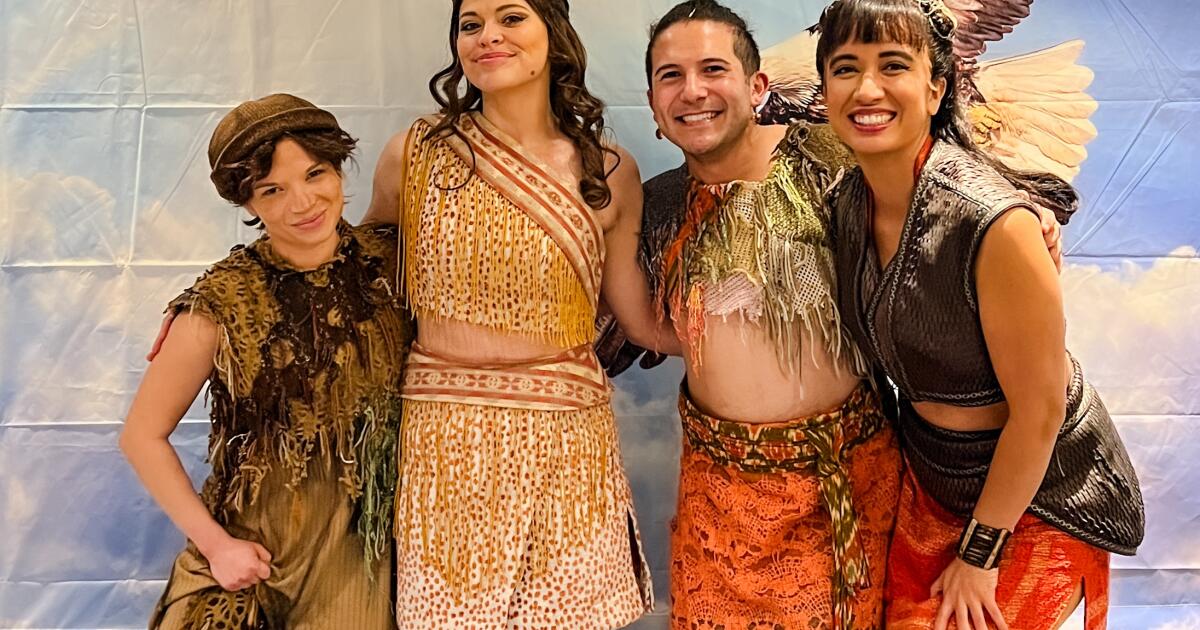
Raye Zaragoza was just a child when she first auditioned to play Tiger Lily. It was the late ’90s, yet another “Peter Pan” project was in the works, and though most adaptations had presented Tiger Lily as an offensive caricature, maybe this one would offer a dimensional, dignified depiction of a Native American.
“The only thing I had to do in the audition was giggle at the Lost Boys,” she recalled. In most “Peter Pan” retellings, “her part is so small, and in an incredibly cringe, stereotypical scene that’s a white perspective of what a Native person would be, and it isn’t even based on real language or dance or culture or anything. She’s the only Indigenous character in the story, and yet she’s almost like a mascot.”
Zaragoza — who is of Akimel O’odham, Mexican, Japanese and Taiwanese descent — was relieved she didn’t get that role. But more than 20 years later, she’s originating a fresh take on Tiger Lily in the “Peter Pan” national tour, now playing at the Hollywood Pantages Theatre through Sunday, followed by Costa Mesa’s Segerstrom Center for the Arts (Aug. 6 to 18). The musical is a restructuring of Jerome Robbins’ stage show and maintains most of its beloved score, composed by Morris Charlap with additional music by Jule Styne and additional lyrics by Betty Comden and Adolph Green.
This production features a new book by Larissa FastHorse that better represents its Native characters, and with Native American actors in the cast, a piece that previously caused harm to Indigenous peoples is now a platform for Native artists. Negotiations are underway to make this version the one that’s available for licensing by theaters and schools moving forward.
“I really don’t think those writers meant any harm, but we just were so asleep as to harming people and it’s amazing how long it took us to wake up,” the new production’s director, Lonny Price, said of the original text. In updating the book, “we didn’t want to be preachy or stand on a soapbox, but we wanted to be fair and equitable to the different cultures we’re representing.”
“Oftentimes, ‘Peter Pan’ is the first big professional stage show a child might see,” he added. “It’s important that all children can enjoy it, that they can not only fall in love with ‘Peter Pan’ but also the theater itself. And if we can get some of those kids to say, ‘I want to see another one of those,’ then we’ve won on so many levels.”
Producers approached FastHorse in early 2022 about rewriting the musical, itself an adaptation of J.M. Barrie’s 1904 play and 1911 novelization. While beloved for generations — after its debut in 1954, the musical was filmed for NBC three times and repeatedly revived on Broadway — it referred to Neverland’s Indians as “redskins” and included “Ugg-a-Wugg,” a percussive dance number with gibberish lyrics and a silly tone. (Schools have individually tweaked the text or outright canceled shows over this problematic material.)
Larissa FastHorse, who wrote the new “Peter Pan” book, and Raye Zaragoza, who plays Tiger Lily onstage.
(Dan Norman)
FastHorse — a dual citizen of the Sicangu Lakota Nation and the U.S., a MacArthur grant recipient and the first known female Native American writer of a play produced on Broadway — initially resisted the gig.
“I was scared, because this show could end my career,” she said. “I’m Native American, I still have to be able to go home and work in my community, and I also didn’t want to do wrong by the ‘Peter Pan’ folks either. But the producers gave me so much freedom and latitude, and despite my initial hesitancy, I’m glad I did it. I’m really proud of it.”
The musical’s source material calls the tribe “piccaninny warriors” and phrases their few lines in broken English. In this production, the tribe is made up of various Indigenous peoples from all over the world, each individual the last of their respective tribes and living in Neverland with hopes of returning home someday.
“In Neverland, you don’t grow old, you can basically live forever, so you can also preserve your culture,” said swing, co-fly captain and dance captain Bailey Frankenberg, a Cherokee Nation tribal member and a Choctaw Nation descendant. “It’s a really special way to take the lore of this magical place that already exists, and use it in a way that is helpful for how we can be perceived in this piece.”
The cast collaborated with FastHorse and costume designer Sarafina Bush to envision the Indigenous characters’ names, extinct tribes and onstage clothing, inspired by each of the actors’ ethnic and cultural backgrounds. Their characters’ names and tribes are listed in the show’s program, and FastHorse’s script requests that future stagings do the same with their performers.
“Let’s be honest, there’ll be towns that don’t have a dozen Native people who can do musical theater,” said FastHorse. “So every person in our tribe plays a version of themselves. They’re from extinct tribes from Mexico or South America or Japan; because we have one white girl in the ensemble, she’s from Eastern Europe, so she’s from an ancient Slavic tribe. This means that, going forward, no one ever has to play redface.”
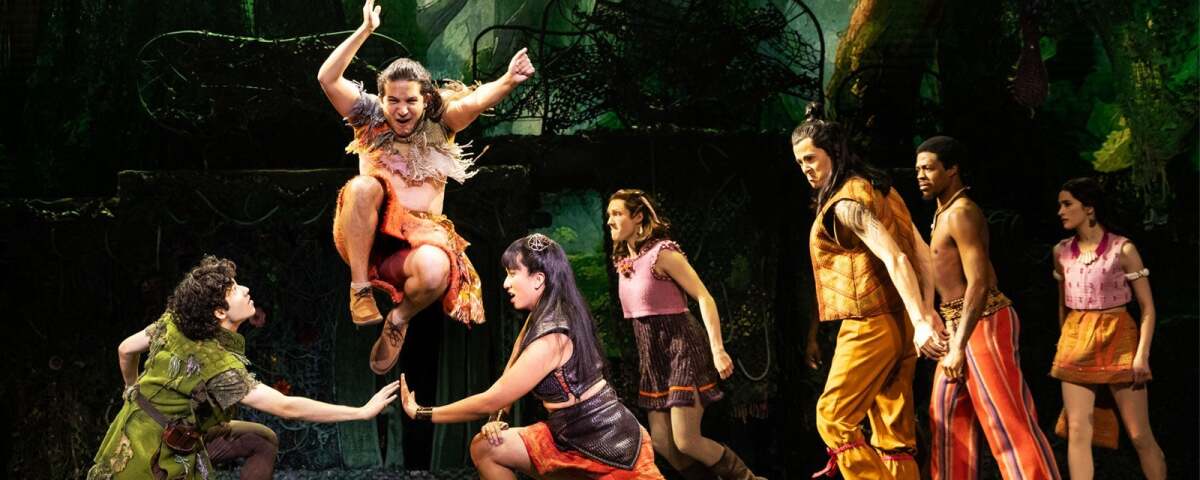
Nolan Almeida, left, as Peter Pan, Kenny Ramos as Acoma, Raye Zaragoza as Tiger Lily and the rest of the “Peter Pan” cast.
(Matthew Murphy for MurphyMade)
Neverland’s Indigenous people are led by the new Tiger Lily, a warrior princess who tells jokes, sings, dances and fights, all just as well as Peter, her friendly foe. “Peter Pan says, ‘I’m having fun adventuring all day,’ and a big part of that is facing off with Tiger Lily and her tribe,” FastHorse explained. “She’s now sharing in the adventure as much as Peter is, and having as much fun with it as he is. Yeah, they take it seriously, but this isn’t a bloodthirsty moment. They see each other and they’re having a good time.”
Tiger Lily does it all while wearing a skirt and a half-down hairdo, which she adjusts amid the action. “She’s both strong and feminine. She can defeat a whole band of pirates in a skirt and still wants to make sure her hair looks good,” said Zaragoza. “It’s a huge responsibility to take on this new version of something that was historically harmful, but this Tiger Lily is so different. Little girls have been coming up to me after the show, telling me she’s their favorite and she makes them feel represented and empowered, and that’s something I’ve never felt about this character before.”
In the original musical, “there was no reason given that the Lost Boys and the Indians were fighting; it was just assumed that you try to kill Indians because they exist, which is the reality of this country,” lamented FastHorse. The new book roots the two groups’ conflict in petty theft and childish boy-girl annoyances, and resolves it in a new Act I finale number, with music from Styne, Comden and Green’s short-lived 1961 musical “Subways Are for Sleeping” and new lyrics by Adolph Green’s daughter, Amanda Green.
Titled “Friends Forever,” the “Ugg-a-Wugg” replacement is an upbeat friendship dance, in which the Lost Boys and the Indigenous people teach each other moves — with the latter’s dancing inspired by the elements, versus the traditions of any specific tribe — and blend them into one routine. “By putting them together in this beautiful way,” Price said of Lorin Latarro’s choreography, “they’re not only uniting in the lyrics and the story, but also in this dance.”

Raye Zaragoza plays a new take on Tiger Lily in the “Peter Pan” national tour.
( From Broadway in Hollywood)
FastHorse was also tasked with trimming the musical’s three-hour run time and minimizing the misogyny. Wendy Darling (Hawa Kamara) is now an aspiring surgeon who volunteers to sew on Peter’s shadow and nudges everyone to take vitamins. “In the original, Wendy works the whole time she’s in Neverland — cooking, cleaning, sewing — because of the assumption that serving men was fun and fulfilling for her,” said FastHorse. “We had to fix that reason for her to believably enjoy this place.”
And for the first time, Wendy sings, dances, fights and even has a conversation with Tiger Lily. “They’ve never spoken to each other before,” said the playwright. “It seems so small, but to have two women speak without a man present happens so infrequently in these older shows. I fought hard for it, and it got cut down a little bit, but I’m glad it’s in there.”
This production also cast Peter — previously played onstage by Mary Martin, Sandy Duncan and Cathy Rigby — with a young, male actor, Nolan Almeida. “Kids are very aware of gender now, and since our story doesn’t go into those conversations, it didn’t feel right to continue that tradition,” said Price.
The show also added back in “When I Went Home,” a song “that explains his emotional unavailability because he’s been so hurt,” added Price. “It was in the original show, but it was cut on the road because Mary Martin thought it was too sad for the children, but children today can take some sadness, they’ve experienced it in their world.”
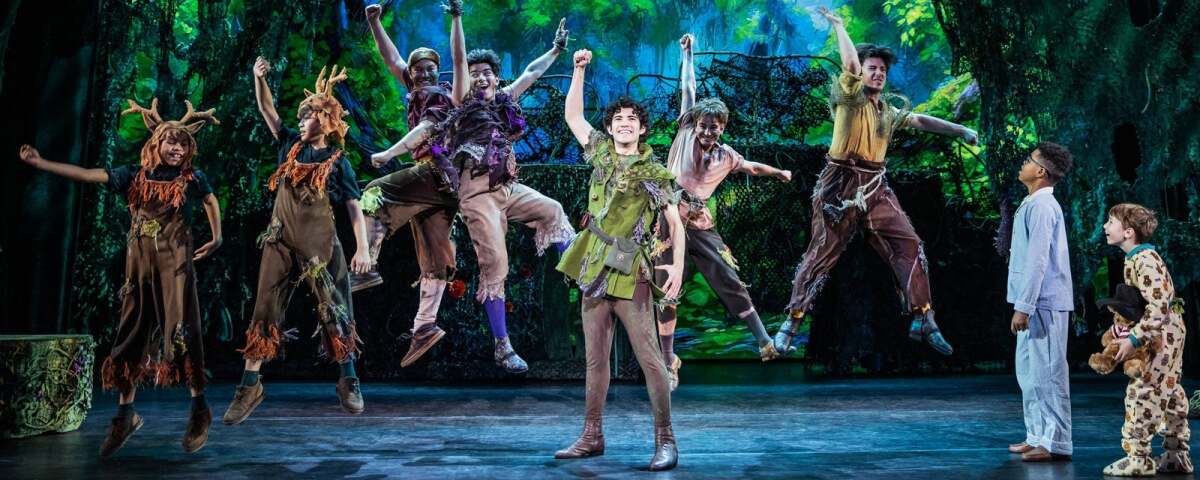
Nolan Almeida as Peter Pan, center, and the cast of “Peter Pan.”
(Matthew Murphy for MurphyMade)
FastHorse surprised producers by placing “Peter Pan” in contemporary America, ridding the opening and closing scenes in the Darling home of their 1950s London setting. The script encourages future stagings to consider their setting “quite broadly, with all socio economic levels, areas of the country, races, cultures, and types of families as the basis for what is truly universal.”
“Where I’m from in South Dakota, London is so unbelievably foreign, and to lots of children around the world, London is imperialism and the cause of the genocide of their people,” FastHorse said. “In this process, there was definitely some pushback, a fear that losing London and the period was going to be a problem. But it was important to me that any child going to this show could believe they could look out their window and see Peter fly by.”
The national tour, which began in late 2023 and continues through mid-2025, might be the first with its own land acknowledgment, recorded for each stop by FastHorse herself. So far, it’s traveled without any major backlash, just the occasional complaint about the cast’s diversity. (“We have a Darling family with several ethnicities in it, and if you can’t be OK with an ethnically diverse family, there’s nothing I can do for you,” FastHorse said.)
Its hit status should be a wake-up call to the industry’s decision makers, said ensemble actor Kenny Ramos, who is from the Barona Band of Mission Indians/Kumeyaay Nation and grew up on the Barona Indian Reservation. “It’s great that we have this Broadway-caliber musical production and this correction of a piece that was so problematic to the point where it basically became unproducible,” he said. “And yet, there are so many Native works out there that are not being produced.
“I hope that this successful production is a reminder that there’s Native talent out there, that Native stories are for everyone, and that the American musical theater is a place for Native people.”
‘Peter Pan’
Where: Hollywood Pantages Theatre, 6233 Hollywood Blvd.
When: 7:30 p.m. Tuesdays-Thursdays, 8 p.m. Fridays, 2 and 8 p.m. Saturdays, 1 and 6:30 p.m. Sundays. Through July 28.
Cost: $57 and up.
Info: (800) 982-2787, broadwayinhollywood.com or ticketmaster.com
Running time: 2 hours and 10 minutes, with one intermission
Also in Costa Mesa:
Where: Segerstrom Center for the Arts, 600 Town Center Drive.
When: Aug. 6-18. 7:30 p.m. Tuesdays-Fridays, 2 and 7:30 p.m. Saturdays, 1 and 6:30 p.m. Sundays
Cost: $33 and up
Info: (714) 556-2787, scfta.org

Entertainment
Lucas Museum to give free annual passes to South L.A. neighbors, host community preview day

The Lucas Museum of Narrative Art, which is moving at light speed toward its Sept. 22 opening, announced Thursday that it will give free annual passes to its South L.A. neighbors living in the 90037 ZIP Code. The 300,000-square-foot, $1-billion museum located in Exposition Park will also host a special community preview day on Sept. 13, more than a week before the general public gets to step inside.
The 90037 ZIP Code has a population of more than 65,000 and is bordered roughly by the 110 Freeway to the west, Slauson Avenue to the south, Central Avenue to the east and Martin Luther King Jr. Boulevard to the north. Residents can register for passes at lucasmuseum.org/lm37 and will be alerted in August when the program launches. Pass holders can reserve tickets for themselves and one guest.
Tickets for non-pass holders go on sale July 21. They cost $25 for adults and $21 for seniors. Kids 17 and under are free.
“Storytelling has the power to bring people together and create a sense of community,” said Lucas Museum Chief Executive Tracey Bates in a news release about the program. “Through LM37, we are inviting our South Los Angeles neighbors to make the museum part of their lives and take their own path of discovery through the art, programs and experiences that will help shape this new cultural hub for Los Angeles.”
The community preview day is designed to give local business owners, community partners, civic leaders and registered LM37 pass holders a sneak peak of the 10,000 square feet of exhibition space, as well as the expansive gardens with 11 acres of park space.
The opening programming, curated by co-founder George Lucas, features 20 inaugural exhibitions across more than 30 galleries, including one titled “Star Wars in Motion,” containing vehicle designs, high-speed racers, flying vessels, props, costumes and illustrations from the first six films in the beloved franchise.
More than 1,200 objects will be on display from Lucas’ personal collection of narrative art. Highlights include work by Norman Rockwell and Dorothea Lange, as well as a variety of manga, children’s book illustrations and comics.

Last year’s “Superman” ended with Iggy Pop singing “Because I’m a punk rocker, yes I am” — an ironic coda for a superlatively square hero. But it rings straightforwardly true for Superman’s cousin.
Milly Alcock’s Kara Zor-El, or Supergirl, sports not a spandex suit but a Blondie T-shirt. When we meet her in Craig Gillespie’s “Supergirl,” she’s been on an interstellar bender for days. She’s more Courtney Love than Clark Kent.
Nonchalant and sarcastic, Kara is also a little Han Solo-ish, you might say, given that she moves capriciously through the galaxy in her junky spaceship while getting in fights in extraterrestrial bars. She’s a welcome, jagged riff on more buttoned-up superheroes, and Alcock is terrific in the role. If only “Supergirl” was as good as she is.
While the latest DC release, and second under James Gunn’s stewardship, has its moments, “Supergirl” struggles to match Kara’s punk-rock energy with an equally spirited supporting cast and story.
Skepticism seems to have gathered for “Supergirl” ahead of its release. Many fans have argued it wasn’t the right next step for DC Universe. But I’m not so sure. Alcock’s breezy cameo in “Superman” was one of that movie’s highlights. Handing the follow-up to her, and her faithful floating dog Krypto, strikes me as an extremely natural next step. When in doubt, follow the dog.
And much of “Supergirl” is winning. It resides almost entirely in space, touching down only momentarily on Earth. In its consistently creative production design, clever needle drops and underdog story arc, “Supergirl” resides a little closer to Gunn’s “Guardians of the Galaxy” movies than other DC entries. Its outer space is filled with cosmic detritus, mean characters and cute critters. Seth Rogen as the voice of a tiny alien co-piloting a space bus is an inspired concoction, as is a shabbier sci-fi realm with rest stops along the intergalactic highway.
Entertainment
Justin Baldoni and wife break silence after ‘It Ends With Us’ legal battle with Blake Lively

Justin Baldoni has broken his silence after reaching a settlement in a lengthy and highly publicized legal dispute with Blake Lively.
Baldoni and his wife, Emily Baldoni, presented a united front in an Instagram video the couple shared Wednesday that began, “So we have not spoken publicly for the better part of the last two years, and it’s not because we haven’t had anything to say, because Lord knows we have.”
The “It Ends With Us” actor and director said that although they’d wanted to address the debacle that involved dueling lawsuits with Lively, nearly two years of tit-for-tat fodder and culminated in a confidential settlement, “something was telling us not to.”
The couple said they prayed about when to make a public statement. “This feels like the moment,” Emily said.
“What does feel important,” she continued, “is that we can genuinely say that we are sitting here today feeling immense gratitude for so many things and so many people and so many things that have happened to us.”
“Gratitude has saved us,” Justin added.
“I also feel that it’s important as we say that — in that gratitude — it doesn’t negate the injustice and the pain that we have also felt in the last few years, and we’ve had to wrestle with so many things and try to understand so many things,” Emily said. “How could something like this even happen? Let alone disguised as a fight for women. So much to unpack. And the truth is, reality is, is that there’s been a lot of trauma for us to move through as a family, which also makes it hard to speak.”
“We don’t even know this is the right thing to say, but we just know we need to share something,” Justin said. “What I will say is that there have been so many painful things that have been spoken into existence — “
“Untruthful,” Emily broke in.
“We didn’t want to add to the noise, so we just wanted to let the justice system run its course,” he said.
“And the truth and the facts have spoken for themselves,” Emily said.
The couple’s statement comes a year and a half after Lively filed a bombshell lawsuit against Baldoni alleging sexual harassment, retaliation and several other charges on the heels of a messy “It Ends With Us” summer release and press tour that fueled rumors of on-set turmoil.
Less than a month after the allegations against Baldoni rallied Hollywood against him, he countersued Lively, her publicist Leslie Sloane and her husband, Ryan Reynolds, for $400 million in damages, claiming they’d smeared his name in the press and wrestled away his control of the film. His suit was later dismissed.
In May, two weeks ahead of the trial, Lively and Baldoni reached an agreement to resolve their legal dispute, bringing an abrupt end to the contentious battle.
“The parties in the Blake Lively and Wayfarer Studios litigation have reached an agreement to resolve the matters,” lawyers for both sides said in a joint statement.
“The end product — the movie ‘It Ends With Us’ — is a source of pride to all of us who worked to bring it to life. Raising awareness, and making a meaningful impact in the lives of domestic violence survivors — and all survivors — is a goal that we stand behind. We acknowledge the process presented challenges and recognize concerns raised by Ms. Lively deserved to be heard. We remain firmly committed to workplaces free of improprieties and unproductive environments. It is our sincere hope that this brings closure and allows all involved to move forward constructively and in peace, including a respectful environment online.”
In June, a federal judge ordered Baldoni and his production company to pay Lively’s attorney fees related to his unsuccessful defamation lawsuit against her, but rejected her bid for additional damages.
“So, how are we doing?” the filmmaker said in the Instagram video. “We are healing, and if you’ve ever been through something traumatic, you know that healing isn’t linear. It lives different every day, and we have had to rethink for ourselves what is real. What matters, and it’s this. It’s our family. It’s our friends. It’s our community. It’s our faith.”
Times staff writer Josh Rottenberg contributed to this report.
-
Culture40 minutes ago
Which Version of the ‘Odyssey’ Should You Read?
-
 Lifestyle43 minutes ago
Terry Tempest Williams on why women with big ideas get labeled ‘crazy’ : Wild Card with Rachel Martin
-

 Technology55 minutes ago
Google’s Nest Thermostat has hit its best price of the year
-

 World58 minutes ago
Argentinian flight instructor jumps to death from plane, 22-year-old student forced to land alone
-

 Politics1 hour ago
Omar’s disclosures erased millions, leaving her with potential negative net worth. She won’t explain why.
-

 Health1 hour ago
Dr Oz links obesity to chronic disease surge, says GLP-1s can ‘jumpstart’ better health
-

 Sports1 hour ago
Pirates star pitcher makes unfortunate history after being taken out in middle of perfect game bid
-

 Technology1 hour ago
Medical identity theft follows you into the doctor’s office

