
Connect with us

Entertainment

'Pachinko' returns with Season 2, a more muted but necessary chapter in the series

Published

on

'Pachinko' returns with Season 2, a more muted but necessary chapter in the series

“Pachinko,” a beautifully wrought historical melodrama, is back for its necessary second season, to fill in some holes, fiddle with loose ends and extend the story even farther beyond the borders of Min Jin Lee’s 2017 novel. It is a transitional season, which ends with little resolved and gaps still to fill, and while it offers all the sensual pleasures of the first season’s performances and production, its portion of love and death, it is very much the middle of a book.

Unlike the novel, which proceeds chronologically, the series, returning Friday on Apple TV+, alternates between the “present day” — 1989 Osaka — and the evolving story that gets us there. Season 1 began in 1915 before the birth of main character Sunja (Minha Kim) in Japanese-occupied Korea, then followed her through her country-girl youth into a romance with handsome, dangerous Hansu (Lee Minho). An unexpected pregnancy led to a marriage of convenience, later affection, with Isak (Steve Sanghyun Noh), a Christian preacher; together they moved to Osaka to join his brother Yoseb (Junwoo Han) and wife, Kyunghee (Eunchae Jung), where they become Zainichi, the term for Koreans living in Japan — a population much discriminated against. (Incidents of prejudice dot the current season, almost as a reminder of what the first season firmly established.)

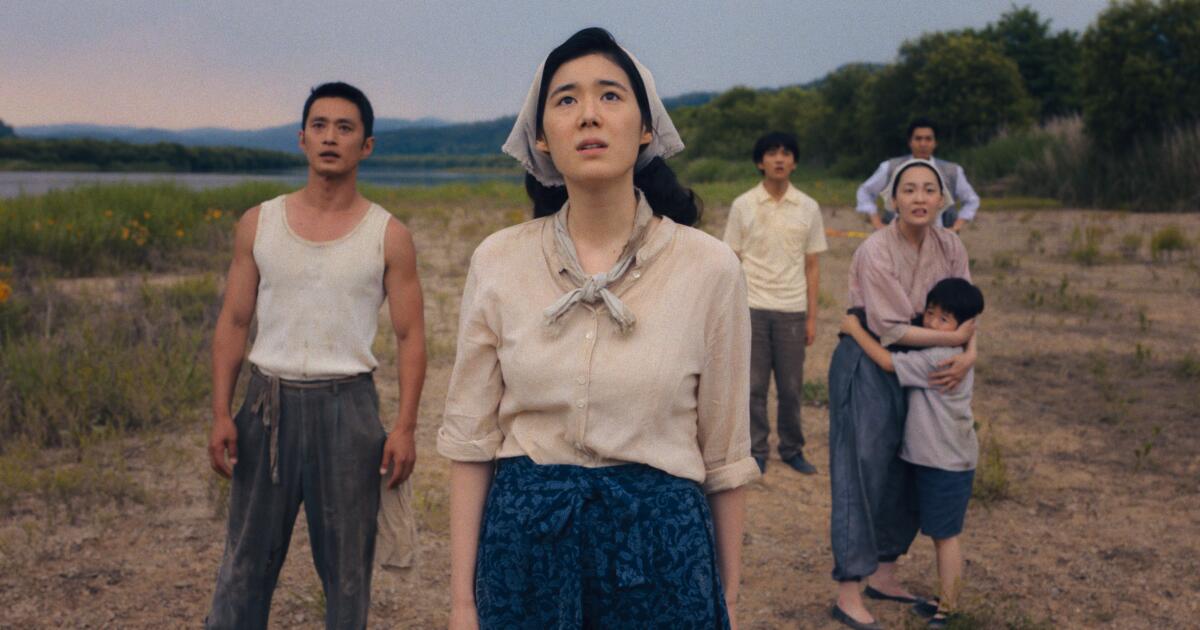
That storyline got us to 1938. The new season picks up in early 1945 (skipping much of the novel), and times are difficult as Japan fearfully braces for an American attack; Sunja and Kyunghee eke out a living selling kimchi, and the cabbage has almost run out. Sunja’s children, Noa (Kang Hoon Kim), her son with Hansu, and Mozasu (Eunseong Kwon), her son with Isak, have grown accordingly. Noa, who is unaware of his birth father and takes after his adoptive father, is shy and studious, Mozasu brash and unsuited to study. Isak is in prison, having been arrested last season for rabble-rousing; Yoseb is working in a munitions factory in Nagasaki, which should raise an eyebrow. But a friendly new character, Mr. Kim (Kim Sungkyu), is hanging around helpfully, and Hansu, keeping an eye on them from near and far, will be back and involved.

In Season 2, Mozasu (Eunseong Kwon), left, and Noa (Kang Hoon Kim) are a little older.

(Apple)

Advertisement

(The Nagasaki sequence, which opens the fifth episode, is shot in black and white in standard aspect ratio, before returning to color and widescreen when the bomb drops. The title credit that follows omits the usual cheerful shots of the cast dancing to the Grass Roots‘ “Let’s Live for Today” as inappropriate. Understandably.)

Nearly all the capital of the 1989 storyline having been spent in the first season, showrunner Soo Hugh has had to create fresh material to keep those characters busy while the earlier narrative catches up. (At the end of the season, they still have three decades to go.)

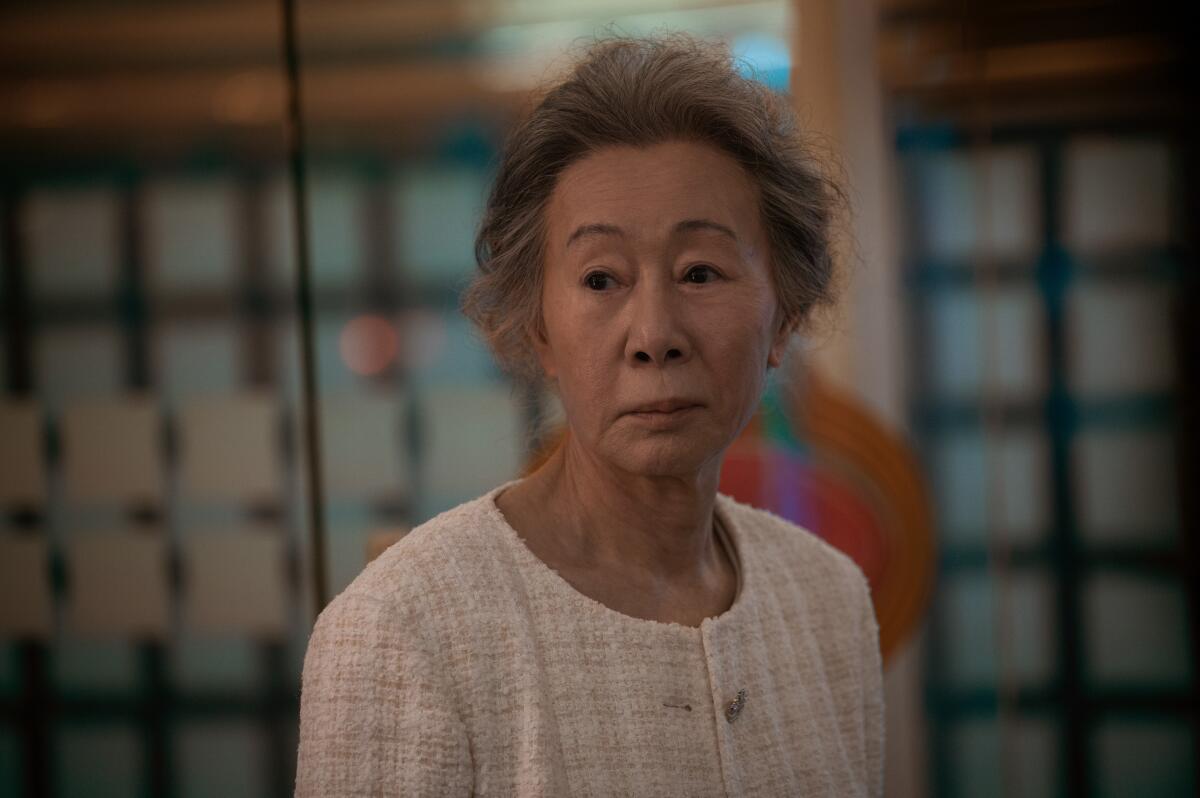
Older Sunja (Yuh-Jung Youn) is still living in Osaka with her successful son Mozasu (Soji Arai), who has grown up to own pachinko parlors — a sort of pinball cum slot machine — and, as a somewhat disreputable if popular business, one of the few avenues then open to Koreans. (Mozasu himself, a major character last season, is mostly absent from this one.) Mozasu’s son, Solomon (Jin Ha), college-educated in America, is in Tokyo, involved in high finance and real estate. In Season 1, he’d attempted to pry an old woman from her home in hopes of putting a golf resort on the land and impressing his bosses; in the end, he advised her not to sign the papers, but the current season finds him unfortunately back on that horse, in a complete moral backsliding. (I found the particulars of Solomon’s business dealings somewhat hard to follow, or perhaps just not worth the effort.)

This authorial trouble making might be expressed in the old Hollywood formulation as “boy meets girl, boy loses girl, boy gets girl, boy loses girl, boy gets (possibly a different) girl” and so on, whether or not we are actually talking about boys and girls. It’s a problem familiar to ongoing original series, where fresh conflicts must be created each year. One expects it will build eventually to another shot at redemption — the series is too sentimental, too good-hearted not to offer him the chance.

Advertisement
An older woman with gray hair pulled back wearing a pink jacket.

Older Sunja (Yuh-Jung Youn) in “Pachinko.”

(Apple)

And of course we get enough of Good Solomon to justify our interest, just as we get enough of Good Hansu to make up for his criminality. Parts of Solomon’s story, which brings in some unsavory characters, do feel constructed as a deliberate mirror of Hansu’s; perhaps not coincidentally they are played by the show’s best-looking actors. As to Sunja’s new, extra-textual adventures, she’ll strike up a friendship with a man at the supermarket that allows for an adorable scene in a Mexican restaurant, something seemingly new to 1989 Osaka.

Though historical events are acknowledged, what with World War II and the Korean War falling within the earlier timeline, and the Japanese asset price bubble and crash on the horizon in the later one, the current season focuses on family life and domestic detail, even as, or perhaps because it’s disrupted. In 1989, Sanju travels on her own from Osaka to Tokyo to check on her grandson, whom she senses is not all right. There’s a lovely scene in which she slices vegetables alongside Solomon’s Japanese love interest and former colleague, Naomi (Anna Sawai); I almost wrote “throwaway scene,” but, in fact, that naturalism is essential to the series, making something real out of the extravagant, even soap-operatic plotting.

And food, often in short supply in the earlier storyline, plays a part — making a meal, making a living, making a place at the table, making a home — most tangibly, out of a barn that Sanju, Kyunghee, Noa, Mozasu and Mr. Kim occupy at the end of the war. (Hansu’s tragedy is that though he provides support for the family, with or without the knowledge, he remains an outsider.) Characters speak of a “life well lived,” which is not at all the same thing as living well.

Advertisement

Obviously, this is not the season to start with “Pachinko,” but if you haven’t yet, it’s worth beginning at the beginning. Even if you watched the first season — which, given that you’ve read this far, I assume you have — it may be worth a look back to remember who all these characters are, what they have to do with one another, and what kind of trouble they got in and out of previously. And if the new season lacks the expositional energy of the first, if it’s more muted in tone, if Sunju is not quite the ray of sunshine she was, her older self will still have occasion to say here that hers was a life well lived.

Movie Reviews

Jeremy Schuetze’s ‘ANACORETA’ (2022) – Movie Review – PopHorror

Published

on

Jeremy Schuetze’s ‘ANACORETA’ (2022) – Movie Review – PopHorror

PopHorror had the chance to check out Anacoreta (2022) ahead of its streaming release! Does this meta-horror flick provide interesting story telling or is it a confusing mess.


Let’s have a look…

Synopsis

A group of friends heads to a secluded woodland cabin for a weekend getaway, planning to film an experimental horror movie. As the shoot progresses, the project begins to fall apart—until a real and terrifying presence emerges from the darkness.

Anacoreta is directed by Jeremy Schuetze. It was written by Jeremy Schuetze and Matt Visser. The film stars Antonia Thomas (Bagman 2024), Jesse Stanley (Raf 2019), Jeremy Schuetze (Jennifer’s Body 2009), and Matt Visser (A Lot Like Christmas 2021)

Advertisement


My Thoughts

Antonia Thomas delivered an outstanding performance as the female lead in Anacoreta. It was remarkable to watch her convey such a wide range of emotions with authenticity and depth. I was continually impressed by her ability to switch seamlessly between different dialects. I absolutely loved her delivery of the dialogue of telling The Scorpion and the Frog fable.

Anacoreta employs a distinctive, meta-horror style of storytelling. The narrative follows a group of friends creating a “scripted reality” horror film, and as the plot unfolds, the boundary between their staged production and their actual lives becomes increasingly blurred. This was interesting, but at the same time frustrating as a viewer.

Check out Anacoreta on Prime Video and let us know your thoughts!

Advertisement
Continue Reading

Entertainment

Todd Meadows, ‘Deadliest Catch’ deckhand, dies at 25

Published

on

Todd Meadows, ‘Deadliest Catch’ deckhand, dies at 25

Todd Meadows, a crewmember on one of the fishing vessels featured on the long-running reality series “Deadliest Catch,” has died. He was 25.

Rick Shelford, the captain of the Aleutian Lady, announced in a Monday post on Facebook and Instagram that Meadows died Feb. 25. He called it “the most tragic day in the history of the Aleutian Lady on the Bering Sea.”

“We lost our brother,” Shelford wrote in his lengthy tribute. “Todd was the newest member of our crew, he quickly became family. His love for fishing and his strong work ethic earned everyone’s respect right away. His smile was contagious, and the sound of his laughter coming up the wheelhouse stairs or over the deck hailer is something we will carry with us always.

“He worked hard, loved deeply, and brought joy to those around him,” he added. “Todd will forever be part of this boat, this crew, and this brotherhood. Though we lost him far too soon, his legacy will live on through his children and in every memory we carry of him.”

A fundraiser set up in Meadows’ name described the deckhand from Montesano, Wash., as a father to “three amazing little boys” who died “while doing what he loved — crabbing out on Alaskan waters.”

Advertisement

According to the Associated Press, Meadows died after he was reported to have fallen overboard around 170 miles north of Dutch Harbor, Alaska.

“He was recovered unresponsive by the crew approximately ten minutes later,” Chief Petty Officer Travis Magee, a spokesperson with the Coast Guard’s Arctic District, told the AP. The Coast Guard is investigating the incident.

Meadows was a first-year cast member of “Deadliest Catch,” the Discovery Channel reality series that follows crab fishermen navigating the perilous winds and waves of the Bering Sea during the Alaskan king crab and snow crab fishing seasons. The show debuted in 2005. No episodes from Meadows’ season has aired.

Deadline reported that the show was in production on its 22nd season when the incident occurred, with the Shelford-led Aleutian Lady being the last of the vessels still out at sea at the time. Production has subsequently concluded, per the outlet.

“We are deeply saddened by the tragic passing of Todd Meadows,” a Discovery Channel spokesperson said in a statement that has been widely circulated. “This is a devastating loss, and our hearts are with his loved ones, his crewmates, and the entire fishing community during this incredibly difficult time.”

Advertisement

Meadows is the latest among “Deadliest Catch” cast members who have died. Previous deaths include Phil Harris, a captain of one of the ships featured on the show, who died after suffering a stroke while filming the show’s sixth season in 2010. Todd Kochutin, a crew member of the Patricia Lee, died in 2021 from injuries he sustained while aboard the fishing vessel, according to an obituary. Other cast members have died from substance abuse or natural causes.

Continue Reading

Movie Reviews

‘Hoppers’ review: Pixar’s best original movie in years

Published

on

‘Hoppers’ review: Pixar’s best original movie in years

“So it’s like Avatar?” one character quips in Disney and Pixar’s “Hoppers,” bluntly translating the film’s high-concept premise for the sugar-fueled kids in the audience. And yes, the comparison is apt. The story follows a nature-obsessed teenage girl who manages to quite literally “hop” her consciousness into the body of a robotic beaver in order to spark an animal rebellion against a greedy mayor determined to bulldoze their forest for a freeway. 

It’s a clever hook. The kind of big, elastic idea Pixar used to make look effortless. “Hoppers” does not reach the rarified air of “Up,” “Wall-E,” or “Inside Out,” but after a stretch of uneven originals like “Turning Red” and “Luca,” and outright misfires such as “Elemental” and “Elio,” this feels like a genuine course correction. The environmental messaging is clear without being preachy, the animals are irresistibly anthropomorphized, and the studio’s once-signature emotional sincerity is back in sturdy form.

Pixar can afford to gamble on originals when it has a guaranteed cash cow like this summer’s “Toy Story 5” waiting in the wings, but “Hoppers” earns its place in the catalogue. Director Daniel Chong crafts a warm, heartfelt film that occasionally strains under the weight of its own ambition, yet remains grounded by character and theme. Its meditation on conservation and animal displacement feels timely in a way that never tips into after-school-special territory.

We meet Mabel, voiced with bright conviction by Piper Curda, as a child liberating her classroom pets and returning them to the wild. Her moral compass is shaped by her grandmother, voiced by Karen Huie, who imparts wisdom about nature’s sanctity. True to both Pixar tradition and the broader Disney playbook, this beacon of guidance does not survive past the opening act. Loss, after all, is Pixar’s favorite inciting incident.

Years later, Mabel is still fighting the good fight, squaring off against the smarmy Mayor Jerry, voiced with slick menace by Jon Hamm. He plans to flatten the glade where Mabel and her grandmother once found solace. Mabel’s resistance feels noble but futile. The animals have already mysteriously vanished, the machinery is coming, and her last-ditch plan involves luring a beaver back to the abandoned forest in hopes of jumpstarting the ecosystem.

Advertisement

That’s when the film gleefully pivots into mad-scientist territory. At Beaverton University, Mabel discovers her professor, voiced by Kathy Najimy, has developed a device that can project human consciousness into synthetic animals. The process, dubbed “hopping,” allows Mabel to inhabit a robotic beaver and infiltrate the forest from within. It’s an inspired escalation that keeps the film buoyant even when the plotting grows predictable.

Her new posse includes King George, a lovably beaver voiced by Bobby Moynihan with distinct Bing Bong energy; a sharp-tongued bear voiced by Melissa Villaseñor; a regal bird king voiced by the late Isiah Whitlock Jr.; and a fish queen voiced by Ego Nwodim. As is often the case with Pixar, even in its lesser efforts, the world-building is meticulous. The animal hierarchy, complete with titles like “paw of the king,” is layered with jokes that play for kids while slyly winking at adults.

The plot ultimately follows a familiar template. Scrappy underdog rallies community. Corporate villain twirls metaphorical mustache. Emotional third-act sacrifice looms. At times, you can feel the machinery working a little too cleanly. Pixar, and Disney at large, has grown increasingly reliant on sequels and established IP, and “Hoppers” does not radically reinvent the wheel. In an animated landscape where films like “K-Pop: Demon Hunters,” “Across the Spider-Verse,” and “Goat” are pushing stylistic and narrative boundaries, being safe and sturdy may not always be enough.

And yet, there is something refreshing about a Pixar original that remembers how to tug at the heart without squeezing it dry. “Hoppers” is playful, peppered with cheeky needle drops, and builds to a sweet emotional catharsis that may or may not have left this critic a little misty-eyed. It feels earnest and engaged. 

“Hoppers” may not be top-tier Pixar. But it is a welcome return to form, a reminder that the studio still knows how to marry big ideas with a bigger heart.

Advertisement

HOPPERS opens in theaters Friday, March 6th.

Continue Reading

Trending
