Entertainment
Nicki Minaj apparently arrested in Netherlands on suspicion of drug possession

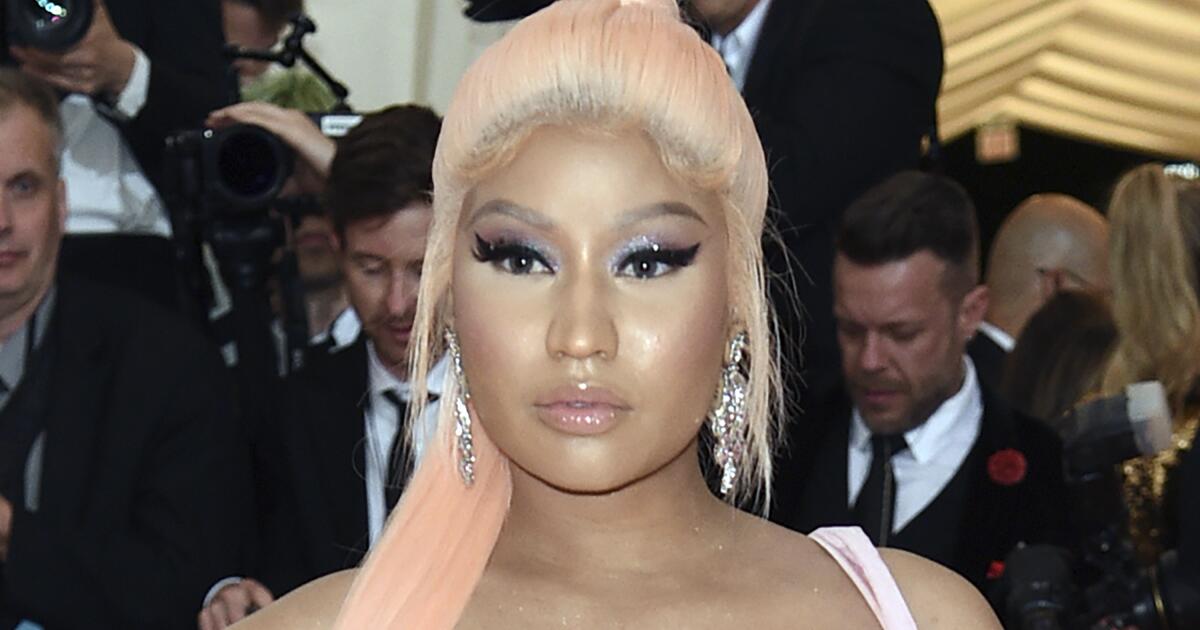
Nicki Minaj was apparently arrested at an airport by Amsterdam police upon her arrival in the Netherlands on Saturday on suspicion of carrying drugs in her luggage. The rapper filmed herself being questioned by police who detained her before she could leave the airport for her show in Manchester at the Co-op Live arena for the next stop on her Pink Friday 2 Tour.
In the video, which she posted to Instagram Live, the 41-year-old rapper whose real name is Onika Tanya Maraj-Petty tells the authorities she was not carrying any drugs. Despite her denial, she was told she needed to go to the police station in video captured on her live recording.
Minaj was “arrested … at Schiphol Airport because of possession of soft drugs,” a spokesperson for the police in the Netherlands told NBC.
According to Minaj’s recording, a man in a police uniform explained to her that she “would get a lawyer at the office” and they would go “as fast as possible.” She was then told “to get into this [police] van and go into the precinct with no lawyer present.”
During the verbal exchange, Minaj alleged that airport security asked that she make a “statement with no lawyer present” after “pre-rolls” (ready-to-smoke joints filled with marijuana) were allegedly discovered in her luggage.
Before the supposed arrest, the “Anaconda” hit-maker made a series of posts on X (formerly known as Twitter) about her bags getting searched at the airport.
Nicki Minaj attends the Metropolitan Museum of Art’s Costume Institute benefit gala celebrating the opening of the “Camp: Notes on Fashion” exhibition in 2019 in New York.
(Charles Sykes/Invision/AP)
“They’ve been trying everything they possibly can to TRY to stop this tour,” she wrote in one tweet. She also accused authorities of trying to “plant things” in her luggage.
Minaj also shared a recording on her Instagram of her verbal exchange with a man who told her that police were going to be searching her bags.
Minaj then asked: “But wasn’t that what you planned on doing from the get-go? Why didn’t you guys search it before it went on the plane?”
The man responded: “They did just a random quick check, but now they want to open it” and said Minaj choosing to film the authorities resulted in them wanting to search her bags.
The rapper replied: “ ‘Do I have any more in those purses’ and I said, ‘No,’ and I asked him where are my bags.” “They took my bags and put them on the plane before I could know what bags are on the plane.”
The airline crew member simply said he was “so sorry for that.”
Minaj replied “OK, of course,” before the video ended.
Minaj also tweeted: “they said they found weed…they took my bags without consent,” seemingly admitting that there was marijuana in her luggage that may have belonged to her security staff.
In Minaj’s caption on Instagram, the rapper wrote “they took my bags before I could see them” then “put it on the plane…This is what it looks like when ppl are paid big money to try to sabotage a tour after all else failed. Everything they’ve done is illegal.”
In her final post on X, Minaj tweeted that she was being told she had to “go 5 mins away to make a statement about my security to the police precinct.”



“Lethal Weapon” star Danny Glover has revealed he has been living with Alzheimer’s disease for years.
In an interview with NBC’s Lester Holt that aired on the “Today” show on Wednesday, the 79-year-old actor and activist opened up about living with the disease. According to People, he received his diagnosis in 2023, which was not long after he was awarded an honorary Oscar in 2022.
“I could live with it, in a sense,” Glover says of his condition, which has been affecting his movement, speech and memory. “I’m sure as it advances, things are going to be different and changing.”
A neurodegenerative disease, Alzheimer’s is a type of dementia that affects memory, thinking and behavior and worsens over time, according to the Alzheimer’s Assn. Holt reports that more than 7 million Americans over 65 are living with Alzheimer’s, with Black men suffering at a rate double the national average.
Glover and his family say the Hollywood icon is sharing his story now to “have ownership of his life” and to help remove the stigma around the disease.
“They’ve got my back,” Glover says of his family’s support.
Besides his portrayal of L.A. police Det. Roger Murtaugh in the “Lethal Weapon” film series, Glover is known for roles in movies including “Places in the Heart” (1984), “The Color Purple” (1985), “To Sleep With Anger” (1990), “Angels in the Outfield” (1994), “Dreamgirls” (2006) and “The Last Black Man in San Francisco” (2019). He’s also been a vocal advocate for social justice and humanitarian causes both in the U.S. and abroad.
He was the recipient of the Academy of Motion Picture Arts and Sciences’ Jean Hersholt Humanitarian Award in 2022.
“I don’t feel like it’s the end of my life,” he said in his interview with People about living with Alzheimer’s. “There’s work to do.”

Enter your email and we’ll send a secure one-click link to sign in.
WKRN is provided by Nexstar Media Inc., and uses the My Nexstar sign-in, which works across our media network.
Nexstar Media Inc. is a leading, diversified media company that produces and distributes engaging local and national news, sports, and entertainment content across its television and digital platforms. The My Nexstar sign-in works across the Nexstar network—including The CW, NewsNation, The Hill, and more. Learn more at nexstar.tv/privacy-policy.
On the Shelf
Come Undone: A Novel
By Eddie Huang
One World: 240 pages, $29
If you buy books linked on our site, The Times may earn a commission from Bookshop.org, whose fees support independent bookstores.
Eddie Huang has never felt lighter. Last month, after his debut novel, “Come Undone,” finally released, something shifted.
“I have a family. I feel healed,” he said over coffee and short ribs in Santa Monica hours ahead of a live talk with Ottessa Moshfegh, the bestselling, critically acclaimed author of Huang’s favorite book, “My Year of Rest and Relaxation.”
“People always write me off as a personality or a multi-hyphenate,” he said. “It’s a nice way of saying I’m not really good at anything. But I didn’t have any of that this time.” He leaned forward, serious. “I have to be honest. I do think the Knicks are a big, big part of it.”
His beloved Knicks winning the championship, he said, kept him from spiraling over the book. In person, Huang subdues his ironic braggadocio with polite eye contact and rolling belly laughs at his own jokes. For years, audiences have watched Huang resist whatever box you put him in. His particular brand of cultural fluency — a rapid-fire mix of food, fashion, basketball, politics and pop culture — is what made the “Gua Bao Bad Boy” impossible to categorize.
For most of his career, Huang has seemed constitutionally incapable of standing still. Chef. Memoirist. TV host. Filmmaker. Lawyer. Comic. Podcaster. His first book, “Fresh Off the Boat,” became the longest-running network sitcom centered on an Asian American family, even as Huang publicly distanced himself from the show. Since leaving post-fires L.A. for New York, he’s reopened Baohaus — returning to the kitchen that built his career. Waiting for him at home after the book tour is his wife, Natashia Perrotti, and their 2-year-old son.
Now there’s “Come Undone,” fiction that Huang called his most honest — and vulnerable — work to date.
“It’s sort of this next-gen auto fiction type thing that is creating its own rules,” Moshfegh said ahead of their Q-and-A. “It made me think about my own appreciation for the experience of male heterosexuality and how much it’s been commodified.”
The book follows Hubie, a globe-trotting food-show host drifting through Chateau Marmont, Madeo, Nobu and other “dirtbag L.A” (as Huang coins) spots. He meets Janine, his equal in appetite and id, sending him into a tailspin of yearning and loops of Sky Ferreira’s “Everything Is Embarrassing” on sadboi walks. The “two walking red flags” decide to try to make it work.
Huang called the novel an “autofictional riddle.” The puzzle isn’t especially difficult if you’ve followed his relationship with Perrotti, who co-hosts their podcast, “Canal Street Dreams.” Marrying a writer, she’s learned, often means finding out what he feels by reading it. “We’ll get into a fight,” she said, “and I’ll wake up to a Substack article about it.”
It’s also part of the private life she’s since conceded. “It’s annoying,” she added. “But now I can read it, and maybe understand him a little bit better. He’s trying to communicate through the writing, like sending somebody a song and saying, ‘I want you to listen to these lyrics.’”
The novel goes further, drawing from experiences the couple has never discussed publicly. In the novel, Hubie and Janine’s relationship pivots after an ectopic pregnancy ends in loss. Perrotti said the scene is fictionalized but mirrors a similar experience they had early in their own relationship.
“It brought us closer together,” she said. “It was the catalyst for us realizing we were serious.”
Before Huang could finish the book, the life he was writing about had to fall apart. “This book was very much about breaking up with your family to start your own,” he said. “There was a lot of anger in the book that had not been resolved.”
By the end of 2024, Huang had stopped speaking to his mother. The break followed what he described as a blowup at a Cheesecake Factory. It also unlocked the ending he’d been chasing.

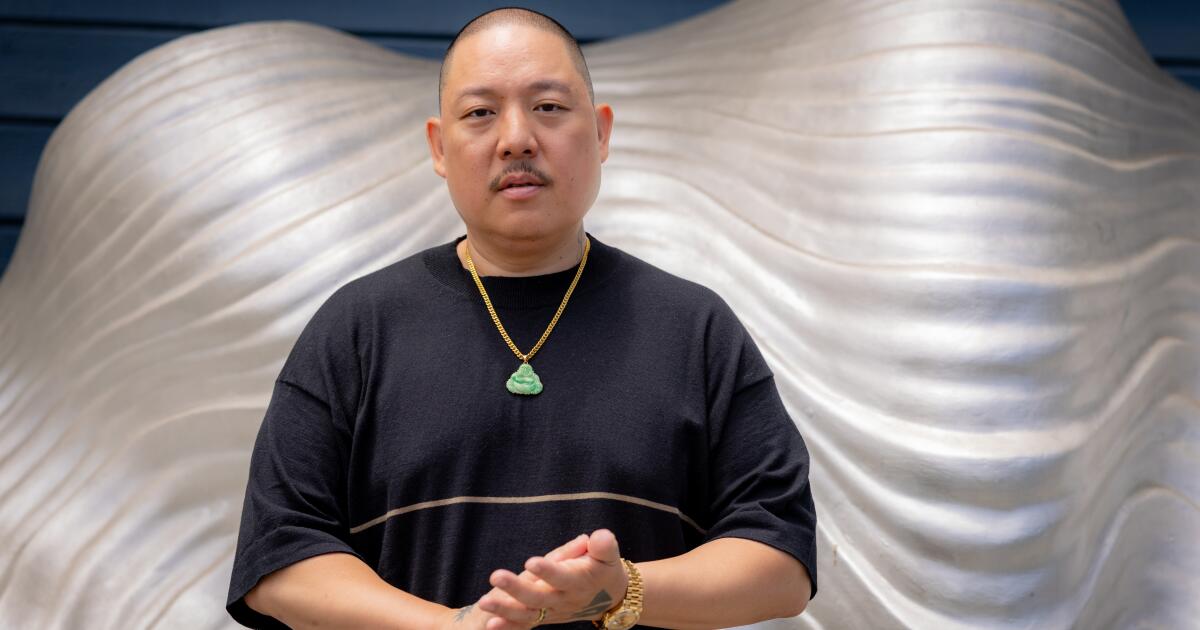
Eddie Huang.
(Jason Armond / Los Angeles Times)
Looking back, Huang thinks the earlier versions failed because he was still arguing with her. He’s still trying, in some way, to communicate with her through his writing. “If there’s one person I wish would read the book,” he said, “it would be my mom.”
There were other chapters he had to close the book on, mainly Hollywood. His foray into fiction coincided with the writers’ strike, drying up all his income and future projects. That same year, he became a father. “I had to accept and realize that my value was not in making money,” he said. “Because for three years, I couldn’t.”
He recalled a particular low point researching life insurance policies. “I had to rebuild my whole self. Really love myself despite not being able to offer anybody anything.”
That new certainty didn’t make Huang any less willing to pick fights. Last year, as his documentary “Vice Is Broke” — an autopsy of the media company behind “Huang’s World” and its eventual bankruptcy — awaited release, Huang said distributor Mubi shelved the film after he boycotted the company over Sequoia Capital’s investment in an Israeli defense technology startup. (Mubi denied this and said it still planned to distribute the film.)
The ghost of Vice still lingers in today’s media ecosystem in what he called our “era of cartel journalism:” creators navigating a world of blurred incentives and corporate interests. He traced this instinct to challenge those systems back to Socrates’ “gadfly” — the person whose job was to annoy power. “As a writer, you should be challenging people,” he said. “If your memoir can be turned into a sitcom, it probably wasn’t challenging.”

Eddie Huang.
(Jason Armond / Los Angeles Times)
After the 2025 L.A. fires drove his new family back to New York, Huang went back to cooking. He worked pop-ups, reopened Baohaus and found himself alongside line cooks half his age. In March 2025, he rewrote the novel in five days. That same month “was the first month I didn’t overdraft my credit card,” he said, with the majority of his income today coming from the restaurant. It’s allowed him to make films, write books and walk away from deals he doesn’t believe in. “Being a chef is the anchor that allows me to maintain my artistic integrity.”
For years, comparisons to Anthony Bourdain followed Huang everywhere. The two eventually became friends.
“He was one of the few people who was as advertised,” Huang said. “Nicer and more generous in person. And wounded.”
Bourdain is the only real person who appears in “Come Undone” under his own name.
When Huang mentions him, he stops talking. He covers his face. Tears come.
“I don’t believe in God,” he said, “but I asked the universe why for many, many years.”
Bourdain’s suicide, he said, was one of the reasons he walked away from “Huang’s World” in 2018. At the time, few people understood why. “It was Tony. It was family. It was everything.”

Eddie Huang.
(Jason Armond / Los Angeles Times)
Now, looking back, Huang thinks he was writing “Come Undone” toward a different ending than the one he’d imagined.
“This book is a guy saying, ‘I don’t want to be like my biological father,’” he said. “And, in the most respectful, loving way, I don’t want to go out like Tony.”
He paused. “I needed to name the sadness in me. I needed to allow myself to be loved.”
Huang is already writing another memoir about getting back into the kitchen. Still, he said, these days, he’d rather write fiction.
Rudi, an L.A. native, is a freelance art and culture writer. She’s at work on her debut novel about a stuttering student journalist.
-
World8 minutes ago
Bereaved South Koreans try AI-generated videos of deceased loved ones
-

 News13 minutes ago
How a Nation of Immigrants Traces Its Roots
-

 Health35 minutes ago
What Is Retatrutide? Dr. Dubrow Calls It the Most Powerful Weight-Loss Drug
-
 Lifestyle50 minutes ago
How World Cup fans reflect America back at us : It’s Been a Minute
-

 Technology58 minutes ago
Apple’s entry-level MacBook Pro could be up for a redesign
-

 World1 hour ago
Khamenei body in cold storage as feared Basij mobilizes ahead of historic Iran funeral
-

 Politics1 hour ago
Coalition of 25 states sues Trump admin over Medicaid work rule designed to prevent fraud
-

 Health1 hour ago
West Nile virus detected in southern state as health officials warn residents about mosquitoes

