Connect with us

Movie Reviews

The Settlers (Los Colonos): Film Review

Published

on

The Settlers (Los Colonos): Film Review

With The Settlers (Los Colonos), Felipe Gálvez offers a piercing and cold look at the brutal actions in La Tierra del Fuego.


The Western genre is undergoing some kind of revision. Filmmakers from across the world – such as Warwick Thornton, Zacharias Kunuk, and even Kelly Reichardt – are looking at it through a new modern lens, one that is centered on untold stories about the darker side of the frontier and dry plains. It is pretty fascinating how these films have been turning out. You can easily see the influence of the auteurs who made the genre so popular and rich, yet with a sensation that feels like a breath of fresh air. The most recent one to join the group is Felipe Gálvez with his feature-length debut, The Settlers (Los Colonos). It starts as a  cold look at colonialism and genocide taking place in early 20th-century Chile and ends with a commentary on how crucial cinema is to shine a light on these sidelined harsh truths.

The Settlers begins in 1901, in a particular place in Chile named Tierra del Fuego (the land of fire, in English). The fire in the title of that location doesn’t refer to a literal one, but the desolation one feels when walking through those empty plains: it feels like a descent to hell. There are some occasional scenes with bright blue skies; yet, for the most part, we see ones that feature a darker haze, which covers the film with significant amounts of dread. The story can be described as easily as a group of three men who must transport some goods from point A to point B. However, the circumstances and situations that transpire during their travels are far more complicated and devastating.

We first see a group of overworked men putting up fences in the vast grasslands owned by their boss, José Menéndez (Alfredo Castro), known as “the god of white gold” – a name that Gálvez puts in bold letters across the screen. These types of titles appear in the film on many occasions, when introducing a vital character or starting a new chapter (The King of White Gold; Half-Blood; The Ends of the Earth; The Red Pig) on this journey. Gálvez does this to give his debut another myth-like coating. It helps give more emphasis on the questions the Chilean filmmaker asks us as we watch. Myths are meant to answer timeless questions and be used as guides for each generation. In this case, Gálvez wants to show us that most of what we read about the past is sanitized to a great degree, trying to cover a darker history.

Even with a ninety-seven-minute runtime, The Settlers takes time to stage all these scenarios authentically while still playing with some Western genre conventions introduced by Sergio Leone in the Spaghetti Westerns and Anthony Mann in his classic renditions of the Wild West. The history books say that Menéndez was a businessman and owner of very large companies that stood tall for decades during the time. However, in this film, we are introduced to him differently, one that’s more reflective of his abusive power. Like many of his accomplices or fellow vendors, he wants his business to grow. These were fast-changing times; every decision these magnets made was tied with a movie towards modernization to increase their wealth. But there’s one specific transaction that Menéndez entrusts three men to do so he doesn’t get his hands dirty.

Advertisement
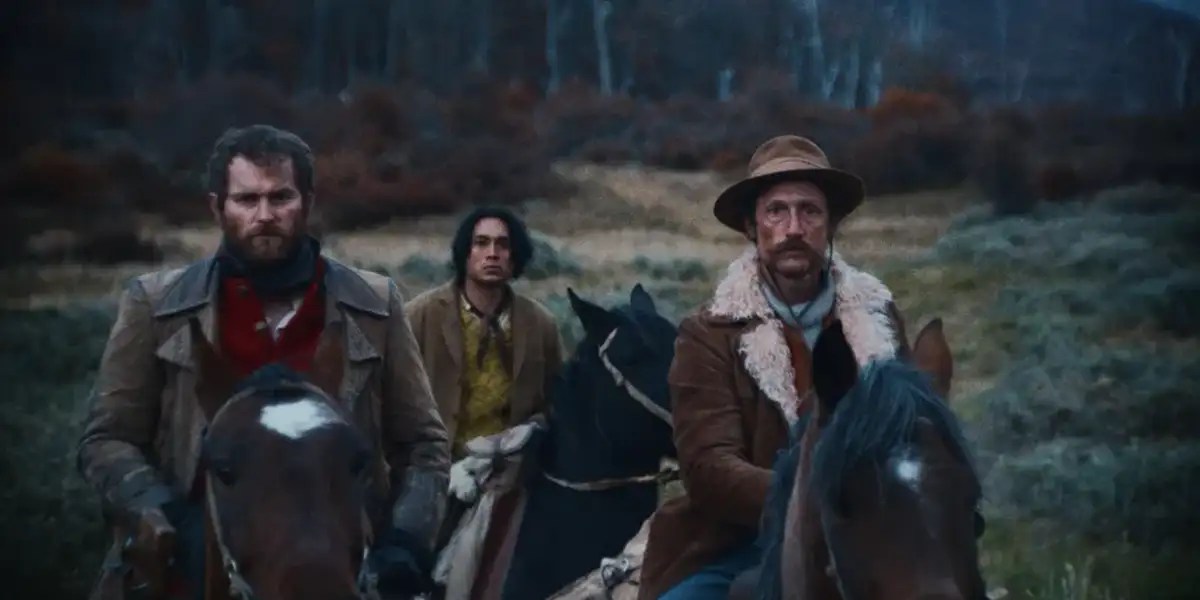
a still from The Settlers (Los Colonos)  loud and clear reviews
The Settlers (Los Colonos) (Quijote Films, Mubi)

Menéndez hires a Scottish Lieutenant named Alexander MacLennan (Mark Stanley) to clear a path to the Atlantic Ocean and efficiently sell his “white gold”. The “white gold” in question refers to sheep, prize livestock that serves of great importance to the colonialist buyers. That’s why Lieutenant MacLennan has a big task ahead of him. But he isn’t going on this journey alone; MacLennan is joined by Bill (Benjamin Westfall), an American mercenary, and Segundo (Camilo Arancibia), a mestizo who Menéndez demanded to join the team. The three of them aren’t there to bond or connect with one another as happens in other Westerns set during troubling times. In The Settlers, they are only trying to survive at an age where genocide occurs in every corner of these hellscape plains.

MacLennan exudes his dominance over his other two companions, wearing a bright red coat that immediately pops from the screen. It symbolizes his nihilistic behavior – the blood that spills from his past and forthcoming actions. On the other hand, Bill is the archetype of a cowboy, similar to those you see in the films of John Ford and Sam Peckinpah. But what separates this character from the others is his overly barbarous nature. Like MacLennan, he also has a token that symbolizes his persona; in Bill’s case, it is a set of severed human ears stringed one on top of the other. Segundo is the most sympathetic by a mile wide of the three, but he is also involved in some of the crimes, sometimes against his will.

As the three of them traverse through the pastures of La Tierra del Fuego, they find themselves having their fair share of harrowing encounters with other settlers and villagers, all of which end violently. These scenes of conversation and psychological confrontations serve as a way for Gálvez to expand on the film’s themes the most. They reveal how morally indifferent these people who ransack the lands are. It will remind many of Martin Scorsese’s latest joint, Killers of the Flower Moon, another film about the tragedy of colonialism. Both stories are engrossing in their respective rights, using moments of brutality and violence to demonstrate to the audience the level of cruelty that occurred back then. Scorsese and Gálvez sometimes dwell on exploitation due to their raw and cold depictions of actual events. However, much to their favor, those scenes never reach a point where they become provocative, which might have caused the directors to miss the point thematically.

With filmmakers like Manuela Martelli, Sebastian Lelio, Pablo Larraín, and Maite Alberdi, Chile is rapidly on the rise to becoming a country with one of the most fascinating filmographies in recent memory. What separates Chilean cinema from the rest of the other current movements, like the ones in Argentina and Denmark, is that the work is based on the country’s past, no matter the subject matter or genre. And Felipe Gálvez’s debut is one of the best examples from the bunch. It is a history lesson in the most true-to-life way, showcasing the cruelty seeded in the lands thousands of people walk in daily.


The Settlers (Los Colonos): Trailer (Mubi)

The Settlers (Los Colonos) will be released in theaters in NY & LA on January 12, 2024, followed by more cities in the US & Canada, Netherlands, Brazil and Mexico, and in February in Germany. The film is coming soon to the UK, Ireland, Italy, Latin America, India and Turkey.

Advertisement
Continue Reading
Click to comment

Leave a Reply

Your email address will not be published. Required fields are marked *

This site uses Akismet to reduce spam. Learn how your comment data is processed.

Movie Reviews

Movie Review – Reminders of Him (2026)

Published

on

Movie Review – Reminders of Him (2026)

Reminders of Him, 2026.

Directed by Vanessa Caswill.
Starring Maika Monroe, Tyriq Withers, Rudy Pankow, Lainey Wilson, Lauren Graham, Jennifer Robertson, Zoe Kosovic, Monika Myers, Sindhyar Baloch, Bradley Whitford, Nicholas Duvernay, Jillian Walchuck, Hilary Jardine, Skye MacDonald, Rick Koy, Susan Serrao, Anne Hawthorne, Laird Reghenas, and Kevin Corey.

SYNOPSIS:

After prison, a woman attempts to reconnect with her young daughter but faces resistance from everyone except a bar owner with ties to her child. As they grow closer, she must confront her past mistakes to build a hopeful future.

Advertisement

Given that Maika Monroe’s just-released-from-incarceration Kenna immediately desecrates the gravesite of her love Scotty (which is unintentionally hilariously on the side of the road where a tragic car accident took his life) by stealing the wooden cross (with an inner voice muttering that he hated memorials anyway), tells another character she doesn’t like cats, and complains to someone else that all music is sad and that she doesn’t like it, it’s reasonable to get the impression that the latest adaptation from Colleen Hoover, Reminders of Him, is intentionally aiming for an unlikable lead. Nothing says “get the audience on the side of our protagonist” like all of the above.

The reality is that Maika Monroe is capable enough to inject a modicum of emotion and grounded sincerity even into a Colleen Hoover character, but that, directed by Vanessa Caswill (with Lauren Levine writing the screenplay alongside the author), these are all characters stuck reaching for depth far out of grasp in a hollow romance that is less about someone with a criminal record ingratiating themselves back into society after a seven-year vehicular manslaughter sentence and earning the trust of her dead boyfriend’s parents (Bradley Whitford and Lauren Graham), now the legal guardians of her five-year-old daughter, for visitation rights or anything that would force the novelist (this is her third book translated to screen in as many years) to write an actual character, and more a dull push-pull possible relationship with the former NFL star best friend picking up the pieces, living next door to those grandparents, and assisting taking care of the young girl.

Asking the question “what would it be like to fuck your dead boyfriend’s best friend” should be a hell of a lot more morally thorny and emotionally charged than this. Rather than engage with that, the filmmakers need to dedicate 70 minutes to an outrageously contrived setup in which Kenna and that best friend, Ledger (Tyriq Withers, also visibly trying to express some personality and humanity, but is left hanging by the script), have never met before. Yes, you read that right (and yes, those are the real ridiculous names of these characters, although the latter is presumably intended to honor the late great Heath Ledger, who once starred in romantic dramas and made them a hell of a lot more watchable).

Despite being best friends, Ledger not only never met his best friend’s girlfriend, but he apparently had never even seen a picture of her until her mugshot (which he conveniently forgets, never mind that Maika Monroe looks mostly the same seven years removed) following the car accident on Scotty’s (Rudy Pankow) birthday, which he bailed on for fitness exams in preparation for the NFL draft. In the present, he no longer plays, having “blown out a shoulder”, yet appears physically fine and in no pain during the numerous shirtless scenes and a couple of sexual ones. Before the film gets there, he is skeptical of going anywhere near Kenna once he discovers her identity. Of course, that doesn’t last long because these two hot leads are gravitating toward spending time together.

Much of this is, to put it bluntly, airless and lifeless despite an ensemble trying their best to elevate the proceedings, with what feels like significant chunks of the novel cut out; there is a single flashback to Kenna’s time in prison – being taken under the wing of a mentor of sorts on how to survive – and Scotty is allocated such a minimal screen time that he hardly feels like a character and is never allowed to feel like a presence looming over the story and the choices these characters make. For some reason, there is also a friend Kenna makes here with Down syndrome (Monika Myers) who seems to exist as a vessel for comedic relief, which might have sat better if, once again, there were actually a damn character behind that.

Advertisement

One waits and waits for the inevitable moment where, after snowcone dates and playful arguments about music, there is a release of sexual tension. However, the drama resulting from this is childish, dumb, and resolved about three scenes later. You won’t need a reminder that Reminders of Him, like all Colleen Hoover adaptations thus far, is bad, once again searching for a romantic pulse and eroticism at the expense of characters who feel like actual people or anything that gives weight to the attempts at thorniness.

Flickering Myth Rating – Film: ★ ★ / Movie: ★ ★

Robert Kojder

https://www.youtube.com/watch?v=embed/playlist


Advertisement
Continue Reading

Movie Reviews

“Resurrection” Movie Review: To Burn, Anyway

Published

on

“Resurrection” Movie Review: To Burn, Anyway

“What can one person do but two people can’t?”

“Dream.”

I knew the 2025 film “Resurrection” (狂野时代) would be elusive the second I walked out of Amherst Cinema and into the cold air, boots gliding over tanghulu-textured ice. The snow had stopped falling, but I wished it hadn’t so that I could bury myself in my thoughts a little longer. But the wind hit my uncovered face, the oxygen slipped from my lungs, and I realized that I had stopped dreaming.

“Resurrection” is a love letter to the evolution of cinematography, the ephemerality of storytelling, and the raw incoherence of life. Structured like an anthology film and set in a futuristic dreamscape, humanity achieves immortality on one condition: They can’t dream. We follow the last moments before the death of one rebel dreamer, called the “Deliriant” or “迷魂者,” as he travels through four different dream worlds, spanning a century in his mind.

Jackson Yee, who plays the main protagonist of the movie. Photo courtesy of Wikimedia Commons.

Being Bi Gan’s third film after the 2015 “Kaili Blues” (路边野餐) and the 2018 “Long Day’s Journey Into Night” (地球最后的夜晚), “Resurrection” follows Gan’s directorial style of creating fantastical, atmospheric worlds. Jackson Yee, known for being a member of the boy group TFBoys, stars as the Deliriant and takes on a different identity in each dream, ranging from a conflicted father-figure conman to an untethered young man looking for love to a hunted vessel with a beautiful voice. His acting morphs unhesitatingly into each role, tailored to the genre of each dream. Of which, “Resurrection” leans into, with practice and precision.

Advertisement

Opening with a silent film that mimics those of German expressionist cinema, “Resurrection” takes the opportunity to explore the genres of film noir, Buddhist fable, neorealism, and underworld romance. The Deliriant’s dreams are situated in the years 1900 to 2000, as we follow the evolution of a century of competing cinematic visions. The characters don’t utter a single word of dialogue in the first twenty minutes, as all exposition occurs through paper-like text cards that yellow at the edges. I was worried it would be like this for the whole film, but I stayed in the theater that Tuesday night, the week before midterms, waiting for the first line of spoken dialogue to hit like the first sip of water after a day of fasting.

Supporting female actress Shu Qi. Photo courtesy of Wikimedia Commons.

Through a massive runtime that spans two hours and 39 minutes, this movie makes you earn everything you get. Gan trains the audience’s patience with a firm hold on precision over the dials of the five senses and the mind.

The dreams may move forward in time through the cultures of the twentieth century, but on a smaller temporal scale, the main setting of each dream functions to tell the story of a day in reverse. The first dream, being a film noir, is told on a rainy night. Without giving any more spoilers, the three subsequent dreams take place at twilight, during multiple sunny afternoons, and then at sunrise. “Resurrection” does not grant sunlight so easily; we are given momentary solace after being deprived of direct sunlight for a solid 70 minutes, until it is stripped from us again and we are dropped into the darkness of pre-dawn – not that I am complaining. I love a movie that knows what it wants the audience to feel. I felt a deep-seated ache as I watched the film, scooting closer to the edge of my seat.

“Resurrection” is a movie that is best watched in theaters, but a home speaker system or padded headphones in a dark room can also suffice. Some of its most gripping moments are controlled by sound. Loud, cluttered echoes of the world, whether from people chatting in a parlor or anxiety in a character’s head, are abruptly cut off with ringing silence and a suspended close-up shot. We are forced to reckon with what the character has just done. I knew I was a world away, but I was convinced and terrified at my own culpability and agency. If I were him, would I have done the same? I could only hear my thoughts fade away as we moved onto the next dream.

Beyond sight and sound, the plot also deals intimately with the senses of taste, smell, and touch, but you will have to watch the movie yourself to find that out.

My high school acting teacher once told us that whenever a character tells a story in a play, they are actually referencing the play’s overall narrative. This exact technique of using framed narratives as vessels of information foreshadowing drives coherence in a seemingly ambiguous, metaphorical anthology film. Instead of easy-to-follow tales that mimic the hero’s journey, we are taken through unadulterated, expansive explorations of characters and their aspirations. We never find out all the details of what or why something happens, as the Deliriant moves quickly through ephemeral lifetimes in each dream, literally dying to move onto the next, but we find closure nonetheless through the parallels between elements and the poetry of it all.

Advertisement

That is why I like to think of “Resurrection” as pure art. It is not bound by structure; it osmoses beyond borders. It is creation in the highest form; it is a movie that I will never be able to watch again.

Perhaps because the dream worlds are so intimate and gorgeous, the exposition for the actual futuristic society feels weak in comparison. We learn that there is a woman whose job is to hunt down Deliriants, but we don’t see the rest of the dystopian infrastructure that runs this system. However, I can understand this as a thematic choice to prioritize dreams over reality. Form follows function, and these omissions of detail compel us to forget the outside world.

What it means to “dream” is up for interpretation, and we never learn the specifics of why or how immortality is achieved. Instead, “Resurrection” compares dreaming to fire. We humans are like candles, the movie claims, with wax that could stand forever if never used. But what is the point in being candles if we are never lit?

The greatest reminder of “Resurrection” is our own mortality. Whether we run from the snow-dipped mountaintops to the back alleyways of rain-streaked Chongqing, we can never escape our own consequences. “Resurrection” gives me a great fear of death, but so does it reignite my conviction to live a life of mistakes and keep dreaming anyway.

Dreaming is nothing without death. Immortality is nothing without love. So, I stumbled back to my dorm that Tuesday night, the week before midterms, thinking about what I loved and feared losing. So few films can channel life and let it go with a gentle hand. I only watch movies to fall in love. I am in love, I am in love. I am so afraid. 

Advertisement
Continue Reading

Movie Reviews

‘Project Hail Mary’ Review: Ryan Gosling and a Rock Make Sci-Fi Magic

Published

on

‘Project Hail Mary’ Review: Ryan Gosling and a Rock Make Sci-Fi Magic

In contrast to other sci-fi heroes, like Interstellar’s Cooper, who ventures into the unknown for the sake of humanity and discovery, knowing the sacrifice of giving up his family, Grace is externally a cynical coward. With no family to call his own, you’d think he’d have the will to go into space for the sake of the planet’s future. Nope, he’s got no courage because the man is a cowardly dog. However, Goddard’s script feels strikingly reflective of our moment. Grace has the tools to make a difference; the Earth flashbacks center on him working towards a solution to the antimatter issue, replete with occasionally confusing but never alienating dialogue. He initially lacks the conviction, embodying a cynicism and hopelessness that many people fall into today. 

The film threads this idea effectively through flashbacks that reveal his reluctance, giving the story a tragic undercurrent. Yet, it also makes his relationship with Rocky, the first living thing he truly learns to care for, ever more beautiful. 

When paired with Rocky, Gosling enters the rare “puppet scene partner” hall of fame alongside Michael Caine in The Muppet Christmas Carol, never letting the fact that he’s acting opposite a puppet disrupt the sincerity of his performance. His commitment to building a gradual, affectionate friendship with this animatronic creation feels completely natural, and the chemistry translates beautifully on screen. It stands as one of the stronger performances of his career.

Project Hail Mary is overly long, and while it can be deeply affecting, the film leans on a few emotional fake-outs that become repetitive in the latter half. By the third time it deploys the same sentimental beat, the effect begins to feel cloying, slightly dulling the powerful emotions it built earlier. The constant intercutting between past and present can also feel thematically uneven at times, occasionally undercutting the narrative momentum. At 2 hours and 36 minutes, the film feels like it’s stretching itself to meet a blockbuster runtime when a tighter cut might have served better.

FINAL STATEMENT

Project Hail Mary is a meticulously crafted, hopeful, and dazzling space epic that proves the most moving friendship in film this year might just be between Ryan Gosling and a rock.

Advertisement
Continue Reading

Trending