Movie Reviews
The Beast (2023) – Movie Review


The Beast, 2023.
Directed by Bertrand Bonello.
Starring Léa Seydoux, George MacKay, Kester Lovelace, Julia Faure, Guslagie Malanda, Dasha Nekrasova, Martin Scali, Elina Löwensohn, Marta Hoskins, Félicien Pinot, Laurent Lacotte, and Xavier Dolan.
SYNOPSIS:
The plot is set partly in a near future in which artificial intelligence is in control of everyone’s lives and human emotions are perceived as a threat.

An ambitious story of tragic and toxic love sprawled across the past, rearview window present, and near future, Bertrand Bonello’s The Beast wonders what it would be like if, in one of those three timelines, a well-intentioned man in one of them was also a raging misogynist making deeply disturbing YouTube videos promoting a violent cleansing coming by his hand as retaliation for women having always rejected his advances. This is a love story that is also anything but a love story, which is part of what makes it so compelling.
It certainly makes for a deeply uncomfortable moment when, roughly halfway into the film, present-day Gabrielle Monnier (Léa Seydoux impressively pulling off three variations of the same character, layering them all with a wide range of emotions and one haunting final shot that sticks in the mind sonically and visually) meets that man, Louis Lewanski (George MacKay, also terrific pulling off polar opposite depictions of this character and, at times, scarily finding a bit of humanity in the deranged variant), feeling that unexplainable gravitational connection, urging him to walk her home after a California earthquake. Louis repeatedly declines, insisting that something bad might happen, signifying that his hatred towards women comes less from the way they treat him and is more about his deep-sea-level fears and insecurities.

While that dynamic does make for some traditional thrills, perhaps the real horror comes from a psychological place that, for anyone fascinated by stories about reincarnation or love across different timelines, there could be an utterly psychotic version of all of us out there. Or that we could be longing for someone so unhinged without knowing it. However, the film is, and rightfully so, much more concerned with Gabrielle’s emotional and physical journey returning to those past timelines as part of an AI-mandated process in the future to eliminate feelings from humans to make them “less dangerous” and more fit for a barebones workforce.
This Eternal Sunshine of the Spotless Mind reminiscent procedure takes Gabrielle to early twentieth-century France, where she is in a loveless marriage to the wealthy Georges (Martin Scali), encountering Louis at a glamorous party who is taken aback by her, vowing to protect her after she speaks of this inexplicable connection and an intense feeling that something disastrous is eventually going to happen. They remain in contact, and he is interested in her and her fascination with crafting dolls (a recurring motif across the film.) It is also worth mentioning that, yes, George MacKay and Léa Seydoux speak English and French in the respective timelines, only adding to the commitment and depth of these tremendous performances. Essentially, he is her savior in one life and her worst nightmare in the next; it’s a loaded juxtaposition that the filmmakers don’t waste.

There is also an experimental visual style that plays with pixel distortion and the nature of filmmaking, chiming in on how green screen and AI remove realism. The script (written by Bertrand Bonello, Guillaume Bréaud, and Benjamin Charbit, loosely based on aspects of the Henry James novel The Beast in the Jungle) brilliantly brings some of these conversations back into a portion of the grand, mind-shattering finale, sharply making that point. Without giving away, the ending sequence is a variation of one earlier scene that brings forth immense dread not only because of what is happening but also on a metatextual level in the filmmaking process.
The Beast is primarily split into two halves, with each containing stops in the future world, which is also fleshed out as a numbing existence overrun by technology and aesthetically detailed nostalgia nightclubs, which does work, especially if one has no idea about the second half-wild direction for George MacKay’s character. However, most viewers might already know about that going in (it’s not worth writing around in a review to be vague about what gives the film such unnerving depth) and become somewhat restless during the slower first half.
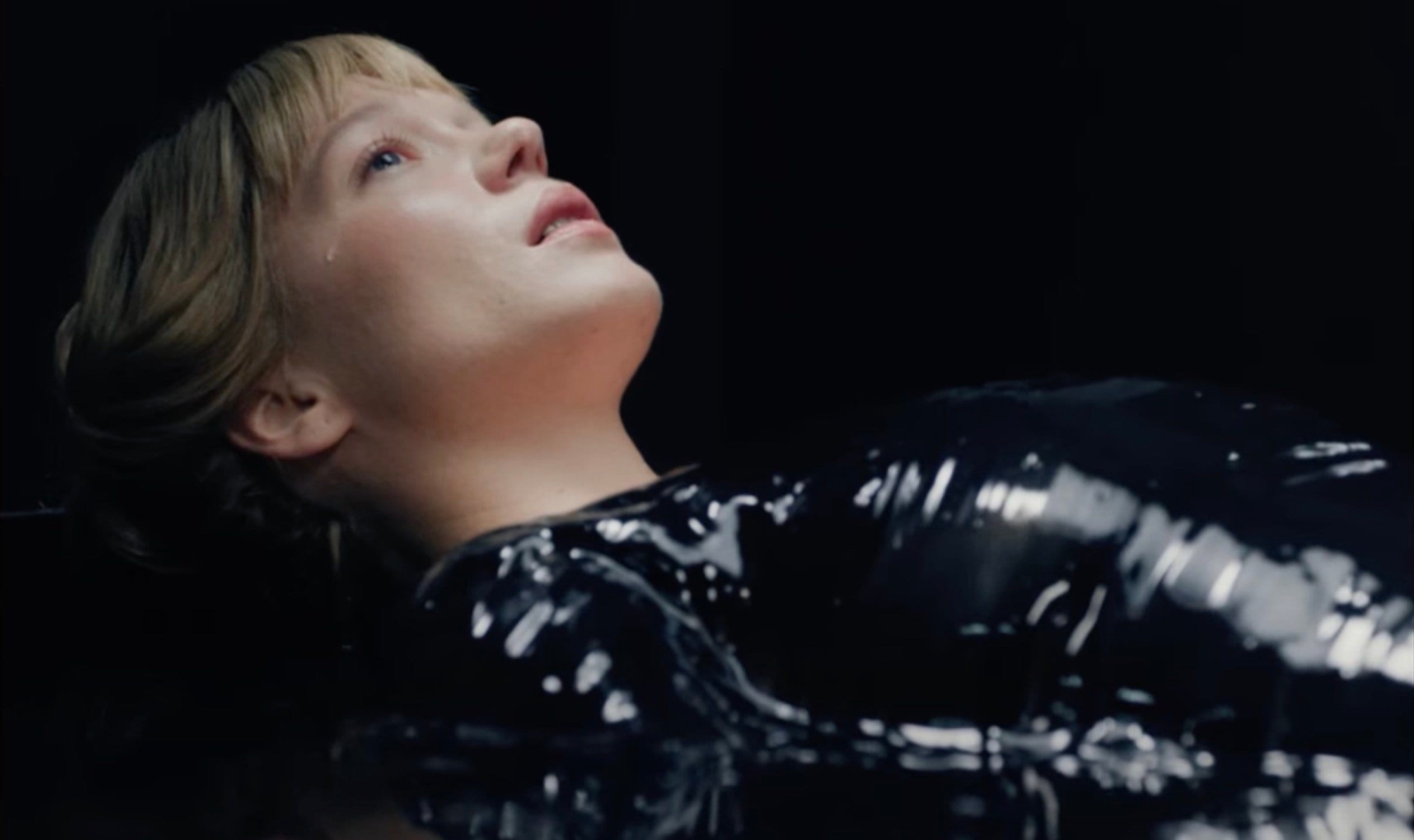
The Beast grows on the viewer as it gradually reveals more information and ideas, which is a lot considering the 146-minute running time. Nevertheless, there is love and danger here, packaged together in one cruel, psychologically torturous package. It is sweet and hellish, yet also clued into a depressing future informing its characters and ideas.
Flickering Myth Rating – Film: ★ ★ ★ ★ / Movie: ★ ★ ★ ★
Robert Kojder is a member of the Chicago Film Critics Association and the Critics Choice Association. He is also the Flickering Myth Reviews Editor. Check here for new reviews, follow my Twitter or Letterboxd, or email me at MetalGearSolid719@gmail.com
https://www.youtube.com/watch?v=embed/playlist



Sam Raimi‘s Evil Dead films and TV series are a fine example of creativity within constraints, playfulness, self-awareness and outright slapstick comedy. The Evil Dead series after Raimi is very, very different. Starting with 2013’s Evil Dead by Fede Álvarez, followed by Evil Dead Rise by Lee Cronin, the new series takes itself more seriously and emphasises pure horror, violence and gore. Some have considered this praiseworthy as it avoids being a mere retread of the old films, but the reception has been mixed.
In Sébastien Vanicek’s Evil Dead Burn, Alice (Souheila Yacoub) loses her abusive husband (George Pullar) to a motor accident. When she goes home to stay with his family, the consequences of the work of their dead grandfather researching the Necronomicon and the Deadites manifest in terrible ways. One by one, the family are turned into the Evil Dead.
Horror is a genre that depends on you relating to the protagonists so you care what happens to them. In the case of Evil Dead Burn, Yacoub does a decent job with the character she’s given, but the gonzo horror elements manifest so early in the film that she may as well be collateral damage in the onslaught, especially as the film’s early point of view is that of her brother-in-law (Hunter Doohan).
Fans of gory violence will get their money’s worth here, but there’s not a lot going on besides that. The film is a descent into madness and carnage that is so resolutely unpleasant that, after some of the early kills, it becomes numbing. It’s hard to gather what the tone is supposed to be, with lots of callbacks to the early films’ style by setting up inevitable kills with Chekhov’s weed trimmer, Chekhov’s fork and every other potentially dangerous prop the camera lingers on. The family are all deeply unpleasant at some level and so their deaths register as meaningless. Yes, the film has the obligatory something to say about how our tendency to ignore domestic abuse creates demons that destroy families, but then absolutely panders to bloodlust by absolutely revelling in some of the most extreme violence imaginable between family members (and a pet). To say this is not a film for the sensitive is to understate things considerably. This is a film that absolutely earns its content guidance warnings.
Is there any comedy? Some, but it feels out of place given the absolute brutality inflicted on the cast. While most of the other films were self-aware about setting up a ludicrously grisly end for a villain as a payoff, in Evil Dead Burn,the kills have very little flair. It’s also hard to know what the rules for getting rid of a Deadite are, as some of them are still upright and chatty after losing most of the contents of their skull and some are dispatched by the repeated application of a blunt object to the head. Towards the end, a McGuffin is added to make the kills final, but before that, who knows?
Should you watch Evil Dead Burn,? It certainly gets vocal reactions from audiences in a cinema, and if you’re a gorehound you’ll be in for a ride. If you’re a horror fan, it’s certainly a horror film, but violent instead of scary. If you’re just a fan of cinema who likes good films whether or not they’re horror films, then this will be an alienating watch. In Evil Dead Rise the decay of the family was more than background noise and factored into the circumstances of the individual deaths, but not here. It has slight pretences of being a film with Themes and Ideas, but in the end it just feels like an excuse to serve up limbs being mutilated, skulls being crushed and any number of stabbings, slicings and gougings rendered with psychopathic visual fidelity. If that’s what you’re after, that’s what it’s got.
Movie Reviews
‘Night Nurse’ Review: A Caretaker Explores Her Kink for Elder Abuse in the Year’s Strangest Erotic Thriller

There are any number of erotic thrillers in which rich old men are robbed blind and/or left for dead, but Georgia Bernstein’s admirably bizarre “Night Nurse” might be the first movie of its kind where elder abuse is the source — and possible subject— of its erotic thrills. If there are others, I’m not sure I want to know.
But this woozy debut feature doesn’t rely on its audience being turned on by the relationship between a nubile caretaker and her dementia-addled patient. Their psychosexual bond, meanwhile, hinges on cold-calling vulnerable old people under the guise of a grandchild in financial distress. (“I’m in trouble, nana, send me $10,000 or I’ll be left to rot in jail!” That sort of thing). With its slim wisp of a premise stretched into a Strickland-esque dreamscape that substitutes kink for conflict, the film itself hardly seems convinced by its own wrinkled lust — all desperate kisses and non-touching poses of subservience. More important to Bernstein is what that lust reveals about her characters’ deepest needs, specifically how their need to care and be cared for can be as easily perverted as any other form of desire.

As moody and weightless as the noir-accented score that blows through the movie like a curlicue gust of wind in an old cartoon (credit to musicians Sam Clapp and Steven Jackson), “Night Nurse” lacks the pulse required for its stray feelings to come alive. Still, the film ambiently taps into the latent eroticism of teasing out the distance between how you see yourself and who you really are. Bernstein plays with that distance like a telephone cord wrapped around her fingers, and Eleni — played by the excellent newcomer Cemre Paksoy, powerfully helpless — only frays even more as the receiver is brought near the hook. “Everything I did before today wasn’t me,” the nurse tells co-worker Mona (Eleonore Hendricks) after starting a new job at an Illinois retirement home. “It was somebody else.”
What she did before today remains unexplored (specifically, what she did to get herself fired from her last gig), but I’m guessing she’s probably changed less than she thought. There’s a faraway flicker in her eyes the moment she catches the vibe between Mona and Douglas (a ribald and elusive Bruce McKenzie), a white-haired seventysomething who shows early signs of dementia but still commands an undiminished sexual energy. “I’m not an invalid,” he coos as Mona bathes him in the tub, to which she replies, “yes, you are,” in a supplicant tone that hints at a rich history of power games between them.
Later that same night, Douglas will force Eleni to call a stranger, pretend that she’s their granddaughter, and ask for money — he’ll wrap the phone cord around the nurse’s body as she talks and shove her against the wall as they kiss. She’s into it. So into it that he has to clarify the terms of his whole deal: “If you’re looking for a pogo stick, I’m really not your guy.” But Eleni isn’t looking for anything to bounce on. She just wants to be needed, and maybe to need someone in return. Someone who will see her for who she really is and allow her the fantasy of pretending she isn’t being herself when she cons vulnerable strangers out of their money — when she exploits how enthralled those strangers are by the care they have for their loved ones.
“Night Nurse” doesn’t belabor the psychology, as Bernstein prefers to express her story through heavy-lidded suggestion. Somnambulating from the moment it starts, the film moves through a series of beautifully arranged poses that stretch their latent meaning thin across the surface (Lidia Nikonova’s cinematography lacquers every shot with a seductive dreaminess). We see Douglas smoking in a lawn chair with Mona and Eleni curled around his feet. Eleni riding in the backseat of a convertible as the wind blows through her curls. The full staff of nurses — all of them under Douglas’ sway — stumbling around his condo in a state of zonked out bliss as they roll on the prescription drugs they’ve stolen from the residents.
Once you’ve seen one shot of this movie, you’ve practically seen them all, at least until things escalate during a rushed and unsatisfying third act that forces Eleni into an honest confrontation with herself. People will do just about anything to feel needed — they’ll give whatever degree of care allows them to receive it in return. “Night Nurse” understands that desire, but remains far too numb to treat it.
Grade: C+
The Independent Film Company will relase “Night Nurse” in theaters on Friday, July 10.

Last year’s “Superman” ended with Iggy Pop singing “Because I’m a punk rocker, yes I am” — an ironic coda for a superlatively square hero. But it rings straightforwardly true for Superman’s cousin.
Milly Alcock’s Kara Zor-El, or Supergirl, sports not a spandex suit but a Blondie T-shirt. When we meet her in Craig Gillespie’s “Supergirl,” she’s been on an interstellar bender for days. She’s more Courtney Love than Clark Kent.
Nonchalant and sarcastic, Kara is also a little Han Solo-ish, you might say, given that she moves capriciously through the galaxy in her junky spaceship while getting in fights in extraterrestrial bars. She’s a welcome, jagged riff on more buttoned-up superheroes, and Alcock is terrific in the role. If only “Supergirl” was as good as she is.
While the latest DC release, and second under James Gunn’s stewardship, has its moments, “Supergirl” struggles to match Kara’s punk-rock energy with an equally spirited supporting cast and story.
Skepticism seems to have gathered for “Supergirl” ahead of its release. Many fans have argued it wasn’t the right next step for DC Universe. But I’m not so sure. Alcock’s breezy cameo in “Superman” was one of that movie’s highlights. Handing the follow-up to her, and her faithful floating dog Krypto, strikes me as an extremely natural next step. When in doubt, follow the dog.
And much of “Supergirl” is winning. It resides almost entirely in space, touching down only momentarily on Earth. In its consistently creative production design, clever needle drops and underdog story arc, “Supergirl” resides a little closer to Gunn’s “Guardians of the Galaxy” movies than other DC entries. Its outer space is filled with cosmic detritus, mean characters and cute critters. Seth Rogen as the voice of a tiny alien co-piloting a space bus is an inspired concoction, as is a shabbier sci-fi realm with rest stops along the intergalactic highway.
-

 Detroit, MI20 minutes ago
Detroit city leaders to DHS: Stop ICE pursuits which endanger the community
-

 San Francisco, CA28 minutes ago
SF Supervisor Jackie Fielder hosts listening session after medical leave
-

 Dallas, TX35 minutes ago
The Stewpot artists find healing, purpose and income through art in Dallas
-

 Miami, FL38 minutes ago
Can Jason Marshall push for a starting spot – The Splash Zone 7/10/26
-

 Boston, MA43 minutes ago
Police investigating shooting in Downtown Crossing – Boston News, Weather, Sports | WHDH 7News
-
 Denver, CO50 minutes ago
Denver mayor announces new $100 million plan to bring in 10,000 jobs
-

 San Diego, CA53 minutes ago
WEBTOON Brings Top Creators for San Diego Comic-Con Panels
-

 Seattle, WA53 minutes ago
Husband of pregnant wife killed in Seattle sues King County homeless authority

