Movie Reviews
Fresh Kills (2024) – Movie Review


Fresh Kills, 2024.
Written and Directed by Jennifer Esposito.
Starring Emily Bader, Odessa A’zion, Jennifer Esposito, Domenick Lombardozzi, Annabella Sciorra, Nicholas Cirillo, Ava DeMary, Stelio Savante, Franco Maicas, David Iacono, Anastasia Veronica Lee, Taylor Madeline Hand, Maya Moravec, Nicole Ehinger, Luciana VanDette, Amanda Corday, Annie Pisapia, Camryn Adele Portagallo, Colleen Kelly, Beatrice Pelliccia, Charlie Reina, and Bettina Skye.
SYNOPSIS:
Follows the story of the loyal women of an organized crime family that dominated some of the boroughs of New York City in the late 20th century.
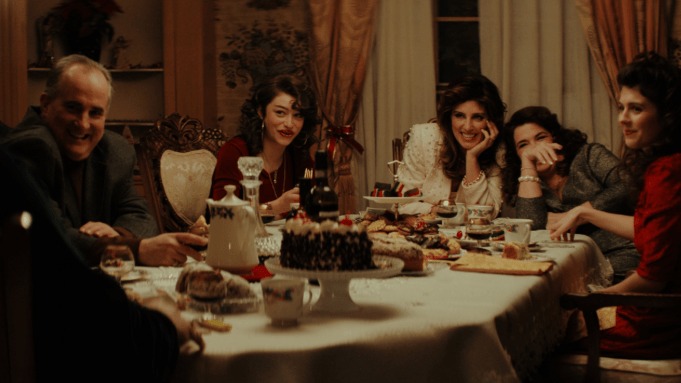
A film for anyone who wonders about the specifics of what goes on in the lives of the mothers, daughters, and granddaughters part of a mobster family household, writer/director/producer/star Jennifer Esposito’s Fresh Kills, for all its clunky pacing and overreaching ambition, is fresh and packs a cumulative punch about this inescapable lifestyle.
Spanning several points in time across the 1980s and 1990s while primarily fixated on tightknit sisters Rose and Connie, Fresh Kills homes in on how these girls, especially as they grow up, couldn’t be any more different from one another, especially when it comes to the privilege of wealth and the expectations of being born into a family dynamic where the women stay at home while the men are involved in the Staten Island Mafia.

Played by Anastasia Veronica Lee and Taylor Madeline Hand as young girls before turning things over to Emily Bader and Odessa A’zion upon growing up, the former, Rose, is the quiet one (you would be forgiven if you assumed she was mute during the first 15 minutes or so) whereas Connie is upbeat and playful. Connie is seen encouraging Rose to “fly” by spreading apart her hands while being boosted on top of her knees. It’s a silly game they play in front of their new home, still innocent of what their father, Joe Larusso (Domenick Lombardozzi), does for a living. Moments later, an unnerving dialogue exchange is overheard in the garage, somewhat clueing them int to different extents. Little do the girls know, it seems no women born into this type of toxic family dynamic truly get to fly, at least independently.
Then there is the matriarch Francine (Jennifer Esposito), aware and horrified by much of her husband’s actions. At one point, in hysterics, she exclaims that she needs to get away. Yet, much like Connie when she ages, she sticks up for this spoiled lifestyle, whether from fashion, a spacious home or simply being blessed with a healthy family. Once upon a time, she did dream of being something more, apparently approached to get into modeling, yet instead ended up around the arm of Joe. Naturally, Connie becomes her favorite since she is the one to embrace and carry on the more traditional roles, whereas Rose finds herself talked down to over having goals beyond marriage and motherhood.

There is the instinct to label Francine a bad mother for trying to enforce such a status quo, and even the screenplay from Jennifer Esposito never fully gets around fleshing out all of the multidimensional characters; she comes across as a complex figure. She is someone who gave up on her dreams and has not chosen to actively go against a daughter trying to make something of herself (Rose is interested in beauty just like her mother was) and escapes something that she knows has been dysfunctional, hostile, unhealthy, and traumatic for quite some time.
The performances from Emily Bader and Odessa A’zion are also rich, going beyond playing two characters gradually transitioning into opposites. Connie is played with such tornado-like ferocity, preaching family first and asserting that she has made the right choice in getting married and having a child, one suspects that she is trying to convince herself just as much as she is verbally tearing her sister down. Meanwhile, Rose gradually tries to come out of her shell and embark on a different path, but at every turn, she is devastatingly and tragically reminded of what she has been born into and might never escape. Naturally, Domenick Lombardozzi is wisely kept off to the side (this is not a mobster movie about the crimes themselves), but is also part of an emotional scene with Rose that ends on such a powerful note you can’t help but pity him. It’s a vicious, towering toxic masculinity takedown.

As mentioned, the pacing in Fresh Kills is sometimes off, with jumps forward in time frustratingly undercutting other developing character dynamics. One also wishes Jennifer Esposito felt more confident as a filmmaker, doing away with unnecessary needle-drops to heighten the importance of certain moments. However, she does find cohesive, full-throttle momentum for her passion project in its third act, which is riveting, heartbreaking, and empowering, retroactively shading in more depth to what comes before.
Flickering Myth Rating – Film: ★ ★ ★ / Movie: ★ ★ ★ ★
Robert Kojder is a member of the Chicago Film Critics Association and the Critics Choice Association. He is also the Flickering Myth Reviews Editor. Check here for new reviews, follow my Twitter or Letterboxd, or email me at MetalGearSolid719@gmail.com
https://www.youtube.com/watch?v=embed/playlist



By ABBIE BERNSTEIN / Staff Writer
Posted: July 11th, 2026 / 10:07 PM
EVIL DEAD BURN movie poster | ©2026 New Line Cinemas / Screen Gems
Rating: R
Stars: Soheila Yacoub, Tandi Wright, Hunter Doohan, Luciane Buchanan, Errol Shand, Maude Davey, George Pullar, Greta van den Brink
Writers: Sébastien Vaniček & Florent Bernard, based on characters created by Sam Raimi
Director: Sébastien Vaniček
Distributor: New Line Cinema/Screen Gems
Release Date: July 12, 2026
The first THE EVIL DEAD was released in 1982, launching the careers of (among others) filmmaker Sam Raimi and actor Bruce Campbell. The film had two direct sequels, 1987’s EVIL DEAD II and 1992’s ARMY OF DARKNESS, both also directed by Raimi and starring Campbell. A three-season TV series, ASH VS EVIL DEAD (2015-2018), executive-produced by Raimi and again starring Campbell, continued the narrative.
The franchise was resurrected for the big screen with a quasi-remake, 2013’s EVIL DEAD, followed by 2023’s EVIL DEAD RISE, and now EVIL DEAD BURN. The latter three have Raimi and Campbell among the producers, but not as immediate creative participants.
The Raimi-directed EVIL DEAD movies centered on Campbell’s Ash, who found himself battling relentless Deadites (think chatty, sadistic rotting undead) summoned by the (fictional) forbidden text THE NECRONOMICON (originally invented by writer H.P. Lovecraft in the 1920s for his Cthulhu Mythos). The Deadites delight in transforming luckless humans into, well, the evil dead.
The first three films and the TV series were splat-stick comedy, with jokes cheek and jowl with the gore.
The subsequent films have flashes of humor, but they are much more focused on straight horror, as well as family drama.
This is absolutely the case with EVIL DEAD BURN, written by Sébastien Vaniček & Florent Bernard and directed by Vaniček.
Here, the family at the center of events is on the verge of imploding, even without demonic intervention.
EVIL DEAD BURN is tangentially related to EVIL DEAD RISE, insofar as the earlier film’s wraparound deposited Deadite Jessica (Anna-Maree Thomas) in a lake. At the start of BURN, two unfortunate fishermen snag a Deadite played by Greta van den Brink, who was Thomas’s stunt double on RISE, so this may be the same character.
Meanwhile, Joseph (Hunter Doohan) is in a dusty upstairs room, curiously perusing clippings, writings, reel-to-reel tape recordings and more amassed by his grandfather. We’ll learn that Grandpa is considered the family flake because he declined to spend time with his wife and daughters in favor of traveling the world investigating the occult.
A recording Joseph’s grandfather left behind conveniently provides us with what we (and Joseph) need in terms of exposition. This includes a bit about the Kandarian dagger, which the Deadites want to obtain and destroy, as it’s the only item that can permanently kill them. Grandad has left it somewhere on the premises.
It’s Joseph’s birthday, and there’s a celebration for him at the party club owned by his older brother Will (George Pullar) and Will’s French wife Alice (Soheila Yacoub). Joseph’s supportive girlfriend Thya (Luciane Buchanan) tries to mediate as Will first condescends to his little brother, then gets into an aggressive fight with Alice.
The argument spills into the club parking lot, where we see further evidence of Will’s controlling, contemptuous and violent personality before he gets into his car and drives away at top speed.
Meanwhile, our lake Deadite has taken to the road, where she easily causes Will to crash. The car erupts in flames.
At the sparse funeral held at a crematorium, Alice is wearing running shoes, to the great displeasure of her grieving in-laws Susan (Tandi Wright) and Edgar (Errol Shand). Susan’s elderly mother Polly (Maude Davey) is in a wheelchair and keeps confusing Susan with Susan’s deceased sibling Bonnie.
Susan and Edgar generally resent Alice and blame her for Will’s death. They also disapprove of Joseph, who they view as a slacker. He hasn’t done a good job of maintaining the isolated two-story family home he’s been given by his parents, and Susan takes a very dim view of Joseph’s investigation into his grandfather’s interests.
So, this is a toxic setup even before Edgar decides he must take one last look at Will in his coffin before the cremation. Then everybody heads back – Edgar is infected, but not “showing” yet – to the house.
From here, EVIL DEAD BURN goes pretty much where we anticipate, and where the subgenre demands, with almost nonstop violence, excellent practical effects, lots of gore, and admirable acting of that encompasses unhappiness, terror, and taunting Deadite glee.
Director Vaniček makes sure to incorporate some of the EVIL DEAD touchstones, including the racing low-to-the-ground shots (using one for a nice in-joke), chainsaws, and some catchphrases. At the same time, there are plenty of new set pieces and types of physical altercations.
With no forcing at all, EVIL DEAD BURN serves as a solid metaphor for both spousal abuse and what happens when parents turn a willful blind eye to the nature of a favored child, to the detriment of everyone and everything in the vicinity.
For those who care about these things (does this really even count as a spoiler?), the dog dies, albeit there’s at least a plot logistics reason here.
There are a couple inconsistencies, like why some people become infected so fast while others take much more time and still others seem immune. Mostly, though, EVIL DEAD BURN does what it’s supposed to do as a horror movie overall and as part of its specific lineage.
Related: Movie Review: CORPORATE RETREAT
Related: Movie Review: TIME OF DEATH
Related: Movie Review: CHAPTER 51
Related: Movie Review: MINIONS & MONSTERS
Related: Movie Review: LOCKBOX
Related: Movie Review: SUPERGIRL
Related: Movie Review: THE GET OUT
Related: Movie Review: CAMP
Related: Movie Review: LEVITICUS
Related: Movie Review: DISCLOSURE DAY
Related: Movie Review: KRAKEN
Related: Movie Review: FIND YOUR FRIENDS
Related: Movie Review: CHUM
Related: Movie Review: CAROLINA CAROLINE
Related: Movie Review: THE SUMMONING
Related: Movie Review: BACKROOMS
Related: Movie Review: SPEED DEMON
Related: Movie Review: PRESSURE
Related: Movie Review: PASSENGER
Related: Movie Review: I LOVE BOOSTERS
Related: TV Review: GREAT PERFORMANCES: STAGEBOUND
Related: Movie Review: OBSESSION
Related: Movie Review: LIFEHACK
Related: Movie Review: IS GOD IS
Related: Movie Review: AFFECTION
Related: Movie Review: ITCH!
Related: Movie Review: HOKUM
Related: Movie Review: ANIMAL FARM
Related: Movie Review: OVER YOUR DEAD BODY
Related: Movie Review: LEE CRONIN’S THE MUMMY
Related: Movie Review: HAPPY HALLOWEEN
Related: Movie Review: NORMAL
Related: Movie Review: FACES OF DEATH
Related: Movie Review: EXIT 8
Related: Movie Review: READY OR NOT 2: HERE I COME
Follow us on Twitter at ASSIGNMENT X
Like us on Facebook at ASSIGNMENT X
Article Source: Assignment X
Article: Movie Review: EVIL DEAD BURN
Related
Related Posts:

Unanswered//Butterfly is far from the first anime to be released as a video game extra—in this case the Echoes of Aincrad Ultimate Edition. However, rather than an extra episode or OVA, Unanswered//Butterfly is a full on feature film that clocks in at just under two hours in length.
At its core, Unanswered//Butterfly has a fantastic hook. The heretical-seeming idea of series hero Kirito massacring people in the early days of Sword Art Online is more than enough to get any fan invested. Moreover, the idea of having the story be told not from the viewpoint of Kirito but of two new characters—a pair out for revenge on the Black Swordsman—is likewise compelling. Unfortunately, the application of these ideas is a mixed bag at best.
On the positive side of things, Rex, the first of our characters out to kill Kirito, is an interesting character from top to bottom. Due to an error with how the NerveGear interacts with his brain, he is unable to attack—leaving him only able to use a shield for defence. This weakness weighs upon him—as does having to rely on Emirun, a 14-year-old that he tutored in the real world. He is serious and goal oriented—which clashes with Emirun’s immature and flighty personality. He also has more than a few layers of hidden depths that completely change how we view his character over the course of the film—making him the movie’s stand-out character.
Emirun, on the other hand, is completely unsuited for her role in the plot—i.e., as a young woman driven to get revenge on a man by killing him. Her flighty and impulsive nature are taken to insane extremes. In the span of just a few minutes, she goes from depressed and angry at the murder of her friends during their funeral, to throwing a childish tantrum in response to another players provocations. This is followed immediately by her enjoyably chowing down on food and fangirling out at a concert. Over the course of the film, her constantly jumping from one emotional extreme to another is exhausting at best, annoying at worst. And while her bouncing back easily is a main facet of her character—and one acknowledged by the plot—she is so rarely focused on revenge that it makes her main goal seem secondary.
Her personality also gives the film an uneven tone. While fun and silly things do happen in Sword Art Online, at this point in the story, things are relatively dire. The survivors are still figuring out the best way to clear floors, people continue to die in sizable numbers, and PKers have begun their murder sprees. But Emirun often treats Sword Art Online like the game it was supposed to be rather than the life-or-death struggle it actually is. The film itself plays along with this—with the music and direction emphasizing the fun to the point that I can’t help but wonder if this aspect of the movie is supposed to be a kind of commercial for the attached game.
As for the main pair of Sword Art Online heroes, Asuna plays the role of Emirun and Rex’s mentor—training them in the more advanced aspects of the game. However, little does she know that the person they are out to kill is Kirito. And, at the same time, she herself is hunting Kirito, trying to understand why the person she has gotten to know more than any other has become a murderer.
Meanwhile, the Kirito we catch glimpses of is not himself. He is always on edge, eyes wildly looking at those he meets as the orange criminal icon hovers above his head. It serves as a scarlet letter of sorts, leaving him isolated from society as other players flee from him while the system itself prevents him from entering towns. Viewing him from the outside, he’s legitimately intimidating and the mystery of his sudden fall keeps the film engaging throughout.
The other issue with the film is a visual one. Now, to be clear, this is not a dig at the animation team. While it’s odd at first glance that this film was done by Polygon Pictures rather than Sword Art Online‘s usual studio A-1 Pictures, the 3DCG animation fits this VR world well and the fight scenes range from adequate to absolutely awesome.
The actual problem comes in the form of the characters. Emirun’s character design (along with the Echoes of Aincrad characters) clashes with those of the returning and background characters. The two tone nature of her hair, the flower accessories she wears, and even the colors of her armor do not match the established visual aesthetic for the early days of Sword Art Online. It breaks the immersion of the world in an odd way as she clearly doesn’t seem to belong there.
On the music side of things, the general soundtrack is passable and the insert song, “Reach for the Rainbow” by Iori (Kato LEIA) and LaLa (Rina), is good enough to sell the idol characters as such.
All in all, I like what Unanswered//Butterfly i trying to do more than what it actually does. Emirun is so out of place both visually and in personality that it undercuts the story the film is attempting to tell. On the other hand, Rex is an interesting character to add into the chaos of Sword Art Online and the entire mystery surrounding Kirito’s murderous turn keeps viewer investment in the plot high—especially if you’re a long time fan.
And while I feel this film is certainly worth watching to anyone who loves Sword Art Online, the fact that the bar to entry is $110—a full $40 above buying the Echoes of Aincrad game on its own—feels ludicrous. If you have the money to burn—and you’re super interested in both the game and this film—then by all means, go for it. If not… well, maybe Crunchyroll or some other streaming service will get the rights to it sometime in the future.
Movie Reviews
‘Only Beautiful Things to Look At’ Review: A Handsome but Muffled Portrait of State-Sanctioned Cruelty

The fashions and furnishings of Czechoslovakia in the 1980s — the height of the state’s racist program of suppressing the Roma population through coerced sterilization — are painstakingly evoked in Slovakian filmmaker Ivan Ostrochovský’s “Only Beautiful Things to Look At.” But the film’s attractive yet oddly bloodless presentation gives the impression of a period drama set much farther back, as though we’re peering at the prettily mounted arrowheads and artifacts of a long-gone atrocity through museum glass. Alongside the decision to centralize the perspective of a white female doctor, this old-school, soft-focus approach robs an undeniably well-intentioned movie of a vital edge of urgency and discomfort, allowing viewers to consign the cruelties it outlines to some imaginary distant past, when in truth, the sterilization policy continued well into the 21st century in both the Czech and Slovak Republics.
The film begins with a montage of young Roma women, each shot as though for a studio portrait, impassively absorbing an offscreen voice lecturing them about family planning. “Sterilization,” the voice concludes disingenuously, “allows Gypsy women to improve their family’s quality of life.” The intention behind the portraiture is noble: to put faces to a crime more often recounted in impersonal statistics, when it is acknowledged at all. But although framed and lit with dignity by cinematographer Juraj Chlpík, none of these Roma women speak. The first words of argument or protest we hear are from Ingrid (Anna Geislerová), the film’s white protagonist, and she is not talking about reproductive rights at all. Instead, she is facing an all-male panel of her peers as she interviews for the role of head doctor at the hospital where she works. Ingrid knows the position will very likely go to one of her male colleagues, but that doesn’t stop her being angry and disappointed when it actually does.
Outside her work at the hospital, which in large part comprises assessing and performing the sterilizations in a procedure that leaves patients with a small scar beneath the navel nicknamed “the bow,” Ingrid has what can only be described as a beautiful life. With her music teacher husband Maros (Vlad Ivanov), she lives in a gorgeous house in the countryside, where her bedroom, glass-paned on two sides overlooking a lush forest, looks almost like a fairytale princess’ lair. In the warm-lit evenings she and Maros read and drink wine and listen to classical music; on her days off she goes for walks in the forest or, when it’s hot, visits the nearby river and looks on benignly as Roma children bob along playfully on tire tubes.
It is only through her burgeoning friendship with Agata (a radiant Simona Boledovičová), a sweet-natured orderly who is reticent about her Romani idenitity, that Ingrid eventually starts to become uncomfortable with the work she does helping the hospital meet its government-recommended quotas for sterilizations. Ostrochovský’s film, co-written with Marek Leščák, is not anything quite as crude as a white savior narrative, but it is certainly one that assumes the best conduit for a wide audience to understand the cruelty visited on Czechoslovakian Roma families, is the moral awakening of a white woman.
This faulty focus is particularly frustrating because Agata’s own story, and the manner in which she comes to reconcile herself with her Roma background, is by far the more intriguing narrative strand. As an orphan, Agata was separated from her sister Jula (an excellent Eva Mores), with each then going on to lead very different lives. Jula married within the Roma community, has had two children and is pregnant with an unwanted third. Agata, who at first barely acknowledges their connection, has been more independent, living with a roommate and working at the hospital, and recently getting serious with a boyfriend. “He’s white?” queries Jula in surprise when she hears that he’s a soldier. “Good for you.”
The tides of unspoken resentment and disapproval that flow between the sisters are fascinating, with Agata able to move between Jula’s world, in a cramped flat in a crumbling building where kids play in dirty stairwells, and Ingrid’s enviably refined domestic environment. Eventually, just like Chlpík’s limpid camera, Agata comes to see the beauty in both, when in the film’s most moving moment, the sisters tacitly reconcile while Jula’s kids splash about in the tub at bathtime. There would have been the opportunity here to probe the long-term consequences for the Roma women bearing “the bow,” many of whom had been conned into a procedure that was misrepresented to them, in a language they did not speak, or in documentation they could not read.
Instead, the film insistently returns us to Ingrid. As she’s kept awake by the first stirrings of her conscience, as she lazes in rumpled white bedsheets watching a beetle trundle across her pillow, as she’s depicted in macro close-ups that emphasize the blondeness of her hair, the fairness of her skin, the blueness of her eyes. Indeed, right up to a finale which resolves the remaining conflict with a rather glib miracle, the film’s loveliness practically becomes a liability, placing the real plight of the Roma several removes of perspective and aesthetic manipulation away, until you begin to wonder why we’re being given only beautiful things to look at, when there are so many ugly things that better warrant the attention.
-

 Nevada4 seconds ago
Nevada joins western coalition that aiming to strengthen regional power grid
-

 New Hampshire5 minutes ago
Rescue Crews Help Injured Woman Off Mt. Washington
-
North Carolina5 minutes ago
Key Raleigh real estate figure who helped bring Hurricanes to North Carolina has died
-

 New Jersey12 minutes ago
Today in History: July 12, riot erupts in New Jersey over police beating of Black taxi driver
-

 New Mexico15 minutes ago
Complicated legacy: Former students reflect on St. Catherine Indian School
-

 North Dakota27 minutes ago
Today in History: July 12, 1932 – A rumor turned into not only one tornado but a flock of them
-

 Ohio30 minutes ago
Car flipped, police investigating scene in Boardman
-

 Oklahoma35 minutes ago
After funding rejection, out-of-state anti-abortion group lobbied to change Oklahoma law


