Movie Reviews
DISCIPLES IN THE MOONLIGHT Review


DISCIPLES IN THE MOONLIGHT is a superbly written, suspenseful thriller. Writer Josh Strychalski has inserted some really good twists and turns. The performances in DISCIPLES are strong, and the direction by Bret Varvel, who plays Nate, is excellent. DISCIPLES IN THE MOONLIGHT has an inspiring Christian, biblical worldview. It sends a powerful message about protecting, spreading and defending the Word of God. It also sends a strong warning against government tyranny. DISCIPLES IN THE MOONLIGHT is one of the best faith-based movies and best thrillers in recent years.
Dominant Worldview and Other Worldview Content/Elements:
Very strong Christian, biblical worldview about protecting the Word of God Written, the Bible, spreading its Gospel message and defending the Bible’s views of the effects of sin and the need for salvation through Jesus Christ’s work on the Cross alone (a man shows his younger brother how, if you water down the Bible’s view of sin and eliminate its messages on Hell, Judgment, Justice, and punishment, you do away with Jesus Christ’s death on the Cross for our sins), and movie strongly opposes big government tyranny and defends freedom of speech, freedom of worship and freedom of the press, plus movie overcomes the tyrannical government’s attack on the Bible, Christianity, the Gospel, and Christians, and its universalist, antinomian indoctrination of the American people;
Foul Language:
No obscenities or profanities, but three or four times people pray to God, the Lord and Jesus in an informal way;
Violence:
Light violence includes government agents shoot at people, a man is shot dead and another is seriously wounded in one shooting incident, a Christian is deliberately assassinated off screen, camera cuts away as a speeding train accidentally hits a pickup truck stalled on the tracks, government agents arrest people, woman hits a woman with a shovel as the woman holds a shotgun on two people to earn some bounty money, people run from some pursuers, and brief fighting and punching;
Sex:
No sex;
Nudity:
Image of upper male nudity from afar as man lies in ambulance after being shot;
Alcohol Use:
No alcohol use;
Smoking and/or Drug Use and Abuse:
Woman smokes cigarettes in two scenes, but no drugs; and,
Miscellaneous Immorality:
Tyrannical government lies and creates its own bible, twisting the words of passages such as movie explicitly shows that the government has changed the words of John 3:16 to give a false universalist, antinomian gospel with no Hell and no Justice to deceive the people while it bans the real Bible (the government’s bible is also clearly much smaller).
DISCIPLES IN THE MOONLIGHT is an excellent thriller about seven people intent on smuggling Bibles into Ohio, Indiana and Kentucky when a tyrannical government creates a false flag operation so it can ban the Bible and persecute Christians. DISCIPLES IN THE MOONLIGHT is a superbly written, suspenseful thriller with strong performances and excellent direction, and an inspiring Christian, biblical worldview that sends a powerful message about spreading the Word of God and warning against government tyranny.
A former pastor named Jim Edwards has withdrawn from preaching after an armed government official killed his wife at an anti-government Christian protest in Springfield, Ohio. Since then, the President of the United States has used the protest to ban the Bible and create a government-approved “Truth Bible.” The smaller, government approved Bible has watered down the Word of God. It even rewrote John 3:16 to preach a universalist, antinomian message of tolerance and “inclusion,” eliminating any notion of Justice, Hell, Judgment, or punishment.
Jim used to work with the leader of the Springfield protest, known only as “The Apostle.” The Apostle has reached out to a friend of Jim’s, named Nate Smith. Nate is still part of an underground church. The Apostle asks Nate to smuggle some hard-copy Bibles to seven churches in Indiana, Ohio and Kentucky.
Nate has a plan, but he needs Jim’s expertise help to help carry it out successfully. However, Jim declines, because he doesn’t want his adult daughter, Ashley to die like his wife did. Ashley wants to help Nate, though, even though her father ties to forbid her.
Can anything convince Jim to help? And, will Nate’s smuggling plan succeed?
DISCIPLES IN THE MOONLIGHT is a superbly written, suspenseful thriller. Writer Josh Strychalski has inserted some really good twists and turns that keep viewers engaged. Josh also plays one of the Bible smugglers, who faces some emotional family obstacles. The performances in DISCIPLES are strong, and the direction by Bret Varvel, who plays Nate, is excellent.
DISCIPLES IN THE MOONLIGHT has an inspiring Christian, biblical worldview. It sends a powerful message about protecting, spreading and defending the Word of God. It also warns against government tyranny. DISCIPLES IN THE MOONLIGHT is one of the best faith-based movies and best thrillers in recent years.
As a faith-based movie, DISCIPLES IN THE MOONLIGHT will be hard to beat when it comes time to hand out awards next year. It should be a contender in the Academy Awards, but Hollywood hates to reward thriller movies, much less thrillers with an overt Christian message about the right to worship.


NEW YORK (OSV News) – “Goat” (Sony) is an animated underdog sports comedy populated by anthropomorphized animals. While mostly inoffensive, and thus suitable for a wide audience — including teens and older kids — the film is also easily forgotten.
The amiable proceedings center on teen goat Will Harris (voice of Caleb McLaughlin). As opening scenes show, it has been Will’s dream since childhood to play for his hometown team, the Vineland Thorns.
The inhabitants of Vineland and the other areas of the movie’s world, however, are divided into so-called bigs and smalls, with professional competition dominated, unsurprisingly, by the former. Though Will stoutly maintains that he’s a medium, those around him regard him as too slight and diminutive to go up against the towering bigs.
Despite this prejudice, a video showing Will more or less holding his own against a famous and arrogant big, Andalusian horse Mane Attraction (voice of Aaron Pierre), goes viral and inspires the Thorns’ devious owner, warthog Flo Everson (voiced by Jenifer Lewis), to give the lad a shot. Though Will is understandably thrilled, his path forward proves challenging.
Will has idolized the Thorns’ sole outstanding player, black panther Jett Fillmore (voice of Gabrielle Union), since he was a youngster. But Jett, it turns out, is not only frustrated by her situation as a star among misfits but scornful of Will’s ambitions and resolute in helping to deprive her new teammate of playing time.
Given such divisions, the Thorns’ fortunes seem destined to continue their long decline.
“Roarball,” the invented game featured in director Tyree Dillihay’s film, is essentially co-ed basketball by another name. As produced by, among others, NBA champion Stephen Curry, the movie — adapted from an idea in Chris Tougas’ book “Funky Dunks” — is an unabashed celebration of hoop culture both on and off the court.
Viewers’ enthusiasm may vary, accordingly, depending on the degree to which they’re invested in the real-life sport.
Moviegoers of every stripe will appreciate the fact that the script, penned by Aaron Buchsbaum and Teddy Riley, shows the negative effects of self-centeredness as well as the value of teamwork and fan support. Plot developments also showcase forgiveness and reconciliation.
Will’s story is, nonetheless, thoroughly formulaic and most of the screenplay’s jokes feel strained and laborious. Still, while hardly qualifying as the Greatest of All Time, “Goat” does provide passable entertainment with little besides a few potty gags to concern parents.
The film contains brief scatological humor and at least one vaguely crass term. The OSV News classification is A-II — adults and adolescents. The Motion Picture Association rating is PG — parental guidance suggested. Some material may not be suitable for children.
Read More Movie & TV Reviews
Copyright © 2026 OSV News

2.5/5
01 Hrs 59 Mins | Romantic Comedy | 27-02-2026
Cast – Sree Vishnu, Nayana Sarika, Satya, Brahmaji, Praveen, Murali Sharma, Srikanth Iyyengar, Satyam Rajesh, Srinivasa Reddy, Goparaju Ramana and others
Director – Yadunaath Maruthi Rao
Producer – Sumanth Naidu G
Banner – Sree Subrahmanyeshwara Cinemas
Music – Radhan
Since 2023, with three commercial hits and one critically acclaimed film, Sree Vishnu has established himself as a minimum guarantee hero and built a loyal audience. To continue the success streak, he chose yet another romantic comedy film, directed by debutant Yadunaath Maruthi Rao. ‘Aay’ fame, Nayana Sarika, played the female lead role and Radhan, scored the music for the film. After creating enough curiosity among the audience with the teaser and trailer, the film was finally released in theatres today. Did Sree Vishnu, deliver yet another hit with a romantic comedy film? Did Nayan Sarika, score a hit in Telugu, after AAY & KA? How does the debutant director, Yadunaath Maruthi Rao, do? Did the music director, Radhan, come up with memorable songs and score? Let’s figure it out with a detailed analysis.
What is it about?
Vishnu(Sree Vishnu), works as a junior lecturer at a college, where Manisha(Nayan Sarika), works as the head of the department(HOD/faculty). Manisha, with her eccentric characteristics, intrigues Vishnu and both of them eventually fall in love with each other. When everything is going well for the couple to get married, Manisha informs Vishnu about a flaw in her Jathakam. What was the Dosham(flaw) in Manisha’s jathakam? How did it impact her prospects of getting married before meeting, Vishnu? Why did Vishnu initially get reluctant to marry Manisha, after hearing about her Jathaka Dosham? Will the couple sort out all the issues and get married eventually? Forms the rest of the story.
Performances:
Sree Vishnu, with his comedy timing generated a few fun moments that worked in favour of the film. However, in an attempt to appear effortless, he went overboard at times and appeared monotonous at a few places. Nayana Sarika got a good role and she delivered a good performance. She looked good throughout the film and appeared confident.
Satya, got a full-length role and he was able to generate a few laughs here and there with his comedy timing. Srikanth Iyyengar’s performance looked over the top and his portions looked rushed and very artificial. Srinivasa Reddy played a role similar to Mallikarjuna Rao’s role in Raviteja’s movie, Venky. He did an ok job but it seemed like he did dub for his role in the film? The film had Brahmaji, Praveen, Murali Sharma, Satyam Rajesh, Goparaju Ramana and a few others, in character roles. All of them made their presence felt but none of their roles gave the desired impact and extra mileage.
Technicalities:
Cinematography by Sai Sriram, is a major plus to the film. The visuals looked colourful, vibrant and gave a pleasant look to the film throughout. Radhan’s music should have been better. The songs scored by him were below par and the background score was pretty standard. Editing by Karthikeyan Rohini, was alright. He tried to cut the film with a very crisp runtime of around two hours and yet, ended up having a few repetitive sequences. Production values by, Sree Subrahmanyeshwara Cinemas, were decent and were within the limitations of a midrange romantic comedy film. Let’s discuss the work of the writer and the director, Yadunaath Maruthi Rao, in detail in the analysis section.
Positives:
1. First Half
2. Comedy Portions
3. Sree Vishnu & Satya’s Timing
4. Cinematography
Negatives:
1. Second Half
2. Lack of Strong Emotions
3. Music
Analysis:
The debutant writer and the director, Yadunaath Maruthi Rao, wrote a so-called peculiar characterisation of the female lead in the film and tried to generate enough fun moments using the comedy timing of his lead actor, Sree Vishnu and the lead comedian, Satya. Right from the word go, the writer intended only to make the audience laugh at any cost, and in doing so, he succeeded in parts but would have done a better job in other parts, especially the latter part of the second half. The film had at least five to six notable actors but for some reason, the director only concentrated on generating fun by using his lead actor.
The entire first half of the film unfolded without any major complaints. There were enough comedy sequences in the first half that engaged the audience in a fairly decent manner and the revelation of the conflict point during intermission, worked as well. However, after the initial few minutes of the second half, the film got into repetitive mode and the drama during the last thirty minutes was the film was written and executed in a very unexciting manner without any proper emotional depth. The twist during the climax was very predictable and it was narrated in a bland and rushed manner. Better care in writing and execution during the second half would have elevated the film’s overall graph.
The bare minimum that the audience expects from debutant writers and directors is original characters and characterisations, isn’t it? In Vishnu Vinyasam, to a crucial character, it was surprising to see a debutant director use the characterisation of ‘Jagadamba Chowdary’, a character from Ravi Teja’s movie Venky. Also, at just around two hours of runtime, the film makes the audience feel monotonous with a few repetitive sequences. One of the major negative points of the film is the songs. For a romantic comedy film to work, it is necessary to have at least one or two chartbuster songs. Unfortunately, none of the songs composed by, Radhan, helped the film in any way.
Overall, the core point of, Vishnu Vinyasam, has enough potential to become a very engaging romantic drama film. But, the half-hearted effort from the writer, director and the music director, ended up making it a decent watch. You may give it a try watching for a few well-executed comedy portions, Sree Vishnu and Satya’s timing.
Final Verdict – Partly Entertaining
Rating – 2.5/5
Related
Movie Reviews
‘Scream 7’ Review: Neve Campbell Returns for a Back-to-Basics Sequel That’s a Little Too Basic

The “Scream” movies, at their best, are delectable booby-trapped entertainments, and part of that is how cleverly they stay a step ahead of us. But there’s a moment in “Scream 7” that typifies the sensation this new movie gives you: that it’s leading the audience and lagging behind it at the same time.
We’re watching a homicidal pursuit through the home of Sidney Prescott (Neve Campbell), who is not only back but once again the central character (let’s call her the Final Girl as Mom). Sidney and her teenage daughter, Tatum (Isabel May), a kind of Final Girl in Training, are attempting to elude the blade of Ghostface. There’s a good bit where they inch along a catwalk behind the living-room wall, with Ghostface stabbing it from the other side. He misses, and they wind up on the street outside, where the killer gets smashed by a car that comes barreling out of nowhere (the driver, in fact, turns out to be an old friend).
The killer’s costume-shop Edvard Munch mask gets pulled off, revealing his identity, and this is followed by some chatter about how Ghostface often turns out to be more than one person. You don’t say! Considering that we’re only 45 minutes into the movie, that’s kind of a super duh. “Scream 7” is inadvertantly revealing its true theme, which is: Does anyone even care anymore who Ghostface is? Once all the obvious suspects have been eliminated, the answer is destined to be as arbitrary as it is forgettable.
The last two “Scream” films were nothing if not busy — nearly antic at times, stuffed to the bloody gills with backstory and mythology and schlock trivia. Yet there’s no denying that that was part of what kept the pulse of the series alive. In the lead-up to “Scream 7,” however, the busy quality seemed to transfer over to the drama offscreen: the firing of Melissa Barrera after comments she made that some judged to be antisemitic; the bowing out of Jenna Ortega; the fight over Neve Campbell’s salary (she sat out “Scream VI”); the fact that the directors who’d taken over the franchise, Matt Bettinelli-Olpin and Tyler Gillett, opted out, and their replacement, Christopher Landon, then quit after he started getting death threats over Barrera’s firing.
As if to calm the waters, the reins were handed back to Kevin Williamson, who 30 years ago wrote and created the original “Scream.” He was the series’ true auteur: the one who devised the whole concept of a meta slasher movie, a trash thriller maze that would be equal parts straight horror and a hack-’em-up version of Trivial Pursuit.
But Williamson returns to the “Scream” franchise, now directing one of the films for the first time, with a weirdly restricted agenda. The whole slaughter-movie scholarship side of the “Scream” films — “Look! We’re deconstructing the prospect of our own deaths like horror-film-class geeks!” — has basically been played out. And the series is all too aware of that. Williamson knows that he can’t just go back to that age-of-VHS ’90s drawing board. So what he’s done instead is to return the series to its “roots” in a straightforward, analog, Jamie Lee Curtis-in-the-rebooted-“Halloween”-franchise sort of way. “Scream 7” has enough shocks and yocks to keep the product churning and the audience, at least for a weekend, turning out. Williamson has gone back to basics, but the result is a “Scream” sequel that, while it nods in the direction of being seductively convoluted, is really just…basic.
The teenage Tatum, named for Sidney’s late lamented bestie (the Rose McGowan character from the original “Scream”), has a boyfriend, Ben (Sam Rechner) who smirks too much, along with a minor circle of friends who could all, theoretically, be suspects. But they get bumped off with a regularity that lets us know the mystery is elsewhere. One of the murders is a grisly piece of showmanship: Hannah (Mckenna Grace), flying around on a harness as she rehearses the high-school play, gets slashed with Ghostface’s knife until her innards fall out. But that scene is the exception to the film’s rule of routine “sensational” killings. Simply put, “Scream 7” isn’t very scary, and it isn’t very inventively gory (which some of the sequels have been).
The film opens with a fun variation on the ritual Ghostface phone call: Scott and Madison (Jimmy Tatro and Michelle Randolph) are visiting the former home of Stu Macher, which has been turned into a slasher museum. Among the nostalgic artifacts is a life-size Ghostface model that turns its head via movement sensors. Roger L. Jackson is once again the voice of Ghostface (the aggro psycho as AM radio DJ), and all of this erupts into a satisfyingly incendiary prelude.
But once “Scream 7” settles into its main story, Williamson adopts a tone of mordant sincerity regarding Sidney and the trauma she can’t seem to outrun. Courteney Cox’s Gale Weathers shows up, and she too becomes a major player, though the “media” commentary is strictly pro forma. The film has better luck reviving Matthew Lillard’s Stu, a character we were certain was dead‚ and he may in fact be. But then how is Stu, with mottled skin, calling up Sidney and conducting threatening live video-phone chats with her? Lillard’s raging performance could almost be his answer to Quentin Tarantino’s dis of him. The actor, like the character, is saying, “I’m still here,” and that’s true even if Stu is just a deepfake.
As Mindy, the aspiring TV news reporter who’s working for Gale, Jasmin Savoy Brown gets to deliver the film’s few token snippets of horror-snob geekery, and she’s so good at it that she made me wish Williamson had included more of it. Maybe the reason this stuff got so played out is that the series, creatively speaking, could actually use a more expansive vision of what horror movies are. But that’s not about to happen, because the “Scream” films are so successful they’re now effectively trapped in a genre that can’t risk being too smart about playing dumb.

Movie Review: ‘Goat’ – Catholic Review

Video: Pakistan Launches Airstrikes on Afghanistan

Video: The Web of Companies Owned by Elon Musk
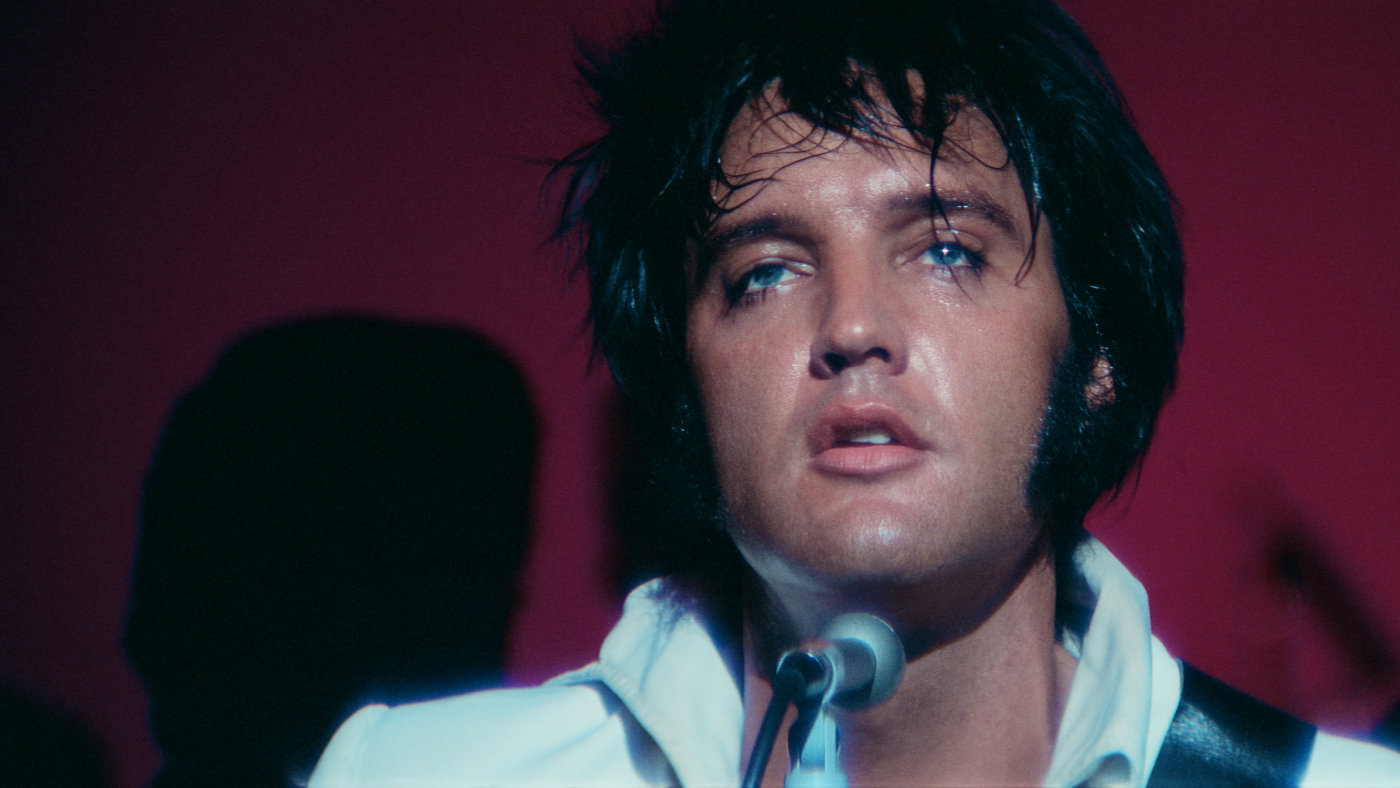
Baz Luhrmann will make you fall in love with Elvis Presley

Here’s your first look at Kratos in Amazon’s God of War show

Florida High School Football Rankings: Top 25 teams – Oct. 21

Cleary's 21 help Le Moyne down Central Connecticut State 69-64 in OT

How old is Bo Nix? What to know about Oregon quarterback ahead of 2024 NFL Draft

99th annual Pony Swim held in Virginia

Indiana Members Credit Union announced as new anchor tenant at Bottleworks District

Where Iran’s ballistic missiles can reach — and how close they are to the US

Has India’s influence in Afghanistan grown under the Taliban?

Bill Clinton to testify before House committee investigating Epstein links

Read Judge Schiltz’s Order

Vulnerable House Dem lashes out at Trump’s ‘racist’ SOTU challenge: ‘That was uncomfortable’
-

 World2 days ago
Exclusive: DeepSeek withholds latest AI model from US chipmakers including Nvidia, sources say
-

 Massachusetts2 days ago
Mother and daughter injured in Taunton house explosion
-

 Montana1 week ago
2026 MHSA Montana Wrestling State Championship Brackets And Results – FloWrestling
-

 Oklahoma1 week ago
Wildfires rage in Oklahoma as thousands urged to evacuate a small city
-

 Louisiana4 days ago
Wildfire near Gum Swamp Road in Livingston Parish now under control; more than 200 acres burned
-

 Technology6 days ago
YouTube TV billing scam emails are hitting inboxes
-

 Denver, CO2 days ago
10 acres charred, 5 injured in Thornton grass fire, evacuation orders lifted
-

 Technology6 days ago
Stellantis is in a crisis of its own making