Sports
Tennis usually passes the torch. Carlos Alcaraz is running away with it


WIMBLEDON — This wasn’t a torch-passing. It was more like a torch-grabbing, followed by a sprint around the bend and then another mile or two down the road.
Last year, Carlos Alcaraz beat Novak Djokovic by a whisker in the Wimbledon men’s final, taking advantage of a few rare errors from the now 24-time Grand Slam champion to win an up-and-down five-set saga that lasted nearly five hours.
He snuck away with that title. On Sunday, he hammered and danced and drop-shotted his way to a second consecutive Wimbledon men’s singles title. This was a 6-2, 6-2 7-6(7-4) drubbing of Djokovic and his surgically-repaired right knee, on a court the Serb has mostly owned for more than a decade.
When something happens twice, it ceases to be an accident, ailing knee or not.
A deteriorating joint is the sort of thing that a 37-year-old champion who has played professional tennis for 20 years has to deal with.
Alcaraz had Djokovic contorting himself throughout the final (Henry Nicholls/AFP via Getty Images)
It’s bad luck. It’s also life in the tennis twilight, as so many others who have gone through it can attest. It’s the sort of slow dying of the light that gives a player such as 21-year-old Alcaraz — a generational talent who plays with a joy so many other players yearn for — the chance to grab a torch and run away with it, lighting up the sport.
For the better part of a decade, Djokovic has been the dominant player. Even last year, when Alcaraz nicked him on Centre Court, it was the lone stumble in one of his greatest seasons. He won Grand Slam titles at the Australian, French, and U.S. Opens; he won the season-ending Tour Finals; he had a No 1 next to his name in the rankings at the end of the year for a record eighth time.
All at 36 years old.
But he is 37 now.
And in seven magical weeks, beginning in Paris in late May and ending Sunday on the most famous court in the sport, Alcaraz made all that look like the last great chapter in the most decorated and accomplished career in the modern era of tennis, which began in 1968.
Djokovic may yet rise again. He did plenty of rising at the All England Club over the past two weeks, when few would have even tried. He should be as good as a a 37-year-old fighting to keep his body in tune can be, by the time he defends his U.S. Open title in New York at the end of August.
Forget all that for a minute, though. With this win, Alcaraz joined one of the most exclusive clubs in men’s tennis. He became the rare player who can win on the slow red clay of Roland Garros in June, then repeat the trick on the slick grass of SW19 in July.
Rod Laver. Bjorn Borg. Rafael Nadal. Roger Federer. Djokovic. And now Alcaraz. That’s it in the Open Era. With an extra chair on the end, they can fit in a booth at one of the pubs in Wimbledon Village.

Alcaraz holds the Wimbledon title for the second consecutive year (Aaron Chown/PA Images via Getty Images)
“A huge honor to me,” the Spaniard said, as he clutched the winner’s trophy in the late-afternoon sun. “Huge champions.”
Then, he said he isn’t one of them yet. He still has a lot of work to do.
He is off to a very good start.

Djokovic called Alcaraz’s win “inevitable”, after 12 days in which the Serbian had made his surgeon, and the physical therapist who guided his rehabilitation from a meniscus operation on June 5, look like true masters of the trade. By the time he dispatched Lorenzo Musetti on Friday to cruise into his 10th Wimbledon final, and 37th Grand Slam final, he appeared to be floating across and up and down the court, as though the surgery had happened in the distant past.
In recent years, he had won Grand Slam titles with tears in an abdominal muscle and a hamstring. At Wimbledon today, he was on the verge of doing it less than six weeks after a knee operation.
Then, however, Alcaraz appeared on the other side of the net.
This was not the nervous, first-time Wimbledon finalist who 12 months ago lost the first five games of the final before somehow recovering from that early blitz. Alcaraz is no longer some boy wonder, and on Sunday he was a man with a championship to defend and a chance to put the sport in a headlock.
Alcaraz slid this shot over the net for a winner (Julian Finney/Getty Images)
“He was better than me in every aspect of the game,” Djokovic said. This final may have an asterisk, one that may grow larger if Djokovic returns to being the player he was before knee surgery, or even a figment of that player. For now, it is an assessment without blemish. “Movement. He was striking the ball beautifully. From the very beginning, he was better.”
Djokovic served first. A dozen minutes later, he was still serving, fighting with everything he had to win what is so often the meaningless first game of a match. Back and forth they went, through seven deuces and five chances for Alcaraz to break.
Alcaraz unleashed his first outrageous shot of the day midway through those 12 minutes, a scorching forehand down the line with Djokovic rushing the net. Djokovic didn’t even bother turning his head. It’s the shot that Alcaraz lands when he is feeling his magic.
Djokovic’s chest was rising and falling between points, his panting audible from 250 feet away. No wonder he was a half-step late to catch up with a volley, the ball dipping below the net before a furtive backhand swish of his racket sent it into the mesh. Then he sent an easy forehand sailing wide. He put himself in a hole — a hole he would spend the next 135 minutes trying to dig himself out of.

Alcaraz dragged Djokovic all over a court he has made his living room (John Walton/PA Images via Getty Images)
Afterwards, he thought back to last year’s epic five-set loss.
“We went toe-to-toe,” Djokovic said, with a mix of pride for having gotten so far so soon after his surgery, and resignation about how dramatically the dynamic had shifted in 12 months. “This year, it was nothing like that. It was all about him. He was the dominant force.”
It’s something everyone is probably going to have to get used to, if they haven’t already.
Jannik Sinner of Italy, the 23-year-old Australian Open champion, remains the world No. 1, because of the complicated formula the sport uses for its rankings. Alcaraz is likely to be back there before too long. Plus, no matter what the rankings say, the Spaniard is now the sport’s alpha dog, a four-time Grand Slam champion with a game that is still developing. He is capable of tennis acrobatics that he relishes almost as much as does winning – and sometimes more. He does plenty of both.
“Shotmaker” doesn’t do the flair of his game justice. Alcaraz is a shot creator, a player who has to always be innovating and improvising, pushing the limits of what he can do with a racket and ball.
After muffing three championship points on his own serve, Alcaraz had to reset to push the final set to a tiebreak and ward off Djokovic one last time.
As he rushed the net, Djokovic fired a ball at his shoelaces. Alcaraz skipped up and dipped the top of his racket to the grass. Somehow, he made the ball spin just over the net. He tried to fight off a grin as he walked back to start the next point, shaking his finger at the crowd.

Alcaraz’s finesse in the front of the court made a huge difference (Frey/TPN via Getty Images)
Then he cracked a 120mph second serve like those three match points had never happened, and then it was the tiebreak and then it was deja vu from Paris. Alcaraz climbed into the stands once more, joining a clump with his team, a three-way embrace with his parents, and then the longest hug of all with Juan Carlos Ferrero, the former world No 1, his coach and tennis father since he was 14.
He knew what he had pulled off, as he rose into the rarefied air of the French Open-Wimbledon double club, ready to sink into another year as the champion of the most important tournament in the sport.
He’s on the road to where he wants to go, still emerging while already a star.
“It’s good for tennis to have new faces,” he said.
Especially him, the brightest new face of all.
(Photos: Getty Images; design: Dan Goldfarb)



Sports
London descends into disorder as Morocco fans flood streets after World Cup elimination by France

NEWYou can now listen to Fox News articles!
Public unrest began in parts of London late Thursday night, and it appears Morocco’s exit from the 2026 FIFA World Cup at the hands of France is the reason.
France took down Morocco 2-0, eliminating the African country for the second consecutive tournament, this time in a quarterfinal match.
As a result, many feared Paris would erupt into riots, especially after the chaos that followed Paris Saint-Germain’s UEFA Champions League victory over Arsenal in May.
Instead, images and videos from Edgware Road in northwest London showed police clashing with large crowds as smoke billowed through the streets and debris littered the roadway.
A police vehicle is parked in a road as people from pro-Palestinian activist groups gather near the Edgware United Synagogue during a demonstration against the “Great Israeli Real Estate Event” organized by real-estate agency My Home in Israel, which markets property in Israeli settlements in the occupied West Bank, in London, Britain, June 14, 2026. (Toby Shepheard)
Riot police, equipped with shields and body armor, tried to contain the crowds as they clashed with people launching fireworks and throwing debris. One video also appeared to show an officer down.
KYLIAN MBAPPÉ, OUSMANE DEMBÉLÉ FIRE FRANCE INTO WORLD CUP SEMIFINALS WITH WIN OVER MOROCCO
It’s unknown what happened to the officer who was down on the asphalt or how he was injured.
Fans waved Moroccan flags in the middle of the streets, which held up traffic. Some even jumped on top of vehicles trying to get through the area.
Moroccan fans in the stands before a FIFA World Cup 2026 quarterfinal match between France and Morocco at Boston Stadium July 9, 2026, in Foxborough, Mass. (Richard Sellers/SportsphotoAllstar)
Similar scenes unfolded after Egypt’s World Cup exit, when Argentina rallied for a controversial 3-2 victory that featured several disputed officiating decisions.
Paris, on the other hand, looked more like a city celebrating than one on the brink of a riot. Supporters of both France and Morocco flooded the streets, slowing traffic in several parts of the city.
One video showed horns blasting from cars with French and Moroccan flags out the windows on the L’avenue des Champs-Élysées in Paris. Supporters on the side of the road, waving their own flags, joined in on the celebration.
France’s Kylian Mbappé scored his eighth goal of this World Cup, which ties him for the most with Argentina’s Lionel Messi. Ousmane Dembélé also scored in the second half for France in the 2-0 win over Morocco.
It’s the third straight semifinal appearance for France, while Morocco still made World Cup history despite the loss. After becoming the first African country to reach the quarterfinals and semifinals in World Cup history in 2022, Morocco added to that by becoming the first-ever African nation to reach more than one quarterfinal.
Moroccan fans react while attending a watch party for the World Cup round of 8 match between France and Morocco in Boston, Massachusetts, on July 9, 2026. (Joseph Prezioso/AFP)
CLICK HERE TO DOWNLOAD THE FOX NEWS APP
Morocco’s exit means there are no more African nations alive in the World Cup. France will be taking on the winner of Spain and Belgium, while England and Norway and Argentina and Switzerland face off in the quarterfinals.
Follow Fox News Digital’s sports coverage on X and subscribe to the Fox News Sports Huddle newsletter.
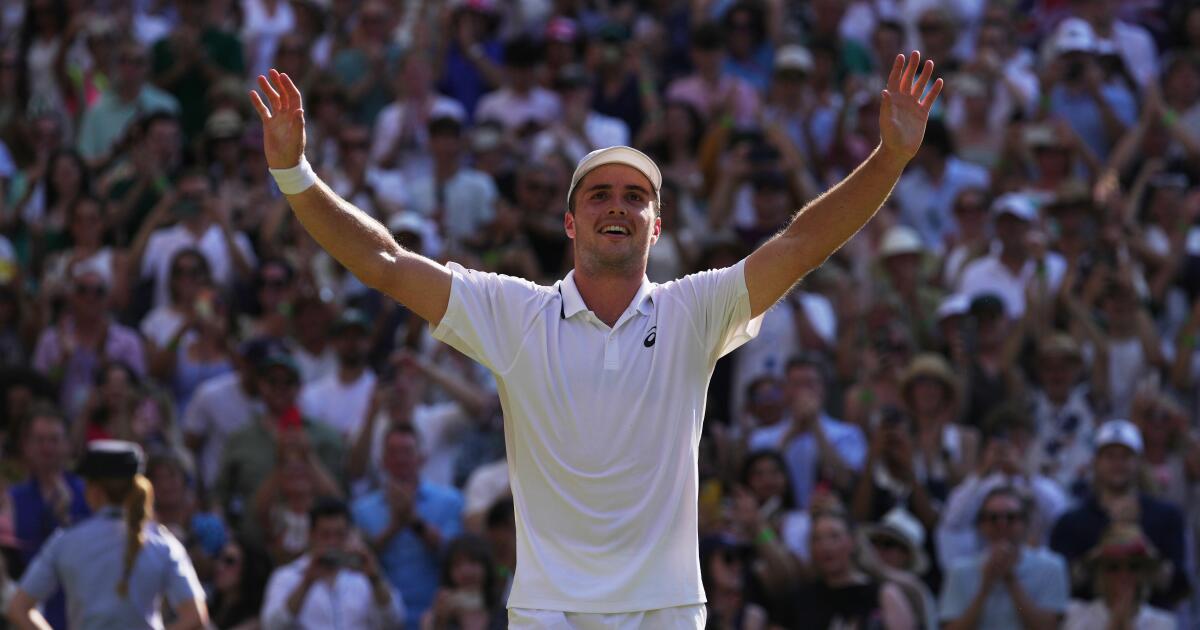
LONDON — A local boy sleeps in his own bed, plays in front of a king and queen and makes a Cinderella run to the Wimbledon semifinals. Sounds like a Hollywood script that might never see the silver screen.
But it’s no fairy tale — it’s Arthur Fery’s out-of-nowhere performance over the last 10 days.
Fery, a virtually unknown British wild card with a triple-digit ranking, has become the emotional heartbeat of Wimbledon while legitimately diverting some national attention from England’s World Cup quest.
The royal treatment at his matches across the All England Club has come in more ways than one.
Fery, who grew up five minutes from Wimbledon and is staying at home during the tournament, first played before grass-court king Roger Federer, Wimbledon’s eight-time singles champion, during Monday’s fourth-round victory. Two days later, he beat No. 9 seed and French Open runner-up Flavio Cobolli of Italy in the quarterfinals 6-4, 7-6 (4), 6-0 in front of Queen Camilla.
Ranked 114th, Fery had never reached the semifinals of an ATP Tour event, let alone a major, before his brief chat with the queen following the match.
“She just said, ‘Congratulations, keep going,’” 23-year-old Fery told reporters later. “I told her it was my birthday on Sunday, so it would be great to play the Wimbledon final on my birthday.”
That’s still a match away. To get there, Fery will have to get past one of the hottest players on tour: No. 2 seed Alexander Zverev, who is fresh off his first Grand Slam title at the French Open. Looming on the other side of the draw is a highly anticipated showdown between defending champion Jannik Sinner against 24-time major winner Novak Djokovic.
If Fery can continue his magical run to the end, he would become the first British wild card to win a Wimbledon title.
Arthur Fery reacts after defeating Flavio Cobolli in the Wimbledon quarterfinals on Wednesday.
(Maja Smiejkowska / Associated Press)
Born in France, Fery’s family moved to Wimbledon when he was an infant. His mother played professional tennis. He was a top British junior but chose to sharpen his game for three years in the U.S. collegiate system at Stanford, as many of his compatriots have done.
“I came out with a lot of hunger coming out of that, and I was ready to attack the pro circuit,” Fery said.
After struggling with bone bruising in his arm that limited him to playing mostly on the lower-tier Challenger circuit in recent years, Fery is finally healthy and playing consistently.
His path to the last four in London has been a masterclass in clutch come-from-behind performances. The Brit has stared down near-certain elimination in multiple matches, repeatedly breaking his opponents’ momentum with Houdini-like on-court acts.
At 5-foot-9, Fery possesses a skill set perfectly suited for low-bounding grass.
His compact strokes, low center of gravity, and elite movement allow him to hug the baseline, take time away from opponents, and confidently execute delicate volleys at the net, according to ESPN analyst Chris Eubanks.
“He defends well,” said Eubanks, a 2023 Wimbledon quarterfinalist. “He can scrap. He can claw. He can dig his way back into points. And when he ventures forward, he’s very, very comfortable at the net. This is a picture-perfect example of someone whose game is built for the surface.”
Still, it’s hard to fathom the multitude of milestones for Fery, who briefly reached the No. 1 ranking in college and earned 2023 Pac-12 Singles Player of the Year honors before leaving early to pursue a pro career.
He arrived at Wimbledon with just one main-draw victory at a major, a losing record as a professional, and only one previous ATP quarterfinal, at Queen’s Club last month. He’s now 11-8, won his first two five-set matches, and is the first British wild card to reach the Wimbledon men’s semifinals in the Open Era. The only other men’s wild-card semifinalist was Goran Ivanisevic, who won the title as a wild card in 2001.
Fery, who started the season ranked No. 185 and will climb to at least No. 36 after the tournament, said there were a “lot of first times” as he reflected on his unprecedented run. “First five-setter, longest match that I’ve ever played, first time breaking into the top 100, first second week in a slam, all at home, five minutes from where I grew up. It’s a great story for me,” he said.
The gap with his fellow semifinalists is understandably massive.
Entering Wimbledon, Djokovic, Sinner and Zverev’s combined records include 29 Grand Slam titles, 2,088 match wins and 155 tour-level titles. Fery was 6-8 in tour-level matches with zero titles.
But he has singlehandedly lifted the tournament for locals. With top hopes Jack Draper and Emma Raducanu withdrawing before the tournament and the rest of Britain’s singles prospects falling one by one — 18 men and women were eliminated by the third round — Fery became the nation’s last knight standing.
If his first name inevitably evokes Arthurian legend, Fery’s march through the draw gave Britain reason to believe again. No sword, no Round Table, just world-class shot-making, a lion’s heart and a Centre Court crowd thrilled to rally behind him.
“This is really quite something to see on home soil,” said Russell Fuller, the BBC’s tennis correspondent, who compared it with Raducanu’s stunning U.S. Open win in 2021 as a qualifier.
Fery earned every bit of it.
In the first round against Damir Dzumhur, Fery dropped the opening set and trailed by a break in the second before surging back. Against Zizou Bergs in the third round, he faced a 4-1 deficit with a double break in the fourth set, and again fell behind 4-1 in the fifth, before somehow surviving.
Then, stepping onto Centre Court for the first time against former top-10 stalwart Grigor Dimitrov of Bulgaria in the fourth round, Fery clawed out of a 2-sets-to-1 hole and a break down in the fourth set to clinch the victory in a fifth-set tiebreak.
“He carries himself with humility, but he’s a fierce competitor, and he’s got a ton of belief in himself,” said Stanford men’s coach and former top-60 player Paul Goldstein, who flew to England Tuesday to see his former charge compete against Cobolli.
While Fery attempts to outmaneuver Zverev on Friday, the other semifinal features a 2025 Wimbledon semifinal rematch between seven-time Wimbledon winner Djokovic and top-ranked Sinner, who defeated the Serb in straight sets on his way to the title. It’s also their second Grand Slam semifinal meeting in 2026. At January’s Australian Open on hard courts, Djokovic bested 24-year-old Sinner in five sets before falling to now-injured Carlos Alcaraz in the Melbourne final.

Arthur Fery hits a return during his Wimbledon quarterfinal win over Flavio Cobolli on Wednesday.
(Clive Brunskill / Getty Images)
Djokovic, 39, enters the match after surviving a grueling five-set, 5-hour-plus quarterfinal slugfest against No. 3 Félix Auger-Aliassime that concluded just minutes before Wimbledon’s 11 p.m. curfew. But the seventh-seeded Serb has a way of defying Father Time and he has had two days to recover on a surface where points are shorter and generally less taxing on the body.
Italy’s Sinner, who defeated Alcaraz in last year’s Wimbledon final, has been efficient if not at the level that saw him capture five consecutive titles before crashing out in the second round at the French Open. After a first-round scare here, the four-time Grand Slam champion has dominated opponents behind his improving serve, winning 80% of his first-serve points. He hasn’t dropped a set since the opening round. Sinner leads the head-to-head with Djokovic 6-5.
According to Eubanks, Djokovic must disrupt Sinner’s movement to break his rhythm, and take his chances.
“He’s got to play similar to how he played in Australia, where it was just all-out aggression,” Eubanks said.
For Sinner, he added: “His serve can be a neutralizing force for what Novak is going to try to do.”
On the other side of the ledger, Fery’s poise under pressure and deft use of the home crowd will be paramount to continue his surprise run against Germany’s Zverev, whom he called a “step up again” from his last five matches. Zverev, 29, is seeking his fifth major final and first at Wimbledon.
“I’m ready for it,” Fery said. “I have nothing to lose. I’m just going to go out there and … put my game on the court, do what I’ve done, believe in myself. We’ll see where that takes me.”
Home has never been closer to Centre Court. Nor has Arthur Fery ever been closer to tennis history.
Sports
Pirates star pitcher makes unfortunate history after being taken out in middle of perfect game bid

NEWYou can now listen to Fox News articles!
Jared Jones was flirting with Major League Baseball history on Wednesday night — he got it, but it was not what he originally envisioned.
The Pittsburgh Pirates pitcher retired the first 18 batters he faced, but he was taken out in the middle of his perfect game bid after six innings.
Now, the Pirates certainly have their reasons — the 24-year-old Jones hasn’t thrown more than 81 pitches in eight starts since returning May 20 after missing all of last season while undergoing ulnar collateral ligament internal brace surgery on May 21, 2025. He was yanked with 77 pitches and likely would have needed more than 100 pitches to record the 25th perfect game in MLB history.
Jared Jones of the Pittsburgh Pirates pitches during the first inning against the Atlanta Braves at PNC Park on July 8, 2026, in Pittsburgh, Pennsylvania. (Photo by Joe Sargent/Getty Images)
However, Jones left the game after getting zero run support, so when the Atlanta Braves tacked on three runs late for a 3-0 victory, Jones instead found himself in the wrong chapter of the history books.
According to Opta Stats, Jones became the first pitcher in the modern era (since 1920) to pitch at least six perfect innings and not record a win.
“It does suck. Something’s cool coming on, but I’m on what? My eighth start off of surgery? I completely understand it, and it is what it is,” Jones told reporters after the game.
Pittsburgh Pirates starting pitcher Jared Jones (17) makes his way to the field to warm up before pitching against the Atlanta Braves at PNC Park. (Charles LeClaire/Imagn Images)
JUSTIN VERLANDER ANNOUNCES HE WILL RETIRE AFTER THIS SEASON: ‘I’VE REALIZED THAT TIME HAS COME’
Jones said he didn’t entertain attempting to complete the perfect game.
“Not with the pitch count,” he said. “Not really ever expecting to go nine right now, so that was never in my head.”
Joey Bart, traded to the Braves from the Pirates on June 18, followed a double by Mike Yastrzemski with a 422-foot, two-run homer to left-center field off a slider from Dennis Santana. Drake Baldwin added an RBI single to center in the ninth for good measure.
It was the second time in less than a week that a pitcher was taken out of the game with a perfect bid through six innings — the Miami Marlins took Eury Perez out after seven innings in which he had 92 pitches. Perez, too, is in the midst of returning from injury and has surprisingly found himself right in the postseason mix.
He was pulled for Lake Bachar to start the eighth, and the Marlins allowed eight runs to the Athletics in the final two innings, but held on to win 9-8.
Jared Jones (17) of the Pittsburgh Pirates delivers a pitch during a MLB game against the Cincinnati Reds on June 27, 2026, at PNC Park in Pittsburgh, Pennsylvania. (Joe Robbins/Icon Sportswire via Getty Images)
CLICK HERE TO DOWNLOAD THE FOX NEWS APP
The Pirates are 4.0 games out of the final wild card spot, which is held by the Marlins.
The Associated Press contributed to this report.
Follow Fox News Digital’s sports coverage on X, and subscribe to the Fox News Sports Huddle newsletter.
-

 Ohio4 minutes ago
Ohio reports nearly 200 cases of ‘explosive diarrhea’ illness
-

 Oklahoma7 minutes ago
Every Oklahoma State Cowboys’ College Football 27 Preseason Player Rating
-

 Oregon12 minutes ago
Illicit massage businesses shut down in Washington County
-
Pennsylvania19 minutes ago
Man arrested over alleged antisemitic threats to Gov. Josh Shapiro | The Jerusalem Post
-

 Rhode Island22 minutes ago
Aquatic Weed Treatments Planned for 2 RI Ponds, 1 Lake
-

 South-Carolina27 minutes ago
South Carolina Lottery Pick 3, Pick 4 results for July 9, 2026
-

 South Dakota34 minutes ago
Iverson Ford Welcomes the 2027 Ford Expedition to Drivers Across Eastern South Dakota
-

 Tennessee37 minutes ago
Tennessee Highway Patrol holds open house at Jackson district office


