Entertainment
Michael Keaton returns to 'Saturday Night Live,' and so does Alec Baldwin

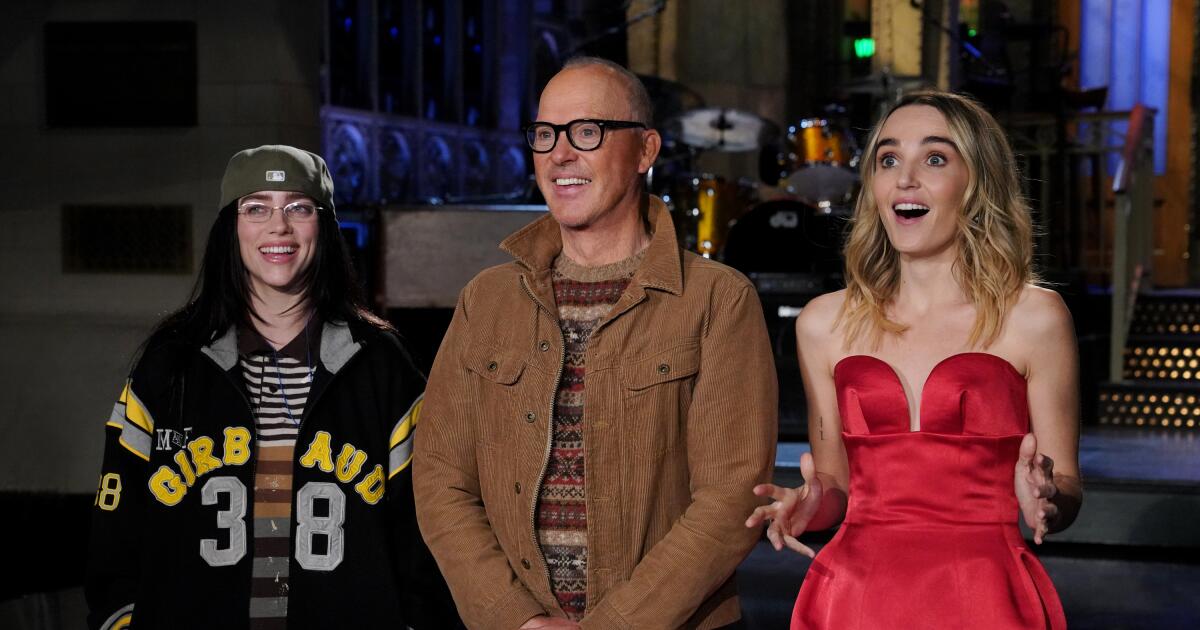
For his fourth time hosting “Saturday Night Live” (last time was in 2015), Michael Keaton proved a grounding presence in several sketches. That’s not surprising given that at one time, he was one of the world’s most popular comedic film actors — you could argue that he and “SNL” alum Eddie Murphy dominated movie comedies of the 1980s.
But that comedic durability — Keaton doesn’t break character and he’s still got crack timing and line deliveries — felt like it was on the back burner in an episode that didn’t seem to make the most of Keaton’s talents. After a monologue in which a few cast members were dressed as one of his iconic characters, Beetlejuice, Keaton played a cookie maker with a zombie-eye cookie that looks like a breast, a father whose son unwisely performs the song “Hey, Soul Sister” about his proposed interracial marriage, and a canceled Lyft driver roped into a live Uber-car game show.
It’s not that the sketches weren’t funny. It’s that most of the pieces, plus a late-in-the-show restaurant sketch about lost love, didn’t really allow Keaton to create memorable new characters. In fact, they seemed to use his dramatic-acting gear more, like when he played a sad skydiving instructor in the first new Please Don’t Destroy video sketch of the season.
The exception to the drama-or-sidekick problem was a sketch in which Keaton played the stunt movement coordinator for a “Halloween” movie in which he makes Michael Myers move like a modern dancer instead of a serial killer. But the sketch was one joke stretched too long, despite Keaton’s performance.
Musical guest Billie Eilish performed “Birds of a Feather” and “Wildflower” with her band, including her also-famous brother, Finneas.
For the fourth week in a row, guest stars Maya Rudolph and Dana Carvey returned to reprise their roles, multiple times, as Vice President Kamala Harris and President Biden. But this time, Alec Baldwin, who used to portray former President Trump on “SNL” was here to play Bret Baier of Fox News in a takedown of his interview with Harris this week. Baldwin as Baier interrupted Harris frequently, suggesting he’ll only let her finish when he goes to bed. Kamala took interview breaks to turn to a phone camera and make quick TikTok spots (“See how I don’t let men interrupt my answers? Very demure, very mindful.”). Harris countered claims she can’t handle immigration cartels by saying, “If I was in ‘Breaking Bad,’ it would have ended in three episodes,” and complained that clips of Trump (James Austin Johnson) and Biden were being played out of context. And much hay was made out of Trump playing music for 40 minutes at a town hall — Harris points out that it seemed to be full of gay anthems such as “Y.M.C.A.” and “It’s Raining Men.” “Does he not listen to the lyrics?” she asked.

Keaton celebrated the 50th season of “SNL” by mentioning that when the show began, he was a production assistant on “Mr. Rogers’ Neighborhood.” What did they have in common? “Lots of puppets, tons of cocaine,” he joked. When he brought up the phenomenon of grown men wearing Beetlejuice costumes for Halloween, he was joined by Mike Day and Andy Samberg (“The writers couldn’t jam Doug Emhoff into the opening.”), each in full ‘Juice costumes and hamming it up with their impression. Sarah Sherman, who is typically dressed in vivid colors, wore a striped black-and-white suit for the monologue, but said it wasn’t a costume. After much prodding, Keaton finally performed the voice of Beetlejuice, but only to say, “We’ve got a great show!”
Best sketch of the night: This Shop TV cookie is simply the breast
The Shop TV sketches are reliably funny because the premise is solid: An artisan goes on to sell a product alongside hosts Rhett and Lindy, played by Day and Heidi Gardner, but the product is always shaped like genitalia or is unsuitable for TV in some way. Last time, Adam Driver had a naughty Santa chocolate; this time it’s Keaton as a baker who’s made a Halloween zombie eyeball cookie that looks exactly like a woman’s breast, complete with a red velvet nipple center. As Day and Gardner struggle to keep the show on track, viewers calling in ask questions like, “Is the cookie available in different ethnicities?”
Also good: TikTok’s algorithm, but as an ‘SNL’ sketch
“SNL” has done this one before, too, back in 2021, but it works just as well again: a random assortment of TikTok moments on someone’s smartphone. It’s a lot of jokes in a short amount of time, some very topical. Harris, Rudolph and Eilish all appear as people subjected to bad singing from Bowen Yang as influencer Harry Daniels. Carvey returns as Biden on a balance board while Ego Nwodim plays a woman with many, many complaints about her local Chili’s restaurant. Bethenny Frankel, a tradwife, a man slow dancing with his cat, and “Call Her Daddy” podcast host Alex Cooper make appearances in the mock TikTok clips. Sadly, the person viewing the videos misses the birth of their son, as we learn from a text message.
‘Weekend Update’ winner: Emil Wakim Says Christian Arabs are practically French
Sarah Sherman returned to talk about what’s missing in the Victoria’s Secret Fashion Show, including infected belly button rings and diapers, but Emil Wakim won the week by discussing what it’s like to be both Arab and Christian. Wakim, one of the season’s new featured cast members, had a chance to introduce himself to the “SNL” audience by talking about how his Iranian immigrant father was such a success that he’s now a Republican. Wakim scored with jokes about how tension in any room drops when he tells people he’s a Christian Arab (including in Studio 8H). Wakim said that his father always told him that his family is more European than Middle Eastern in its beliefs, and that they’re pretty much French. (The French, Wakim suggested, would strongly disagree.) Or, Wakim added that Christian Arabs are just, “Hairy, sweaty, passionate guys … a Greek you’re kinda afraid of.”



When the pandemic hit, and reality settled in that life would be isolated and mostly inside, Grammy winner Anderson .Paak found himself on the outside looking in, in a way he didn’t anticipate. “I was the odd man out. My son was 8, and BTS took over the whole house,” .Paak explained in an interview with The Times at his WeHo lounge, Andy’s. “It was a K-pop storm. Before that, me and my son were bonding off of my music.”
.Paak’s son, Soul Rasheed, and his now ex-wife originally from Korea, Jaylyn Chang, had become obsessed with K-pop alongside much of America, which reminded .Paak of the intensity of Beatlemania. Black American music influenced the birth of a new style, which formed and expanded across oceans, then returned to the U.S. and exploded. This effect in the .Paak household was palpable, causing Soul and Chang to deeply bond in a new way. .Paak himself, as a soul, R&B and hip-hop aficionado, was tapped into the source, but not the reinterpreted subject. So he had to find a way in.
Soul, at the time, like many 8-year-olds, had also become obsessed with becoming a YouTuber. Besides .Paak’s music, the father-and-son duo had also previously connected over humor, so .Paak started there. They began with funny skits and eventually fused them with BTS dances. Soon, there were even videos featuring them comedically educating each other about their individual music tastes. “I loved it,” .Paak recalled, getting lost in the memory. “I was getting to know him more, and he was getting to know me. My mom would always say, ‘It’s one thing for your kids to love you, but it’s another to share things you’re interested in.’ It wasn’t like I was being Anderson .Paak, I was just Dad.”
“I was getting to know him more, and he was getting to know me,” .Paak said of bonding with his son, Soul.
(Carlin Stiehl / For The Times)
Through this exploration and the realization of a potential continued familial bond, a story idea emerged, then a treatment for a K-pop-centered film that .Paak would direct and he and Soul would both star in. .Paak then began directing a slew of music videos as the pandemic began to fade, building a portfolio and gaining experience in the medium. But he could start to sense Soul’s interest fading as time passed. After a few failed pitch attempts, .Paak urgently enlisted the help of one of his oldest friends and fellow entertainer, Jonnie “Dumbfoundead” Park, who brought .Paak and the idea to Stampede Ventures.
“The pitch was from an idea that Anderson had, and [to introduce it], we showed them this TikTok that he had with his son,” Park recalled over Zoom. “Anderson was like, ‘Do you know anything about BET, son?’ And [Soul] was like, ‘No, but I know BTS.’ Then they were just going back and forth, arguing about BET and BTS. That was literally the deck, [us saying] we would take that energy and put it into a two-hour film. They loved it. As soon as we walked out of the office, Anderson looked over like, ‘Are we greenlit?!’ They just understood it, the whole intergenerational, intercultural element of Black and Korean.” Stampede combined forces on the project with Live Nation Studios and .Paak’s debut feature “K-Pops!” was off to the races.
It’s important to note that .Paak is himself Black and Korean. His mother was adopted from Korea by a SoCal Black American military family and .Paak’s father was also a Black military officer. Thus, while his mother was born in Korea, he was raised almost entirely within a Black cultural space. .Paak didn’t experience much direct exposure to Korean culture until his 20s, when he met Chang at the Musicians Institute in Hollywood. As an immigrant directly from Korea, Chang showed him the fortitude of structure amid her community. He was also taken by their inherent family value system. “In Korean households, you stay in the house until you get older so you can take care of your parents, and your parents can help take care of the kids,” .Paak explained. “There’s an infrastructure that’s worked out. Also, Korean food is important, as is learning the language. I was drawn to that. My son didn’t eat anything outside of Korean food for so long, and he’s just now getting into tacos.”
.Paak then further explored his Korean side through a burgeoning friendship with Park, which happened a bit later, after Chang had already given birth to Soul. Park introduced .Paak to K-town-based Korean culture through their shared music scene. “The people that came from K-town had a lot of Latino and Black influences as well,” .Paak remembered. “There was a little more of a melting pot, and it was more urban. But in a similarly communal way [to Koreans from Korea], they were all hanging out in K-town with other Korean friends. They’d drink soju, and go to after-hours where you had to have somebody Korean with you.”
While .Paak had some opportunities in adulthood to grasp a bit of his Korean heritage, in “K-Pops!,” through his main character BJ, he also got to actualize what his mother may have missed. In the film, BJ, a failed karaoke bar R&B musician, gets a lucky chance to go to Korea and be the drummer for a popular K-pop competition series. There, he bumps into his estranged ex-girlfriend’s son, Tae Young (played by Soul), who is competing on the show. He then finds out that the kid is his. While a messy transition ensues, BJ and Tae Young eventually get to galavant around Korea and work together to try to win the competition. Through this exploration, BJ finds out he can thrive in Korea while still holding onto his Blackness. .Paak’s mother’s dive back into her roots had a different result. “My mom went abroad and spent a year in Korea, but when she went there, she just didn’t like it,” .Paak explained. “In the movie, initially, BJ doesn’t really have any connection to his Korean side and doesn’t really care to know, but then he finds a bridge.” That bridge is music.
Actor Yvette Nicole Brown, who in “K-Pops!” plays BJ’s mother, proclaimed over Zoom that, “Everything about the film and the music in it is Blasian, every culture is celebrated and massaged and made into something beautiful.” .Paak made a concerted, intentional effort to explore both the Black and Korean sides of K-pop in two scenes.
The first is an early breakdown initiated by Soul’s character, Tae Young, who explains the structured roles of a K-pop group, which may be fun for superfans and educational for laypeople to the genre. The next is a winding presentation by BJ to Tae Young about the influence of Motown groups like the Jackson 5 and boy bands like New Edition on the momentum of K-pop’s rise. It’s particularly poignant because it is all shot at a record store on the streets of Korea, where .Paak explained he actually found the records he was referencing. “There’s nothing wrong with people doing their interpretation of Black music, as long as you pay homage and as long as you respect it and take care of it,” .Paak declared. “Because [if you do], then they’ll take care of you, but the moment you don’t, you’ll see what happens … I wanted to explain that history because that’s how I saw it.”

Real-life father and son, Anderson .Paak, left, and Soul Rasheed, co-star in “K-Pops!”
(Jake Giles Netter)
”K-Pops!” has as much of who .Paak and Soul are as father and son as he could fit in. There are appearances by legacy Black artists like Earth, Wind & Fire, as well as K-pop stars like Vernon from Seventeen. There are original songs co-written and co-produced by .Paak and musician Dem Jointz, that feature K-pop fused with soul and funk, one of which Tae Young performs as his finale competition number (soundtrack arriving soon). The film was shot in both L.A. and Korea and provided ample time for bonding (especially during scenes filled with off-the-cuff humor) that .Paak envisioned from the beginning. Yet still, at the time they were about to shoot, .Paak almost couldn’t get Soul on board because he had turned 11 and wasn’t as into K-pop or acting comedically anymore; he insisted he was instead “into Slipknot.”
The duo did find their footing, though, and executed a winding story that centers on their connection. As a burgeoning teenager in 2024, Soul went with his father to the world premiere at the Toronto International Film Festival, along with a plethora of Korean relatives from his mom’s side. .Paak anxiously awaited their full reaction to the culmination of his quest for a deeper bond.
“Everybody really enjoyed it,” .Paak remembered, relieved. “[Soul] was like, ‘I’m proud of you, Dad.’ I asked him, ‘You think you would ever do part two?’ He was like, ‘Nah, I don’t think acting is my passion, but I’ll never forget those moments … You know what? On second thought, it depends on the script.’ But I think he’s really proud of it. I think it’s something like, when he gets older, he’ll see how special it is as well. But yeah, he didn’t say it’s cringe.”
“K-Pops!” has its L.A. premiere on Tuesday and debuts in select theaters Friday.

Claiming to be from the future, a man takes hostages at a Los Angeles diner to recruit unlikely heroes to help him save the world. The newest movie from director Gore Verbinski is not only one of the best of the year so far, but it is also one of the most fun you will have in a theatre in recent memory.
There is honestly so much to say about this movie, but saying too much would definitely spoil things, and this is the type of movie you want to go in blind if you could. Having said that, this is going to be a shorter review. Still, there are plenty of things to acknowledge about this one. We have seen so many movies showing us a future where technology takes over the world. That is nothing new. However, the well-written script, amazing cast of characters, and the current topic of AI really set this film apart from the rest.
Sam Rockwell is excellent as the lead character from the future looking for a group of civilians to help save the world. The action starts right away as we realize that this guy has tried to save the world from AI several times with a different group each time, and failing each time. He has yet to find the perfect combination of help. Our cast of characters this time around includes Michael Peña, Zazie Beetz, Juno Temple, and Haley Lu Richardson. Everyone is so good in their roles, specifically Richardson and Temple, proving that they can handle the serious moments as well as the more comedic ones.

How Does it Make You Feel?
There are several different ways to review or critique a movie. Some movies get just about everything right from a technical angle, but still won’t please folks. Some movies get everything wrong from a technical aspect, and it will be someone’s favorite thing. When I review films, I try to be 50/50 to give them a fair chance. Is the movie well-made, and does it leave me feeling anything? While many movies lean more one way than the other, Good Luck, Have Fun, Don’t Die manages to please on all accounts.
The movie is shot well with tons of amazing set pieces. The characters are likeable and developed enough that you truly care about them, and the script is so original that it truly left me not knowing where the movie was going next. Verbinski had previously directed Pirates of the Caribbean and The Ring: two completely different movies and tones, but both very successful. Verbinski really shows his range in this new movie. He manages to capture both tones of horror and comedy in this film perfectly while sprinkling in a few other ones as well.
The movie is so successful at making you laugh one moment, then leaving you uncomfortable and on the edge of your seat in the next. I will not spoil anything, but there are a couple of scenes in this movie that, if they were in another film, they just wouldn’t work. They are either too weird or too controversial. Current topics in real life are played for satire in this film, and these scenes pack a punch for sure.
The movie is also very smart in how it tackles the idea of AI. The goal of this movie isn’t to completely erase technology or the use of AI. The movie is smart enough to know that AI is already here to stay, whether people like it or not. The heroes are not here to destroy it, but rather find a way to control it responsibly so that we have a world where people can be aware of what is reality and what isn’t. This was such an intelligent and fascinating way to handle things.
Overall
Good Luck, Have Fun, Don’t Die is the best movie I have seen so far this year and probably the most entertained I have been at the movies in some time. It is an original Sci Fi comedy that has a lot to say without being preachy. It is truly a trip that feels like an old-school adventure film full of rich characters and excitement. It is truly a shame that this movie hasn’t received more screenings, but if there is one local to you, you owe it to yourself to check it out.
Entertainment
Eric Dane’s final thoughts in Netflix’s ‘Famous Last Words’: ‘I was absolutely more than enough’

Eric Dane said he first shut down emotionally at just 7 years old, when navigating his father’s sudden death from a gunshot wound in a bathroom at his family’s home.
It wasn’t until his diagnosis with ALS decades later that the seasoned actor felt his own spirit return, Dane said in an interview released Friday on Netflix. The actor died Thursday at 53 following a public battle with the disease. The nearly hour-long interview, filmed in November, is part of the docuseries “Famous Last Words,” which features posthumous interviews with notable figures — the first centered on conservationist Jane Goodall and released two days after her death.
The actor spoke candidly about his debilitating disease, saying it “made me a little bit softer, a little bit more open.” The intimate conversation was conducted by television producer Brad Falchuk, who executive produces “Famous Last Words.”
“All I’m left with is me,” Dane said. “It’s kind of a f— up way of realizing that you were enough the whole time, when everything gets taken away and all you have left is this person.”
In the episode, Dane’s speech is noticeably slurred, and he sits in a motorized wheelchair while speaking to Falchuk. He’s thoughtful and responsive throughout as he reflects on his life and career, which spanned more than three decades.
“I didn’t think this was gonna be the end of the road for me. This was never part of the story I created for myself,” Dane said.
The actor described himself as a complainer during the interview, adding that he’s “always historically been the guy that would b— and moan on his way to doing anything, but my spirit has been surprisingly pretty buoyant throughout this journey.”
A final message to his daughters
Dane stared straight into the camera in the last few minutes of the Netflix special, his voice wavering when tears welled up in his eyes. He directed his parting words to his two daughters, Billie, 15, and Georgia, 14, sharing four lessons he’s learned from ALS.
“Billie and Georgia, you are my heart. You are my everything. Good night. I love you. Those are my last words,” Dane said.
Dane married Rebecca Gayheart, the mother of his children, in 2004 and the couple separated in 2017, though the divorce was never finalized. They maintained a friendship after their separation, though, and Dane said he had “never fallen in love with another woman as deeply as I fell in love with Rebecca.”
Dane said he spent most of his life “wallowing and worrying in self-pity, shame and doubt.” But with ALS, he was “forced to stay in the present,” he said, which he encouraged his daughters to do.
Eric Dane, left, in conversation with Brad Falchuk on “Famous Last Words.”
(Courtesy of Netflix)
“I don’t want to be anywhere else. The past contains regrets. The future remains unknown, so you have to live now,” Dane said. “The present is all you have. Treasure it. Cherish every moment.”
Dane also encouraged his daughters to fall in love, not just with people, but with something “that makes you want to get up in the morning,” he said. For Dane, that love was acting, which “eventually got me through my darkest hours, my darkest days, my darkest year,” he said.
The actor, who was open about his struggles with addiction, had been sober for nine years before slipping back into drug and alcohol use during a writer’s strike that halted “Grey’s Anatomy” production in 2007.
Dane told his daughters they inherited his resilience and urged them to “fight with every ounce of your being, and with dignity.”
Dane added: “This disease is slowly taking my body, but it will never take my spirit.”
ALS diagnosis brought peace
Aside from throwing a few punches to people who “deserved it,” Dane said he had no crazy confessions to make as the interview came to a close.
“I’ve never murdered anyone, Brad,” the actor joked to Falchuk.
The actor assured he lived a life full of fun, whether healthy or unhealthy. His fruitful career took off with his role as Dr. Mark “McSteamy” Sloan in “Grey’s Anatomy.” The gig started as a one-time guest role but “ignited a fan hysteria so intense,” Falchuk said, that the show was rewritten to make Dane a leading man.
Dane further cemented his legacy when he portrayed Cal Jacobs in “Euphoria,” a complicated character who leads a double life, which Dane said he related to. “I know what it’s like to not have my inside match my outside,” he said, referencing his long-standing battle with drugs and alcohol addiction.
His ALS diagnosis freed him from a constant state of self-judgment, Dane said, and helped him realize that he was always “absolutely more than enough.”
“I hope I’ve demonstrated that you can face anything. You can face the end of your days, you can face hell, with dignity,” he said.

Nothing couldn’t wait to show off the Phone 4A

North Korea’s Kim Jong Un re-elected as ruling party leader

Trump envoy rebukes Greenland leader for rejecting hospital ship proposal

Blood test could predict when Alzheimer’s symptoms will start years in advance

Team USA hockey stars keep America’s heroes top of mind after grabbing Olympic gold

Florida High School Football Rankings: Top 25 teams – Oct. 21

Cleary's 21 help Le Moyne down Central Connecticut State 69-64 in OT

How old is Bo Nix? What to know about Oregon quarterback ahead of 2024 NFL Draft

99th annual Pony Swim held in Virginia

Indiana Members Credit Union announced as new anchor tenant at Bottleworks District
Trump envoy rebukes Greenland leader for rejecting hospital ship proposal

Gulf countries back Kuwait’s sovereignty after Iraq draws new boundaries

Suspected gunman identified after being shot dead at Mar-a-Lago – US politics live

Video: Armed Man Is Shot and Killed at Mar-a-Lago, Authorities Say

Suspect identified after fatal shooting at Trump’s Mar-a-Lago estate: officials
-

 Montana3 days ago
2026 MHSA Montana Wrestling State Championship Brackets And Results – FloWrestling
-

 Oklahoma5 days ago
Wildfires rage in Oklahoma as thousands urged to evacuate a small city
-

 Culture1 week ago
Video: How Much Do You Know About Romance Books?
-

 Science1 week ago
What a Speech Reveals About Trump’s Plans for Nuclear Weapons
-

 Politics1 week ago
Schumer’s ‘E. coli’ burger photo resurfaces after another Dem’s grilling skills get torched: ‘What is that?’
-

 Technology2 days ago
YouTube TV billing scam emails are hitting inboxes
-

 Technology1 week ago
The DJI Romo robovac had security so poor, this man remotely accessed thousands of them
-
 Science1 week ago
Notoriously hazardous South L.A. oil wells finally plugged after decades of community pressure