Entertainment
Heather Gay says 'Housewives' rescued her. And she's got the receipts to prove it

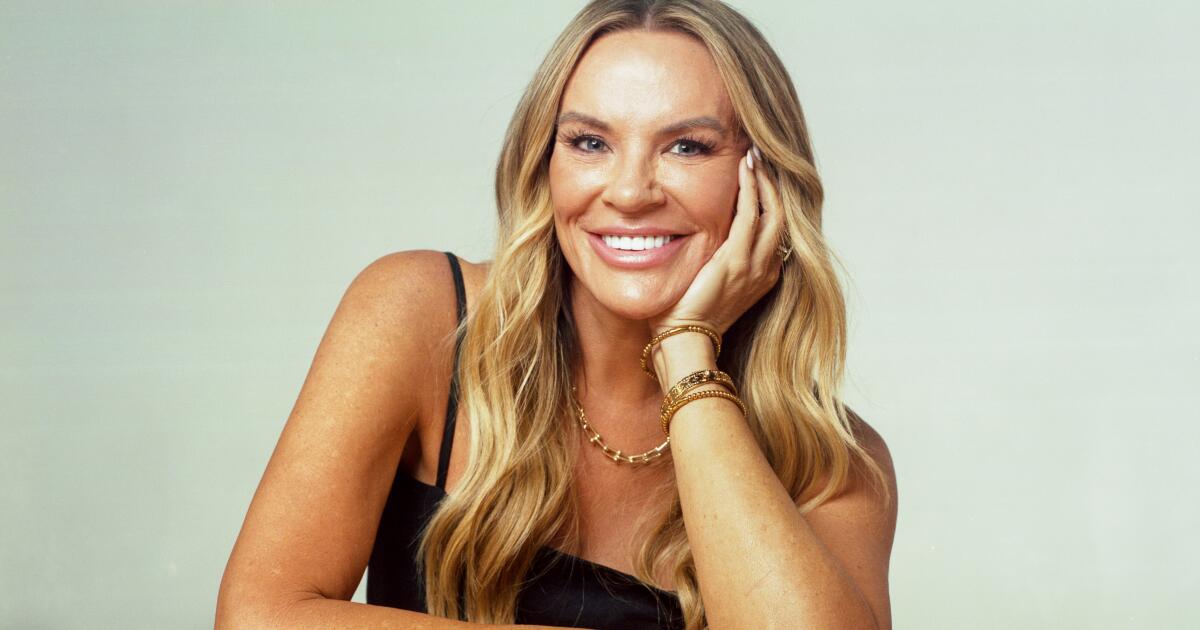
Not so long ago, Heather Gay was a middle-aged mother of three, struggling to reclaim her sense of self. She’d spent most of her adult life embodying the “Molly Mormon” stereotype — a devoted wife, mother and member of the Church of Jesus Christ of Latter-day Saints. Then her marriage fell apart, and with it her entire identity. Financially dependent on her ex-husband, she was determined to get her medspa business off the ground. Becoming famous was hardly an option.
“I was just set out to pasture. I had no plausible hope for the future. I was just trying to be a good mom and morally upright citizen, turn my face to the wall and die. That, literally, was the plan,” she recalls.
Then Bravo came calling. Gay was cast in “The Real Housewives of Salt Lake City,” which premiered in 2020 and distinguished itself by looking at how the women in the cast were influenced by organized religion, particularly the LDS church. Gay instantly became the show’s breakout star — the smart, self-aware and hyper-relatable one who was quick to share her insecurities or crack a self-deprecating joke. She wasn’t model thin, didn’t dress in head-to-toe Chanel or travel with a glam team. She did, however, get very excited about eating meat on a stick and sometimes wound up with her head in the toilet after drinking too many espresso martinis.
Reality TV can be a lot of things — a bid for attention, a cash grab. But for Gay, it turned out to be a calling.
“It’s the most important work I’ve ever done,” she says, perched at the bar of a hotel in midtown Manhattan. Gay is in town for a watch party for Season 5 of “RHOSLC.” With her taut jawline, blazing white teeth and recently slimmed-down physique, she has embraced the prototypical Housewife look.
“‘Housewives’ rescued me. It gave me a second lease on life,” she says. “It scooped me up and pulled me out of the church, pulled me into financial independence and fame.”
Lisa Barlow, left, Heather Gay and Britani Bateman in the Season 5 premiere of “The Real Housewives of Salt Lake City.”
(Fred Hayes / Bravo)
Gay has leveraged her popularity by writing a bestselling memoir, “Bad Mormon,” with a second book, “Good Time Girl,” due in December. She has faced some ups and downs, including a rough patch when she exasperated fans with her unflinching loyalty to castmate Jen Shah, who went to prison last year for her role in a telemarketing scam, and may have given Gay a black eye. But she cemented her place in the pantheon of “Real Housewives” greats last season by confronting cast member Monica Garcia, linking her to a social media account that trashed her co-stars. A clip of Gay’s tirade went viral, particularly the line, “Receipts, proof, timeline, screenshots.” It has been quoted by congressional lawmakers, spoofed by Marvel and slyly referenced on “Jeopardy.”
She has also undergone another dramatic transformation, losing more than 25 pounds by taking Ozempic. She has approached the subject with her typical candor, speaking openly about using the weight-loss drug.
“This last year has been the best year of my life,” she says, sipping a glass of lime and basil infused water. (No, she has not given up her beloved espresso martinis; the bar is not yet open.)
Now, with Season 5 underway, Gay is at a crossroads: Can she enjoy the fruits of her “Housewives” celebrity while also maintaining the down-to-earth appeal that made her a fan favorite? Based on our conversation, which includes digressions about “Degrassi High,” “The Parent Trap” and her $29 ring from Zara, Gay appears determined to remain a friendly proxy for Bravo’s pop culture-obsessed audience.
“The most rewarding part of this job is taking someone, and watching them go from obscurity to really finding their voice and taking the opportunity and soaring. Heather is an amazing example of that,” says executive producer Lisa Shannon. “Heather serves as the voice of the audience because she’s so honest. She’s very observant, she doesn’t sit back on her opinions, and her opinions are usually correct.”

“The most rewarding part of this job is taking someone, and watching them go from obscurity to really finding their voice and taking the opportunity and soaring. Heather is an amazing example of that,” says “Housewives” executive producer Lisa Shannon.
(Sean Dougherty / For The Times)
Co-star Meredith Marks says that Gay “uses humor to deflect from her own pain.” She met Gay while working together on an event at the Sundance Film Festival but bonded with her on the way home from a cast trip to Zion National Park in Utah. Marks had just lost her father and believed some of her co-stars were making light of his death. “It was really hurtful, and I was in a lot of pain. I was terrified to get on the Sprinter van,” Marks says. “Heather grabbed me, and she’s like, ‘Come sit with me.’ I sat in the back with her, and she had me laughing the entire ride home. That is Heather. She knows how to take a tough situation and make you smile and laugh and pull you through.”
For her part, Gay suggests her relatability stems from the fact that she was a fan — of reality TV in general, but especially ‘The Real Housewives” — before she became one herself.
I ask her to elaborate, and she tears up (one of several times in our conversation). “You want me to cry?” she says, doing just that as she remembers getting hooked on early seasons of “The Real Housewives of Orange County.”
She lived vicariously through women like Tamra Judge (formerly Barney), as she bluntly told her then-husband she wanted a divorce. “I wanted a divorce when I saw that scene, but I could never say that out loud. I could never even think it to myself,” Gay says. “I’m grateful to these women for putting their lives on television, for showing the good, the bad and the ugly, for giving me escape and … showing me a life that I never would have seen because my bubble was so insular.”
Before “RHOSLC,” Gay was what she calls a “PIMO”; physically in, mentally out of the LDS church. She had a Keurig but would leave only hot chocolate pods out, lest her family or neighbors think she was drinking coffee. “That’s an absurd thing for a divorced adult woman to be concerned with,” she says now.
Participating in the show finally enabled her to leave the church for good. Without it, she thinks she’d still be a “PIMO.” But “Housewives” notoriety also contributed to Gay’s estrangement from most of her family.
If she had chosen to walk away from the church in private, they would have been upset but accepted it, Gay says. “But I’ve done it loudly and proudly, and I’m unapologetic about it. I’m also successful, which is even scarier if I were in the streets, addicted to drugs, or all the things they promised would happen to me if I left,” she says.
Like Gay, most of the original “RHOSLC” cast has ties to the LDS church. Between the crazy Sprinter van rides, it has also broken new ground by exploring heavy subjects such as excommunication and religious trauma.
It also helped kick the door open for “The Secret Lives of Mormon Wives,” a hit Hulu reality series that debuted in September and follows a clique of young Utah influencers whose modern choices (divorce, swinging) don’t always conform to church teachings. Its debut coincided with deafening discourse about the “trad wife” phenomenon, epitomized by LDS influencer and mother of eight Hannah Neeleman, a.k.a. “Ballerina Farm.”
The cultural fascination with pressures faced by women in the church is “incredibly validating,” Gay says. “It’s what I’ve been screaming from the rafters. I’m like, ’Thank you, women, for showing up and showing how we’re manipulated in our marriages, how we are exclusive in who can attend our religious events, and how we have double standards.’”
Gay hopes the conversation continues: Despite the accountability faced by many institutions in the wake of movements such as Black Lives Matter and #MeToo, the LDS church “remains unchanged,” she says. “No one’s tearing down statues of Brigham Young even though, historically, he’s done much worse than Christopher Columbus.”

Heather Gay finds the recent fascination with Mormon women validating: “I’m like, ’Thank you, women, for showing up and showing how we’re manipulated in our marriages, how we are exclusive in who can attend our religious events, and how we have double standards.’”
(Sean Dougherty / For The Times)
Like elite athletes, Housewives have good seasons and bad seasons. Gay’s popularity took a hit in Season 3, as she stood by Shah, who repeatedly denied involvement in the telemarketing scheme only to plead guilty just before she was set to go to trial.
Gay’s allegiance to Shah was so blind, she even refused to say how she’d ended up with a black eye after a night of partying in San Diego. She dodged questions for months; then in the Season 4 finale, alleged that Shah caused the injury, as many viewers already suspected. (For the record, Gay tells me she doesn’t remember the incident and knows how she got the black eye only because Shah told her. Shah has denied responsibility.)
Gay sees a connection between her devotion to Shah and a religious upbringing that “taught me to protect everybody but myself,” she says. “I thought my only way to contribute was to put my head down and be loyal. That was behavior I learned from decades of Mormonism: put up, shut up, don’t criticize, don’t look for evidence of fault,” she says, tears again welling up in her eyes. “I was f— up. I came out of a cult after 40 years and suddenly I had money, freedom and opportunity. I didn’t want to mess that up.”
Shah’s betrayal is part of what made Garcia’s relatively minor violation — setting up a troll account that few people were even aware of — so activating. “Her refusal to be accountable reminded me a lot of when we would confront Jen with things,” she says. To Gay, it also felt like Garcia was betting against her own team and had violated the cardinal rule of reality TV: Don’t bite the hand that feeds you.
Gay has taken the zeal and devotion she once felt for the LDS church and brought it to her role as a housewife. “I traded the church for the cult of reality television,” she jokes.
But being on TV comes with downsides, like scrutiny over her physical appearance. Co-stars have called Gay names such as “Shrek” and likened her body to that of a Lego figurine. Viewers have said even worse. “There’s a weird, cruel irony: Just when our bodies are giving out, we’re on TV. We’re not supermodels. We’re aging, middle-aged women,” Gay says.
The second-season glow-up has become something of a trope on “The Real Housewives,” with many veteran cast members radically altering their appearance after seeing themselves on TV. But Gay’s was belated; she focused on her “emotional glow-up” first. She is one of a few “Housewives” stars who have admitted to taking a weight-loss drug, though many others have been suspected.
“Listen, everybody and their dog is on it,” she says. “I’m grateful that it worked. But if it hadn’t, I would still be here. I just wouldn’t be wearing shorts.”
Gay was recently quoted saying that losing weight helped her realize that body positivity was “a big lie.” The point she was trying to make, that people treat you better when you’re thinner, got lost in the click-bait furor that ensued. “I wish it wasn’t that way,” she says. “I’ve been fat and I’ve been thin. I liked myself either way, but the way people respond to me is different.”
Gay has to leave soon for the premiere watch party. As our conversation winds down, she describes the wild emotional roller coaster ride that each new season brings. Usually, she gets to see the episodes just a day or two before they air on Bravo, and fans render their verdict — loudly and passionately — on social media.
“It’s 16 weeks of not knowing whether you live or die by the sort of the episode. You could have a week of wonderful reviews, and then you are slaughtered the next,” she says. It’s nauseating, but exhilarating. “I f— love it. At my age and at this stage of life, where else would I ever get this type of adrenaline?”



Movie Reviews
‘Only Beautiful Things to Look At’ Review: A Handsome but Muffled Portrait of State-Sanctioned Cruelty

The fashions and furnishings of Czechoslovakia in the 1980s — the height of the state’s racist program of suppressing the Roma population through coerced sterilization — are painstakingly evoked in Slovakian filmmaker Ivan Ostrochovský’s “Only Beautiful Things to Look At.” But the film’s attractive yet oddly bloodless presentation gives the impression of a period drama set much farther back, as though we’re peering at the prettily mounted arrowheads and artifacts of a long-gone atrocity through museum glass. Alongside the decision to centralize the perspective of a white female doctor, this old-school, soft-focus approach robs an undeniably well-intentioned movie of a vital edge of urgency and discomfort, allowing viewers to consign the cruelties it outlines to some imaginary distant past, when in truth, the sterilization policy continued well into the 21st century in both the Czech and Slovak Republics.
The film begins with a montage of young Roma women, each shot as though for a studio portrait, impassively absorbing an offscreen voice lecturing them about family planning. “Sterilization,” the voice concludes disingenuously, “allows Gypsy women to improve their family’s quality of life.” The intention behind the portraiture is noble: to put faces to a crime more often recounted in impersonal statistics, when it is acknowledged at all. But although framed and lit with dignity by cinematographer Juraj Chlpík, none of these Roma women speak. The first words of argument or protest we hear are from Ingrid (Anna Geislerová), the film’s white protagonist, and she is not talking about reproductive rights at all. Instead, she is facing an all-male panel of her peers as she interviews for the role of head doctor at the hospital where she works. Ingrid knows the position will very likely go to one of her male colleagues, but that doesn’t stop her being angry and disappointed when it actually does.
Outside her work at the hospital, which in large part comprises assessing and performing the sterilizations in a procedure that leaves patients with a small scar beneath the navel nicknamed “the bow,” Ingrid has what can only be described as a beautiful life. With her music teacher husband Maros (Vlad Ivanov), she lives in a gorgeous house in the countryside, where her bedroom, glass-paned on two sides overlooking a lush forest, looks almost like a fairytale princess’ lair. In the warm-lit evenings she and Maros read and drink wine and listen to classical music; on her days off she goes for walks in the forest or, when it’s hot, visits the nearby river and looks on benignly as Roma children bob along playfully on tire tubes.
It is only through her burgeoning friendship with Agata (a radiant Simona Boledovičová), a sweet-natured orderly who is reticent about her Romani idenitity, that Ingrid eventually starts to become uncomfortable with the work she does helping the hospital meet its government-recommended quotas for sterilizations. Ostrochovský’s film, co-written with Marek Leščák, is not anything quite as crude as a white savior narrative, but it is certainly one that assumes the best conduit for a wide audience to understand the cruelty visited on Czechoslovakian Roma families, is the moral awakening of a white woman.
This faulty focus is particularly frustrating because Agata’s own story, and the manner in which she comes to reconcile herself with her Roma background, is by far the more intriguing narrative strand. As an orphan, Agata was separated from her sister Jula (an excellent Eva Mores), with each then going on to lead very different lives. Jula married within the Roma community, has had two children and is pregnant with an unwanted third. Agata, who at first barely acknowledges their connection, has been more independent, living with a roommate and working at the hospital, and recently getting serious with a boyfriend. “He’s white?” queries Jula in surprise when she hears that he’s a soldier. “Good for you.”
The tides of unspoken resentment and disapproval that flow between the sisters are fascinating, with Agata able to move between Jula’s world, in a cramped flat in a crumbling building where kids play in dirty stairwells, and Ingrid’s enviably refined domestic environment. Eventually, just like Chlpík’s limpid camera, Agata comes to see the beauty in both, when in the film’s most moving moment, the sisters tacitly reconcile while Jula’s kids splash about in the tub at bathtime. There would have been the opportunity here to probe the long-term consequences for the Roma women bearing “the bow,” many of whom had been conned into a procedure that was misrepresented to them, in a language they did not speak, or in documentation they could not read.
Instead, the film insistently returns us to Ingrid. As she’s kept awake by the first stirrings of her conscience, as she lazes in rumpled white bedsheets watching a beetle trundle across her pillow, as she’s depicted in macro close-ups that emphasize the blondeness of her hair, the fairness of her skin, the blueness of her eyes. Indeed, right up to a finale which resolves the remaining conflict with a rather glib miracle, the film’s loveliness practically becomes a liability, placing the real plight of the Roma several removes of perspective and aesthetic manipulation away, until you begin to wonder why we’re being given only beautiful things to look at, when there are so many ugly things that better warrant the attention.

Here’s a terrible-seeming idea: The Rolling Stones should get started on their next album.
Like, now.
After taking nearly two decades to release 2023’s “Hackney Diamonds” — the band’s first set of original material since “A Bigger Bang” in 2005 — the Stones are back this week with a follow-up, “Foreign Tongues,” that took them less than 36 months to get out.
And it’s the better record in every way.
In the old days, of course, two and a half years was all they needed to make “Beggars Banquet,” “Let It Bleed” and “Sticky Fingers.” So let’s not get too carried away by the fact Mick Jagger, Keith Richards and Ronnie Wood are working as fast as they are in their late 70s and early 80s.
Yet to listen to the brisk and sportive “Foreign Tongues” is to hear a band clearly going on instinct rather than overthinking the music à la any number of veteran acts in legacy-maintenance mode. I don’t know if the result is the Stones’ best since 1978’s “Some Girls,” but it’s definitely the funniest, which is actually the more impressive achievement.
“Wake up in the morning and you wanna make me puke,” Jagger sneers in the punky “Hit Me in the Head” — exactly the kind of lyric you’d hope to hear from a band whose only possible reason for still being in the game is to have a gas-gas-gas.
Like “Hackney Diamonds” — and, for that matter, like Paul McCartney’s “The Boys of Dungeon Lane” (to name one recent overthinking-veteran LP) — “Foreign Tongues” was produced by 35-year-old Andrew Watt, who’s made a career of helping boomer icons put a little shine on their late-in-life efforts. And he’s helped the Stones convene an appealingly motley crew of collaborators here, including McCartney (who plays bass on “Covered in You”), the Cure’s Robert Smith (who contributes guitar to “Divine Intervention”), Steve Winwood (who plays piano and organ throughout the album) and Bruno Mars (who’s credited with, uh, cowbell in “Never Wanna Lose You”).
You also get a welcome appearance from the late Charlie Watts in a hard-thwacking performance recorded before his death in 2021. (Steve Jordan otherwise keeps time.)
But none of the stunt casting feels like the point of the album, which instead simply doles out a dozen tunes in the Stones’ various idioms — the bluesy stomp, the country-ish lope, the sleazy disco jam — plus a couple of covers in just over an hour. It’s frisky and lighthearted, even when Jagger is lamenting what he sees as the sorry state of his beloved America in “Ringing Hollow” and when Richards is croaking about love having put him on his knees in “Some of Us.”
And when they go goblin mode, they really lean in: “Mr. Charm” is a demented soul-rock rave-up about how boring money is — OK, Mick — in which Jagger drops a diss of the “mad mogul Mr. Musk” into a verse laying out the delights of staying home and doing anagrams.
In “Divine Intervention,” Jagger offers a colorful travelogue of trips through New York and Los Angeles — “I kept moving on to Silver Lake / To play guitar with a brand new friend of mine” — while Richards and Wood get their guitars slip-sliding all over the place. “Jealous Lover” is gorgeously trashy: a horny little strut that sounds like “Dirty Mind”-era Prince doing “Waiting on a Friend.” (Legitimately loony Mick vocal here.)
For God knows what reason, the Stones offer up a faithful rendition of Amy Winehouse’s “You Know I’m No Good” with Jagger on harmonica. And the album ends with a very ragged take on Chuck Berry’s “Beautiful Delilah,” obviously meant to remind you of how the two lifers at the core of the Stones came together more than half a century ago.
The memory is ancient; the thrill, somehow, is alive.

Comedy is a matter of taste and preference — it’s a deeply personal thing. Which makes it hard for a critic to give a blanket assessment of a specific kind of comedy, especially if it didn’t work for them, but clearly worked for others (the laughter or lack thereof is the indication). “It’s not funny,” the critic says, “well I had fun,” someone else can reply, and then we’re at an impasse.
Which is the dilemma one finds oneself in with “Gail Daughtry and the Celebrity Sex Pass,” a very strange and shaggy Hollywood satire of sorts from David Wain and The State crew, still riding the goodwill of “Wet Hot American Summer” after all these years. If only this were as funny.
“Gail Daughtry” lives in the same world as that iconic summer camp spoof, as well as Wain’s 2014 rom-com parody, “They Came Together,” in that he’s playing with genre convention and expectation, taking well-known norms to the goofiest extremes. But those films hewed more closely to their respective genres, while “Gail Daughtry” is totally scattered, combining crime and spy movie tropes with a fish-out-of-water comedy and a Hollywood send-up. It has far too many ideas for its own good, and yet no ideas that are good enough to sustain this bizarre curio of a comedy.
What’s ironic is that one of the problems driving this wacky plot forward is the characters have to come up with a movie idea to pitch to star Jon Hamm (playing himself of course), leading them to do some pretty inane and shockingly violent things. It’s almost as if Wain and co-writer and co-star Ken Marino had no idea for a movie, then baked their search for an idea into their script, and then turned it into a madcap adventure about a woman on a quest to have sex with Jon Hamm. What an ouroboros!
OK, about the sex quest. Gail Daughtry (Zoey Deutch) is a chipper hairdresser from Kansas born without the part of the brain that recognizes sarcasm or irony. She’s a cheerful, Pollyanna-ish naïf whose literal-mindedness is almost as extreme as Amelia Bedelia. Her childhood sweetheart and fiancé Tom (Michael Cassidy) is the same. She tells him about the concept of the “celebrity sex pass” as a joke, and he promptly boinks Jennifer Aniston at local book reading.
(Nitpicky aside: why didn’t they use the common nomenclature “hall pass”? Is it copyrighted? “Celebrity sex pass” is clunky and sounds like an off-brand version of the well-known slang.)
That infidelity crisis is how Gail ends up in Los Angeles determined to bang Hamm, collecting a motley crew of similarly clueless helpers along the way. There’s her best friend Otto (Miles Guttierez-Riley), her salon bestie; Caleb (Ben Wang), an overly ambitious intern at Creative Artists Agency; Vince (Marino), a screenwriter turned paparazzo with a heart of gold; and John Slattery, as John Slattery, down on his luck. An accidental briefcase swap has a pair of thugs on their tail, in a forgettable and underdeveloped B-plot.
With a parade of celebrity cameos and collaborators in bit parts, “Gail Daughtry” at times feels like an excuse for Wain and co. to make something at home with all of their friends. Fair enough, it’s great to see all these people employed, but what about what we’re watching? Behold, the Los Angeles of the middle-aged working comedian: the CAA lobby, the Chateau Marmont, Griffith Park, etc. And the plot is as half-baked as the pitch they present to Hamm.
What’s actually interesting about this comedy is the distinct streak of despair and even resentment that reveals itself at the climax, a feeling of helplessness and uselessness. Everyone’s been striving to make it in this crazy town: the intern, the actor, the paparazzo. But not even Jon Hamm can help them get a movie made; even he feels inherently powerless. There’s an unexplored anxiety vibrating there that feels the most thematically fruitful, about what it means, some 25 years after bursting onto the scene with a generation-defining comedy, about maintaining the work, the drive, a sense of purpose, after years of strikes, and in the face of a constricting industry. Do they still have it? Is the dream still alive?
Maybe that’s why Wain and Marino need to invent a dreamer stand-in with Gail, a guileless eternal optimist who knows nothing of the craven Los Angeles and accepts everything at face value (though she is filled with a scary bit of rage too). She might behave like she has a head injury, but she’s going to achieve her goal, dammit. “Gail Daughtry and the Celebrity Sex Pass” might not be as funny as “Wet Hot American Summer” (for this critic), but reframed, it serves as a fascinating status update on life in La La Land for this troupe.
‘Gail Daughtry and the Celebrity Sex Pass’
2 stars (out of 4)
MPA rating: R (for sexual content, violence/bloody images and language)
Running time: 1:33
How to watch: In theaters July 10
-

 Alaska2 minutes ago
Delegation Welcomes Corps Permit for King Cove Road
-

 Arizona7 minutes ago
2026 MLB Draft: Arizona likely to be minimally impacted after down season
-

 Arkansas14 minutes ago
ARKANSAS A-Z: Band formed by faculty members of what is now UCA | Arkansas Democrat Gazette
-
 California16 minutes ago
Disneyland turns to cheaper evening passes and the internet speculation explodes
-

 Colorado22 minutes ago
Colorado mountains could see near-record temperatures as heat dome develops over the West
-
Connecticut29 minutes ago
I moved from Connecticut to the South chasing a cheaper, simpler life. It wasn’t at all what I expected, so I moved back.
-

 Delaware29 minutes ago
New information on “sophisticated cybercriminal attack” against Delaware County
-

 Florida37 minutes ago
NW Florida authorities make two more arrests in murder case

