Entertainment
'Curb Your Enthusiasm' finale and its 'Seinfeld' moment: 'A joke 26 years in the making'

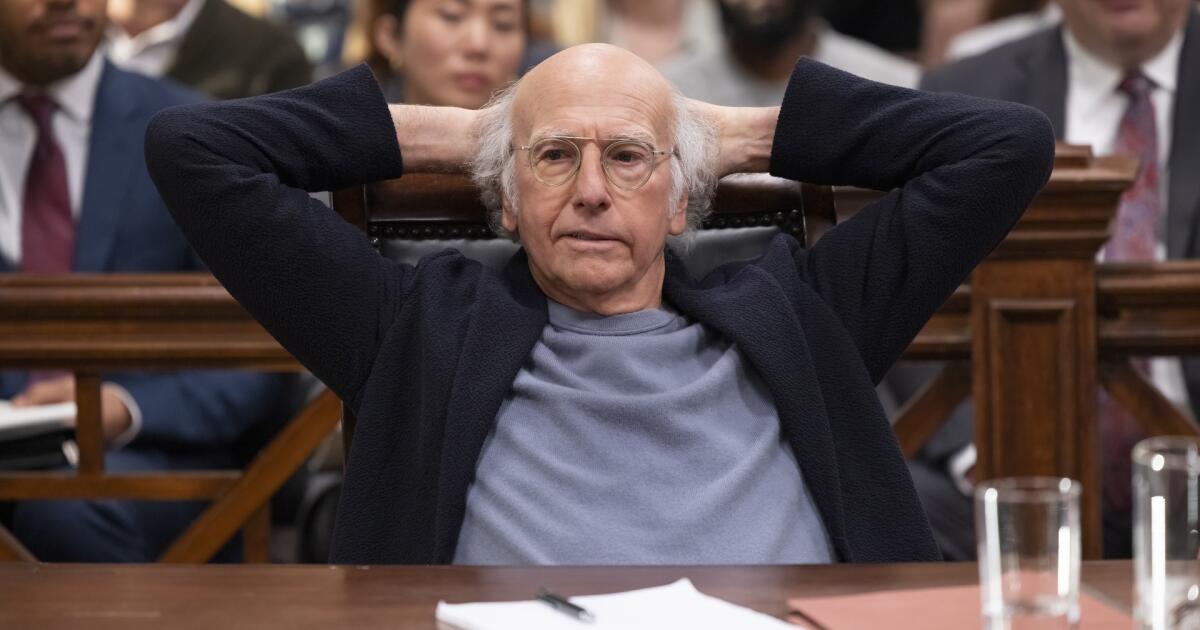
“Mr. David. It seems you have a history of doing the same things wrong over and over. And I truly hope this time you finally learned your lesson,” Dean Norris’ Judge Whittaker told Larry David — the fictionalized version of himself — during the series finale of HBO comedy “Curb Your Enthusiasm.”
He has not.
The line, which came with the judge sentencing the comedian and writer to a year in jail, was meant to be read as both literal and meta. Neither the fake Larry David, who has spent 12 seasons calling out “pig parkers” and insulting someone’s “beloved aunt”— and who now can’t even pay attention as his attorney Sibby Sanders (Sanaa Lathan) attempts to deify him to a jury — nor the real Larry David, who is a staunch defender of the similar ending for his and Jerry Seinfeld’s NBC sitcom “Seinfeld,” has ever been capable of learning a life lesson (Driving the point home, the last episode of “Curb” is titled “No Lessons Learned”).
“Curb” executive producer and showrunner Jeff Schaffer, who also directed Sunday’s finale, says the impetus for the finale came when they were writing a scene from earlier in the episode when a boy hits David’s character in the head with a ball. The child’s mother wants him to apologize and learn from his mistakes. The wisdom David’s character imparts to the tyke? That, despite being a septuagenarian, he’s never learned a life lesson.
“We realized we should own that and tell everyone Larry’s never learned a lesson and just do the finale again,” Schaffer says, adding that “Larry doesn’t care what you thought about the ‘Seinfeld’ finale. He cares so little about your thoughts that he’s going to redo it.”
And, although the “Curb” finale is full of call-backs and nods to the “Seinfeld” finale — including bringing back Seinfeld himself to be the episode’s Superman to save the day by getting the charges dropped — there is at least one major difference between the two. In “Seinfeld,” the four leads stand trial for their meanness and are sentenced to a year in jail together because they were caught mocking another person. In “Curb,” our hero’s on trial because of a decent act. He gives water to his friend Rae (Ellia English) when she’s in line to vote during a hot day in Georgia; a gesture that’s illegal under the state’s Election Integrity Act of 2021.
Still, Schaffer says “the parallel between the ‘Seinfeld’ and ‘Curb’ instigating incident doesn’t really exist” and that “it wasn’t something that motivated us in the writing.”
“It was Larry saying, ‘You know, this is crazy law in Georgia, I should get arrested for that,’” Schaffer explains. “It wasn’t ‘I’m gonna perform an act of kindness.’”
In an interview that has been edited, and condensed, for clarity, Schaffer and “Curb” co-star Susie Essman school The Times on “Lessons Learned” and other takeaways from the show’s last season.
Susie Essman, not Larry David, has the last line in the “Curb Your Enthusiasm” finale.
(John Johnson/HBO)
Susie, you have the last audible line of “Curb.” Your character, Susie Greene, and other key characters are fighting on the airplane on the way back to Los Angeles and you tell David’s character, in so many words, to shut up and go back to jail. How does that feel?
Susie Essman: It feels good. It made me very happy. I saw it last night for the first time. And I was like, “Oh, wow, I have the last line.” It’s fitting that Susie should have the last line in the world that we have created here. I don’t think that was on purpose. My voice just happened to be loud.
Jeff Schaffer: It was a final, strident grace note. When we were filming that scene, we tried a lot of different things, as we always do. There were these moves that as everyone was arguing, we would drift over to Larry. The idea, as we conceived it, was sort of ending on Larry’s face. When we were in the editing room, Larry goes, “This isn’t right. It shouldn’t end on me, it should end on our group.”
He was so great about that. Because when we ended on Larry, no matter what expression he gave, it still felt sentimental. And that’s not what we were going for. But when you end it on our guys doing what they do best, which is going at each other, you get this feeling of this is what they’re always going to be like. It’s the best retinal ghost of the show.
The finale also pays homage to Richard Lewis, who was sick while filming this season and died in February, by referencing a scene from the first episode of “Curb” and also seeing Larry continue to sabotage his friend’s love life. Were you intentionally trying to focus on him?
Essman: We didn’t know Richard was going to die, that’s for sure. He was not well, and clearly anybody who sees the season can see he’s not well. But his death was quite shocking. I don’t think anything was written toward that.
Schaffer: Once we knew we were going to do this recapitulation of the “Seinfeld” finale, the question was how far do we take it? How close do we get to the end? I really wanted us to get to that pull-out shot [of Larry in jail and repeating a conversation he’s already had; just as Jerry had done]. … It was all about [let’s] take it as far as we possibly can and make people think that we just were redoing it, shot for shot at the end.
There’s also a whole bit in the courtroom of David swatting at a fly as his attorney attempts to lionize him. And some of it is shot from the fly’s point of view. Why did you want to change up the look of the show by directing that?
Schaffer: Honestly, because it’s funny seeing Larry really go into that straight-to-camera of him trying to kill that fly during this spirited defense. The fact that he didn’t hear a word she said was funny. So we were just mixing up the shots. We wanted that shot. We wanted to see it from the jury’s POV. We wanted him in the background. There was also just one shot of his hand slamming on the table.
It was just building that sequence out of Larry trying to hunt the fly like he’s a tiger in the jungle during that speech.
Larry David and Jerry Seinfeld in the series finale of “Curb Your Enthusiasm.”
(John Johnson/HBO)
The finale has a “Seinfeld”-like scene with Larry and Jerry riffing on a hypothetical about dating a bearded lady from the circus. I’m assuming there’s a lot of unaired footage from that exchange.
Schaffer: Larry had had this hypothetical that he wanted to talk about during the season. … We didn’t know what show to put it in. And it was like, ‘Oh, this is perfect.” I’m so glad we saved it. It was the perfect hypothetical for Jerry and Larry to talk about so you could just see these two be funny together and get a sense of “OK, maybe this is how ‘Seinfeld’ got written. It was just watching these two pals making each other laugh.”
And I’m assuming that Seinfeld was OK with poking fun at his show’s finale?
Schaffer: He loved it. After we shot the jail scene, he said, “This is so great. This is a joke that’s 26 years in the making.”
This season has also gotten some intense fan reactions. An actual billboard of Essman’s character modeling her line of caftans was defaced in a similar manner to what happened to the one on the show. And a fan at a Bruce Springsteen concert came with a sign that referenced the musician’s guest appearance on the show. How are you feeling about this fandom?
Essman: Oh, my God. People called and said, “Are you upset by this?” when the billboard was defaced. I thought it was the funniest thing in the whole world. I mean, it was no small feat to get up there and do the graffiti. … They needed ropes and scaffolding.
Schaffer: It was our genital “Field of Dreams.” If we build it, they will deface it.
And poor Bruce. He does us a huge favor. He does one day of shooting, and now, for all of his concerts .…
Essman: And let me say something very important: Bruce improvised that line. He was really not given his stuff. Sometimes, somebody comes on and they’re not an actor and are spoon-fed. That’s not true. He was brilliant.
Do either of you find the “Seinfeld” finale to be as divisive as the rest of the internet seems to?
Essman: I haven’t watched it since it aired. And honestly, when it aired, I thought it was fine. And I haven’t really thought about it since then.
Schaffer: Larry and I watched it again when we realized we were doing this. … And [we both thought] that it was funny. That made this even more perfect. Because it was like, if you didn’t like that, f— you. We’re gonna do it again.
That’s one of the things I love about this finale. It’s bigger than “Curb” and it speaks to Larry as a contrarian. It not only wraps up the show, but it helps wrap up all this amazing work that Larry has done in a very Larry way. [That] is, “I thought it was funny. And you know what, I still think it’s funny.” And you know what? He’s right.


By and large, the zombie subgenre has bitten off more than it can chew in modern times. Between George Romero survival films and camp comedies, the well has become pretty infected. But once in a while, along comes a movie like This Is Not A Test.
Let’s sink our teeth into this new release and see how it stacks up against the classics.
The tone and tenor of this film represent the classic survival movies like Night Of The Living Dead. But the thing that grabs the audience about This Is Not A Test is the trauma of the characters. Holt shines as a withdrawn survivor of an abusive home, trying to cut through the wreckage to reunite with her sister. Each of the main characters have standout traits, and they bathe in strongly acted moments as the stress of the situation changes who they are.
The gore in This Is Not A Test is pretty strong. The attacks spring quickly and when they do, the special effects team does a good job showcasing the battle scars. The camera work is also frenetic in a good way, because the chaos of the chase scenes puts the viewers in a first-person perspective. This film lets you feel like a part of the survivors, so their journeys are interactive.

Longtime fans may say that there’s nothing new in This Is Not A Test, and maybe they’re right. There’s no fresh take on the monsters here, no crazy origin, nothing that we haven’t seen in the past fifty-eight years. But the pacing nails a great balance between getting to know the characters and getting the zombie splatter fest. The mental meltdowns of the characters feel well earned, and the arc of Sloane and her sister brings a lot of heart and investment to the story. Even the most jaded zombie horror fans will find something to appreciate here, even as a background movie.
Adam MacDonald has made another intense hit here, and This Is Not A Test is currently available to stream on Shudder.
Entertainment
‘You’re scaring my people.’ Shia LaBeouf’s alleged stalker arrested after posting viral video
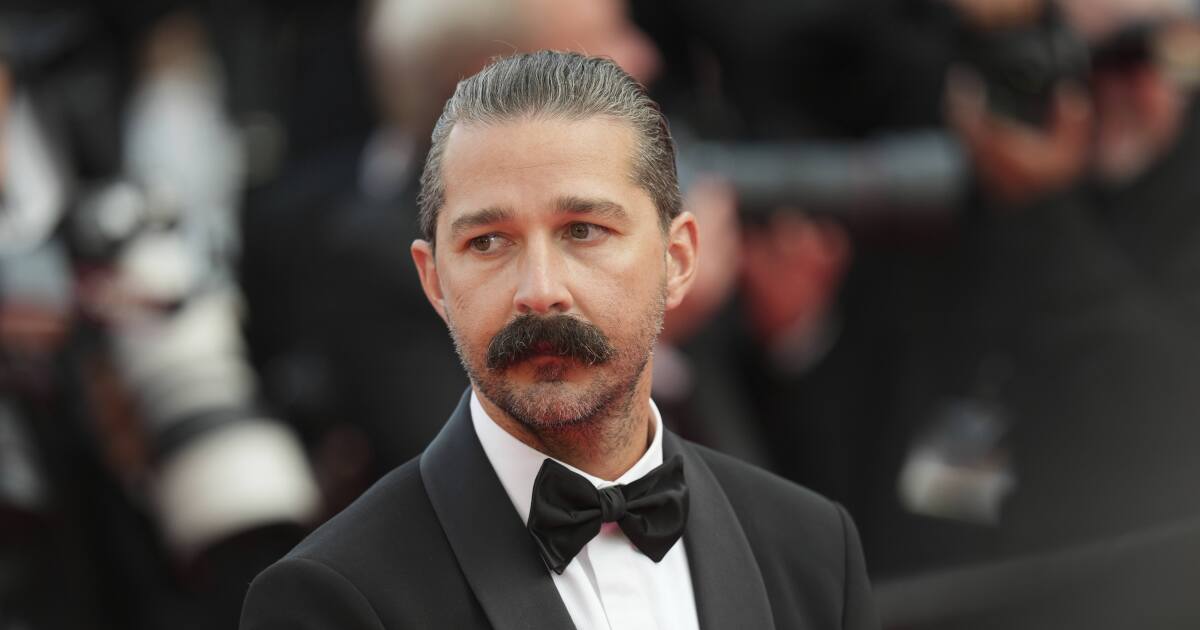
Shia LaBeouf’s alleged stalker has been arrested after posting a video of the actor asking to be left alone.
According to Orleans Parish Sheriff’s Office booking records, Alyssa Lee Couture, 40, was arrested Monday night and booked on a misdemeanor charge of stalking. Hours earlier, Couture had posted a video of a confrontation with LaBeouf in what appeared to be a grocery store parking lot. The “Honey Boy” actor is shown speaking to Couture through the window of a car.
“Leave me alone. God bless you. Leave me alone,” LaBeouf says calmly in the video. “You’re scaring my dad. You’re scaring my people. Leave me alone.”
Couture has posted more than 5,000 videos on her Instagram, most of which feature the woman addressing the embattled actor, whom she appears to believe is her husband. In a GoFundMe launched in May, Couture wrote that she was hoping to raise $70,000 to find permanent housing and that she had been living in her car and staying with family members. She also wrote that she had schizophrenia, among other disabilities.
Although the New Orleans Police Department does not identify Couture’s stalking victim as LaBeouf due to privacy policies, the timeline of her booking appears to line up with the confrontation with LaBeouf.
According to People, LaBeouf left Los Angeles after his split from actor Mia Goth last year and relocated to Louisiana to be closer to family.
In June, he pleaded guilty to three counts of simple battery, months after he went viral for his involvement in a Mardi Gras altercation in New Orleans. The actor, 39, was arrested in New Orleans on Feb. 17. At the time, New Orleans police confirmed LaBeouf was charged with two counts of simple battery for allegedly assaulting two men near a bar in the French Quarter. TMZ published bystander video of the incident and footage of LaBeouf walking through the French Quarter hours before the brawl.
The actor was released from jail shortly after his arrest and posted $100,000 in bond. More than a week after LaBeouf’s initial arrest, the New Orleans Police Department issued a second warrant for the actor’s arrest in connection with the same incident, and he racked up an additional simple battery charge. Prior to the second arrest, a New Orleans judge ordered LaBeouf to begin substance abuse treatment and undergo weekly drug testing.
Times staff reporter Alexandra Del Rosario contributed to this report.

- THE ODYSSEY
- Starring: Matt Damon, Tom Holland and Anne Hathaway
- Directed by: Christopher Nolan
- Rated: R
- Running time: 2 hrs 45 mins
- Universal
Our score: 4.5 out of 5
EPIC. If I was asked to describe Christopher Nolan’s latest film, that is the word I would use. He has mounted a film that rivals the greatest achievements of filmmakers like Cecil B. DeMille or David Lean. And, like the films of those mentioned, it’s runs a tad too long.
I was shocked, but pleased, to see that my 12-year-old granddaughter recently did a school paper on King Agamemnon. Thank goodness they’re still teaching History in our schools. Based on Homer’s “The Odyssey,” the film tells the story of King Odysseus (Damon) and his adventures which, if you’ve read “The Odyssey,” include the Trojan Horse, the Cyclops and assorted angry Greek gods. The film covers each of these adventures in great detail, sparing nothing in the production design department. While Odysseus is away – and he’s gone for a l-o-n-g time, his wife Penelope (Hathaway) has to endure a never ending string of “suitors,” men lining up in the hopes of replacing the King should he not return. The men are nothing more then scavengers, taking advantage of the law of Zeus, which decrees no one should be turned away. This angers the Queen’s son, Telemachus (Holland), who must control his temper when the men try to bait him into a fight, the idea being if Telemachus is killed, the new husband would become the King. It’s all very interesting and complicated. And long.

Director Nolan is one of the rare filmmakers who, in my opinion, has never made a bad film. From “Memento” to the “Dark Knight” trilogy to the Oscar-winning “Oppenheimer,” he has proven himself a true master of cinema. “The Odyssey” only adds to that distinguished resume’

The cast is a tribute to Nolan himself who, like Woody Allen, can pretty much get anyone he wants for his films because, as an actor, why wouldn’t you want a credit in one of his films. Besides the three stars named above, the cast includes Robert Pattinson, John Leguizamo, Zendaya, James Remar, Jon Bernthal, Oscar nominees Samantha Morton and Elliot Page as well as Oscar winners Charlize Theron and Lupita Nyongo. As MGM used to advertise, “more stars than there are in heaven.”
The script and story are pretty faithful to the source material, though for some reason it bothered me whenever Telemacus referred to Odysseus as “dad.” Never father. The weird things you notice. Visual.y the film is stunning and the Trojan Horse and battle of Troy are worth the price of admission alone. I will add that I did see the film in 70 mm and, if that format is playing in your town, I urge you to see it in that format.
On a scale of zero to five, “The Odyssey” receives ★★★★ ½
-

 Louisiana6 minutes ago
Louisiana pastor ordered to stay away from home of man he attacked
-

 Maine12 minutes ago
In Maine, Bobby Charles vs. Hannah Pingree is the race that matters | Opinion
-

 Maryland18 minutes ago
Maryland confirms 5 new measles cases, bringing year’s total to 9 – WTOP News
-

 Michigan24 minutes ago
Michigan health expert talks impact of Canadian wildfire smoke: There’s really a long list of who is at risk”
-

 Massachusetts30 minutes ago
The science behind Massachusetts’ wildfire smoke-darkened skies
-

 Minnesota36 minutes ago
Minnesota United Statement on International Friendly | Minnesota United FC
-

 Mississippi42 minutes ago
GPS data tracks boat Mississippi teen Nolan Wells was on before he went missing
-

 Missouri48 minutes ago
Missouri teen Gabbriana Boyster shot dead in home as mom makes horrifying discovery; 3 friends charged

