Entertainment
Box office doldrums continue, but 'Dune: Part Two' looms on the horizon

As the industry held its collective breath awaiting Friday’s opening of “Dune: Part Two,” North American moviegoers continued to largely ignore new releases.
Last week’s No. 1 film, Paramount’s “Bob Marley: One Love,” maintained the top spot with $13.5 million, according to estimates from market research firm Comscore, while anime stalwart “Demon Slayer: Kimetsu no Yaiba — to the Hashira Training,” from Sony and Crunchyroll, lived up to expectations, earning $11.6 million in its debut to finish second.
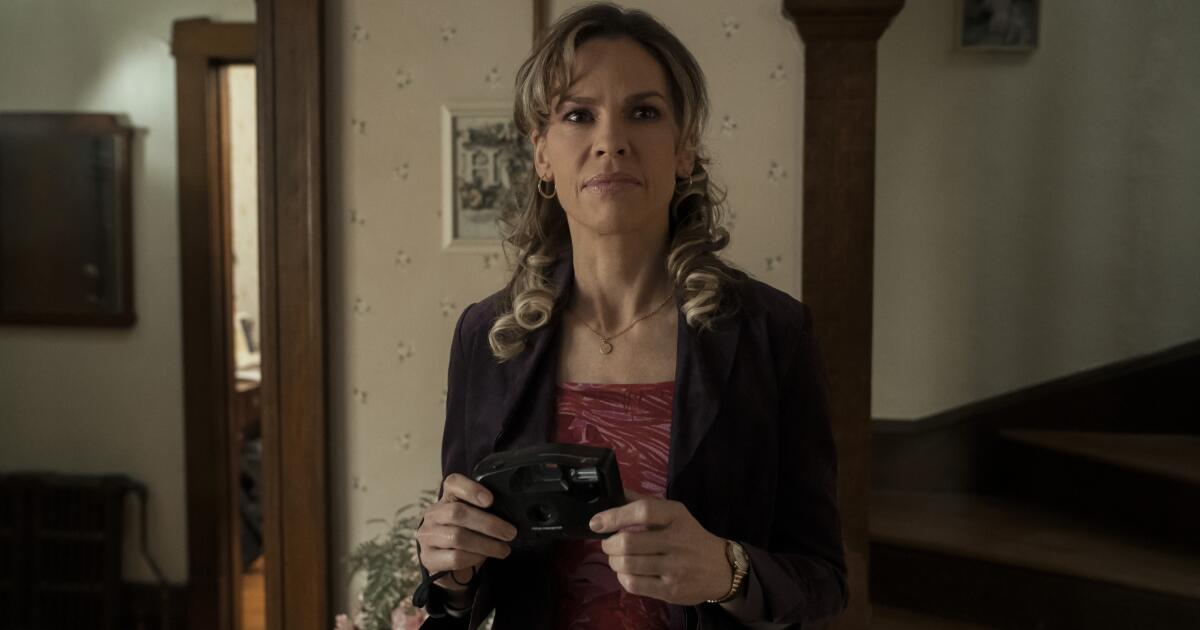
However, two higher-profile releases, Lionsgate’s third-place “Ordinary Angels,” starring Hilary Swank, and Ethan Coen’s eighth-place “Drive-Away Dolls,” from Focus Features, failed to find large audiences, grossing $6.5 million and $2.4 million respectively.
“One Love,” starring Kingsley Ben-Adir as the reggae legend, dropped a respectable 51% from its debut to reach $71.2 million domestically and crossed the $100-million mark globally.
In fourth place, Columbia Pictures’ disappointing “Madame Web” tallied a projected $6 million in its second weekend for a total domestic gross of $35.4 million. Universal’s animated hit “Migration” rounds out the top five in its 10th weekend with $3 million and a domestic cumulative of $120 million.
Universal and Apple Originals’ “Argylle,” earned $2.8 million in its fourth weekend for a domestic total of $41.7 million. Warner Bros.’ “Wonka” finished seventh in its 11th weekend, grossing $2.5 million and bringing its North American total to $214.5 million.
Opening exclusively in New York and Los Angeles, Sideshow and Janus Films’ release of Nuri Bilge Ceylan’s “About Dry Grasses” grossed an estimated $14,400 for a $4,800 per-screen average despite its three-hour-plus running time, which limited the number of daily screenings.
The highly anticipated “Dune: Part Two” carries a heavy burden next week but boasts a strong critical response with a 97% fresh rating on review aggregation site Rotten Tomatoes. It follows “Dune: Part One,” which grossed $41 million domestically its first weekend in 2021 on its way to a worldwide cumulative of more than $400 million and six Academy Awards.




Running free during a game of catch on the empty field at SoFi Stadium is a fantasy most Angelenos will never experience. For comedians Jo Koy and Gabriel Iglesias, it’s just a warm-up to a dream that’s been a lifetime in the making.
Gripping the football with fingers covered in Filipino tribal tattoos extending in a sleeve up his arm, Koy looks across the expanse of emerald green turf at his son jogging toward the south end zone of the Inglewood stadium on a recent afternoon. “To be able to throw at SoFi is crazy,” Koy said with a sparkling grin of bright white veneers.
The 54-year-old comedian with a beard full of gray stubble drops back to pass, launching a tight spiral underneath SoFi’s massive technicolor halo scoreboard hovering above a sea of empty stands. Joseph Jr. — a wiry 22-year-old with a head full of curly dark brown hair — runs briskly toward the goal line with a black cast on his left arm. He raises his right arm just in time to scoop it into his chest for a touchdown. The imaginary crowd goes wild.
“Yes!!!” Koy shouts, his excitement echoing in the stadium. He jogs over to Joseph in his navy blue coverall jumpsuit and L.A. Dodgers cap to deliver a satisfying father-son chest bump.
A few yards away, Iglesias is watching Roka, his tiny black chihuahua, dart around the field like four pounds of rambunctious entitlement. The plus-sized comedian — better known as “Fluffy” — is sporting his typical loose-fitting vintage Hawaiian shirt, denim shorts and black flat cap. Whenever they stand together, the duo’s dynamic is like a modern-day Laurel and Hardy.
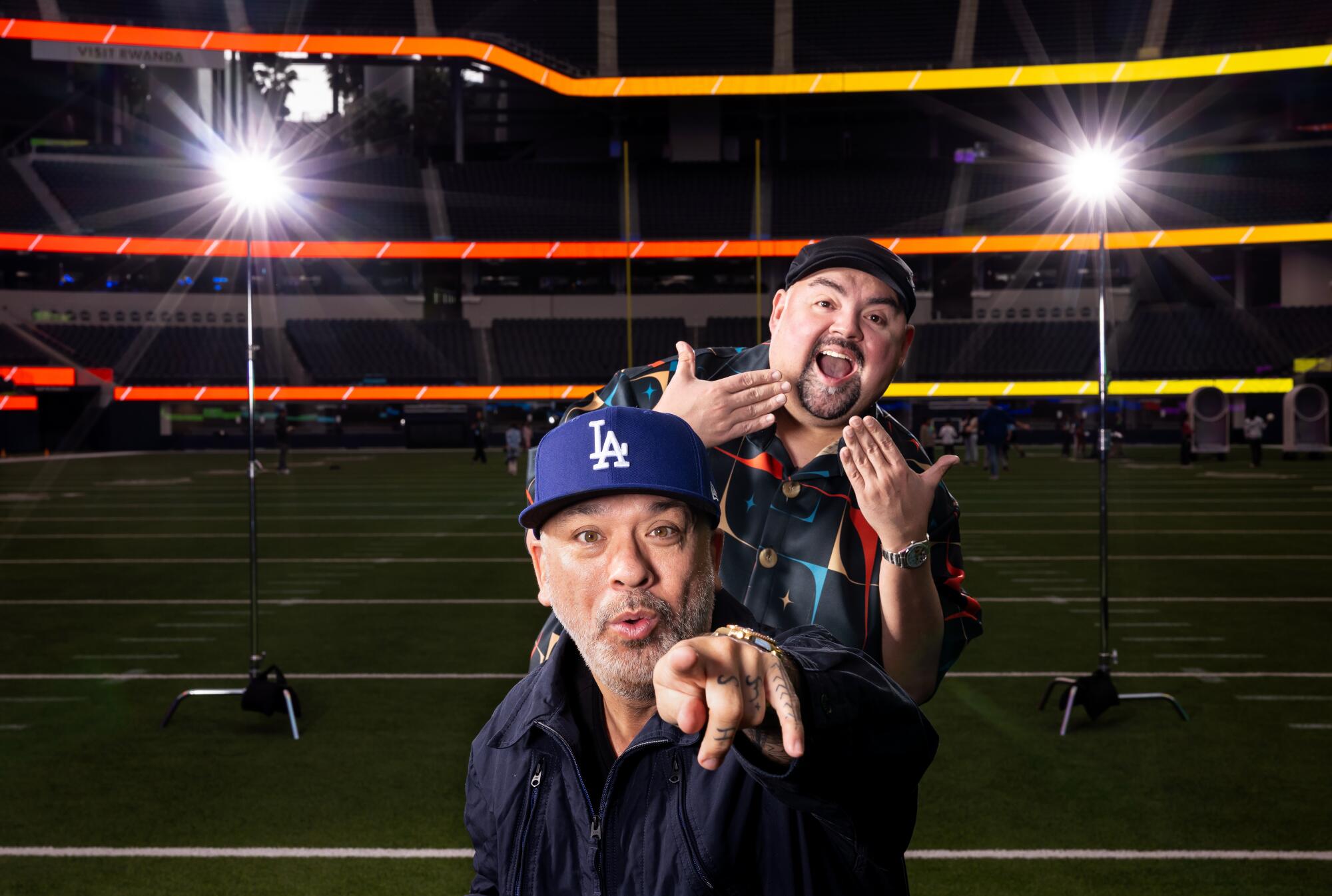
Nearly 70% of tickets for Koy and Iglesias’ SoFi show sold within days, making this the largest stadium stand-up performance to date.
(Christina House/Los Angeles Times)
“The fact that we’ve known each other as long as we have is wild … we’ve known each other since we both had hair,” Iglesias, 49, says as they both lift up their caps in unison, laughing and exposing their shiny bald heads.
On March 21, this stadium will be filled with more than 70,000 guests as the pair takes center stage at the Super Bowl of comedy — the largest stadium stand-up show to date. Koy and Iglesias are now part of a small fraternity of comics, including Kevin Hart, Dane Cook, Bill Burr and Larry the Cable Guy, who’ve sold out stadiums across the country.
The one-night-only show, which won’t be televised or recorded as a special, is meant to be one giant party for comedy fans who’ve supported Koy and Iglesias since their early days. The comics will be passing the mic back and forth throughout the night, which will feature special guests, surprise moments and plenty of other unplanned interruptions that will make for a roughly four-hour show. Though the L.A. comedy scene tends to exist in the shadow of Hollywood, this feat managed by two of its biggest names puts a historic spotlight on stand-up.
“It’s more sweet because it’s taken so long,” Iglesias said. “This wasn’t an overnight thing. Nowadays, everybody wants everything so fast. Between the two of us, we’ve got about 60 years of comedy experience.”
“It’s insane. I can’t explain it,” Koy adds, staring up at the stadium’s glass roof, preparing to crack it with decibels of laughter. “Every time we come in here and look up, I’m like, ‘There’s going to be a stage here the size of the end zone.’ We took the stage from the arenas that we normally play and injected steroids into it.”
For comedians who’ve witnessed their ascent, which now literally includes hands and feet cemented in front of TCL Chinese Theatre and a star for Fluffy on the Hollywood Walk of Fame, the journey has been incredible to watch.
“It’s huge for stand-up, it used to be just in dingy clubs and bars and always something small and intimate and kinda like an afterthought,” said fellow comedy star Tiffany Haddish, a longtime friend to both Koy and Iglesias. “To be honest I never thought comedy would be this big.”
Jay Leno, a confidant to Iglesias and the man who inspired him to start his own insane car collection and offered Koy his first late-night appearance on “The Tonight Show,” agrees that a show like this is a huge step for comedy.
“My attitude when I came to this town was if you can’t get in through the front door, go in the back door,” Leno said. “And they didn’t do it the traditional way, they got to where they are as comedians, one audience member at a time.”

For the two L.A. comedians, the historic milestone represents decades of work and signals comedy’s arrival in mainstream entertainment venues.
(Christina House/Los Angeles Times)
When the pair of arena-selling comics announced last year they’d be joining forces to perform at SoFi, the task of filling the massive concert venue and football stadium seemed laughable. But within a week, it clearly wasn’t a joke. Nearly 70% of the tickets were sold just days after going on sale. Now, weeks before the gig, the show is completely sold out with more seats being added. If there’s one person who is not necessarily surprised, it’s Iglesias. By his calculations — including his ability to sell out Dodger Stadium twice for the filming of his 2022 Netflix special, “Stadium Fluffy,” and Koy’s ability to sell out the Forum a record-setting six consecutive times (more than any other comedian) — the math checked out.
“At a certain point it’s like we’ve been doing [huge stand-up shows] for so many years, it becomes normal,” Iglesias said. “What do you do to change things? What do you do to grow? The worst thing that happens is it fails. But at least we know we tried it. Then we know what our ceiling is. But as of now, this isn’t the ceiling.”
Despite the logic, looking at the stadium’s massive seating chart during an initial meeting with the venue made the task feel akin to climbing Mt. Everest.
“SoFi is the size of like five Forums. That seating chart on a wall was the most discouraging thing I could possibly look at,” Koy said. “And then looking at the amount of money it was gonna cost us even before we sell one ticket. Me and Gabe should’ve been looking at that and been like, ‘What … are we thinking? Hell nah we ain’t doing this … !’”
It took more than a little convincing from Iglesias to get Koy on board. “[Jo] does not like change. I had to break down the math for him and I pushed it a lot,” Iglesias said. “And I’m glad we did because now that it’s sold out, the hard part is over. We just have to show up and deliver a kick-ass show. And then we can both celebrate after, crack a couple bottles and I know I’m taking a week off after that.”
Unlike a typical arena show, which takes several months to coordinate, their big night at SoFi required a full year of planning. The production and stage will be three times the size of the comedians’ normal stages and will be managed by the same team that produces stadium shows for acts like Los Bukis and Bad Bunny.

“It’s more sweet because it’s taken so long,” Iglesias said. “This wasn’t an overnight thing. Nowadays, everybody wants everything so fast. Between the two of us, we’ve got about 60 years of comedy experience.”
(Christina House/Los Angeles Times)
“It’s almost like a chessboard,” Iglesias said. “You got to do a bunch of moves in order to pull something like this off, it’s not just we’re gonna do it. This took a lot of planning, a lot of coordinating.”
When asked how the tickets could’ve possibly moved so fast, outside of typical avenues of good marketing and promotion, Koy says it was really comedy fans making a statement of support for them and for stand-up.
“There’s no such thing as marketing on this one, to me it’s a phenom,” he said, noting the pride both he and Iglesias have to see the excitement and support from local fans, especially Filipino and Latin communities across L.A. that have been a major part of their respective fanbases. “That type of reaction and that response to us saying we’re gonna be at SoFi is almost like a bragging right and it’s ‘our night, we’re gonna be there, I don’t care where we’re sitting.’”
The SoFi gig was conceived in February of 2024 during Koy’s sixth sold-out show at Kia Forum. In the hoopla of Koy breaking his own audience record at the venue, Iglesias crashed the show, presented his friend with a plaque and laid down the gauntlet in front of 17,500 fans. When Iglesias asked Koy if they should contemplate performing “across the street” together, the crowd erupted with excitement.
“Our agents and managers were like, ‘Are you sure you wanna do that?’’’ Iglesias said. “I think they missed a couple bonuses. But at the end of the day, it’s part of history.”
“That’s what’s beautiful about Gabe, he’s not scared to take on those big risks,” Koy said. “But the whole thing was a risk. We gotta alter our tour dates and sacrifice other opportunities to make this happen.”
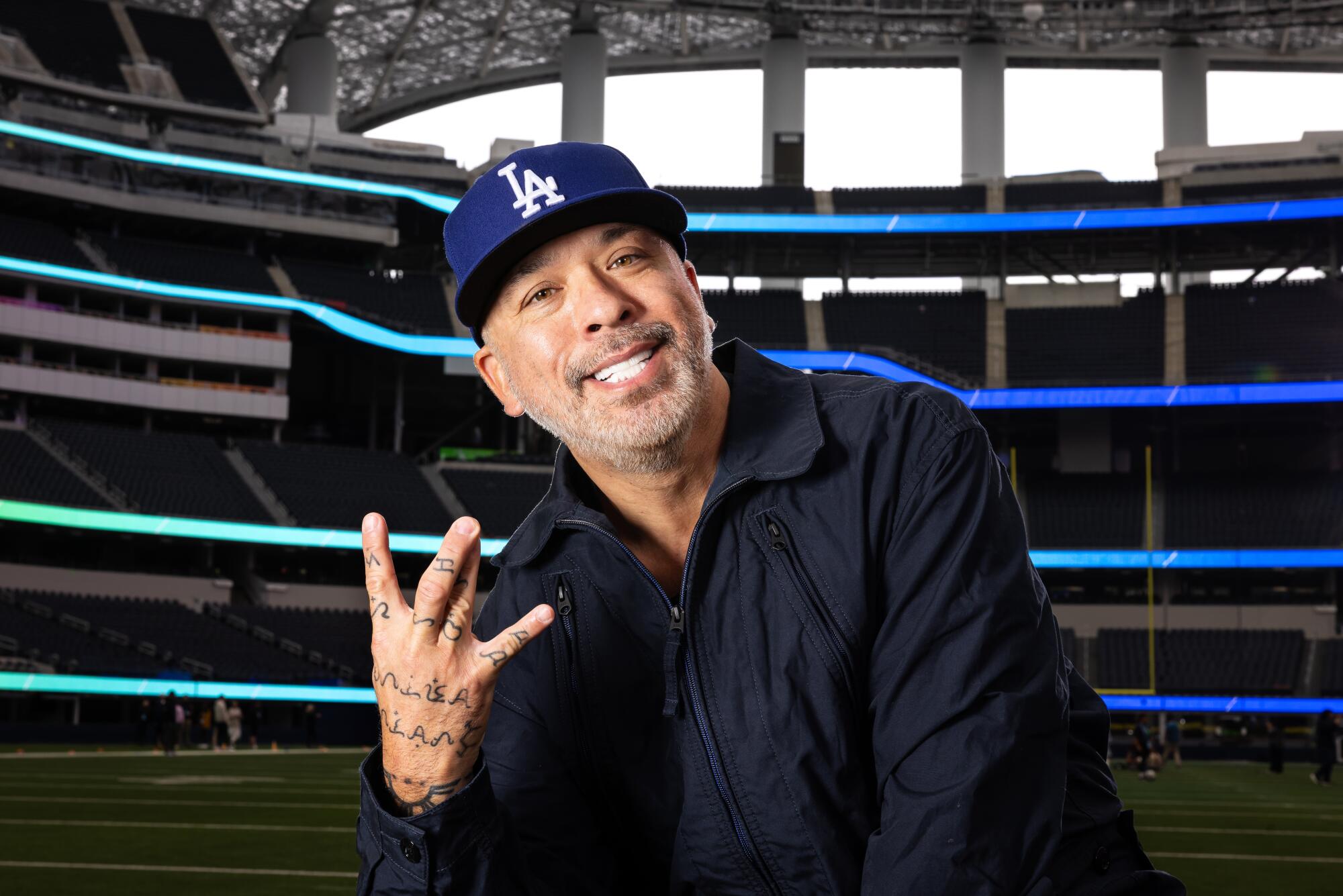
“Every time we come in here and look up, I’m like, ‘There’s going to be a stage here the size of the end zone,‘” Koy said about the upcoming SoFi show on Mar. 21. “We took the stage from the arenas that we normally play and injected steroids into it.”
(Christina House/Los Angeles Times)
For Koy, a life of comedy was a risk inspired by his heroes while growing up in Tacoma, Wash. He traces it back to being 15 and seeing Eddie Murphy perform at Climate Pledge Arena during his “Raw” tour in Seattle. He remembers taking a panoramic look at the sold-out crowd roaring in the darkness before the leather-suited legend even took the stage. “I’m like, ‘Wait a minute, this guy got this many people in here?’ I just thought that was the most impossible thing,” Koy remembers. “And now I get to share this moment with my son and let him walk with me and let him see that this is possible.”
When Koy was moving up the comedy ranks under his real name Joseph Glenn Herbert, the thought of calling himself a comedian felt like a pipe dream. Koy, the son of a white father and Filipina mother, saw comedy as a way to channel an overactive personality and need to make people laugh into a career. Going from coffee shop open mics in Tacoma to clubs and casinos in Las Vegas in 1989, Koy scratched out a living doing random jobs to move to L.A. in 2001 with hopes of making it big.
Working at a bank or Nordstrom Rack offered some stability as he drove up and down Sunset Boulevard in his battered Honda Prelude with one broken headlight, looking for a way forward to pursue his passion. Haddish, his longtime friend, spent years working with Koy, who served as her mentor at the Laugh Factory. Between sets on stage, the two would often take breaks to fantasize about fame.
“Jo and I would sit outside of the Laugh Factory and have these conversations and we’d be eating hot dogs wrapped in bacon and we’d be dreaming about being in a big movie, playing big theaters and helping people heal through laughter,” Haddish said. “Now here we are.”

“At the end of the day, this is a big stamp. And I think it also lets other comics know, ‘Hey, man, step up your game. Let’s grow this,’” Iglesias said.
(Christina House/Los Angeles Times)
Pulling off a show of this magnitude is jaw-dropping to think about, Iglesias said, even after having achieved a similar feat just a few years ago at Dodgers Stadium where he filmed his special over the course of two shows. He also set a record for fines incurred by a performer for going over his allotted time slot (a hefty $250,000 for not leaving the venue until 4 a.m.). The SoFi gig leaves him only one shot to get it right. This time around, Iglesias feels infinitely less pressure despite the bigger venue.
“[Dodger Stadium] for me was grueling,” Iglesias said. “I didn’t know what to expect, I didn’t know how it was gonna go. Every day we were pulling our hair out trying to figure it out. Fortunately we were still able to pull it off and we learned a lot from it. This time around, believe me when I tell you the stress of this show is not even there.”
Iglesias, a native of Long Beach, has spent over 30 years rising up the comedy ranks. Among his accomplishments are seven major comedy specials, a TV show (“Mr. Iglesias”) and becoming the first Mexican American comic with a top-grossing worldwide tour. Like Koy, who also has seven major specials, Iglesias went through a lot of metamorphosis on stage prior to finding his calling as a gregarious, fun-loving comedian with a penchant for doing cartoon-ish voices.
Leno says one of the key factors in Fluffy’s mass appeal is his likability.
“The great thing about Gabriel is that the kindness comes across, there’s not a mean spirit in his body,” he said. “There’s a lot of comics who are really funny but people don’t like them because they think they’re mean-spirited. … When you watch Gabe even when he does something that’s not fall-down hysterical, you smile because you like him. … I find him a joy to watch.”
Much of what Iglesias learned about marketing himself was inspired by the WWE. The costumes, witty banter and theatrics of the wrestling ring influenced his consistent look and even allowed the name “Fluffy” to become his calling card.

Comedians Gabriel Iglesias, aka, “Fluffy,” in front, and Jo Koy are photographed at SoFi Stadium in Inglewood on February 10, 2026, ahead of their March 21st show.
(Christina House/Los Angeles Times)
“There is a certain level of pandemonium, as they say in wrestling, that’s needed to get people excited,” Iglesias said. “Then there’s the marketing and the way that you do it — so I did study wrestling a lot.”
Handing the kingdom of SoFi over to the court jesters for a night is a feat worthy of celebration.
“At the end of the day, this is a big stamp. And I think it also lets other comics know, ‘Hey, man, step up your game. Let’s grow this,’” Iglesias said. “And it’s not, ‘Step up your game,’ like we’re competing with each other. It’s more so like, ‘Let’s elevate the game of comedy.’”
Right now Koy feels plenty elevated, as though he’s floating every time he enters the stadium and looks up at the stands — like the night he saw Eddie Murphy all those years ago.
“You should’ve heard the whispers me and Gabe had to ourselves walking out of the stadium tunnel, like, ‘Yo, is this really happening?!’” Koy said with a megawatt smile. “Coming from an open mic night at a coffee house, never in my wildest dreams did I say, ‘Someday, a football stadium’ … we’re literally living our dreams right now.”


That’s both a promise and a challenge she delivers, since what follows may rub some viewers the wrong way. Yet Gyllenhaal’s full-throttle commitment to her vision is compelling in and of itself, and she has marshalled an absolutely smashing-looking and -sounding production. The story proper begins in 1936 Chicago, which, like everything and everyplace else in the movie, has been luminously shot by cinematographer Lawrence Sher and sumptuously conjured by production designer Karen Murphy. Her involvement is appropriate given that her previous credits include Bradley Cooper’s A STAR IS BORN and Baz Luhrmann’s ELVIS, since among other things, THE BRIDE! is a nostalgic musical. Its Frankenstein (Christian Bale), who has taken the name of his maker, is obsessed with big-screen tuners, and imagines himself in elaborate song-and-dance numbers. (Considering the reception to JOKER: FOLIE À DEUX, one must applaud the daring of Warner Bros. for greenlighting another expensive film in which a tormented protagonist has that kind of fantasy life.)
THE BRIDE! may be revisionist on many levels, but its characterization of its “monster” holds true to past screen incarnations from Karloff’s to Elordi’s: His scarred appearance masks a lonely soul who desires companionship. Frankenstein has arrived in Chicago to seek out Dr. Cornelia Euphronious (Annette Bening), correctly believing she has the scientific know-how to create an appropriate mate for him. Rather than piece one together, Dr. Euphronious resurrects the corpse of Ida (Jessie Buckley), whose consorting with underworld types led to her brutal death. Previously chafing against the man’s world she inhabited in life, she becomes even more defiant and unruly as a revenant, apparently possessed by the spirit of Shelley herself, declaiming in free-associative sentences and quoting rebellious literature.
Buckley, currently an Oscar favorite for her very different literary-inspired role in HAMNET, tears into the role of the Bride (who now goes by the name Penny) with invigorating abandon that bursts off the screen. Unsure of her identity yet overflowing with self-confident bravado, she’s the opposite of the sensitive “Frank,” but they’re united by the world that stands against them. That becomes literal when a violent incident sends them on the lam, road-tripping to New York City and beyond, on a trail inspired by the films of Ronnie Reed (Jake Gyllenhaal), Frank’s favorite song-and-dance-man star.
With THE BRIDE!, Gyllenhaal has made a film that’s at once her very own and a feverish homage to all sorts of cinema past and present. It’s a horror story, a lovers-on-the-run movie, a crime thriller, a musical and more, and historical fealty be damned if it makes for a good scene (as when Penny and Frank sneak into a 3D movie over a decade before such features became popular). In-references are everywhere: It might just be a coincidence that the couple’s travels take them past Fredonia, NY (cf. “Freedonia” in the Marx Brothers’ DUCK SOUP), but it’s certainly no accident that the former Ida is targeted by a crime boss named Lupino, referencing the actress and pioneering filmmaker whose works included noirs and women’s-issues stories. Penny’s exploits lead legions of admiring women to adopt her look and anarchic attitude, echoing the first JOKER (while a headline calls them “Twisted Sisters”), and the use of one Irving Berlin song in a Frankensteinian context immediately recalls a classic comedic take on the property.
Whether the audience should be put in mind of a spoof at a key point in a film with different goals is another matter. At times like these, Gyllenhaal’s pastiche ambitions overtake emotional investment in the story. As strong as the two lead performances are (Bale is quite moving, conveying a great deal of soul from behind his extensive prosthetics), it’s easier to feel for them in individual scenes than during the entire course of the just-over-two-hour running time. The diversions can be entertaining, to be sure, but they also result in an uncertainty of tone. The dissonance continues straight through to the end, where the filmmaker’s choice of closing-credits song once again suggests we’re not supposed to take all this too seriously.
There’s nonetheless much to admire and enjoy about THE BRIDE!, and this kind of risk-taking by a major studio is always to be encouraged (especially considering that we’ll see how long that lasts at Warner Bros. once Paramount takes it over). Beyond the terrific work by the aforementioned actors, there’s fine support from Peter Sarsgaard and Penelope Cruz as detectives on Penny and Frank’s heels, with Sandy Powell’s lavish costumes and Hildur Guðnadóttir’s rich, varied score vital to fashioning this fully imagined world. Kudos also to makeup and prosthetics designer Nadia Stacey and to Chris Gallaher and Scott Stoddard, who did those honors on Frank, for their visceral, evocative work. Uneven as it may be, THE BRIDE! is also as alive! as any film you’ll likely see this year.

New animated sequences of songs from “Encanto,” “Frozen 2” and “Moana 2” are headed to Disney+.
Disney Animation announced Wednesday that “Songs in Sign Language,” comprised of three musical numbers from recent Disney movies newly reimagined in American Sign Language, will debut April 27 in honor of National Deaf History Month.
Directed by veteran Disney animator Hyrum Osmond, “Songs in Sign Language” will feature fresh animation for “Encanto’s” chart-topper “We Don’t Talk About Bruno,” “Frozen 2’s” poignant ballad “The Next Right Thing” and “Moana 2’s” anthem “Beyond.” Produced by Heather Blodget and Christina Chen, the new versions of these songs were created in collaboration with L.A.-based theater company Deaf West Theatre.
“In the majority of cases, we created entirely new animation,” Osmond said in a press statement. “There were a lot of adjustments that we had to do within the animation to be true to the original intention.”
Deaf West Theatre artistic director DJ Kurs, sign language reference choreographer Catalene Sacchetti and a group of eight performers from Deaf West worked together to craft and choreograph the ASL version of the musical numbers for “Songs in Sign Language.” The creatives focused on being true to the concepts and emotion of the songs rather than direct translations of the lyrics.
Kurs said his team jumped at the chance to collaborate and integrate ASL into “the fabric of Disney storytelling.”
“Disney stories are the universal language of childhood,” Kurs said in a statement. “The chance to bring our language into that world was a historic opportunity to reach a global audience. Working on this project was very emotional. For so long, we have known and loved the artistic medium of Disney Animation. Here, the art form was adapting to us. I hope this unlocks possibilities in the minds and hearts of Deaf children, and that this all leads to more down the road.”
Osmond, who led a team of more than 20 animators on this project, said animation was the perfect medium to showcase sign language, which he described as “one of the most beautiful ways of communication on Earth.” The director, whose father is deaf, also saw this project as an opportunity to connect with the Deaf community.
“Growing up, I never learned sign language, and that barrier prevented me from really connecting with my dad,” Osmond said. “This reimagining of Disney Animation musical numbers helps bring down barriers and allows us to connect in a special way with our audiences in the Deaf community. I’m grateful that the Studio got behind making something so impactful.”

Iran continues firing missiles, drones at neighboring states, with multiple interceptions reported

Paxton vows he’s ‘staying in this race’ even if Trump backs Cornyn in Texas GOP clash

Do collagen supplements really improve skin? Major review reveals the truth

Law firm fighting for women’s sports in SCOTUS battle comments on ruling possibly impacting SJSU trans lawsuit

Inside Microsoft’s AI content verification plan

Florida High School Football Rankings: Top 25 teams – Oct. 21

Cleary's 21 help Le Moyne down Central Connecticut State 69-64 in OT

How old is Bo Nix? What to know about Oregon quarterback ahead of 2024 NFL Draft

99th annual Pony Swim held in Virginia

Indiana Members Credit Union announced as new anchor tenant at Bottleworks District
Paxton vows he’s ‘staying in this race’ even if Trump backs Cornyn in Texas GOP clash

Which Kurdish groups is the US rallying to fight Iran?

Man accused of plot to assassinate Trump testifies Iran pressured him, says Biden and Haley were other possible targets

DHS defends McLaughlin against allegations husband’s company profited millions from ad contracts: ‘Baseless’

Fareed Zakaria’s takes on Trump and the collapse of nuclear stability
-

 World1 week ago
Exclusive: DeepSeek withholds latest AI model from US chipmakers including Nvidia, sources say
-

 Massachusetts1 week ago
Mother and daughter injured in Taunton house explosion
-

 Wisconsin3 days ago
Setting sail on iceboats across a frozen lake in Wisconsin
-

 Maryland4 days ago
AM showers Sunday in Maryland
-

 Florida4 days ago
Florida man rescued after being stuck in shoulder-deep mud for days
-

 Denver, CO1 week ago
10 acres charred, 5 injured in Thornton grass fire, evacuation orders lifted
-

 Massachusetts2 days ago
Massachusetts man awaits word from family in Iran after attacks
-

 Oregon6 days ago
2026 OSAA Oregon Wrestling State Championship Results And Brackets – FloWrestling